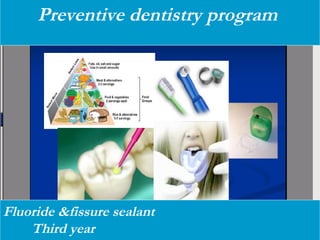
Preventive dentistry program

Fluoride &fissure sealant
Third year
Heidi Emmerling, RDH, PhD

DHYG 104 Pt Ed and Nutrition
Fall 2007
Heidi Emmerling, RDH, PhD

DHYG 104 Pt Ed and Nutrition
Fall 2007
Goals of Fluoride (F) Administration
1) Do not harm the patient.
2) Prevent decay on intact dental
surfaces.
3) Arrest active decay.
4) Remineralize decalcified tooth
surfaces.
Recommended Optimal Fluoride Level
(ppm) in Water Supply depends on
temperature and amount already in water
Average Daily
Air Temperature
(°c)

Optimal
Fluoride
Level (ppm)

Control Range
(ppm)

(10-12)
(12-15)
(15-18)
(18-21)
(21-26)
(26-33)

1.2
1.1
1.0
0.9
0.8
0.7

1.1 to 1.7
1.0 to 1.6
0.9 to 1.5
0.8 to 1.4
0.7 to 1.3
0.6 to 1.2

DHYG 104 Pt Ed and Nutrition
Fall 2007
Probable toxic dose:
Symptoms:
5 mg F / kg body weight

20 kg 6 year old, PTD= 100 mg F

1. Vomiting
2. Excess
salivary and
mucous
discharge
3. Cold wet
skin

DHYG 104 Pt Ed and Nutrition
Fall 2007

4. Convulsion
at higher
dose
A serious systemic consequence is binding of F to Ca
which needed for heart function.

F
F

Ca

Ca

DHYG 104 Pt Ed and Nutrition
Fall 2007
Counter Measures:
1. Emetics
2. 1% calcium chloride
3. Calcium gluconate
4. milk

Divalent
cations like Ca
cause
precipitation,
of F and
prevent
absorbtion in
the intestine.
DHYG 104 Pt Ed and Nutrition
Fall 2007

F
Ca

F

Ca

Ca
F


Can be toxic/lethal
Chemical burn
 Inhibits enzyme systems (protoplasmic
poison)
 Binds calcium need for nerve action
 Hyperkalemia: cardio toxicity
 Adult: 2.5-10g (15 mg/kg = lethal)




In industry, skeletal fluorosis, calcification
of tendons

DHYG 104 Pt Ed and Nutrition
Fall 2007
Emergency Treatment


4 actions
Immediate treatment:
 Induced vomiting
 Orally administered calcium or aluminum
preparations to protect stomach
 Maintenance of blood calcium levels with
intravenous calcium


DHYG 104 Pt Ed and Nutrition
Fall 2007
1. Immediate treatment

DHYG 104 Pt Ed and Nutrition
Fall 2007
First Aid Treatment


2. Milk or milk with eggs


Plenty of fluid including milk should be ingested

3. Lime water (CaOH)
 4. Maalox (aluminum preparation)


Protects mucous membranes of upper GI from
chemical burns
 Contains calcium as a binder


DHYG 104 Pt Ed and Nutrition
Fall 2007
DHYG 104 Pt Ed and Nutrition
Fall 2007
Fluorosis occurs when teeth are developing. The most
critical ages are from 0 to 6 years. After 8 years, risk of
fluorosis is essentially past. During the critical ages F intake
in excess of 0.1mg/kg body weight/day can lead to
fluorosis. This is roughly 1mg/day for a 1 to 2 year old or 1.5
to 2 mg for a 5 year old. Remember that all forms of F intake
comprise the daily consumption. This includes water intake
(up to 1.5mg/day), foods (0.3 to 1.0mg) and especially
significant in young children, swallowed toothpaste.
Children under 2 years swallow 50% of toothpaste during
tooth brushing and at 5years, 25%, both of which may
amount to 1mg F/day.
FLUOROSIS

5 year olds swallow 25% of
toothpaste

Children under 2 years
swallow 50% of toothpaste

1 to 3 grams

Toothpaste = 1 mg F /
gram (1000 ppmF)

“pea” size amount (0.5g) is
recommenred for fluorosis susceptible
children.
Classification of fluorosis

DHYG 104 Pt Ed and Nutrition
Fall 2007
Very Mild

Small opaque, paper white
areas scattered irregularly
over the tooth but not
involving as much as 25% of
the tooth surface. Frequently
included in this classification
are teeth showing no more
than about 1-2 mm of white
opacity at the tip of the
summit of the cusps of the
bicuspids or second molars.

Mild

The white opaque areas in
the enamel of the teeth are
more extensive but do not
involve as much as 50% of
the tooth.

Heidi Emmerling, RDH, PhD

DHYG 104 Pt Ed and Nutrition
Fall 2007
Mild Fluorosis

Heidi Emmerling, RDH, PhD

DHYG 104 Pt Ed and Nutrition
Fall 2007
Moderate

All enamel surfaces of the teeth
are affected, and the surfaces
subject to attrition show wear.
Brown stain is frequently a
disfiguring feature.

Severe

Includes teeth formerly classified
as "moderately severe and
severe." All enamel surfaces are
affected and hypoplasia is so
marked that the general form of
the tooth may be affected. The
major diagnostic sign of this
classification is discrete or
confluent pitting. Brown stains
are widespread and teeth often
present a corroded-like
appearance.

Heidi Emmerling, RDH, PhD

DHYG 104 Pt Ed and Nutrition
Fall 2007
Moderate Fluorosis

Heidi Emmerling, RDH, PhD

DHYG 104 Pt Ed and Nutrition
Fall 2007
DHYG 104 Pt Ed and Nutrition
Fall 2007
Severe Fluorosis

DHYG 104 Pt Ed and Nutrition
Fall 2007
Systemic fluorides




Program began with the younger children
should be continued at least until all permanent
teeth except third molar erupted
Posterior teeth will erupt and need fluoride till
post eruption maturation occur
Water fluoridation






Water fluoridation associated with reduced tooth
decay
50-60%reduction of caries in communities have
water fluoridation between 0.7-1.2
Good cost in comparison to size of population
School water fluoridation





Alternative to community water fluoridation
4-5 times higher that that recommended for
community fluoridation
Student spent only part of the year on their
school also fraction of the daily water intake at
school
Salt fluoridation





Salt intake is difficult to determined
Research showed that salt contained of 90PPM
may be beneficial for reduction of caries
May be it is the best method in developing
countries where piped water supply is rare
Milk fluoridation



It is not completely supported
Milk in the gastrointestinal tract may reduce
absorption of ingested fluoride
DHYG 104 Pt Ed and Nutrition
Fall 2007
Topical fluoride






Topical fluoride at office every 6 months or for
school preventive program (mouth rinsing
program at school )
Topical application at home particularaly at high
risk activity or handicapped patient or with
orthodontic appliance
Fluoride rinse 0.2%NaF ,0.4%SnFapplies






Students rinse for one or two minutes with 710ml
Younger children under school age
contraindicated
Weekly program with 0.2 %Na F is
recommended for school age
Methods of topical applications



Cotton application

Tray technique
Cotton applicators method
Seat patient upright
▪▪Isolate both upper and lower right or left quadrant using
cotton roll isolation and saliva evacuation (half mouth
technique)
▪▪ Dry isolated teeth with compressed air
▪▪ Keep tooth surfaces continually soaked with fluoride
solution for 4-minutes application if active caries
present and 1-minutes if caries inactive
▪▪ Repeat procedures on opposite side of the mouth
▪▪ Have the patient expectorate immediately and
repeatedly upon completion of the topical treatment
▪▪ Advise patient not to eat ,drink ar rinse for 30 minutes
after treatment
Tray technique






Teeth should be dried and free of saliva
Patient in upright
Place enough gel to fill one third of the trough
area of the tray so that they properly fit over
each dental arch
Avoid overloading to reduce oozing of gel
,which may lead to excessive ingestion








Place loaded tray over the arch and squeeze the
buccual and lingual surfaces forcing gel between
teeth
With light biting presssure ,allow tray to remain
in the mouth for 4- minutes
Provide patient with drool bag or saliva ejector
to avoid swallowing excessive fluoride
After 4- minutes remove trays and use high
volume evacuation to thoroughly remove gel
that remains on teeth
▪▪ Have the patient expectorate immediately and
repeatedly upon completion of the topical
treatment
▪▪ Advise patient not to eat ,drink or rinse for 30
minutes after treatment
APF foams and gels
(use trays)

DHYG 104 Pt Ed and Nutrition
Fall 2007
DHYG 104 Pt Ed and Nutrition
Fall 2007
DHYG 104 Pt Ed and Nutrition
Fall 2007
FLUORIDE SUPPLEMENTS
F in drinking water

AGE
Birth-6m
6m-3y

F

<0.3ppm
0

0.30.6ppm
0

>0.6ppm
0

0.25

0

0

3-6y

0.5

0.25

0

6-16y

1.0

0.5

0

Academy of Pediatric Dentistry current recommendations
Fluoride Protection for You






Sensitivity: This condition affects 25% of  most adults.
Gum recession and natural wear can cause sensitivity. 
Fluoride gels can help strengthen these area to insulate
them from hot and cold.
Root surface caries: Fluoride can help protect this
area from acid- producing bacteria.
Cavity control: Fluoride helps to remineralize enamel. 
Fluoride blocks cavities by forming a more acidresistant surface layer.  
DHYG 104 Pt Ed and Nutrition
Fall 2007
Who should receive fluoride varnish?




Children are at risk for
developing dental caries.
Risk assessment based on the
Caries Risk Assessment
Advantages of fluoride varnish:


There is less fluoride ingestion with a fluoride
varnish than with conventional office caries
treatments because the fluoride adheres to the
tooth surface for longer periods of time.



Duraphat releases fluoride for 28 weeks. Twothirds of the fluoride is released by 6 months.**



No special equipment is needed for the
application.

DHYG 104 Pt Ed and Nutrition
Fall 2007
Advantages of fluoride varnish:


Teeth do not need to be professionally
cleaned prior to varnish application.



Children can eat and drink immediately
after application.



Fluoride varnish can prevent decay in both
smooth surface and pit and groove sites.

DHYG 104 Pt Ed and Nutrition
Fall 2007
Advantages of fluoride varnish:


It is fast and easy and can be done in one appointment
with no injections. This varnish is a sticky, yellow semiliquid containing 5% sodium fluoride in a resin base
mixed with alcohol to dry quickly after application.



You can leave immediately after application. There are
no fluoride trays which prevents gagging.



It can be used as a cavity liner or desensitizer or painted
on cervical areas in geriatric patients. It can also be
applied to tooth surfaces between teeth for young
children.

DHYG 104 Pt Ed and Nutrition
Fall 2007
Post application instructions for
parents








Varnish will set on contact with saliva and look like a
yellowish film
Child can eat or drink right after application but
should try to eat soft foods
Instruct parent not to brush their child’s teeth until
the next day.
The first toothbrushing will remove the yellow film
on the teeth.
Epidemiology of pit and fissure
caries






Occlusal caries 60%of total caries experience in
children and adolescents
Morphology of pits and fissures
A-shallow,wide v-shaped fissures
B-deep,narrow ,I shaped fissures (narrow neck
and wide base )like bottle neck

DHYG 104 Pt Ed and Nutrition
Fall 2007
DHYG 104 Pt Ed and Nutrition
Fall 2007
Sealant indications






Deep&retentive pits and fissures
Stained pits and fissures
No radiographic or clinical evidence of
interproximal caries
Patient receiving other preventive treatment

DHYG 104 Pt Ed and Nutrition
Fall 2007
Sealant contraindications






Rampant caries
Interproximal caries
Low risk patients
Well coalesced pits and fissures
Uncoapertive patient

DHYG 104 Pt Ed and Nutrition
Fall 2007
Sealant limitations





Moisture control of utmost importance
Patient cooperation for dry field
Isolation with rubber dam or cotton rolls
Life span of primary tooth

DHYG 104 Pt Ed and Nutrition
Fall 2007
Heidi Emmerling, RDH, PhD

DHYG 104 Pt Ed and Nutrition
Fall 2007
Heidi Emmerling, RDH, PhD

DHYG 104 Pt Ed and Nutrition
Fall 2007
Heidi Emmerling, RDH, PhD

DHYG 104 Pt Ed and Nutrition
Fall 2007
Fluoride lecture
Fluoride lecture

Fluoride lecture

  • 1.
    Preventive dentistry program Fluoride&fissure sealant Third year Heidi Emmerling, RDH, PhD DHYG 104 Pt Ed and Nutrition Fall 2007
  • 2.
    Heidi Emmerling, RDH,PhD DHYG 104 Pt Ed and Nutrition Fall 2007
  • 3.
    Goals of Fluoride(F) Administration 1) Do not harm the patient. 2) Prevent decay on intact dental surfaces. 3) Arrest active decay. 4) Remineralize decalcified tooth surfaces.
  • 4.
    Recommended Optimal FluorideLevel (ppm) in Water Supply depends on temperature and amount already in water Average Daily Air Temperature (°c) Optimal Fluoride Level (ppm) Control Range (ppm) (10-12) (12-15) (15-18) (18-21) (21-26) (26-33) 1.2 1.1 1.0 0.9 0.8 0.7 1.1 to 1.7 1.0 to 1.6 0.9 to 1.5 0.8 to 1.4 0.7 to 1.3 0.6 to 1.2 DHYG 104 Pt Ed and Nutrition Fall 2007
  • 5.
    Probable toxic dose: Symptoms: 5mg F / kg body weight 20 kg 6 year old, PTD= 100 mg F 1. Vomiting 2. Excess salivary and mucous discharge 3. Cold wet skin DHYG 104 Pt Ed and Nutrition Fall 2007 4. Convulsion at higher dose
  • 6.
    A serious systemicconsequence is binding of F to Ca which needed for heart function. F F Ca Ca DHYG 104 Pt Ed and Nutrition Fall 2007
  • 7.
    Counter Measures: 1. Emetics 2.1% calcium chloride 3. Calcium gluconate 4. milk Divalent cations like Ca cause precipitation, of F and prevent absorbtion in the intestine. DHYG 104 Pt Ed and Nutrition Fall 2007 F Ca F Ca Ca F
  • 8.
     Can be toxic/lethal Chemicalburn  Inhibits enzyme systems (protoplasmic poison)  Binds calcium need for nerve action  Hyperkalemia: cardio toxicity  Adult: 2.5-10g (15 mg/kg = lethal)   In industry, skeletal fluorosis, calcification of tendons DHYG 104 Pt Ed and Nutrition Fall 2007
  • 9.
    Emergency Treatment  4 actions Immediatetreatment:  Induced vomiting  Orally administered calcium or aluminum preparations to protect stomach  Maintenance of blood calcium levels with intravenous calcium  DHYG 104 Pt Ed and Nutrition Fall 2007
  • 10.
    1. Immediate treatment DHYG104 Pt Ed and Nutrition Fall 2007
  • 11.
    First Aid Treatment  2.Milk or milk with eggs  Plenty of fluid including milk should be ingested 3. Lime water (CaOH)  4. Maalox (aluminum preparation)  Protects mucous membranes of upper GI from chemical burns  Contains calcium as a binder  DHYG 104 Pt Ed and Nutrition Fall 2007
  • 12.
    DHYG 104 PtEd and Nutrition Fall 2007
  • 13.
    Fluorosis occurs whenteeth are developing. The most critical ages are from 0 to 6 years. After 8 years, risk of fluorosis is essentially past. During the critical ages F intake in excess of 0.1mg/kg body weight/day can lead to fluorosis. This is roughly 1mg/day for a 1 to 2 year old or 1.5 to 2 mg for a 5 year old. Remember that all forms of F intake comprise the daily consumption. This includes water intake (up to 1.5mg/day), foods (0.3 to 1.0mg) and especially significant in young children, swallowed toothpaste. Children under 2 years swallow 50% of toothpaste during tooth brushing and at 5years, 25%, both of which may amount to 1mg F/day.
  • 14.
    FLUOROSIS 5 year oldsswallow 25% of toothpaste Children under 2 years swallow 50% of toothpaste 1 to 3 grams Toothpaste = 1 mg F / gram (1000 ppmF) “pea” size amount (0.5g) is recommenred for fluorosis susceptible children.
  • 15.
    Classification of fluorosis DHYG104 Pt Ed and Nutrition Fall 2007
  • 16.
    Very Mild Small opaque,paper white areas scattered irregularly over the tooth but not involving as much as 25% of the tooth surface. Frequently included in this classification are teeth showing no more than about 1-2 mm of white opacity at the tip of the summit of the cusps of the bicuspids or second molars. Mild The white opaque areas in the enamel of the teeth are more extensive but do not involve as much as 50% of the tooth. Heidi Emmerling, RDH, PhD DHYG 104 Pt Ed and Nutrition Fall 2007
  • 17.
    Mild Fluorosis Heidi Emmerling,RDH, PhD DHYG 104 Pt Ed and Nutrition Fall 2007
  • 18.
    Moderate All enamel surfacesof the teeth are affected, and the surfaces subject to attrition show wear. Brown stain is frequently a disfiguring feature. Severe Includes teeth formerly classified as "moderately severe and severe." All enamel surfaces are affected and hypoplasia is so marked that the general form of the tooth may be affected. The major diagnostic sign of this classification is discrete or confluent pitting. Brown stains are widespread and teeth often present a corroded-like appearance. Heidi Emmerling, RDH, PhD DHYG 104 Pt Ed and Nutrition Fall 2007
  • 19.
    Moderate Fluorosis Heidi Emmerling,RDH, PhD DHYG 104 Pt Ed and Nutrition Fall 2007
  • 20.
    DHYG 104 PtEd and Nutrition Fall 2007
  • 21.
    Severe Fluorosis DHYG 104Pt Ed and Nutrition Fall 2007
  • 22.
    Systemic fluorides   Program beganwith the younger children should be continued at least until all permanent teeth except third molar erupted Posterior teeth will erupt and need fluoride till post eruption maturation occur
  • 23.
    Water fluoridation    Water fluoridationassociated with reduced tooth decay 50-60%reduction of caries in communities have water fluoridation between 0.7-1.2 Good cost in comparison to size of population
  • 24.
    School water fluoridation    Alternativeto community water fluoridation 4-5 times higher that that recommended for community fluoridation Student spent only part of the year on their school also fraction of the daily water intake at school
  • 25.
    Salt fluoridation    Salt intakeis difficult to determined Research showed that salt contained of 90PPM may be beneficial for reduction of caries May be it is the best method in developing countries where piped water supply is rare
  • 26.
    Milk fluoridation   It isnot completely supported Milk in the gastrointestinal tract may reduce absorption of ingested fluoride
  • 27.
    DHYG 104 PtEd and Nutrition Fall 2007
  • 28.
    Topical fluoride    Topical fluorideat office every 6 months or for school preventive program (mouth rinsing program at school ) Topical application at home particularaly at high risk activity or handicapped patient or with orthodontic appliance Fluoride rinse 0.2%NaF ,0.4%SnFapplies
  • 29.
       Students rinse forone or two minutes with 710ml Younger children under school age contraindicated Weekly program with 0.2 %Na F is recommended for school age
  • 30.
    Methods of topicalapplications  Cotton application Tray technique
  • 31.
    Cotton applicators method Seatpatient upright ▪▪Isolate both upper and lower right or left quadrant using cotton roll isolation and saliva evacuation (half mouth technique) ▪▪ Dry isolated teeth with compressed air ▪▪ Keep tooth surfaces continually soaked with fluoride solution for 4-minutes application if active caries present and 1-minutes if caries inactive ▪▪ Repeat procedures on opposite side of the mouth ▪▪ Have the patient expectorate immediately and repeatedly upon completion of the topical treatment ▪▪ Advise patient not to eat ,drink ar rinse for 30 minutes after treatment
  • 32.
    Tray technique     Teeth shouldbe dried and free of saliva Patient in upright Place enough gel to fill one third of the trough area of the tray so that they properly fit over each dental arch Avoid overloading to reduce oozing of gel ,which may lead to excessive ingestion
  • 33.
        Place loaded trayover the arch and squeeze the buccual and lingual surfaces forcing gel between teeth With light biting presssure ,allow tray to remain in the mouth for 4- minutes Provide patient with drool bag or saliva ejector to avoid swallowing excessive fluoride After 4- minutes remove trays and use high volume evacuation to thoroughly remove gel that remains on teeth
  • 34.
    ▪▪ Have thepatient expectorate immediately and repeatedly upon completion of the topical treatment ▪▪ Advise patient not to eat ,drink or rinse for 30 minutes after treatment
  • 35.
    APF foams andgels (use trays) DHYG 104 Pt Ed and Nutrition Fall 2007
  • 36.
    DHYG 104 PtEd and Nutrition Fall 2007
  • 37.
    DHYG 104 PtEd and Nutrition Fall 2007
  • 38.
    FLUORIDE SUPPLEMENTS F indrinking water AGE Birth-6m 6m-3y F <0.3ppm 0 0.30.6ppm 0 >0.6ppm 0 0.25 0 0 3-6y 0.5 0.25 0 6-16y 1.0 0.5 0 Academy of Pediatric Dentistry current recommendations
  • 39.
    Fluoride Protection forYou    Sensitivity: This condition affects 25% of  most adults. Gum recession and natural wear can cause sensitivity.  Fluoride gels can help strengthen these area to insulate them from hot and cold. Root surface caries: Fluoride can help protect this area from acid- producing bacteria. Cavity control: Fluoride helps to remineralize enamel.  Fluoride blocks cavities by forming a more acidresistant surface layer.   DHYG 104 Pt Ed and Nutrition Fall 2007
  • 40.
    Who should receivefluoride varnish?   Children are at risk for developing dental caries. Risk assessment based on the Caries Risk Assessment
  • 41.
    Advantages of fluoridevarnish:  There is less fluoride ingestion with a fluoride varnish than with conventional office caries treatments because the fluoride adheres to the tooth surface for longer periods of time.  Duraphat releases fluoride for 28 weeks. Twothirds of the fluoride is released by 6 months.**  No special equipment is needed for the application. DHYG 104 Pt Ed and Nutrition Fall 2007
  • 42.
    Advantages of fluoridevarnish:  Teeth do not need to be professionally cleaned prior to varnish application.  Children can eat and drink immediately after application.  Fluoride varnish can prevent decay in both smooth surface and pit and groove sites. DHYG 104 Pt Ed and Nutrition Fall 2007
  • 43.
    Advantages of fluoridevarnish:  It is fast and easy and can be done in one appointment with no injections. This varnish is a sticky, yellow semiliquid containing 5% sodium fluoride in a resin base mixed with alcohol to dry quickly after application.  You can leave immediately after application. There are no fluoride trays which prevents gagging.  It can be used as a cavity liner or desensitizer or painted on cervical areas in geriatric patients. It can also be applied to tooth surfaces between teeth for young children. DHYG 104 Pt Ed and Nutrition Fall 2007
  • 50.
    Post application instructionsfor parents     Varnish will set on contact with saliva and look like a yellowish film Child can eat or drink right after application but should try to eat soft foods Instruct parent not to brush their child’s teeth until the next day. The first toothbrushing will remove the yellow film on the teeth.
  • 51.
    Epidemiology of pitand fissure caries     Occlusal caries 60%of total caries experience in children and adolescents Morphology of pits and fissures A-shallow,wide v-shaped fissures B-deep,narrow ,I shaped fissures (narrow neck and wide base )like bottle neck DHYG 104 Pt Ed and Nutrition Fall 2007
  • 53.
    DHYG 104 PtEd and Nutrition Fall 2007
  • 54.
    Sealant indications     Deep&retentive pitsand fissures Stained pits and fissures No radiographic or clinical evidence of interproximal caries Patient receiving other preventive treatment DHYG 104 Pt Ed and Nutrition Fall 2007
  • 55.
    Sealant contraindications      Rampant caries Interproximalcaries Low risk patients Well coalesced pits and fissures Uncoapertive patient DHYG 104 Pt Ed and Nutrition Fall 2007
  • 56.
    Sealant limitations     Moisture controlof utmost importance Patient cooperation for dry field Isolation with rubber dam or cotton rolls Life span of primary tooth DHYG 104 Pt Ed and Nutrition Fall 2007
  • 57.
    Heidi Emmerling, RDH,PhD DHYG 104 Pt Ed and Nutrition Fall 2007
  • 58.
    Heidi Emmerling, RDH,PhD DHYG 104 Pt Ed and Nutrition Fall 2007
  • 59.
    Heidi Emmerling, RDH,PhD DHYG 104 Pt Ed and Nutrition Fall 2007