











FLUIDOTHERAPY
12/14/2020
©2020RohitBhaskarPT
1
INTRODUCTION
Fluidotherapy is a dry heating agent, that provides
mechanical as well as thermal stimuli to produce
therapeutic effect.
2
TRANSMISSION OF HEAT
• Fluidotherapy transfers heat by CONVECTION method.
• Transference of heat to a body by the movement of air,
matter, or liquid around or past the body
• During heating or cooling by convection the thermal agent
is in motion, the kinetic energy of the molecules is
increased, they move farther apart and the part becomes
less dense.
• Consequently the part rises and the above dense part
descends to take its place.
3
EQUIPMENT
• Consists of a cabinet containing finely ground cellulose particlesmade
from corn cob.
• Heated air is made to be circulated through the particles, so that the
particles move like liquid.
• Allows high heating (higher than water and paraffin).
• It utilizes a stream of thermostatically controlled heated air flowing
over and through particles by an electric fan inside a lid coveredsteel
cabinet.
4
• This air stream creates air pockets and bubbles to provide
a powerful massaging action that transmits heat and tactile
stimulation to achieve many physiological and therapeutic
benefits.
5
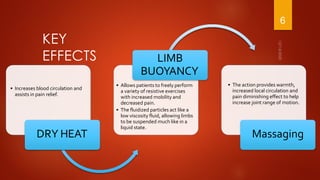
KEY
EFFECTS
• Increases blood circulation and
assists in pain relief.
DRY HEAT
LIMB
BUOYANCY
• Allows patients to freely perform
a variety of resistive exercises
with increased mobility and
decreased pain.
• The fluidized particles act like a
low viscosity fluid, allowing limbs
to be suspended much like in a
liquid state.
• The action provides warmth,
increased local circulation and
pain diminishing effect to help
increase joint range of motion.
Massaging
6
The patients part if put inside the cabinet starts to float as if
floating
inside water and gets heated.
As the system has very low viscosity, it allows exercise to be
performed inside the cabinet, like exercises performed inside
warm water but the part does not get wet.
Temperature range 38 to 45 C.
Treatment time 15 – 20
minutes.
Application
7
• The patient should be prepared in the same way like hot pack
application, i.e. the part is undressed, jewelry etc. is removed and skin
sensation for heat and cold is checked.
• If there is any open wound on the part to be treated, it should be
covered with a plastic sheet.
• The part to be treated is extended through the portal of the unit and
sleeve should be closed to prevent the particles from coming out.
PREPARATION
8
• Moreover the fluidotherapy unit device is such that it
contains additional entry ports to allow the therapist
to enter the cabinet and thus passive movements of
the distal extremities can be performed inside the
device itself.
9
• The required temperature is maintained and the patient is told to
exercise the part inside the cabinet.
• After treatment is over the part is removed from the cabinet and the
skin is examined.
• A mild erythema is normal.
10
INDICATIONS
Treat distal extremities:
1. Decrease pain
2. Increase range of motion
3. Decrease swelling
4. Decrease spasm
5. Inflammation
6. Postoperative Rehabilitation
7. Subacute condition
8. Chronic condition
11
CONTRAINDICATIONS
1. Fever
2. Anesthetic area
3. Severe circulatory disorder
4. Hemorrhage
5. Heat sensitive patient
12
ADVANTAGES
1. Easy to use
2. Agitation can be controlled
3. Most body areas can be treated
4. Allows for some active exercise
5. Provides some dry and comfortable heat
6. Can be used for desensitization treatment
13
Disadvantages
• Expensive to purchase
• Some patients don’t like the closed in feeling
• Some patients are intolerant to the particles present inside
• May require the limb to be placed in dependent position
14

Fluidotherapy - Physiotherapy - Dr Rohit Bhaskar

  • 1.
  • 2.
    INTRODUCTION Fluidotherapy is adry heating agent, that provides mechanical as well as thermal stimuli to produce therapeutic effect. 2
  • 3.
    TRANSMISSION OF HEAT •Fluidotherapy transfers heat by CONVECTION method. • Transference of heat to a body by the movement of air, matter, or liquid around or past the body • During heating or cooling by convection the thermal agent is in motion, the kinetic energy of the molecules is increased, they move farther apart and the part becomes less dense. • Consequently the part rises and the above dense part descends to take its place. 3
  • 4.
    EQUIPMENT • Consists ofa cabinet containing finely ground cellulose particlesmade from corn cob. • Heated air is made to be circulated through the particles, so that the particles move like liquid. • Allows high heating (higher than water and paraffin). • It utilizes a stream of thermostatically controlled heated air flowing over and through particles by an electric fan inside a lid coveredsteel cabinet. 4
  • 5.
    • This airstream creates air pockets and bubbles to provide a powerful massaging action that transmits heat and tactile stimulation to achieve many physiological and therapeutic benefits. 5
  • 6.
    KEY EFFECTS • Increases bloodcirculation and assists in pain relief. DRY HEAT LIMB BUOYANCY • Allows patients to freely perform a variety of resistive exercises with increased mobility and decreased pain. • The fluidized particles act like a low viscosity fluid, allowing limbs to be suspended much like in a liquid state. • The action provides warmth, increased local circulation and pain diminishing effect to help increase joint range of motion. Massaging 6
  • 7.
    The patients partif put inside the cabinet starts to float as if floating inside water and gets heated. As the system has very low viscosity, it allows exercise to be performed inside the cabinet, like exercises performed inside warm water but the part does not get wet. Temperature range 38 to 45 C. Treatment time 15 – 20 minutes. Application 7
  • 8.
    • The patientshould be prepared in the same way like hot pack application, i.e. the part is undressed, jewelry etc. is removed and skin sensation for heat and cold is checked. • If there is any open wound on the part to be treated, it should be covered with a plastic sheet. • The part to be treated is extended through the portal of the unit and sleeve should be closed to prevent the particles from coming out. PREPARATION 8
  • 9.
    • Moreover thefluidotherapy unit device is such that it contains additional entry ports to allow the therapist to enter the cabinet and thus passive movements of the distal extremities can be performed inside the device itself. 9
  • 10.
    • The requiredtemperature is maintained and the patient is told to exercise the part inside the cabinet. • After treatment is over the part is removed from the cabinet and the skin is examined. • A mild erythema is normal. 10
  • 11.
    INDICATIONS Treat distal extremities: 1.Decrease pain 2. Increase range of motion 3. Decrease swelling 4. Decrease spasm 5. Inflammation 6. Postoperative Rehabilitation 7. Subacute condition 8. Chronic condition 11
  • 12.
    CONTRAINDICATIONS 1. Fever 2. Anestheticarea 3. Severe circulatory disorder 4. Hemorrhage 5. Heat sensitive patient 12
  • 13.
    ADVANTAGES 1. Easy touse 2. Agitation can be controlled 3. Most body areas can be treated 4. Allows for some active exercise 5. Provides some dry and comfortable heat 6. Can be used for desensitization treatment 13
  • 14.
    Disadvantages • Expensive topurchase • Some patients don’t like the closed in feeling • Some patients are intolerant to the particles present inside • May require the limb to be placed in dependent position 14