






FLUIDOTHERAPY
KEERTHI PRIYA MPT NEURO,
ASSISTANT PROFESSOR
CONTENTS
INTRODUCTION
CONSTRUCTION
METHOD OF APPLICATION
THERAPEUTIC USES
INDICATIONS
CONTRAINDICATIONS
2
INTRODUCTION
 Dry heat modality that uses
suspended air stream which has
properties of liquid.
 Used to treat distal extremities
 Different types
 Temperature 38-45o c
3
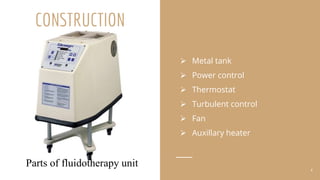
CONSTRUCTION
Parts of fluidotherapy unit
 Metal tank
 Power control
 Thermostat
 Turbulent control
 Fan
 Auxillary heater
4
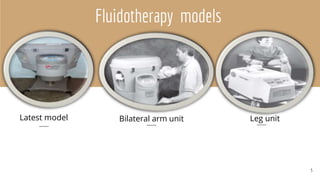
Fluidotherapy models
Latest model Bilateral arm unit Leg unit
5
Methods of application
Preparation of patient
 Explaining procedure to
the patient.
 Checking for
contraindications
 Check for skin
sensations
Preparation of apparatus
 Check for temperature
 Check auxillary heater
 Check the knobs
 Preparation of
treatment tray
Preparation of part to be treated
 Wash the part to be
treated
 Position of patient
6
Methods of application
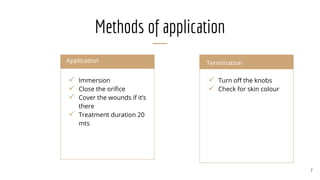
Application
 Immersion
 Close the orifice
 Cover the wounds if it’s
there
 Treatment duration 20
mts
Termination
 Turn off the knobs
 Check for skin colour
7
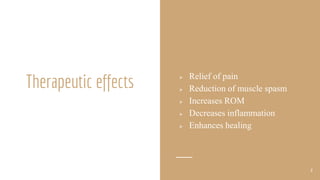
Therapeutic effects  Relief of pain
 Reduction of muscle spasm
 Increases ROM
 Decreases inflammation
 Enhances healing
8
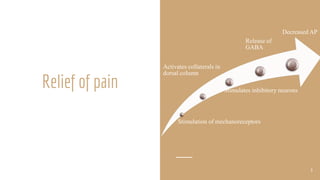
Relief of pain
Stimulation of mechanoreceptors
Activates collaterals in
dorsal column
Stimulates inhibitory neurons
Release of
GABA
Decreased AP
9
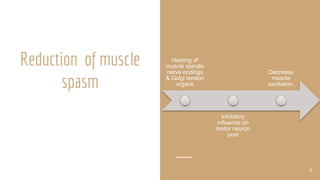
Reduction of muscle
spasm
Heating of
muscle spindle
nerve endings
& Golgi tendon
organs
Inhibitory
influence on
motor neuron
pool
Decrease
muscle
excitation.
10
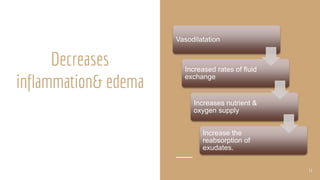
Decreases
inflammation& edema
Vasodilatation
Increased rates of fluid
exchange
Increases nutrient &
oxygen supply
Increase the
reabsorption of
exudates.
11
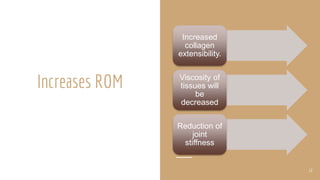
Increases ROM
Increased
collagen
extensibility.
Viscosity of
tissues will
be
decreased
Reduction of
joint
stiffness
12
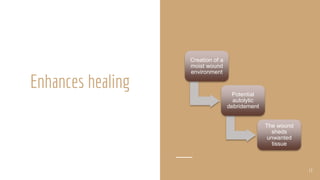
Enhances healing
Creation of a
moist wound
environment
Potential
autolytic
debridement
The wound
sheds
unwanted
tissue
13
INDICATIONS
 Scar tissue
 Post op stiffness
 Pain
 Contractures
 Arthritis
 Edema
14
CONTRAINDICATIONS
● Fever
● Cancerous tissue
● Impaired sensation
● Circulatory deficits
● Uncooperative patient
● Haemorrhage
15
REFERENCES
 PHYSICAL AGENTSTHEORY AND PRACTICE ,THIRD EDITION, BARBARA J.
BEHRENS, PTA, MS
 THERAPEUTIC FOR SPORTS MEDICINE AND ATHLETIC TRAINING MODALITIES,
SIXTH EDITION, W I L L I A M E . P R E N T I C E
 ELECTROTHERAPY EXPLAINED, LOW & REED
16
17
18

Fluidotherapy