ASSESSING PRELOAD RESPONSIVENESS
USING ECHOCARDIOGRAPHY
Dr ASHISH NAIR MBBS,MD,IDCCM
DrNB CRITICAL CARE(SR)
CASE VIGNETTE
• 35 YO FEMALE IN SEPTIC SHOCK
SECONDARY TO UTI
• HAS RECEIVED 5 L OF IVF O VER
THE PAST 4 HRS
• HR 130 , BP 75/52
• TACHYPNEIC, ON 2 L O2
• LACTATE 3.8 MMOL/L
SHOULD YOU GIVE MORE IVF?
CVP?
INDUCE A CHANGE IN CARDIAC PRELOAD AND
OBSERVE THE EFFECT ON CARDIAC OUTPUT
FLUID RESPONSIVENESS = increa se in C O or CI by ≥15%.
Preload change CO measurements
Heart-Lung interaction PPV/Pulse contour analysis of arterial line
Mini or small fluid bolus SVV/(PiCCO, LiDCCO, flotrack)
PLR test Desc Ao flow (esophageal doppler)
EEOT/EIOT VTI (TTE)
Bioreactance (NICOM)
Method Threshold
SVV/PPV 12%
PLR 15%
Mini fluid
challenge
9%
EEOT with EIOT 13%
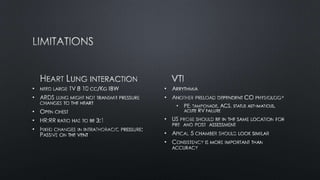
Changes with respiration  SVC/IVC diameter changes
SVC collapsibility 36%
IVC collapsibility
or distensibility
40- 50%
10- 21%
Cherpanath, T
. “Predicting Fluid Responsiveness by Passive Leg Raising: A Systematic Review and Meta-
Analysis of 23 Clinical Trials.” Critical care medicine vol. 44,5 (2016): 981-91.
(PiCCO, LiDCCO, flotrack)
(NICOM)
DURING SPONTANEOUS BREATHING (NOT ON MV):
Negative intrathoracic
pressure during
spontaneous
inspiration
↑ Venous return to RV
↑ RV filling and shift of
IVS to the left
↓ LV filling
↓ Pulmonary venous
pressure
↑ LV afterload
↓ LV stroke volume
DURING
MECHANICAL
VENTILATION
(PASSIVE):
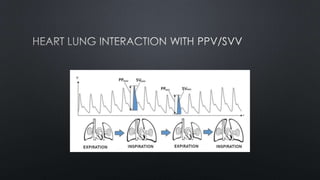
Insufflation Expiration
Serial ventricular
interdependence
Reverse
pulsus
paradoxus
these cyclic cha nges
in LV stroke volume are
greater when the LV
operates on the
a scending portion of
the Frank-Starling
curve.
SVV >13%
SVV <13%
PPV= PP max - PP min/PP mean
PPV= 2 (PP ma x – PP min)/(PP ma x + PP
min)
PPV= 2 x (40-30) / (40 + 30)
PPV= 20/70=0.28 which is > 13%
•
•
•
•
•
•
•
•
PWD
at
A5C
LVOT PEAK VELOCITY VARIATION
“
”
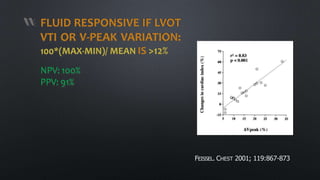
FLUID RESPONSIVE IF LVOT
VTI OR V-PEAK VARIATION:
100*(MAX-MIN)/ MEAN IS >12%
NPV: 100%
PPV: 91%
FEISSEL. CHEST 2001; 119:867-873
•
•
•
•
•
•
•
•
•
•
•
•
•
•
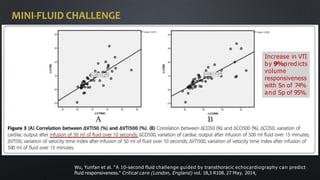
MINI-FLUID CHALLENGE
Wu, Yunfan et al. “A 10-second fluid challenge guided by transthoracic echocardiography can predict
fluid responsiveness.” Critical care (London, England) vol. 18,3 R108. 27 May. 2014,
Increase in VTI
by 9%predicts
volume
responsiveness
with Sn of 74%
and Sp of 95%.
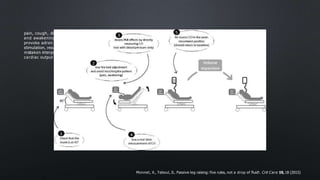
pain, cough, dis
and awakening
provoke adren
stimulation, resu
mistaken interpret
cardiac output
Monnet, X., Teboul, JL. Passive leg raising: five rules, not a drop of fluid!. Crit Care 19, 18 (2015)
•
Sensitivity 86%
Specificity 92%
Cherpanath, T
. “Predicting Fluid Responsiveness by Passive Leg Raising: A Systematic Review and Meta-
Analysis of 23 Clinical Trials.” Critical care medicine vol. 44,5 (2016): 981-91.
(PiCCO, LiDCCO, flotrack)
(NICOM)
•
Monnet, Xavier et al. “Passive leg raising predicts fluid responsiveness in the critically ill.” Critical care medicine vol. 34,5 (2006): 1402-7.
•
•
•
•
•
•
Lanspa, Michael J et al. “Data availability and feasibility of various techniques to predict response to volume
expansion in critically ill patients.” International journal of critical illness and injury science vol. 7,3 (2017): 163-165.
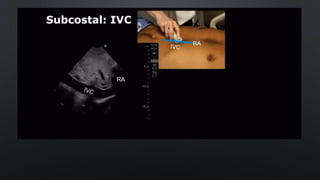
END-EXPIRATORY AND END-INSPIRATORY
OCCLUSION TESTS
Annals of Translational Medicine, Vol 8, No 12 June 2020
Jozwiak, Mathieu et al. “Predicting Fluid Responsiveness in Critically Ill Patients by Using Combined End-Expiratory and End-
Inspiratory Occlusions With Echocardiography.” Critical care medicine vol. 45,11 (2017): e1131-e1138.
If consecutive end-inspiratory occlusion and end-expiratory occlusion change velocity-time integral
is greater than or equal to 13%in total, fluid responsiveness is accurately predicted. With Sensitivity
and Specificity of 93%.
( EEOT VTI – EIOT VTI)/ baseline VTI If > 13% >> fluid responsive
- MECHANICALLY VENTILATED
- CA N HAVE SOME OCCASIONAL ASSISTED BREATHS
- CANNOT BE USED IN PATIENTS WHO INTERRUPT A 15 SECOND RESPIRATORY HOLD
- CA N HAVE LOW TV
- CA N HAVE POOR LUNG COMPLIANCE
- CA N BE USED IN IRREGULAR HEART RHYTHM (AVERAGE LAST 5 BEATS
Lanspa, Michael J et al. “Data availability and feasibility of various techniques to predict response to volume
expansion in critically ill patients.” International journal of critical illness and injury science vol. 7,3 (2017): 163-165.
•
•
•
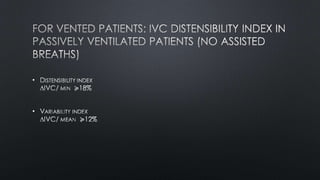
• VENA CAVA DISTENSIBILITYINDEX : (MAXIMAL DIAMETER – MINIMAL DIAMETER)/ MINIMAL
DIAMETER
• VENA CAVA COLLAPSIBILITY INDEX : (MAXIMAL DIAMETER –MINIMAL DIAMETER)/ MAXIMAL
DIAMETER
• VENA CAVA VARIABILITY: (MAXIMAL DIAMETER – MINIMAL DIAMETER)/ MEAN DIAMETER
•
Caplan, Morgan et al. “Measurement site of inferior vena cava diameter affects the accuracy
with which fluid responsiveness can be predicted in spontaneously breathing patients: a post
hoc analysis of two prospective cohorts.” Annals of intensive carevol. 10,1 168. 11 Dec. 2020,
• Vena Cava collapsibility index : (maximal
diameter –minimal diameter)/ maximal diameter
• >40-50%predicts volume responsiveness
•
•
INTERNAL JUGULAR VEIN DISTENSIBILITY
• >18%
•
Guarracino, Fabio et al. “Jugular vein distensibility predicts fluid responsiveness in septic
patients.” Critical care (London, England) vol. 18,6 647. 5 Dec. 2014, doi:10.1186/s13054-014-0647-1
Via, G et al. “Ten situations where inferior vena cava ultrasound may fail to accurately predict fluid responsiveness: a
physiologically based point of view.” Intensive care medicine vol. 42,7 (2016): 1164-7. doi:10.1007/s00134-016-4357-9
Vignon, Philippe et al. “Comparison of Echocardiographic Indices Used to Predict Fluid
Responsiveness in Ventilated Patients.” American journal of respiratory and critical care
medicine vol. 195,8 (2017): 1022-1032.
Method Passive
ventilatio
n
Assisted
ventilatio
n
Spontaneou
s breathing
Irregul
ar
rhythm
Low Vt Low lung
compliance
Threshold
SVV
PPV
Yes No No No No No 12%
SVC
collapsibility
Yes No Unstudied Yes No No 36%
IVC
collapsibility
or
distensibility
Yes No Yes Yes No No
40- 50%
10- 21%
PLR Yes Yes Yes Yes Yes Yes 15%
Mini fluid
challenge
Yes Yes Yes Yes Yes Yes 9%
EEOT with
EIOT
Yes Yes Do NOT do it Yes Yes Yes 13%
Monnet, Xavier et al. “Prediction of fluid
responsiveness:an update.” Annalsof
intensive care vol. 6,1 (2016): 111.
doi:10.1186/s13613-016-0216-7
•
•
•
•
•
ARDS
COPD
LUNG-PROTECTIVE VENTILATION
BIPAP
•
•
• PULLING
AGAINST RESTRAINTS
• 47 YO FEMALE, POST ANOXIC BRAIN INJURY, TV 1O ML/KG, PASSIVELY BREATHING ON THE VENT,
SINUS BRADYCARDIA
• TYPE 2 M O BITZ HFNC ELECTRIC A L
ALTERNANS
•
•
•
•
•
•
• IVC COLLAPSIBILITY
•
•
•
fluid responsiveness.pptx

fluid responsiveness.pptx

  • 1.
  • 2.
    Dr ASHISH NAIRMBBS,MD,IDCCM DrNB CRITICAL CARE(SR)
  • 3.
    CASE VIGNETTE • 35YO FEMALE IN SEPTIC SHOCK SECONDARY TO UTI • HAS RECEIVED 5 L OF IVF O VER THE PAST 4 HRS • HR 130 , BP 75/52 • TACHYPNEIC, ON 2 L O2 • LACTATE 3.8 MMOL/L SHOULD YOU GIVE MORE IVF?
  • 4.
  • 5.
    INDUCE A CHANGEIN CARDIAC PRELOAD AND OBSERVE THE EFFECT ON CARDIAC OUTPUT
  • 6.
    FLUID RESPONSIVENESS =increa se in C O or CI by ≥15%.
  • 7.
    Preload change COmeasurements Heart-Lung interaction PPV/Pulse contour analysis of arterial line Mini or small fluid bolus SVV/(PiCCO, LiDCCO, flotrack) PLR test Desc Ao flow (esophageal doppler) EEOT/EIOT VTI (TTE) Bioreactance (NICOM) Method Threshold SVV/PPV 12% PLR 15% Mini fluid challenge 9% EEOT with EIOT 13%
  • 8.
    Changes with respiration SVC/IVC diameter changes SVC collapsibility 36% IVC collapsibility or distensibility 40- 50% 10- 21%
  • 9.
    Cherpanath, T . “PredictingFluid Responsiveness by Passive Leg Raising: A Systematic Review and Meta- Analysis of 23 Clinical Trials.” Critical care medicine vol. 44,5 (2016): 981-91. (PiCCO, LiDCCO, flotrack) (NICOM)
  • 11.
    DURING SPONTANEOUS BREATHING(NOT ON MV): Negative intrathoracic pressure during spontaneous inspiration ↑ Venous return to RV ↑ RV filling and shift of IVS to the left ↓ LV filling ↓ Pulmonary venous pressure ↑ LV afterload ↓ LV stroke volume
  • 12.
    DURING MECHANICAL VENTILATION (PASSIVE): Insufflation Expiration Serial ventricular interdependence Reverse pulsus paradoxus thesecyclic cha nges in LV stroke volume are greater when the LV operates on the a scending portion of the Frank-Starling curve.
  • 14.
    SVV >13% SVV <13% PPV=PP max - PP min/PP mean PPV= 2 (PP ma x – PP min)/(PP ma x + PP min) PPV= 2 x (40-30) / (40 + 30) PPV= 20/70=0.28 which is > 13%
  • 15.
  • 17.
  • 18.
  • 19.
    “ ” FLUID RESPONSIVE IFLVOT VTI OR V-PEAK VARIATION: 100*(MAX-MIN)/ MEAN IS >12% NPV: 100% PPV: 91% FEISSEL. CHEST 2001; 119:867-873
  • 20.
  • 21.
  • 22.
    MINI-FLUID CHALLENGE Wu, Yunfanet al. “A 10-second fluid challenge guided by transthoracic echocardiography can predict fluid responsiveness.” Critical care (London, England) vol. 18,3 R108. 27 May. 2014, Increase in VTI by 9%predicts volume responsiveness with Sn of 74% and Sp of 95%.
  • 24.
    pain, cough, dis andawakening provoke adren stimulation, resu mistaken interpret cardiac output Monnet, X., Teboul, JL. Passive leg raising: five rules, not a drop of fluid!. Crit Care 19, 18 (2015)
  • 25.
  • 26.
    Cherpanath, T . “PredictingFluid Responsiveness by Passive Leg Raising: A Systematic Review and Meta- Analysis of 23 Clinical Trials.” Critical care medicine vol. 44,5 (2016): 981-91. (PiCCO, LiDCCO, flotrack) (NICOM)
  • 27.
    • Monnet, Xavier etal. “Passive leg raising predicts fluid responsiveness in the critically ill.” Critical care medicine vol. 34,5 (2006): 1402-7.
  • 28.
    • • • • • • Lanspa, Michael Jet al. “Data availability and feasibility of various techniques to predict response to volume expansion in critically ill patients.” International journal of critical illness and injury science vol. 7,3 (2017): 163-165.
  • 29.
  • 30.
    Annals of TranslationalMedicine, Vol 8, No 12 June 2020
  • 31.
    Jozwiak, Mathieu etal. “Predicting Fluid Responsiveness in Critically Ill Patients by Using Combined End-Expiratory and End- Inspiratory Occlusions With Echocardiography.” Critical care medicine vol. 45,11 (2017): e1131-e1138. If consecutive end-inspiratory occlusion and end-expiratory occlusion change velocity-time integral is greater than or equal to 13%in total, fluid responsiveness is accurately predicted. With Sensitivity and Specificity of 93%. ( EEOT VTI – EIOT VTI)/ baseline VTI If > 13% >> fluid responsive
  • 32.
    - MECHANICALLY VENTILATED -CA N HAVE SOME OCCASIONAL ASSISTED BREATHS - CANNOT BE USED IN PATIENTS WHO INTERRUPT A 15 SECOND RESPIRATORY HOLD - CA N HAVE LOW TV - CA N HAVE POOR LUNG COMPLIANCE - CA N BE USED IN IRREGULAR HEART RHYTHM (AVERAGE LAST 5 BEATS Lanspa, Michael J et al. “Data availability and feasibility of various techniques to predict response to volume expansion in critically ill patients.” International journal of critical illness and injury science vol. 7,3 (2017): 163-165.
  • 33.
  • 34.
    • • • VENA CAVADISTENSIBILITYINDEX : (MAXIMAL DIAMETER – MINIMAL DIAMETER)/ MINIMAL DIAMETER • VENA CAVA COLLAPSIBILITY INDEX : (MAXIMAL DIAMETER –MINIMAL DIAMETER)/ MAXIMAL DIAMETER • VENA CAVA VARIABILITY: (MAXIMAL DIAMETER – MINIMAL DIAMETER)/ MEAN DIAMETER
  • 36.
    • Caplan, Morgan etal. “Measurement site of inferior vena cava diameter affects the accuracy with which fluid responsiveness can be predicted in spontaneously breathing patients: a post hoc analysis of two prospective cohorts.” Annals of intensive carevol. 10,1 168. 11 Dec. 2020, • Vena Cava collapsibility index : (maximal diameter –minimal diameter)/ maximal diameter • >40-50%predicts volume responsiveness
  • 39.
  • 40.
    INTERNAL JUGULAR VEINDISTENSIBILITY • >18% • Guarracino, Fabio et al. “Jugular vein distensibility predicts fluid responsiveness in septic patients.” Critical care (London, England) vol. 18,6 647. 5 Dec. 2014, doi:10.1186/s13054-014-0647-1
  • 42.
    Via, G etal. “Ten situations where inferior vena cava ultrasound may fail to accurately predict fluid responsiveness: a physiologically based point of view.” Intensive care medicine vol. 42,7 (2016): 1164-7. doi:10.1007/s00134-016-4357-9
  • 43.
    Vignon, Philippe etal. “Comparison of Echocardiographic Indices Used to Predict Fluid Responsiveness in Ventilated Patients.” American journal of respiratory and critical care medicine vol. 195,8 (2017): 1022-1032.
  • 44.
    Method Passive ventilatio n Assisted ventilatio n Spontaneou s breathing Irregul ar rhythm LowVt Low lung compliance Threshold SVV PPV Yes No No No No No 12% SVC collapsibility Yes No Unstudied Yes No No 36% IVC collapsibility or distensibility Yes No Yes Yes No No 40- 50% 10- 21% PLR Yes Yes Yes Yes Yes Yes 15% Mini fluid challenge Yes Yes Yes Yes Yes Yes 9% EEOT with EIOT Yes Yes Do NOT do it Yes Yes Yes 13%
  • 45.
    Monnet, Xavier etal. “Prediction of fluid responsiveness:an update.” Annalsof intensive care vol. 6,1 (2016): 111. doi:10.1186/s13613-016-0216-7
  • 46.
  • 47.
    ARDS COPD LUNG-PROTECTIVE VENTILATION BIPAP • • • PULLING AGAINSTRESTRAINTS • 47 YO FEMALE, POST ANOXIC BRAIN INJURY, TV 1O ML/KG, PASSIVELY BREATHING ON THE VENT, SINUS BRADYCARDIA • TYPE 2 M O BITZ HFNC ELECTRIC A L ALTERNANS
  • 48.
  • 49.