





















Disclosure: The speaker is member of the medical
advisory board of Getinge (manu.malbrain@telenet.be)
@Manu_Malbrain
Co-chairman Fluid Academy
@Fluid_Academy
Fluids are DRUGS
#dasSMACC HARDCORE
ICU WORKSHOP
Berlin – June 26th 2017
HYPOVOLEMIA IS BAD
“The application of what we already know will
have a bigger impact than any drug or
technology likely to be introduced
in the next decade.”
Sir Muir Gray
Chief Knowledge Officer,
National Health Service, UK
“The application of what we already know will
have a bigger impact than any drug or fluid or
technology likely to be introduced
in the next decade.”
Sir Muir Gray
Chief Knowledge Officer,
National Health Service, UK
We need to
make better
DRUGS
We need to
make good
DRUGS
better
We need to
make good
FLUIDS
better
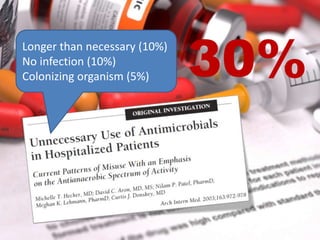
Longer than necessary (10%)
No infection (10%)
Colonizing organism (5%) 30%
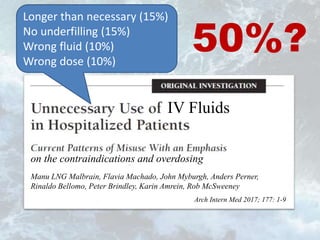
IV Fluids
on the contraindications and overdosing
Arch Intern Med 2017; 177: 1-9
Manu LNG Malbrain, Flavia Machado, John Myburgh, Anders Perner,
Rinaldo Bellomo, Peter Brindley, Karin Amrein, Rob McSweeney
Longer than necessary (15%)
No underfilling (15%)
Wrong fluid (10%)
Wrong dose (10%)
50%?
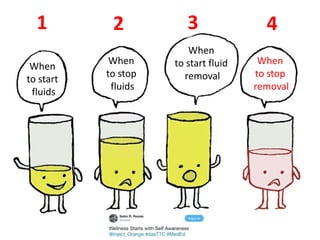
1
When
to start
fluids
When
to stop
fluids
When
to start fluid
removal
2 3
When
to stop
removal
4
Fluid overload: Poor cosmetics or bad medecine? 9Fluid overload: Poor cosmetics or bad medecine?
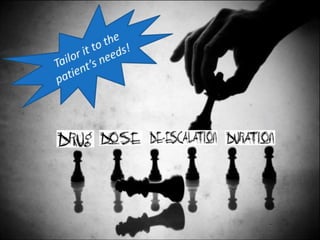
Drug
Dose
De-escalation
Duration
HOW MUCH
HOW LONG
WHAT
WHEN
www.fluidacademy.com
IFAD Faculty Dinner 18/11/2011
AntibioticsDRUG
AntibioticsDRUG
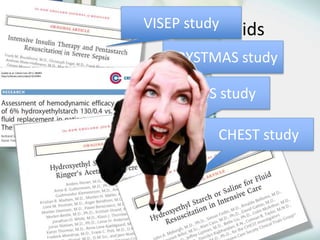
DRUG Colloids vs CrystalloidsVISEP study
CRYSTMAS study
6S study
CHEST study
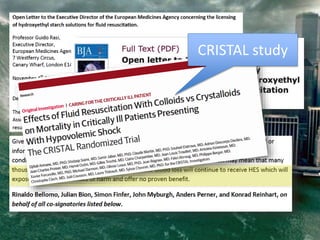
CRISTAL study
18
ALBIOS study
High Quality Research ???
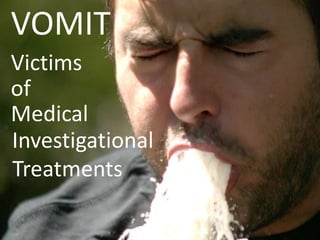
VOMIT
Victims
of
Medical
Investigational
Treatments
Fluid overload: Poor cosmetics or bad medecine? 22Fluid overload: Poor cosmetics or bad medecine?
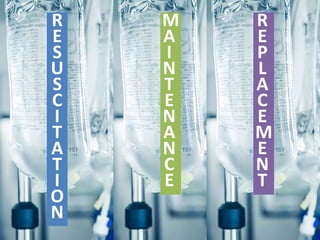
R
E
S
U
S
C
I
T
A
T
I
O
N
M
A
I
N
T
E
N
A
N
C
E
R
E
P
L
A
C
E
M
E
N
T
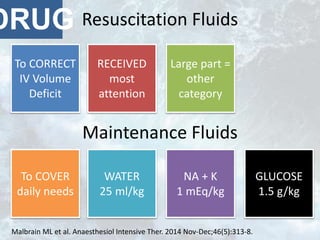
Resuscitation FluidsDRUG
Malbrain ML et al. Anaesthesiol Intensive Ther. 2014 Nov-Dec;46(5):313-8.
To CORRECT
IV Volume
Deficit
RECEIVED
most
attention
Large part =
other
category
Maintenance Fluids
To COVER
daily needs
WATER
25 ml/kg
NA + K
1 mEq/kg
GLUCOSE
1.5 g/kg
Maintenance FluidsDRUG
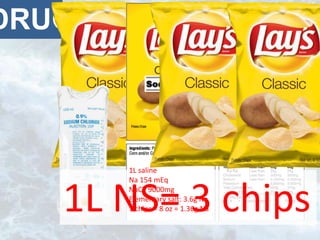
1L NS= 3 chips
1L saline
Na 154 mEq
NaCl: 9000mg
Elementary salt: 3.6g Na
1 chips = 8 oz = 1.36g Na
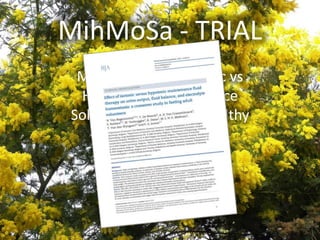
MihMoSa - TRIAL
Metabolism of Isotonic vs
Hypotonic Maintenance
Solutions in Fasting Healthy
Adults
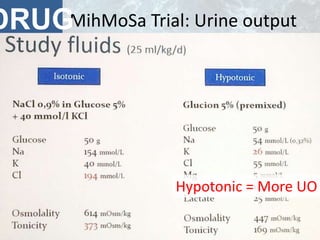
MihMoSa Trial: Urine outputDRUG
Van Regenmortel N, Malbrain ML et al. British J Anaesthesiol 2017; 118 (6): 892-900
HYPOTONIC FLUIDISOTONIC FLUID
Hypotonic = More UO
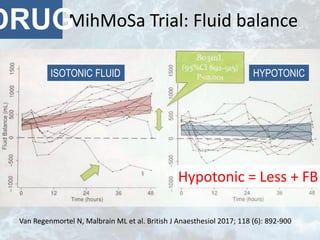
MihMoSa Trial: Fluid balanceDRUG
Van Regenmortel N, Malbrain ML et al. British J Anaesthesiol 2017; 118 (6): 892-900
HYPOTONICISOTONIC FLUID
Hypotonic = Less + FB
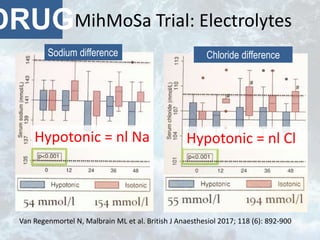
MihMoSa Trial: ElectrolytesDRUG
Van Regenmortel N, Malbrain ML et al. British J Anaesthesiol 2017; 118 (6): 892-900
Sodium difference Chloride difference
Hypotonic = nl Na Hypotonic = nl Cl
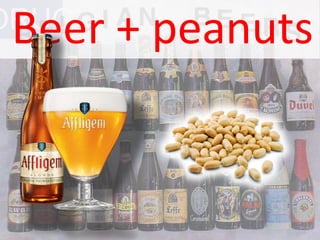
DRUGBeer + peanuts
Fluid overload: Poor cosmetics or bad medecine? 32Fluid overload: Poor cosmetics or bad medecine?
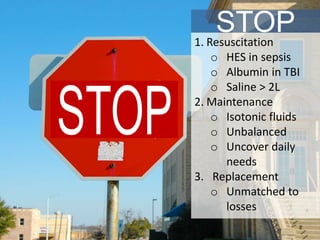
STOP1. Resuscitation
o HES in sepsis
o Albumin in TBI
o Saline > 2L
2. Maintenance
o Isotonic fluids
o Unbalanced
o Uncover daily
needs
3. Replacement
o Unmatched to
losses
Fluid overload: Poor cosmetics or bad medecine? 33Fluid overload: Poor cosmetics or bad medecine?
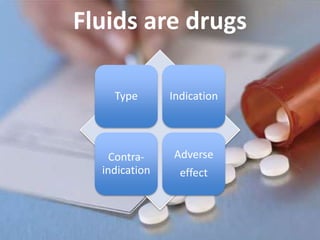
Fluids are drugs
Type Indication
Contra-
indication
Adverse
effect
Not a good idea
• Start with whisky in the morning
• Continue with wine at lunch
• Some soup at 16 o clock
• Some milk at dinner
• Some coffee before sleeping
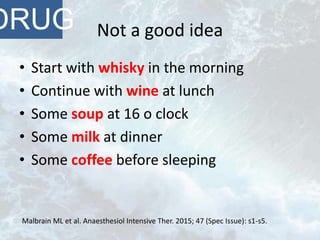
DRUG
Malbrain ML et al. Anaesthesiol Intensive Ther. 2015; 47 (Spec Issue): s1-s5.
Likewise not a good idea
IN HEMORHAGIC SHOCK
• Start with glucose 5% in 1st hour
• Continue with albumin 20% afterwards
• Add some litres of NS + balanced solutions
• Top it with HES
• Finish with Packed cells
• Conclude with FFP + fibrinogen
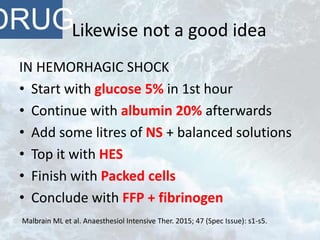
DRUG
Malbrain ML et al. Anaesthesiol Intensive Ther. 2015; 47 (Spec Issue): s1-s5.
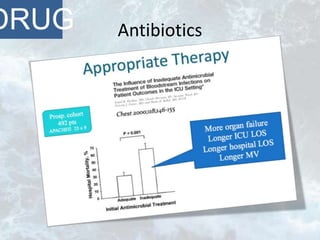
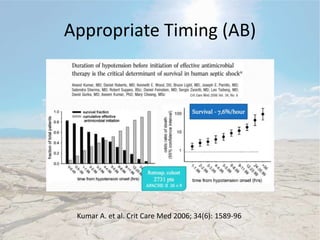
Appropriate Timing (AB)
Kumar A. et al. Crit Care Med 2006; 34(6): 1589-96
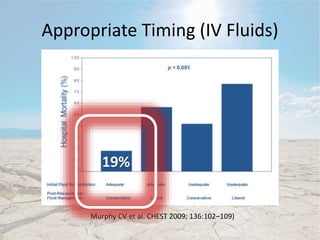
Appropriate Timing (IV Fluids)
Murphy CV et al. CHEST 2009; 136:102–109)
19%
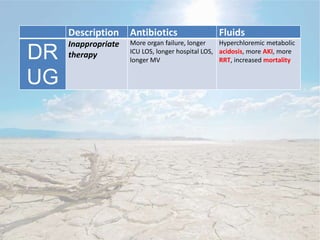
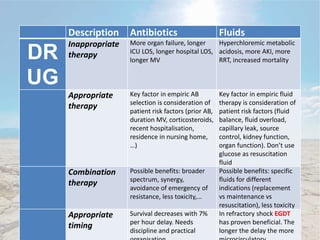
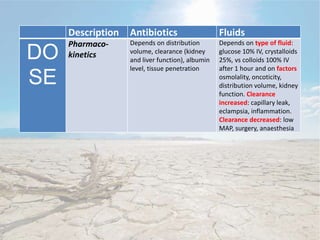
Description Antibiotics Fluids
DR
UG
Inappropriate
therapy
More organ failure, longer
ICU LOS, longer hospital LOS,
longer MV
Hyperchloremic metabolic
acidosis, more AKI, more
RRT, increased mortality
Description Antibiotics Fluids
DR
UG
Inappropriate
therapy
More organ failure, longer
ICU LOS, longer hospital LOS,
longer MV
Hyperchloremic metabolic
acidosis, more AKI, more
RRT, increased mortality
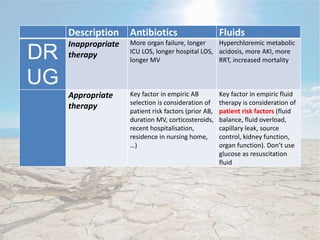
Appropriate
therapy
Key factor in empiric AB
selection is consideration of
patient risk factors (prior AB,
duration MV, corticosteroids,
recent hospitalisation,
residence in nursing home,
…)
Key factor in empiric fluid
therapy is consideration of
patient risk factors (fluid
balance, fluid overload,
capillary leak, source
control, kidney function,
organ function). Don’t use
glucose as resuscitation
fluid
Description Antibiotics Fluids
DR
UG
Inappropriate
therapy
More organ failure, longer
ICU LOS, longer hospital LOS,
longer MV
Hyperchloremic metabolic
acidosis, more AKI, more
RRT, increased mortality
Appropriate
therapy
Key factor in empiric AB
selection is consideration of
patient risk factors (prior AB,
duration MV, corticosteroids,
recent hospitalisation,
residence in nursing home,
…)
Key factor in empiric fluid
therapy is consideration of
patient risk factors (fluid
balance, fluid overload,
capillary leak, source
control, kidney function,
organ function). Don’t use
glucose as resuscitation
fluid
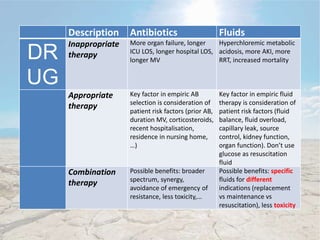
Combination
therapy
Possible benefits: broader
spectrum, synergy,
avoidance of emergency of
resistance, less toxicity,…
Possible benefits: specific
fluids for different
indications (replacement
vs maintenance vs
resuscitation), less toxicity
Description Antibiotics Fluids
DR
UG
Inappropriate
therapy
More organ failure, longer
ICU LOS, longer hospital LOS,
longer MV
Hyperchloremic metabolic
acidosis, more AKI, more
RRT, increased mortality
Appropriate
therapy
Key factor in empiric AB
selection is consideration of
patient risk factors (prior AB,
duration MV, corticosteroids,
recent hospitalisation,
residence in nursing home,
…)
Key factor in empiric fluid
therapy is consideration of
patient risk factors (fluid
balance, fluid overload,
capillary leak, source
control, kidney function,
organ function). Don’t use
glucose as resuscitation
fluid
Combination
therapy
Possible benefits: broader
spectrum, synergy,
avoidance of emergency of
resistance, less toxicity,…
Possible benefits: specific
fluids for different
indications (replacement
vs maintenance vs
resuscitation), less toxicity
Appropriate
timing
Survival decreases with 7%
per hour delay. Needs
discipline and practical
In refractory shock EGDT
has proven beneficial. The
longer the delay the more
"All things are poison, and nothing is without
poison; only the dose permits something not to be
poisonous.“
Paracelsus
Philippus Aureolus Theophrastus Bombastus von Hohenheim, 1493 – 1541
Alle Ding' sind Gift, und nichts ohn' Gift; allein die
Dosis macht, daß ein Ding kein Gift ist
T IS THE DOSE
AT MAKES THE POISON
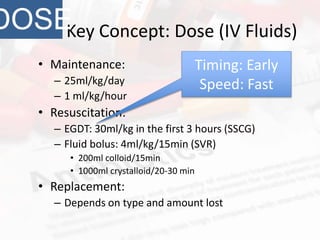
Key Concept: Dose (IV Fluids)DOSE
• Maintenance:
– 25ml/kg/day
– 1 ml/kg/hour
• Resuscitation:
– EGDT: 30ml/kg in the first 3 hours (SSCG)
– Fluid bolus: 4ml/kg/15min (SVR)
• 200ml colloid/15min
• 1000ml crystalloid/20-30 min
• Replacement:
– Depends on type and amount lost
Timing: Early
Speed: Fast
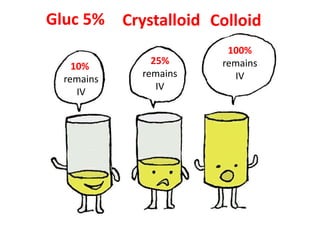
Gluc 5%
10%
remains
IV
25%
remains
IV
100%
remains
IV
Crystalloid Colloid
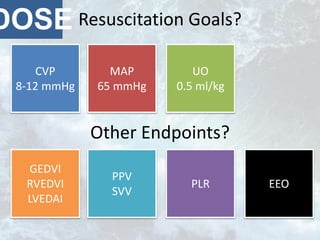
Resuscitation Goals?DOSE
CVP
8-12 mmHg
MAP
65 mmHg
UO
0.5 ml/kg
Other Endpoints?
GEDVI
RVEDVI
LVEDAI
PPV
SVV
PLR EEO
Description Antibiotics Fluids
DO
SE
Pharmaco-
kinetics
Depends on distribution
volume, clearance (kidney
and liver function), albumin
level, tissue penetration
Depends on type of fluid:
glucose 10% IV, crystalloids
25%, vs colloids 100% IV
after 1 hour and on factors
osmolality, oncoticity,
distribution volume, kidney
function. Clearance
increased: capillary leak,
eclampsia, inflammation.
Clearance decreased: low
MAP, surgery, anaesthesia
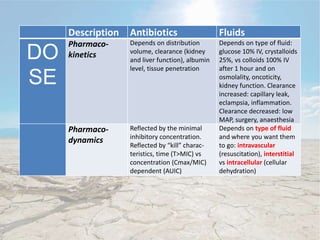
Description Antibiotics Fluids
DO
SE
Pharmaco-
kinetics
Depends on distribution
volume, clearance (kidney
and liver function), albumin
level, tissue penetration
Depends on type of fluid:
glucose 10% IV, crystalloids
25%, vs colloids 100% IV
after 1 hour and on
osmolality, oncoticity,
kidney function. Clearance
increased: capillary leak,
eclampsia, inflammation.
Clearance decreased: low
MAP, surgery, anaesthesia
Pharmaco-
dynamics
Reflected by the minimal
inhibitory concentration.
Reflected by “kill” charac-
teristics, time (T>MIC) vs
concentration (Cmax/MIC)
dependent (AUIC)
Depends on type of fluid
and where you want them
to go: intravascular
(resuscitation), interstitial
vs intracellular (cellular
dehydration)
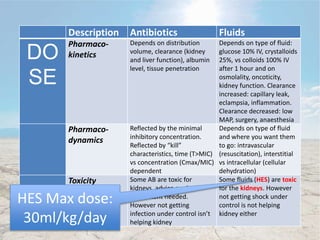
Description Antibiotics Fluids
DO
SE
Pharmaco-
kinetics
Depends on distribution
volume, clearance (kidney
and liver function), albumin
level, tissue penetration
Depends on type of fluid:
glucose 10% IV, crystalloids
25%, vs colloids 100% IV
after 1 hour and on
osmolality, oncoticity,
kidney function. Clearance
increased: capillary leak,
eclampsia, inflammation.
Clearance decreased: low
MAP, surgery, anaesthesia
Pharmaco-
dynamics
Reflected by the minimal
inhibitory concentration.
Reflected by “kill”
characteristics, time (T>MIC)
vs concentration (Cmax/MIC)
dependent
Depends on type of fluid
and where you want them
to go: intravascular
(resuscitation), interstitial
vs intracellular (cellular
dehydration)
Toxicity Some AB are toxic for
kidneys, advice on dose
adjustment needed.
However not getting
infection under control isn’t
helping kidney
Some fluids (HES) are toxic
for the kidneys. However
not getting shock under
control is not helping
kidney either
HES Max dose:
30ml/kg/day
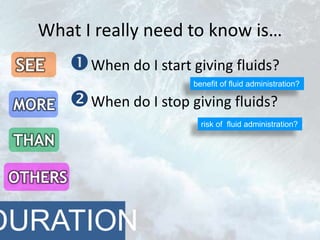
What I really need to know is…
When do I start giving fluids?
When do I stop giving fluids?
SEE
MORE
THAN
OTHERS
benefit of fluid administration?
risk of fluid administration?
DURATION
RIVERS study
FEAST study
ProCess study
SEPSISPAM study
ARISE study
ProMise trial
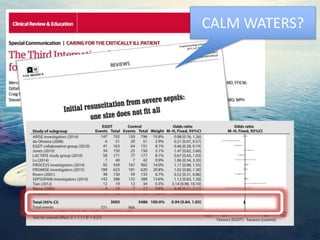
CALM WATERS?
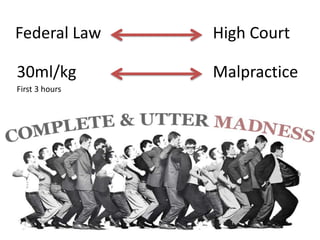
Federal Law High Court
30ml/kg Malpractice
First 3 hours
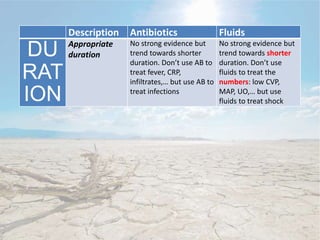
Description Antibiotics Fluids
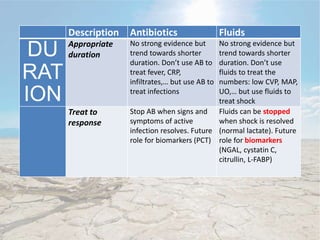
DU
RAT
ION
Appropriate
duration
No strong evidence but
trend towards shorter
duration. Don’t use AB to
treat fever, CRP,
infiltrates,… but use AB to
treat infections
No strong evidence but
trend towards shorter
duration. Don’t use
fluids to treat the
numbers: low CVP,
MAP, UO,… but use
fluids to treat shock
Description Antibiotics Fluids
DU
RAT
ION
Appropriate
duration
No strong evidence but
trend towards shorter
duration. Don’t use AB to
treat fever, CRP,
infiltrates,… but use AB to
treat infections
No strong evidence but
trend towards shorter
duration. Don’t use
fluids to treat the
numbers: low CVP, MAP,
UO,… but use fluids to
treat shock
Treat to
response
Stop AB when signs and
symptoms of active
infection resolves. Future
role for biomarkers (PCT)
Fluids can be stopped
when shock is resolved
(normal lactate). Future
role for biomarkers
(NGAL, cystatin C,
citrullin, L-FABP)
medisch-financieel overleg
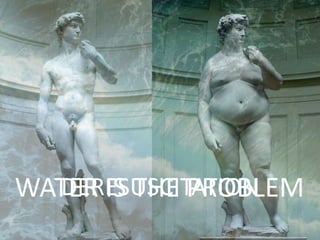
WATER IS THE PROBLEMDERESUSCITATION
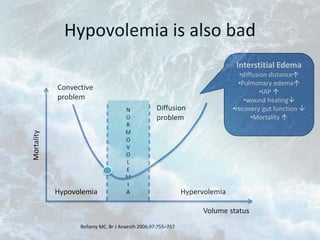
Interstitial Edema
•diffusion distance
•Pulmonary edema
•IAP 
•wound healing
•recovery gut function 
•Mortality 
N
O
R
M
O
V
O
L
E
M
I
A
Hypovolemia is also bad
Volume status
Mortality
HypervolemiaHypovolemia
Diffusion
problem
Convective
problem
Bellamy MC. Br J Anaesth 2006;97:755–757
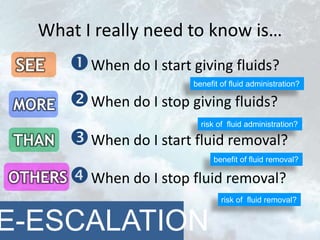
What I really need to know is…
When do I start giving fluids?
When do I stop giving fluids?
When do I start fluid removal?
When do I stop fluid removal?
SEE
MORE
THAN
OTHERS
benefit of fluid administration?
risk of fluid administration?
benefit of fluid removal?
risk of fluid removal?
E-ESCALATION
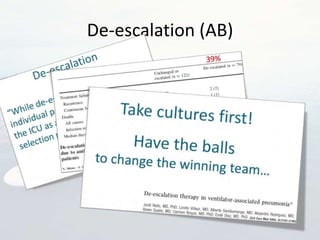
De-escalation (AB)
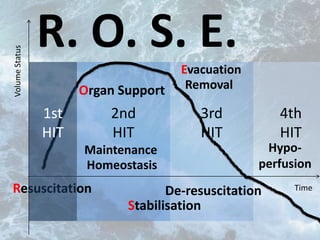
The R.O.S.E.
2nd
HIT
3rd
HIT
4th
HIT
R. O. S. E.
TimeResuscitation
Organ Support
VolumeStatus
Evacuation
Removal
Maintenance
Homeostasis
De-resuscitation
Hypo-
perfusion
Stabilisation
1st
HIT
2nd
HIT
3rd
HIT
4th
HIT
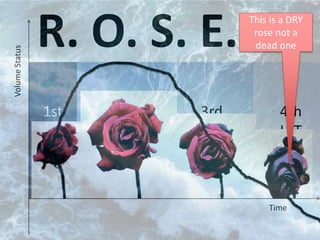
R. O. S. E.
Time
VolumeStatus
1st
HIT
This is a DRY
rose not a
dead one
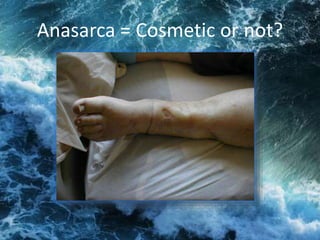
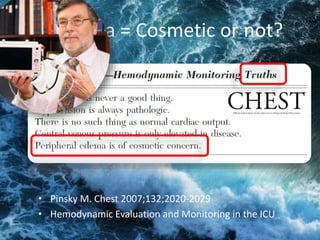
Anasarca = Cosmetic or not?
• Pinsky M. Chest 2007;132;2020-2029
• Hemodynamic Evaluation and Monitoring in the ICU
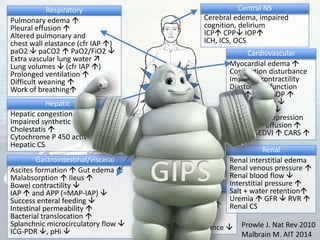
Respiratory
Pulmonary edema 
Pleural effusion 
Altered pulmonary and
chest wall elastance (cfr IAP )
paO2  paCO2  PaO2/FiO2 
Extra vascular lung water 
Lung volumes  (cfr IAP )
Prolonged ventilation 
Difficult weaning 
Work of breathing
Cerebral edema, impaired
cognition, delirium
ICP CPP IOP
ICH, ICS, OCS
Ascites formation  Gut edema 
Malabsorption  Ileus 
Bowel contractility 
IAP  and APP (=MAP-IAP) 
Success enteral feeding 
Intestinal permeability 
Bacterial translocation 
Splanchnic microcirculatory flow 
ICG-PDR , pHi 
Tissue edema 
Poor wound healing
Wound infection
Pressure ulcers 
Abdominal compliance 
Myocardial edema 
Conduction disturbance
Impaired contractility
Diastolic dysfunction
CVP  and PAOP 
Venous return 
SV  and CO 
Myocardial depression
Pericardial effusion 
GEF  GEDVI  CARS 
Hepatic congestion 
Impaired synthetic function
Cholestatis 
Cytochrome P 450 activity 
Hepatic CS
Fluid
Overload
Hepatic
Gastrointestinal/visceral
Central NS
Cardiovascular
Renal
Abdominal Wall
Renal interstitial edema
Renal venous pressure 
Renal blood flow 
Interstitial pressure 
Salt + water retention
Uremia  GFR  RVR 
Renal CS
Prowle J. Nat Rev 2010
Malbrain M. AIT 2014
GIPS
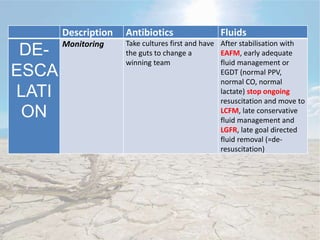
Description Antibiotics Fluids
DE-
ESCA
LATI
ON
Monitoring Take cultures first and have
the guts to change a
winning team
After stabilisation with
EAFM, early adequate
fluid management or
EGDT (normal PPV,
normal CO, normal
lactate) stop ongoing
resuscitation and move to
LCFM, late conservative
fluid management and
LGFR, late goal directed
fluid removal (=de-
resuscitation)
Fluid overload: Poor cosmetics or bad medecine? 74Fluid overload: Poor cosmetics or bad medecine?
Fluid overload: Poor cosmetics or bad medecine? 75Fluid overload: Poor cosmetics or bad medecine?
Fluid overload: Poor cosmetics or bad medecine? 76Fluid overload: Poor cosmetics or bad medecine?
Wrap it up
FOLLOW US ON:
Therefore…
RELAX
I only have 2 statements left…
Take Home Messages
• Answer the 4 questions of
fluid therapy
• Consider the 4 D’s of fluid
therapy
• Don’t forget 4 phases
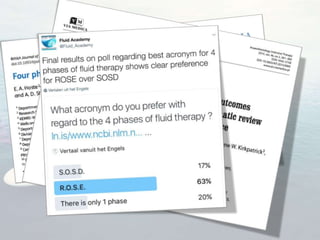
of fluid therapy (ROSE)
The 4 D’s of Fluid Therapy
• Treat Fluids as Drugs
– (contra)indications
– adverse effects
• Fluid Dose
– Timing, initial dose, speed, cumulative dose
• Duration
– Stop when no longer fluid responsive
– Use dynamic indices, PLR, EEO
• De-escalation whenever possible
– Deresuscitation if fluid overload (FO)
– FO causes increased morbidity/mortality

The four phases of intravenous fluid therapy: Manu Malbrain

  • 1.
    Disclosure: The speakeris member of the medical advisory board of Getinge (manu.malbrain@telenet.be) @Manu_Malbrain Co-chairman Fluid Academy @Fluid_Academy Fluids are DRUGS #dasSMACC HARDCORE ICU WORKSHOP Berlin – June 26th 2017
  • 3.
  • 4.
    “The application ofwhat we already know will have a bigger impact than any drug or technology likely to be introduced in the next decade.” Sir Muir Gray Chief Knowledge Officer, National Health Service, UK
  • 5.
    “The application ofwhat we already know will have a bigger impact than any drug or fluid or technology likely to be introduced in the next decade.” Sir Muir Gray Chief Knowledge Officer, National Health Service, UK We need to make better DRUGS We need to make good DRUGS better We need to make good FLUIDS better
  • 6.
    Longer than necessary(10%) No infection (10%) Colonizing organism (5%) 30%
  • 7.
    IV Fluids on thecontraindications and overdosing Arch Intern Med 2017; 177: 1-9 Manu LNG Malbrain, Flavia Machado, John Myburgh, Anders Perner, Rinaldo Bellomo, Peter Brindley, Karin Amrein, Rob McSweeney Longer than necessary (15%) No underfilling (15%) Wrong fluid (10%) Wrong dose (10%) 50%?
  • 8.
    1 When to start fluids When to stop fluids When tostart fluid removal 2 3 When to stop removal 4
  • 9.
    Fluid overload: Poorcosmetics or bad medecine? 9Fluid overload: Poor cosmetics or bad medecine? Drug Dose De-escalation Duration HOW MUCH HOW LONG WHAT WHEN
  • 12.
  • 13.
  • 14.
  • 15.
    DRUG Colloids vsCrystalloidsVISEP study CRYSTMAS study 6S study CHEST study
  • 16.
  • 18.
  • 19.
  • 20.
  • 21.
  • 22.
    Fluid overload: Poorcosmetics or bad medecine? 22Fluid overload: Poor cosmetics or bad medecine?
  • 24.
  • 25.
    Resuscitation FluidsDRUG Malbrain MLet al. Anaesthesiol Intensive Ther. 2014 Nov-Dec;46(5):313-8. To CORRECT IV Volume Deficit RECEIVED most attention Large part = other category Maintenance Fluids To COVER daily needs WATER 25 ml/kg NA + K 1 mEq/kg GLUCOSE 1.5 g/kg
  • 26.
    Maintenance FluidsDRUG 1L NS=3 chips 1L saline Na 154 mEq NaCl: 9000mg Elementary salt: 3.6g Na 1 chips = 8 oz = 1.36g Na
  • 27.
    MihMoSa - TRIAL Metabolismof Isotonic vs Hypotonic Maintenance Solutions in Fasting Healthy Adults
  • 28.
    MihMoSa Trial: UrineoutputDRUG Van Regenmortel N, Malbrain ML et al. British J Anaesthesiol 2017; 118 (6): 892-900 HYPOTONIC FLUIDISOTONIC FLUID Hypotonic = More UO
  • 29.
    MihMoSa Trial: FluidbalanceDRUG Van Regenmortel N, Malbrain ML et al. British J Anaesthesiol 2017; 118 (6): 892-900 HYPOTONICISOTONIC FLUID Hypotonic = Less + FB
  • 30.
    MihMoSa Trial: ElectrolytesDRUG VanRegenmortel N, Malbrain ML et al. British J Anaesthesiol 2017; 118 (6): 892-900 Sodium difference Chloride difference Hypotonic = nl Na Hypotonic = nl Cl
  • 31.
  • 32.
    Fluid overload: Poorcosmetics or bad medecine? 32Fluid overload: Poor cosmetics or bad medecine? STOP1. Resuscitation o HES in sepsis o Albumin in TBI o Saline > 2L 2. Maintenance o Isotonic fluids o Unbalanced o Uncover daily needs 3. Replacement o Unmatched to losses
  • 33.
    Fluid overload: Poorcosmetics or bad medecine? 33Fluid overload: Poor cosmetics or bad medecine? Fluids are drugs Type Indication Contra- indication Adverse effect
  • 35.
    Not a goodidea • Start with whisky in the morning • Continue with wine at lunch • Some soup at 16 o clock • Some milk at dinner • Some coffee before sleeping DRUG Malbrain ML et al. Anaesthesiol Intensive Ther. 2015; 47 (Spec Issue): s1-s5.
  • 36.
    Likewise not agood idea IN HEMORHAGIC SHOCK • Start with glucose 5% in 1st hour • Continue with albumin 20% afterwards • Add some litres of NS + balanced solutions • Top it with HES • Finish with Packed cells • Conclude with FFP + fibrinogen DRUG Malbrain ML et al. Anaesthesiol Intensive Ther. 2015; 47 (Spec Issue): s1-s5.
  • 37.
    Appropriate Timing (AB) KumarA. et al. Crit Care Med 2006; 34(6): 1589-96
  • 38.
    Appropriate Timing (IVFluids) Murphy CV et al. CHEST 2009; 136:102–109) 19%
  • 39.
    Description Antibiotics Fluids DR UG Inappropriate therapy Moreorgan failure, longer ICU LOS, longer hospital LOS, longer MV Hyperchloremic metabolic acidosis, more AKI, more RRT, increased mortality
  • 40.
    Description Antibiotics Fluids DR UG Inappropriate therapy Moreorgan failure, longer ICU LOS, longer hospital LOS, longer MV Hyperchloremic metabolic acidosis, more AKI, more RRT, increased mortality Appropriate therapy Key factor in empiric AB selection is consideration of patient risk factors (prior AB, duration MV, corticosteroids, recent hospitalisation, residence in nursing home, …) Key factor in empiric fluid therapy is consideration of patient risk factors (fluid balance, fluid overload, capillary leak, source control, kidney function, organ function). Don’t use glucose as resuscitation fluid
  • 41.
    Description Antibiotics Fluids DR UG Inappropriate therapy Moreorgan failure, longer ICU LOS, longer hospital LOS, longer MV Hyperchloremic metabolic acidosis, more AKI, more RRT, increased mortality Appropriate therapy Key factor in empiric AB selection is consideration of patient risk factors (prior AB, duration MV, corticosteroids, recent hospitalisation, residence in nursing home, …) Key factor in empiric fluid therapy is consideration of patient risk factors (fluid balance, fluid overload, capillary leak, source control, kidney function, organ function). Don’t use glucose as resuscitation fluid Combination therapy Possible benefits: broader spectrum, synergy, avoidance of emergency of resistance, less toxicity,… Possible benefits: specific fluids for different indications (replacement vs maintenance vs resuscitation), less toxicity
  • 42.
    Description Antibiotics Fluids DR UG Inappropriate therapy Moreorgan failure, longer ICU LOS, longer hospital LOS, longer MV Hyperchloremic metabolic acidosis, more AKI, more RRT, increased mortality Appropriate therapy Key factor in empiric AB selection is consideration of patient risk factors (prior AB, duration MV, corticosteroids, recent hospitalisation, residence in nursing home, …) Key factor in empiric fluid therapy is consideration of patient risk factors (fluid balance, fluid overload, capillary leak, source control, kidney function, organ function). Don’t use glucose as resuscitation fluid Combination therapy Possible benefits: broader spectrum, synergy, avoidance of emergency of resistance, less toxicity,… Possible benefits: specific fluids for different indications (replacement vs maintenance vs resuscitation), less toxicity Appropriate timing Survival decreases with 7% per hour delay. Needs discipline and practical In refractory shock EGDT has proven beneficial. The longer the delay the more
  • 44.
    "All things arepoison, and nothing is without poison; only the dose permits something not to be poisonous.“ Paracelsus Philippus Aureolus Theophrastus Bombastus von Hohenheim, 1493 – 1541 Alle Ding' sind Gift, und nichts ohn' Gift; allein die Dosis macht, daß ein Ding kein Gift ist T IS THE DOSE AT MAKES THE POISON
  • 45.
    Key Concept: Dose(IV Fluids)DOSE • Maintenance: – 25ml/kg/day – 1 ml/kg/hour • Resuscitation: – EGDT: 30ml/kg in the first 3 hours (SSCG) – Fluid bolus: 4ml/kg/15min (SVR) • 200ml colloid/15min • 1000ml crystalloid/20-30 min • Replacement: – Depends on type and amount lost Timing: Early Speed: Fast
  • 46.
  • 47.
    Resuscitation Goals?DOSE CVP 8-12 mmHg MAP 65mmHg UO 0.5 ml/kg Other Endpoints? GEDVI RVEDVI LVEDAI PPV SVV PLR EEO
  • 48.
    Description Antibiotics Fluids DO SE Pharmaco- kinetics Dependson distribution volume, clearance (kidney and liver function), albumin level, tissue penetration Depends on type of fluid: glucose 10% IV, crystalloids 25%, vs colloids 100% IV after 1 hour and on factors osmolality, oncoticity, distribution volume, kidney function. Clearance increased: capillary leak, eclampsia, inflammation. Clearance decreased: low MAP, surgery, anaesthesia
  • 49.
    Description Antibiotics Fluids DO SE Pharmaco- kinetics Dependson distribution volume, clearance (kidney and liver function), albumin level, tissue penetration Depends on type of fluid: glucose 10% IV, crystalloids 25%, vs colloids 100% IV after 1 hour and on osmolality, oncoticity, kidney function. Clearance increased: capillary leak, eclampsia, inflammation. Clearance decreased: low MAP, surgery, anaesthesia Pharmaco- dynamics Reflected by the minimal inhibitory concentration. Reflected by “kill” charac- teristics, time (T>MIC) vs concentration (Cmax/MIC) dependent (AUIC) Depends on type of fluid and where you want them to go: intravascular (resuscitation), interstitial vs intracellular (cellular dehydration)
  • 50.
    Description Antibiotics Fluids DO SE Pharmaco- kinetics Dependson distribution volume, clearance (kidney and liver function), albumin level, tissue penetration Depends on type of fluid: glucose 10% IV, crystalloids 25%, vs colloids 100% IV after 1 hour and on osmolality, oncoticity, kidney function. Clearance increased: capillary leak, eclampsia, inflammation. Clearance decreased: low MAP, surgery, anaesthesia Pharmaco- dynamics Reflected by the minimal inhibitory concentration. Reflected by “kill” characteristics, time (T>MIC) vs concentration (Cmax/MIC) dependent Depends on type of fluid and where you want them to go: intravascular (resuscitation), interstitial vs intracellular (cellular dehydration) Toxicity Some AB are toxic for kidneys, advice on dose adjustment needed. However not getting infection under control isn’t helping kidney Some fluids (HES) are toxic for the kidneys. However not getting shock under control is not helping kidney either HES Max dose: 30ml/kg/day
  • 52.
    What I reallyneed to know is… When do I start giving fluids? When do I stop giving fluids? SEE MORE THAN OTHERS benefit of fluid administration? risk of fluid administration? DURATION
  • 53.
    RIVERS study FEAST study ProCessstudy SEPSISPAM study
  • 54.
  • 55.
  • 57.
    Federal Law HighCourt 30ml/kg Malpractice First 3 hours
  • 58.
    Description Antibiotics Fluids DU RAT ION Appropriate duration Nostrong evidence but trend towards shorter duration. Don’t use AB to treat fever, CRP, infiltrates,… but use AB to treat infections No strong evidence but trend towards shorter duration. Don’t use fluids to treat the numbers: low CVP, MAP, UO,… but use fluids to treat shock
  • 59.
    Description Antibiotics Fluids DU RAT ION Appropriate duration Nostrong evidence but trend towards shorter duration. Don’t use AB to treat fever, CRP, infiltrates,… but use AB to treat infections No strong evidence but trend towards shorter duration. Don’t use fluids to treat the numbers: low CVP, MAP, UO,… but use fluids to treat shock Treat to response Stop AB when signs and symptoms of active infection resolves. Future role for biomarkers (PCT) Fluids can be stopped when shock is resolved (normal lactate). Future role for biomarkers (NGAL, cystatin C, citrullin, L-FABP)
  • 61.
    medisch-financieel overleg WATER ISTHE PROBLEMDERESUSCITATION
  • 62.
    Interstitial Edema •diffusion distance •Pulmonaryedema •IAP  •wound healing •recovery gut function  •Mortality  N O R M O V O L E M I A Hypovolemia is also bad Volume status Mortality HypervolemiaHypovolemia Diffusion problem Convective problem Bellamy MC. Br J Anaesth 2006;97:755–757
  • 64.
    What I reallyneed to know is… When do I start giving fluids? When do I stop giving fluids? When do I start fluid removal? When do I stop fluid removal? SEE MORE THAN OTHERS benefit of fluid administration? risk of fluid administration? benefit of fluid removal? risk of fluid removal? E-ESCALATION
  • 65.
  • 67.
  • 68.
    2nd HIT 3rd HIT 4th HIT R. O. S.E. TimeResuscitation Organ Support VolumeStatus Evacuation Removal Maintenance Homeostasis De-resuscitation Hypo- perfusion Stabilisation 1st HIT
  • 69.
    2nd HIT 3rd HIT 4th HIT R. O. S.E. Time VolumeStatus 1st HIT This is a DRY rose not a dead one
  • 70.
  • 71.
    Anasarca = Cosmeticor not? • Pinsky M. Chest 2007;132;2020-2029 • Hemodynamic Evaluation and Monitoring in the ICU
  • 72.
    Respiratory Pulmonary edema  Pleuraleffusion  Altered pulmonary and chest wall elastance (cfr IAP ) paO2  paCO2  PaO2/FiO2  Extra vascular lung water  Lung volumes  (cfr IAP ) Prolonged ventilation  Difficult weaning  Work of breathing Cerebral edema, impaired cognition, delirium ICP CPP IOP ICH, ICS, OCS Ascites formation  Gut edema  Malabsorption  Ileus  Bowel contractility  IAP  and APP (=MAP-IAP)  Success enteral feeding  Intestinal permeability  Bacterial translocation  Splanchnic microcirculatory flow  ICG-PDR , pHi  Tissue edema  Poor wound healing Wound infection Pressure ulcers  Abdominal compliance  Myocardial edema  Conduction disturbance Impaired contractility Diastolic dysfunction CVP  and PAOP  Venous return  SV  and CO  Myocardial depression Pericardial effusion  GEF  GEDVI  CARS  Hepatic congestion  Impaired synthetic function Cholestatis  Cytochrome P 450 activity  Hepatic CS Fluid Overload Hepatic Gastrointestinal/visceral Central NS Cardiovascular Renal Abdominal Wall Renal interstitial edema Renal venous pressure  Renal blood flow  Interstitial pressure  Salt + water retention Uremia  GFR  RVR  Renal CS Prowle J. Nat Rev 2010 Malbrain M. AIT 2014 GIPS
  • 73.
    Description Antibiotics Fluids DE- ESCA LATI ON MonitoringTake cultures first and have the guts to change a winning team After stabilisation with EAFM, early adequate fluid management or EGDT (normal PPV, normal CO, normal lactate) stop ongoing resuscitation and move to LCFM, late conservative fluid management and LGFR, late goal directed fluid removal (=de- resuscitation)
  • 74.
    Fluid overload: Poorcosmetics or bad medecine? 74Fluid overload: Poor cosmetics or bad medecine?
  • 75.
    Fluid overload: Poorcosmetics or bad medecine? 75Fluid overload: Poor cosmetics or bad medecine?
  • 76.
    Fluid overload: Poorcosmetics or bad medecine? 76Fluid overload: Poor cosmetics or bad medecine? Wrap it up
  • 77.
  • 79.
    Therefore… RELAX I only have2 statements left…
  • 80.
    Take Home Messages •Answer the 4 questions of fluid therapy • Consider the 4 D’s of fluid therapy • Don’t forget 4 phases of fluid therapy (ROSE)
  • 81.
    The 4 D’sof Fluid Therapy • Treat Fluids as Drugs – (contra)indications – adverse effects • Fluid Dose – Timing, initial dose, speed, cumulative dose • Duration – Stop when no longer fluid responsive – Use dynamic indices, PLR, EEO • De-escalation whenever possible – Deresuscitation if fluid overload (FO) – FO causes increased morbidity/mortality

Editor's Notes

  • #16 Medical fluids Different types of fluids Crystalloids vs colloids Synthetic vs blood derived Balanced vs unbalanced Route of administration: IV vs PO Indications Contra-indications Adverse effects
  • #23 Colloids: Conclusion Starches (HES) should NOT be used in: Sepsis Burns Acute or chronic kidney injury Oliguria not responsive to fluids (6h) Starches (HES) can be used in: Postoperative hypovolemic patients (<24h) Trauma and hemorrhagic shock Respect maximum dose (30 ml/kg) Albumin 20% can be used in: Late sepsis Deresuscitation
  • #24 Crystalloid: conclusion (Ab)normal saline as resuscitation fluid Not in large amounts Not above 2L/ 1 week Risk of hyperNa Risk of hyperchloremic metabolic acidosis Risk for AKI …/... Balanced solutions are good first choice Hartmann Ringer’s lactate PlasmlaLyte …/... Cover daily baseline electrolyte needs Glucion 5% …/...
  • #26 RESUSCITATION To correct an intravascular volume deficit acute hypovolemia Received most scientific attention especially in the light of the recent colloid-crystalloid debate Large part of the total infused volume during a patient’s stay in the hospital does not fall into this category… MAINTENANCE: To cover the patient’s daily basal needs + requirements of water and electrolytes These basic daily needs are: Water: 25-30 mL/kg of body weight Sodium: 1 mEq/kg Potassium: 1 mEq/kg Glucose or dextrose 5 or 10%: 1.4-1.6 g/kg Some specific maintenance solutions are commercially available, but far from ideal REPLACEMENT To correct existing or developing deficits that cannot be compensated by oral intake when fluids are lost via drains or stomata, fistulas, fever, open wounds (including evaporation during surgery), polyuria (salt wasting nephropathy or diabetes insipidus) Data on replacement fluids are scarse Several recent guidelines advise to match the amount of fluid and electrolytes as closely as possible to the fluid that is being or has been lost
  • #27 Potassium 50—100 mEq/day Sodium 80—120 mEq/day 1L fysiologisch = 9g NaCl = salt = 3.6gr elementary Na 1 zakje chips = 8 oz en per oz = 170mg => 1 zakje = 1360mg Dus 1 L fysiologisch = 3 zakjes chips
  • #28 Metabolism of Isotonic vs Hypotonic Maintenance Solutions in Fasting Healthy Adults
  • #48 RESUSCITATION To correct an intravascular volume deficit acute hypovolemia Received most scientific attention especially in the light of the recent colloid-crystalloid debate Large part of the total infused volume during a patient’s stay in the hospital does not fall into this category… MAINTENANCE: To cover the patient’s daily basal needs + requirements of water and electrolytes These basic daily needs are: Water: 25-30 mL/kg of body weight Sodium: 1 mEq/kg Potassium: 1 mEq/kg Glucose or dextrose 5 or 10%: 1.4-1.6 g/kg Some specific maintenance solutions are commercially available, but far from ideal REPLACEMENT To correct existing or developing deficits that cannot be compensated by oral intake when fluids are lost via drains or stomata, fistulas, fever, open wounds (including evaporation during surgery), polyuria (salt wasting nephropathy or diabetes insipidus) Data on replacement fluids are scarse Several recent guidelines advise to match the amount of fluid and electrolytes as closely as possible to the fluid that is being or has been lost The requirements for and response to fluid resuscitation: Vary greatly during the course of any critical illness Therefore: No single physiological or biochemical measurement adequately reflects Complexity of fluid depletion Response to fluid
  • #54 https://nycaamn.files.wordpress.com/2014/10/sepsis3.jpg
  • #75 It is important that we use the right targets
  • #76 To reach our goals