












Balanced crystalloids-
Need of the hour
NIRMAL JAISWAL
MD(med)FCCS(instructor)
ICU Director and chief Intensivist
TEACHER IDCCM COURSES
Suretech Hospital,Nagpur
Mostly guided by Clinical Experience
“ Making the same mistake with increasing
confidence over an impressive number of years ”
..Michael O’Donnell
Fluid Therapy
 Fluids as drug
 Hypovolemia
 Fluid responsiveness
 Harms fluids can do : Understanding Dilutional
Hyperchloremic Acidosis and SID
 Balanced Salt Solutions: ? Raising threshold for
possible harm
An understanding of
fluid therapy
 Trauma/sepsis : Intravascular volume
 Dehydration : Extracellular volume
 Electrolytes/acid-base : Extracellular
composition
imbalance balance
 Prevent toxicity and/ : Maintenance of flow in
or precipitation of distal renal tubules
drugs/radiocontrast
Goals of Fluid Therapy
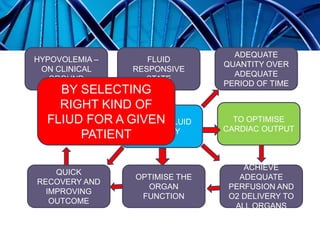
QUICK
RECOVERY AND
IMPROVING
OUTCOME
OPTIMISE THE
ORGAN
FUNCTION
ACHIEVE
ADEQUATE
PERFUSION AND
O2 DELIVERY TO
ALL ORGANS
TO OPTIMISE
CARDIAC OUTPUT
ADEQUATE
QUANTITY OVER
ADEQUATE
PERIOD OF TIME
FLUID
RESPONSIVE
STATE
HYPOVOLEMIA –
ON CLINICAL
GROUND
ROLE OF FLUID
THERAPY
BY SELECTING
RIGHT KIND OF
FLIUD FOR A GIVEN
PATIENT
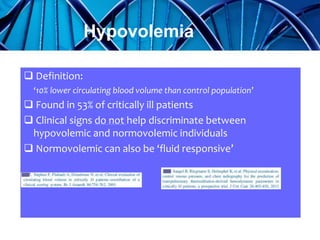
 Definition:
‘10% lower circulating blood volume than control population’
 Found in 53% of critically ill patients
 Clinical signs do not help discriminate between
hypovolemic and normovolemic individuals
 Normovolemic can also be ‘fluid responsive’
Hypovolemia
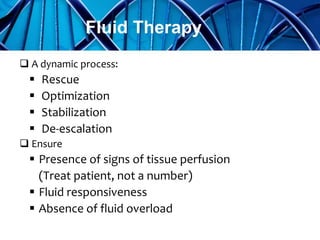
 A dynamic process:
 Rescue
 Optimization
 Stabilization
 De-escalation
 Ensure
 Presence of signs of tissue perfusion
(Treat patient, not a number)
 Fluid responsiveness
 Absence of fluid overload
Fluid Therapy
 Fluids likely to affect clinical outcomes
 Fluids should be treated like drugs for maximum efficacy
and minimum toxicity
 Following aspects must be kept in mind when ordering
fluids
 Indications, Contraindications, Drug interactions
 Type, Strength, Dose, Route, Frequency, Rate, Total
Volume
Intravenous Fluids
Raghunathan K, Shaw AD, Bagshaw SM: Fluids are drugs:
Type, dose and toxicity. Curr Opin Crit Care 19:290-298, 2013
Myburgh JA, Mythen MG: Resuscitation fluids. N Engl J Med
369:1243-1251, 2013
 953 colorectal cancer patients, for every 1 litre excess
fluid given on the day of surgery, a 32% increase was
seen in measured postoperative complications.
 ‘Excess’ postoperative fluid is a marker of impending
trouble, rather than its cause;
 For example, the drip stays up on the patient with an intestinal
ileus who is vomiting and apparently unable to drink.
 Excess IV fluid could also be simply because it is ‘standard
practice.’
Excess fluid associated with
poor recovery
G. Minto, M. G. Mythen;
Perioperative fluid management: science, art or random chaos?
British Journal of Anaesthesia 114 (5): 717–21 (2015)British Journal of Anaesthesia 114 (5): 717–21 (2015) Advance Access publication 19 March
2015 . doi:10.1093/bja/aev067 Perioperative fluid management: science, art or random
chaos? G. Minto1,2 and M. G. Mythen3,4,*
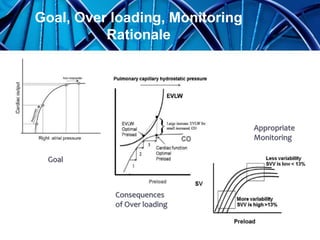
Goal, Over loading, Monitoring
Rationale
Goal
Consequences
of Over loading
Appropriate
Monitoring
 Produces a predictable and sustainable increase in
intravascular volume
 Has a chemical composition as close as possible to that of
extracellular fluid
 Is metabolized and completely excreted without
accumulation in tissues
 Does not produce adverse metabolic or systemic effects
 Is cost effective in terms of improving patient outcome
Ideal Fluid
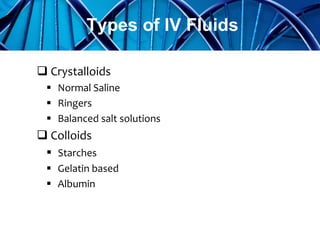
 Crystalloids
 Normal Saline
 Ringers
 Balanced salt solutions
 Colloids
 Starches
 Gelatin based
 Albumin
Types of IV Fluids
 Crystalloids: solutions in water of small
inorganic ions and small
organic molecules
 Balanced Crystalloids: crystalloids that closely
mimic ionic makeup of aqueous fraction of
plasma by adding bicarbonate or metabolizable
anions such as acetate, lactate, malate and
citrate.
 ? Balanced
• Tonicity ….. osmolality
• Electrolytes …… acid-base
Balanced Crystalloids
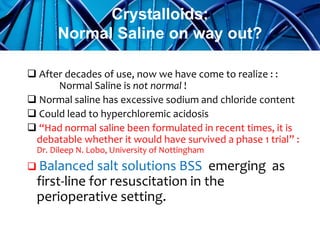
 After decades of use, now we have come to realize : :
Normal Saline is not normal !
 Normal saline has excessive sodium and chloride content
 Could lead to hyperchloremic acidosis
 “Had normal saline been formulated in recent times, it is
debatable whether it would have survived a phase 1 trial” :
Dr. Dileep N. Lobo, University of Nottingham
 Balanced salt solutions BSS emerging as
first-line for resuscitation in the
perioperative setting.
Crystalloids:
Normal Saline on way out?
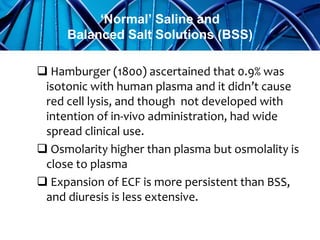
 Hamburger (1800) ascertained that 0.9% was
isotonic with human plasma and it didn’t cause
red cell lysis, and though not developed with
intention of in-vivo administration, had wide
spread clinical use.
 Osmolarity higher than plasma but osmolality is
close to plasma
 Expansion of ECF is more persistent than BSS,
and diuresis is less extensive.
‘Normal’ Saline and
Balanced Salt Solutions (BSS)
 Physiological Approach
 Base-excess Approach
 Physico-chemical Approach (Stewart
Approaches to
Acid-base Analysis
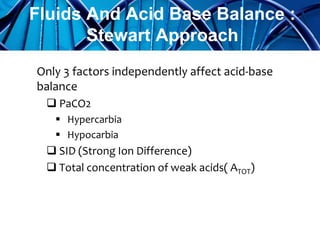
Only 3 factors independently affect acid-base
balance
 PaCO2
 Hypercarbia
 Hypocarbia
 SID (Strong Ion Difference)
 Total concentration of weak acids( ATOT)
Fluids And Acid Base Balance :
Stewart Approach
SID = Net positive charge – Net negative charge
Most abundant strong ions in extracellular fluid
Na+ and Cl-
Other ions
K+, Mg+ + , Ca+ +, SO4- -
SID is always positive
Strong Ions
 In normal ECF, the SID is 44 mEq, and this positive charge is balanced
principally by weak acids.
 Anything that increases the SID will increase the relative
concentration of cations to anions and alkalinize the solution.
 Anything that decreases the SID will decrease the relative
concentration of cations to anions and will acidify the solution.
 If the extracellular compartment volume is expanded with free water
(no electrolytes), the components of the system are diluted, with
relatively more dilution of more abundant moieties (Na+ rather than
Cl−); the results are a reduction in SID and dilutional acidosis.
 This condition rarely occurs in the presence of normally functioning
functioning kidneys.
 Reverse happens when volume is contracted.
Metabolic disturbances and
SID
Metabolic Acid-base Abnormalities
Caused by alterations
 SID
 ATOT
 Both
 In perioperative medicine, “normal saline” (NaCl 0.9%),
containing 154 mEq of Na+ and 154 mEq of Cl− is
commonly used.
 The SID of this solution is 0.
 Functionally, however, each liter of normal saline
delivers approximately 50 mmol of hydrochloric acid
into ECF.
 The effects are a net reduction in the relative
concentration of Na+ to Cl−, a reduction in SID, and
hyperchloremic acidosis.1
NS and
Hyperchloremic Acidosis
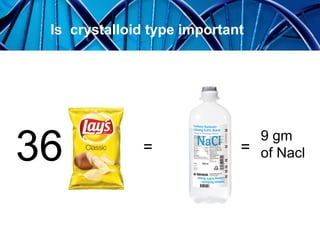
Is crystalloid type important
36 9 gm
of Nacl= =
 Corcoran T, Rhodes JE, Clarke S, et al. Perioperative fluid management
strategies in major surgery: A stratified meta-analysis. Anesth
Analg. 2012;114:640–651
 Boland MR, Noorani A, Varty K, et al. Perioperative fluid resuscitation in
major abdominal surgery: Systematic review and meta-analysis of
randomized clinical trials. World J Surg. 2013;37:1193–1202
 Evans RG, Naidu B. Does a conservative fluid management strategy in the
perioperative management of lung resection patients reduce the risk of
acute lung injury?. Interact Cardiovasc Thorac Surg. 2012;15:498–504
 Doherty M, Buggy DJ. Intraoperative fluids: how much is too much?. Br J
Anaesth. 2012;109:69–79
 McGee WT, Raghunathan K: Physiologic goal-directed therapy in the
perioperative period: the volume prescription for high-risk patients. J
Cardiothorac Vasc Anesth 27:1079-1086, 2013
 Chowdhury AH, Cox EF, Francis ST et al. A randomized, controlled, double-
blind crossover study on the effects of 2-L infusions of 0.9% saline and
plasma-lyte(R) 148 on renal blood flow velocity and renal cortical tissue
perfusion in healthy volunteers. Ann Surg 2012; 256: 18–24
Balanced Salt Solutions vs
Normal Saline
 A single-center prospective clinical trial
(n = 1,553; 2008-2009)
 Fluid therapy with chloride-restrictive solutions in
critically ill adults significantly decreased
 Risks of renal injury and
 Risk of renal replacement therapy.
Yunos NM, Kim IB, Bellomo R et al. The biochemical effects of restricting chloride-rich
fluids in intensive care. Crit Care Med 2011; 39: 2419–2424
Yunos NM, Bellomo R, Hegarty C, et al: Association between a chloride-liberal vs
chloride-restrictive intravenous fluid administration strategy and kidney injury in
critically ill adults. JAMA 308: 1566-1572,2012
Balanced Salt Solutions vs
Normal Saline
• Rarely
• Traumatic brain injury
• HCl loss (severe vomiting)
• Almost never in cardiac surgical practice
When should we give abnormal saline?
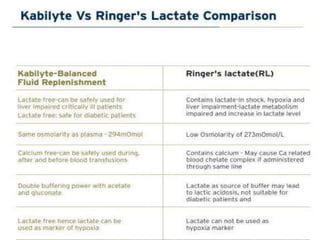
 Neither isotonic nor balanced
 With an osmolarity of 273 mOsmol/L and
measured osmolality of 254 mOsm/kg, infused RL
solution leads to decrease in plasma osmolality
 Potential increase in brain water and effects on
diuresis.
 In liver disease, severe hypoxia and shock RL
infusion can lead to lactate acidosis
Disadvantages of RL
 Overall lower osmolarity than NaCl, lower Na
and much lower Cl-, slightly hypotonic
 Reduction in Cl- is compensated by stable
anionic buffers such as gluconate or acetate
since HCO-3 is not suitable
 HCO3
- reacts with water to form CO2 which
diffuses out from most of packages
 HCO-
3 can shift pH, that can precipitate Ca/Mg
Balanced Salt Solutions
The following anions of organic acids are used as
metabolizable bases:
 Lactate
 Acetate
 Gluconate
 Malate
 Citrate
Consuming H+ ions and oxygen in the process, these anions
are metabolized in the intact liver (mainly lactate) or in
muscle (mainly acetate and malate)
Organic Anions of BSS
1. Lower need of blood product
2. Lower incidence of RRT
3. Lower incidence of hyperkalemia
4. Lower incidence of postoperative infections
possibly by avoiding acidosis mediated
a) Production of pro-inflammatory mediators
b) Impaired leucocyte chemotaxis
c) Lymphocyte toxicity
Possible advantages BSS
 Observational study, adult patients undergoing
abdominal surgery received 0.9% Saline or BSS on day of
surgery
 In-hospital mortality:
 Saline group: 5.6%
 BSS : 2.9%
 BSS associated with fewer complications like post-
operative infection, renal failure requiring dialysis, blood
transfusions, electrolyte disturbance and acidosis.
Shaw AD. Ann Surg 2012; 255: 821–829
821–829
Burdett E. Cochrane Database Syst Rev 2012; 12: CD004089
Major abdominal surgery
and BSS
 Retrospective study, 360 US hospitals, 2005-10. 53,448 patients with sepsis
 Among 6,730 patients in a propensity-matched cohort, receipt of balanced
fluids was associated with lower in-hospital mortality (19.6% vs 22.8%)
 Mortality was progressively lower among patients receiving larger
proportions of balanced fluids.
 Conclusions: Among critically ill adults with sepsis, resuscitation with
balanced fluids was associated with a lower risk of in-hospital mortality.
Raghunathan et al. Crit Care Med 2014; 42:1585–1591
Sepsis and BSS
 Young et al conducted a RCT of adult trauma patients requiring blood
transfusion, intubation, or operation within 60 minutes of arrival at the
Medical Center.
 Patients received either 0.9% NaCl or Calcium free BSS for resuscitation
during the first 24 hours after injury
 Compared with 0.9% NaCl, resuscitation of trauma patients with BSS
resulted in improved acid-base status and less hyperchloremia at 24
hours post injury.
Young JB et al. Annals of Surgery. 259(2):255-262, February 2014.
Trauma
 A total of 104 donors undergoing right hepatectomy for
liver transplantation were randomly allocated to receive
lactated Ringer’s (LR) solution (n = 552) or Lactate free
BSS (n = 552).
The lactate concentrations were significantly higher in the
LR group than in the Plasmalyte group 1 h after
hepatectomy [4.2 (3.2–5.7) vs. 3.3 (2.6–4.6)mmol/l;
P0.005)
Liver Transplant
DKA
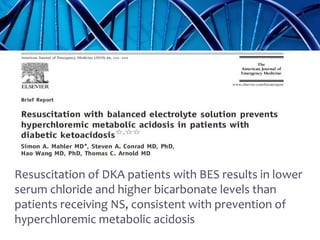
Resuscitation of DKA patients with BES results in lower
serum chloride and higher bicarbonate levels than
patients receiving NS, consistent with prevention of
hyperchloremic metabolic acidosis
 Balanced salt solutions appear to reduce the incidence of
metabolic acidosis and hyperkalaemia after kidney
transplantation.
 Turkish, Iranian and Korean studies : Significant decrease in pH,
rise in Cl- in NS group but no significant differences in renal
functions seen
Hadimioglu N, Anesth Analg 2008; 107: 264–269 108.
Khajavi MR, Ren Fail 2008; 30: 535–539 109.
Kim SY, Transplant Proc 2013; 45: 2191–2196 110.
O’Malley, Anesth Analg 2005; 100: 1518–1524.
Kidney Transplant
 SID of fluid infused
 HCO3
- in patients
May become clinically relevant in specific situations, like
resuscitation when large volumes are infused in short
period of time.
 ? Effect specific electrolyte content of fluid
 Does deficiency of Mg2+ and Ca2+ in some fluids affect
outcome ?
 Do accompanying organic anion added for electrical
neutrality affect balance and outcome?
Factors to decide fluid
 Lactate may be associated with cardiac toxicity and
encephalopathy in patients with renal failure
 Lactated solutions should be avoided with liver failure
 High acetate is pro-inflammatory, depresses
myocardium, is vasodilatory, and promotes hypoxemia
and hence has been removed from renal dialysis fluids
Caution! Organic anions
can cause harm
Crystalloids are the fluids of choice for expanding and
maintaining plasma volume in critically ill ICU patients with
hypovolemic shock
Observed differences in chloride load and SID in various
crystalloids appear to be clinically important
Advantages of balanced salt solutions include lower
incidence of RRT and lower postoperative complications
A critical appraisal of data suggests that balanced salt
solutions deserve consideration as infusates of first choice
compared to other crystalloids
Conclusion
“ Why we should not offer
the same respect to fluids
as other I V drugs as it has
shown over decades that
unmonitored and wrong
choice of the fluid for a
scenario causes harm and
there by outcome ? ”
• gsggs
ICU is team
work

Balanced solution is a boon for fluid resuscitation

  • 2.
  • 3.
    NIRMAL JAISWAL MD(med)FCCS(instructor) ICU Directorand chief Intensivist TEACHER IDCCM COURSES Suretech Hospital,Nagpur
  • 4.
    Mostly guided byClinical Experience “ Making the same mistake with increasing confidence over an impressive number of years ” ..Michael O’Donnell Fluid Therapy
  • 5.
     Fluids asdrug  Hypovolemia  Fluid responsiveness  Harms fluids can do : Understanding Dilutional Hyperchloremic Acidosis and SID  Balanced Salt Solutions: ? Raising threshold for possible harm An understanding of fluid therapy
  • 6.
     Trauma/sepsis :Intravascular volume  Dehydration : Extracellular volume  Electrolytes/acid-base : Extracellular composition imbalance balance  Prevent toxicity and/ : Maintenance of flow in or precipitation of distal renal tubules drugs/radiocontrast Goals of Fluid Therapy
  • 7.
    QUICK RECOVERY AND IMPROVING OUTCOME OPTIMISE THE ORGAN FUNCTION ACHIEVE ADEQUATE PERFUSIONAND O2 DELIVERY TO ALL ORGANS TO OPTIMISE CARDIAC OUTPUT ADEQUATE QUANTITY OVER ADEQUATE PERIOD OF TIME FLUID RESPONSIVE STATE HYPOVOLEMIA – ON CLINICAL GROUND ROLE OF FLUID THERAPY BY SELECTING RIGHT KIND OF FLIUD FOR A GIVEN PATIENT
  • 8.
     Definition: ‘10% lowercirculating blood volume than control population’  Found in 53% of critically ill patients  Clinical signs do not help discriminate between hypovolemic and normovolemic individuals  Normovolemic can also be ‘fluid responsive’ Hypovolemia
  • 9.
     A dynamicprocess:  Rescue  Optimization  Stabilization  De-escalation  Ensure  Presence of signs of tissue perfusion (Treat patient, not a number)  Fluid responsiveness  Absence of fluid overload Fluid Therapy
  • 10.
     Fluids likelyto affect clinical outcomes  Fluids should be treated like drugs for maximum efficacy and minimum toxicity  Following aspects must be kept in mind when ordering fluids  Indications, Contraindications, Drug interactions  Type, Strength, Dose, Route, Frequency, Rate, Total Volume Intravenous Fluids Raghunathan K, Shaw AD, Bagshaw SM: Fluids are drugs: Type, dose and toxicity. Curr Opin Crit Care 19:290-298, 2013 Myburgh JA, Mythen MG: Resuscitation fluids. N Engl J Med 369:1243-1251, 2013
  • 11.
     953 colorectalcancer patients, for every 1 litre excess fluid given on the day of surgery, a 32% increase was seen in measured postoperative complications.  ‘Excess’ postoperative fluid is a marker of impending trouble, rather than its cause;  For example, the drip stays up on the patient with an intestinal ileus who is vomiting and apparently unable to drink.  Excess IV fluid could also be simply because it is ‘standard practice.’ Excess fluid associated with poor recovery G. Minto, M. G. Mythen; Perioperative fluid management: science, art or random chaos? British Journal of Anaesthesia 114 (5): 717–21 (2015)British Journal of Anaesthesia 114 (5): 717–21 (2015) Advance Access publication 19 March 2015 . doi:10.1093/bja/aev067 Perioperative fluid management: science, art or random chaos? G. Minto1,2 and M. G. Mythen3,4,*
  • 12.
    Goal, Over loading,Monitoring Rationale Goal Consequences of Over loading Appropriate Monitoring
  • 13.
     Produces apredictable and sustainable increase in intravascular volume  Has a chemical composition as close as possible to that of extracellular fluid  Is metabolized and completely excreted without accumulation in tissues  Does not produce adverse metabolic or systemic effects  Is cost effective in terms of improving patient outcome Ideal Fluid
  • 14.
     Crystalloids  NormalSaline  Ringers  Balanced salt solutions  Colloids  Starches  Gelatin based  Albumin Types of IV Fluids
  • 15.
     Crystalloids: solutionsin water of small inorganic ions and small organic molecules  Balanced Crystalloids: crystalloids that closely mimic ionic makeup of aqueous fraction of plasma by adding bicarbonate or metabolizable anions such as acetate, lactate, malate and citrate.  ? Balanced • Tonicity ….. osmolality • Electrolytes …… acid-base Balanced Crystalloids
  • 16.
     After decadesof use, now we have come to realize : : Normal Saline is not normal !  Normal saline has excessive sodium and chloride content  Could lead to hyperchloremic acidosis  “Had normal saline been formulated in recent times, it is debatable whether it would have survived a phase 1 trial” : Dr. Dileep N. Lobo, University of Nottingham  Balanced salt solutions BSS emerging as first-line for resuscitation in the perioperative setting. Crystalloids: Normal Saline on way out?
  • 17.
     Hamburger (1800)ascertained that 0.9% was isotonic with human plasma and it didn’t cause red cell lysis, and though not developed with intention of in-vivo administration, had wide spread clinical use.  Osmolarity higher than plasma but osmolality is close to plasma  Expansion of ECF is more persistent than BSS, and diuresis is less extensive. ‘Normal’ Saline and Balanced Salt Solutions (BSS)
  • 18.
     Physiological Approach Base-excess Approach  Physico-chemical Approach (Stewart Approaches to Acid-base Analysis
  • 19.
    Only 3 factorsindependently affect acid-base balance  PaCO2  Hypercarbia  Hypocarbia  SID (Strong Ion Difference)  Total concentration of weak acids( ATOT) Fluids And Acid Base Balance : Stewart Approach
  • 20.
    SID = Netpositive charge – Net negative charge Most abundant strong ions in extracellular fluid Na+ and Cl- Other ions K+, Mg+ + , Ca+ +, SO4- - SID is always positive Strong Ions
  • 21.
     In normalECF, the SID is 44 mEq, and this positive charge is balanced principally by weak acids.  Anything that increases the SID will increase the relative concentration of cations to anions and alkalinize the solution.  Anything that decreases the SID will decrease the relative concentration of cations to anions and will acidify the solution.  If the extracellular compartment volume is expanded with free water (no electrolytes), the components of the system are diluted, with relatively more dilution of more abundant moieties (Na+ rather than Cl−); the results are a reduction in SID and dilutional acidosis.  This condition rarely occurs in the presence of normally functioning functioning kidneys.  Reverse happens when volume is contracted. Metabolic disturbances and SID
  • 22.
    Metabolic Acid-base Abnormalities Causedby alterations  SID  ATOT  Both
  • 23.
     In perioperativemedicine, “normal saline” (NaCl 0.9%), containing 154 mEq of Na+ and 154 mEq of Cl− is commonly used.  The SID of this solution is 0.  Functionally, however, each liter of normal saline delivers approximately 50 mmol of hydrochloric acid into ECF.  The effects are a net reduction in the relative concentration of Na+ to Cl−, a reduction in SID, and hyperchloremic acidosis.1 NS and Hyperchloremic Acidosis
  • 24.
    Is crystalloid typeimportant 36 9 gm of Nacl= =
  • 25.
     Corcoran T,Rhodes JE, Clarke S, et al. Perioperative fluid management strategies in major surgery: A stratified meta-analysis. Anesth Analg. 2012;114:640–651  Boland MR, Noorani A, Varty K, et al. Perioperative fluid resuscitation in major abdominal surgery: Systematic review and meta-analysis of randomized clinical trials. World J Surg. 2013;37:1193–1202  Evans RG, Naidu B. Does a conservative fluid management strategy in the perioperative management of lung resection patients reduce the risk of acute lung injury?. Interact Cardiovasc Thorac Surg. 2012;15:498–504  Doherty M, Buggy DJ. Intraoperative fluids: how much is too much?. Br J Anaesth. 2012;109:69–79  McGee WT, Raghunathan K: Physiologic goal-directed therapy in the perioperative period: the volume prescription for high-risk patients. J Cardiothorac Vasc Anesth 27:1079-1086, 2013  Chowdhury AH, Cox EF, Francis ST et al. A randomized, controlled, double- blind crossover study on the effects of 2-L infusions of 0.9% saline and plasma-lyte(R) 148 on renal blood flow velocity and renal cortical tissue perfusion in healthy volunteers. Ann Surg 2012; 256: 18–24 Balanced Salt Solutions vs Normal Saline
  • 26.
     A single-centerprospective clinical trial (n = 1,553; 2008-2009)  Fluid therapy with chloride-restrictive solutions in critically ill adults significantly decreased  Risks of renal injury and  Risk of renal replacement therapy. Yunos NM, Kim IB, Bellomo R et al. The biochemical effects of restricting chloride-rich fluids in intensive care. Crit Care Med 2011; 39: 2419–2424 Yunos NM, Bellomo R, Hegarty C, et al: Association between a chloride-liberal vs chloride-restrictive intravenous fluid administration strategy and kidney injury in critically ill adults. JAMA 308: 1566-1572,2012 Balanced Salt Solutions vs Normal Saline
  • 27.
    • Rarely • Traumaticbrain injury • HCl loss (severe vomiting) • Almost never in cardiac surgical practice When should we give abnormal saline?
  • 28.
     Neither isotonicnor balanced  With an osmolarity of 273 mOsmol/L and measured osmolality of 254 mOsm/kg, infused RL solution leads to decrease in plasma osmolality  Potential increase in brain water and effects on diuresis.  In liver disease, severe hypoxia and shock RL infusion can lead to lactate acidosis Disadvantages of RL
  • 30.
     Overall lowerosmolarity than NaCl, lower Na and much lower Cl-, slightly hypotonic  Reduction in Cl- is compensated by stable anionic buffers such as gluconate or acetate since HCO-3 is not suitable  HCO3 - reacts with water to form CO2 which diffuses out from most of packages  HCO- 3 can shift pH, that can precipitate Ca/Mg Balanced Salt Solutions
  • 31.
    The following anionsof organic acids are used as metabolizable bases:  Lactate  Acetate  Gluconate  Malate  Citrate Consuming H+ ions and oxygen in the process, these anions are metabolized in the intact liver (mainly lactate) or in muscle (mainly acetate and malate) Organic Anions of BSS
  • 32.
    1. Lower needof blood product 2. Lower incidence of RRT 3. Lower incidence of hyperkalemia 4. Lower incidence of postoperative infections possibly by avoiding acidosis mediated a) Production of pro-inflammatory mediators b) Impaired leucocyte chemotaxis c) Lymphocyte toxicity Possible advantages BSS
  • 33.
     Observational study,adult patients undergoing abdominal surgery received 0.9% Saline or BSS on day of surgery  In-hospital mortality:  Saline group: 5.6%  BSS : 2.9%  BSS associated with fewer complications like post- operative infection, renal failure requiring dialysis, blood transfusions, electrolyte disturbance and acidosis. Shaw AD. Ann Surg 2012; 255: 821–829 821–829 Burdett E. Cochrane Database Syst Rev 2012; 12: CD004089 Major abdominal surgery and BSS
  • 34.
     Retrospective study,360 US hospitals, 2005-10. 53,448 patients with sepsis  Among 6,730 patients in a propensity-matched cohort, receipt of balanced fluids was associated with lower in-hospital mortality (19.6% vs 22.8%)  Mortality was progressively lower among patients receiving larger proportions of balanced fluids.  Conclusions: Among critically ill adults with sepsis, resuscitation with balanced fluids was associated with a lower risk of in-hospital mortality. Raghunathan et al. Crit Care Med 2014; 42:1585–1591 Sepsis and BSS
  • 35.
     Young etal conducted a RCT of adult trauma patients requiring blood transfusion, intubation, or operation within 60 minutes of arrival at the Medical Center.  Patients received either 0.9% NaCl or Calcium free BSS for resuscitation during the first 24 hours after injury  Compared with 0.9% NaCl, resuscitation of trauma patients with BSS resulted in improved acid-base status and less hyperchloremia at 24 hours post injury. Young JB et al. Annals of Surgery. 259(2):255-262, February 2014. Trauma
  • 36.
     A totalof 104 donors undergoing right hepatectomy for liver transplantation were randomly allocated to receive lactated Ringer’s (LR) solution (n = 552) or Lactate free BSS (n = 552). The lactate concentrations were significantly higher in the LR group than in the Plasmalyte group 1 h after hepatectomy [4.2 (3.2–5.7) vs. 3.3 (2.6–4.6)mmol/l; P0.005) Liver Transplant
  • 37.
    DKA Resuscitation of DKApatients with BES results in lower serum chloride and higher bicarbonate levels than patients receiving NS, consistent with prevention of hyperchloremic metabolic acidosis
  • 38.
     Balanced saltsolutions appear to reduce the incidence of metabolic acidosis and hyperkalaemia after kidney transplantation.  Turkish, Iranian and Korean studies : Significant decrease in pH, rise in Cl- in NS group but no significant differences in renal functions seen Hadimioglu N, Anesth Analg 2008; 107: 264–269 108. Khajavi MR, Ren Fail 2008; 30: 535–539 109. Kim SY, Transplant Proc 2013; 45: 2191–2196 110. O’Malley, Anesth Analg 2005; 100: 1518–1524. Kidney Transplant
  • 39.
     SID offluid infused  HCO3 - in patients May become clinically relevant in specific situations, like resuscitation when large volumes are infused in short period of time.  ? Effect specific electrolyte content of fluid  Does deficiency of Mg2+ and Ca2+ in some fluids affect outcome ?  Do accompanying organic anion added for electrical neutrality affect balance and outcome? Factors to decide fluid
  • 40.
     Lactate maybe associated with cardiac toxicity and encephalopathy in patients with renal failure  Lactated solutions should be avoided with liver failure  High acetate is pro-inflammatory, depresses myocardium, is vasodilatory, and promotes hypoxemia and hence has been removed from renal dialysis fluids Caution! Organic anions can cause harm
  • 41.
    Crystalloids are thefluids of choice for expanding and maintaining plasma volume in critically ill ICU patients with hypovolemic shock Observed differences in chloride load and SID in various crystalloids appear to be clinically important Advantages of balanced salt solutions include lower incidence of RRT and lower postoperative complications A critical appraisal of data suggests that balanced salt solutions deserve consideration as infusates of first choice compared to other crystalloids Conclusion
  • 43.
    “ Why weshould not offer the same respect to fluids as other I V drugs as it has shown over decades that unmonitored and wrong choice of the fluid for a scenario causes harm and there by outcome ? ”
  • 44.

Editor's Notes

  • #13 British Journal of Anaesthesia 114 (5): 717–21 (2015) Advance Access publication 19 March 2015 . doi:10.1093/bja/aev067 Perioperative fluid management: science, art or random chaos? G. Minto1,2 and M. G. Mythen3,4,*
  • #15 kaplan
  • #17 kaplan
  • #18 kaplan
  • #20 kaplan
  • #21 kaplan
  • #22 Miller 1815/2110
  • #23 kaplan
  • #24 kaplan
  • #26 kaplan
  • #27 kaplan
  • #35 kaplan
  • #36 kaplan
  • #41 kaplan
  • #44 Pietro Caironi
  • #45 Pietro Caironi
  • #46 Pietro Caironi