Complicated intra-abdominal
infection
Dr.(Prof) Santosh Kumar Bhaskar
A 50-year-old man presents to hospital with fever and an acute
abdomen. He undergoes an emergency laparotomy, the findings of
which include perforated carcinoma in the splenic flexure and
generalized faecal soiling of the peritoneum. He undergoes a left
hemicolectomy with a defunctioning colostomy. Post-operatively he is
transferred to the intensive care unit because of septic shock.
What antibiotic regimen will you consider and why?
Triple therapy or Timentin or Tazocin – cover enterococcus, gram
negatives and anaerobes.
May consider adding empiric fluconazole
Vancomycin, gentamicin, metronidazole if penicillin allergic
Despite a five-day course of antibiotics he remains unwell with fever up
to 38.50C, WCC 16.7 x 10⁹ /l. He is unable to tolerate oral feeds and is
on TPN.
Literature support for single antibiotic vs combination
therapy in surgical patients
Literature support for single antibiotic vs combination
therapy in surgical patients
List the likely abdominal causes of persistent fever and
leukocytosis?
Intra-abdominal collection
Wound infection
Acalculous cholecystitis
Pancreatitis
Stomal necrosis
Blood cultures show Candida glabrata in one of the three bottles.
Predisposing factors for this infection in this patient.
Malignancy
Abdominal soiling (repeated abdominal surgery)
TPN
Recent broad spectrum antibiotic therapy
Indwelling CVC
Exposure to fluconazole
Diabetes
Renal failure
Literature support for risk factors for fungal infection
What antibiotic therapy will you commence whilst waiting for
sensitivities and why?
Voriconazole or amphotericin B or caspofungin
Candida glabrata may not be sensitive to fluconazole
Based on the culture report, give one other investigation, the
results of which might influence the prognosis and duration of
antifungal treatment, and the rationale for your choice.
Echocardiography – vegetations
CT / USS abdomen – liver abscess
Ophthalmic examination – retinal abscesses
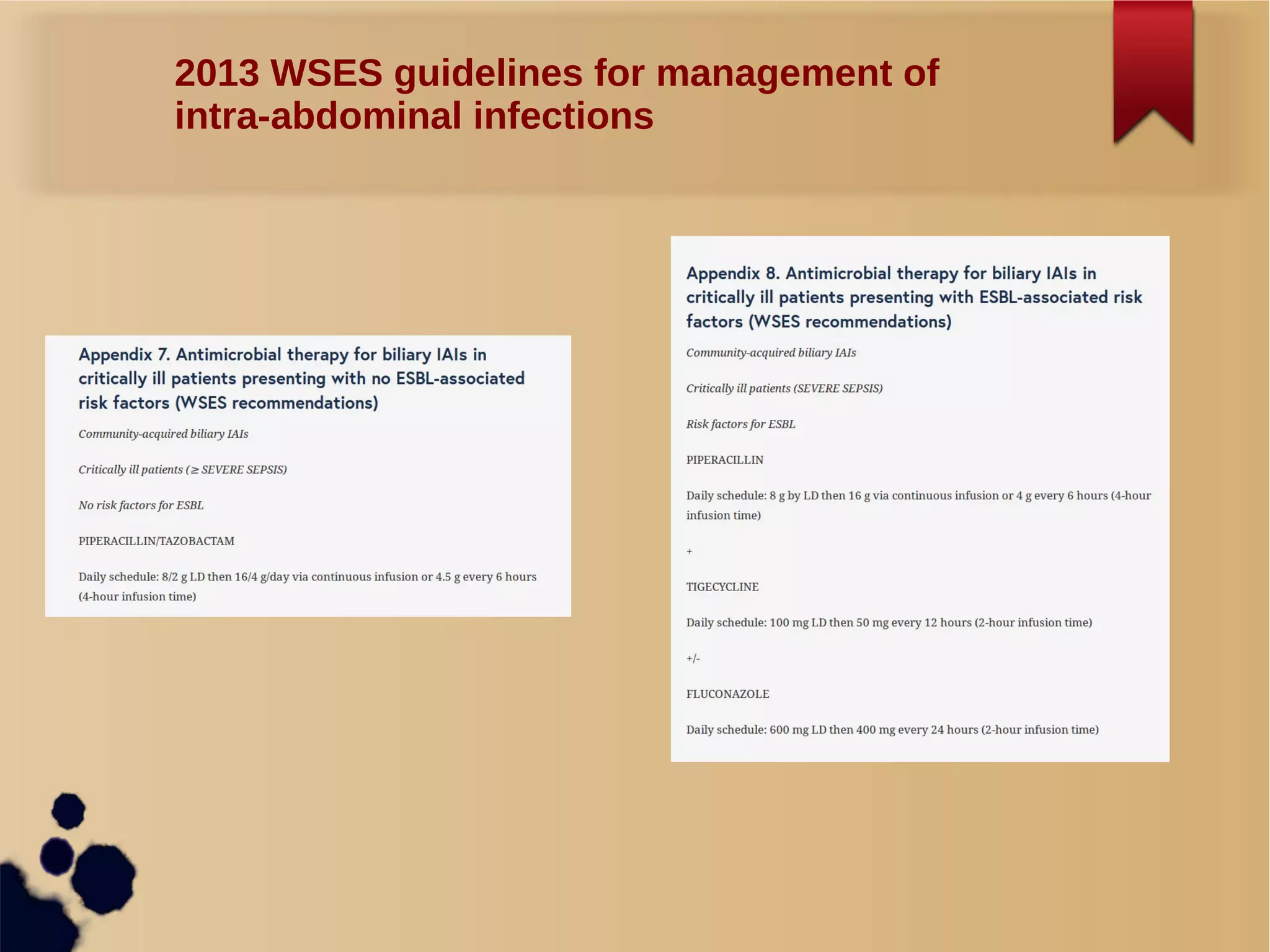
2013 WSES guidelines for management of
intra-abdominal infections
2013 WSES guidelines for management of
intra-abdominal infections
2013 WSES guidelines for management of
intra-abdominal infections
2013 WSES guidelines for management of
intra-abdominal infections
2013 WSES guidelines for management of
intra-abdominal infections
2013 WSES guidelines for management of
intra-abdominal infections
OR
Complicated intra abdominal infection

Complicated intra abdominal infection

  • 1.
  • 2.
    A 50-year-old manpresents to hospital with fever and an acute abdomen. He undergoes an emergency laparotomy, the findings of which include perforated carcinoma in the splenic flexure and generalized faecal soiling of the peritoneum. He undergoes a left hemicolectomy with a defunctioning colostomy. Post-operatively he is transferred to the intensive care unit because of septic shock. What antibiotic regimen will you consider and why?
  • 3.
    Triple therapy orTimentin or Tazocin – cover enterococcus, gram negatives and anaerobes. May consider adding empiric fluconazole Vancomycin, gentamicin, metronidazole if penicillin allergic Despite a five-day course of antibiotics he remains unwell with fever up to 38.50C, WCC 16.7 x 10⁹ /l. He is unable to tolerate oral feeds and is on TPN.
  • 4.
    Literature support forsingle antibiotic vs combination therapy in surgical patients
  • 5.
    Literature support forsingle antibiotic vs combination therapy in surgical patients
  • 6.
    List the likelyabdominal causes of persistent fever and leukocytosis? Intra-abdominal collection Wound infection Acalculous cholecystitis Pancreatitis Stomal necrosis Blood cultures show Candida glabrata in one of the three bottles.
  • 7.
    Predisposing factors forthis infection in this patient. Malignancy Abdominal soiling (repeated abdominal surgery) TPN Recent broad spectrum antibiotic therapy Indwelling CVC Exposure to fluconazole Diabetes Renal failure
  • 8.
    Literature support forrisk factors for fungal infection
  • 9.
    What antibiotic therapywill you commence whilst waiting for sensitivities and why? Voriconazole or amphotericin B or caspofungin Candida glabrata may not be sensitive to fluconazole
  • 10.
    Based on theculture report, give one other investigation, the results of which might influence the prognosis and duration of antifungal treatment, and the rationale for your choice. Echocardiography – vegetations CT / USS abdomen – liver abscess Ophthalmic examination – retinal abscesses
  • 11.
    2013 WSES guidelinesfor management of intra-abdominal infections
  • 12.
    2013 WSES guidelinesfor management of intra-abdominal infections
  • 13.
    2013 WSES guidelinesfor management of intra-abdominal infections
  • 14.
    2013 WSES guidelinesfor management of intra-abdominal infections
  • 15.
    2013 WSES guidelinesfor management of intra-abdominal infections
  • 16.
    2013 WSES guidelinesfor management of intra-abdominal infections
  • 17.