Parenteral Nutrition
Parenteral nutrition is defined as the infusion of complete nutrient solutions into the bloodstream via a peripheral vein or, more commonly, by central venous access to meet nutritional needsDefinition
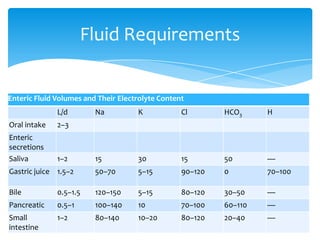
Fluid Requirements
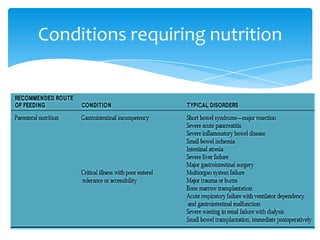
Conditions requiring nutrition
Central access—TPN both long- and short-term placementPeripheral or PPN—New catheters allow longer support via this method limited to 800 to 900 mOsm/kg due to thrombophlebitis	<2000 kcal required or <10 daysRoutes of Parenteral Nutrition
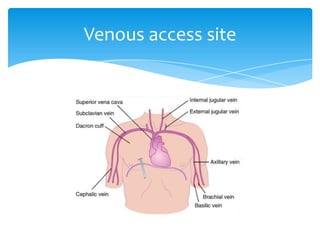
Venous access site
Utilization of peripheral veins for the administration of nutrientsA. Indications for use: PN necessary but no access to central vein2. Malnourished patients with frequent NPO for procedures/tests Peripheral Parenteral Nutrition (PPN)
B. Contraindications:Patient can be fed enterallyPt. has weak peripheral veinsC. LimitationsPeripheral site more prone to inflammation/infectionCatheter may need to be repeatedly inserted Poor choice for long-term nutritionPeripheral Parenteral Nutrition (PPN)
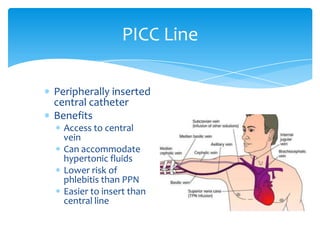
Peripherally inserted central catheterBenefitsAccess to central veinCan accommodate hypertonic fluidsLower risk of phlebitis than PPNEasier to insert than central linePICC Line
Provides nutrients when less than 2 to 3 feet of small intestine remainsAllows nutrition support when GI intolerance prevents oral or enteral supportAdvantages- Parenteral Nutrition
CostlyLong term risk of liver dysfunction, kidney and bone disease, and nutrient deficienciesDisadvantages
GI non functioningNBM >5 daysGI fistulaAcute pancreatitisShort bowel syndromeMalnutrition with >10% to 15 % weight lossNutritional needs not met; patient refuses foodIndications for Total Parenteral Nutrition
Working GI tractTerminally illOnly needed briefly (<14 days)Contraindications
Avoid excess kcal (> 40 kcal/kg) Adults	kcal/kg BW	Obese—use desired BMI range or an adjusted factorCalculating Nutrient Needs
Carbohydrate	glucose or dextrose monohydrate	3.4 kcal/gAmino acids	3, 3.5, 5, 7, 8.5, 10% solutionsFat	10% emulsions = 1.1 kcal/ml	20% emulsions = 2 kcal/mlParenteral Components
1.2 to 1.5 g protein/kg IBW mild or moderate stress2.5 g protein/kg IBW burns or severe traumaProtein Requirements
Max. 0.36 g/kg BW/hrExcess glucose causes:		Increased minute ventilation		Increased CO2  production		Increased RQ		Increased O2 consumptionLipogenesis and liver problemsCarbohydrate Requirements
4% to 10% kcals given as lipid meets EFA requirements; or 2% to 4% kcals given as lineoleic acidUsual range 25% to 35% max. 60% of kcal or 2.5 g fat/kgLipid Requirements
Fluid—30 to 50 ml/kgElectrolytes		Use acetate or chloride forms			to manage acidosis or alkalosisVitaminsTrace elementsOther Requirements
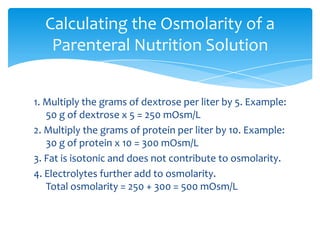
1. Multiply the grams of dextrose per liter by 5. Example: 50 g of dextrose x 5 = 250 mOsm/L2. Multiply the grams of protein per liter by 10. Example: 30 g of protein x 10 = 300 mOsm/L3. Fat is isotonic and does not contribute to osmolarity.4. Electrolytes further add to osmolarity. Total osmolarity = 250 + 300 = 500 mOsm/LCalculating the Osmolarity of a Parenteral Nutrition Solution
Total nutrient admixture of amino acids, glucose, additives3-in-1 solution of lipid, amino acids, glucose, additivesCompounding Methods
Intralipid(separately by  syringe pump via a 3-way   connector)Aminoven+5% Dextrose50% Dextrose +MVI +Heparin (0.5 - 1unit/ml)+Add. electrolytes, as reqdCompounds
Start slowly(1 L 1st day; 2 L 2nd day)Stop slowly(reduce rate by half every 1 to 2 hrsor switch to dextrose IV)Cyclic give 12 to 18 hours per dayAdministration
InfectionHemodynamic stabilityCatheter careRefeeding syndromeMonitoring and Complications
HypophosphatemiaHyperglycemiaFluid retentionCardiac arrest	Refeeding Syndrome
Weight(daily)BloodDaily    Electrolytes (Na+, K+, Cl-)    Glucose    Acid-base status3 times/week    BUNCa+, P    Plasma transaminasesMonitor
BloodTwice/week    Ammonia    Mg    Plasma transaminasesWeeklyHgbProthrombin time    Zn    Cu    TriglyceridesMonitor—cont’d
Urine:Glucose and ketones (4-6/day)Specific gravity or osmolarity (2-4/day)Urinary urea nitrogen (weekly)Other:Volume infusate (daily)Oral intake (daily) if applicableUrinary output (daily)Activity, temperature, respiration (daily)WBC and differential (as needed)Cultures (as needed)Monitor—cont’d
PPNSite irritationTPN1. Catheter sepsis2. Placement problems3. MetabolicProblems
Type of feeding formula and tubeMethod (bolus, drip, pump)Rate and water flushIntake energy and proteinTolerance, complications, and corrective actions Patient educationDocument in Chart
Thankyou

Parentral nutrition

  • 1.
  • 2.
    Parenteral nutrition isdefined as the infusion of complete nutrient solutions into the bloodstream via a peripheral vein or, more commonly, by central venous access to meet nutritional needsDefinition
  • 3.
  • 4.
  • 5.
    Central access—TPN bothlong- and short-term placementPeripheral or PPN—New catheters allow longer support via this method limited to 800 to 900 mOsm/kg due to thrombophlebitis <2000 kcal required or <10 daysRoutes of Parenteral Nutrition
  • 6.
  • 7.
    Utilization of peripheralveins for the administration of nutrientsA. Indications for use: PN necessary but no access to central vein2. Malnourished patients with frequent NPO for procedures/tests Peripheral Parenteral Nutrition (PPN)
  • 8.
    B. Contraindications:Patient canbe fed enterallyPt. has weak peripheral veinsC. LimitationsPeripheral site more prone to inflammation/infectionCatheter may need to be repeatedly inserted Poor choice for long-term nutritionPeripheral Parenteral Nutrition (PPN)
  • 9.
    Peripherally inserted centralcatheterBenefitsAccess to central veinCan accommodate hypertonic fluidsLower risk of phlebitis than PPNEasier to insert than central linePICC Line
  • 10.
    Provides nutrients whenless than 2 to 3 feet of small intestine remainsAllows nutrition support when GI intolerance prevents oral or enteral supportAdvantages- Parenteral Nutrition
  • 11.
    CostlyLong term riskof liver dysfunction, kidney and bone disease, and nutrient deficienciesDisadvantages
  • 12.
    GI non functioningNBM>5 daysGI fistulaAcute pancreatitisShort bowel syndromeMalnutrition with >10% to 15 % weight lossNutritional needs not met; patient refuses foodIndications for Total Parenteral Nutrition
  • 13.
    Working GI tractTerminallyillOnly needed briefly (<14 days)Contraindications
  • 14.
    Avoid excess kcal(> 40 kcal/kg) Adults kcal/kg BW Obese—use desired BMI range or an adjusted factorCalculating Nutrient Needs
  • 15.
    Carbohydrate glucose or dextrosemonohydrate 3.4 kcal/gAmino acids 3, 3.5, 5, 7, 8.5, 10% solutionsFat 10% emulsions = 1.1 kcal/ml 20% emulsions = 2 kcal/mlParenteral Components
  • 16.
    1.2 to 1.5g protein/kg IBW mild or moderate stress2.5 g protein/kg IBW burns or severe traumaProtein Requirements
  • 17.
    Max. 0.36 g/kgBW/hrExcess glucose causes: Increased minute ventilation Increased CO2 production Increased RQ Increased O2 consumptionLipogenesis and liver problemsCarbohydrate Requirements
  • 18.
    4% to 10%kcals given as lipid meets EFA requirements; or 2% to 4% kcals given as lineoleic acidUsual range 25% to 35% max. 60% of kcal or 2.5 g fat/kgLipid Requirements
  • 19.
    Fluid—30 to 50ml/kgElectrolytes Use acetate or chloride forms to manage acidosis or alkalosisVitaminsTrace elementsOther Requirements
  • 20.
    1. Multiply thegrams of dextrose per liter by 5. Example: 50 g of dextrose x 5 = 250 mOsm/L2. Multiply the grams of protein per liter by 10. Example: 30 g of protein x 10 = 300 mOsm/L3. Fat is isotonic and does not contribute to osmolarity.4. Electrolytes further add to osmolarity. Total osmolarity = 250 + 300 = 500 mOsm/LCalculating the Osmolarity of a Parenteral Nutrition Solution
  • 21.
    Total nutrient admixtureof amino acids, glucose, additives3-in-1 solution of lipid, amino acids, glucose, additivesCompounding Methods
  • 22.
    Intralipid(separately by syringe pump via a 3-way connector)Aminoven+5% Dextrose50% Dextrose +MVI +Heparin (0.5 - 1unit/ml)+Add. electrolytes, as reqdCompounds
  • 23.
    Start slowly(1 L1st day; 2 L 2nd day)Stop slowly(reduce rate by half every 1 to 2 hrsor switch to dextrose IV)Cyclic give 12 to 18 hours per dayAdministration
  • 24.
    InfectionHemodynamic stabilityCatheter careRefeedingsyndromeMonitoring and Complications
  • 25.
  • 26.
    Weight(daily)BloodDaily Electrolytes (Na+, K+, Cl-) Glucose Acid-base status3 times/week BUNCa+, P Plasma transaminasesMonitor
  • 27.
    BloodTwice/week Ammonia Mg Plasma transaminasesWeeklyHgbProthrombin time Zn Cu TriglyceridesMonitor—cont’d
  • 28.
    Urine:Glucose and ketones(4-6/day)Specific gravity or osmolarity (2-4/day)Urinary urea nitrogen (weekly)Other:Volume infusate (daily)Oral intake (daily) if applicableUrinary output (daily)Activity, temperature, respiration (daily)WBC and differential (as needed)Cultures (as needed)Monitor—cont’d
  • 29.
    PPNSite irritationTPN1. Cathetersepsis2. Placement problems3. MetabolicProblems
  • 30.
    Type of feedingformula and tubeMethod (bolus, drip, pump)Rate and water flushIntake energy and proteinTolerance, complications, and corrective actions Patient educationDocument in Chart
  • 31.