







Assessment of fluid responsiveness
Beyond PPV
French
Intensive
Care
Society
Prof. Xavier MONNET
Medical Intensive Care Unit
Paris-Sud University Hospitals
xavier.monnet@bct.aphp.fr
Link of interest
Member of the Medical Advisory Board
of Pulsion Medical Systems
PPV cannot be used in patients with spontaneous breathing, cardiac
arrhythmias and ARDS with low Vt and/or low lung compliance
1
2
3
4
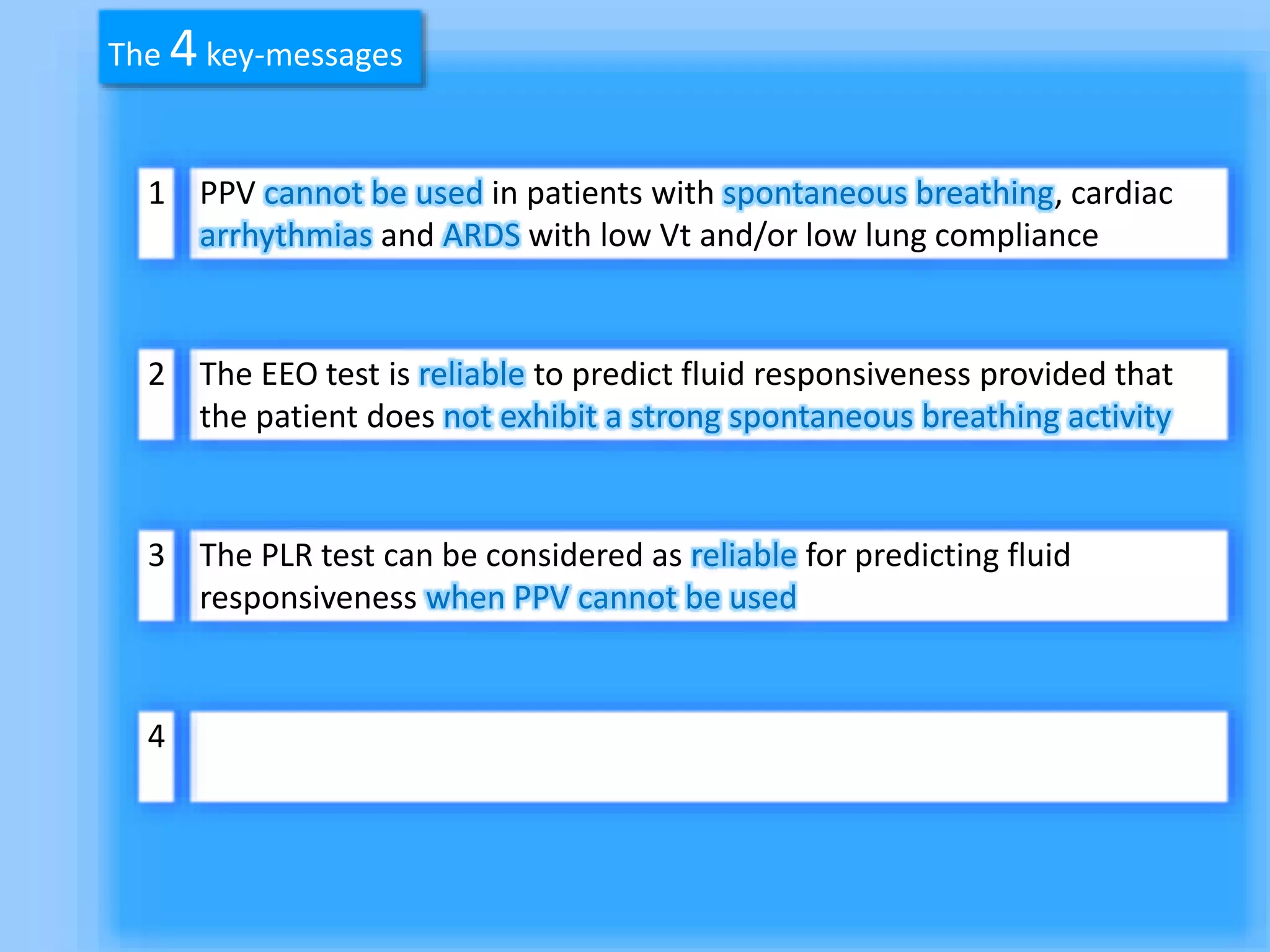
The 4key-messages
PPV, SVV EEO test
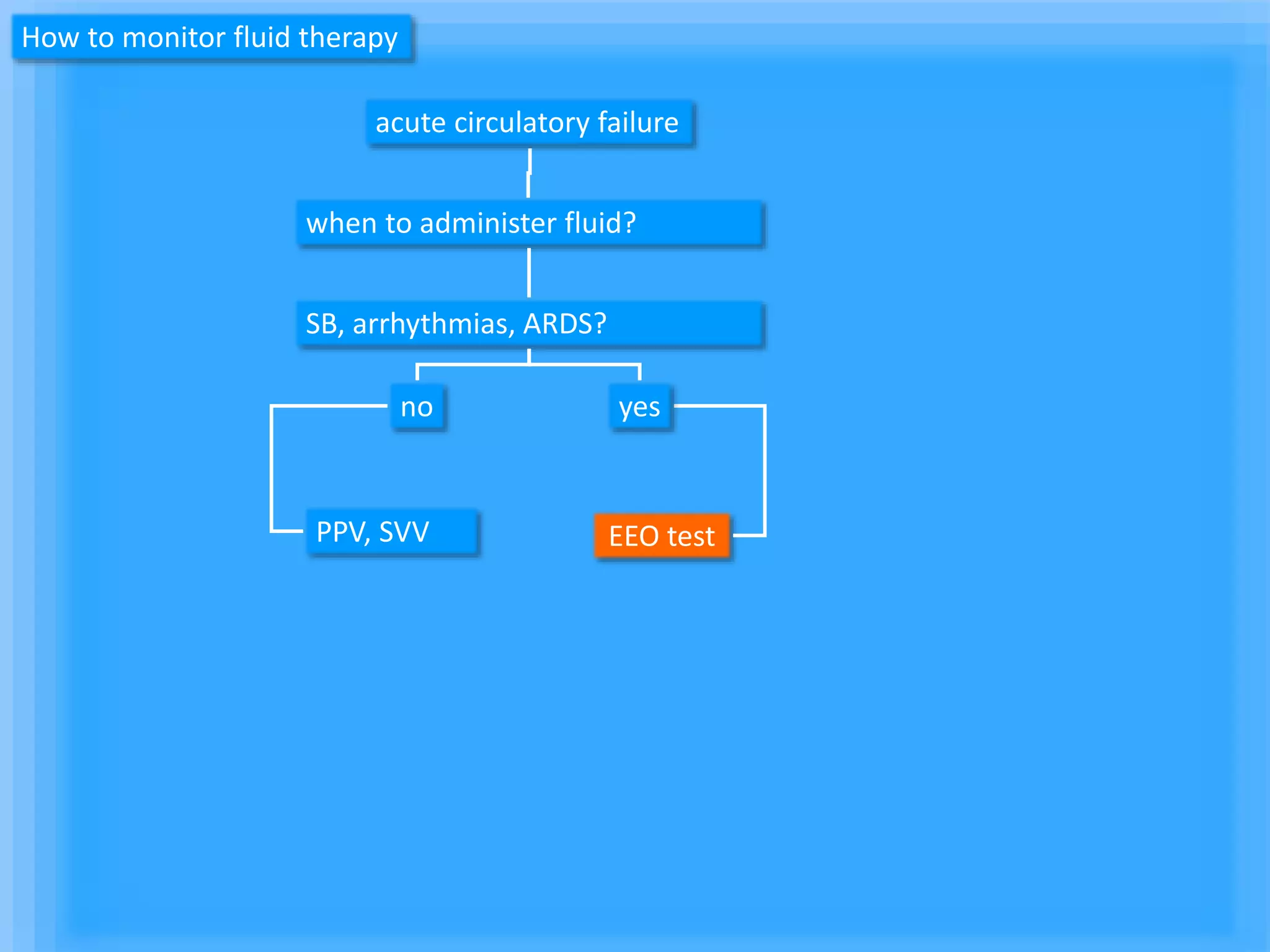
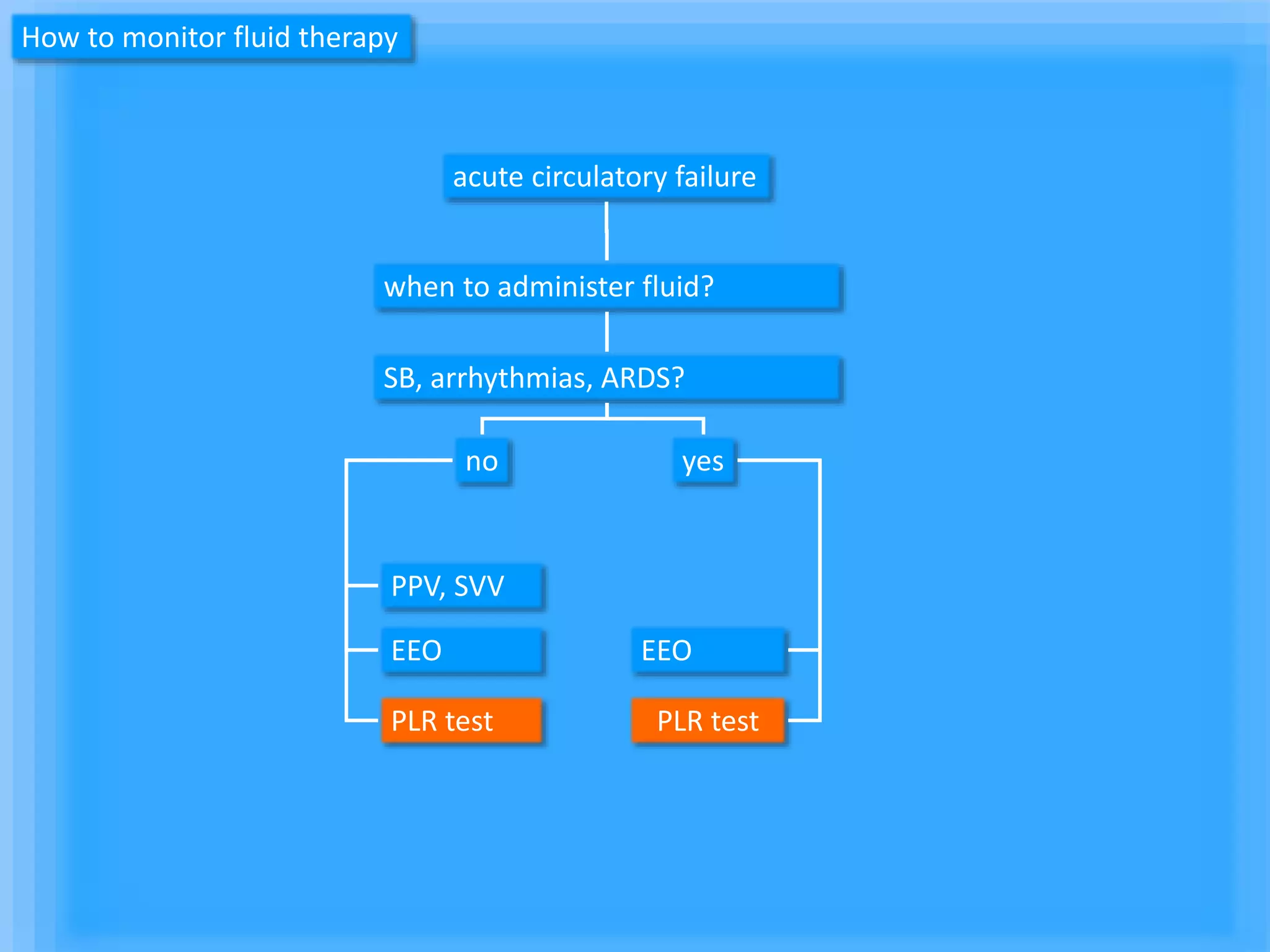
acute circulatory failure
when to administer fluid?
SB, arrhythmias, ARDS?
yesno
How to monitor fluid therapy
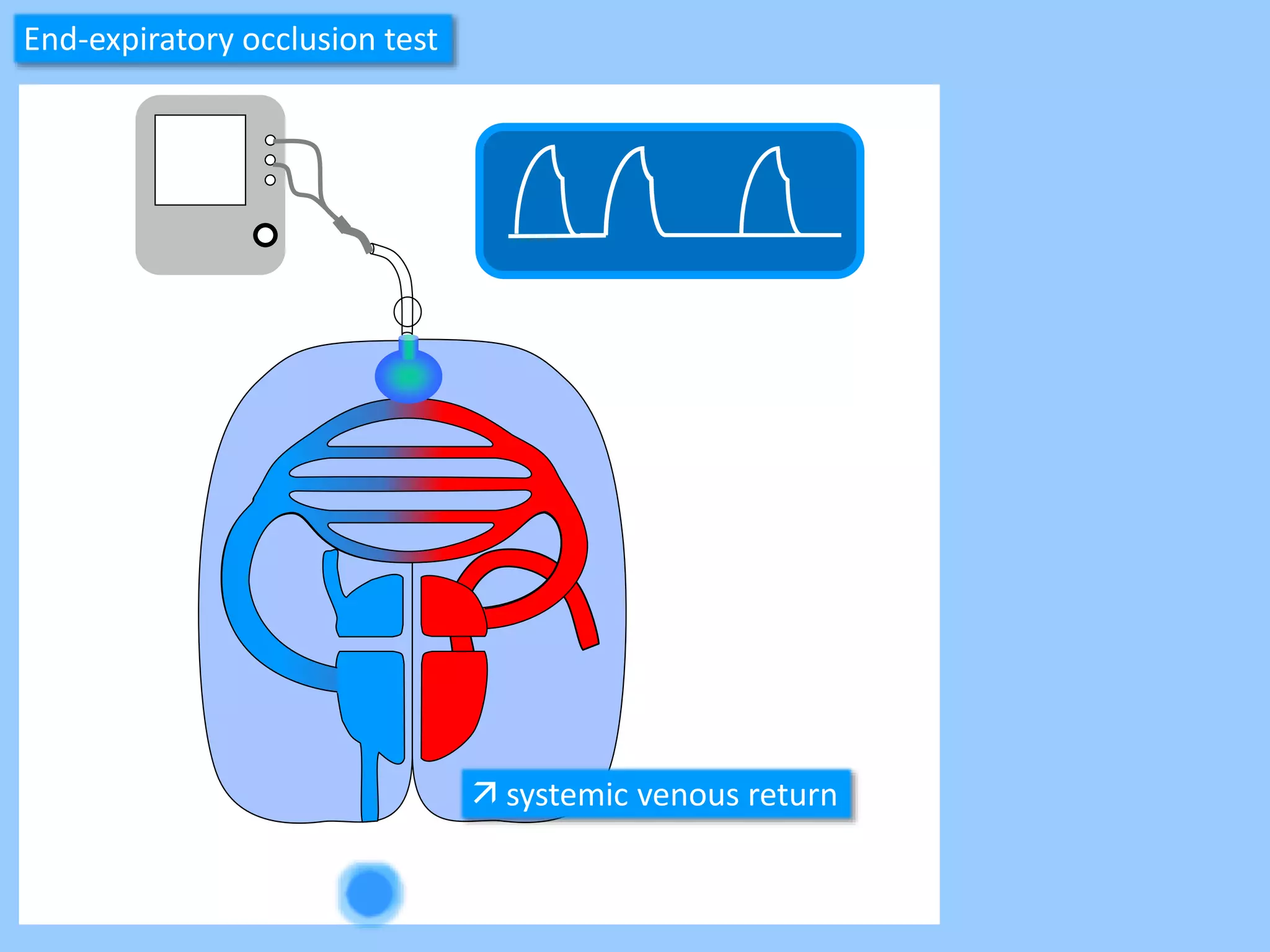
 systemic venous return
End-expiratory occlusion test
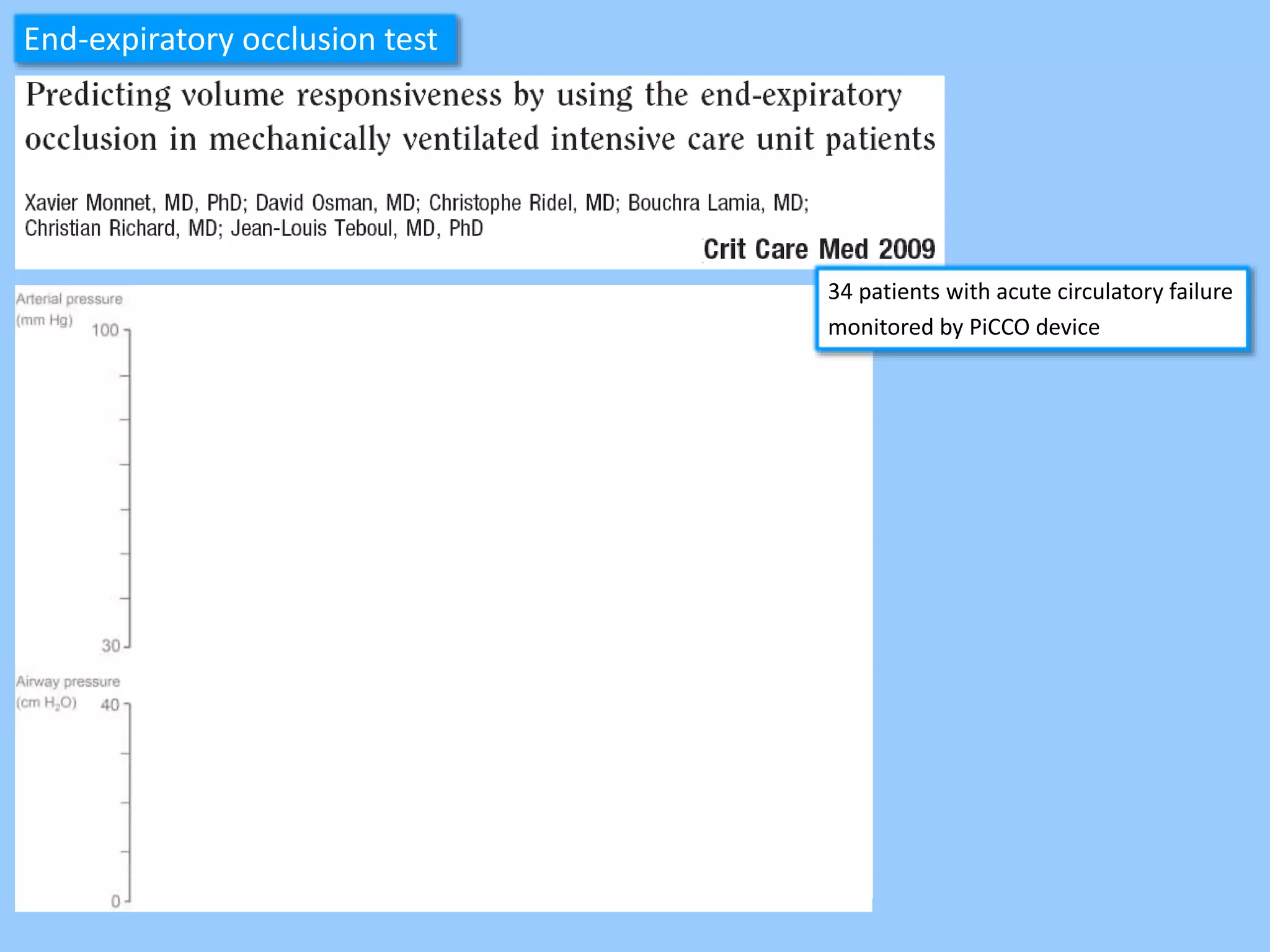
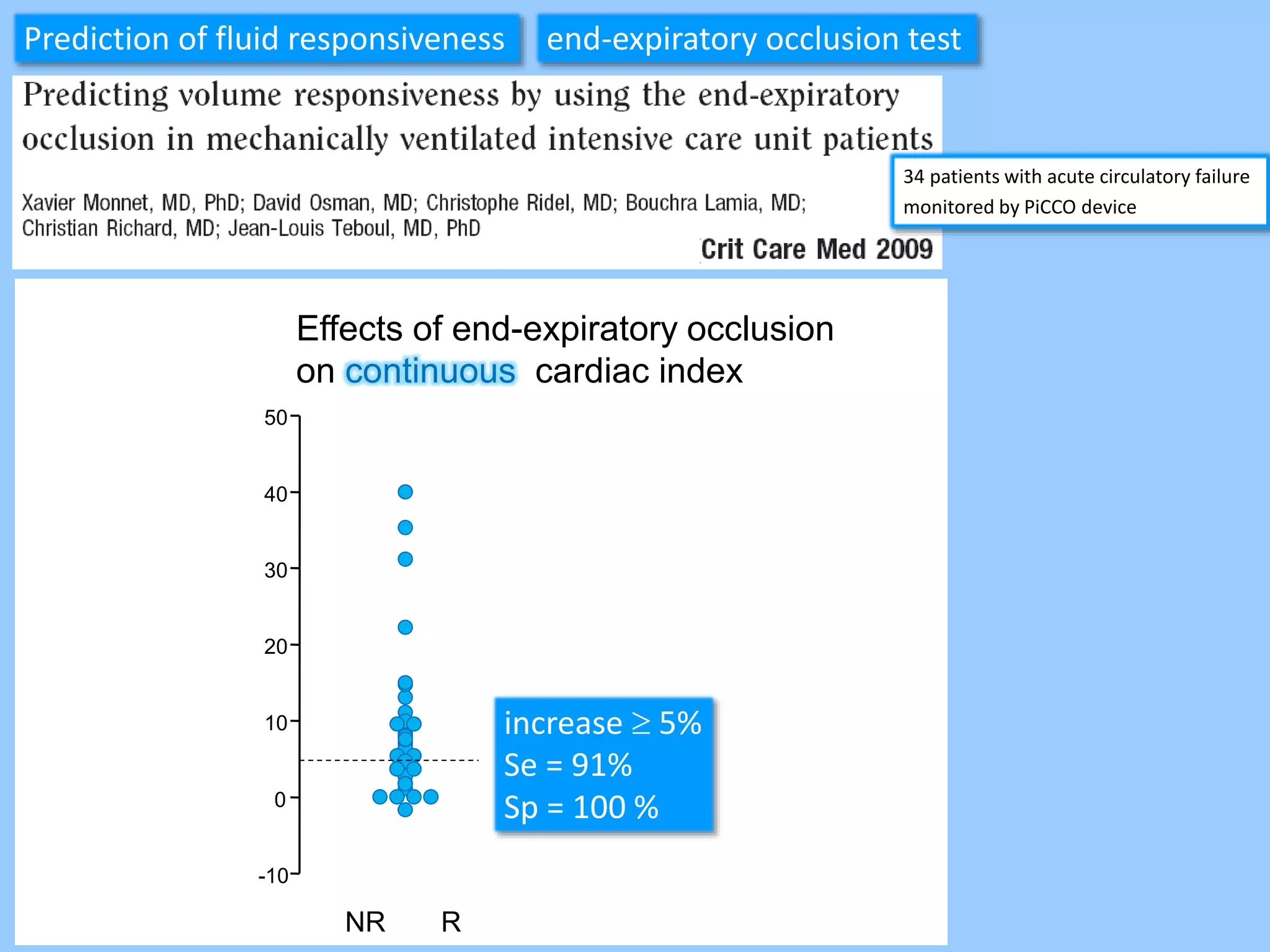
34 patients with acute circulatory failure
monitored by PiCCO device
End-expiratory occlusion test
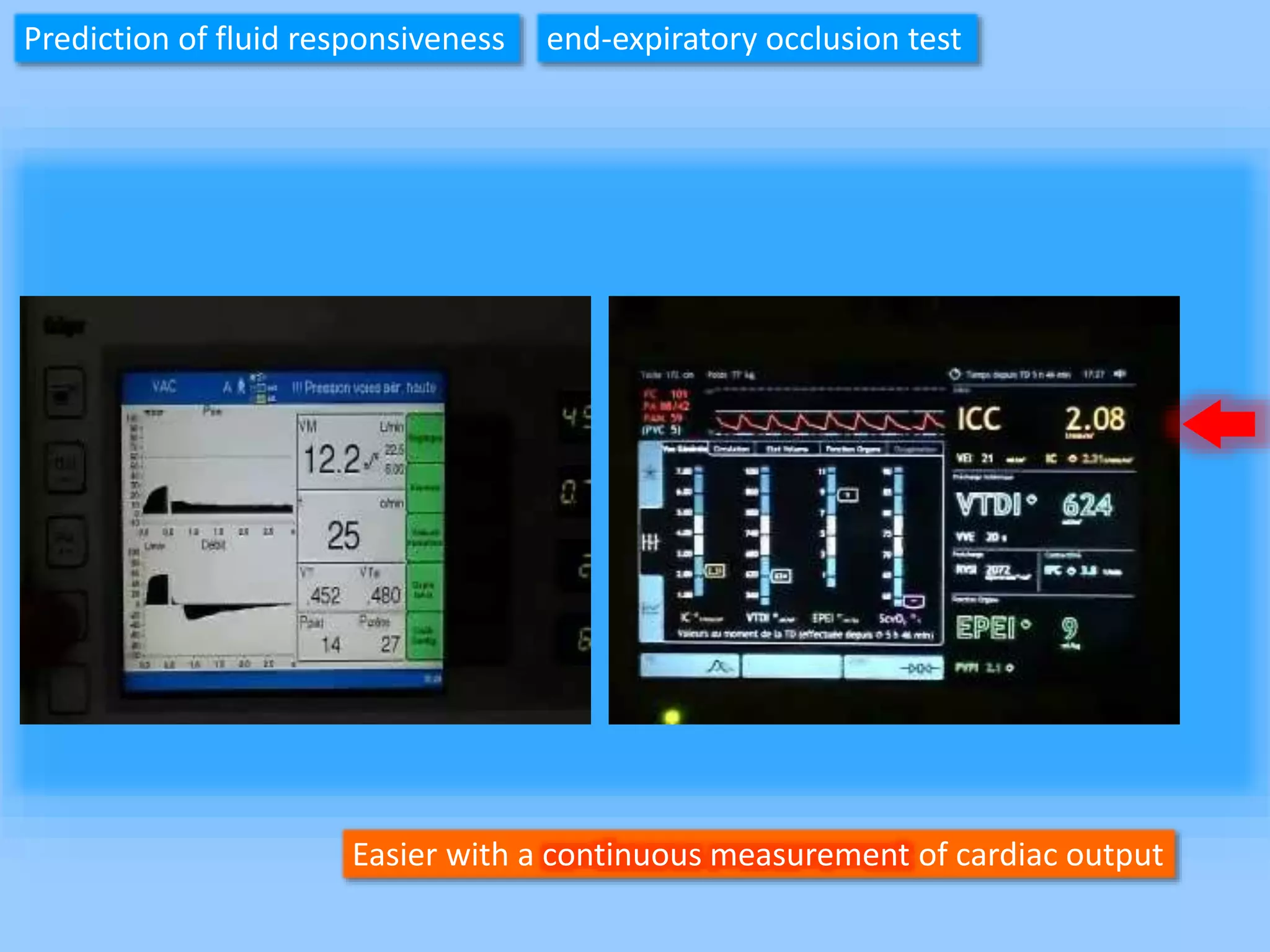
Easier with a continuous measurement of cardiac output
Prediction of fluid responsiveness end-expiratory occlusion test
-10
0
10
20
30
40
50
Effects of end-expiratory occlusion
on continuous cardiac index
increase  5%
Se = 91%
Sp = 100 %
34 patients with acute circulatory failure
monitored by PiCCO device
NR R
Prediction of fluid responsiveness end-expiratory occlusion test
EEO test
PEEP level?
limitations
0 20 40 60 80 100
0
20
40
60
80
100
100-Specificity
Sensitivity
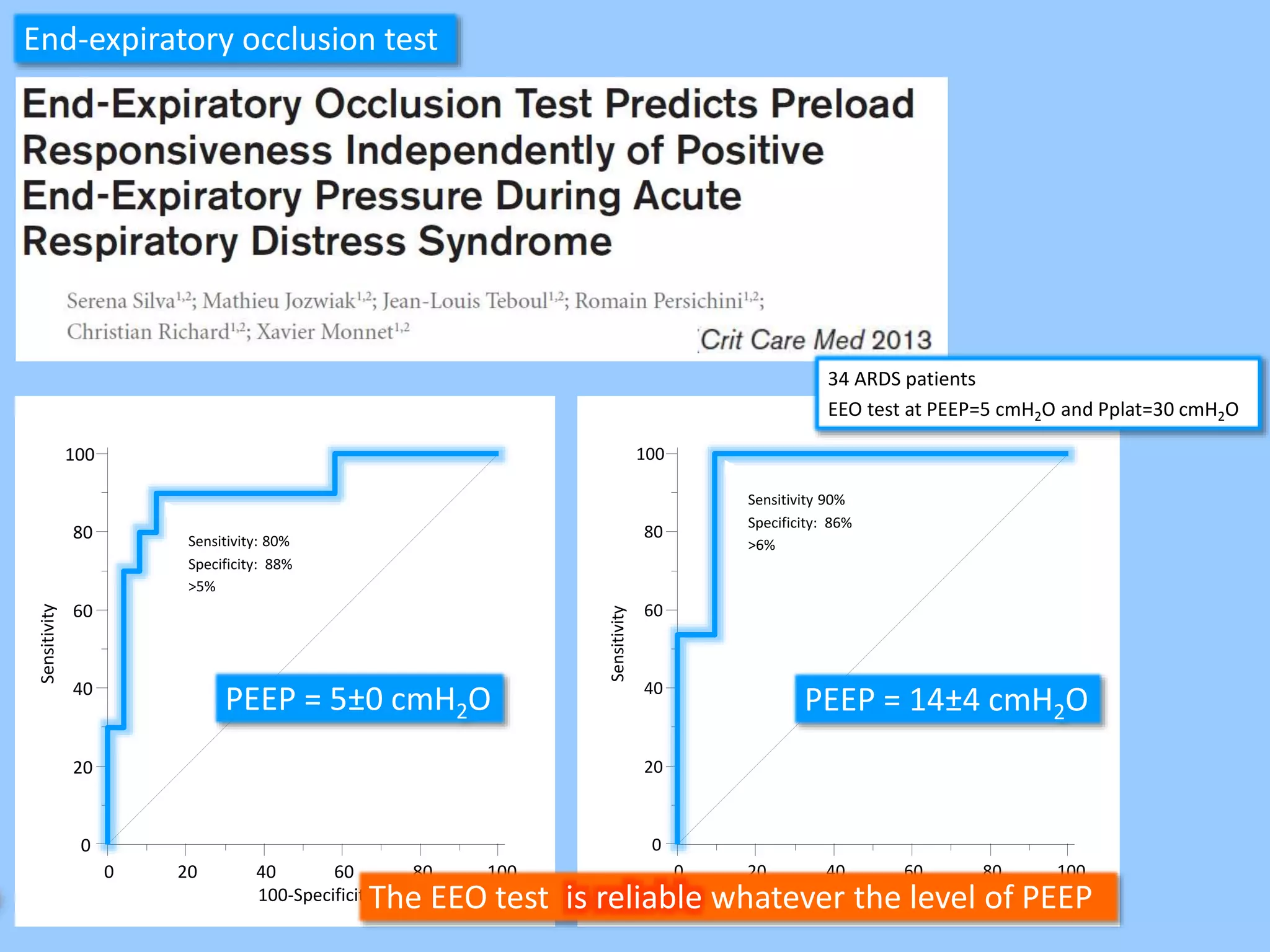
Sensitivity 90%
Specificity: 86%
>6%
PEEP = 14±4 cmH2O
0 20 40 60 80 100
0
20
40
60
80
100
100-Specificity
Sensitivity
Sensitivity: 80%
Specificity: 88%
>5%
PEEP = 5±0 cmH2O
End-expiratory occlusion test
The EEO test is reliable whatever the level of PEEP
34 ARDS patients
EEO test at PEEP=5 cmH2O and Pplat=30 cmH2O
EEO test
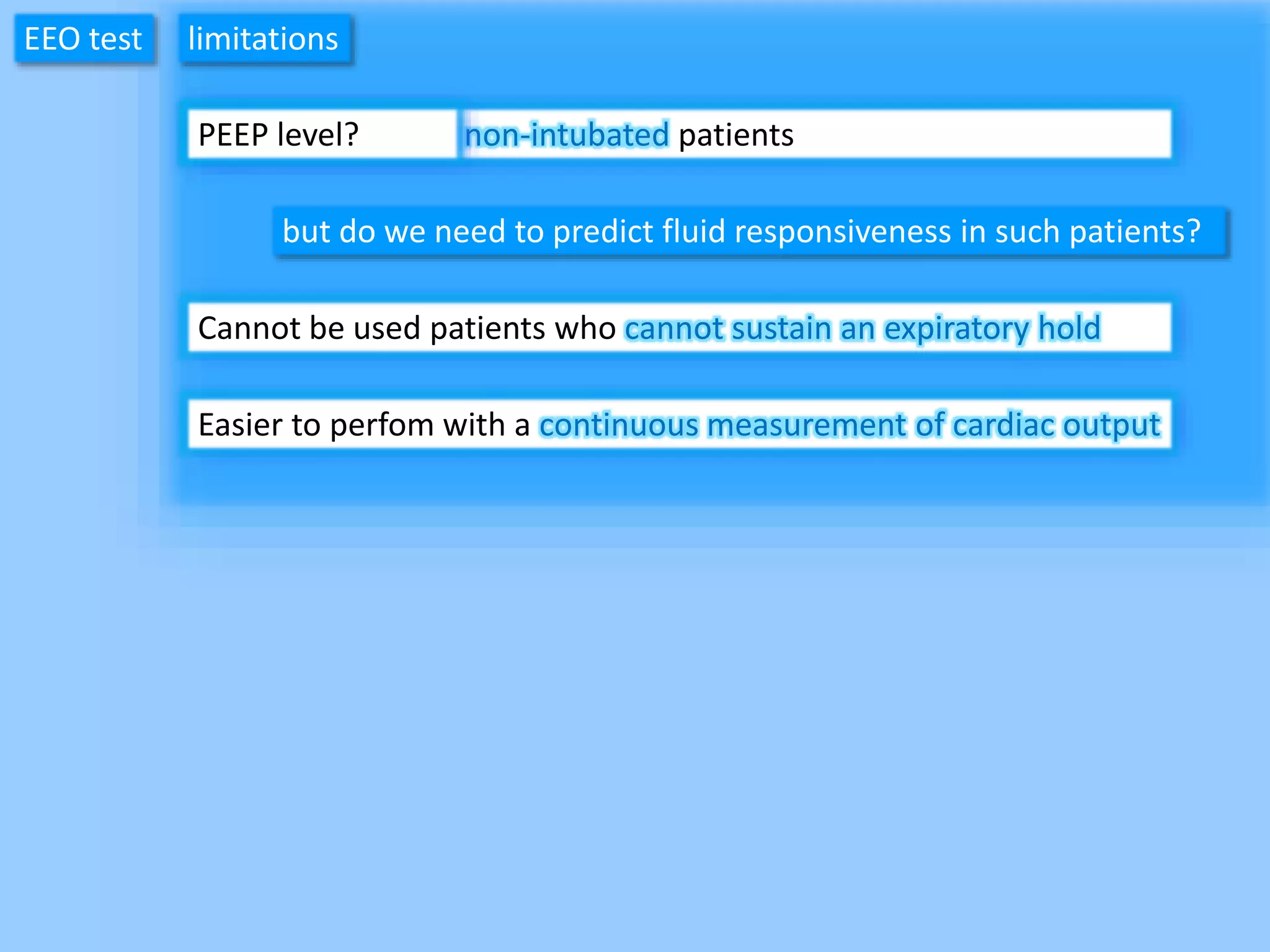
Cannot be used in non-intubated patients
but do we need to predict fluid responsiveness in such patients?
limitations
Cannot be used patients who cannot sustain an expiratory hold
Easier to perfom with a continuous measurement of cardiac output
PEEP level?
PPV cannot be used in patients with spontaneous breathing, cardiac
arrhythmias and ARDS with low Vt and/or low lung compliance
The EEO test is reliable to predict fluid responsiveness provided that
the patient does not exhibit a strong spontaneous breathing activity
1
2
3
4
The 4key-messages
PPV, SVV
EEO
acute circulatory failure
when to administer fluid?
SB, arrhythmias, ARDS?
yesno
EEO
PLR testPLR test
How to monitor fluid therapy
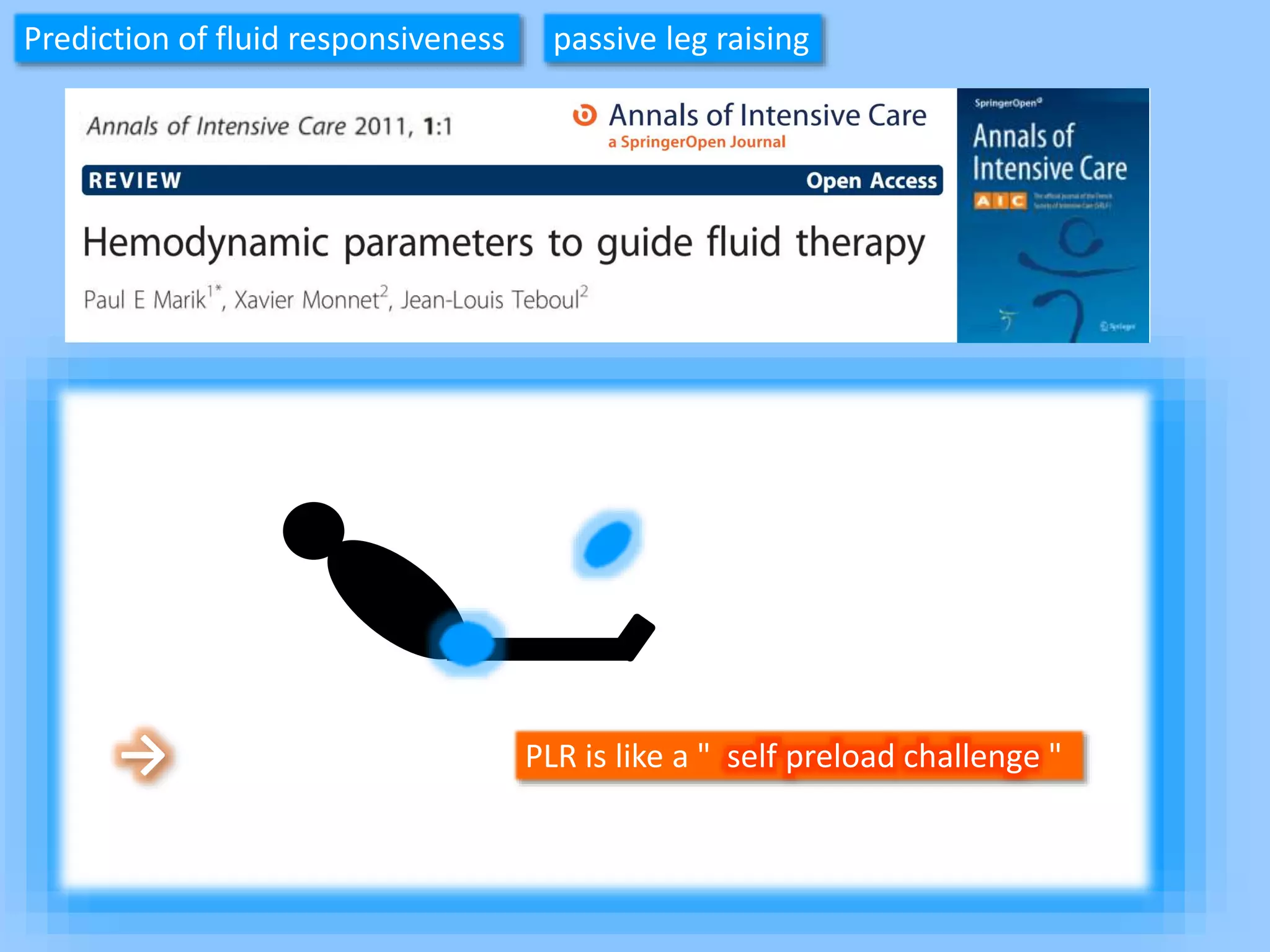
→ PLR is like a " self preload challenge "
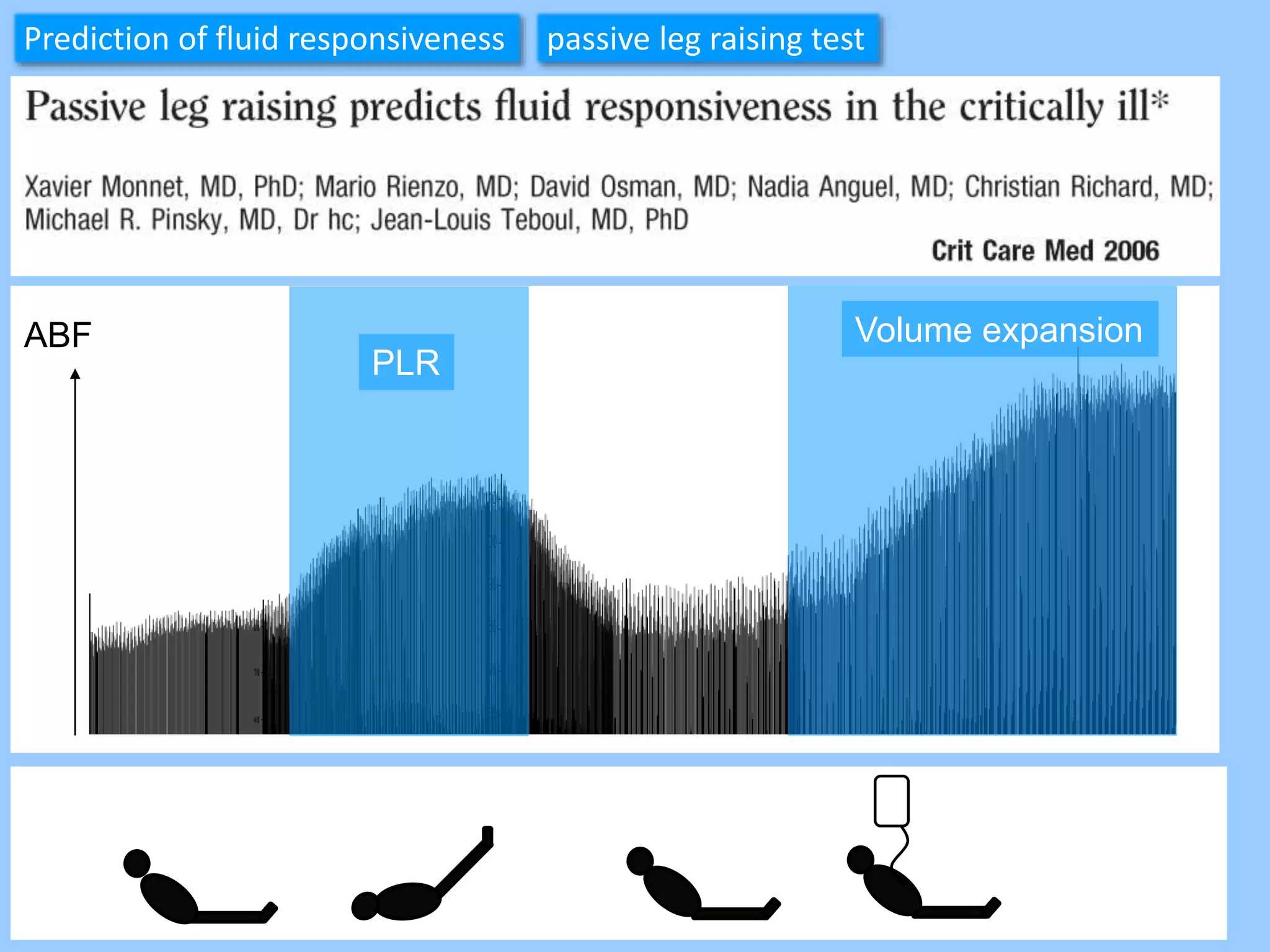
Prediction of fluid responsiveness passive leg raising
ABF
PLR
Volume expansion
Prediction of fluid responsiveness passive leg raising test
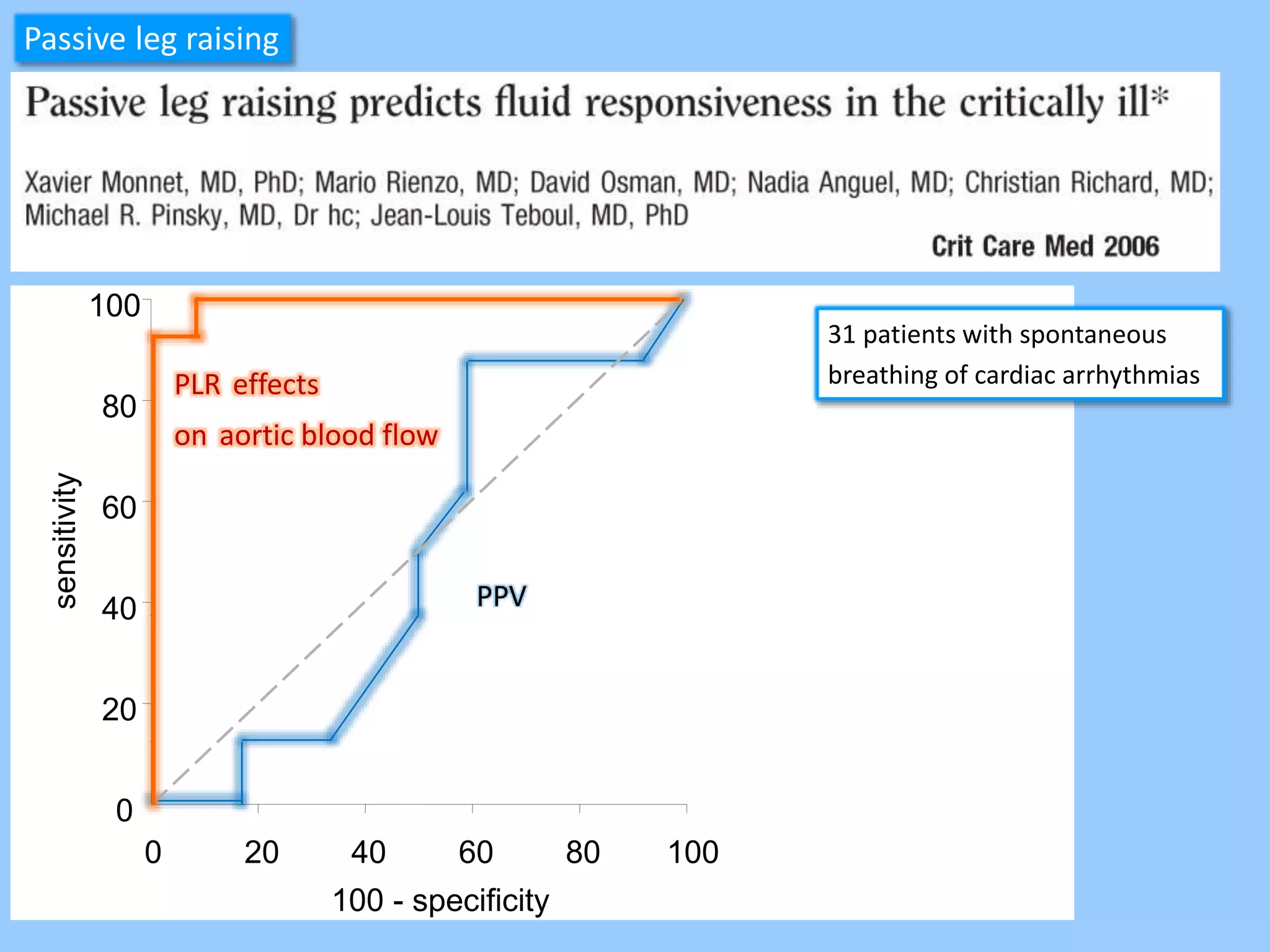
PPV
0
20
40
60
80
100
0 20 40 60 80 100
100 - specificity
sensitivity
PLR effects
on aortic blood flow
31 patients with spontaneous
breathing of cardiac arrhythmias
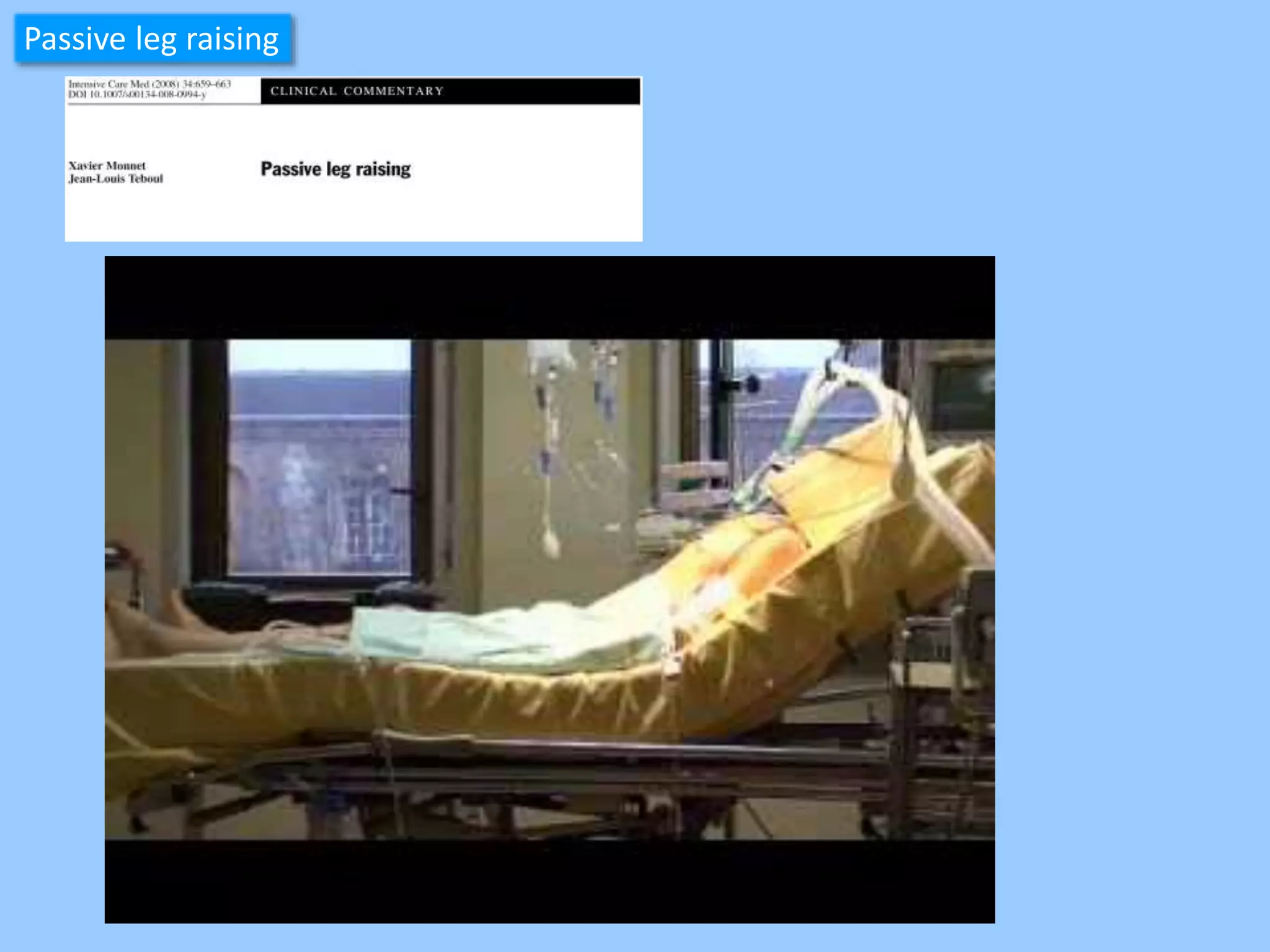
Passive leg raising
Passive leg raising
PPV cannot be used in patients with spontaneous breathing, cardiac
arrhythmias and ARDS with low Vt and/or low lung compliance
The EEO test is reliable to predict fluid responsiveness provided that
the patient does not exhibit a strong spontaneous breathing activity
The PLR test can be considered as reliable for predicting fluid
responsiveness when PPV cannot be used
1
2
3
4
The 4key-messages
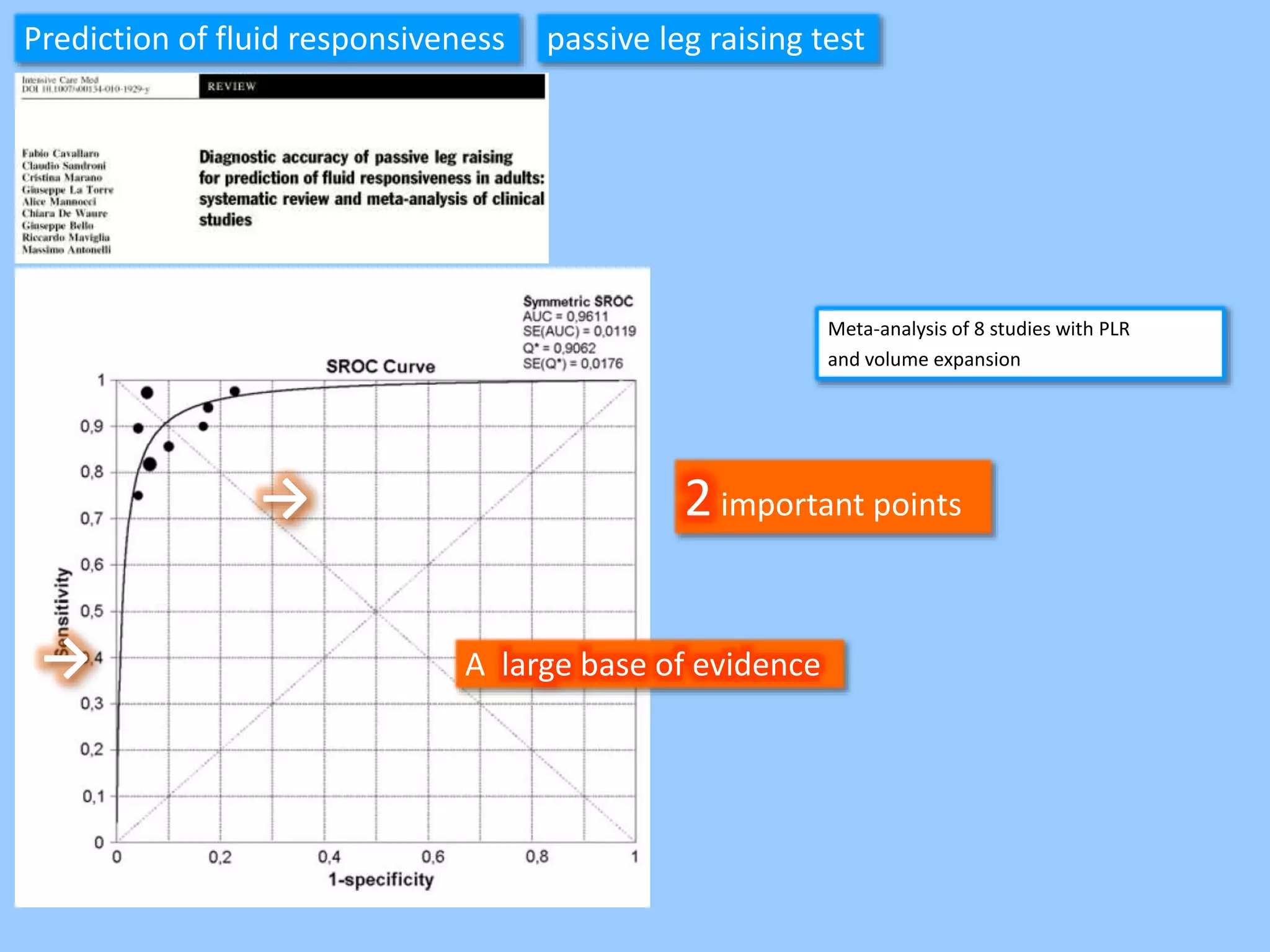
Meta-analysis of 8 studies with PLR
and volume expansion
A large base of evidence→
Prediction of fluid responsiveness passive leg raising test
2important points→
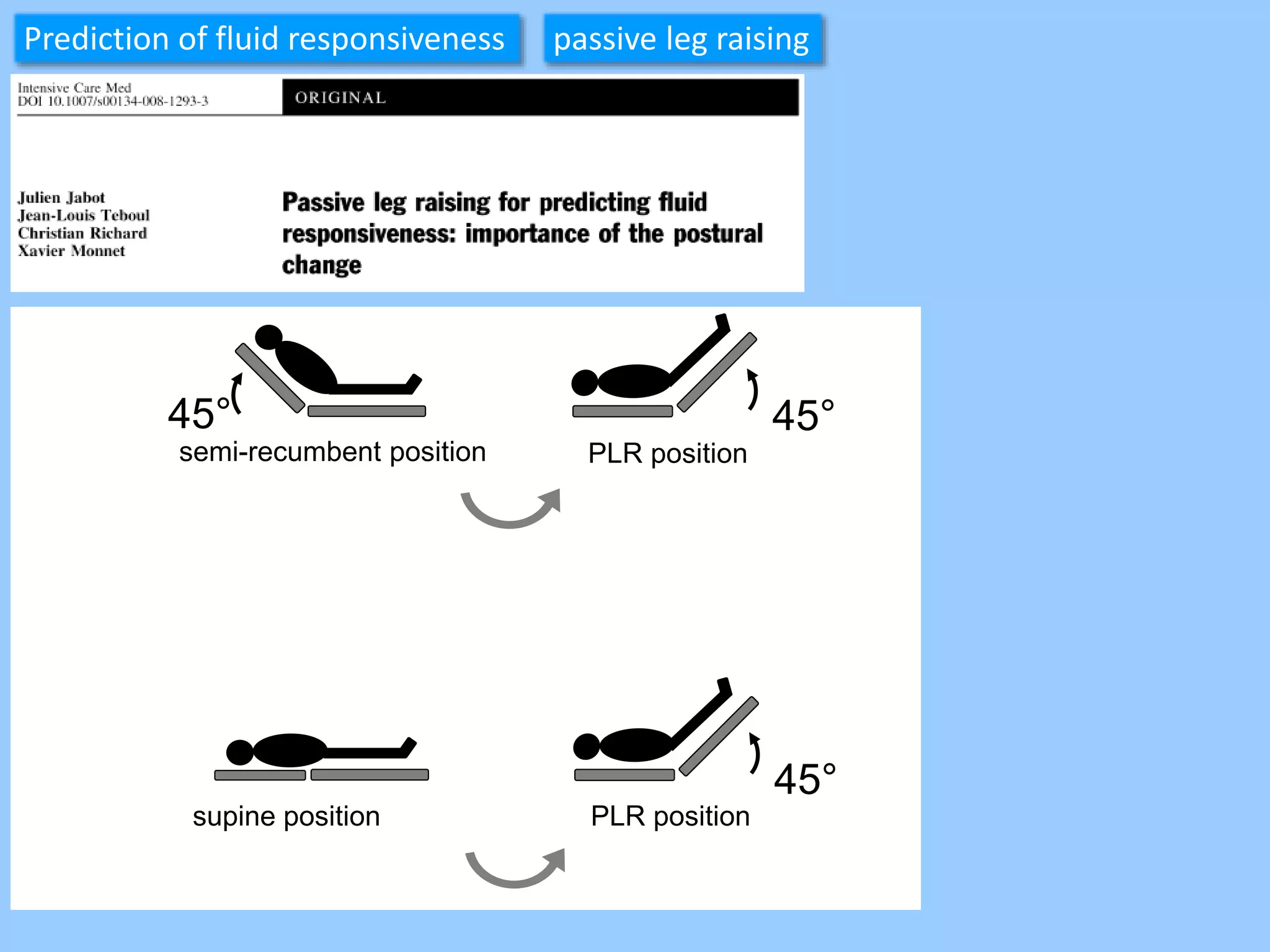
semi-recumbent position PLR position
45° 45°
45°
PLR positionsupine position
Prediction of fluid responsiveness passive leg raising
0
25
12.5
37.5
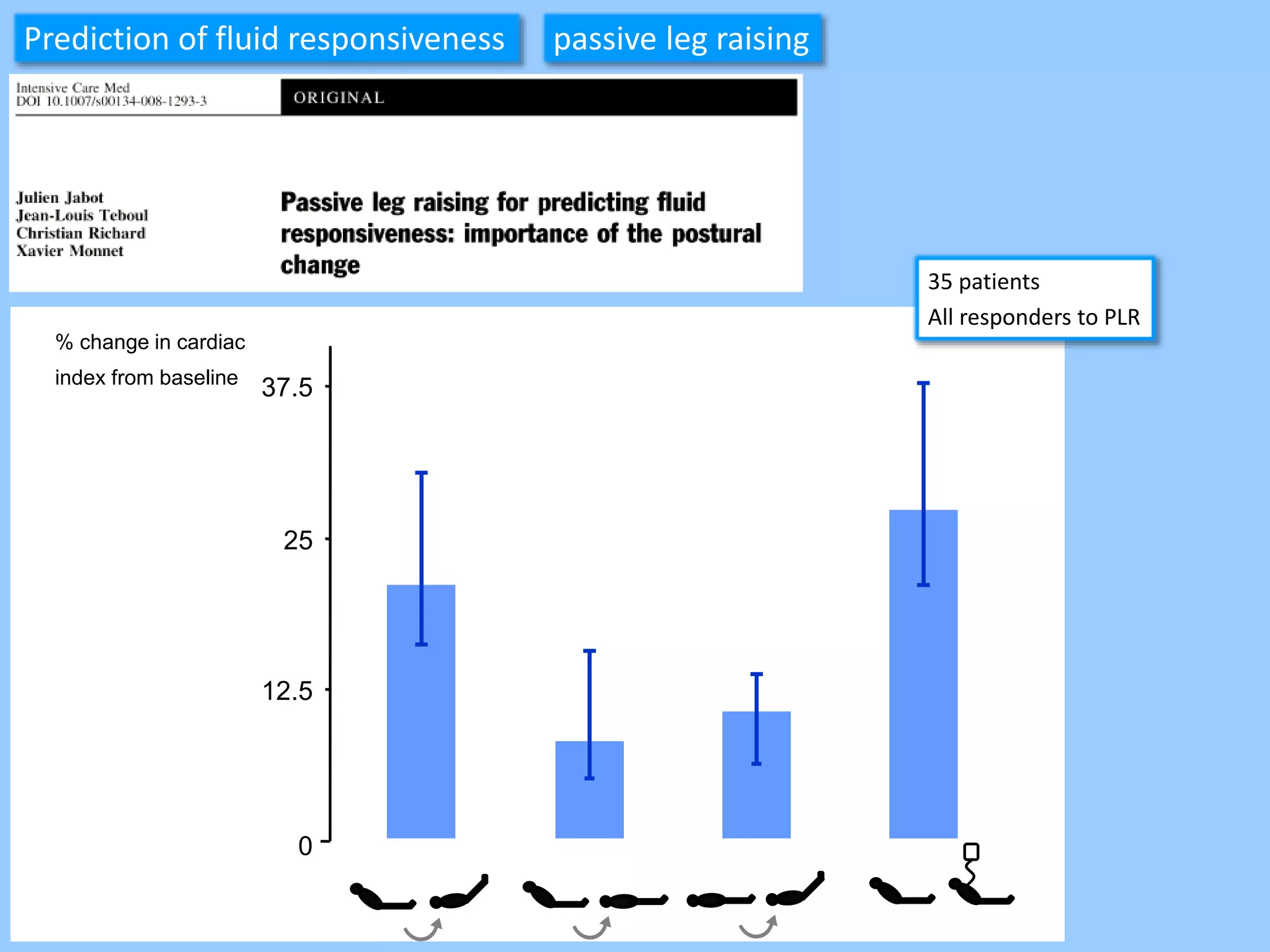
% change in cardiac
index from baseline
35 patients
All responders to PLR
Prediction of fluid responsiveness passive leg raising
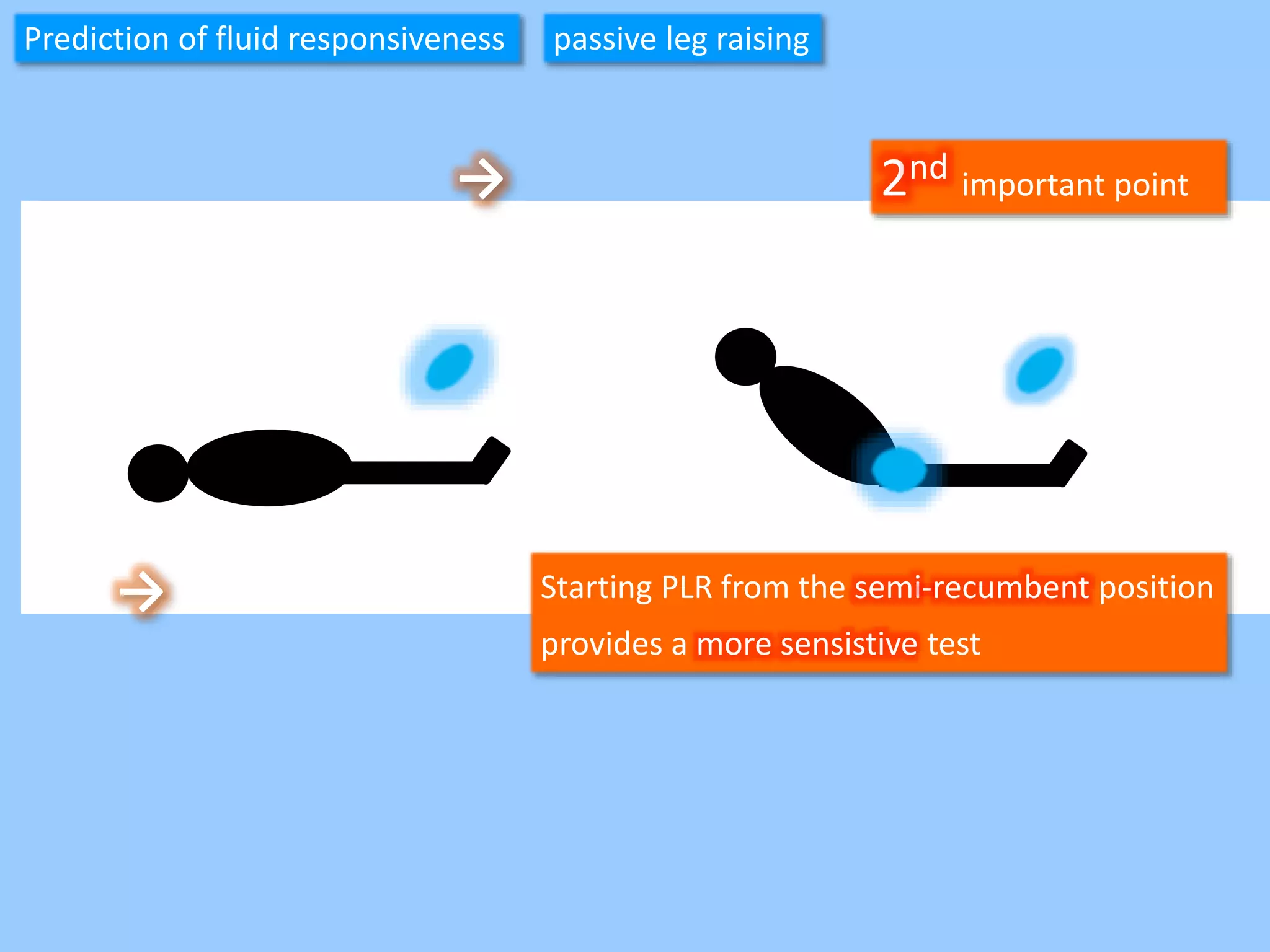
Starting PLR from the semi-recumbent position
provides a more sensistive test
→
2nd important point→
Eso Doppler
echo
echo
echo and arterial flow
Flotrac/vigileo USCOM
PiCCO
Eso Doppler
PiCCO
echo
bioreactance
Passive leg raising
echo
-40
-20
0
20
40
60
80
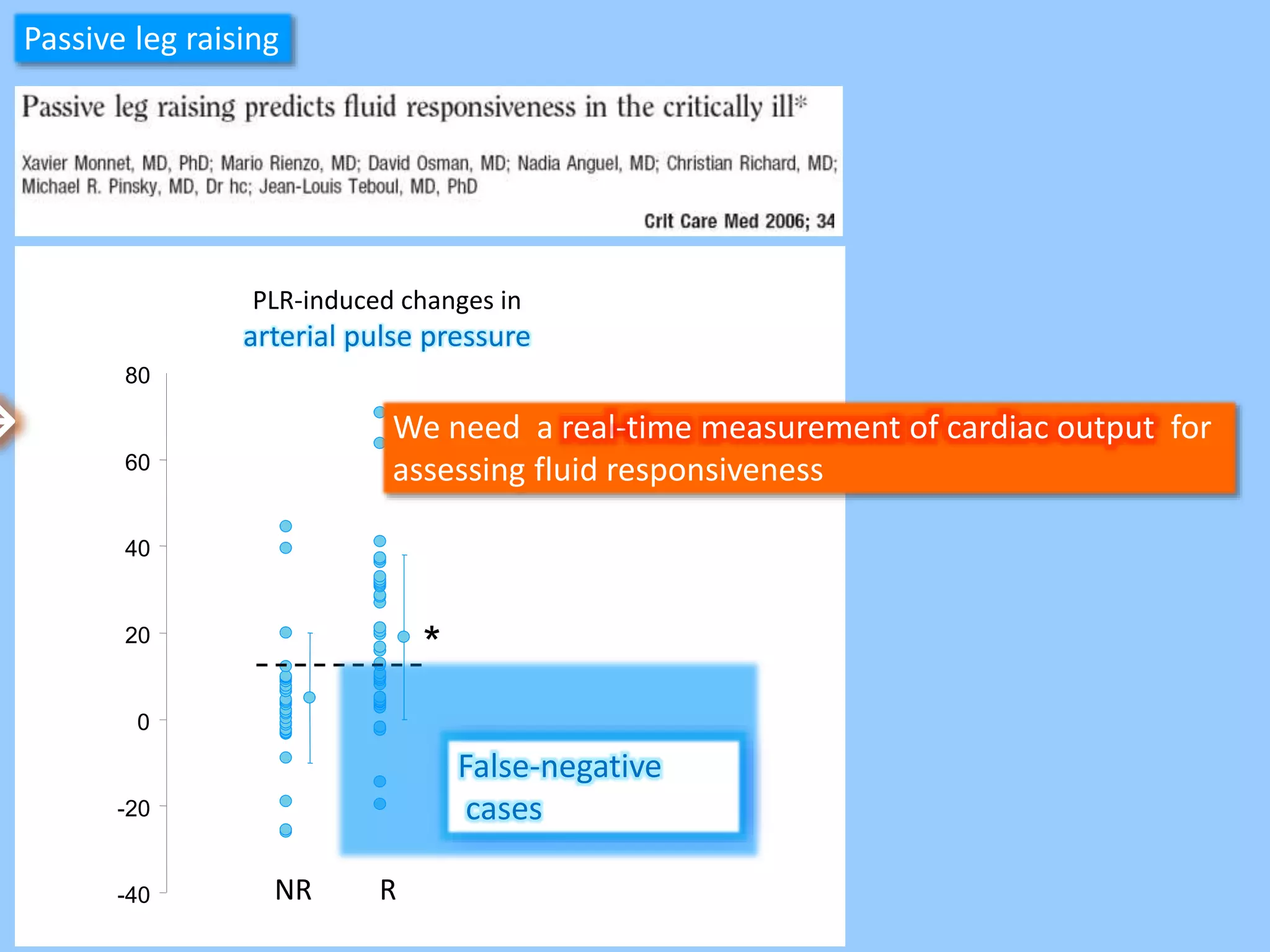
PLR-induced changes in
arterial pulse pressure
*
RNR
False-negative
cases
We need a real-time measurement of cardiac output for
assessing fluid responsiveness
→
Passive leg raising
Passive leg raising
Passive leg raising
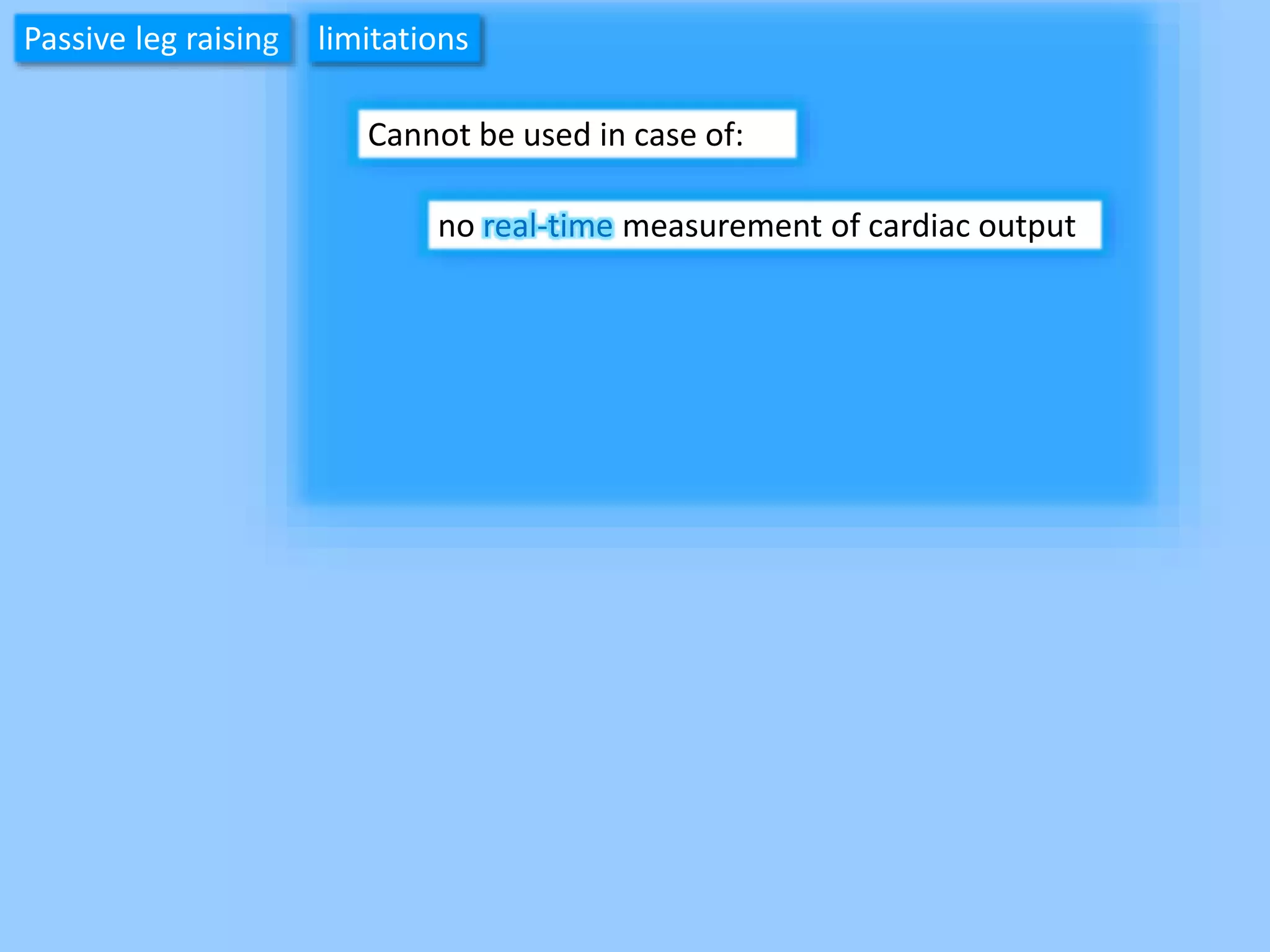
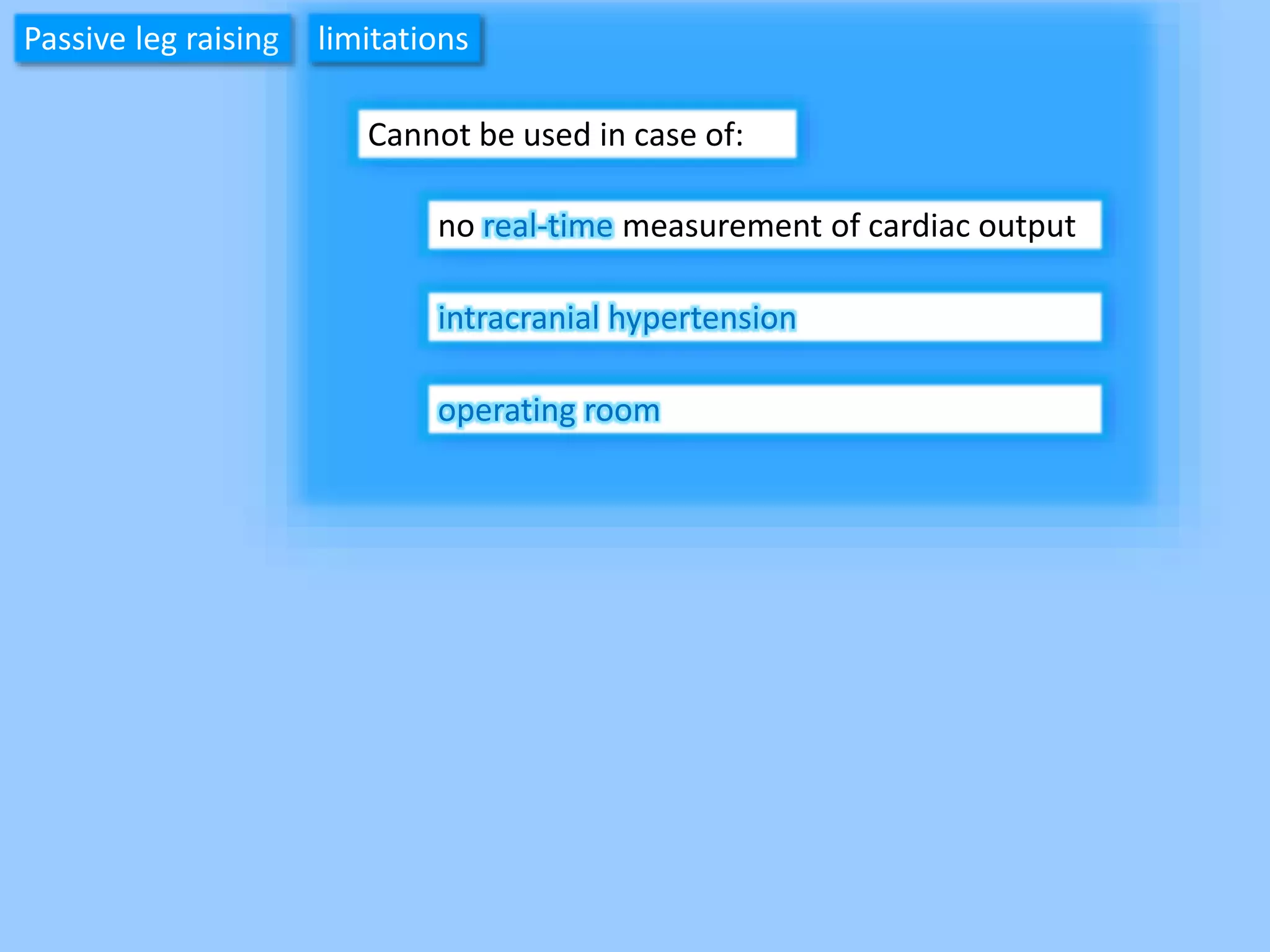
Cannot be used in case of:
no real-time measurement of cardiac output
limitations
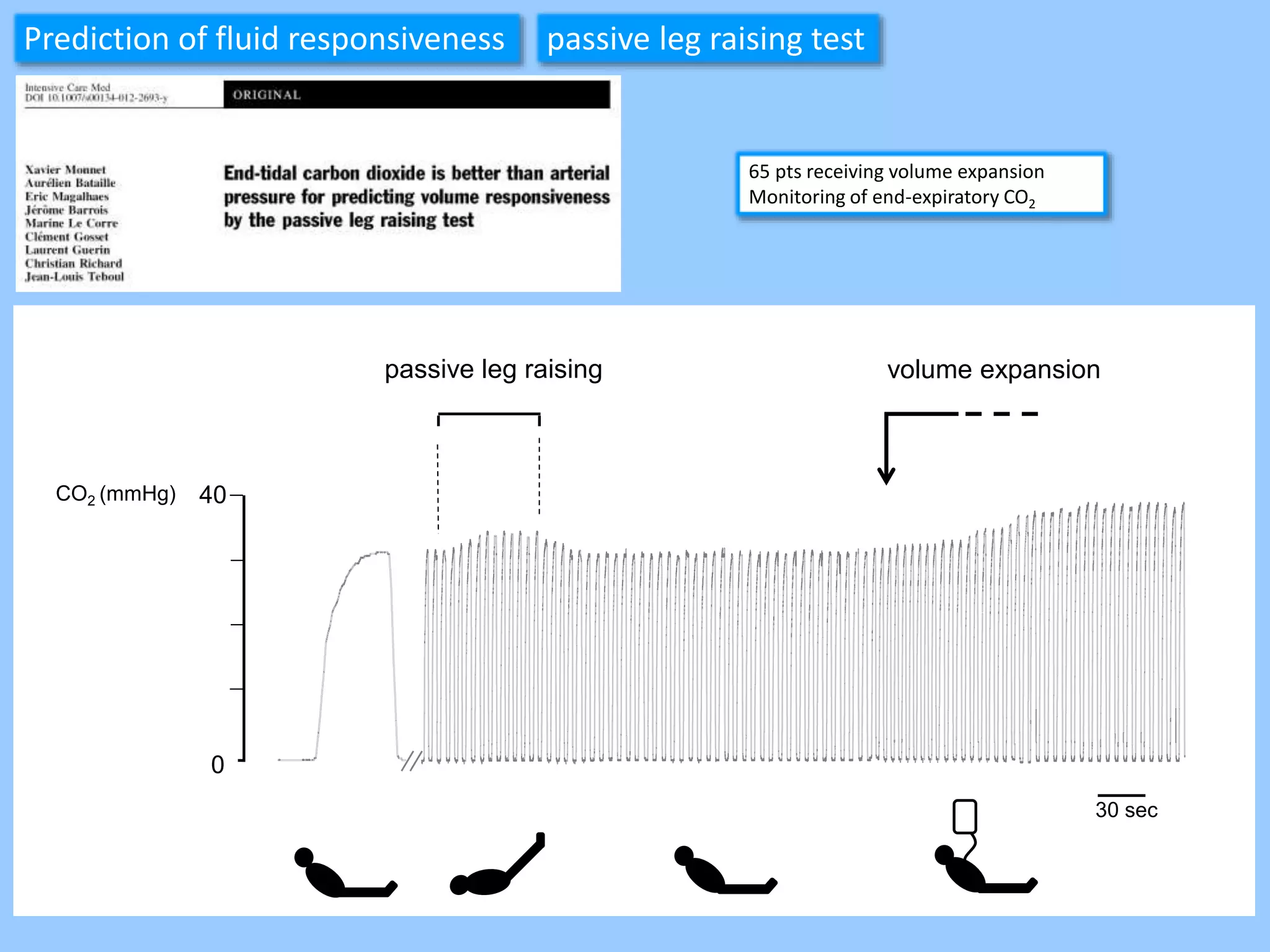
40CO2 (mmHg)
30 sec
0
Prediction of fluid responsiveness passive leg raising test
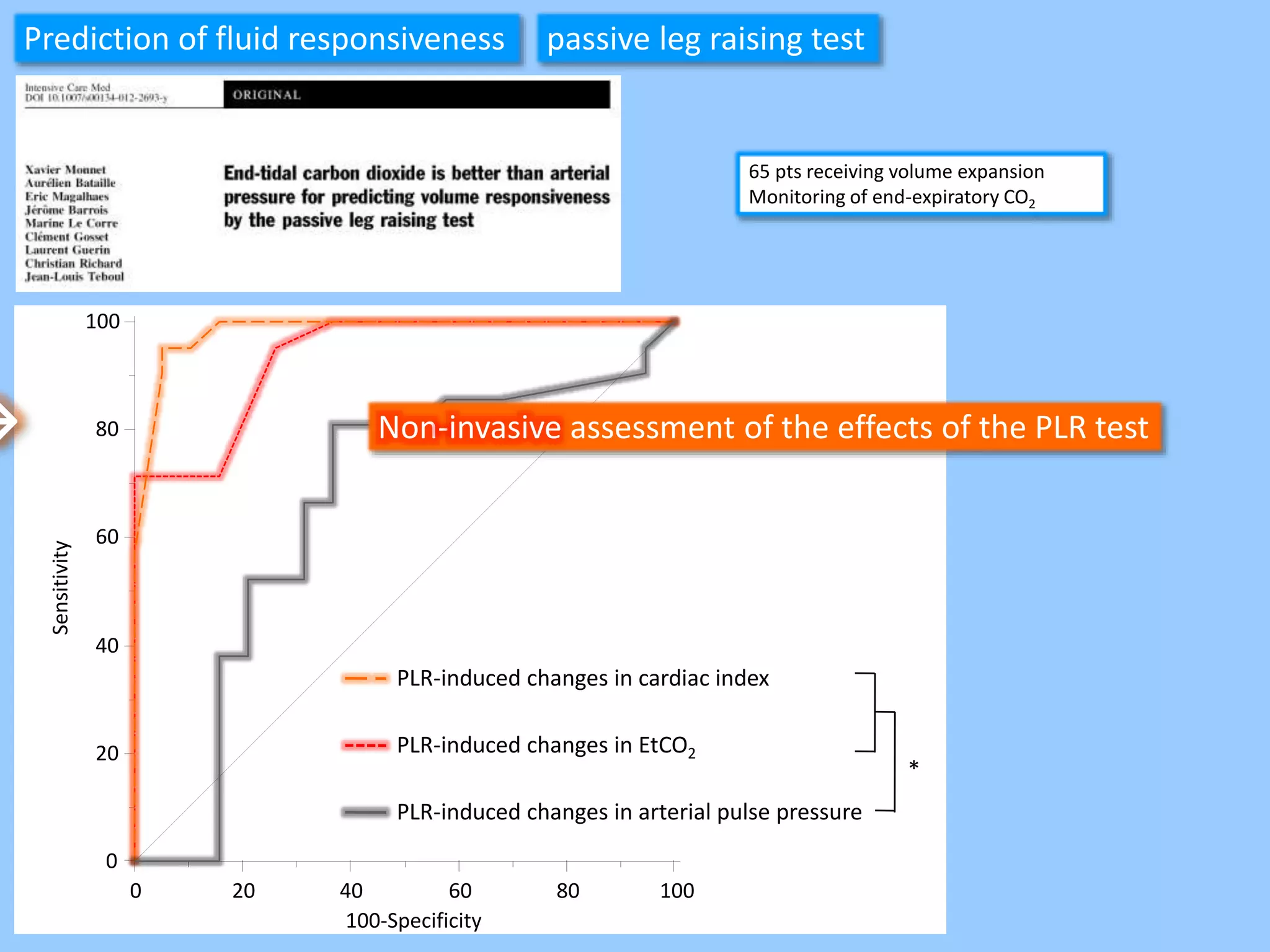
65 pts receiving volume expansion
Monitoring of end-expiratory CO2
passive leg raising volume expansion
Prediction of fluid responsiveness passive leg raising test
65 pts receiving volume expansion
Monitoring of end-expiratory CO2
PLR-induced changes in cardiac index
PLR-induced changes in EtCO2
0 20 40 60 80 100
0
20
40
60
80
100
100-Specificity
Sensitivity
*
PLR-induced changes in arterial pulse pressure
Non-invasive assessment of the effects of the PLR test→
Passive leg raising
Cannot be used in case of:
no real-time measurement of cardiac output
intracranial hypertension
operating room
limitations
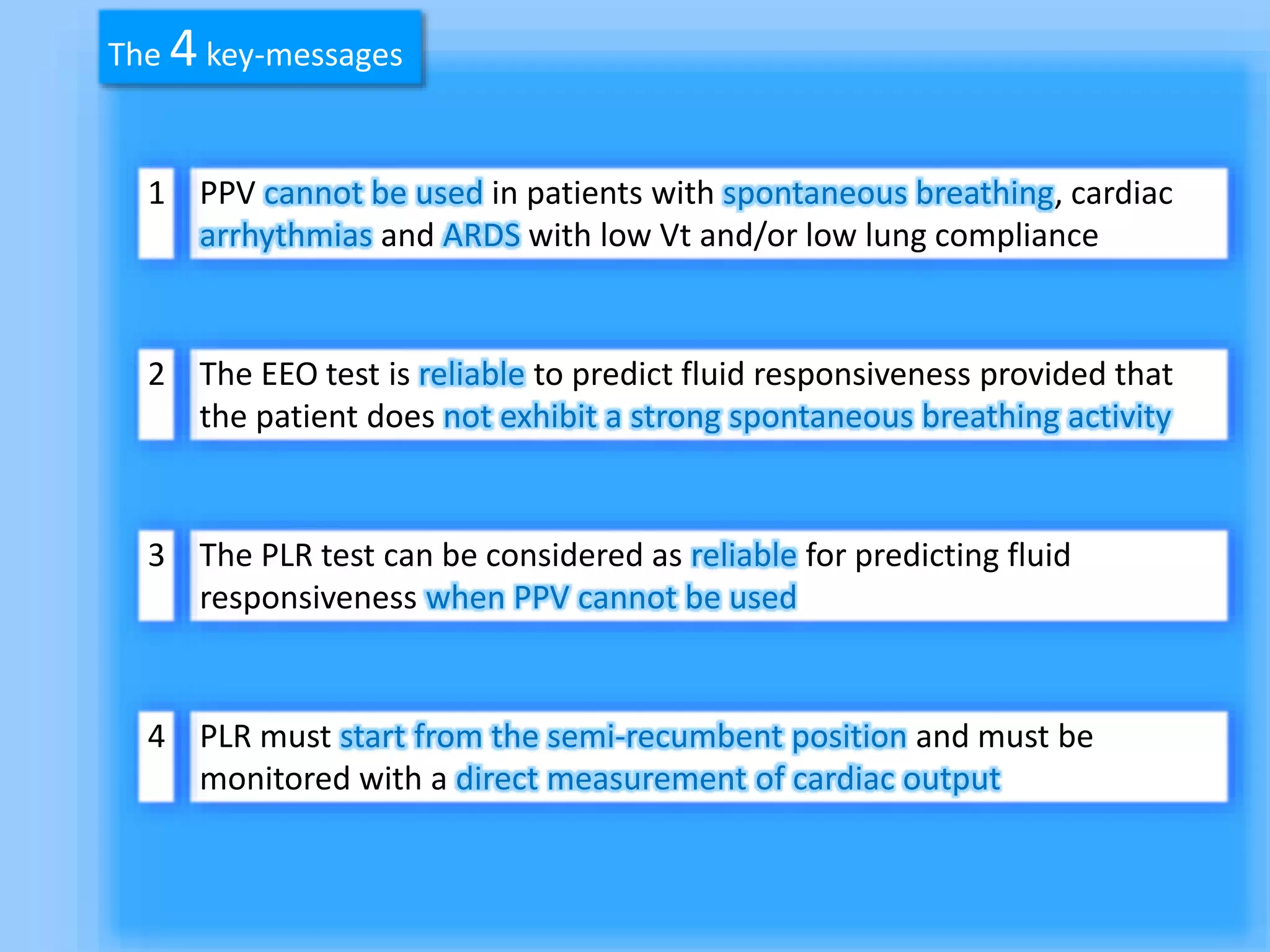
PPV cannot be used in patients with spontaneous breathing, cardiac
arrhythmias and ARDS with low Vt and/or low lung compliance
The EEO test is reliable to predict fluid responsiveness provided that
the patient does not exhibit a strong spontaneous breathing activity
The PLR test can be considered as reliable for predicting fluid
responsiveness when PPV cannot be used
PLR must start from the semi-recumbent position and must be
monitored with a direct measurement of cardiac output
1
2
3
4
The 4key-messages
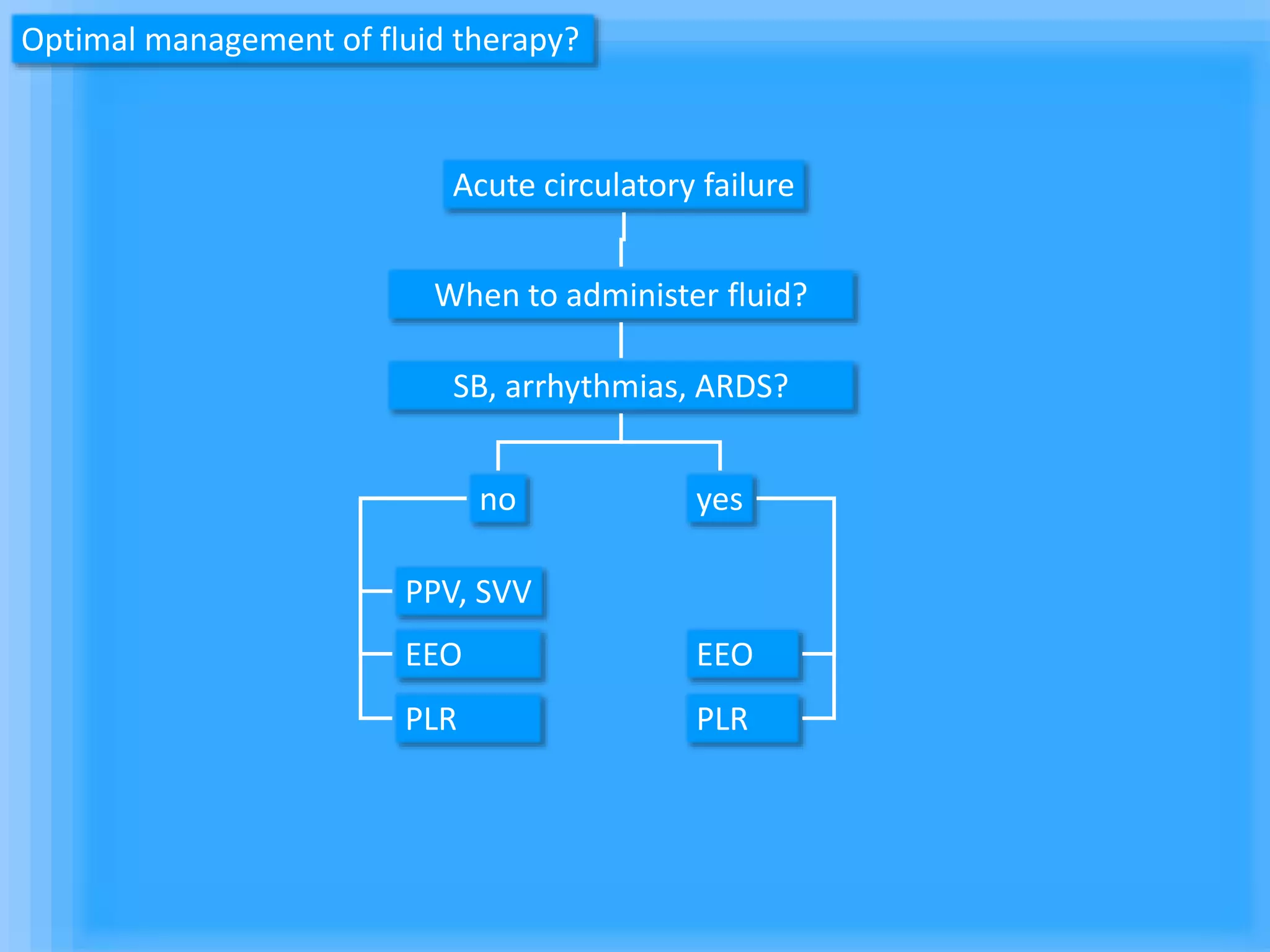
EEO EEO
Acute circulatory failure
When to administer fluid?
PPV, SVV
SB, arrhythmias, ARDS?
yesno
PLRPLR
Optimal management of fluid therapy?
Assessment of fluid responsiveness Beyond PPV

Assessment of fluid responsiveness Beyond PPV

  • 1.
    Assessment of fluidresponsiveness Beyond PPV French Intensive Care Society Prof. Xavier MONNET Medical Intensive Care Unit Paris-Sud University Hospitals xavier.monnet@bct.aphp.fr
  • 2.
    Link of interest Memberof the Medical Advisory Board of Pulsion Medical Systems
  • 3.
    PPV cannot beused in patients with spontaneous breathing, cardiac arrhythmias and ARDS with low Vt and/or low lung compliance 1 2 3 4 The 4key-messages
  • 4.
    PPV, SVV EEOtest acute circulatory failure when to administer fluid? SB, arrhythmias, ARDS? yesno How to monitor fluid therapy
  • 5.
     systemic venousreturn End-expiratory occlusion test
  • 6.
    34 patients withacute circulatory failure monitored by PiCCO device End-expiratory occlusion test
  • 7.
    Easier with acontinuous measurement of cardiac output Prediction of fluid responsiveness end-expiratory occlusion test
  • 8.
    -10 0 10 20 30 40 50 Effects of end-expiratoryocclusion on continuous cardiac index increase  5% Se = 91% Sp = 100 % 34 patients with acute circulatory failure monitored by PiCCO device NR R Prediction of fluid responsiveness end-expiratory occlusion test
  • 9.
  • 10.
    0 20 4060 80 100 0 20 40 60 80 100 100-Specificity Sensitivity Sensitivity 90% Specificity: 86% >6% PEEP = 14±4 cmH2O 0 20 40 60 80 100 0 20 40 60 80 100 100-Specificity Sensitivity Sensitivity: 80% Specificity: 88% >5% PEEP = 5±0 cmH2O End-expiratory occlusion test The EEO test is reliable whatever the level of PEEP 34 ARDS patients EEO test at PEEP=5 cmH2O and Pplat=30 cmH2O
  • 11.
    EEO test Cannot beused in non-intubated patients but do we need to predict fluid responsiveness in such patients? limitations Cannot be used patients who cannot sustain an expiratory hold Easier to perfom with a continuous measurement of cardiac output PEEP level?
  • 12.
    PPV cannot beused in patients with spontaneous breathing, cardiac arrhythmias and ARDS with low Vt and/or low lung compliance The EEO test is reliable to predict fluid responsiveness provided that the patient does not exhibit a strong spontaneous breathing activity 1 2 3 4 The 4key-messages
  • 13.
    PPV, SVV EEO acute circulatoryfailure when to administer fluid? SB, arrhythmias, ARDS? yesno EEO PLR testPLR test How to monitor fluid therapy
  • 14.
    → PLR islike a " self preload challenge " Prediction of fluid responsiveness passive leg raising
  • 15.
    ABF PLR Volume expansion Prediction offluid responsiveness passive leg raising test
  • 16.
    PPV 0 20 40 60 80 100 0 20 4060 80 100 100 - specificity sensitivity PLR effects on aortic blood flow 31 patients with spontaneous breathing of cardiac arrhythmias Passive leg raising
  • 17.
  • 18.
    PPV cannot beused in patients with spontaneous breathing, cardiac arrhythmias and ARDS with low Vt and/or low lung compliance The EEO test is reliable to predict fluid responsiveness provided that the patient does not exhibit a strong spontaneous breathing activity The PLR test can be considered as reliable for predicting fluid responsiveness when PPV cannot be used 1 2 3 4 The 4key-messages
  • 19.
    Meta-analysis of 8studies with PLR and volume expansion A large base of evidence→ Prediction of fluid responsiveness passive leg raising test 2important points→
  • 20.
    semi-recumbent position PLRposition 45° 45° 45° PLR positionsupine position Prediction of fluid responsiveness passive leg raising
  • 21.
    0 25 12.5 37.5 % change incardiac index from baseline 35 patients All responders to PLR Prediction of fluid responsiveness passive leg raising
  • 22.
    Prediction of fluidresponsiveness passive leg raising Starting PLR from the semi-recumbent position provides a more sensistive test → 2nd important point→
  • 23.
    Eso Doppler echo echo echo andarterial flow Flotrac/vigileo USCOM PiCCO Eso Doppler PiCCO echo bioreactance Passive leg raising echo
  • 24.
    -40 -20 0 20 40 60 80 PLR-induced changes in arterialpulse pressure * RNR False-negative cases We need a real-time measurement of cardiac output for assessing fluid responsiveness → Passive leg raising
  • 25.
  • 26.
    Passive leg raising Cannotbe used in case of: no real-time measurement of cardiac output limitations
  • 27.
    40CO2 (mmHg) 30 sec 0 Predictionof fluid responsiveness passive leg raising test 65 pts receiving volume expansion Monitoring of end-expiratory CO2 passive leg raising volume expansion
  • 28.
    Prediction of fluidresponsiveness passive leg raising test 65 pts receiving volume expansion Monitoring of end-expiratory CO2 PLR-induced changes in cardiac index PLR-induced changes in EtCO2 0 20 40 60 80 100 0 20 40 60 80 100 100-Specificity Sensitivity * PLR-induced changes in arterial pulse pressure Non-invasive assessment of the effects of the PLR test→
  • 29.
    Passive leg raising Cannotbe used in case of: no real-time measurement of cardiac output intracranial hypertension operating room limitations
  • 30.
    PPV cannot beused in patients with spontaneous breathing, cardiac arrhythmias and ARDS with low Vt and/or low lung compliance The EEO test is reliable to predict fluid responsiveness provided that the patient does not exhibit a strong spontaneous breathing activity The PLR test can be considered as reliable for predicting fluid responsiveness when PPV cannot be used PLR must start from the semi-recumbent position and must be monitored with a direct measurement of cardiac output 1 2 3 4 The 4key-messages
  • 31.
    EEO EEO Acute circulatoryfailure When to administer fluid? PPV, SVV SB, arrhythmias, ARDS? yesno PLRPLR Optimal management of fluid therapy?