FLUDIZED BED DRYER
(FBD)
Presented by- sachin suryawanshi
M.pharm (Roll no. 112)
Department of pharmaceutics
Amrutvahini college of pharmacy, sangamner
CONTENT -
 1. Introduction
 2. Working
 3. Type of FBD
 4. Type of processor
 5. Factor Affecting FBD
 6.Advantage
 7.Disadvantage
 8.Reference
2
Introduction -
 Fluid bed drying is most widely used technique for drying
pharmaceutical powders and granulation.
 The direct contact between particles and air/gas is possible in
fluid bed system.
 Here any type of inert gas or air is used.
 They can be designed in either batch or continuous type fluid
bed dryer.
 In fluidized bed dryer, hot air is passed at high pressure through
a perforated bottom of the container containing granules to be
dried.
 The granules are lifted from the bottom and suspended in the
stream of air.
3
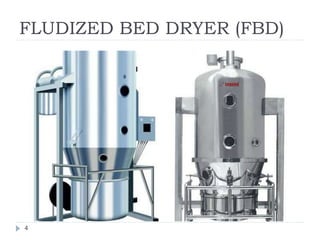
FLUDIZED BED DRYER (FBD)
4
WORKING -
 When the velocity of the air is greater than the settling
velocity of granules, the granules remain partially
suspended in the gas stream.
 After some time, a point of pressure is reached at which
frictional drag in the particles is equal to the force of
gravity.
 The granules rise in the container because of high
velocity gas and fell back in a random boiling motion.
 This condition is said to be fluidized state.
 Drying is achieved at constant rate and falling rate period
is very short.
5
Types of FBD -
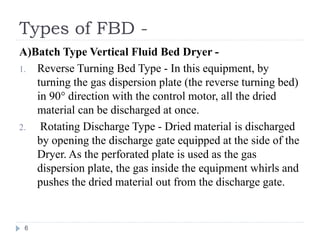
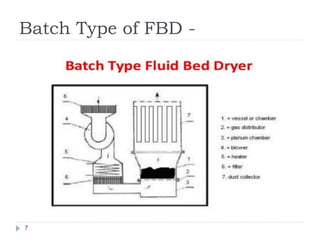
A)Batch Type Vertical Fluid Bed Dryer -
1. Reverse Turning Bed Type - In this equipment, by
turning the gas dispersion plate (the reverse turning bed)
in 90° direction with the control motor, all the dried
material can be discharged at once.
2. Rotating Discharge Type - Dried material is discharged
by opening the discharge gate equipped at the side of the
Dryer. As the perforated plate is used as the gas
dispersion plate, the gas inside the equipment whirls and
pushes the dried material out from the discharge gate.
6
Batch Type of FBD -
7
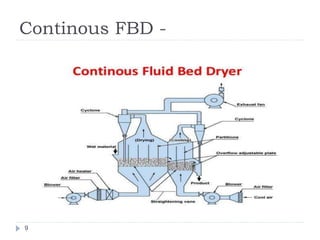
B)Continuous Type Horizontal Vibrating
Conveyor FBD
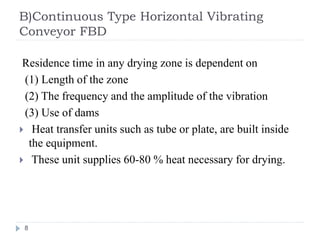
Residence time in any drying zone is dependent on
(1) Length of the zone
(2) The frequency and the amplitude of the vibration
(3) Use of dams
 Heat transfer units such as tube or plate, are built inside
the equipment.
 These unit supplies 60-80 % heat necessary for drying.
8
Continous FBD -
9
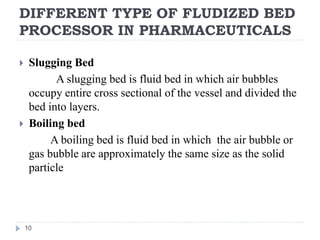
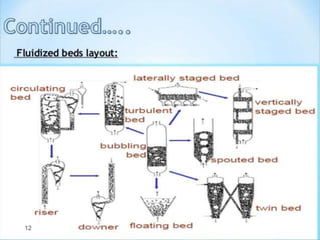
DIFFERENT TYPE OF FLUDIZED BED
PROCESSOR IN PHARMACEUTICALS
 Slugging Bed
A slugging bed is fluid bed in which air bubbles
occupy entire cross sectional of the vessel and divided the
bed into layers.
 Boiling bed
A boiling bed is fluid bed in which the air bubble or
gas bubble are approximately the same size as the solid
particle
10
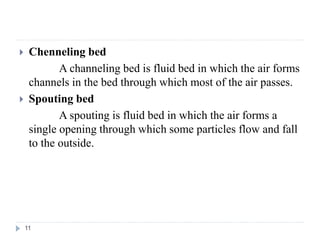
 Chenneling bed
A channeling bed is fluid bed in which the air forms
channels in the bed through which most of the air passes.
 Spouting bed
A spouting is fluid bed in which the air forms a
single opening through which some particles flow and fall
to the outside.
11
12
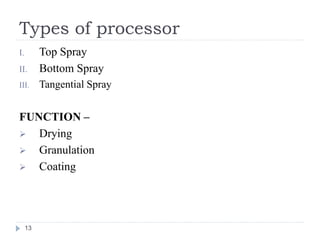
Types of processor
I. Top Spray
II. Bottom Spray
III. Tangential Spray
FUNCTION –
 Drying
 Granulation
 Coating
13
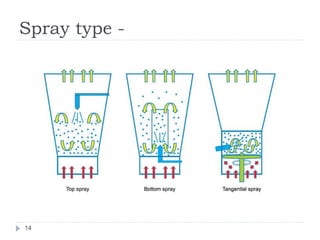
Spray type -
14
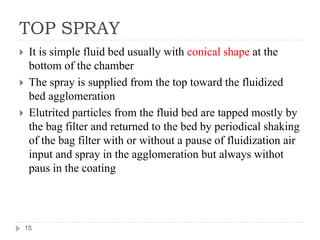
TOP SPRAY
 It is simple fluid bed usually with conical shape at the
bottom of the chamber
 The spray is supplied from the top toward the fluidized
bed agglomeration
 Elutrited particles from the fluid bed are tapped mostly by
the bag filter and returned to the bed by periodical shaking
of the bag filter with or without a pause of fluidization air
input and spray in the agglomeration but always withot
paus in the coating
15
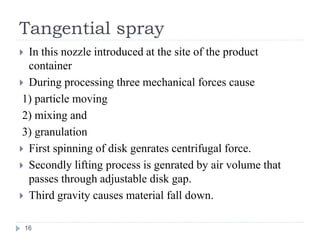
Tangential spray
 In this nozzle introduced at the site of the product
container
 During processing three mechanical forces cause
1) particle moving
2) mixing and
3) granulation
 First spinning of disk genrates centrifugal force.
 Secondly lifting process is genrated by air volume that
passes through adjustable disk gap.
 Third gravity causes material fall down.
16
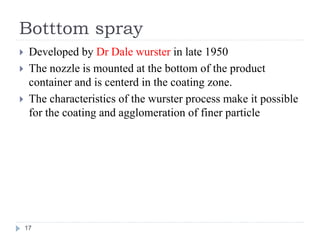
Botttom spray
 Developed by Dr Dale wurster in late 1950
 The nozzle is mounted at the bottom of the product
container and is centerd in the coating zone.
 The characteristics of the wurster process make it possible
for the coating and agglomeration of finer particle
17
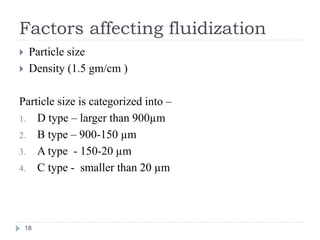
Factors affecting fluidization
 Particle size
 Density (1.5 gm/cm )
Particle size is categorized into –
1. D type – larger than 900µm
2. B type – 900-150 µm
3. A type - 150-20 µm
4. C type - smaller than 20 µm
18
19
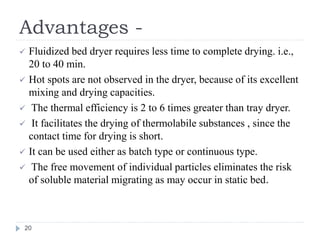
Advantages -
 Fluidized bed dryer requires less time to complete drying. i.e.,
20 to 40 min.
 Hot spots are not observed in the dryer, because of its excellent
mixing and drying capacities.
 The thermal efficiency is 2 to 6 times greater than tray dryer.
 It facilitates the drying of thermolabile substances , since the
contact time for drying is short.
 It can be used either as batch type or continuous type.
 The free movement of individual particles eliminates the risk
of soluble material migrating as may occur in static bed.
20
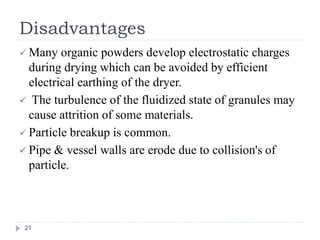
Disadvantages
 Many organic powders develop electrostatic charges
during drying which can be avoided by efficient
electrical earthing of the dryer.
 The turbulence of the fluidized state of granules may
cause attrition of some materials.
 Particle breakup is common.
 Pipe & vessel walls are erode due to collision's of
particle.
21
Reference -
 www.pharmainfo.net
 www.ikev.org/haber/bozzonejune1.pdf
 www.pharmweb.net
 Herbert a liberman leon,lachman.pharmaceutical dosage
form tablets vol.2nd edition.352-354
22
23

Fludized bed dryer (fbd)

  • 1.
    FLUDIZED BED DRYER (FBD) Presentedby- sachin suryawanshi M.pharm (Roll no. 112) Department of pharmaceutics Amrutvahini college of pharmacy, sangamner
  • 2.
    CONTENT -  1.Introduction  2. Working  3. Type of FBD  4. Type of processor  5. Factor Affecting FBD  6.Advantage  7.Disadvantage  8.Reference 2
  • 3.
    Introduction -  Fluidbed drying is most widely used technique for drying pharmaceutical powders and granulation.  The direct contact between particles and air/gas is possible in fluid bed system.  Here any type of inert gas or air is used.  They can be designed in either batch or continuous type fluid bed dryer.  In fluidized bed dryer, hot air is passed at high pressure through a perforated bottom of the container containing granules to be dried.  The granules are lifted from the bottom and suspended in the stream of air. 3
  • 4.
  • 5.
    WORKING -  Whenthe velocity of the air is greater than the settling velocity of granules, the granules remain partially suspended in the gas stream.  After some time, a point of pressure is reached at which frictional drag in the particles is equal to the force of gravity.  The granules rise in the container because of high velocity gas and fell back in a random boiling motion.  This condition is said to be fluidized state.  Drying is achieved at constant rate and falling rate period is very short. 5
  • 6.
    Types of FBD- A)Batch Type Vertical Fluid Bed Dryer - 1. Reverse Turning Bed Type - In this equipment, by turning the gas dispersion plate (the reverse turning bed) in 90° direction with the control motor, all the dried material can be discharged at once. 2. Rotating Discharge Type - Dried material is discharged by opening the discharge gate equipped at the side of the Dryer. As the perforated plate is used as the gas dispersion plate, the gas inside the equipment whirls and pushes the dried material out from the discharge gate. 6
  • 7.
  • 8.
    B)Continuous Type HorizontalVibrating Conveyor FBD Residence time in any drying zone is dependent on (1) Length of the zone (2) The frequency and the amplitude of the vibration (3) Use of dams  Heat transfer units such as tube or plate, are built inside the equipment.  These unit supplies 60-80 % heat necessary for drying. 8
  • 9.
  • 10.
    DIFFERENT TYPE OFFLUDIZED BED PROCESSOR IN PHARMACEUTICALS  Slugging Bed A slugging bed is fluid bed in which air bubbles occupy entire cross sectional of the vessel and divided the bed into layers.  Boiling bed A boiling bed is fluid bed in which the air bubble or gas bubble are approximately the same size as the solid particle 10
  • 11.
     Chenneling bed Achanneling bed is fluid bed in which the air forms channels in the bed through which most of the air passes.  Spouting bed A spouting is fluid bed in which the air forms a single opening through which some particles flow and fall to the outside. 11
  • 12.
  • 13.
    Types of processor I.Top Spray II. Bottom Spray III. Tangential Spray FUNCTION –  Drying  Granulation  Coating 13
  • 14.
  • 15.
    TOP SPRAY  Itis simple fluid bed usually with conical shape at the bottom of the chamber  The spray is supplied from the top toward the fluidized bed agglomeration  Elutrited particles from the fluid bed are tapped mostly by the bag filter and returned to the bed by periodical shaking of the bag filter with or without a pause of fluidization air input and spray in the agglomeration but always withot paus in the coating 15
  • 16.
    Tangential spray  Inthis nozzle introduced at the site of the product container  During processing three mechanical forces cause 1) particle moving 2) mixing and 3) granulation  First spinning of disk genrates centrifugal force.  Secondly lifting process is genrated by air volume that passes through adjustable disk gap.  Third gravity causes material fall down. 16
  • 17.
    Botttom spray  Developedby Dr Dale wurster in late 1950  The nozzle is mounted at the bottom of the product container and is centerd in the coating zone.  The characteristics of the wurster process make it possible for the coating and agglomeration of finer particle 17
  • 18.
    Factors affecting fluidization Particle size  Density (1.5 gm/cm ) Particle size is categorized into – 1. D type – larger than 900µm 2. B type – 900-150 µm 3. A type - 150-20 µm 4. C type - smaller than 20 µm 18
  • 19.
  • 20.
    Advantages -  Fluidizedbed dryer requires less time to complete drying. i.e., 20 to 40 min.  Hot spots are not observed in the dryer, because of its excellent mixing and drying capacities.  The thermal efficiency is 2 to 6 times greater than tray dryer.  It facilitates the drying of thermolabile substances , since the contact time for drying is short.  It can be used either as batch type or continuous type.  The free movement of individual particles eliminates the risk of soluble material migrating as may occur in static bed. 20
  • 21.
    Disadvantages  Many organicpowders develop electrostatic charges during drying which can be avoided by efficient electrical earthing of the dryer.  The turbulence of the fluidized state of granules may cause attrition of some materials.  Particle breakup is common.  Pipe & vessel walls are erode due to collision's of particle. 21
  • 22.
    Reference -  www.pharmainfo.net www.ikev.org/haber/bozzonejune1.pdf  www.pharmweb.net  Herbert a liberman leon,lachman.pharmaceutical dosage form tablets vol.2nd edition.352-354 22
  • 23.