Federal Aviation Administration
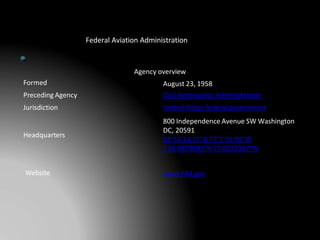
Agency overview
Formed
Preceding Agency
Jurisdiction
Headquarters
Website
August 23, 1958
Civil Aeronautics Administration
United States federal government
800 Independence Avenue SW Washington
DC, 20591
38°53′14.31″N 77°1′19.98″W
/ 38.8873083°N 77.0222167°W
www.FAA.gov
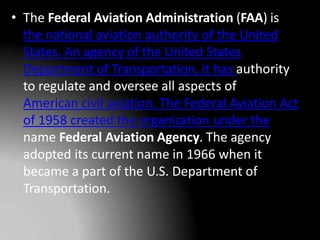
• The Federal Aviation Administration (FAA) is
the national aviation authority of the United
States. An agency of the United States
Department of Transportation, it has authority
to regulate and oversee all aspects of
American civil aviation. The Federal Aviation Act
of 1958 created the organization under the
name Federal Aviation Agency. The agency
adopted its current name in 1966 when it
became a part of the U.S. Department of
Transportation.
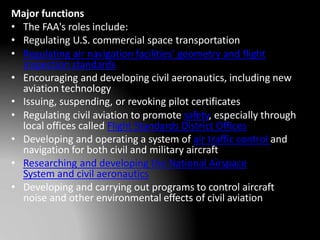
Major functions
• The FAA's roles include:
• Regulating U.S. commercial space transportation
• Regulating air navigation facilities' geometry and flight
inspection standards
• Encouraging and developing civil aeronautics, including new
aviation technology
• Issuing, suspending, or revoking pilot certificates
• Regulating civil aviation to promote safety, especially through
local offices called Flight Standards District Offices
• Developing and operating a system of air traffic control and
navigation for both civil and military aircraft
• Researching and developing the National Airspace
System and civil aeronautics
• Developing and carrying out programs to control aircraft
noise and other environmental effects of civil aviation
Organizations[edit]
The FAA is divided into four "lines of business"
(LOB).[3] Each LOB has a specific role within the FAA.
Airports (ARP) - plans and develops projects involving
airports, overseeing their construction and operations.
Ensures compliance with federal regulations.[4]
• Air Traffic Organization (ATO) - primary duty is to safely
and efficiently move air traffic within the National
Airspace System. ATO employees manage air traffic
facilities including Airport Traffic Control Towers (ATCT)
and Terminal Radar Approach Control Facilities
(TRACONs).[5] See also Airway Operational Support.
Aviation Safety (AVS) - Responsible for
aeronautical certification of personnel and
aircraft, including pilots, airlines, and
mechanics.[6]
Commercial Space Transportation (AST) - ensures
protection of U.S. assets during the launch or
reentry of commercial space vehicles.[7]
Regions and Aeronautical Center
Operations[edit]
• The FAA has its headquarters in Washington, D.C[8] as
well as the William J. Hughes Technical Center in Atlantic
City, the Mike Monroney Aeronautical Center in
Oklahoma City, and nine regional offices:
• Alaskan Region – Anchorage, Alaska
• Northwest Mountain – Renton, Washington
• Western Pacific – Hawthorne, California
• Southwest – Fort Worth, Texas
• Central – Kansas City, Missouri
• Great Lakes – Chicago, Illinois
• Southern – Atlanta, Georgia
• Eastern – New York City
• New England – Burlington, Massachusetts
History
FAA Headquarters,Washington, D.C.
The Air Commerce Act of May 20, 1926, is the cornerstone
of the federal government's regulation of civil aviation. This
landmark legislation was passed at the urging of
the aviation industry, whose leaders believed the airplane
could not reach its full commercial potential without
federal action to improve and maintain safety standards.
The Act charged the Secretary of Commerce with fostering
air commerce, issuing and enforcing air traffic rules,
licensing pilots, certifying aircraft, establishing airways, and
operating and maintaining aids to air navigation. The newly
created Aeronautics Branch, operating under
the Department of Commerce assumed primary
responsibility for aviation oversight.
• In fulfilling its civil aviation responsibilities, the Department
of Commerce initially concentrated on such functions as
safety regulations and the certification of pilots and aircraft.
It took over the building and operation of the nation's system
of lighted airways, a task that had been begun by the Post
Office Department. The Department of Commerce improved
aeronautical radio communications and introduced radio
beacons as an effective aid to air navigation.
• The Aeronautics Branch was renamed the Bureau of Air
Commerce in 1934 to reflect its enhanced status within the
Department. As commercial flying increased, the Bureau
encouraged a group of airlines to establish the first three
centers for providing air traffic control (ATC) along the
airways. In 1936, the Bureau itself took over the centers and
began to expand the ATC system. The pioneer air traffic
controllers used maps, blackboards, and mental calculations
to ensure the safe separation of aircraft traveling along
designated routes between cities.
• In 1938, the Civil Aeronautics Act transferred the federal
civil aviation responsibilities from the Commerce
Department to a new independent agency, the Civil
Aeronautics Authority. The legislation also expanded the
government's role by giving them the authority and the
power to regulate airline fares and to determine the
routes that air carriers would serve.
• President Franklin D. Roosevelt split the authority into
two agencies in 1940, the Civil Aeronautics
Administration (CAA) and the Civil Aeronautics Board
(CAB). CAA was responsible for ATC, airman and aircraft
certification, safety enforcement, and airway
development. CAB was entrusted with safety regulation,
accident investigation, and economic regulation of the
airlines. The CAA was part of the Department of
Commerce. The CAB was an independent federal agency.
• On the eve of America's entry into World War II,
CAA began to extend its ATC responsibilities to
takeoff and landing operations at airports. This
expanded role eventually became permanent
after the war. The application of radar to ATC
helped controllers in their drive to keep abreast
of the postwar boom in commercial air
transportation. In 1946, meanwhile, Congress
gave CAA the added task of administering the
federal-aid airport program, the first peacetime
program of financial assistance aimed
exclusively at promoting development of the
nation's civil airports.
• The same year witnessed the birth of
the National Aeronautics and Space
Administration (NASA), created in the wake of
the Soviet launching of the first artificial
satellite. NASA assumed NACA's role of
aeronautical research while achieving world
leadership in space technology and exploration.
THANK YOU
ANY QUESTIONS ?

FAA.pptx

  • 1.
  • 2.
    Federal Aviation Administration Agencyoverview Formed Preceding Agency Jurisdiction Headquarters Website August 23, 1958 Civil Aeronautics Administration United States federal government 800 Independence Avenue SW Washington DC, 20591 38°53′14.31″N 77°1′19.98″W / 38.8873083°N 77.0222167°W www.FAA.gov
  • 3.
    • The FederalAviation Administration (FAA) is the national aviation authority of the United States. An agency of the United States Department of Transportation, it has authority to regulate and oversee all aspects of American civil aviation. The Federal Aviation Act of 1958 created the organization under the name Federal Aviation Agency. The agency adopted its current name in 1966 when it became a part of the U.S. Department of Transportation.
  • 4.
    Major functions • TheFAA's roles include: • Regulating U.S. commercial space transportation • Regulating air navigation facilities' geometry and flight inspection standards • Encouraging and developing civil aeronautics, including new aviation technology • Issuing, suspending, or revoking pilot certificates • Regulating civil aviation to promote safety, especially through local offices called Flight Standards District Offices • Developing and operating a system of air traffic control and navigation for both civil and military aircraft • Researching and developing the National Airspace System and civil aeronautics • Developing and carrying out programs to control aircraft noise and other environmental effects of civil aviation
  • 5.
    Organizations[edit] The FAA isdivided into four "lines of business" (LOB).[3] Each LOB has a specific role within the FAA. Airports (ARP) - plans and develops projects involving airports, overseeing their construction and operations. Ensures compliance with federal regulations.[4] • Air Traffic Organization (ATO) - primary duty is to safely and efficiently move air traffic within the National Airspace System. ATO employees manage air traffic facilities including Airport Traffic Control Towers (ATCT) and Terminal Radar Approach Control Facilities (TRACONs).[5] See also Airway Operational Support.
  • 6.
    Aviation Safety (AVS)- Responsible for aeronautical certification of personnel and aircraft, including pilots, airlines, and mechanics.[6] Commercial Space Transportation (AST) - ensures protection of U.S. assets during the launch or reentry of commercial space vehicles.[7] Regions and Aeronautical Center Operations[edit]
  • 7.
    • The FAAhas its headquarters in Washington, D.C[8] as well as the William J. Hughes Technical Center in Atlantic City, the Mike Monroney Aeronautical Center in Oklahoma City, and nine regional offices: • Alaskan Region – Anchorage, Alaska • Northwest Mountain – Renton, Washington • Western Pacific – Hawthorne, California • Southwest – Fort Worth, Texas • Central – Kansas City, Missouri • Great Lakes – Chicago, Illinois • Southern – Atlanta, Georgia • Eastern – New York City • New England – Burlington, Massachusetts
  • 8.
    History FAA Headquarters,Washington, D.C. TheAir Commerce Act of May 20, 1926, is the cornerstone of the federal government's regulation of civil aviation. This landmark legislation was passed at the urging of the aviation industry, whose leaders believed the airplane could not reach its full commercial potential without federal action to improve and maintain safety standards. The Act charged the Secretary of Commerce with fostering air commerce, issuing and enforcing air traffic rules, licensing pilots, certifying aircraft, establishing airways, and operating and maintaining aids to air navigation. The newly created Aeronautics Branch, operating under the Department of Commerce assumed primary responsibility for aviation oversight.
  • 9.
    • In fulfillingits civil aviation responsibilities, the Department of Commerce initially concentrated on such functions as safety regulations and the certification of pilots and aircraft. It took over the building and operation of the nation's system of lighted airways, a task that had been begun by the Post Office Department. The Department of Commerce improved aeronautical radio communications and introduced radio beacons as an effective aid to air navigation. • The Aeronautics Branch was renamed the Bureau of Air Commerce in 1934 to reflect its enhanced status within the Department. As commercial flying increased, the Bureau encouraged a group of airlines to establish the first three centers for providing air traffic control (ATC) along the airways. In 1936, the Bureau itself took over the centers and began to expand the ATC system. The pioneer air traffic controllers used maps, blackboards, and mental calculations to ensure the safe separation of aircraft traveling along designated routes between cities.
  • 10.
    • In 1938,the Civil Aeronautics Act transferred the federal civil aviation responsibilities from the Commerce Department to a new independent agency, the Civil Aeronautics Authority. The legislation also expanded the government's role by giving them the authority and the power to regulate airline fares and to determine the routes that air carriers would serve. • President Franklin D. Roosevelt split the authority into two agencies in 1940, the Civil Aeronautics Administration (CAA) and the Civil Aeronautics Board (CAB). CAA was responsible for ATC, airman and aircraft certification, safety enforcement, and airway development. CAB was entrusted with safety regulation, accident investigation, and economic regulation of the airlines. The CAA was part of the Department of Commerce. The CAB was an independent federal agency.
  • 11.
    • On theeve of America's entry into World War II, CAA began to extend its ATC responsibilities to takeoff and landing operations at airports. This expanded role eventually became permanent after the war. The application of radar to ATC helped controllers in their drive to keep abreast of the postwar boom in commercial air transportation. In 1946, meanwhile, Congress gave CAA the added task of administering the federal-aid airport program, the first peacetime program of financial assistance aimed exclusively at promoting development of the nation's civil airports.
  • 12.
    • The sameyear witnessed the birth of the National Aeronautics and Space Administration (NASA), created in the wake of the Soviet launching of the first artificial satellite. NASA assumed NACA's role of aeronautical research while achieving world leadership in space technology and exploration.
  • 13.