IATA
International Air Transport Association
I- History of IATA
Foundation Of IATA
The Early Days
Foundation Of IATA



The old IATA was able to start small and grow gradually..
By the end of the world war 1 in 1919 , The International air traffic
association was founded in the hague..
It was also limited to a European dimension until 1939when Pan

American joined
Afterwards by the end of the world war2 in 1945, the international
airtransport association came as a successor in april 1945, and it
is founded in havana , cuba .. which had at its founding 57
members from 31nations mostly in Europe and North America
 IT was considered as the prime vehicle for the inter-air line
cooperation in promoting safe and economical air services
 nowadays,The international scheduled airtransport industry
became 100times larger than it was in 1945
The Early Days
 Immediately after 1945( after the end of the
world war2 ) IATAhad to handle worldwide
responsibilities with a more systematic
organization and a larger infrastracture.
II- Mission
 To represent
 To lead
 To serve
The airline industry
: To represent -1
 IATAseeks to improve understanding of the
industry among decision makers and
increase awareness of the benefits that
aviation brings to national and global
economies. It fights for the interests of
airlines across the globe, challenging
unreasonable rules and charges, holding
regulators and governments to account, and
striving for sensible regulation.
2- To lead
 IATA's aim is to help airlines help themselves by
simplifying processes and increasing passenger
convenience while reducing costs and improving
efficiency. The groundbreaking Simplifying the
Business initiative is crucial in this area. Moreover,
safety is IATA's number one priority, and IATA's
goal is to continually improve safety standards,
notably through IATA's Operational SafetyAudit
(IOSA). Another main concern is to minimize the
impact of airtransport on the environment.
:To serve -3
 IATAensures that people and goods can
move around the global airline network as
easily as if they were on a single airline in a
single country. In addition, it provides
essential professional support to all industry
stakeholders with a wide range of products
and expert services, such as publications,
training and consulting. IATA's financial
systems also help carriers and the travel
industry maximize revenues
III- Membership
 Formal membership:
Formal IATAmembership only applies to
airlines.
 other industry partners can participate in
different IATAprograms and benefit from a
wealth of resources to carry out their
operations
 Airlines: IATAmembership is open to both
scheduled and non-scheduled airlines.
 TravelAgencies & other Travel and Tourism
intermediaries: travel and tourism accreditation
and code services simplify the business
relationship between agents and airlines as well as
other tourism service providers.
 Freight Forwarders: IATAaccreditation provides
industry recognition forcargo agents.
 Industry Suppliers: IATAStrategic Partnerships
program allows suppliers and service providers to
interact with IATAand its member airlines in the
development of industry solutions.
Why Become an IATA Airline
?Member
 Airline members of IATAenjoy the support
of an internationally renowned organization
that represents, leads and serves one of the
most dynamic industries in the world.
 From 57 founding members in 1945,
IATAnow represents some 290 airlines
in over 115countries from around the
globe. Carrying 84%of the world’s air
traffic, IATAmembers include the
world’s leading passenger and cargo
airlines.
?Who can be an IATA
IATAmembership is open to airlines
operating both scheduled and non-
scheduled services and covers two
categories:
 Active membership, for airlines operating
either international services or international
and domestic services
 Associate membership, for airlines operating
domestic services only.
what are the requirements of
?membership
 The IATAOperational SafetyAudit (IOSA)
is a pre-requisite of IATA membership.
What are the benefits of
?membership
 IATAprovides a powerful, unified and experienced
voice which supports and promotes the interests of
its members in a number of different ways
including:
 International recognition and lobbying
 Targeting key industry priorities
 Driving industry change
 Reducing costs
 Communication
 Training and other services.
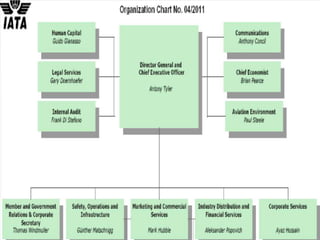
IV- How it functions
Human Capital
 These professional and vocational
programs transfer knowledge and
expertise to promote leadership,
commercial success, and industry
standards on a global s
cale for the
sake of developing human capital
Environment
Building a greener future
 IATAhas a vision for the air line
industry to achieve carbon neutral
growth in the medium term and to
build a plane that produces no
emissions within 50 years.
IATA Economics
 IATAanalysis of proposed changes
to UKAirPassenger Duty indicates
they would be positive for the
broader economy and address
inequities of the current system
Legal, Government & Industry
Affairs
 IATAmanages regulatory affairs
and policy matters on behalf of its
airline members
V-Future development
… We see the Future
Berlin 2010
IATAunveiled it’s vision for a better
future for the aviation industry
VISION
2050
The air transfer industry will focus
:on
 Zero accidents
 Reducing carbon footprint
 Reducing delays
 Increasing profitability
 Reshaping infrastructure
 Find sustainable aircraft fuel
 Enhance customer satisfaction
..The process is launched
Singapore 2011
strategic thinkers from around the 35
globe They represented all stakeholder
:groups, including
 Governments
 Regulators
 Air lines
 Manufacturers
 Technologists
 Financiers
 Air ports
 Airnavigation service
providers
 Labor
 Consumers

IATA.pptx

  • 2.
  • 3.
    I- History ofIATA Foundation Of IATA The Early Days
  • 4.
    Foundation Of IATA    Theold IATA was able to start small and grow gradually.. By the end of the world war 1 in 1919 , The International air traffic association was founded in the hague.. It was also limited to a European dimension until 1939when Pan  American joined Afterwards by the end of the world war2 in 1945, the international airtransport association came as a successor in april 1945, and it is founded in havana , cuba .. which had at its founding 57 members from 31nations mostly in Europe and North America  IT was considered as the prime vehicle for the inter-air line cooperation in promoting safe and economical air services  nowadays,The international scheduled airtransport industry became 100times larger than it was in 1945
  • 5.
    The Early Days Immediately after 1945( after the end of the world war2 ) IATAhad to handle worldwide responsibilities with a more systematic organization and a larger infrastracture.
  • 6.
    II- Mission  Torepresent  To lead  To serve The airline industry
  • 7.
    : To represent-1  IATAseeks to improve understanding of the industry among decision makers and increase awareness of the benefits that aviation brings to national and global economies. It fights for the interests of airlines across the globe, challenging unreasonable rules and charges, holding regulators and governments to account, and striving for sensible regulation.
  • 8.
    2- To lead IATA's aim is to help airlines help themselves by simplifying processes and increasing passenger convenience while reducing costs and improving efficiency. The groundbreaking Simplifying the Business initiative is crucial in this area. Moreover, safety is IATA's number one priority, and IATA's goal is to continually improve safety standards, notably through IATA's Operational SafetyAudit (IOSA). Another main concern is to minimize the impact of airtransport on the environment.
  • 9.
    :To serve -3 IATAensures that people and goods can move around the global airline network as easily as if they were on a single airline in a single country. In addition, it provides essential professional support to all industry stakeholders with a wide range of products and expert services, such as publications, training and consulting. IATA's financial systems also help carriers and the travel industry maximize revenues
  • 10.
    III- Membership  Formalmembership: Formal IATAmembership only applies to airlines.  other industry partners can participate in different IATAprograms and benefit from a wealth of resources to carry out their operations
  • 11.
     Airlines: IATAmembershipis open to both scheduled and non-scheduled airlines.  TravelAgencies & other Travel and Tourism intermediaries: travel and tourism accreditation and code services simplify the business relationship between agents and airlines as well as other tourism service providers.  Freight Forwarders: IATAaccreditation provides industry recognition forcargo agents.  Industry Suppliers: IATAStrategic Partnerships program allows suppliers and service providers to interact with IATAand its member airlines in the development of industry solutions.
  • 12.
    Why Become anIATA Airline ?Member  Airline members of IATAenjoy the support of an internationally renowned organization that represents, leads and serves one of the most dynamic industries in the world.
  • 13.
     From 57founding members in 1945, IATAnow represents some 290 airlines in over 115countries from around the globe. Carrying 84%of the world’s air traffic, IATAmembers include the world’s leading passenger and cargo airlines.
  • 14.
    ?Who can bean IATA IATAmembership is open to airlines operating both scheduled and non- scheduled services and covers two categories:  Active membership, for airlines operating either international services or international and domestic services  Associate membership, for airlines operating domestic services only.
  • 15.
    what are therequirements of ?membership  The IATAOperational SafetyAudit (IOSA) is a pre-requisite of IATA membership.
  • 16.
    What are thebenefits of ?membership  IATAprovides a powerful, unified and experienced voice which supports and promotes the interests of its members in a number of different ways including:  International recognition and lobbying  Targeting key industry priorities  Driving industry change  Reducing costs  Communication  Training and other services.
  • 17.
    IV- How itfunctions
  • 19.
    Human Capital  Theseprofessional and vocational programs transfer knowledge and expertise to promote leadership, commercial success, and industry standards on a global s cale for the sake of developing human capital
  • 20.
    Environment Building a greenerfuture  IATAhas a vision for the air line industry to achieve carbon neutral growth in the medium term and to build a plane that produces no emissions within 50 years.
  • 21.
    IATA Economics  IATAanalysisof proposed changes to UKAirPassenger Duty indicates they would be positive for the broader economy and address inequities of the current system
  • 22.
    Legal, Government &Industry Affairs  IATAmanages regulatory affairs and policy matters on behalf of its airline members
  • 23.
  • 24.
    Berlin 2010 IATAunveiled it’svision for a better future for the aviation industry
  • 25.
  • 26.
    The air transferindustry will focus :on  Zero accidents  Reducing carbon footprint  Reducing delays  Increasing profitability  Reshaping infrastructure  Find sustainable aircraft fuel  Enhance customer satisfaction
  • 27.
    ..The process islaunched Singapore 2011
  • 28.
    strategic thinkers fromaround the 35 globe They represented all stakeholder :groups, including  Governments  Regulators  Air lines  Manufacturers  Technologists  Financiers  Air ports  Airnavigation service providers  Labor  Consumers