Seminar On
Flight Control Surfaces
Guided By
DR. M.S. KHIDIYA
Submitted to
DR. CHITRANJAN Agarwal
Submitted By
SWAPNIL JANI
B.Tech IV year
(Mechanical Engg.)
2016-17
COLLEGE OF TECHNOLOGY AND ENGINEERING
Introduction
What and Why Flight control surfaces??
• Aircraft flight control surfaces allow a pilot to adjust and control the
aircraft's flight altitude as well as direction.
• Early efforts at fixed-wing aircraft design succeeded in generating
sufficient lift to get the aircraft off the ground, but once aloft, the aircraft
proved uncontrollable, often with disastrous results.
• Hinged control surfaces have the advantage of less stresses and are easier
to build into structures.
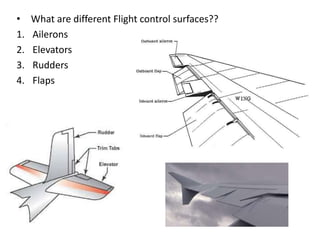
• What are different Flight control surfaces??
1. Ailerons
2. Elevators
3. Rudders
4. Flaps
Bernoulli’s Principle
• Bernoulli's principle states that an increase in the speed of a fluid occurs
simultaneously with a decrease in pressure or a decrease in
the fluid's potential energy.
Ailerons
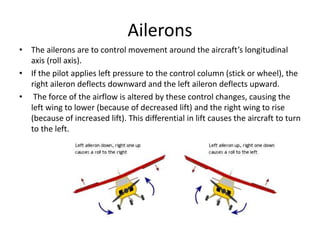
• The ailerons are to control movement around the aircraft’s longitudinal
axis (roll axis).
• If the pilot applies left pressure to the control column (stick or wheel), the
right aileron deflects downward and the left aileron deflects upward.
• The force of the airflow is altered by these control changes, causing the
left wing to lower (because of decreased lift) and the right wing to rise
(because of increased lift). This differential in lift causes the aircraft to turn
to the left.
Elevators
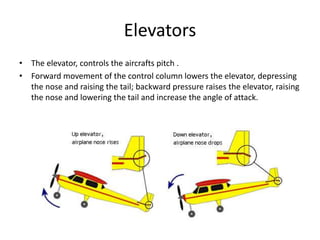
• The elevator, controls the aircrafts pitch .
• Forward movement of the control column lowers the elevator, depressing
the nose and raising the tail; backward pressure raises the elevator, raising
the nose and lowering the tail and increase the angle of attack.
Flaps
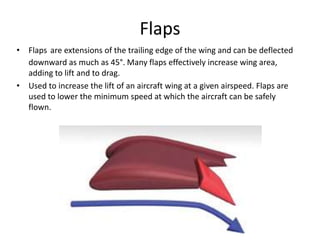
• Flaps are extensions of the trailing edge of the wing and can be deflected
downward as much as 45°. Many flaps effectively increase wing area,
adding to lift and to drag.
• Used to increase the lift of an aircraft wing at a given airspeed. Flaps are
used to lower the minimum speed at which the aircraft can be safely
flown.
Rudder
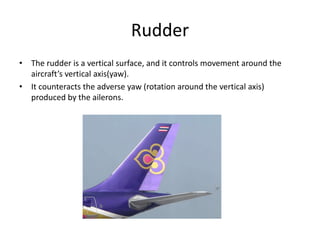
• The rudder is a vertical surface, and it controls movement around the
aircraft’s vertical axis(yaw).
• It counteracts the adverse yaw (rotation around the vertical axis)
produced by the ailerons.
• When rudder is pushed left the air pushes aircraft to move left and
similarly in the right direction.
• Thus a turn is the result of the combined inputs of the ailerons, rudder,
and elevator.
Conclusion
• To change the direction of airplane these components are necessary.
• For takeoff and in the approach to landing, their deployment is generally
to provide greater lift than drag.
• In flight or after touchdown, if rapid deceleration is desired, they can be
deployed in a manner to greatly increase drag.
Refrences
• https://en.wikipedia.org/wiki/Flight_control_surfaces
• https://www.britannica.com/technology/airplane#ref528012
• http://www.usatoday.com/flaps-spoilers-ailerons-jet-aircraft
• Aircraft systems by Ian Moir and Allan seabridge
THANK YOU

flight control surfaces

  • 1.
    Seminar On Flight ControlSurfaces Guided By DR. M.S. KHIDIYA Submitted to DR. CHITRANJAN Agarwal Submitted By SWAPNIL JANI B.Tech IV year (Mechanical Engg.) 2016-17 COLLEGE OF TECHNOLOGY AND ENGINEERING
  • 2.
    Introduction What and WhyFlight control surfaces?? • Aircraft flight control surfaces allow a pilot to adjust and control the aircraft's flight altitude as well as direction. • Early efforts at fixed-wing aircraft design succeeded in generating sufficient lift to get the aircraft off the ground, but once aloft, the aircraft proved uncontrollable, often with disastrous results. • Hinged control surfaces have the advantage of less stresses and are easier to build into structures.
  • 3.
    • What aredifferent Flight control surfaces?? 1. Ailerons 2. Elevators 3. Rudders 4. Flaps
  • 4.
    Bernoulli’s Principle • Bernoulli'sprinciple states that an increase in the speed of a fluid occurs simultaneously with a decrease in pressure or a decrease in the fluid's potential energy.
  • 6.
    Ailerons • The aileronsare to control movement around the aircraft’s longitudinal axis (roll axis). • If the pilot applies left pressure to the control column (stick or wheel), the right aileron deflects downward and the left aileron deflects upward. • The force of the airflow is altered by these control changes, causing the left wing to lower (because of decreased lift) and the right wing to rise (because of increased lift). This differential in lift causes the aircraft to turn to the left.
  • 7.
    Elevators • The elevator,controls the aircrafts pitch . • Forward movement of the control column lowers the elevator, depressing the nose and raising the tail; backward pressure raises the elevator, raising the nose and lowering the tail and increase the angle of attack.
  • 8.
    Flaps • Flaps areextensions of the trailing edge of the wing and can be deflected downward as much as 45°. Many flaps effectively increase wing area, adding to lift and to drag. • Used to increase the lift of an aircraft wing at a given airspeed. Flaps are used to lower the minimum speed at which the aircraft can be safely flown.
  • 9.
    Rudder • The rudderis a vertical surface, and it controls movement around the aircraft’s vertical axis(yaw). • It counteracts the adverse yaw (rotation around the vertical axis) produced by the ailerons.
  • 10.
    • When rudderis pushed left the air pushes aircraft to move left and similarly in the right direction. • Thus a turn is the result of the combined inputs of the ailerons, rudder, and elevator.
  • 11.
    Conclusion • To changethe direction of airplane these components are necessary. • For takeoff and in the approach to landing, their deployment is generally to provide greater lift than drag. • In flight or after touchdown, if rapid deceleration is desired, they can be deployed in a manner to greatly increase drag.
  • 12.
    Refrences • https://en.wikipedia.org/wiki/Flight_control_surfaces • https://www.britannica.com/technology/airplane#ref528012 •http://www.usatoday.com/flaps-spoilers-ailerons-jet-aircraft • Aircraft systems by Ian Moir and Allan seabridge
  • 13.