Welcome


A D V A N C E D F lig h t
            C o n t r o ls


                     Presented by

               2LT Kevin McNulty


                                    1
Learning Objectives
At the end of this course, you will be able to…

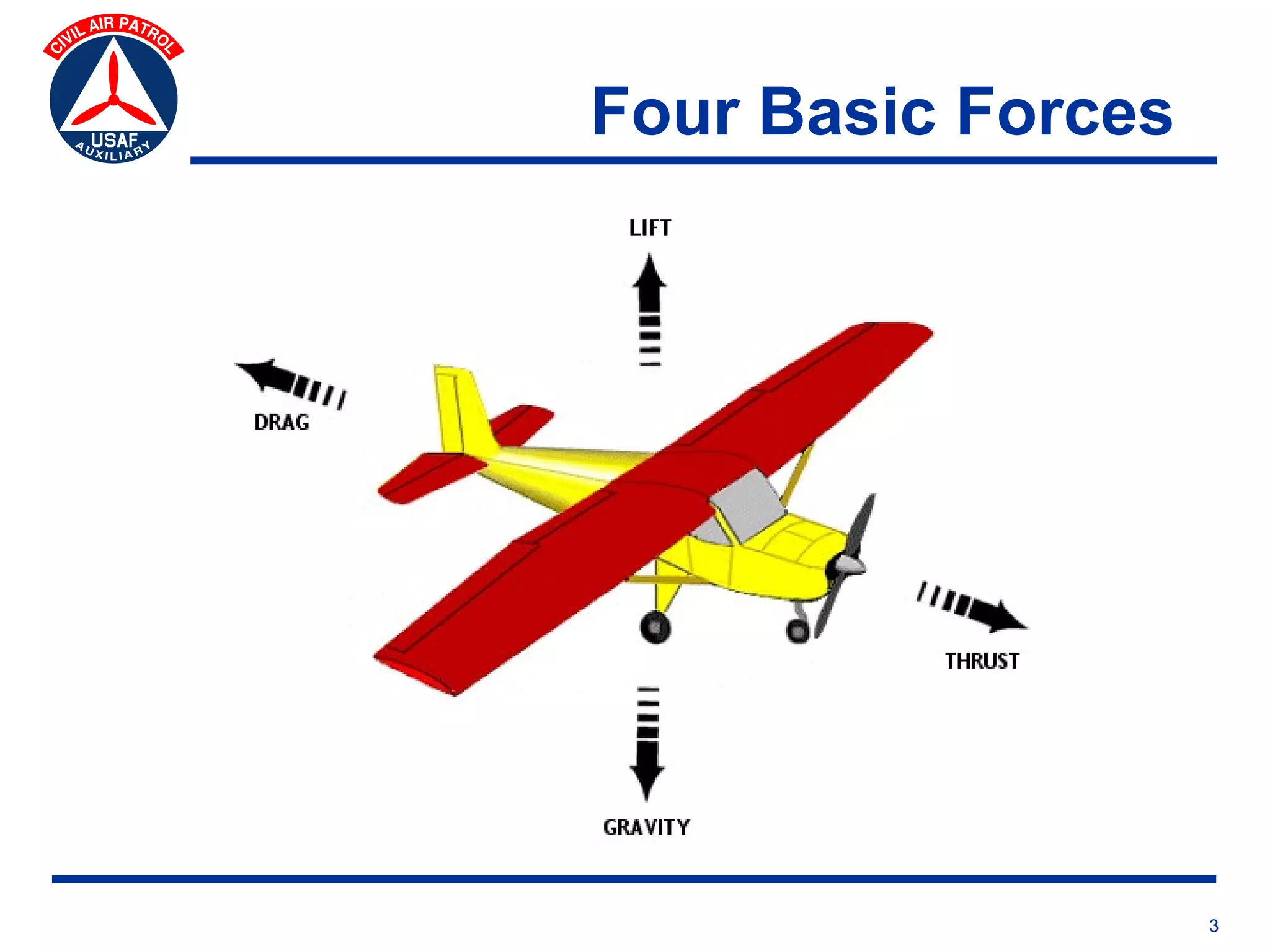
    v   Describe four basic aerodynamic forces and three
        movement axes of aircraft
    v   Identify standard flight controls of modern aircraft
    v   Describe some of the secondary effects of flight
        controls in use
    v   Identify alternative flight controls of high performance
        or non-traditional aircraft
    v   Describe the advantages and disadvantages of each
        type of alternative control


                                                                   2
Four Basic Forces


                    3
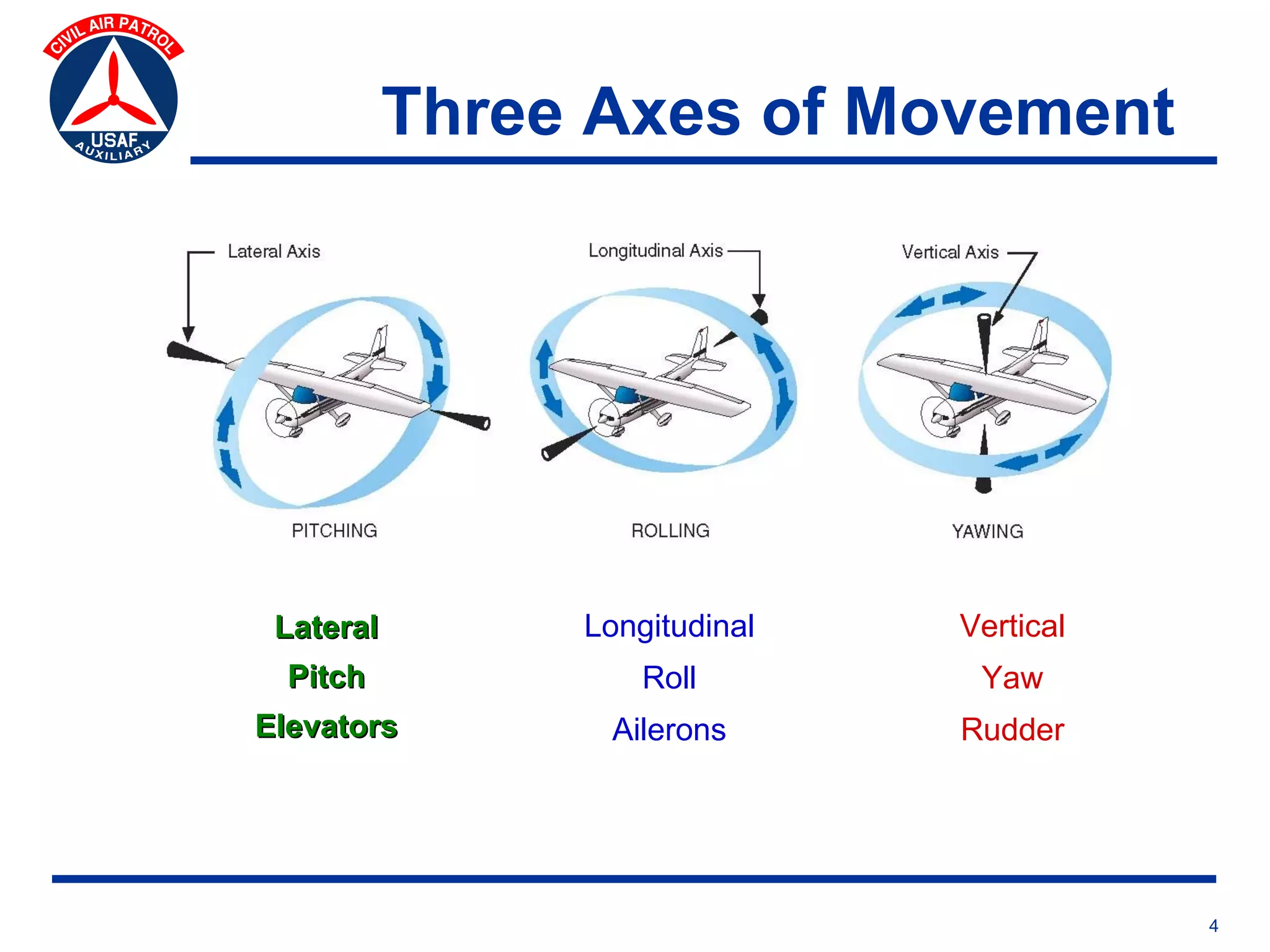
Three Axes of Movement


 Lateral        Longitudinal   Vertical
  Pitch             Roll        Yaw
Elevators        Ailerons      Rudder


                                          4
Standard Flight Controls
                                  Modern Complex Wings


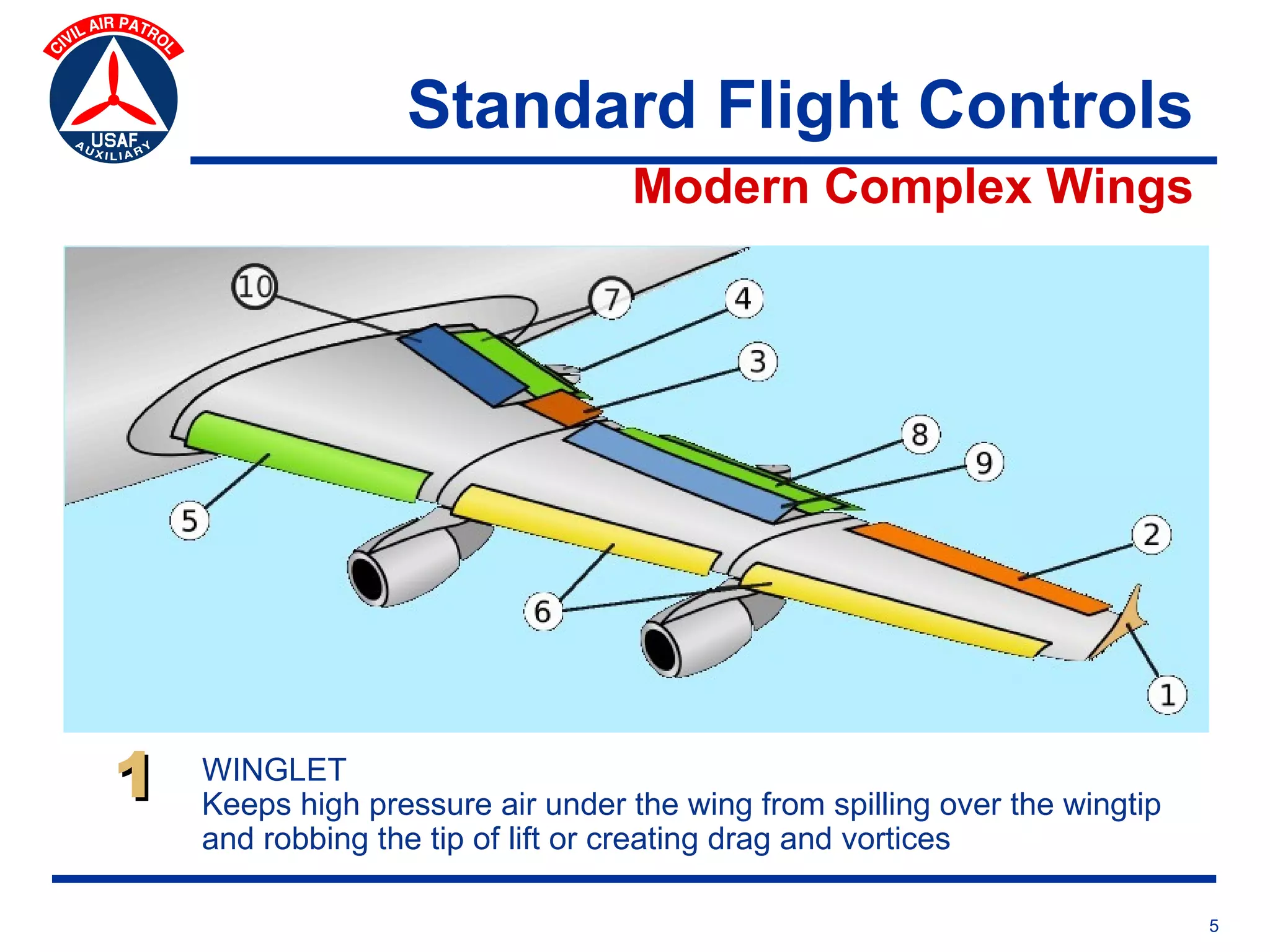
1   WINGLET
    Keeps high pressure air under the wing from spilling over the wingtip
    and robbing the tip of lift or creating drag and vortices

                                                                            5
Standard Flight Controls
                                    Modern Complex Wings


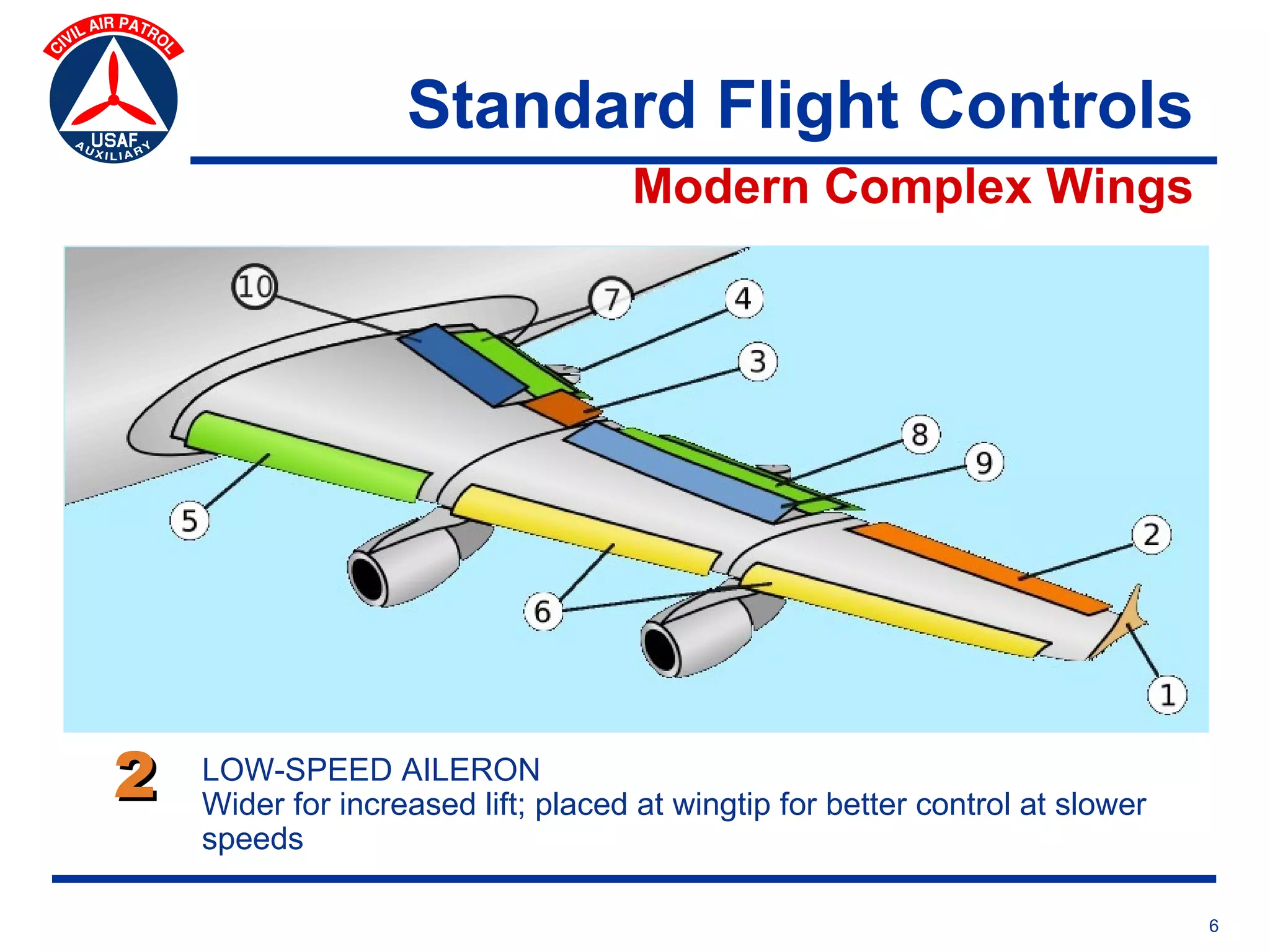
2   LOW-SPEED AILERON
    Wider for increased lift; placed at wingtip for better control at slower
    speeds

                                                                               6
Standard Flight Controls
                                  Modern Complex Wings


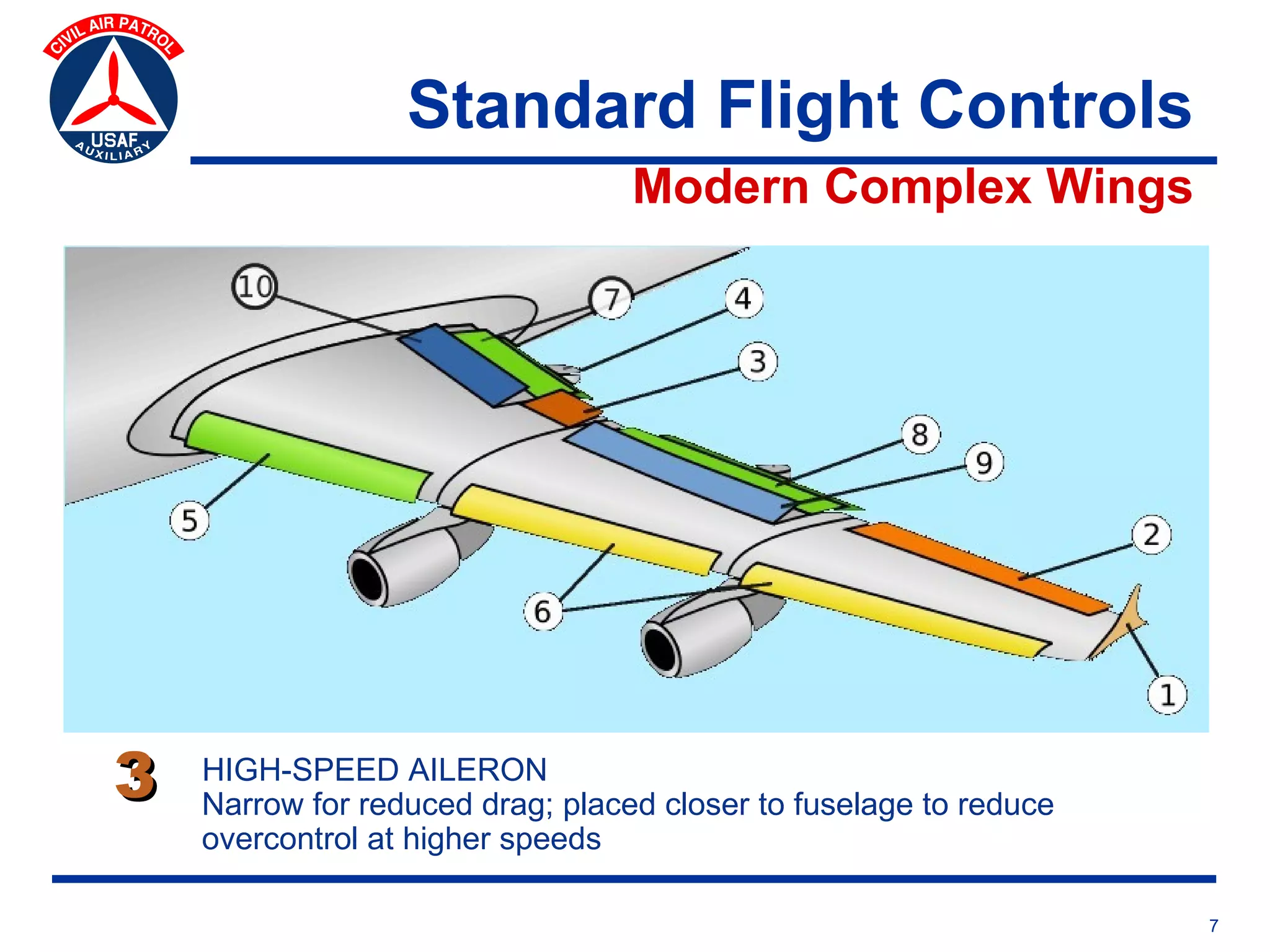
3   HIGH-SPEED AILERON
    Narrow for reduced drag; placed closer to fuselage to reduce
    overcontrol at higher speeds

                                                                   7
Standard Flight Controls
                                 Modern Complex Wings


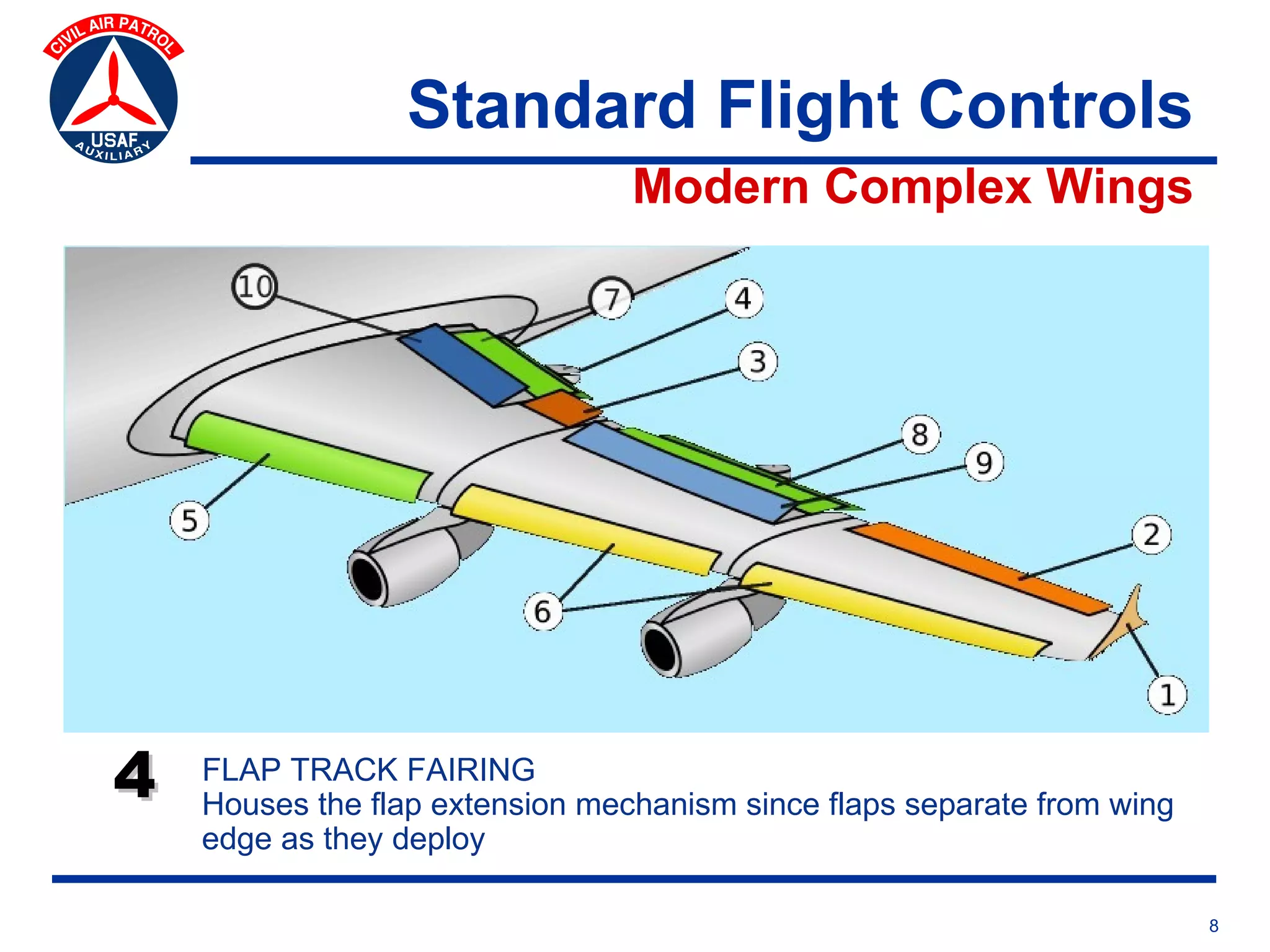
4   FLAP TRACK FAIRING
    Houses the flap extension mechanism since flaps separate from wing
    edge as they deploy

                                                                         8
Standard Flight Controls
                                   Modern Complex Wings


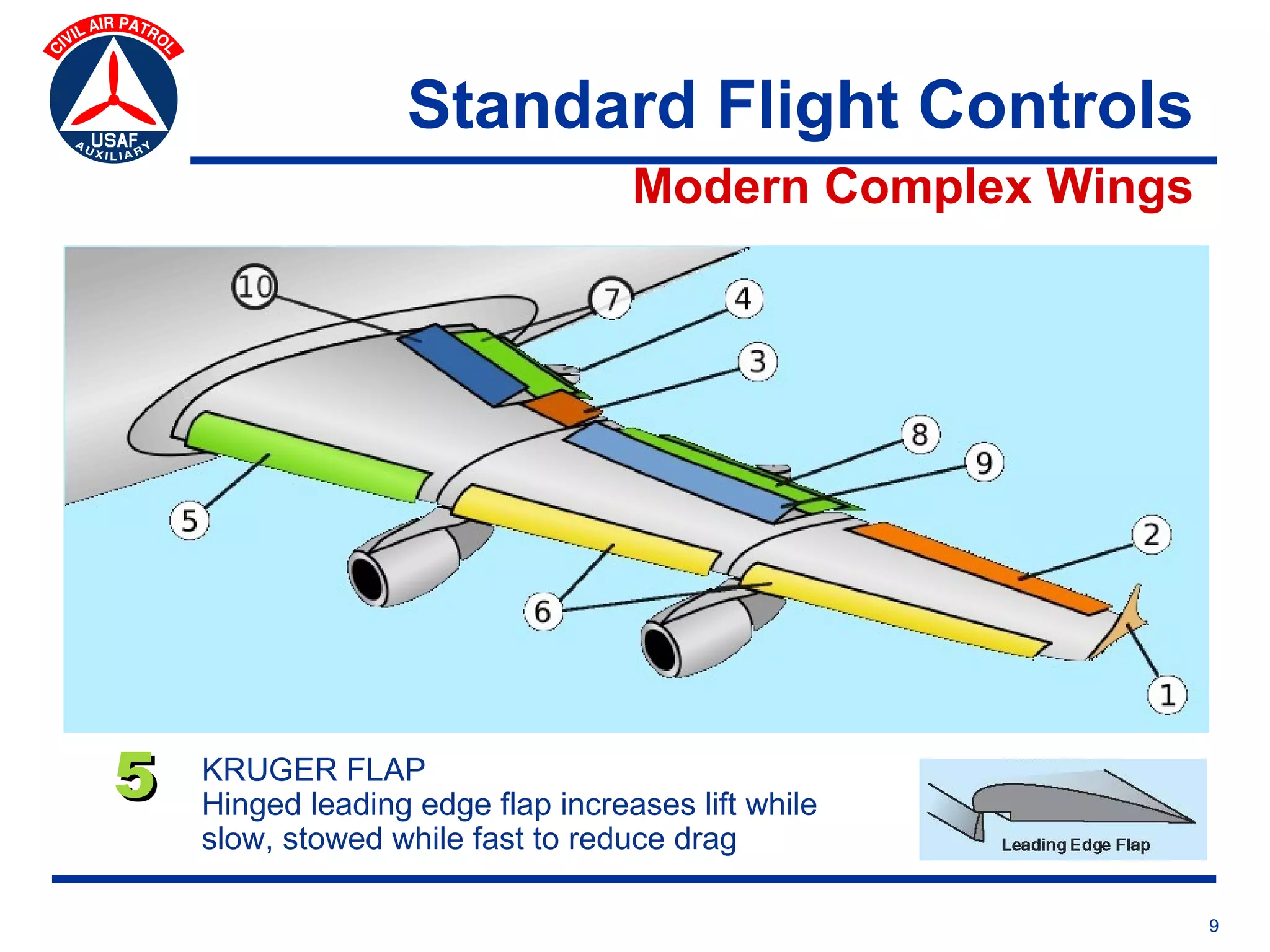
5   KRUGER FLAP
    Hinged leading edge flap increases lift while
    slow, stowed while fast to reduce drag

                                                          9
Standard Flight Controls
                                    Modern Complex Wings


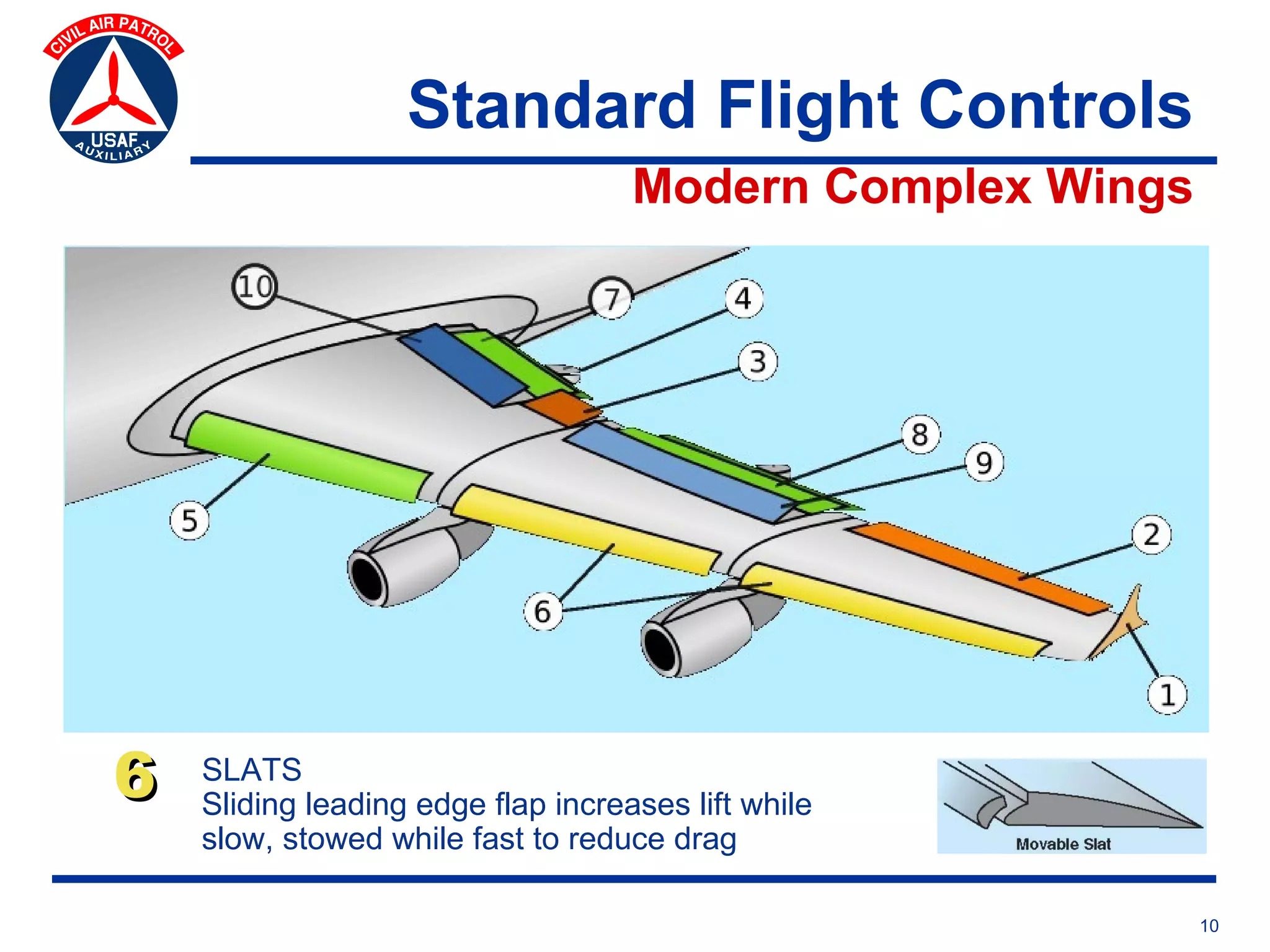
6   SLATS
    Sliding leading edge flap increases lift while
    slow, stowed while fast to reduce drag

                                                           10
Standard Flight Controls
                                     Modern Complex Wings


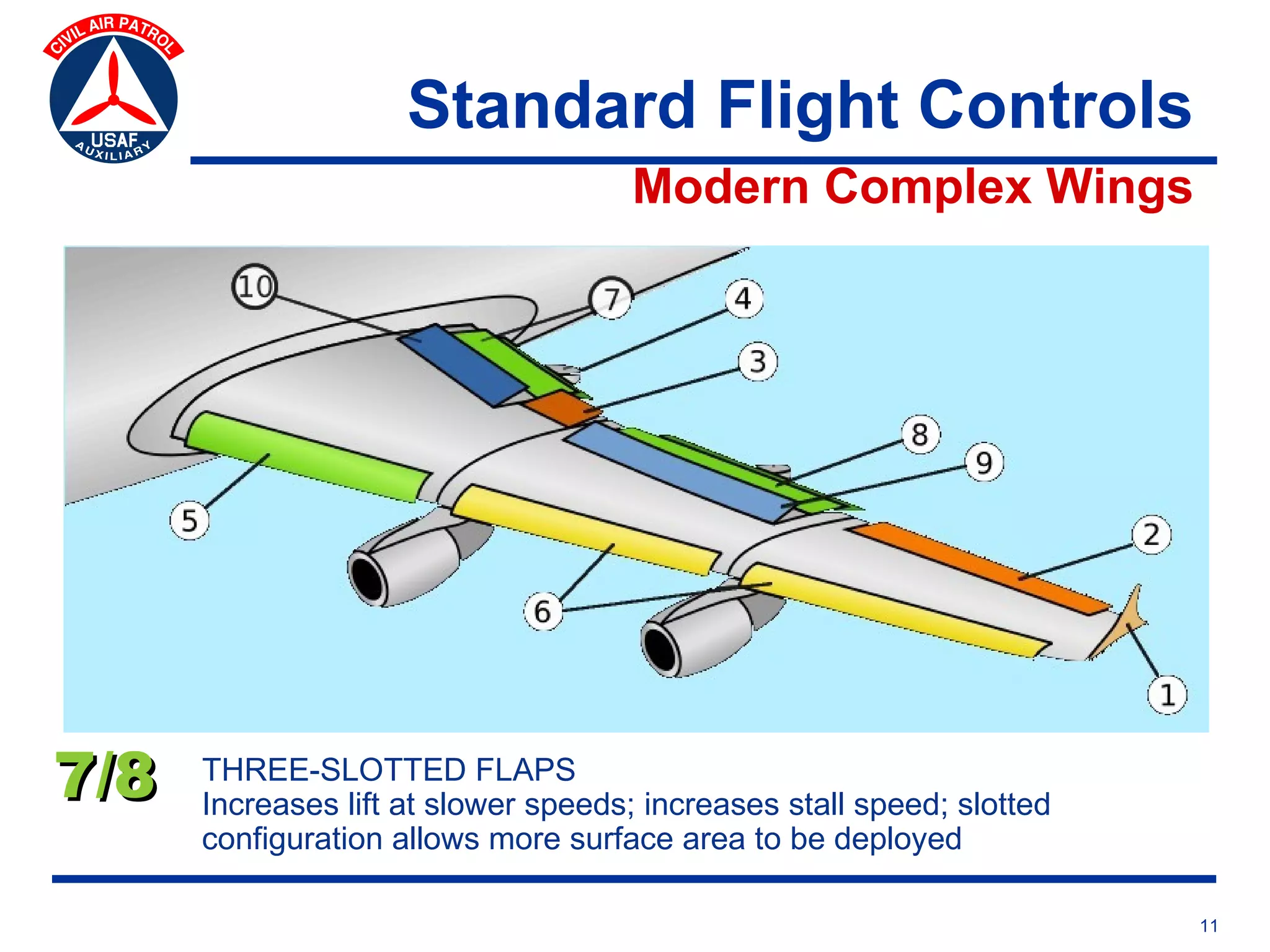
7/8   THREE-SLOTTED FLAPS
      Increases lift at slower speeds; increases stall speed; slotted
      configuration allows more surface area to be deployed

                                                                        11
Standard Flight Controls
                                 Modern Complex Wings


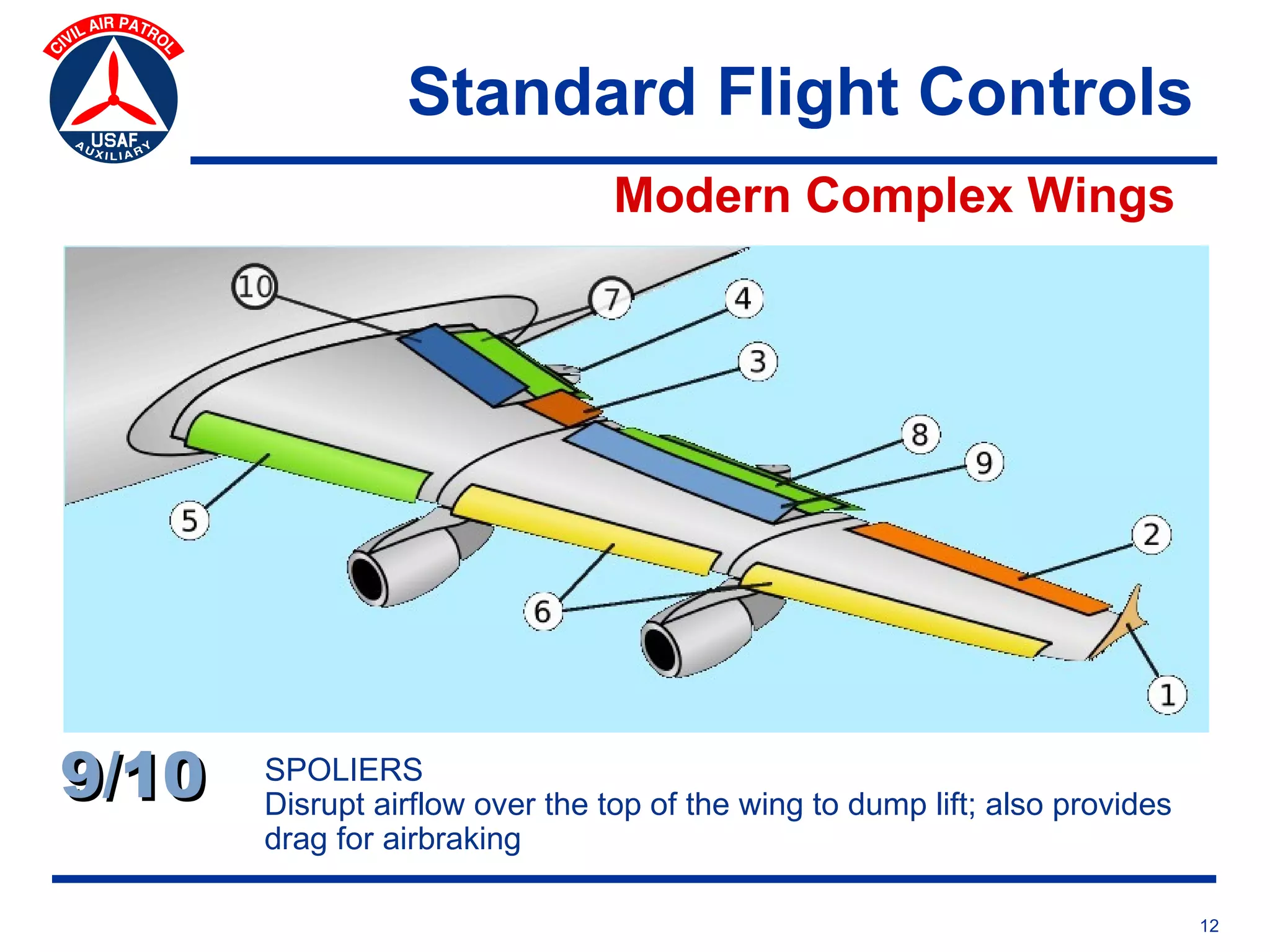
9/10   SPOLIERS
       Disrupt airflow over the top of the wing to dump lift; also provides
       drag for airbraking

                                                                              12
Secondary Effects
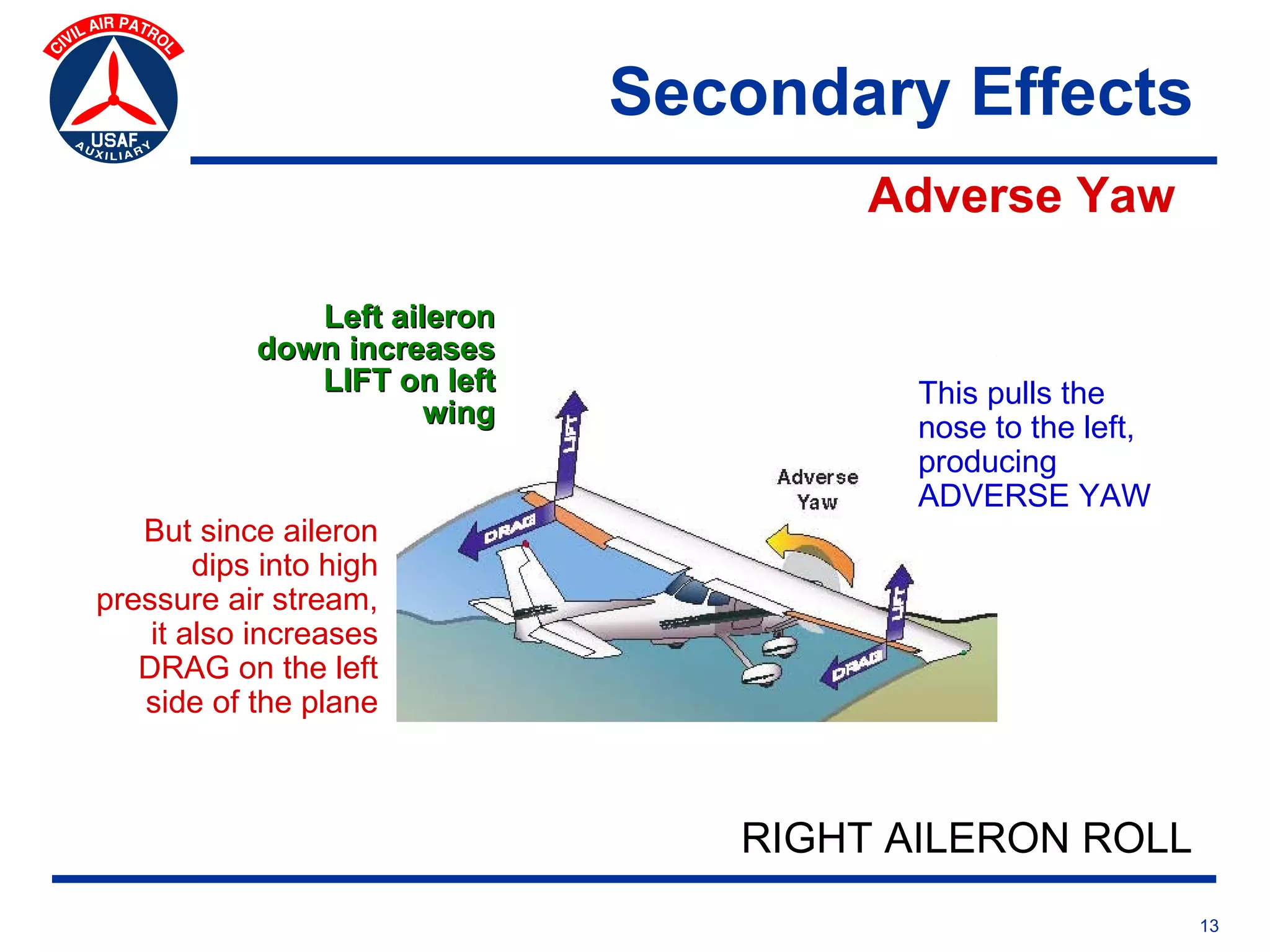
                                      Adverse Yaw

               Left aileron
            down increases
               LIFT on left             This pulls the
                       wing             nose to the left,
                                        producing
                                        ADVERSE YAW
   But since aileron
        dips into high
pressure air stream,
    it also increases
   DRAG on the left
   side of the plane


                                 RIGHT AILERON ROLL
                                                            13
Secondary Effects
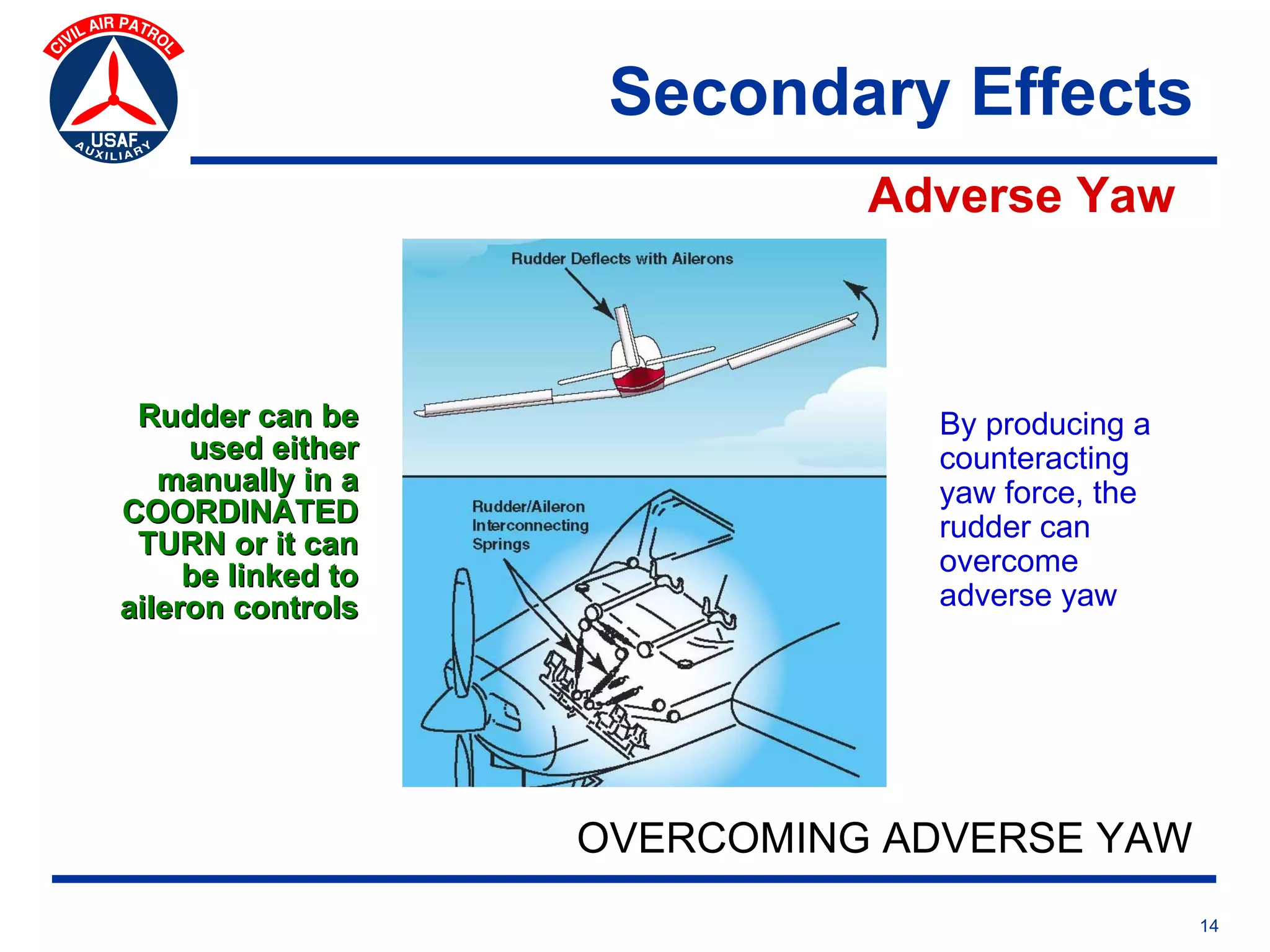
                              Adverse Yaw


 Rudder can be                  By producing a
     used either                counteracting
   manually in a                yaw force, the
COORDINATED                     rudder can
 TURN or it can
     be linked to               overcome
aileron controls                adverse yaw


                    OVERCOMING ADVERSE YAW
                                                 14
Secondary Effects
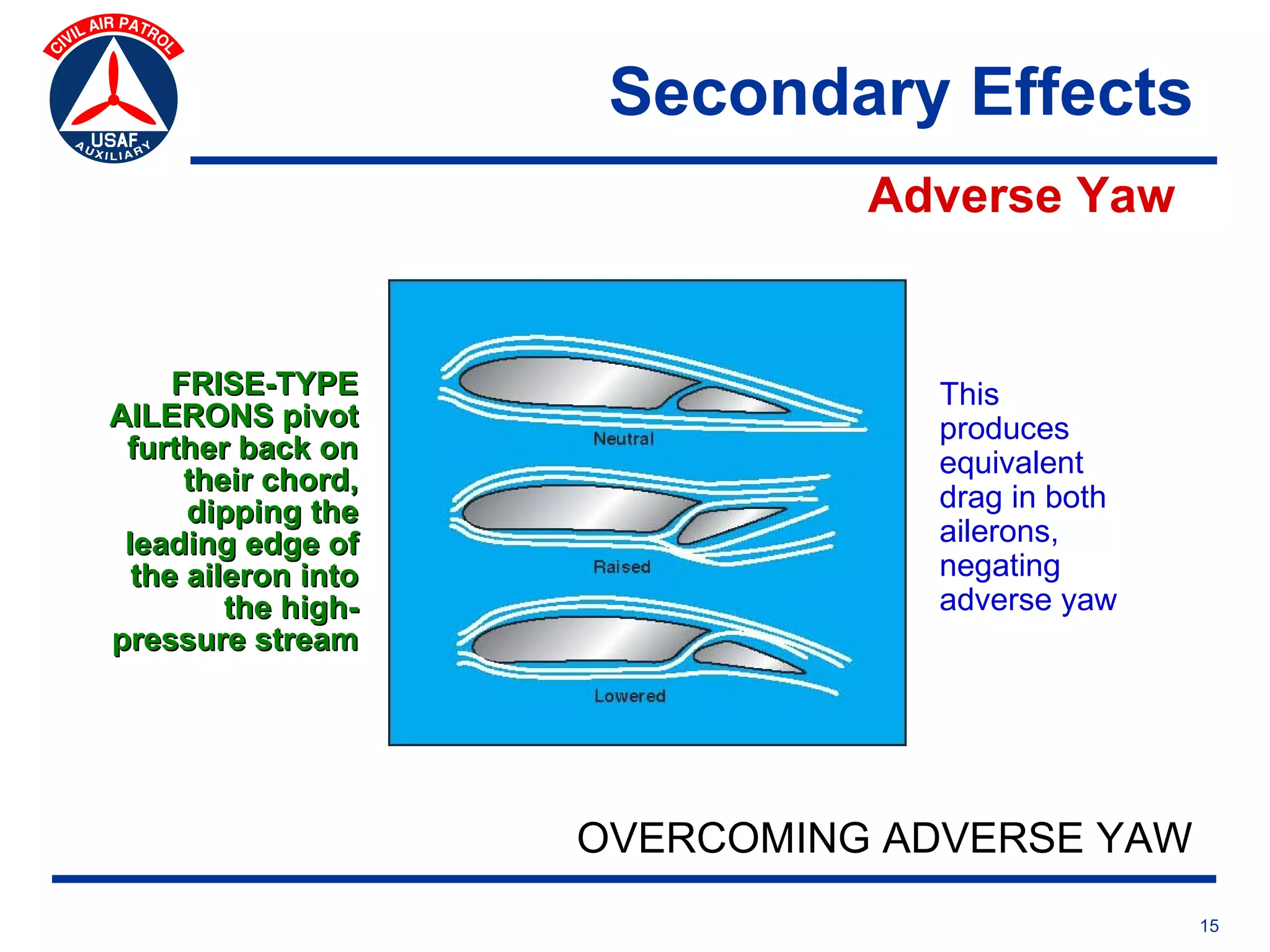
                               Adverse Yaw


     FRISE-TYPE                  This
AILERONS pivot                   produces
 further back on                 equivalent
      their chord,
      dipping the                drag in both
 leading edge of                 ailerons,
  the aileron into               negating
         the high-               adverse yaw
pressure stream


                     OVERCOMING ADVERSE YAW
                                                15
Secondary Effects
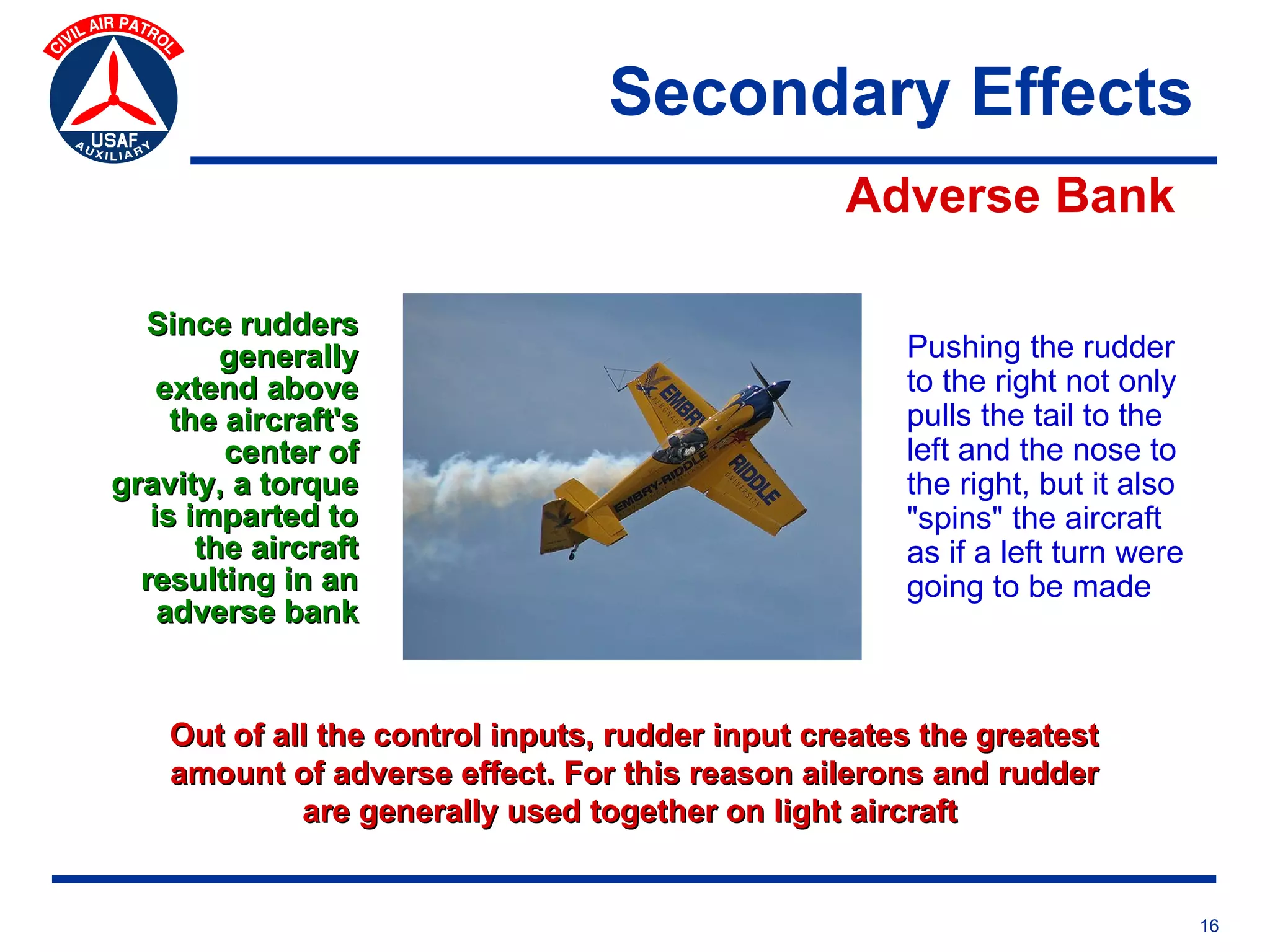
                                                  Adverse Bank

  Since rudders
         generally                                    Pushing the rudder
    extend above                                      to the right not only
     the aircraft's                                   pulls the tail to the
         center of                                    left and the nose to
gravity, a torque                                     the right, but it also
   is imparted to                                     "spins" the aircraft
       the aircraft                                   as if a left turn were
  resulting in an                                     going to be made
    adverse bank


    Out of all the control inputs, rudder input creates the greatest
    amount of adverse effect. For this reason ailerons and rudder
             are generally used together on light aircraft


                                                                               16
Alternative Controls
                                                     Stabilators


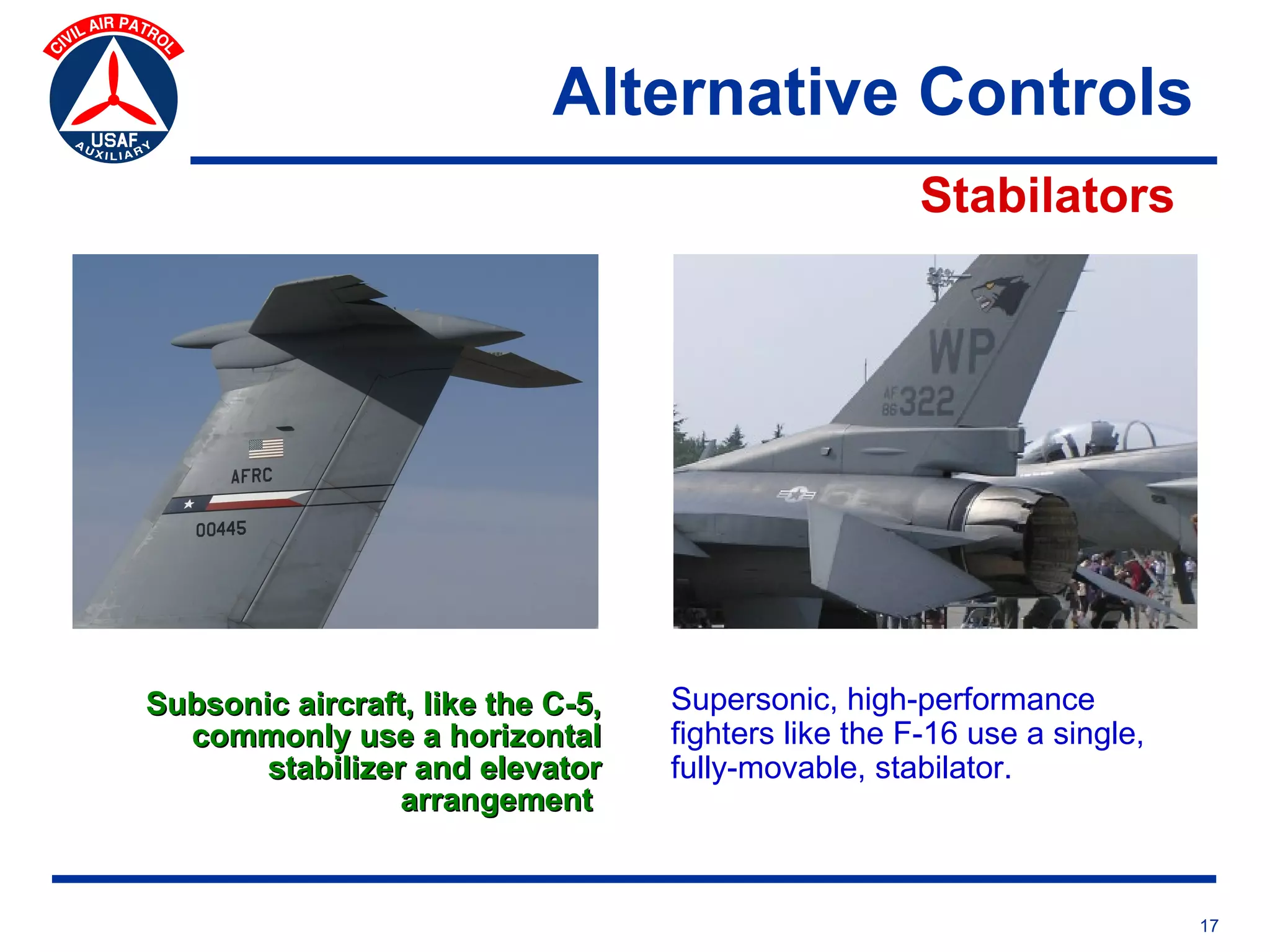
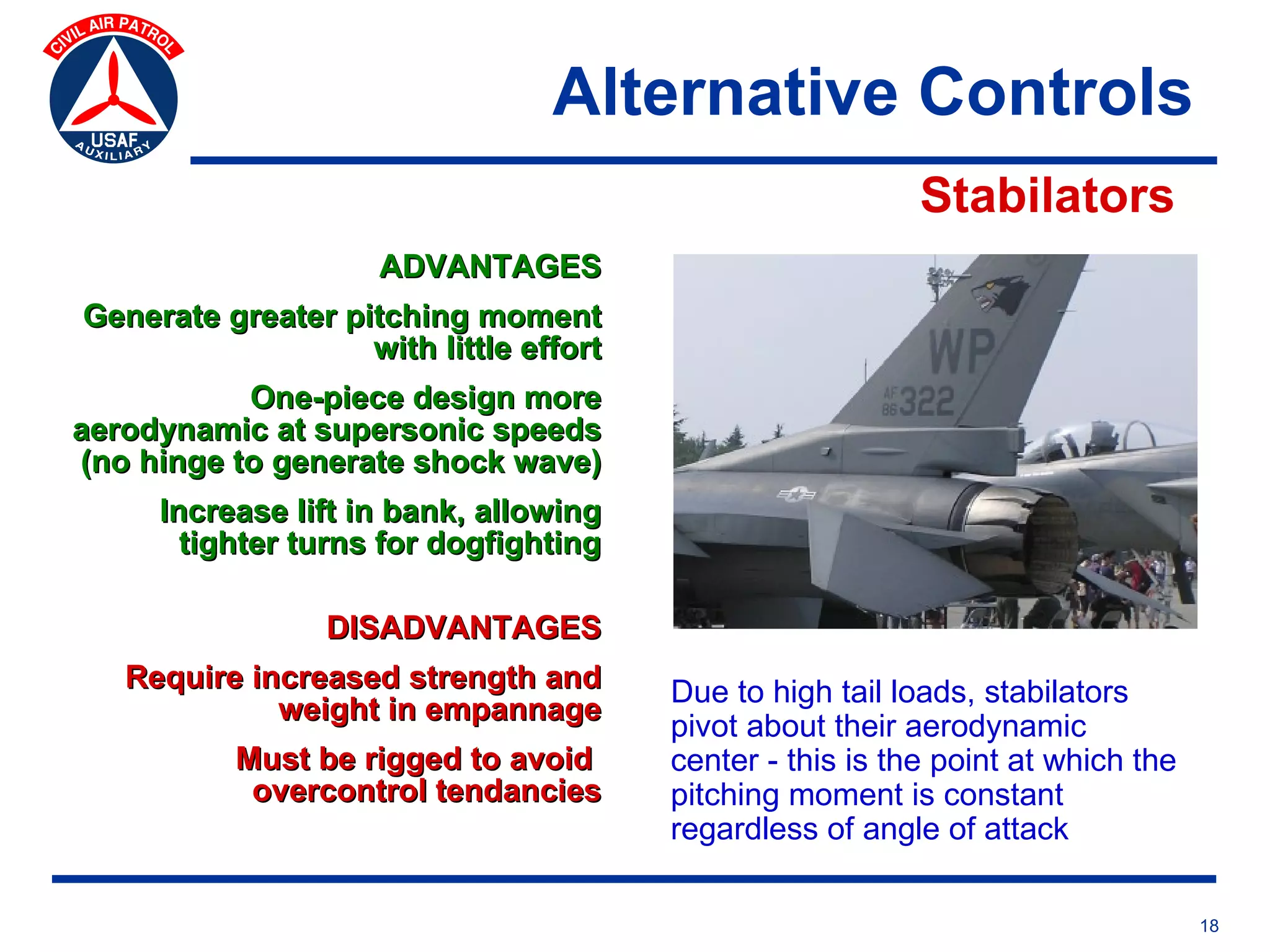
Subsonic aircraft, like the C-5,   Supersonic, high-performance
  commonly use a horizontal        fighters like the F-16 use a single,
       stabilizer and elevator     fully-movable, stabilator.
                 arrangement


                                                                          17
Alternative Controls
                                                           Stabilators
                     ADVANTAGES
Generate greater pitching moment
                   with little effort
           One-piece design more
aerodynamic at supersonic speeds
(no hinge to generate shock wave)
     Increase lift in bank, allowing
       tighter turns for dogfighting

                 DISADVANTAGES
   Require increased strength and       Due to high tail loads, stabilators
             weight in empannage
                                        pivot about their aerodynamic
          Must be rigged to avoid       center - this is the point at which the
           overcontrol tendancies       pitching moment is constant
                                        regardless of angle of attack

                                                                                  18
Alternative Controls
                                                          Tailerons
                     ADVANTAGES
                Drastically improve
                   maneuverability
           Flight control software or
      mechanical mixers can blend
 control inputs so that elevator and
aileron functions can be performed
      by the same control surfaces

                 DISADVANTAGES
Complex design & control needed
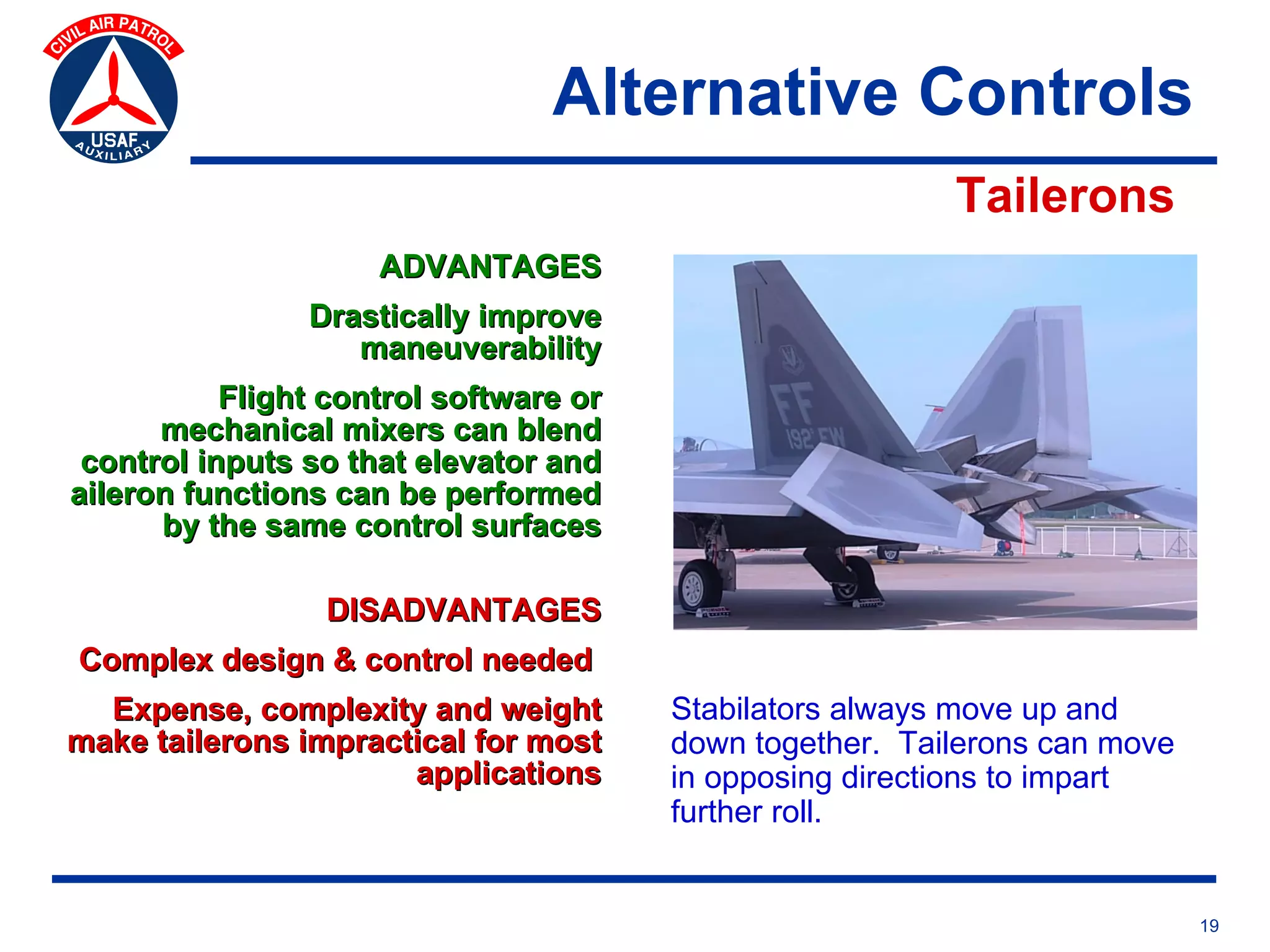
  Expense, complexity and weight        Stabilators always move up and
make tailerons impractical for most     down together. Tailerons can move
                      applications      in opposing directions to impart
                                        further roll.


                                                                            19
Alternative Controls
                                                    Spoilerons
              ADVANTAGES
       Very effective quickly
    Used in large aircraft like
    the B-52 to avoid flexing
  long wings excessively by
      using wingtip ailerons
 (ailerons must be near tips
to be effective at low speed)


          DISADVANTAGES
Add weight and complexity
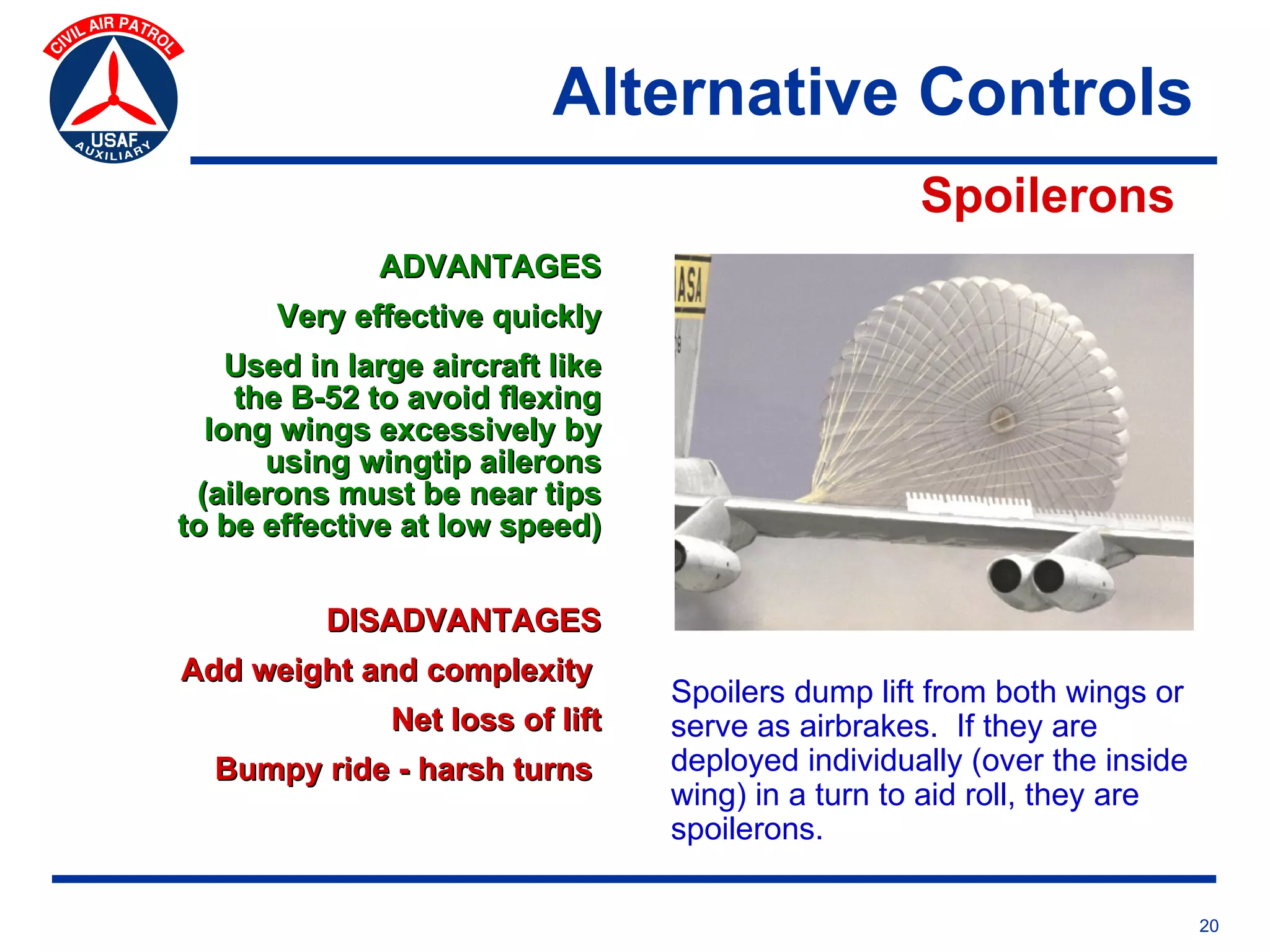
                                  Spoilers dump lift from both wings or
               Net loss of lift   serve as airbrakes. If they are
  Bumpy ride - harsh turns        deployed individually (over the inside
                                  wing) in a turn to aid roll, they are
                                  spoilerons.

                                                                           20
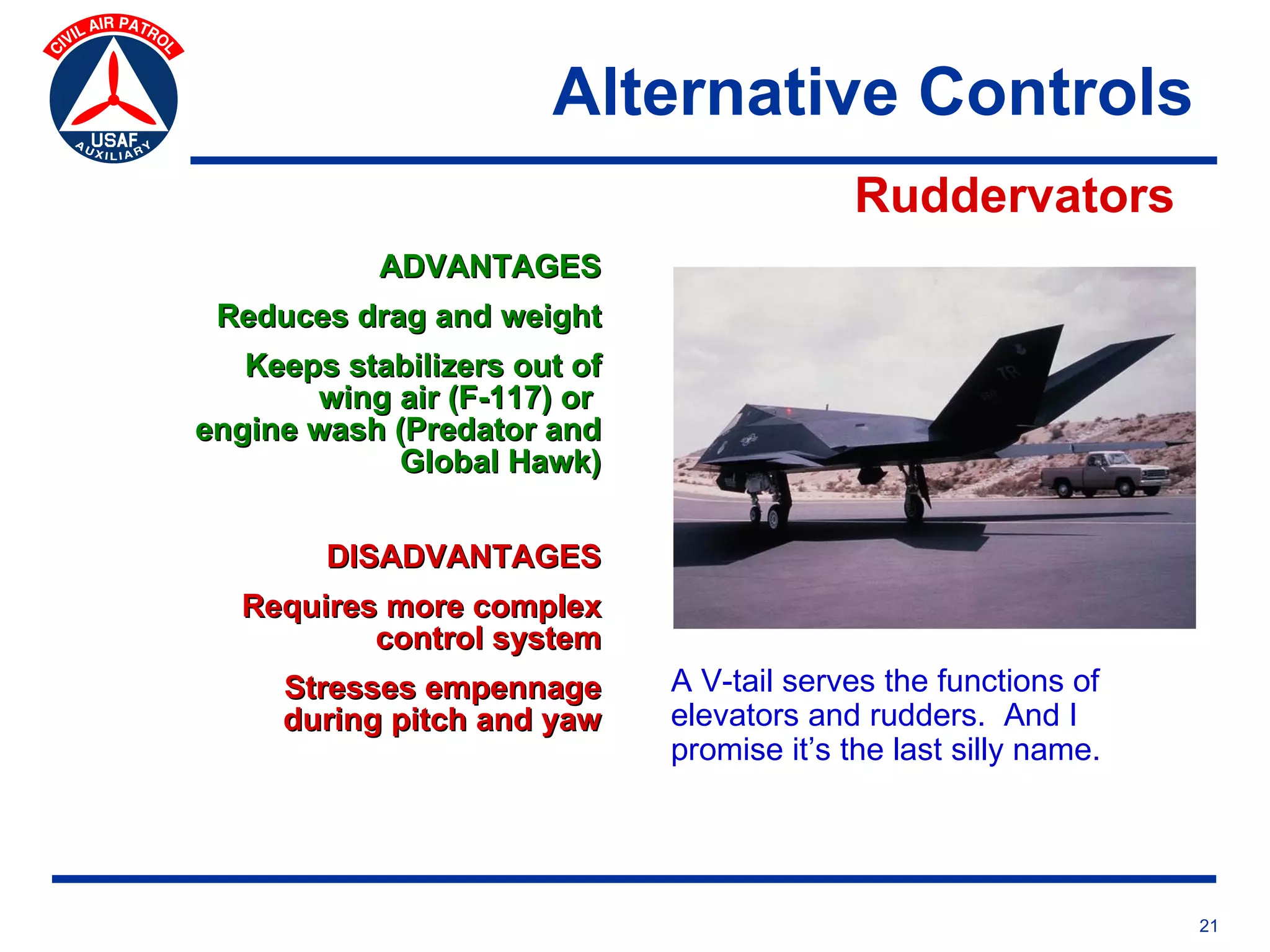
Alternative Controls
                                            Ruddervators
            ADVANTAGES
 Reduces drag and weight
   Keeps stabilizers out of
       wing air (F-117) or
engine wash (Predator and
            Global Hawk)


        DISADVANTAGES
   Requires more complex
           control system
     Stresses empennage       A V-tail serves the functions of
     during pitch and yaw     elevators and rudders. And I
                              promise it’s the last silly name.


                                                                  21

Advanced Aerodynamics

  • 1.
    Welcome A D VA N C E D F lig h t C o n t r o ls Presented by 2LT Kevin McNulty 1
  • 2.
    Learning Objectives At theend of this course, you will be able to… v Describe four basic aerodynamic forces and three movement axes of aircraft v Identify standard flight controls of modern aircraft v Describe some of the secondary effects of flight controls in use v Identify alternative flight controls of high performance or non-traditional aircraft v Describe the advantages and disadvantages of each type of alternative control 2
  • 3.
  • 4.
    Three Axes ofMovement Lateral Longitudinal Vertical Pitch Roll Yaw Elevators Ailerons Rudder 4
  • 5.
    Standard Flight Controls Modern Complex Wings 1 WINGLET Keeps high pressure air under the wing from spilling over the wingtip and robbing the tip of lift or creating drag and vortices 5
  • 6.
    Standard Flight Controls Modern Complex Wings 2 LOW-SPEED AILERON Wider for increased lift; placed at wingtip for better control at slower speeds 6
  • 7.
    Standard Flight Controls Modern Complex Wings 3 HIGH-SPEED AILERON Narrow for reduced drag; placed closer to fuselage to reduce overcontrol at higher speeds 7
  • 8.
    Standard Flight Controls Modern Complex Wings 4 FLAP TRACK FAIRING Houses the flap extension mechanism since flaps separate from wing edge as they deploy 8
  • 9.
    Standard Flight Controls Modern Complex Wings 5 KRUGER FLAP Hinged leading edge flap increases lift while slow, stowed while fast to reduce drag 9
  • 10.
    Standard Flight Controls Modern Complex Wings 6 SLATS Sliding leading edge flap increases lift while slow, stowed while fast to reduce drag 10
  • 11.
    Standard Flight Controls Modern Complex Wings 7/8 THREE-SLOTTED FLAPS Increases lift at slower speeds; increases stall speed; slotted configuration allows more surface area to be deployed 11
  • 12.
    Standard Flight Controls Modern Complex Wings 9/10 SPOLIERS Disrupt airflow over the top of the wing to dump lift; also provides drag for airbraking 12
  • 13.
    Secondary Effects Adverse Yaw Left aileron down increases LIFT on left This pulls the wing nose to the left, producing ADVERSE YAW But since aileron dips into high pressure air stream, it also increases DRAG on the left side of the plane RIGHT AILERON ROLL 13
  • 14.
    Secondary Effects Adverse Yaw Rudder can be By producing a used either counteracting manually in a yaw force, the COORDINATED rudder can TURN or it can be linked to overcome aileron controls adverse yaw OVERCOMING ADVERSE YAW 14
  • 15.
    Secondary Effects Adverse Yaw FRISE-TYPE This AILERONS pivot produces further back on equivalent their chord, dipping the drag in both leading edge of ailerons, the aileron into negating the high- adverse yaw pressure stream OVERCOMING ADVERSE YAW 15
  • 16.
    Secondary Effects Adverse Bank Since rudders generally Pushing the rudder extend above to the right not only the aircraft's pulls the tail to the center of left and the nose to gravity, a torque the right, but it also is imparted to "spins" the aircraft the aircraft as if a left turn were resulting in an going to be made adverse bank Out of all the control inputs, rudder input creates the greatest amount of adverse effect. For this reason ailerons and rudder are generally used together on light aircraft 16
  • 17.
    Alternative Controls Stabilators Subsonic aircraft, like the C-5, Supersonic, high-performance commonly use a horizontal fighters like the F-16 use a single, stabilizer and elevator fully-movable, stabilator. arrangement 17
  • 18.
    Alternative Controls Stabilators ADVANTAGES Generate greater pitching moment with little effort One-piece design more aerodynamic at supersonic speeds (no hinge to generate shock wave) Increase lift in bank, allowing tighter turns for dogfighting DISADVANTAGES Require increased strength and Due to high tail loads, stabilators weight in empannage pivot about their aerodynamic Must be rigged to avoid center - this is the point at which the overcontrol tendancies pitching moment is constant regardless of angle of attack 18
  • 19.
    Alternative Controls Tailerons ADVANTAGES Drastically improve maneuverability Flight control software or mechanical mixers can blend control inputs so that elevator and aileron functions can be performed by the same control surfaces DISADVANTAGES Complex design & control needed Expense, complexity and weight Stabilators always move up and make tailerons impractical for most down together. Tailerons can move applications in opposing directions to impart further roll. 19
  • 20.
    Alternative Controls Spoilerons ADVANTAGES Very effective quickly Used in large aircraft like the B-52 to avoid flexing long wings excessively by using wingtip ailerons (ailerons must be near tips to be effective at low speed) DISADVANTAGES Add weight and complexity Spoilers dump lift from both wings or Net loss of lift serve as airbrakes. If they are Bumpy ride - harsh turns deployed individually (over the inside wing) in a turn to aid roll, they are spoilerons. 20
  • 21.
    Alternative Controls Ruddervators ADVANTAGES Reduces drag and weight Keeps stabilizers out of wing air (F-117) or engine wash (Predator and Global Hawk) DISADVANTAGES Requires more complex control system Stresses empennage A V-tail serves the functions of during pitch and yaw elevators and rudders. And I promise it’s the last silly name. 21