Extensor Tendon Injury
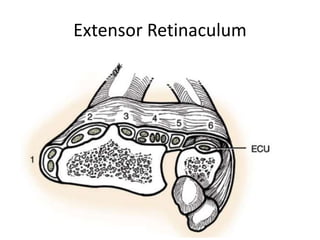
Extensor Retinaculum
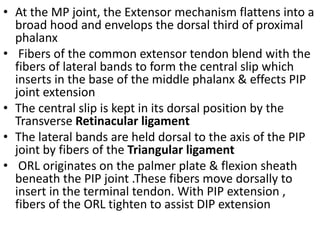
• At the MP joint, the Extensor mechanism flattens into a
broad hood and envelops the dorsal third of proximal
phalanx
• Fibers of the common extensor tendon blend with the
fibers of lateral bands to form the central slip which
inserts in the base of the middle phalanx & effects PIP
joint extension
• The central slip is kept in its dorsal position by the
Transverse Retinacular ligament
• The lateral bands are held dorsal to the axis of the PIP
joint by fibers of the Triangular ligament
• ORL originates on the palmer plate & flexion sheath
beneath the PIP joint .These fibers move dorsally to
insert in the terminal tendon. With PIP extension ,
fibers of the ORL tighten to assist DIP extension
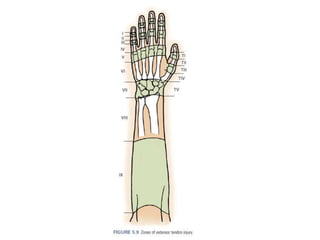
Zone I injury
• Occurs at the DIP joint of the finger or the IP joint
of the thumb
• Mechanism of injury is usually forced flexion of
an actively extended distal joint
• aka Mallet finger, Base ball finger, Dropped
finger, or Extension lag
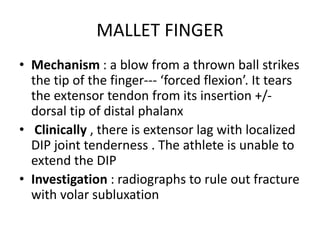
MALLET FINGER
• Mechanism : a blow from a thrown ball strikes
the tip of the finger--- ‘forced flexion’. It tears
the extensor tendon from its insertion +/-
dorsal tip of distal phalanx
• Clinically , there is extensor lag with localized
DIP joint tenderness . The athlete is unable to
extend the DIP
• Investigation : radiographs to rule out fracture
with volar subluxation
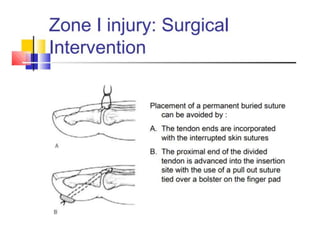
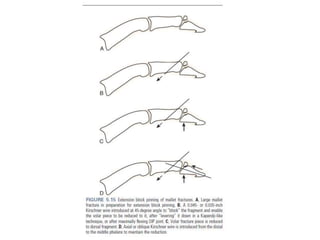
• Management : continuous splint immobilization for 8
weeks in full extension followed by 4 weeks of night
time splinting .
• Indications for surgery: open injuries, a large dorsal
fragment with palmar subluxation of the distal
fragment
• Complications : skin ulceration is most common.
Compensatory Swan neck deformity is known to occur.
• Chronic Mallet injuries with compensatory swan neck
deformity are reconstructed with ORL reconstruction
techniques , central slip tenotomy (Fowler). Those
chronic deformities which are painful, arthritic, and
interfere with hand function are treated with DIP fusion
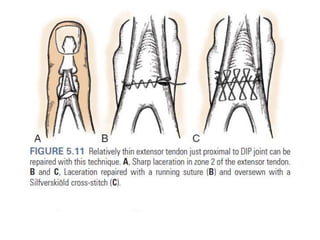
ZONE II INJURY
• Extensor tendon width is greater in zone II than zone I
& the extensor mechanism has two lateral bands which
extend the distal phalanx
• Lacerations of less than 50% of the tendon cut can be
treated by skin closure alone, rest are repaired by a pull
out suture technique
• Typically seen in conjunction with sharp lacerations,
saw injuries, and crushing injuries
• The DIP is splinted in extension for 4 to 6 weeks
• Turrent Exostosis is a mass of bone formed secondary
to a periosteum injury in a zone II laceration. This mass
limits DIP flexion and resection is the treatment of
choice
ZONE III INJURY
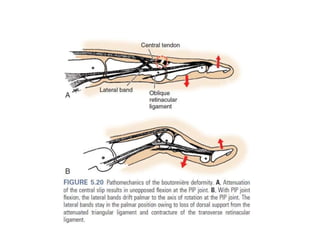
• Disruption of the extensor apparatus at or just proximal to
the PIP joint results in a loss of extensor power at the PIP
joint
• Forced flexion of the PIP joint damages the central slip of the
extensor tendon
• After central slip disruption the triangular ligament stretches
over time shifting the lateral bands in a volar direction
• The head of the proximal phalanx ‘buttonholes’ through the
extensor mechanism, creating the Boutonniere deformity
• Lateral bands falling volar become PIP joint flexors instead of
extensors while continuing to exert an extensor force on the
DIP joint
• Boutonniere deformity can be acute –(closed or open) and
chronic
Chronic Boutonniere Deformity
Burton & Melchior classification:
• Stage 1: supple, passively correctable deformity
• Stage 2: fixed contracture: contracted lateral bands
• Stage 3: fixed contracture: joint fibrosis, collateral
ligament & palmar plate contractures
• Stage 4: Stage with PIP joint arthritis
Treatment plan in Boutonniere
deformity
• Acute closed Boutonniere injuries: extension
splinting of PIP joint
• Acute open Boutonniere injuries: primary repair (
Doyle’s, Snow’s, Aiche’s methods)
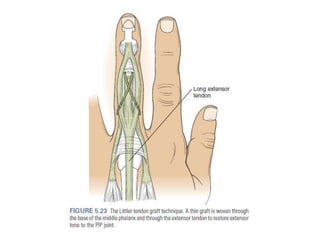
• Chronic Boutonniere deformity: Stage 1 & 2-
therapy regimen of active assisted extension of the
PIP joint combined with passive flexion of the DIP
joint . Stage 3 – options include Tenotomy, Tendon
grafting, Tendon relocation
Burton & Melchior’s guidelines for
Boutonniere surgery
• Boutonniere reconstruction are most successful on
supple joints. If necessary, a joint release can be
performed as a first stage.
• An Arthritic joint usually precludes soft tissue
reconstruction. The surgeon should consider either a
PIP joint fusion or Arthroplasty with extensor tendon
reconstruction
• Goal of Boutonniere reconstruction is to rebalance the
extensor system by reducing extensor tone at the DIP
joint and increasing tone at the PIP joint
• Splinting is an important component of the post
operative care; it may be necessary for several months
Extensor Tenotomy for Supple
Boutonniere deformity
Pseudo Boutonniere Deformity
• Flexion deformity of PIP joint, often following
an axial load injury
• Hyper extension injury to PIP joint
• Volar plate avulsion on X-ray with volar PIP
joint tenderness
• More common than Boutonniere deformity
• Protected immobilization required
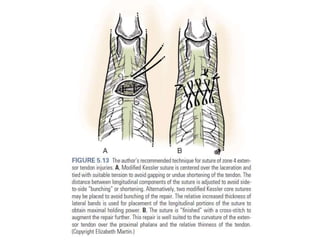
ZONE IV INJURY
• Partial zone IV injury is more common than a
complete laceration because the extensor
mechanism is flat & it curves around the proximal
phalanx
• Often associated with a proximal phalanx fracture
• Treatment is repair with modified Kessler’s suture
using 4-0 braided polyester
• Within 1 week of repair the patient is started on
passive extension & active flexion
Dynamic splint in zone IV injuries
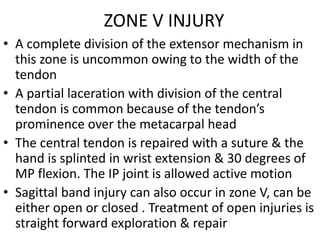
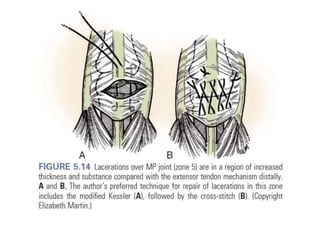
ZONE V INJURY
• A complete division of the extensor mechanism in
this zone is uncommon owing to the width of the
tendon
• A partial laceration with division of the central
tendon is common because of the tendon’s
prominence over the metacarpal head
• The central tendon is repaired with a suture & the
hand is splinted in wrist extension & 30 degrees of
MP flexion. The IP joint is allowed active motion
• Sagittal band injury can also occur in zone V, can be
either open or closed . Treatment of open injuries is
straight forward exploration & repair
Closed Sagittal band injuries
(Extensor tendon subluxation)
• Result from direct blow, from forced MP joint
flexion
• Symptoms range from pain & loss of MP joint
motion to extensor tendon snapping or catching
during finger flexion
• Acute injuries that are 2 -3 week old can be treated
with extension splinting of the MP joint
• Patients who fail splint treatment or who have an
injury more than 3 weeks old should be treated
with direct repair of the Sagittal band
ZONE VI INJURY
• Have a better prognosis than distal injuries because
decreased surface area & increased subcutaneous
tissue lessens adhesion formation and also there is
greater tendon excursion with no complex tendon
imbalances
• Modified Bunnel or Kessler’s core suture
supplanted with epitendinous sutures is the
standard treatment
• Complications after zone VI repair are loss of
flexion, loss of extension, & tendon rupture in the
order of frequency
ZONE VII INJURY
• There is almost always an associated injury to
the extensor Retinaculum
• Point in favor of excision of Retinaculum are
that it improves exposure & prevents friction
between bulky repairs and the retinaculum
while its preservation prevents bow stringing
or subluxation of the extensor tendons
• Treatment is same as zone VI in acute cases
Chronic injuries of zone VII
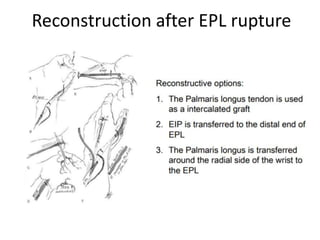
• Most common cause is attritional rupture e.g. EPL
rupture after distal radius fracture or with
Rheumatoid Arthritis
• Management is difficult as there is no Paratenon in
this region leading to retraction of the proximal
tendon. Also, since the ends are frayed, end to end
repair is not possible without unacceptable
shortening of the musculotendinous unit & a loss of
flexion
• Tendon transfer or a graft is the standard treatment
Reconstruction after EPL rupture
ZONE VIII INJURY
• Includes ruptures of musculotendinous
junction and muscle belly lacerations
• Repair of these injuries is complicated by the
difficulty of placing sutures in the thin fascia
overlying the muscle
• When repair is not feasible, a side to side
tendon transfer provides the best means to
restore tendon function
ZONE IX INJURY
• Penetrating trauma in this region can be
accompanied by nerve injuries making assessment
difficult
• A proximal forearm laceration with a loss of distal
muscle group function is probably a motor nerve
injury rather than a tendon division
• Multiple interrupted absorbable sutures are used
to repair the Epimysium & fibrous intramuscular
septum.
• Suture repair of muscle lacerations have virtually
no tensile strength. Post op treatment is 4 weeks of
cast immobilization
COMPLICATIONS
• Most common complication after tendon repair is the
formation of adhesions between the repair site,
adjacent skin and the bone. The adhesions can restrict
joint flexion as well as extension. Treatment includes
Tenolysis, Capsulotomy or Collateral ligament release
• Gapping
• Disruption
• Non healing skin site
• Scarring
• Decreased Joint mobility

Extensor tendon injury

  • 1.
  • 2.
  • 5.
    • At theMP joint, the Extensor mechanism flattens into a broad hood and envelops the dorsal third of proximal phalanx • Fibers of the common extensor tendon blend with the fibers of lateral bands to form the central slip which inserts in the base of the middle phalanx & effects PIP joint extension • The central slip is kept in its dorsal position by the Transverse Retinacular ligament • The lateral bands are held dorsal to the axis of the PIP joint by fibers of the Triangular ligament • ORL originates on the palmer plate & flexion sheath beneath the PIP joint .These fibers move dorsally to insert in the terminal tendon. With PIP extension , fibers of the ORL tighten to assist DIP extension
  • 8.
    Zone I injury •Occurs at the DIP joint of the finger or the IP joint of the thumb • Mechanism of injury is usually forced flexion of an actively extended distal joint • aka Mallet finger, Base ball finger, Dropped finger, or Extension lag
  • 9.
    MALLET FINGER • Mechanism: a blow from a thrown ball strikes the tip of the finger--- ‘forced flexion’. It tears the extensor tendon from its insertion +/- dorsal tip of distal phalanx • Clinically , there is extensor lag with localized DIP joint tenderness . The athlete is unable to extend the DIP • Investigation : radiographs to rule out fracture with volar subluxation
  • 12.
    • Management :continuous splint immobilization for 8 weeks in full extension followed by 4 weeks of night time splinting . • Indications for surgery: open injuries, a large dorsal fragment with palmar subluxation of the distal fragment • Complications : skin ulceration is most common. Compensatory Swan neck deformity is known to occur. • Chronic Mallet injuries with compensatory swan neck deformity are reconstructed with ORL reconstruction techniques , central slip tenotomy (Fowler). Those chronic deformities which are painful, arthritic, and interfere with hand function are treated with DIP fusion
  • 17.
    ZONE II INJURY •Extensor tendon width is greater in zone II than zone I & the extensor mechanism has two lateral bands which extend the distal phalanx • Lacerations of less than 50% of the tendon cut can be treated by skin closure alone, rest are repaired by a pull out suture technique • Typically seen in conjunction with sharp lacerations, saw injuries, and crushing injuries • The DIP is splinted in extension for 4 to 6 weeks • Turrent Exostosis is a mass of bone formed secondary to a periosteum injury in a zone II laceration. This mass limits DIP flexion and resection is the treatment of choice
  • 19.
    ZONE III INJURY •Disruption of the extensor apparatus at or just proximal to the PIP joint results in a loss of extensor power at the PIP joint • Forced flexion of the PIP joint damages the central slip of the extensor tendon • After central slip disruption the triangular ligament stretches over time shifting the lateral bands in a volar direction • The head of the proximal phalanx ‘buttonholes’ through the extensor mechanism, creating the Boutonniere deformity • Lateral bands falling volar become PIP joint flexors instead of extensors while continuing to exert an extensor force on the DIP joint • Boutonniere deformity can be acute –(closed or open) and chronic
  • 22.
    Chronic Boutonniere Deformity Burton& Melchior classification: • Stage 1: supple, passively correctable deformity • Stage 2: fixed contracture: contracted lateral bands • Stage 3: fixed contracture: joint fibrosis, collateral ligament & palmar plate contractures • Stage 4: Stage with PIP joint arthritis
  • 23.
    Treatment plan inBoutonniere deformity • Acute closed Boutonniere injuries: extension splinting of PIP joint • Acute open Boutonniere injuries: primary repair ( Doyle’s, Snow’s, Aiche’s methods) • Chronic Boutonniere deformity: Stage 1 & 2- therapy regimen of active assisted extension of the PIP joint combined with passive flexion of the DIP joint . Stage 3 – options include Tenotomy, Tendon grafting, Tendon relocation
  • 24.
    Burton & Melchior’sguidelines for Boutonniere surgery • Boutonniere reconstruction are most successful on supple joints. If necessary, a joint release can be performed as a first stage. • An Arthritic joint usually precludes soft tissue reconstruction. The surgeon should consider either a PIP joint fusion or Arthroplasty with extensor tendon reconstruction • Goal of Boutonniere reconstruction is to rebalance the extensor system by reducing extensor tone at the DIP joint and increasing tone at the PIP joint • Splinting is an important component of the post operative care; it may be necessary for several months
  • 28.
    Extensor Tenotomy forSupple Boutonniere deformity
  • 31.
    Pseudo Boutonniere Deformity •Flexion deformity of PIP joint, often following an axial load injury • Hyper extension injury to PIP joint • Volar plate avulsion on X-ray with volar PIP joint tenderness • More common than Boutonniere deformity • Protected immobilization required
  • 32.
    ZONE IV INJURY •Partial zone IV injury is more common than a complete laceration because the extensor mechanism is flat & it curves around the proximal phalanx • Often associated with a proximal phalanx fracture • Treatment is repair with modified Kessler’s suture using 4-0 braided polyester • Within 1 week of repair the patient is started on passive extension & active flexion
  • 34.
    Dynamic splint inzone IV injuries
  • 35.
    ZONE V INJURY •A complete division of the extensor mechanism in this zone is uncommon owing to the width of the tendon • A partial laceration with division of the central tendon is common because of the tendon’s prominence over the metacarpal head • The central tendon is repaired with a suture & the hand is splinted in wrist extension & 30 degrees of MP flexion. The IP joint is allowed active motion • Sagittal band injury can also occur in zone V, can be either open or closed . Treatment of open injuries is straight forward exploration & repair
  • 37.
    Closed Sagittal bandinjuries (Extensor tendon subluxation) • Result from direct blow, from forced MP joint flexion • Symptoms range from pain & loss of MP joint motion to extensor tendon snapping or catching during finger flexion • Acute injuries that are 2 -3 week old can be treated with extension splinting of the MP joint • Patients who fail splint treatment or who have an injury more than 3 weeks old should be treated with direct repair of the Sagittal band
  • 39.
    ZONE VI INJURY •Have a better prognosis than distal injuries because decreased surface area & increased subcutaneous tissue lessens adhesion formation and also there is greater tendon excursion with no complex tendon imbalances • Modified Bunnel or Kessler’s core suture supplanted with epitendinous sutures is the standard treatment • Complications after zone VI repair are loss of flexion, loss of extension, & tendon rupture in the order of frequency
  • 40.
    ZONE VII INJURY •There is almost always an associated injury to the extensor Retinaculum • Point in favor of excision of Retinaculum are that it improves exposure & prevents friction between bulky repairs and the retinaculum while its preservation prevents bow stringing or subluxation of the extensor tendons • Treatment is same as zone VI in acute cases
  • 41.
    Chronic injuries ofzone VII • Most common cause is attritional rupture e.g. EPL rupture after distal radius fracture or with Rheumatoid Arthritis • Management is difficult as there is no Paratenon in this region leading to retraction of the proximal tendon. Also, since the ends are frayed, end to end repair is not possible without unacceptable shortening of the musculotendinous unit & a loss of flexion • Tendon transfer or a graft is the standard treatment
  • 42.
  • 43.
    ZONE VIII INJURY •Includes ruptures of musculotendinous junction and muscle belly lacerations • Repair of these injuries is complicated by the difficulty of placing sutures in the thin fascia overlying the muscle • When repair is not feasible, a side to side tendon transfer provides the best means to restore tendon function
  • 44.
    ZONE IX INJURY •Penetrating trauma in this region can be accompanied by nerve injuries making assessment difficult • A proximal forearm laceration with a loss of distal muscle group function is probably a motor nerve injury rather than a tendon division • Multiple interrupted absorbable sutures are used to repair the Epimysium & fibrous intramuscular septum. • Suture repair of muscle lacerations have virtually no tensile strength. Post op treatment is 4 weeks of cast immobilization
  • 45.
    COMPLICATIONS • Most commoncomplication after tendon repair is the formation of adhesions between the repair site, adjacent skin and the bone. The adhesions can restrict joint flexion as well as extension. Treatment includes Tenolysis, Capsulotomy or Collateral ligament release • Gapping • Disruption • Non healing skin site • Scarring • Decreased Joint mobility