Indo-Pacific Fish ID Training Reef Check EcoDiver Course
Diver movements can scare fish Water clarity and light Spatial scale of survey vs swimming range of fish Fish behavior patterns e.g. cryptic Swimming speed - more fish will be seen by a diver who swims slowly Fish monitoring:  What affects reliability of fish counts?
Fish monitoring methods Four 5 m wide by 20 m long by 5 m high belt (or tunnel) transects First survey done Ideal start time 9-10 AM Takes about up to 60 minutes to complete
To conduct this survey: Deploy the line first Wait 15 minutes until fish resume normal activity Work with a buddy to conduct surveys Fish monitoring methods
Fish monitoring methods  Transect methods: Lay line. Exit water and wait 15 minutes. At beginning of line, wait 1 minute. During this time, check width of 2.5 m belt versus your body length. Check your 20 cm and 30 cm size estimates against transect line  Swim at a SLOW and STEADY pace while counting At 5 m mark wait again for 1 minute. Continue counting while you wait if new fish enter. Check belt estimations again. Communicate with your buddy.
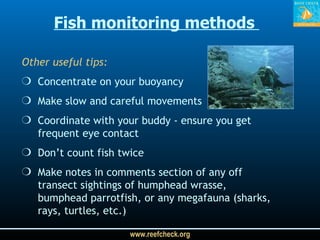
Other useful tips: Concentrate on your buoyancy Make slow and careful movements Coordinate with your buddy - ensure you get frequent eye contact Don’t count fish twice Make notes in comments section of any off transect sightings of humphead wrasse, bumphead parrotfish, or any megafauna (sharks, rays, turtles, etc.) Fish monitoring methods
Long-term fish monitoring For a snapshot, do one Reef Check survey (4 x 20 m replicates) at two depths (2- 6 m, >6 -12 m) For detailed long-term monitoring, 3 full Reef Check surveys (24 replicates), up to 4 times each year.
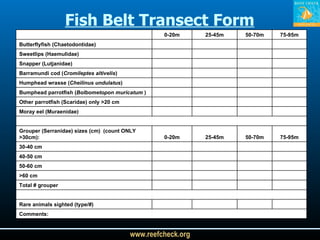
Fish Belt Transect Form     0-20m 25-45m 50-70m 75-95m Butterflyfish (Chaetodontidae)         Sweetlips (Haemulidae)         Snapper (Lutjanidae)         Barramundi cod ( Cromileptes altivelis )         Humphead wrasse ( Cheilinus undulatus )         Bumphead parrotfish ( Bolbometopon muricatum  )         Other parrotfish (Scaridae) only >20 cm         Moray eel (Muraenidae)                     Grouper (Serranidae) sizes (cm)  (count ONLY >30cm): 0-20m 25-45m 50-70m 75-95m 30-40 cm         40-50 cm         50-60 cm         >60 cm         Total # grouper                     Rare animals sighted (type/#)         Comments:   
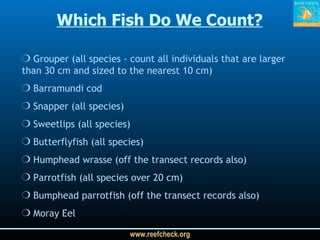
Grouper (all species - count all individuals that are larger  than 30 cm and sized to the nearest 10 cm) Barramundi cod Snapper (all species) Sweetlips (all species) Butterflyfish (all species) Humphead wrasse (off the transect records also) Parrotfish (all species over 20 cm) Bumphead parrotfish (off the transect records also) Moray Eel Which Fish Do We Count?
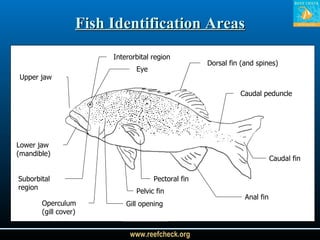
Fish Identification Areas Lower jaw (mandible) Interorbital region Eye Upper jaw Dorsal fin (and spines) Caudal peduncle Caudal fin Anal fin Suborbital region Operculum (gill cover) Gill opening Pelvic fin Pectoral fin
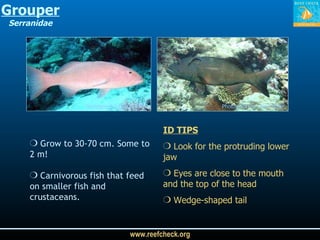
Grouper Serranidae ID TIPS Look for the protruding lower jaw Eyes are close to the mouth and the top of the head Wedge-shaped tail Grow to 30-70 cm. Some to 2 m! Carnivorous fish that feed on smaller fish and crustaceans. Photograph by Dean Miller Photograph by Dean Miller
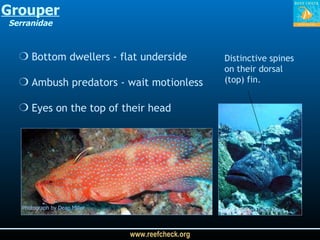
Bottom dwellers - flat underside Ambush predators - wait motionless Eyes on the top of their head  Grouper Serranidae Photograph by Dean Miller Photograph by Dean Miller Distinctive spines on their dorsal (top) fin.
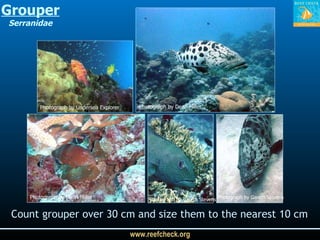
Count grouper over 30 cm and size them to the nearest 10 cm Grouper Serranidae Photograph by Dean Miller Photograph by Undersea Explorer Photograph by Dean Miller Photograph by Gareth Stevens Photograph by Gareth Stevens
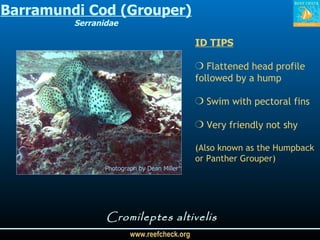
Barramundi Cod (Grouper) Serranidae Cromileptes altivelis Photograph by Dean Miller ID TIPS Flattened head profile followed by a hump  Swim with pectoral fins Very friendly not shy (Also known as the Humpback or Panther Grouper)
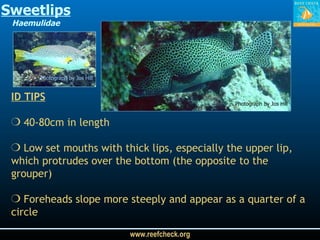
Sweetlips Haemulidae Photograph by Jos Hill ID TIPS 40-80cm in length  Low set mouths with thick lips, especially the upper lip, which protrudes over the bottom (the opposite to the grouper) Foreheads slope more steeply and appear as a quarter of a circle Photograph by Jos Hill
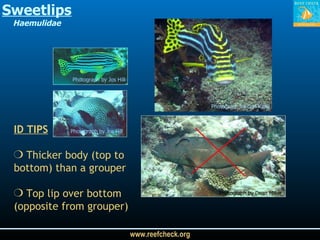
Sweetlips Haemulidae Photograph by Cori Kane Photograph by Jos Hill Photograph by Jos Hill Photograph by Dean Miller ID TIPS Thicker body (top to bottom) than a grouper Top lip over bottom (opposite from grouper)
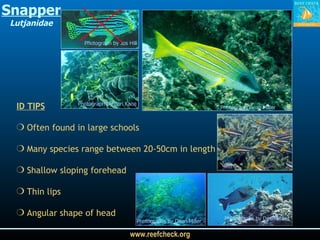
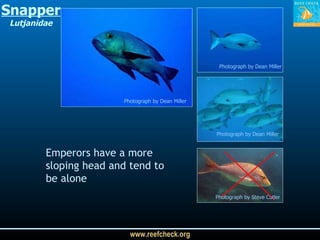
ID TIPS Often found in large schools Many species range between 20-50cm in length Shallow sloping forehead Thin lips Angular shape of head Snapper Lutjanidae Photograph Dean Miller Photograph by Cori Kane Photograph by Jos Hill Photographs by Dean Miller Photographs by Dean Miller
Photograph by Dean Miller Photograph by Dean Miller Snapper Lutjanidae Emperors have a more sloping head and tend to be alone Photograph by Steve Cutler Photograph by Dean Miller
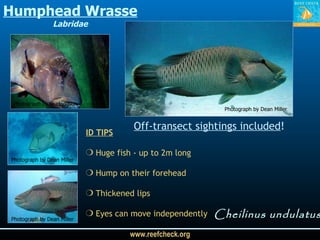
Humphead Wrasse Labridae Cheilinus undulatus Photograph by Dean Miller Photograph by Dean Miller ID TIPS Huge fish - up to 2m long Hump on their forehead  Thickened lips Eyes can move independently  Photograph by Dean Miller Off-transect sightings included ! Photograph by G. Hodgson
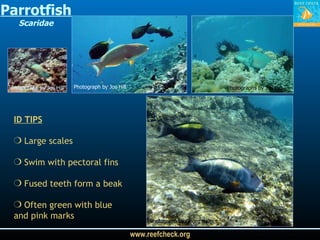
Parrotfish Scaridae Photograph by Jos Hill Photographs by Jos Hill Photograph by Georg Heiss ID TIPS Large scales Swim with pectoral fins Fused teeth form a beak Often green with blue and pink marks Photograph by Jos Hill
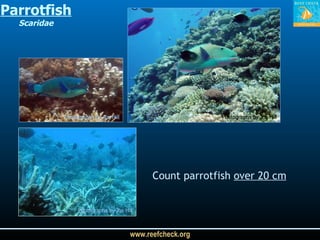
Parrotfish Scaridae Photographs by Jos Hill Photographs by Jos Hill Photographs by Jos Hill Count parrotfish  over 20 cm Photographs by Jos Hill Photographs by Jos Hill
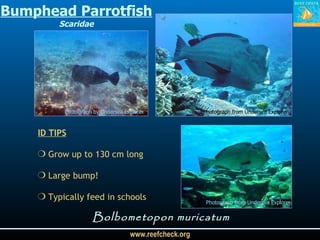
Bumphead Parrotfish Scaridae Bolbometopon muricatum Photograph from Undersea Explorer ID TIPS Grow up to 130 cm long  Large bump!  Typically feed in schools Photograph by Undersea Explorer Photograph from Undersea Explorer
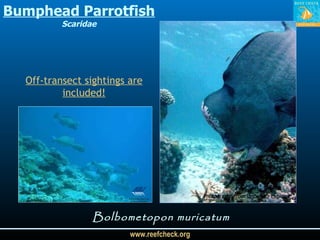
Bumphead Parrotfish Scaridae Bolbometopon muricatum Photographs from Undersea Explorer Off-transect sightings are included!
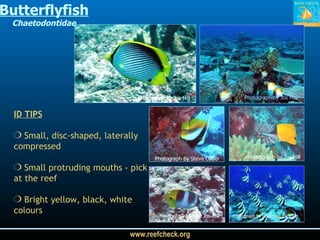
Photograph by Jos Hill Butterflyfish Chaetodontidae Photograph by Jos Hill ID TIPS Small, disc-shaped, laterally compressed Small protruding mouths - pick at the reef Bright yellow, black, white colours  Photograph by Undersea Explorer Photograph by Jos Hill Photograph by Jos Hill Photograph by Steve Cutler
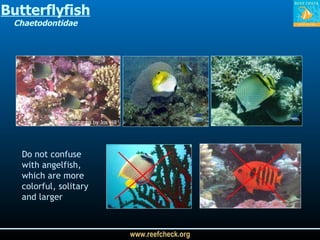
Butterflyfish Chaetodontidae Photographs by Jos Hill Do not confuse with angelfish, which are more colorful, solitary and larger
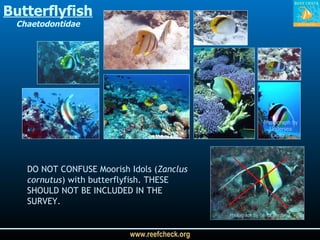
DO NOT CONFUSE Moorish Idols ( Zanclus cornutus ) with butterflyfish. THESE SHOULD NOT BE INCLUDED IN THE SURVEY.  Photograph by Undersea Explorer Photograph by Gerick Bergsma Butterflyfish Chaetodontidae
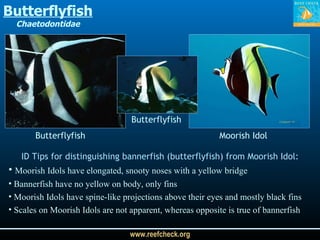
Butterflyfish Chaetodontidae Butterflyfish Butterflyfish Moorish Idol ID Tips for distinguishing bannerfish (butterflyfish) from Moorish Idol: Moorish Idols have elongated, snooty noses with a yellow bridge Bannerfish have no yellow on body, only fins Moorish Idols have spine-like projections above their eyes and mostly black fins Scales on Moorish Idols are not apparent, whereas opposite is true of bannerfish
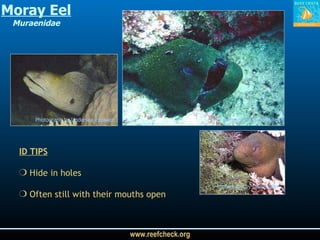
Moray Eel Muraenidae Photograph by Dean Miller Photograph by Dean Miller Photograph by Undersea Explorer ID TIPS Hide in holes Often still with their mouths open
THE END! These materials were produced by Jos Hill and colleagues.  ©Reef Check 2005