
Prepared by:-
Krishan Kumar Yadav
M.F.Sc -1st Year
COLLEGE OF FISHERIES ,UDAIPUR
INTRODUCTION
• Basically, it is a fish culture in which more than one type of
compatible fish is cultured simultaneously.
• Fuller utilization of the pond's productivity for maximization of fish
yield, the aim in composite fish culture.
• This method enables maximum fish yield/production from a pond
through utilization of available fish feed.
• Carp culture is a highly economic and profitable enterprise. Among
many fish farming practices, the composite fish culture is one, which
a common fish farmer can easily adopt with comparatively less
investment to have more production and income than the
traditional farming practice.
ADVANTAGES OF COMPOSITE FISH CULTURE:-
• composite fish culture is the most advanced &
popular culture technique practiced in the
country.
• The main advantage of composite fish culture is
high production by utilizing feed in the pond
effectively.
• In this system , farmers can supply different
species based on the market demand.
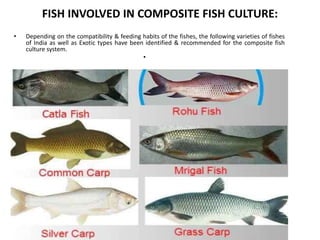
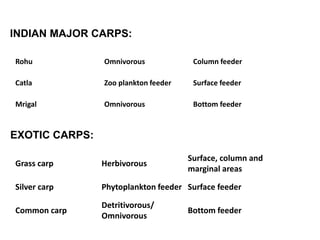
FISH INVOLVED IN COMPOSITE FISH CULTURE:
• Depending on the compatibility & feeding habits of the fishes, the following varieties of fishes
of India as well as Exotic types have been identified & recommended for the composite fish
culture system.
•
Rohu Omnivorous Column feeder
Catla Zoo plankton feeder Surface feeder
Mrigal Omnivorous Bottom feeder
INDIAN MAJOR CARPS:
Grass carp Herbivorous
Surface, column and
marginal areas
Silver carp Phytoplankton feeder Surface feeder
Common carp
Detritivorous/
Omnivorous
Bottom feeder
EXOTIC CARPS:
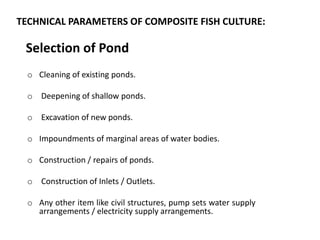
TECHNICAL PARAMETERS OF COMPOSITE FISH CULTURE:
o Cleaning of existing ponds.
o Deepening of shallow ponds.
o Excavation of new ponds.
o Impoundments of marginal areas of water bodies.
o Construction / repairs of ponds.
o Construction of Inlets / Outlets.
o Any other item like civil structures, pump sets water supply
arrangements / electricity supply arrangements.
Selection of Pond
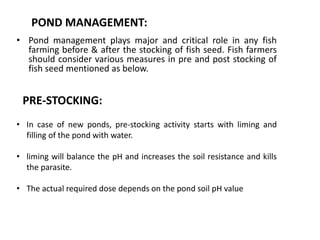
POND MANAGEMENT:
• Pond management plays major and critical role in any fish
farming before & after the stocking of fish seed. Fish farmers
should consider various measures in pre and post stocking of
fish seed mentioned as below.
PRE-STOCKING:
• In case of new ponds, pre-stocking activity starts with liming and
filling of the pond with water.
• liming will balance the pH and increases the soil resistance and kills
the parasite.
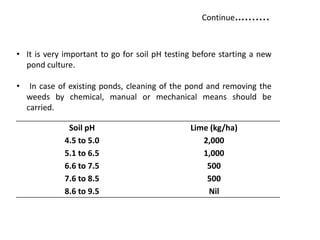
• The actual required dose depends on the pond soil pH value
Soil pH Lime (kg/ha)
4.5 to 5.0 2,000
5.1 to 6.5 1,000
6.6 to 7.5 500
7.6 to 8.5 500
8.6 to 9.5 Nil
• It is very important to go for soil pH testing before starting a new
pond culture.
• In case of existing ponds, cleaning of the pond and removing the
weeds by chemical, manual or mechanical means should be
carried.
Continue….......
FERTILIZATION/ MANURING IN COMPOSITE FISH
CULTURE:
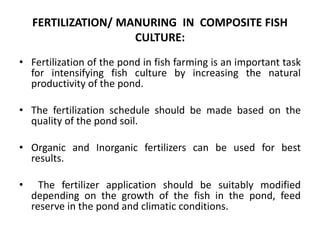
• Fertilization of the pond in fish farming is an important task
for intensifying fish culture by increasing the natural
productivity of the pond.
• The fertilization schedule should be made based on the
quality of the pond soil.
• Organic and Inorganic fertilizers can be used for best
results.
• The fertilizer application should be suitably modified
depending on the growth of the fish in the pond, feed
reserve in the pond and climatic conditions.
• Cow dung @ 5000 kg/ha or any other organic manure in equivalent
manurial value can be applied. This can be applied after 3 days of
liming.
ORGANIC MANURE:
IN-ORGANIC MANURE:
Continue…
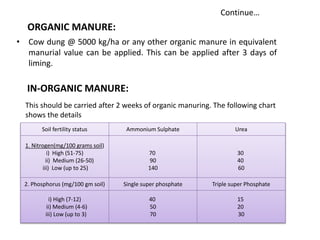
This should be carried after 2 weeks of organic manuring. The following chart
shows the details
Soil fertility status Ammonium Sulphate Urea
1. Nitrogen(mg/100 grams soil)
i) High (51-75)
ii) Medium (26-50)
iii) Low (up to 25)
70
90
140
30
40
60
2. Phosphorus (mg/100 gm soil) Single super phosphate Triple super Phosphate
i) High (7-12)
ii) Medium (4-6)
iii) Low (up to 3)
40
50
70
15
20
30
STOCKING IN COMPOSITE FISH CULTURE:
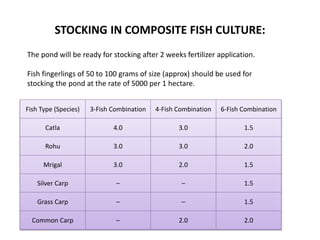
The pond will be ready for stocking after 2 weeks fertilizer application.
Fish fingerlings of 50 to 100 grams of size (approx) should be used for
stocking the pond at the rate of 5000 per 1 hectare.
Fish Type (Species) 3-Fish Combination 4-Fish Combination 6-Fish Combination
Catla 4.0 3.0 1.5
Rohu 3.0 3.0 2.0
Mrigal 3.0 2.0 1.5
Silver Carp – – 1.5
Grass Carp – – 1.5
Common Carp – 2.0 2.0
POST STOCKING IN COMPOSITE FISH CULTURE:-
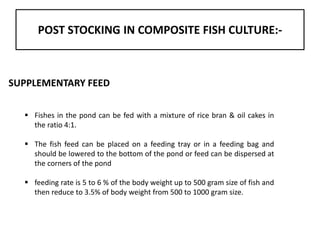
SUPPLEMENTARY FEED
 Fishes in the pond can be fed with a mixture of rice bran & oil cakes in
the ratio 4:1.
 The fish feed can be placed on a feeding tray or in a feeding bag and
should be lowered to the bottom of the pond or feed can be dispersed at
the corners of the pond
 feeding rate is 5 to 6 % of the body weight up to 500 gram size of fish and
then reduce to 3.5% of body weight from 500 to 1000 gram size.
• Organic manuring should be done in monthly
installments @ 1000 kg/ha where as inorganic
fertilization should be done at monthly
intervals alternating with organic manuring.
• Rate of fertilization will depends on the pond
productivity & the growth rate of the fish.
MANURING:
Continue…
HARVESTING AND YIELD IN COMPOSITE FISH
CULTURE
• Fish can be harvested at the end of first year, when the
fishes attain average weight of 500 grams to 1.50 kg.
• With proper management and care a production of 4 to
6 tons/ha can be achieved in a year.
• Harvesting is done by partial de-watering and repeated
netting.
REFERENCE
• FAO , 2014
• HANDBOOK ON FISHERIES , 2012
• Aquaculture Production Systems – Edited by james H. Tidwell.
• www.fao.org/../general metodology for composite fish
culture.htm
Composite fish culture system

Composite fish culture system

  • 1.
    Prepared by:- Krishan KumarYadav M.F.Sc -1st Year COLLEGE OF FISHERIES ,UDAIPUR
  • 2.
    INTRODUCTION • Basically, itis a fish culture in which more than one type of compatible fish is cultured simultaneously. • Fuller utilization of the pond's productivity for maximization of fish yield, the aim in composite fish culture. • This method enables maximum fish yield/production from a pond through utilization of available fish feed. • Carp culture is a highly economic and profitable enterprise. Among many fish farming practices, the composite fish culture is one, which a common fish farmer can easily adopt with comparatively less investment to have more production and income than the traditional farming practice.
  • 3.
    ADVANTAGES OF COMPOSITEFISH CULTURE:- • composite fish culture is the most advanced & popular culture technique practiced in the country. • The main advantage of composite fish culture is high production by utilizing feed in the pond effectively. • In this system , farmers can supply different species based on the market demand.
  • 4.
    FISH INVOLVED INCOMPOSITE FISH CULTURE: • Depending on the compatibility & feeding habits of the fishes, the following varieties of fishes of India as well as Exotic types have been identified & recommended for the composite fish culture system. •
  • 5.
    Rohu Omnivorous Columnfeeder Catla Zoo plankton feeder Surface feeder Mrigal Omnivorous Bottom feeder INDIAN MAJOR CARPS: Grass carp Herbivorous Surface, column and marginal areas Silver carp Phytoplankton feeder Surface feeder Common carp Detritivorous/ Omnivorous Bottom feeder EXOTIC CARPS:
  • 6.
    TECHNICAL PARAMETERS OFCOMPOSITE FISH CULTURE: o Cleaning of existing ponds. o Deepening of shallow ponds. o Excavation of new ponds. o Impoundments of marginal areas of water bodies. o Construction / repairs of ponds. o Construction of Inlets / Outlets. o Any other item like civil structures, pump sets water supply arrangements / electricity supply arrangements. Selection of Pond
  • 7.
    POND MANAGEMENT: • Pondmanagement plays major and critical role in any fish farming before & after the stocking of fish seed. Fish farmers should consider various measures in pre and post stocking of fish seed mentioned as below. PRE-STOCKING: • In case of new ponds, pre-stocking activity starts with liming and filling of the pond with water. • liming will balance the pH and increases the soil resistance and kills the parasite. • The actual required dose depends on the pond soil pH value
  • 8.
    Soil pH Lime(kg/ha) 4.5 to 5.0 2,000 5.1 to 6.5 1,000 6.6 to 7.5 500 7.6 to 8.5 500 8.6 to 9.5 Nil • It is very important to go for soil pH testing before starting a new pond culture. • In case of existing ponds, cleaning of the pond and removing the weeds by chemical, manual or mechanical means should be carried. Continue….......
  • 9.
    FERTILIZATION/ MANURING INCOMPOSITE FISH CULTURE: • Fertilization of the pond in fish farming is an important task for intensifying fish culture by increasing the natural productivity of the pond. • The fertilization schedule should be made based on the quality of the pond soil. • Organic and Inorganic fertilizers can be used for best results. • The fertilizer application should be suitably modified depending on the growth of the fish in the pond, feed reserve in the pond and climatic conditions.
  • 10.
    • Cow dung@ 5000 kg/ha or any other organic manure in equivalent manurial value can be applied. This can be applied after 3 days of liming. ORGANIC MANURE: IN-ORGANIC MANURE: Continue… This should be carried after 2 weeks of organic manuring. The following chart shows the details Soil fertility status Ammonium Sulphate Urea 1. Nitrogen(mg/100 grams soil) i) High (51-75) ii) Medium (26-50) iii) Low (up to 25) 70 90 140 30 40 60 2. Phosphorus (mg/100 gm soil) Single super phosphate Triple super Phosphate i) High (7-12) ii) Medium (4-6) iii) Low (up to 3) 40 50 70 15 20 30
  • 11.
    STOCKING IN COMPOSITEFISH CULTURE: The pond will be ready for stocking after 2 weeks fertilizer application. Fish fingerlings of 50 to 100 grams of size (approx) should be used for stocking the pond at the rate of 5000 per 1 hectare. Fish Type (Species) 3-Fish Combination 4-Fish Combination 6-Fish Combination Catla 4.0 3.0 1.5 Rohu 3.0 3.0 2.0 Mrigal 3.0 2.0 1.5 Silver Carp – – 1.5 Grass Carp – – 1.5 Common Carp – 2.0 2.0
  • 12.
    POST STOCKING INCOMPOSITE FISH CULTURE:- SUPPLEMENTARY FEED  Fishes in the pond can be fed with a mixture of rice bran & oil cakes in the ratio 4:1.  The fish feed can be placed on a feeding tray or in a feeding bag and should be lowered to the bottom of the pond or feed can be dispersed at the corners of the pond  feeding rate is 5 to 6 % of the body weight up to 500 gram size of fish and then reduce to 3.5% of body weight from 500 to 1000 gram size.
  • 13.
    • Organic manuringshould be done in monthly installments @ 1000 kg/ha where as inorganic fertilization should be done at monthly intervals alternating with organic manuring. • Rate of fertilization will depends on the pond productivity & the growth rate of the fish. MANURING: Continue…
  • 14.
    HARVESTING AND YIELDIN COMPOSITE FISH CULTURE • Fish can be harvested at the end of first year, when the fishes attain average weight of 500 grams to 1.50 kg. • With proper management and care a production of 4 to 6 tons/ha can be achieved in a year. • Harvesting is done by partial de-watering and repeated netting.
  • 15.
    REFERENCE • FAO ,2014 • HANDBOOK ON FISHERIES , 2012 • Aquaculture Production Systems – Edited by james H. Tidwell. • www.fao.org/../general metodology for composite fish culture.htm