WHAT IS FISCAL POLICY?
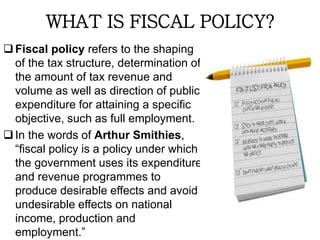
Fiscal policy refers to the shaping
of the tax structure, determination of
the amount of tax revenue and
volume as well as direction of public
expenditure for attaining a specific
objective, such as full employment.
In the words of Arthur Smithies,
“fiscal policy is a policy under which
the government uses its expenditure
and revenue programmes to
produce desirable effects and avoid
undesirable effects on national
income, production and
employment.”
INSTRUMENTS OF FISCAL
POLICY
PUBLIC EXPENDITURE:
It can affect the economic development of a
country through its size and composition.
Expenditure on defence, police and other
activities can rare help in the growth of the
country, being unproductive.
On the other hand, productive expenditure on
development of infrastructure and basic
industries assists growth in a significant manner.
 TAXATION:
It is one of the powerful instruments of fiscal policy in the hands of
public authorities which greatly affects changes in disposable
income ,consumption and investment. Taxation policy is relates to
new amendments in direct tax and indirect tax . Every year Govt. of
India passes the finance bill . In this policy govt. determines the rate
of taxes . Govt. can increase or decrease these tax rates and amend
previous rules of taxation .Govt.'s earning's main source is taxation
. But more tax on public will adverse effect on the development of
economy.
→ If Govt. will increase taxes , more burden will be on the public
and it will reduce production and purchasing power of public .
→ If Govt. will decrease taxes , then public's purchasing power
will increase and it will increase the inflation.
Govt. analyzes both the situation and will make its taxation policy
more progressive .
 PUBLIC BORROWING:
Taxation policy may fail to mobilize enough resources in the
developing countries due to low level of per capita income. In
such a case, public borrowing may be used to check non-
essential private consumption expenditure. The govt. may
issue bonds, debentures, etc., with attractive rates of interest
for this purpose. When the govt. fails to collect sufficient
resources, it may resort to compulsory savings. Public
borrowing will be successful only when debts are collected
from the idle balance with the people. If borrowing leads to a
fall in the current consumption or is financed through cut in
investment, it may not have a desired result.
For external borrowings, funds from World Bank, IMF can be
relied upon.
OBJECTIVES OF FISCAL
POLICY
 MOBILIZATION OF RESOURCES:
The principal objective of fiscal policy is to ensure rapid
economic growth and development. This objective of
economic growth and development can be achieved by
Mobilization of Financial Resources. The central and the
state governments in India have used fiscal policy to
mobilize resources. The financial resources can be mobilized
by:
 Taxation : Through effective fiscal policies, the government
aims to mobilize resources by way of direct taxes as well as
indirect taxes because most important source of resource
mobilization in India is taxation.
 Public Savings : The resources can be mobilized through
public savings by reducing government expenditure and
increasing surpluses of public sector enterprises.
 Private Savings : Through effective fiscal measures such as
tax benefits, the government can raise resources from
private sector and households.
 EFFICIENT ALLOCATION OF FINANCIAL RESOURCES:
The central and state governments have tried to make efficient
allocation of financial resources. These resources are allocated for
Development Activities which includes expenditure on railways,
infrastructure, etc. While Non-development Activities includes
expenditure on defence, interest payments, subsidies, etc.
But generally the fiscal policy should ensure that the resources are
allocated for generation of goods and services which are socially
desirable. Therefore, India's fiscal policy is designed in such a
manner so as to encourage production of desirable goods and
discourage those goods which are socially undesirable.
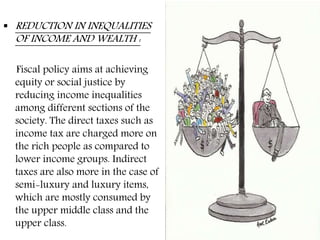
 REDUCTION IN INEQUALITIES
OF INCOME AND WEALTH :
Fiscal policy aims at achieving
equity or social justice by
reducing income inequalities
among different sections of the
society. The direct taxes such as
income tax are charged more on
the rich people as compared to
lower income groups. Indirect
taxes are also more in the case of
semi-luxury and luxury items,
which are mostly consumed by
the upper middle class and the
upper class.
 EXPANSION OF EMPLOYMENT:
The government is making every possible effort to increase
employment in the country through effective fiscal measure.
Investment in infrastructure has resulted in direct and indirect
employment. Lower taxes and duties on small-scale industrial
(SSI) units encourage more investment and consequently
generates more employment. Various rural employment
programmes have been undertaken by the Government of India
to solve problems in rural areas. Similarly, self employment
scheme is taken to provide employment to technically qualified
persons in the urban areas.
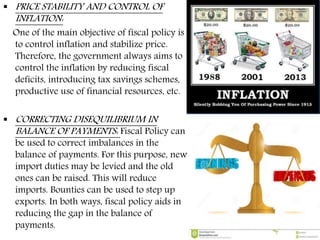
 PRICE STABILITY AND CONTROL OF
INFLATION:
One of the main objective of fiscal policy is
to control inflation and stabilize price.
Therefore, the government always aims to
control the inflation by reducing fiscal
deficits, introducing tax savings schemes,
productive use of financial resources, etc.
 CORRECTING DISEQUILIBRIUM IN
BALANCE OF PAYMENTS: Fiscal Policy can
be used to correct imbalances in the
balance of payments. For this purpose, new
import duties may be levied and the old
ones can be raised. This will reduce
imports. Bounties can be used to step up
exports. In both ways, fiscal policy aids in
reducing the gap in the balance of
payments.

Fiscal policy

  • 2.
    WHAT IS FISCALPOLICY? Fiscal policy refers to the shaping of the tax structure, determination of the amount of tax revenue and volume as well as direction of public expenditure for attaining a specific objective, such as full employment. In the words of Arthur Smithies, “fiscal policy is a policy under which the government uses its expenditure and revenue programmes to produce desirable effects and avoid undesirable effects on national income, production and employment.”
  • 3.
    INSTRUMENTS OF FISCAL POLICY PUBLICEXPENDITURE: It can affect the economic development of a country through its size and composition. Expenditure on defence, police and other activities can rare help in the growth of the country, being unproductive. On the other hand, productive expenditure on development of infrastructure and basic industries assists growth in a significant manner.
  • 4.
     TAXATION: It isone of the powerful instruments of fiscal policy in the hands of public authorities which greatly affects changes in disposable income ,consumption and investment. Taxation policy is relates to new amendments in direct tax and indirect tax . Every year Govt. of India passes the finance bill . In this policy govt. determines the rate of taxes . Govt. can increase or decrease these tax rates and amend previous rules of taxation .Govt.'s earning's main source is taxation . But more tax on public will adverse effect on the development of economy. → If Govt. will increase taxes , more burden will be on the public and it will reduce production and purchasing power of public . → If Govt. will decrease taxes , then public's purchasing power will increase and it will increase the inflation. Govt. analyzes both the situation and will make its taxation policy more progressive .
  • 5.
     PUBLIC BORROWING: Taxationpolicy may fail to mobilize enough resources in the developing countries due to low level of per capita income. In such a case, public borrowing may be used to check non- essential private consumption expenditure. The govt. may issue bonds, debentures, etc., with attractive rates of interest for this purpose. When the govt. fails to collect sufficient resources, it may resort to compulsory savings. Public borrowing will be successful only when debts are collected from the idle balance with the people. If borrowing leads to a fall in the current consumption or is financed through cut in investment, it may not have a desired result. For external borrowings, funds from World Bank, IMF can be relied upon.
  • 6.
  • 7.
     MOBILIZATION OFRESOURCES: The principal objective of fiscal policy is to ensure rapid economic growth and development. This objective of economic growth and development can be achieved by Mobilization of Financial Resources. The central and the state governments in India have used fiscal policy to mobilize resources. The financial resources can be mobilized by:  Taxation : Through effective fiscal policies, the government aims to mobilize resources by way of direct taxes as well as indirect taxes because most important source of resource mobilization in India is taxation.  Public Savings : The resources can be mobilized through public savings by reducing government expenditure and increasing surpluses of public sector enterprises.  Private Savings : Through effective fiscal measures such as tax benefits, the government can raise resources from private sector and households.
  • 8.
     EFFICIENT ALLOCATIONOF FINANCIAL RESOURCES: The central and state governments have tried to make efficient allocation of financial resources. These resources are allocated for Development Activities which includes expenditure on railways, infrastructure, etc. While Non-development Activities includes expenditure on defence, interest payments, subsidies, etc. But generally the fiscal policy should ensure that the resources are allocated for generation of goods and services which are socially desirable. Therefore, India's fiscal policy is designed in such a manner so as to encourage production of desirable goods and discourage those goods which are socially undesirable.
  • 9.
     REDUCTION ININEQUALITIES OF INCOME AND WEALTH : Fiscal policy aims at achieving equity or social justice by reducing income inequalities among different sections of the society. The direct taxes such as income tax are charged more on the rich people as compared to lower income groups. Indirect taxes are also more in the case of semi-luxury and luxury items, which are mostly consumed by the upper middle class and the upper class.
  • 10.
     EXPANSION OFEMPLOYMENT: The government is making every possible effort to increase employment in the country through effective fiscal measure. Investment in infrastructure has resulted in direct and indirect employment. Lower taxes and duties on small-scale industrial (SSI) units encourage more investment and consequently generates more employment. Various rural employment programmes have been undertaken by the Government of India to solve problems in rural areas. Similarly, self employment scheme is taken to provide employment to technically qualified persons in the urban areas.
  • 11.
     PRICE STABILITYAND CONTROL OF INFLATION: One of the main objective of fiscal policy is to control inflation and stabilize price. Therefore, the government always aims to control the inflation by reducing fiscal deficits, introducing tax savings schemes, productive use of financial resources, etc.  CORRECTING DISEQUILIBRIUM IN BALANCE OF PAYMENTS: Fiscal Policy can be used to correct imbalances in the balance of payments. For this purpose, new import duties may be levied and the old ones can be raised. This will reduce imports. Bounties can be used to step up exports. In both ways, fiscal policy aids in reducing the gap in the balance of payments.