Design and Implementation of a Service
Monitoring Console within a Service Oriented
          Architecture Framework

                 Arvind Krishnaa .J
                    31508104017
                         Guided By
                    Dr. Chitra Babu
                       HOD/CSE


             SSN College of Engineering

              First Review - 23rd February, 2012
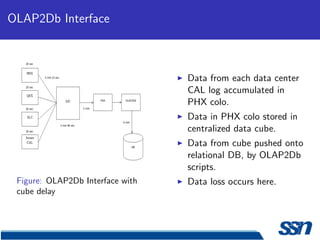
OLAP2Db Interface


                                  Data from each data center
                                  CAL log accumulated in
                                  PHX colo.
                                  Data in PHX colo stored in
                                  centralized data cube.
                                  Data from cube pushed onto
                                  relational DB, by OLAP2Db
                                  scripts.
 Figure: OLAP2Db Interface with   Data loss occurs here.
 cube delay
Minimizing the data loss


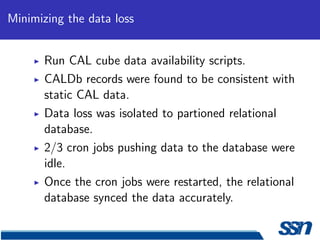
      Run CAL cube data availability scripts.
      CALDb records were found to be consistent with
      static CAL data.
      Data loss was isolated to partioned relational
      database.
      2/3 cron jobs pushing data to the database were
      idle.
      Once the cron jobs were restarted, the relational
      database synced the data accurately.
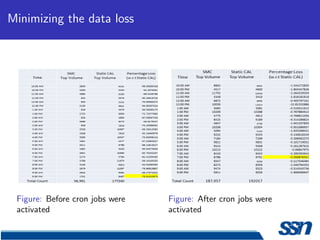
Minimizing the data loss


 Figure: Before cron jobs were   Figure: After cron jobs were
 activated                       activated
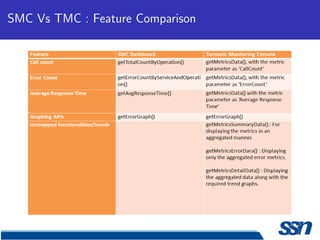
SMC Vs TMC : Feature Comparison
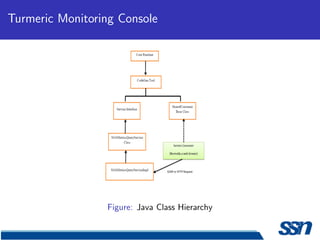
Turmeric Monitoring Console


                 Figure: Java Class Hierarchy
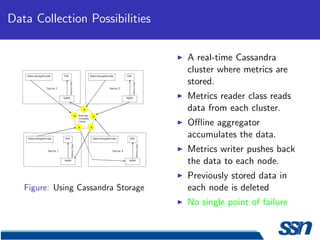
Data Collection Possibilities

                                     A real-time Cassandra
                                     cluster where metrics are
                                     stored.
                                     Metrics reader class reads
                                     data from each cluster.
                                     Offline aggregator
                                     accumulates the data.
                                     Metrics writer pushes back
                                     the data to each node.
                                     Previously stored data in
   Figure: Using Cassandra Storage   each node is deleted
                                     No single point of failure
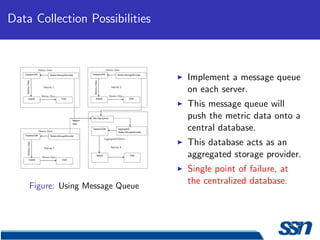
Data Collection Possibilities


                                  Implement a message queue
                                  on each server.
                                  This message queue will
                                  push the metric data onto a
                                  central database.
                                  This database acts as an
                                  aggregated storage provider.
                                  Single point of failure, at
                                  the centralized database.
    Figure: Using Message Queue
Minimizing the data loss


   Using OpenTSDB
      Distributed, scalable high performance time
      series database, implemented over HBase.
      Allows simple storage and retrieval of metrics.
      Easy to graph the trends.
      Difficult to set up hardware components.
      Complicated installation procedure.
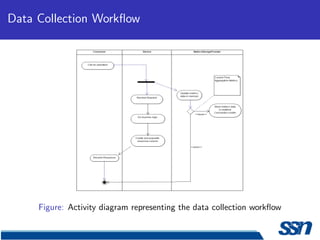
Data Collection Workflow


     Figure: Activity diagram representing the data collection workflow
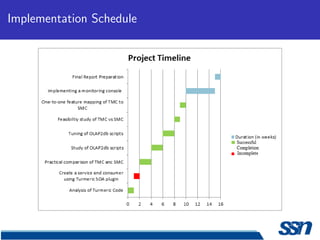
Implementation Schedule
References


   [1]Jeffrey Dean, Sanjay Ghemawat, Google Inc., MapReduce:
   Simplified Data Processing on Large Clusters, In Sixth Symposium
   on Operating System Design and Implementation(OSDI’04), San
   Francisco, CA, December, 2004
   [2] Eben Hewitt, Cassandra: The Definitive Guide, OReilly
   Publications, November 2010.
   [3] eBay Open Source Project, Turmeric SOA platform,
   http:
   //www.ebayopensource.org/index.php/Turmeric/HomePage
References

   [4] eBay Open Source Project, Documentation of Turmeric SOA
   platform,
   https://www.ebayopensource.org/wiki/display/
   TURMERICDOC110GA/Turmeric+Documentation+Overview
   [5] eBay Open Source Project, Turmeric Source Code,
   http://www.github.com/ebayopensource
   [6] Internal eBay documentation
   [7] Google Web Toolkit,
   http://code.google.com/webtoolkit
   [8] Apache Cassandra,
   http://cassandra.apache.org/

First review presentation

  • 1.
    Design and Implementationof a Service Monitoring Console within a Service Oriented Architecture Framework Arvind Krishnaa .J 31508104017 Guided By Dr. Chitra Babu HOD/CSE SSN College of Engineering First Review - 23rd February, 2012
  • 2.
    OLAP2Db Interface Data from each data center CAL log accumulated in PHX colo. Data in PHX colo stored in centralized data cube. Data from cube pushed onto relational DB, by OLAP2Db scripts. Figure: OLAP2Db Interface with Data loss occurs here. cube delay
  • 3.
    Minimizing the dataloss Run CAL cube data availability scripts. CALDb records were found to be consistent with static CAL data. Data loss was isolated to partioned relational database. 2/3 cron jobs pushing data to the database were idle. Once the cron jobs were restarted, the relational database synced the data accurately.
  • 4.
    Minimizing the dataloss Figure: Before cron jobs were Figure: After cron jobs were activated activated
  • 5.
    SMC Vs TMC: Feature Comparison
  • 6.
    Turmeric Monitoring Console Figure: Java Class Hierarchy
  • 7.
    Data Collection Possibilities A real-time Cassandra cluster where metrics are stored. Metrics reader class reads data from each cluster. Offline aggregator accumulates the data. Metrics writer pushes back the data to each node. Previously stored data in Figure: Using Cassandra Storage each node is deleted No single point of failure
  • 8.
    Data Collection Possibilities Implement a message queue on each server. This message queue will push the metric data onto a central database. This database acts as an aggregated storage provider. Single point of failure, at the centralized database. Figure: Using Message Queue
  • 9.
    Minimizing the dataloss Using OpenTSDB Distributed, scalable high performance time series database, implemented over HBase. Allows simple storage and retrieval of metrics. Easy to graph the trends. Difficult to set up hardware components. Complicated installation procedure.
  • 10.
    Data Collection Workflow Figure: Activity diagram representing the data collection workflow
  • 11.
  • 12.
    References [1]Jeffrey Dean, Sanjay Ghemawat, Google Inc., MapReduce: Simplified Data Processing on Large Clusters, In Sixth Symposium on Operating System Design and Implementation(OSDI’04), San Francisco, CA, December, 2004 [2] Eben Hewitt, Cassandra: The Definitive Guide, OReilly Publications, November 2010. [3] eBay Open Source Project, Turmeric SOA platform, http: //www.ebayopensource.org/index.php/Turmeric/HomePage
  • 13.
    References [4] eBay Open Source Project, Documentation of Turmeric SOA platform, https://www.ebayopensource.org/wiki/display/ TURMERICDOC110GA/Turmeric+Documentation+Overview [5] eBay Open Source Project, Turmeric Source Code, http://www.github.com/ebayopensource [6] Internal eBay documentation [7] Google Web Toolkit, http://code.google.com/webtoolkit [8] Apache Cassandra, http://cassandra.apache.org/