
Download to read offline
![International Journal of Modern Research in Engineering and Technology (IJMRET)
www.ijmret.org Volume 3 Issue 6 ǁ June 2018.
w w w . i j m r e t . o r g I S S N : 2 4 5 6 - 5 6 2 8 Page 33
Hadoop Cluster Analysis and Assessment
Saliha KESKİN1
, Atilla ERGÜZEN2
1
(Department of Computer Engineering, Kırıkkale University, Turkey)
ABSTRACT:Large amount of data are produced daily from various fields such as science, economics,
engineering and health. The main challenge of pervasive computing is to store and analyze large amount of
data.This has led to the need for usable and scalable data applications and storage clusters. In this article, we
examine the hadoop architecture developed to deal with these problems. The Hadoop architecture consists of
the Hadoop Distributed File System (HDFS) and Mapreduce programming model, which enables storage and
computation on a set of commodity computers. In this study, a Hadoop cluster consisting of four nodes was
created.Regarding the data size and cluster size, Pi and Grep MapReduce applications, which show the effect of
different data sizes and number of nodes in the cluster, have been made and their results examined.
KEYWORDS -Bigdata, Hadoop, MapReduce, HDFS
I. INTRODUCTION
We are in a Big Data era where large
amounts of data are collected and processed in
terabytes or petabytes from various sectors. Big
Data refers data that can not be processed or
analyzed using conventional methods.
These big data, which can not be
processed by conventional data processing
techniques and stored in the conventional database,
lead institutions and organizations to a technology
that provides a fast and efficient data processing
model. Nowadays, Big Data has become a
necessity in many areas.
In Chapter 2, Hadoop framework and its
some components are examined.In Chapter 3,
information about Hadoop cluster setup is given
and the applications and results for the cluster test
are presented. Finally, the results of the paper is
indicated in Chapter 4.
II. MATERIALS AND METHODS
With the development of technology,
hardware prices are falling, but storage costs are
increasing as the volume and variety of the data
increases. Day-by-day data's level can reach
exabytes or even zettabyte. The data from many
different sectors such as aeronautics, meteorology,
IOT applications, health, distance education and
energy sectors are obtained[1–2]. Dataset is
growing, and RDBMSs are not suitable for storing
and managing this large dataset[3].
New techniques and technologies are
developing to store and analyze big data.Until now,
scientists have developed various techniques and
technologies to collect, cluster, analyze and
visualize the big data.
Hadoop is one of the famous and powerful
Big Data tools. It provides infrastructure and
platforms for other specialized Big Data
applications.A number of Big Data systems are
built on top of Hadoop and have many uses in
different areas such as data mining and machine
learning [4]. Also, thanks to Hadoop's multi-node
structure, the storage system has a stronger
structure and more performance is achieved with
the Hadoop file system [5].
2.1. HADOOP
Hadoop [6] is an open-source software
framework that allows processing of large amounts
of data in a distributed computing environment.
Rather than expensive equipment and dependency
on different systems to store and process data, it
allows inexpensive parallel processing with Big
Data.
Companies need to use terabytes or
petabytes of data to understand specific queries and
requests from users. Existing tools are insufficient
to handle big data sets. Hadoop provided a solution
to this large amount of data analysis problem.
Hadoop is a convenient tool for solving all
the difficulties of big data. It can process large
amounts of data in the petabyte range. It provides
great convenience with scalability and also ensures
continuous operation with high fault tolerance. It
provides reliability for the data by creating multiple
copies of the data (replication) in different
locations (nodes) throughout the cluster.](https://image.slidesharecdn.com/03063337-180813120456/85/Hadoop-Cluster-Analysis-and-Assessment-1-320.jpg)
![International Journal of Modern Research in Engineering and Technology (IJMRET)
www.ijmret.org Volume 3 Issue 6 ǁ June 2018.
w w w . i j m r e t . o r g I S S N : 2 4 5 6 - 5 6 2 8 Page 34
Hadoop has two components, HDFS
(Hadoop distributed file system) and
Mapreduce.While Mapreduce is used for data
processing, HDFS is used for data storage[2].
2.1.1 MAPREDUCE
Today, there are many different hardware
architectures that support parallel computing. There
are two popular examples: (1) Multi-core
computing: A multi-core processor is a processor
that contains more than one computer core on a
single chip;and (2) Distributed computing:
Distributed computing systems enable independent
computers to communicate with a common
network for parallel computing [7].
Mapreduce [8], is a programming model
used to processlarge data sets in cluster by
providing parallelization and distribution of
calculations based on several processors.It was
inspired by the map and reduce functions in the
functional programming. In MapReduce tasks, data
is handled by these two functions. (Fig 1). In the
map phase, Hadoop splits the data into small pieces
and distributes them to the slave nodes (datanodes).
Therefore, when the map tasks are run in parallel,
the data processing load is balanced. To further
split the piece, a datanode can reapply the map
task.Datanode handles the little problem it gets and
returns a list in the form of a binary (key, value) as
a result.Reduce phase, the outputs of the map task
are collected and combined to form the result of the
problem they want to solve[9].
Figure 1. MapReduce diagram [10]
MapReduce greatly simplifies a large-
scale analysis task on distributed data.It is much
easier to process an application than to process it
many times, with the MapReduce form being
implemented more easily with thousands of
machines in the cluster. This feature makes the
MapReduce programming model more attractive.
The Mapreduce programming model [11]
consists of two components that control the work
execution process:the central component
JobTracker and the distributed components
TaskTrackers. When a MapReduce application is
sent to Hadoop, the application is delivered to
JobTracker. JobTracker does the job scheduling
and distributes the job to TaskTrackers. Each
TaskTracker performs the given operation and
sends information to JobTracker about the progress
of the job.
2.1.2. HDFS
Hadoop Distributed File System (HDFS),
which allows distribution and storage of data
between Hadoop clusters, is a file system that
provides high speed access to large amounts of data
[7].
HDFS architecture adopts a master / slave
architecture that includes a single NameNode and
all other nodes DataNodes.When the data are
stored, they are stored separately as metadata and
application data. While the NameNode stores the
meta data, the DataNodes do the actual storage
jobs. NameNode holds meta data for each file
stored in HDFS in the main memory. These
metadata includes a list of "stored filenames,
corresponding blocks of each file, and Datanodes
containing these blocks".For this reason, when a
client reads a file, it first communicates with
Namenode to get the locations of the data blocks
that make up the file, and Namenode directs the
client to the Datanode cluster hosting the requested
file. The client then communicates directly with
Datanode to perform file operations [12] [13].
The files in HDFS are divided into smaller
blocks, typically 64 MB block size, and these
divided blocks are duplicated and distributed to
various Datanodes, as shown in Fig 2. Although
HDFS has many similarities with existing
distributed file systems, it is different.Compared to
traditional distributed file systems, HDFS has two
important advantages: (1) has high fault tolerance
and is usually developed for low cost
hardware.Datanodes send a "signal indicating that
it is alive", which is called continuous heartbeat for
storage space and malfunction detection. When a
hardware or software problem occurs in a
DataNode, Namenode detects it and reassigns the
job to the other Datanode; (2) It provides effective
access to data and is suitable for applications with
big data sets.](https://image.slidesharecdn.com/03063337-180813120456/85/Hadoop-Cluster-Analysis-and-Assessment-2-320.jpg)
![International Journal of Modern Research in Engineering and Technology (IJMRET)
www.ijmret.org Volume 3 Issue 6 ǁ June 2018.
w w w . i j m r e t . o r g I S S N : 2 4 5 6 - 5 6 2 8 Page 35
Figure2. HDFS file block structure
III. PERFORMANCE EVALUATIONS
Using Oracle VirtualBox, four virtual
machines have been installed in the Ubuntu
operating system, one of which have been master
node and the other three have been slave nodes.
While slave nodes are 4 GB memory, master node
is 8 GB memory, and each nodes are also
configured as 20 GB SSDs.
Each node has a Java Development Kit
jdk.1.8.0 and Hadoop 2.7.2 installed.SSH (Secure
Shell) is used to access other nodes in the cluster
from the master node.Once the IP settings and
Hadoop configurations are done, the Hadoop
MapReduce function is run.In this section, Pi
calculation and Grep algorithms are used.
3.1 PI CALCULATE
The area of the circle segment in the unit
square shown in Fig. 3 is π / 4. If N points are
randomly selected in the square, it means that
approximately N * π / 4 of these points fall into the
circle.This program selects random points inside
the square and then checks whether the point is
inside the circle (x2 + y2 <R2, it is in the circle, x
and y points are the coordinates and R is radius of
the circle).With the Quasi-Monte-Carlo method,
the Pi estimation account is measured in terms of
all points (N) and how many of these points are in
the circle (M) (Pi = 4 * M / N) [14].
In this application, each map function
forms some random points in the square, counting
how many points are inside / outside the circle
segment.The reduce function adds up all points and
points in the circle to calculate the number of Pi.
Figure 3. Monte Carlo Pi Calculation [15]
The first parameter entered in the
application is the map number and the second
parameter is the number of samples to be used for
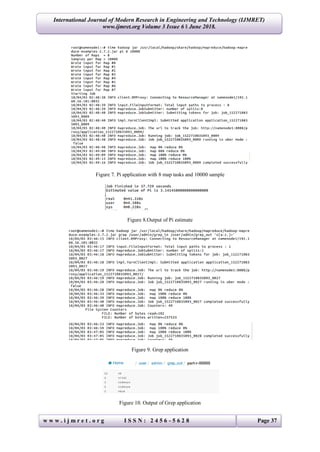
each map.Figure 7 shows the operation of the Pi
application with 8 map tasks and 10000 samples.
1, 2 and 4 nodes were used for the test of
Pi application, respectively. In all tests 8 map tasks
and 1000 samples were used. The run times of the
executed Pi application are given in Figure 4.
According to the results, as the number of nodes
increases, the duration of study decreases.
Figure4. Pi test on different node numbers
We also observed the results of Pi
calculation using different map and sample
numbers. According to at the working times shown
in Fig. 5, it is seen that the working time increases
when both the map number increases, and the
number of samples run for each map increases.
Figure 5. Pi test in different map / sample numbers
0
10
20
30
40
50
1 2 4
Runtime(sn)
Numberof Nodes
0
500
1000
1500
1 10 100 1000 10000
RunTime(sn)
Numberof Maps
100000000
10000000
Number of Samples](https://image.slidesharecdn.com/03063337-180813120456/85/Hadoop-Cluster-Analysis-and-Assessment-3-320.jpg)
![International Journal of Modern Research in Engineering and Technology (IJMRET)
www.ijmret.org Volume 3 Issue 6 ǁ June 2018.
w w w . i j m r e t . o r g I S S N : 2 4 5 6 - 5 6 2 8 Page 36
3.2. GREP APPLICATION
The Grep application, used as a search
tool, counts matches of regular expressions in the
given input. Each map task outputs lines containing
one of the models. The reduce task collects the
numbers from the map tasks and produces output in
pairs.Figure 9 shows a Grep study that interrogates
all expressions that start with "v" in the input.
The Grep application has been tested in
file sizes of 100 MB, 500 MB and 1 GB. During
the operation, first sorting is performed in the
document and then the desired expression search is
performed.The run times of the Grep application
run in Figure 6 are shown. The Grep output of a
100 MB file is shown in Figure 10. According to
the test results, as the file size increases, the
processing time increases.
Figure 6. Execute times of Grep tests
IV. CONCLUSION
Today, the digital world is growing
exponentially.Every second, data that cannot be
directly managed or used with traditional data
management tools are produced.In this article, we
have reviewed the Hadoop architecture, which has
several interfaces to create tools and applications
for harmonizing data from many different data
sources.The Hadoop MapReduce programming
model and HDFS are increasingly being used to
process and store big data sets.
In this study, a four-node hadoop cluster
was created using virtualization platform.In these
nodes, performance analysis was performed by
applying various parameters with the
benchmarking tools available under the Hadoop
framework.We applied the Grep algorithm and Pi
estimation algorithm for different node numbers
and different file size and analyzed the
results.Adding more nodes resulted in increased
performance of the cluster; With a growing number
of Data node, Hadoop cluster performance can be
improved. Moreover, as the size of the input data
increases, the performance of the runtime
increases.
REFERENCES
[1] M. Ünver, E. Erdal, A. Ergüzen, "Big Data Example
In Web Based Learning Management Systems", International
Journal of Advanced Computational Engineering and
Networking, ISSN(p): 2320-2106, ISSN(e): 2321-2063 Volume-
6, Issue-2, Feb.-2018
[2] A. Ergüzen, E. Erdal, "Medical Image Archiving
System Implementation with Lossless Region of Interest and
Optical Character Recognition", Journal of Medical Imaging
and Health Informatics Vol. 7, 1246–1252, 2017
[3] A. Erguzen, E. Erdal, M. Unver,"Big Data
Challenges And Opportunities In Distance Education",
International Journal of Advanced Computational Engineering
and Networking, ISSN(p): 2320-2106, ISSN(e): 2321-2063
Volume-6, Issue-2, Feb.-2018
[4] P. Chen, C-Y Zhang, "Data-intensive applications,
challenges, techniques and technologies: A survey on Big Data"
Information SciencesVolume 275, Page 314-347,10 August
2014
[5] A. Ergüzen, E. Erdal, "An Efficient Middle Layer
Platform for Medical Imaging Archives",Journal of Healthcare
Engineering, 9 May 2018
[6] Harness the Power of Big Data - The IBM Big Data
Platform, USA 2012, s.87-88
[7] T. Huang, L. Lan, X. Fang, P. An, J. Min, F. Wang
"Promises and Challenges of Big Data Computing in Health
Sciences" Big Data ResearchVolume 2, Issue 1, March 2015,
Pages 2-11
[8] J. Dean, S. Ghemawat "MapReduce: Simplified
Data Processing on Large Clusters", Magazine Communications
of the ACM,Volume 51 Issue 1, January 2008 Pages 107-113
[9] R. Nanduri, N. Maheshwari, A. Reddyraja, V. Varma
"Job Aware Scheduling Algorithm for MapReduce Framework"
Cloud Computing Technology and Science (CloudCom), IEEE
Third International Conference2011
[10] J. Kun, https://jeremykun.com/2014/10/05/on-the-
computational-complexity-of-mapreduce/ October 5, 2014
[11] J. Dhok and V. Varma, “Using pattern classification
for task assignment in Mapreduce” in ISEC, 2010
[12] S. J. Andaloussi, A. Sekkaki "Medical Content Based
Image Retrieval by Using the Hadoop Framework",
Telecommunications (ICT), 2013 20th International Conference,
2013
[13] M. B. Bisane , F. Pushpanjali, M. Chouragade,
"Improving Access Efficiency of Small Files in HDFS"
International Journal of Scientific & Engineering Research,
Volume 7, Issue 2, February-2016
[14] J. H. Mathews, "Module for Monte Carlo Pi",
http://mathfaculty.fullerton.edu/mathews/n2003/montecarlopim
od.html 2005
[15] M. Völske, S. Syed, "Getting Started with Hadoop",
https://www.uni-
weimar.de/fileadmin/user/fak/medien/professuren/Webis/teachi
ng/ss18/big-data-seminar/hadoop-tutorial-frame.pdf May 28,
2018
0
100
200
300
400
search sort
RunTime(sn)
100
500
1000
file size (mb)](https://image.slidesharecdn.com/03063337-180813120456/85/Hadoop-Cluster-Analysis-and-Assessment-4-320.jpg)
The document discusses the challenges of storing and analyzing large datasets in various fields, highlighting the Hadoop architecture which includes the Hadoop Distributed File System (HDFS) and the MapReduce programming model. A four-node Hadoop cluster setup was created to test the performance of these components using Pi and Grep MapReduce applications, demonstrating improvements in runtime with increased nodes and data sizes. The study concludes that Hadoop effectively addresses big data processing needs and enhances cluster performance through scalable architecture.


