1
Proposal Progress
Prepared by
Mohd Azarul Ikhwan bin Anuar Salim
(BTBL17047526)
Supervisor
Wan Nor Shuhadah binti Wan Nik
Task Scheduling using Tabu Search algorithm in Cloud Computing
Environment using CloudSim
2
OUTLINE
 Introduction/Project Background
 Problem Statement
 Objective
 Scope
 Limitation
 Literature Review
 Expected Result
 Gantt Chart
 References
3
Introduction
 Today, cloud computing is considered to be one of the hottest trends in the IT industry
and the fastest growing buzzword in the computing environment. It is an enticing
approach used to architect and remotely manage computing resources.
 Since it is a “cloud”, the drawback is of course it will not work well under a low speed
connections and may be slow depends on the applied scheduling algorithm.
 Luckily, there is CloudSim which is a simulator that provides simulations of file
replication strategies such as replica placement, replication scheduling, and replica
consistency maintenance.
 Tabu search algorithm will be compared to traditional algorithm in term of throughput
and turnaround time by using the CloudSim.
 In conclusion, CloudSim can help researcher in choosing the most efficient algorithm for
their computing devices.
4
Problem Statement
 Certain resources scheduling can not adjust well due to big scale of workloads which then
lead to starvation. A process had to wait for a resource that is continuously given to other
processes.
 Short processes might need to wait for a long time due to long processes holding the CPU
resulting in low throughput.
 Wrong choice of scheduling algorithm will affect the CPU speed and will waste its resources
and time.
5
Objective
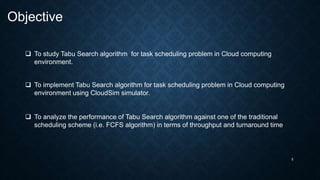
 To study Tabu Search algorithm for task scheduling problem in Cloud computing
environment.
 To implement Tabu Search algorithm for task scheduling problem in Cloud computing
environment using CloudSim simulator.
 To analyze the performance of Tabu Search algorithm against one of the traditional
scheduling scheme (i.e. FCFS algorithm) in terms of throughput and turnaround time
6
Scope
 CloudSim will be used to apply or implement various scheduling type which user can simulate the
real computing performance. By running the simulation, it helps user to choose an algorithm that
best suits their computing devices.
 The end result of the simulation will be analysed and help the user to determine which algorithm that
can maximize the throughput and minimized the turnaround time in graph information form.
7
Limitation
 Since it’s a simulation tool ,simulation performance output can not be
guaranteed close to that of real time computer performance output.
8
Literature Review
Author Year Title Purpose Advantages Disadvantages
Au, Regina 2006 To Cloud Compute, or Not to
Cloud Compute?
The popularity of cloud
computing is sweeping the
entire business world – but
there are many pros and
cons that need to be
considered.
• IT Cost Savings
• Storage
• Capacity
• Accessibility
• Downtime
• Security
M.A. Elaziz, S.
Xiong, K.P.N.
Jayasena
2019 Task scheduling in cloud
computing based on hybrid
moth search algorithm and
differential evolution
This paper presents an
alternative method for cloud
task scheduling problem
which aims to minimize
makespan that required to
schedule a number of tasks
on different Virtual
Machines (VMs)
• MSDE algorithm
can efficiently
schedule the
tasks to the VM
while consuming
minimum
makespan
• MSA exploitation
ability is not good like
its exploration ability
REN Xun-yi,
WANG Ru-chuan,
KONG Qiang
2010 Using Cloudsim to efficiently
simulate replica placement
strategies
This article presents the
implementation of a new
strategy to improve the
CloudSim.
• a scale-free
algorithm to
generate
network
topology
implemented
• reduce
processing time
and storage
consumption
• Lacks GUI
• Typical replica
algorithms in
Cloudsim cannot
simultaneously reduce
processing time and
storage consumption
9
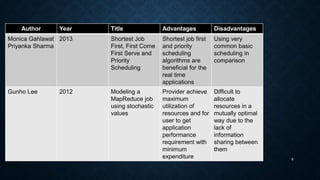
Author Year Title Advantages Disadvantages
Monica Gahlawat
Priyanka Sharma
2013 Shortest Job
First, First Come
First Serve and
Priority
Scheduling
Shortest job first
and priority
scheduling
algorithms are
beneficial for the
real time
applications
Using very
common basic
scheduling in
comparison
Gunho Lee 2012 Modeling a
MapReduce job
using stochastic
values
Provider achieve
maximum
utilization of
resources and for
user to get
application
performance
requirement with
minimum
expenditure
Difficult to
allocate
resources in a
mutually optimal
way due to the
lack of
information
sharing between
them
10
Methodology
In this section, you will find a brief description of how the Cloudsim simulator and
Tabu Search algorithm works.
11
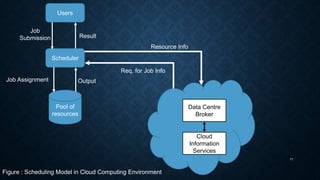
Users
Data Centre
Broker
Scheduler
Cloud
Information
Services
Pool of
resources
Job
Submission Result
OutputJob Assignment
Figure : Scheduling Model in Cloud Computing Environment
Req. for Job Info
Resource Info
12
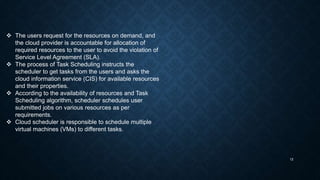
 The users request for the resources on demand, and
the cloud provider is accountable for allocation of
required resources to the user to avoid the violation of
Service Level Agreement (SLA).
 The process of Task Scheduling instructs the
scheduler to get tasks from the users and asks the
cloud information service (CIS) for available resources
and their properties.
 According to the availability of resources and Task
Scheduling algorithm, scheduler schedules user
submitted jobs on various resources as per
requirements.
 Cloud scheduler is responsible to schedule multiple
virtual machines (VMs) to different tasks.
13
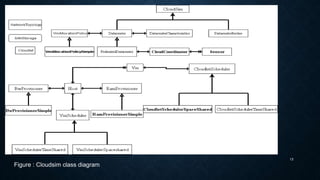
Figure : Cloudsim class diagram
14
The function of the main class in CloudSim :
o Cloudlet
o Cloudlet Scheduler
o Virtual Machines (VM)
o Vm Allocation Policy
o VmScheduler
o Datacenter
o DatacenterBroker or Cloud Broker
o BwProvisioner
o CloudCoordinator
o DatacenterCharateristics
o Host
o NetworkTopology
o RamProvisioner
o SanStorage
o Sensor
15
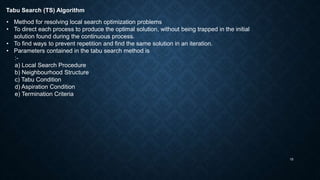
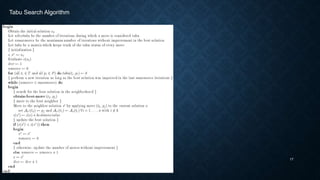
Tabu Search (TS) Algorithm
• Method for resolving local search optimization problems
• To direct each process to produce the optimal solution, without being trapped in the initial
solution found during the continuous process.
• To find ways to prevent repetition and find the same solution in an iteration.
• Parameters contained in the tabu search method is
:-
a) Local Search Procedure
b) Neighbourhood Structure
c) Tabu Condition
d) Aspiration Condition
e) Termination Criteria
16
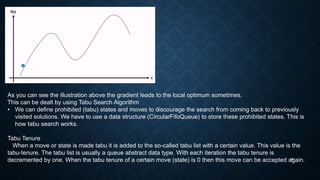
As you can see the illustration above the gradient leads to the local optimum sometimes.
This can be dealt by using Tabu Search Algorithm
• We can define prohibited (tabu) states and moves to discourage the search from coming back to previously
visited solutions. We have to use a data structure (CircularFifoQueue) to store these prohibited states. This is
how tabu search works.
Tabu Tenure
When a move or state is made tabu it is added to the so-called tabu list with a certain value. This value is the
tabu-tenure. The tabu list is usually a queue abstract data type. With each iteration the tabu tenure is
decremented by one. When the tabu tenure of a certain move (state) is 0 then this move can be accepted again.
17
Tabu Search Algorithm
18
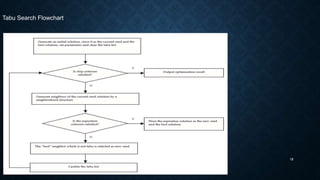
Tabu Search Flowchart
19
Expected Result
 By using tabu search algorithm, it is expected that the throughput of cloud resources can be maximized
while minimizing tasks turnaround time as compared to the traditional scheduling algorithm i.e. FCFS
algorithm.
20
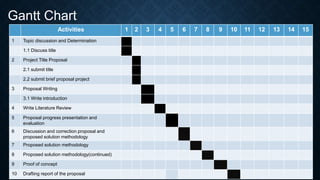
Gantt Chart
Activities 1 2 3 4 5 6 7 8 9 10 11 12 13 14 15
1 Topic discussion and Determination
1.1 Discuss title
2 Project Title Proposal
2.1 submit title
2.2 submit brief proposal project
3 Proposal Writing
3.1 Write introduction
4 Write Literature Review
5 Proposal progress presentation and
evaluation
6 Discussion and correction proposal and
proposed solution methodology
7 Proposed solution methodology
8 Proposed solution methodology(continued)
9 Proof of concept
10 Drafting report of the proposal
21
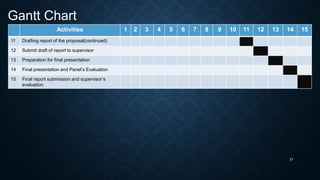
Gantt Chart
Activities 1 2 3 4 5 6 7 8 9 10 11 12 13 14 15
11 Drafting report of the proposal(continued)
12 Submit draft of report to supervisor
13 Preparation for final presentation
14 Final presentation and Panel’s Evaluation
15 Final report submission and supervisor’s
evaluation
22
References
1. Au, Regina. (2016). To Cloud Compute, or Not to Cloud Compute?. Innovations in
Pharmaceutical Technology. 32-35.
2. M.A. Elaziz, S. Xiong, K.P.N. Jayasena et al., Task scheduling in cloud computing based on
hybrid moth search algorithm and differential evolution, Knowledge-Based Systems (2019)
3. REN Xun-yi, WANG Ru-chuan, KONG Qiang et al. Using optorsim to efficiently simulate replica
placement strategies. (2010)
4. Chapter 5 Scheduling. Retrieved from https://cseweb.ucsd.edu/classes/sp16/cse120-
a/applications/ln/lecture5.html
5. Laguna, Manuel & Barnes, John & Glover, Fred. (1991). Tabu search methods for a single
machine scheduling problem. Journal of Intelligent Manufacturing. 2. 63-73.
10.1007/BF01471219.
6. Martins, Simone & Ribeiro, Celso. (2006). Metaheuristics and Applications to Optimization
Problems in Telecommunications. 10.1007/978-0-387-30165-5_4.

Task Scheduling using Tabu Search algorithm in Cloud Computing Environment using CloudSim

  • 1.
    1 Proposal Progress Prepared by MohdAzarul Ikhwan bin Anuar Salim (BTBL17047526) Supervisor Wan Nor Shuhadah binti Wan Nik Task Scheduling using Tabu Search algorithm in Cloud Computing Environment using CloudSim
  • 2.
    2 OUTLINE  Introduction/Project Background Problem Statement  Objective  Scope  Limitation  Literature Review  Expected Result  Gantt Chart  References
  • 3.
    3 Introduction  Today, cloudcomputing is considered to be one of the hottest trends in the IT industry and the fastest growing buzzword in the computing environment. It is an enticing approach used to architect and remotely manage computing resources.  Since it is a “cloud”, the drawback is of course it will not work well under a low speed connections and may be slow depends on the applied scheduling algorithm.  Luckily, there is CloudSim which is a simulator that provides simulations of file replication strategies such as replica placement, replication scheduling, and replica consistency maintenance.  Tabu search algorithm will be compared to traditional algorithm in term of throughput and turnaround time by using the CloudSim.  In conclusion, CloudSim can help researcher in choosing the most efficient algorithm for their computing devices.
  • 4.
    4 Problem Statement  Certainresources scheduling can not adjust well due to big scale of workloads which then lead to starvation. A process had to wait for a resource that is continuously given to other processes.  Short processes might need to wait for a long time due to long processes holding the CPU resulting in low throughput.  Wrong choice of scheduling algorithm will affect the CPU speed and will waste its resources and time.
  • 5.
    5 Objective  To studyTabu Search algorithm for task scheduling problem in Cloud computing environment.  To implement Tabu Search algorithm for task scheduling problem in Cloud computing environment using CloudSim simulator.  To analyze the performance of Tabu Search algorithm against one of the traditional scheduling scheme (i.e. FCFS algorithm) in terms of throughput and turnaround time
  • 6.
    6 Scope  CloudSim willbe used to apply or implement various scheduling type which user can simulate the real computing performance. By running the simulation, it helps user to choose an algorithm that best suits their computing devices.  The end result of the simulation will be analysed and help the user to determine which algorithm that can maximize the throughput and minimized the turnaround time in graph information form.
  • 7.
    7 Limitation  Since it’sa simulation tool ,simulation performance output can not be guaranteed close to that of real time computer performance output.
  • 8.
    8 Literature Review Author YearTitle Purpose Advantages Disadvantages Au, Regina 2006 To Cloud Compute, or Not to Cloud Compute? The popularity of cloud computing is sweeping the entire business world – but there are many pros and cons that need to be considered. • IT Cost Savings • Storage • Capacity • Accessibility • Downtime • Security M.A. Elaziz, S. Xiong, K.P.N. Jayasena 2019 Task scheduling in cloud computing based on hybrid moth search algorithm and differential evolution This paper presents an alternative method for cloud task scheduling problem which aims to minimize makespan that required to schedule a number of tasks on different Virtual Machines (VMs) • MSDE algorithm can efficiently schedule the tasks to the VM while consuming minimum makespan • MSA exploitation ability is not good like its exploration ability REN Xun-yi, WANG Ru-chuan, KONG Qiang 2010 Using Cloudsim to efficiently simulate replica placement strategies This article presents the implementation of a new strategy to improve the CloudSim. • a scale-free algorithm to generate network topology implemented • reduce processing time and storage consumption • Lacks GUI • Typical replica algorithms in Cloudsim cannot simultaneously reduce processing time and storage consumption
  • 9.
    9 Author Year TitleAdvantages Disadvantages Monica Gahlawat Priyanka Sharma 2013 Shortest Job First, First Come First Serve and Priority Scheduling Shortest job first and priority scheduling algorithms are beneficial for the real time applications Using very common basic scheduling in comparison Gunho Lee 2012 Modeling a MapReduce job using stochastic values Provider achieve maximum utilization of resources and for user to get application performance requirement with minimum expenditure Difficult to allocate resources in a mutually optimal way due to the lack of information sharing between them
  • 10.
    10 Methodology In this section,you will find a brief description of how the Cloudsim simulator and Tabu Search algorithm works.
  • 11.
    11 Users Data Centre Broker Scheduler Cloud Information Services Pool of resources Job SubmissionResult OutputJob Assignment Figure : Scheduling Model in Cloud Computing Environment Req. for Job Info Resource Info
  • 12.
    12  The usersrequest for the resources on demand, and the cloud provider is accountable for allocation of required resources to the user to avoid the violation of Service Level Agreement (SLA).  The process of Task Scheduling instructs the scheduler to get tasks from the users and asks the cloud information service (CIS) for available resources and their properties.  According to the availability of resources and Task Scheduling algorithm, scheduler schedules user submitted jobs on various resources as per requirements.  Cloud scheduler is responsible to schedule multiple virtual machines (VMs) to different tasks.
  • 13.
    13 Figure : Cloudsimclass diagram
  • 14.
    14 The function ofthe main class in CloudSim : o Cloudlet o Cloudlet Scheduler o Virtual Machines (VM) o Vm Allocation Policy o VmScheduler o Datacenter o DatacenterBroker or Cloud Broker o BwProvisioner o CloudCoordinator o DatacenterCharateristics o Host o NetworkTopology o RamProvisioner o SanStorage o Sensor
  • 15.
    15 Tabu Search (TS)Algorithm • Method for resolving local search optimization problems • To direct each process to produce the optimal solution, without being trapped in the initial solution found during the continuous process. • To find ways to prevent repetition and find the same solution in an iteration. • Parameters contained in the tabu search method is :- a) Local Search Procedure b) Neighbourhood Structure c) Tabu Condition d) Aspiration Condition e) Termination Criteria
  • 16.
    16 As you cansee the illustration above the gradient leads to the local optimum sometimes. This can be dealt by using Tabu Search Algorithm • We can define prohibited (tabu) states and moves to discourage the search from coming back to previously visited solutions. We have to use a data structure (CircularFifoQueue) to store these prohibited states. This is how tabu search works. Tabu Tenure When a move or state is made tabu it is added to the so-called tabu list with a certain value. This value is the tabu-tenure. The tabu list is usually a queue abstract data type. With each iteration the tabu tenure is decremented by one. When the tabu tenure of a certain move (state) is 0 then this move can be accepted again.
  • 17.
  • 18.
  • 19.
    19 Expected Result  Byusing tabu search algorithm, it is expected that the throughput of cloud resources can be maximized while minimizing tasks turnaround time as compared to the traditional scheduling algorithm i.e. FCFS algorithm.
  • 20.
    20 Gantt Chart Activities 12 3 4 5 6 7 8 9 10 11 12 13 14 15 1 Topic discussion and Determination 1.1 Discuss title 2 Project Title Proposal 2.1 submit title 2.2 submit brief proposal project 3 Proposal Writing 3.1 Write introduction 4 Write Literature Review 5 Proposal progress presentation and evaluation 6 Discussion and correction proposal and proposed solution methodology 7 Proposed solution methodology 8 Proposed solution methodology(continued) 9 Proof of concept 10 Drafting report of the proposal
  • 21.
    21 Gantt Chart Activities 12 3 4 5 6 7 8 9 10 11 12 13 14 15 11 Drafting report of the proposal(continued) 12 Submit draft of report to supervisor 13 Preparation for final presentation 14 Final presentation and Panel’s Evaluation 15 Final report submission and supervisor’s evaluation
  • 22.
    22 References 1. Au, Regina.(2016). To Cloud Compute, or Not to Cloud Compute?. Innovations in Pharmaceutical Technology. 32-35. 2. M.A. Elaziz, S. Xiong, K.P.N. Jayasena et al., Task scheduling in cloud computing based on hybrid moth search algorithm and differential evolution, Knowledge-Based Systems (2019) 3. REN Xun-yi, WANG Ru-chuan, KONG Qiang et al. Using optorsim to efficiently simulate replica placement strategies. (2010) 4. Chapter 5 Scheduling. Retrieved from https://cseweb.ucsd.edu/classes/sp16/cse120- a/applications/ln/lecture5.html 5. Laguna, Manuel & Barnes, John & Glover, Fred. (1991). Tabu search methods for a single machine scheduling problem. Journal of Intelligent Manufacturing. 2. 63-73. 10.1007/BF01471219. 6. Martins, Simone & Ribeiro, Celso. (2006). Metaheuristics and Applications to Optimization Problems in Telecommunications. 10.1007/978-0-387-30165-5_4.