Language Acquisition
Introduction
• What works best for ESL students?
• Language is not taught in isolation
• Movement towards a constructive, holistic
approach
Language and Culture
In this presentation:
– Language Acquisition
• The Prism Model
• L2 Processes
– Instructional Approaches to ESL
– Culture: Perspectives and Processes
Language Acquisition
• Myth 1: L2 learning is simple and quick for
young students
• Myth 2: L1 “interferes” with L2
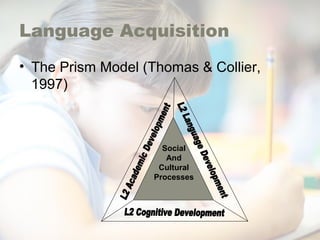
• L2 Acquisition in schools is affected by:
– Socio-cultural processes
– Language development
– Academic development
– Cognitive development
Language Acquisition
• The Prism Model (Thomas & Collier,
1997)
Social
And
Cultural
Processes
Socio-Cultural Processes
• Central to L2 acquisition in schools
• Involve factors such as:
– Setting: home, school, community, society
– Individual: self-esteem and anxiety (affective)
– School: classroom environment and programs
– Community: acceptance and support
• These factors can strongly influence the
student’s response to a new language, affecting
L2 acquisition positively or negatively
Language Development
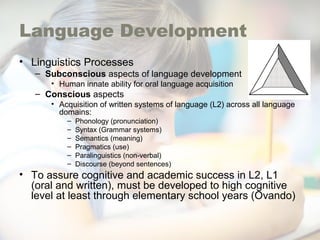
• Linguistics Processes
– Subconscious aspects of language development
• Human innate ability for oral language acquisition
– Conscious aspects
• Acquisition of written systems of language (L2) across all language
domains:
– Phonology (pronunciation)
– Syntax (Grammar systems)
– Semantics (meaning)
– Pragmatics (use)
– Paralinguistics (non-verbal)
– Discourse (beyond sentences)
• To assure cognitive and academic success in L2, L1
(oral and written), must be developed to high cognitive
level at least through elementary school years (Ovando)
Academic Development
• Includes school work in all subjects
– Language Arts, Math, Science, and Social Studies
– K-12 and beyond
• Academic knowledge and concepts transfer
from L1 to L2
• Thus, it is more efficient to develop an academic
L1 while teaching L2 through the content areas
• By teaching English as the first step, academic
development is postponed and academic failure
is likely to be promoted (Ovando)
Cognitive Development
• Natural subconscious process
• Occurs developmentally
• Cognitive development in L1+L2 is
advantageous for children
• Linguistic, cognitive, and academic
development must be addressed equally
to assure academic success in L2
Interdependence of the 4
Factors
• If one is developed to the neglect of another, this
may be detrimental
• Academic, linguistic and cognitive
factors should be viewed as
developmental in both L1 and L2
• Socio-cultural processes affect the above in both
positive and negative ways
• Educators must provide a socio-culturally
supportive environment for L2 to flourish
(Ovando)
First Language Acquisition
• A complex life-long process
• Oral development is universal
– Listening and speaking (birth-age 5)
– Phonology, grammar, semantics, etc (age 5)
– Complex grammar and discourse (5-12)
– Formal instruction-reading and writing
– Language development continues throughout one’s
lifetime
Simultaneous L2 Acquisition
• L2 acquisition is equally complex
• Same subconscious process in both languages
• Initially appear to combine both languages into one
system
• Eventually both languages separate into two different
systems (3-5 years of age)
• If regular exposure and cognitive development is
maintained in two languages, the child develops the
same level of proficiency in both
• Children who develop strong academic proficiency in
both languages experience cognitive advantages over
monolinguals (Ovando)
L2 Acquisition: Social Language
• Also known as BICS, context embedded, or
conversational
• Meaning is negotiated through contextual clues
• Myth: Young children learn a second language
faster than adults
• Children do, however, acquire native-like
pronunciation to a greater extent than adult SLLs
• Older is faster but younger is better
L2 Acquisition:
Academic Language
• More complex than social language
• Defined as the language and cognitive skills
required in the content areas to achieve
successful academic performance at secondary
and university levels
• Cummins called this dimension CALP
• This dimension is an extension of BICS
• A good teacher incorporates both social and
academic language development into every
lesson
Instructional Approaches
to ESL
• Traditional approaches
– Grammar translation
– Audiolingual method
– Direct method
• Transitional approaches
– Silent Way
– Suggestopedia
– Community Language Learning
– Total Physical Response
– Natural Approach
• Current approaches
– Integration of language and content
– Content ESL and Sheltered Content Teaching
– Whole Language
– Cognitive Development CALLA
More on Current Approaches
• Value students’ first languages
• Incorporate multicultural/global
perspectives
• Learner-centered
• Interactive classrooms
• Thematic units
• Use of technology

Language acquisition

  • 1.
  • 2.
    Introduction • What worksbest for ESL students? • Language is not taught in isolation • Movement towards a constructive, holistic approach
  • 3.
    Language and Culture Inthis presentation: – Language Acquisition • The Prism Model • L2 Processes – Instructional Approaches to ESL – Culture: Perspectives and Processes
  • 4.
    Language Acquisition • Myth1: L2 learning is simple and quick for young students • Myth 2: L1 “interferes” with L2 • L2 Acquisition in schools is affected by: – Socio-cultural processes – Language development – Academic development – Cognitive development
  • 5.
    Language Acquisition • ThePrism Model (Thomas & Collier, 1997) Social And Cultural Processes
  • 6.
    Socio-Cultural Processes • Centralto L2 acquisition in schools • Involve factors such as: – Setting: home, school, community, society – Individual: self-esteem and anxiety (affective) – School: classroom environment and programs – Community: acceptance and support • These factors can strongly influence the student’s response to a new language, affecting L2 acquisition positively or negatively
  • 7.
    Language Development • LinguisticsProcesses – Subconscious aspects of language development • Human innate ability for oral language acquisition – Conscious aspects • Acquisition of written systems of language (L2) across all language domains: – Phonology (pronunciation) – Syntax (Grammar systems) – Semantics (meaning) – Pragmatics (use) – Paralinguistics (non-verbal) – Discourse (beyond sentences) • To assure cognitive and academic success in L2, L1 (oral and written), must be developed to high cognitive level at least through elementary school years (Ovando)
  • 8.
    Academic Development • Includesschool work in all subjects – Language Arts, Math, Science, and Social Studies – K-12 and beyond • Academic knowledge and concepts transfer from L1 to L2 • Thus, it is more efficient to develop an academic L1 while teaching L2 through the content areas • By teaching English as the first step, academic development is postponed and academic failure is likely to be promoted (Ovando)
  • 9.
    Cognitive Development • Naturalsubconscious process • Occurs developmentally • Cognitive development in L1+L2 is advantageous for children • Linguistic, cognitive, and academic development must be addressed equally to assure academic success in L2
  • 10.
    Interdependence of the4 Factors • If one is developed to the neglect of another, this may be detrimental • Academic, linguistic and cognitive factors should be viewed as developmental in both L1 and L2 • Socio-cultural processes affect the above in both positive and negative ways • Educators must provide a socio-culturally supportive environment for L2 to flourish (Ovando)
  • 11.
    First Language Acquisition •A complex life-long process • Oral development is universal – Listening and speaking (birth-age 5) – Phonology, grammar, semantics, etc (age 5) – Complex grammar and discourse (5-12) – Formal instruction-reading and writing – Language development continues throughout one’s lifetime
  • 12.
    Simultaneous L2 Acquisition •L2 acquisition is equally complex • Same subconscious process in both languages • Initially appear to combine both languages into one system • Eventually both languages separate into two different systems (3-5 years of age) • If regular exposure and cognitive development is maintained in two languages, the child develops the same level of proficiency in both • Children who develop strong academic proficiency in both languages experience cognitive advantages over monolinguals (Ovando)
  • 13.
    L2 Acquisition: SocialLanguage • Also known as BICS, context embedded, or conversational • Meaning is negotiated through contextual clues • Myth: Young children learn a second language faster than adults • Children do, however, acquire native-like pronunciation to a greater extent than adult SLLs • Older is faster but younger is better
  • 14.
    L2 Acquisition: Academic Language •More complex than social language • Defined as the language and cognitive skills required in the content areas to achieve successful academic performance at secondary and university levels • Cummins called this dimension CALP • This dimension is an extension of BICS • A good teacher incorporates both social and academic language development into every lesson
  • 15.
    Instructional Approaches to ESL •Traditional approaches – Grammar translation – Audiolingual method – Direct method • Transitional approaches – Silent Way – Suggestopedia – Community Language Learning – Total Physical Response – Natural Approach • Current approaches – Integration of language and content – Content ESL and Sheltered Content Teaching – Whole Language – Cognitive Development CALLA
  • 16.
    More on CurrentApproaches • Value students’ first languages • Incorporate multicultural/global perspectives • Learner-centered • Interactive classrooms • Thematic units • Use of technology