Directions: Identify the following
statements if it’s TRUE or FALSE
based on the underlined
word/phrase.
•1. Fire is a chemical
reaction of oxygen and
other substances that
gives out light, heat,
and smoke.
Directions: Identify the following
statements if it’s TRUE or FALSE
based on the underlined
word/phrase.
•2. Oxygen is one
of the ingredients
for fire to start
and continue.
Directions: Identify the following
statements if it’s TRUE or FALSE
based on the underlined
word/phrase.
•3. Smoke is one of
the components of
the Fire Triangle
together with Heat
and Fuel.
Directions: Identify the following
statements if it’s TRUE or FALSE
based on the underlined
word/phrase.
•4. Sun is one of
the natural
sources of
heat.
Directions: Identify the following
statements if it’s TRUE or FALSE
based on the underlined
word/phrase.
•5. Gas may be a
flammable material
considered to be as
heat in the fire
triangle.
What is
fire? What
causes a
fire?
FIRE
•is a state of
combustion in which
fuel or other
materials is ignited
and combined with
oxygen, giving off
light, heat, and flame.
FIRE
•fire is the only event that is
both beneficial to man and
his environment as well as
destructive and deadly.
Fire is beneficial when
controlled but is very
destructive and deadly if
not.
You are only going to see fires in two
places – indoors and outdoors
Outdoor fires are
forest fire or
wildfire
indoor fires are
building fires
and/or housefires.
Major causes of fire range
electrical neglects or accidents,
smoking,
kitchen accidents,
neglected heating equipment,
hazardous goods such as paints and adhesives, and
even man-made causes of fire such as Arson
What
causes a
fire?
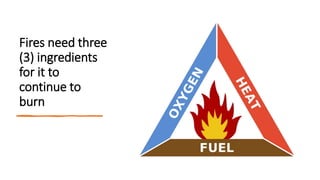
Fires need three
(3) ingredients
for it to
continue to
burn
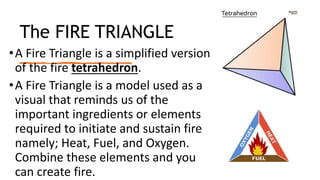
The FIRE TRIANGLE
•A Fire Triangle is a simplified version
of the fire tetrahedron.
•A Fire Triangle is a model used as a
visual that reminds us of the
important ingredients or elements
required to initiate and sustain fire
namely; Heat, Fuel, and Oxygen.
Combine these elements and you
can create fire.
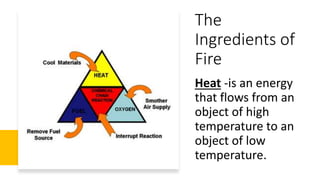
The
Ingredients of
Fire
Heat -is an energy
that flows from an
object of high
temperature to an
object of low
temperature.
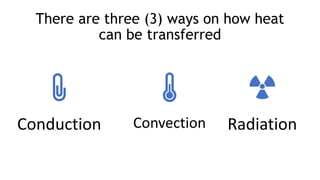
There are three (3) ways on how heat
can be transferred
Conduction Convection Radiation
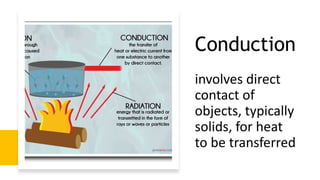
Conduction
involves direct
contact of
objects, typically
solids, for heat
to be transferred
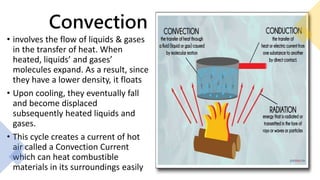
Convection
• involves the flow of liquids & gases
in the transfer of heat. When
heated, liquids’ and gases’
molecules expand. As a result, since
they have a lower density, it floats
• Upon cooling, they eventually fall
and become displaced
subsequently heated liquids and
gases.
• This cycle creates a current of hot
air called a Convection Current
which can heat combustible
materials in its surroundings easily
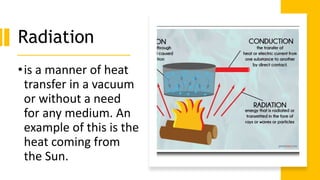
Radiation
•is a manner of heat
transfer in a vacuum
or without a need
for any medium. An
example of this is the
heat coming from
the Sun.
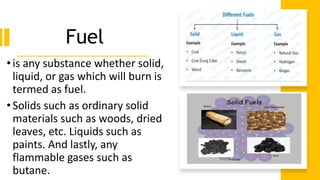
Fuel
•is any substance whether solid,
liquid, or gas which will burn is
termed as fuel.
•Solids such as ordinary solid
materials such as woods, dried
leaves, etc. Liquids such as
paints. And lastly, any
flammable gases such as
butane.
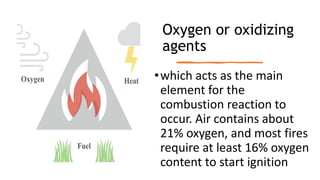
Oxygen or oxidizing
agents
•which acts as the main
element for the
combustion reaction to
occur. Air contains about
21% oxygen, and most fires
require at least 16% oxygen
content to start ignition
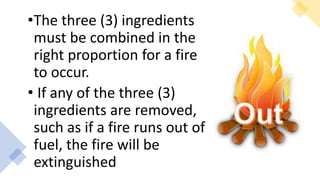
•The three (3) ingredients
must be combined in the
right proportion for a fire
to occur.
• If any of the three (3)
ingredients are removed,
such as if a fire runs out of
fuel, the fire will be
extinguished
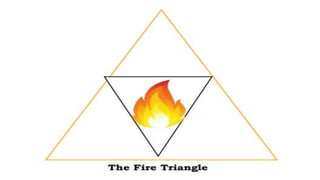
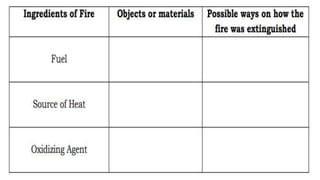
ACTIVITY #1: THE FIRE TRIANGLE
Directions: Label the
diagram below
completing the fire
triangle. After labeling,
observe the materials in
your surroundings, the
materials inside and
outside your house.
List objects that can be
considered as FUEL,
SOURCE OF HEAT, and
an OXIDIZING AGENT
for a fire to happen. List
these objects in its
corresponding part of
the Fire Triangle
ACTIVITY #2:
FIRE
SCENARIO
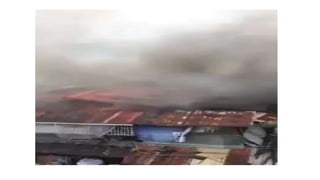
•Last February 20, 2018, a
warehouse and about 40
houses were hit by a fire in
Jenny’s Ave. Barangay
Rosario, Pasig City. According
to the report, at least 4
victims were injured and
brought to the hospital for
treatment.
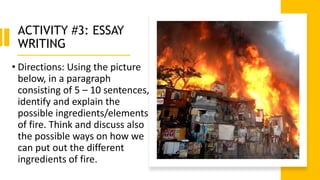
ACTIVITY #3: ESSAY
WRITING
• Directions: Using the picture
below, in a paragraph
consisting of 5 – 10 sentences,
identify and explain the
possible ingredients/elements
of fire. Think and discuss also
the possible ways on how we
can put out the different
ingredients of fire.
•When and how can we
say that the materials in
our house are
combustible or
flammable?
•How can we prevent our
house to be caught on
fire?
Sources of Fire
Hazards
•Fire and combustion have
been defined in various
ways.
•Combustion represents
a self-sustaining run of
reactions consisting of
physical and chemical
transformations.
Combustion
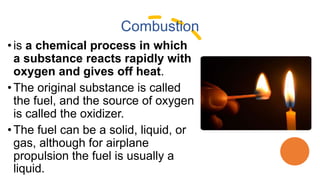
• is a chemical process in which
a substance reacts rapidly with
oxygen and gives off heat.
•The original substance is called
the fuel, and the source of oxygen
is called the oxidizer.
•The fuel can be a solid, liquid, or
gas, although for airplane
propulsion the fuel is usually a
liquid.
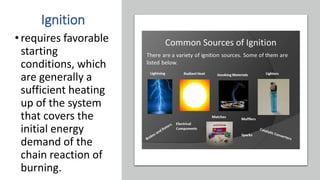
Ignition
•requires favorable
starting
conditions, which
are generally a
sufficient heating
up of the system
that covers the
initial energy
demand of the
chain reaction of
burning.
The Bureau
of Fire
Protection
Operational
Procedures
Manual has
listed down
the causes of
fire as
follows:
• Faulty electrical wiring or connection
• LPG-related
• Neglected cooking or stove
• Cigarette butt
• Unattended open flame: torch or sulo
• Unattended open flame: candle or gasera
• Matchstick or lighter
The Bureau
of Fire
Protection
Operational
Procedures
Manual has
listed down
the causes of
fire as
follows:
Direct flame contact or static electricity
• Neglected electrical appliances or device
• Electrical machinery
• Chemicals
• Incendiary device or ignited flammable liquid
• Spontaneous combustion
• Pyrotechnics
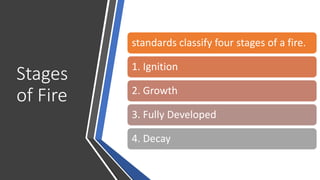
Stages
of Fire
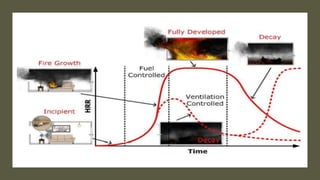
standards classify four stages of a fire.
1. Ignition
2. Growth
3. Fully Developed
4. Decay
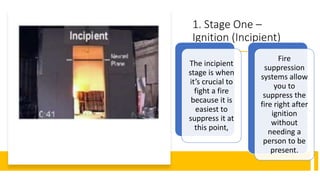
1. Stage One –
Ignition (Incipient)
The incipient
stage is when
it’s crucial to
fight a fire
because it is
easiest to
suppress it at
this point,
Fire
suppression
systems allow
you to
suppress the
fire right after
ignition
without
needing a
person to be
present.
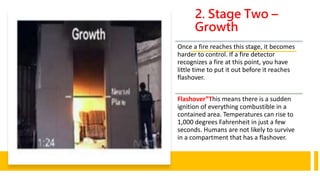
2. Stage Two –
Growth
Once a fire reaches this stage, it becomes
harder to control. If a fire detector
recognizes a fire at this point, you have
little time to put it out before it reaches
flashover.
Flashover”This means there is a sudden
ignition of everything combustible in a
contained area. Temperatures can rise to
1,000 degrees Fahrenheit in just a few
seconds. Humans are not likely to survive
in a compartment that has a flashover.
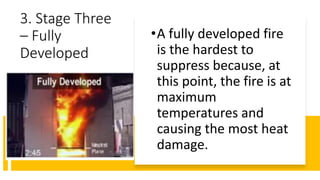
3. Stage Three
– Fully
Developed
•A fully developed fire
is the hardest to
suppress because, at
this point, the fire is at
maximum
temperatures and
causing the most heat
damage.
4. Stage Four
– Decay
•The decay of a fire is the
phase when the fire
decreases in intensity
until it is either a
smolder or non-existent.
If there was no
suppression, this is likely
when there is nothing
left for the fire to burn.
Directions:
Tell the
stage/s of
fire that is
being
described
1. Smoke and heat are
produced.
2. Oxygen supply = 21%
3. Also known as incipient
4. Temperatures reach
between 640° to 870°
Directions:
Tell the
stage/s of
fire that is
being
described
5. Highly dangerous flashovers
may occur anytime.
6. Also known as free burning
phase
7. Hottest phase of a fire
Directions:
Tell the
stage/s of
fire that is
being
described
8. Fire is now dependent on
the amount of oxygen.
9. Fire starts to diminish as fuel
and/or oxygen is consumed
10. Backdraft could potentially
occur.
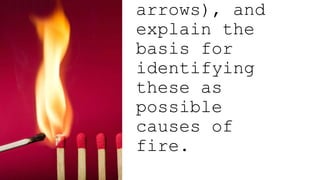
arrows), and
explain the
basis for
identifying
these as
possible
causes of
fire.
Fire Triangle.pptx
Fire Triangle.pptx
Fire Triangle.pptx
Fire Triangle.pptx
Fire Triangle.pptx

Fire Triangle.pptx

  • 1.
    Directions: Identify thefollowing statements if it’s TRUE or FALSE based on the underlined word/phrase. •1. Fire is a chemical reaction of oxygen and other substances that gives out light, heat, and smoke.
  • 2.
    Directions: Identify thefollowing statements if it’s TRUE or FALSE based on the underlined word/phrase. •2. Oxygen is one of the ingredients for fire to start and continue.
  • 3.
    Directions: Identify thefollowing statements if it’s TRUE or FALSE based on the underlined word/phrase. •3. Smoke is one of the components of the Fire Triangle together with Heat and Fuel.
  • 4.
    Directions: Identify thefollowing statements if it’s TRUE or FALSE based on the underlined word/phrase. •4. Sun is one of the natural sources of heat.
  • 5.
    Directions: Identify thefollowing statements if it’s TRUE or FALSE based on the underlined word/phrase. •5. Gas may be a flammable material considered to be as heat in the fire triangle.
  • 6.
  • 7.
    FIRE •is a stateof combustion in which fuel or other materials is ignited and combined with oxygen, giving off light, heat, and flame.
  • 8.
    FIRE •fire is theonly event that is both beneficial to man and his environment as well as destructive and deadly. Fire is beneficial when controlled but is very destructive and deadly if not.
  • 9.
    You are onlygoing to see fires in two places – indoors and outdoors Outdoor fires are forest fire or wildfire indoor fires are building fires and/or housefires.
  • 10.
    Major causes offire range electrical neglects or accidents, smoking, kitchen accidents, neglected heating equipment, hazardous goods such as paints and adhesives, and even man-made causes of fire such as Arson
  • 11.
  • 12.
    Fires need three (3)ingredients for it to continue to burn
  • 13.
    The FIRE TRIANGLE •AFire Triangle is a simplified version of the fire tetrahedron. •A Fire Triangle is a model used as a visual that reminds us of the important ingredients or elements required to initiate and sustain fire namely; Heat, Fuel, and Oxygen. Combine these elements and you can create fire.
  • 14.
    The Ingredients of Fire Heat -isan energy that flows from an object of high temperature to an object of low temperature.
  • 15.
    There are three(3) ways on how heat can be transferred Conduction Convection Radiation
  • 16.
    Conduction involves direct contact of objects,typically solids, for heat to be transferred
  • 17.
    Convection • involves theflow of liquids & gases in the transfer of heat. When heated, liquids’ and gases’ molecules expand. As a result, since they have a lower density, it floats • Upon cooling, they eventually fall and become displaced subsequently heated liquids and gases. • This cycle creates a current of hot air called a Convection Current which can heat combustible materials in its surroundings easily
  • 18.
    Radiation •is a mannerof heat transfer in a vacuum or without a need for any medium. An example of this is the heat coming from the Sun.
  • 19.
    Fuel •is any substancewhether solid, liquid, or gas which will burn is termed as fuel. •Solids such as ordinary solid materials such as woods, dried leaves, etc. Liquids such as paints. And lastly, any flammable gases such as butane.
  • 20.
    Oxygen or oxidizing agents •whichacts as the main element for the combustion reaction to occur. Air contains about 21% oxygen, and most fires require at least 16% oxygen content to start ignition
  • 21.
    •The three (3)ingredients must be combined in the right proportion for a fire to occur. • If any of the three (3) ingredients are removed, such as if a fire runs out of fuel, the fire will be extinguished
  • 22.
    ACTIVITY #1: THEFIRE TRIANGLE Directions: Label the diagram below completing the fire triangle. After labeling, observe the materials in your surroundings, the materials inside and outside your house. List objects that can be considered as FUEL, SOURCE OF HEAT, and an OXIDIZING AGENT for a fire to happen. List these objects in its corresponding part of the Fire Triangle
  • 24.
    ACTIVITY #2: FIRE SCENARIO •Last February20, 2018, a warehouse and about 40 houses were hit by a fire in Jenny’s Ave. Barangay Rosario, Pasig City. According to the report, at least 4 victims were injured and brought to the hospital for treatment.
  • 27.
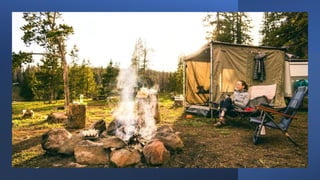
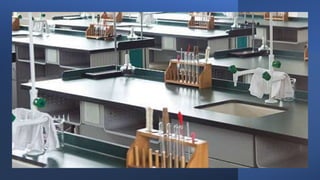
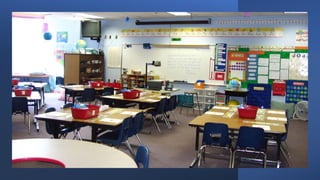
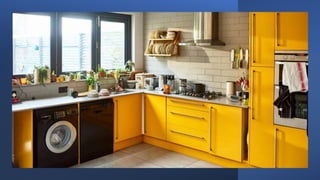
    ACTIVITY #3: ESSAY WRITING •Directions: Using the picture below, in a paragraph consisting of 5 – 10 sentences, identify and explain the possible ingredients/elements of fire. Think and discuss also the possible ways on how we can put out the different ingredients of fire.
  • 28.
    •When and howcan we say that the materials in our house are combustible or flammable? •How can we prevent our house to be caught on fire?
  • 29.
    Sources of Fire Hazards •Fireand combustion have been defined in various ways. •Combustion represents a self-sustaining run of reactions consisting of physical and chemical transformations.
  • 30.
    Combustion • is achemical process in which a substance reacts rapidly with oxygen and gives off heat. •The original substance is called the fuel, and the source of oxygen is called the oxidizer. •The fuel can be a solid, liquid, or gas, although for airplane propulsion the fuel is usually a liquid.
  • 31.
    Ignition •requires favorable starting conditions, which aregenerally a sufficient heating up of the system that covers the initial energy demand of the chain reaction of burning.
  • 32.
    The Bureau of Fire Protection Operational Procedures Manualhas listed down the causes of fire as follows: • Faulty electrical wiring or connection • LPG-related • Neglected cooking or stove • Cigarette butt • Unattended open flame: torch or sulo • Unattended open flame: candle or gasera • Matchstick or lighter
  • 33.
    The Bureau of Fire Protection Operational Procedures Manualhas listed down the causes of fire as follows: Direct flame contact or static electricity • Neglected electrical appliances or device • Electrical machinery • Chemicals • Incendiary device or ignited flammable liquid • Spontaneous combustion • Pyrotechnics
  • 34.
    Stages of Fire standards classifyfour stages of a fire. 1. Ignition 2. Growth 3. Fully Developed 4. Decay
  • 36.
    1. Stage One– Ignition (Incipient) The incipient stage is when it’s crucial to fight a fire because it is easiest to suppress it at this point, Fire suppression systems allow you to suppress the fire right after ignition without needing a person to be present.
  • 37.
    2. Stage Two– Growth Once a fire reaches this stage, it becomes harder to control. If a fire detector recognizes a fire at this point, you have little time to put it out before it reaches flashover. Flashover”This means there is a sudden ignition of everything combustible in a contained area. Temperatures can rise to 1,000 degrees Fahrenheit in just a few seconds. Humans are not likely to survive in a compartment that has a flashover.
  • 38.
    3. Stage Three –Fully Developed •A fully developed fire is the hardest to suppress because, at this point, the fire is at maximum temperatures and causing the most heat damage.
  • 39.
    4. Stage Four –Decay •The decay of a fire is the phase when the fire decreases in intensity until it is either a smolder or non-existent. If there was no suppression, this is likely when there is nothing left for the fire to burn.
  • 40.
    Directions: Tell the stage/s of firethat is being described 1. Smoke and heat are produced. 2. Oxygen supply = 21% 3. Also known as incipient 4. Temperatures reach between 640° to 870°
  • 41.
    Directions: Tell the stage/s of firethat is being described 5. Highly dangerous flashovers may occur anytime. 6. Also known as free burning phase 7. Hottest phase of a fire
  • 42.
    Directions: Tell the stage/s of firethat is being described 8. Fire is now dependent on the amount of oxygen. 9. Fire starts to diminish as fuel and/or oxygen is consumed 10. Backdraft could potentially occur.
  • 43.
    arrows), and explain the basisfor identifying these as possible causes of fire.