Presented by-
Shabnam
1303
Msc 3rd semester
INTRODUCTION
 Arson continues to be a serious problem on the
global scale resulting in high costs in terms of
property loss,injuries ,etc.
 Arson is the act of burning or charring property on
purpose.
 Definition : Arson is the crime of maliciously ,
voluntarily and unlawful act by setting fire to the
building or other property of another or burning
ones own property for an improper , such as to
collect insurance.
 Arson crimes are hard to solve,become difficult to
investigate due to fact that the preparator has
thoroughly planned the act destruction is extensive.
CONT…
 Hence the criminalist’s
function is limited to
detecting and identifying
relevant chemical
materials collected at the
scene and reconstructing
and identifying ignitors or
detonating mechanisms.
 Only 17% of cases in
2003 ended in arrest.
 Vandalism is leading
cause of arson.
CHEMISTRY OF ARSON
 Chemically, fire is type of oxidation , which is the
combination of oxygen with other substances to
produce new substances.
 To start the fire minimum temp. is required to
spontaneous ignite the fuel known as ignition
temperature.
 An additional factor to explain the fire rate or speed at
which the oxidation reaction takes place.
 A liduid burns when the temperature is high enough
to vaporize it,while a solid must be hot enough to
decompose into gaseous products(pyrolysis) and fuel
burns with oxygen sufficient to produce a flame only
when it is in gaseous state.
FUEL
 Organic fuels (most common):
- wood & paper
-petroleum products & fossils fuels
-hydrocarbons.
 Inorganic fuels:
-elemental ( alkali metals , magnesium ,
hydrogen,phosphorus)
-metal salts like azide.
ELEMENTS OF ARSON
 According to common law,there is certain elements
required to determine a fire to be caused by arson
include :
 1. the malicious
 2. burning
 3. of a dwelling
 4. belonging to another
 Legislation has expanding the definition of arson to
include burning of persons own property as well as
the burning of personal property,vehicles and land.
FIRE TRIANGLE.
MOTIVES FOR ARSON
 Typically there are different motives which responsible
for causing fire:
1. Vandalism – When the goal is to mischievously or
maliciously harm property such as abandoned
buildings.
2. Excitement – When a fire is set to gain attention or
get rush, example is fire is set so that arsonist act as
hero by calling fire-fighters or helping to put fireout.
3. Revenge – When fire is set in malicious attempt to
right a wrong , whether the offence is real or
imagenated.This type of fire is planed by other
motives as well.It may be for personal( target
individual), institutional, societal or groups.
CONT..
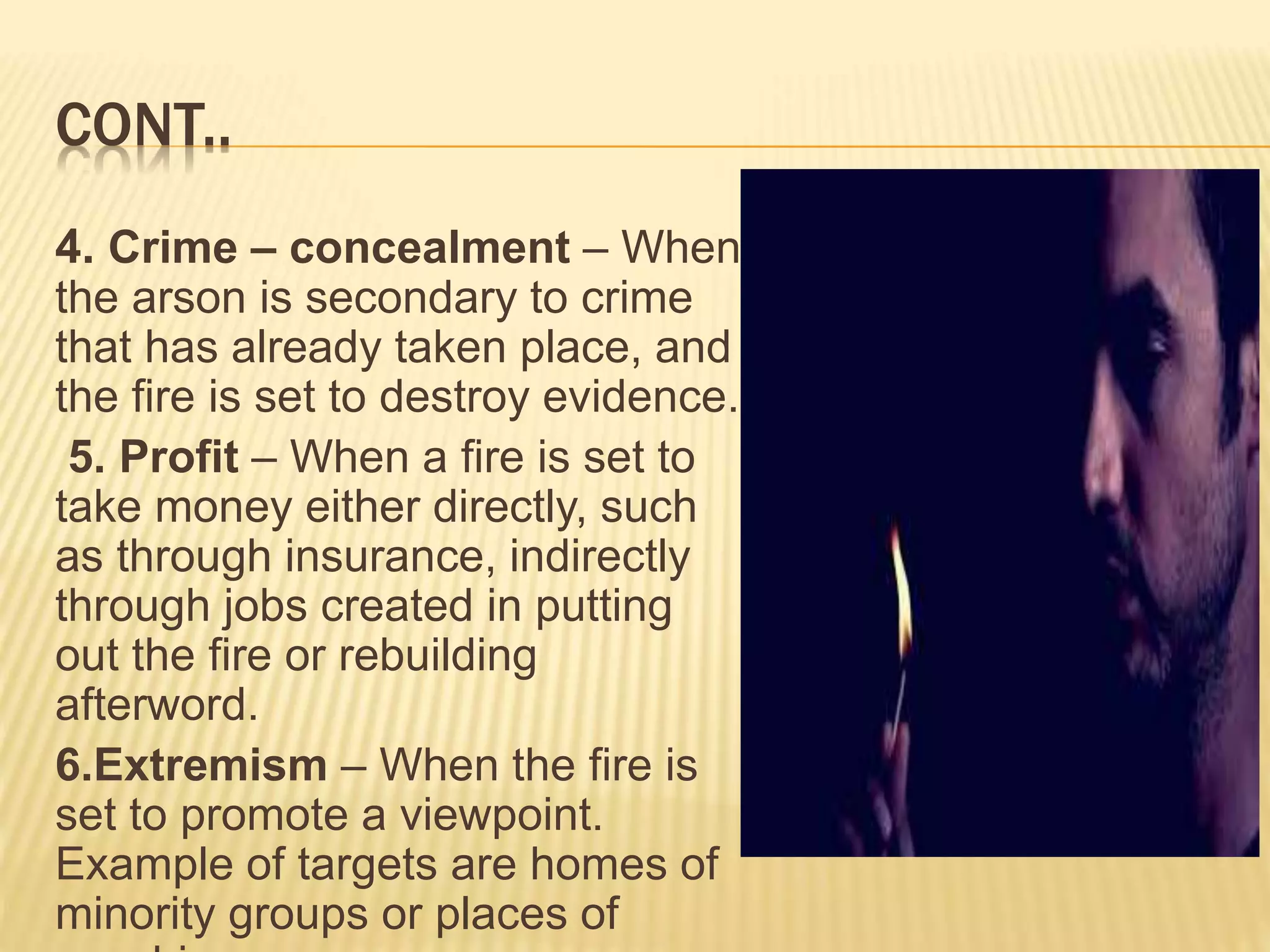
4. Crime – concealment – When
the arson is secondary to crime
that has already taken place, and
the fire is set to destroy evidence.
5. Profit – When a fire is set to
take money either directly, such
as through insurance, indirectly
through jobs created in putting
out the fire or rebuilding
afterword.
6.Extremism – When the fire is
set to promote a viewpoint.
Example of targets are homes of
minority groups or places of
DEGREES OF ARSON
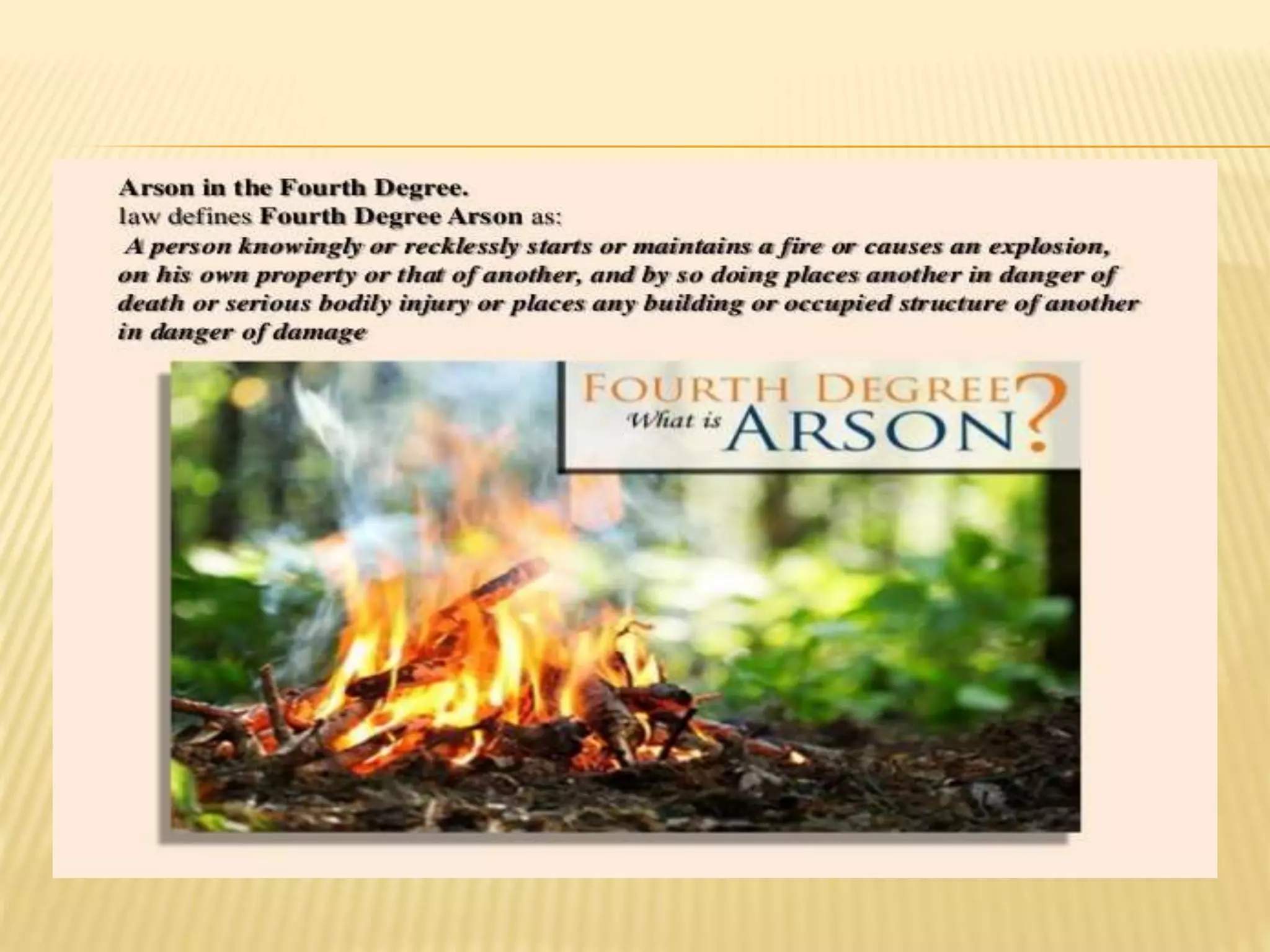
 Most states define different degrees of arson depending
on the circumstances surrounding the act . This includes
factors such as whether the building was occupied at the
time of fire or whether the act was commit in order to
commit fraud. Another factor taken into consideration in
determination of degrees of arson is the amount of
damages caused by the crime.
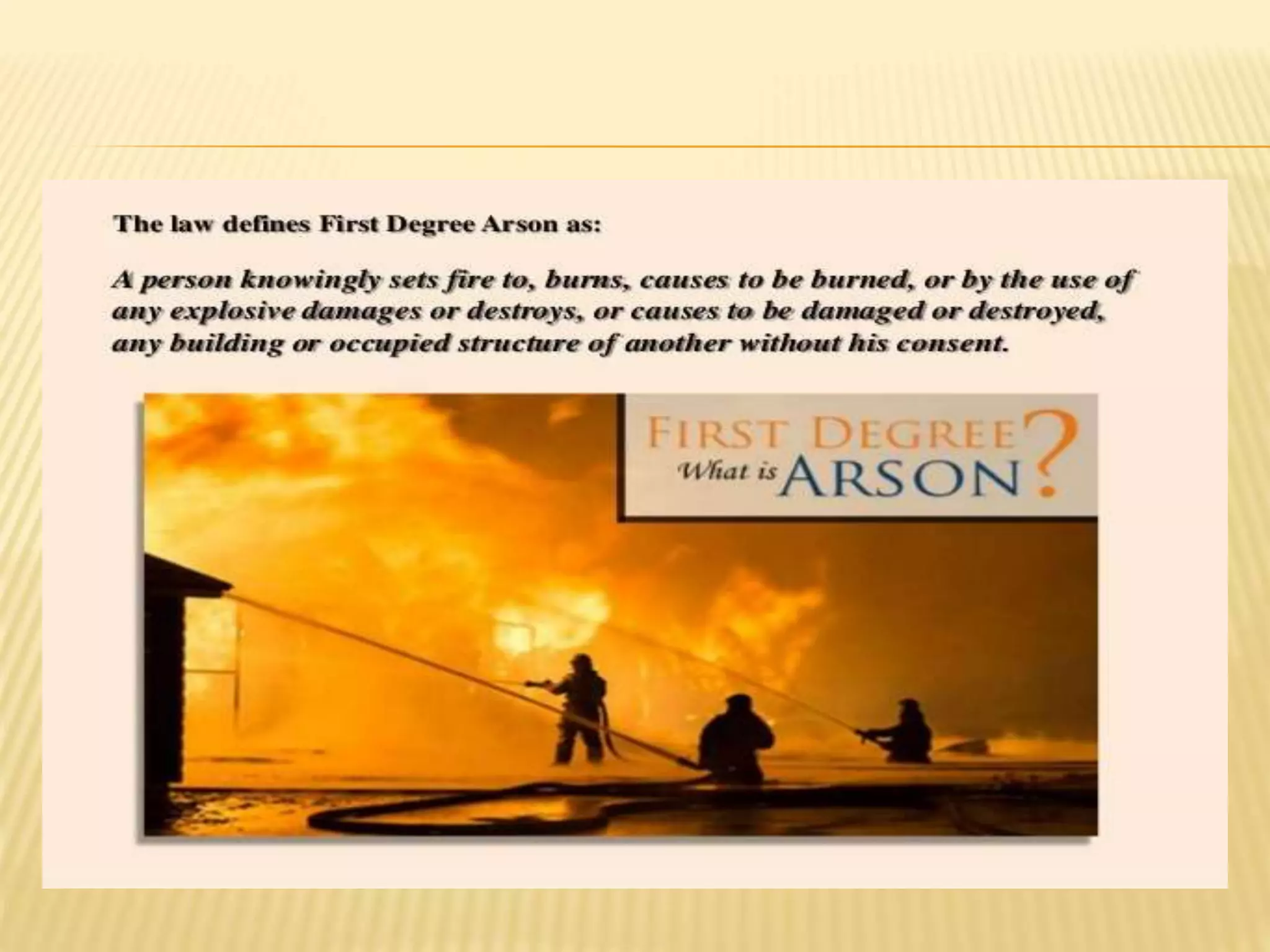
 1.First Degree Arson – an act in which a person sets a
fire to an occupied home or building.
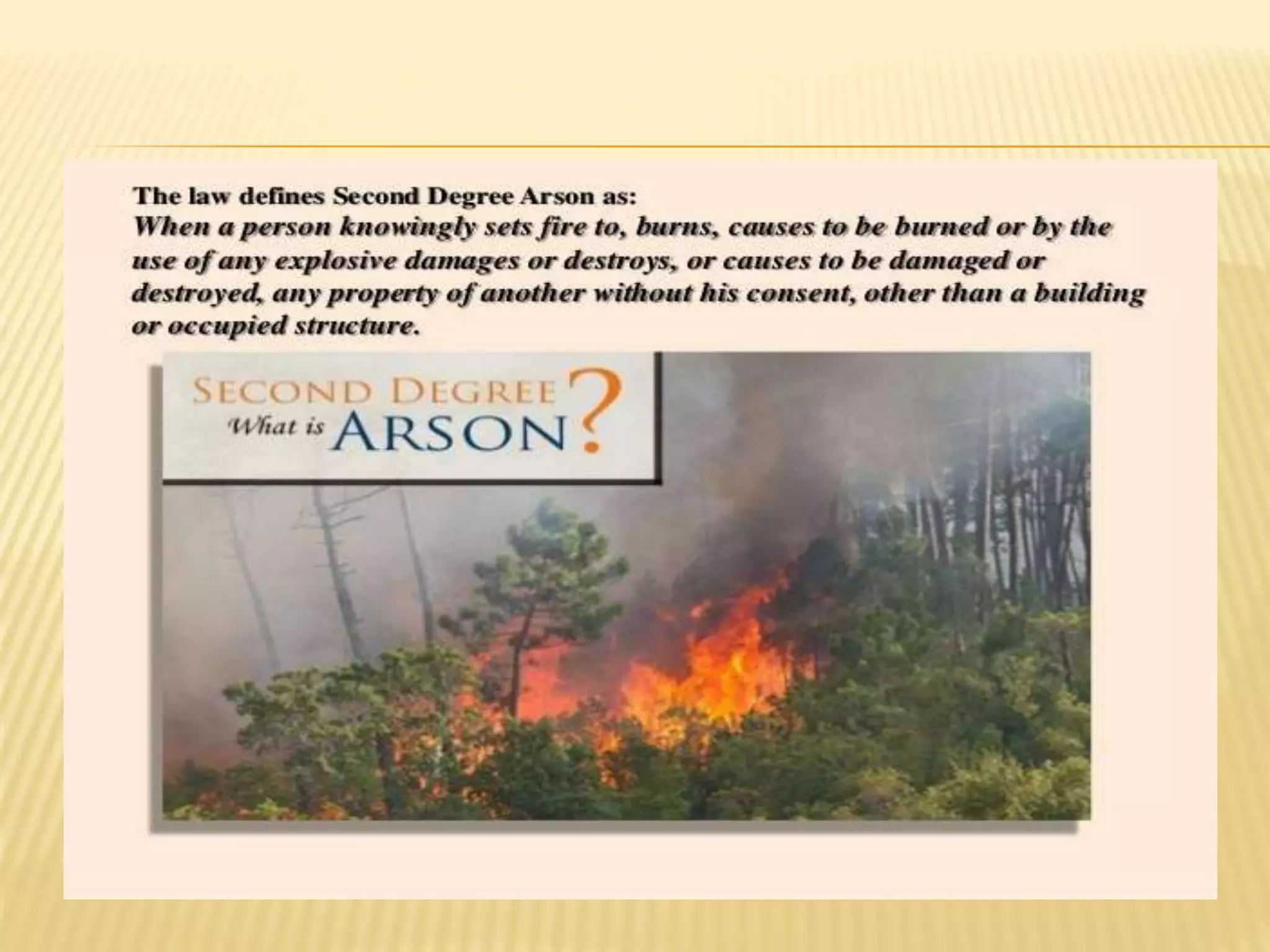
 2.Second Degree Arson – an act in which a person
sets fire to an empty or abandoned structure.
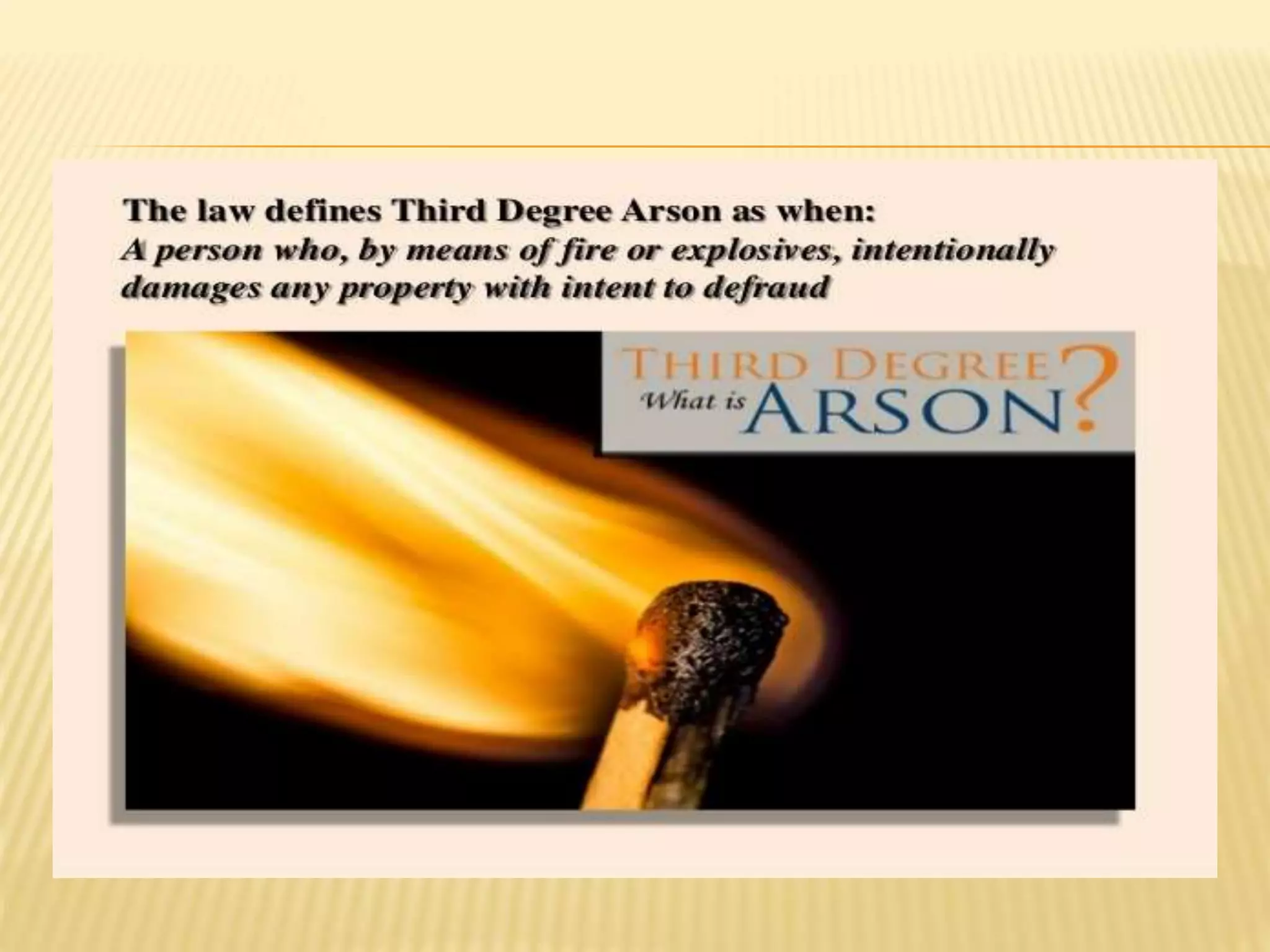
 3.Third Degree Arson – an act in which a person sets
fire to an abandoned area of space such as a vacant
lot or field.
ADDITIONAL PUNISHMENTS
 If person commits another crime in
conjunction with the arson , additional
penalties may be imposed.
1 . Breaking the entry
2. Larceny
3. Arson.
 Additional punishments often determined
by the amount of damages caused by the
fire.
AGGRAVATED ARSON
 I many states, a charge of arson may be upgraded to
aggravated arson which takes into account such
factors was whether the accused anticipated a
person being inside the building when they started
the fire.
 The primary consideration in classifying aggravated
arson is malicious intent.Intent may be caused by
financial distress ,anger and other issues fraught with
emotion.
 Aggravated arson is same as the First Degree Arson
on some states and may include the burning building
to obtained an insurance settlement or setting of a
fire for the purpose of harming another person or to
cause fear.
CONTS…
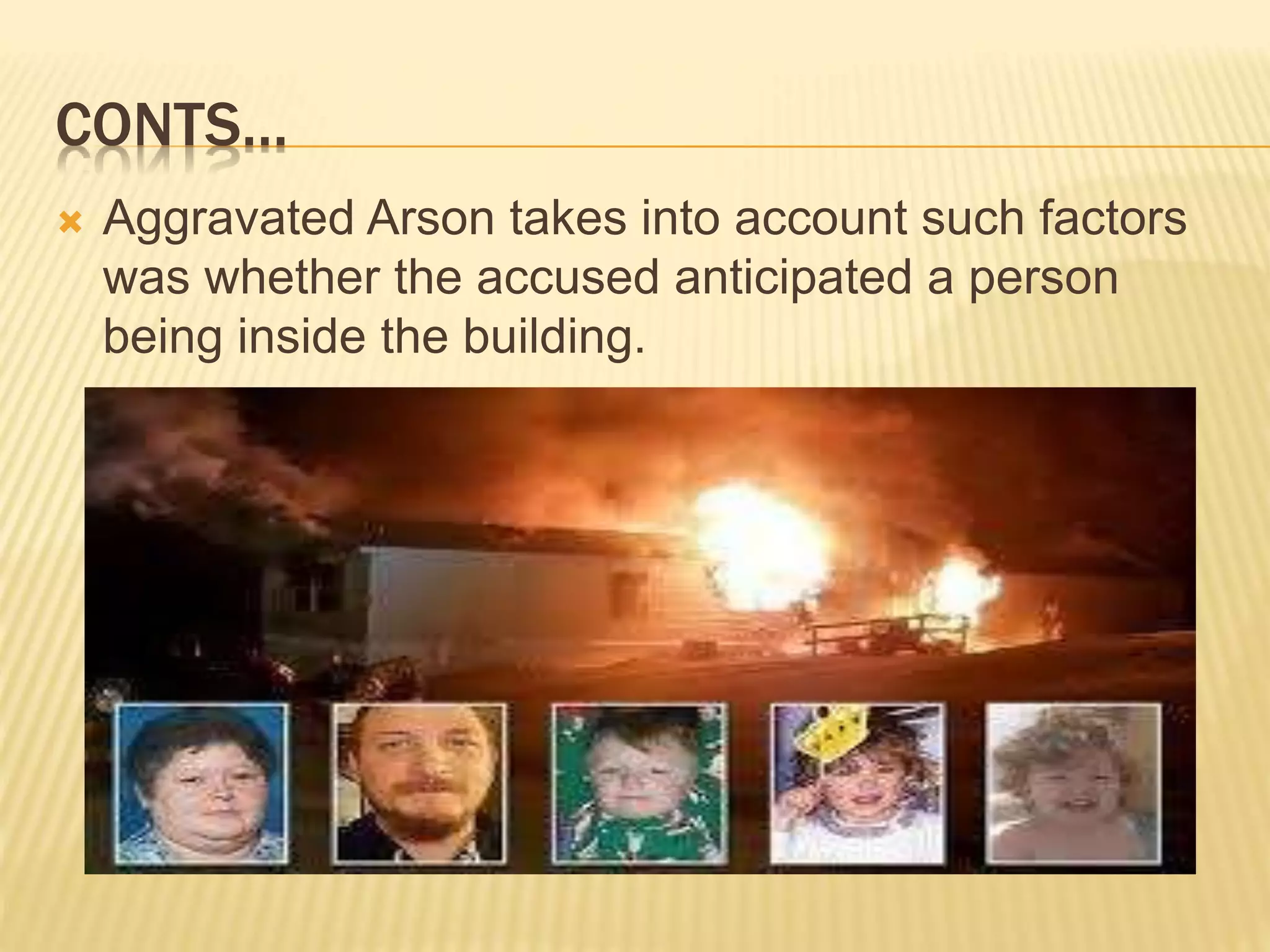
 Aggravated Arson takes into account such factors
was whether the accused anticipated a person
being inside the building.
RECKLESS ARSON
 While most people consider arson to be the
intentional setting of fires, reckless behaviour that
leads to the destruction of property by fire may also
lead to arson charges.
 Accidental arson is that the fire are started
accidentally , even though the person tried to be
carefully.
 The investigator may prove the cause of fire its an
accidental or intentional fire.
WHY INVESTIGATE FIRES?
 As we know, fire is enormously costly to society.Fire
departments across the country are required to
investigate fires to determine the origin and cause.
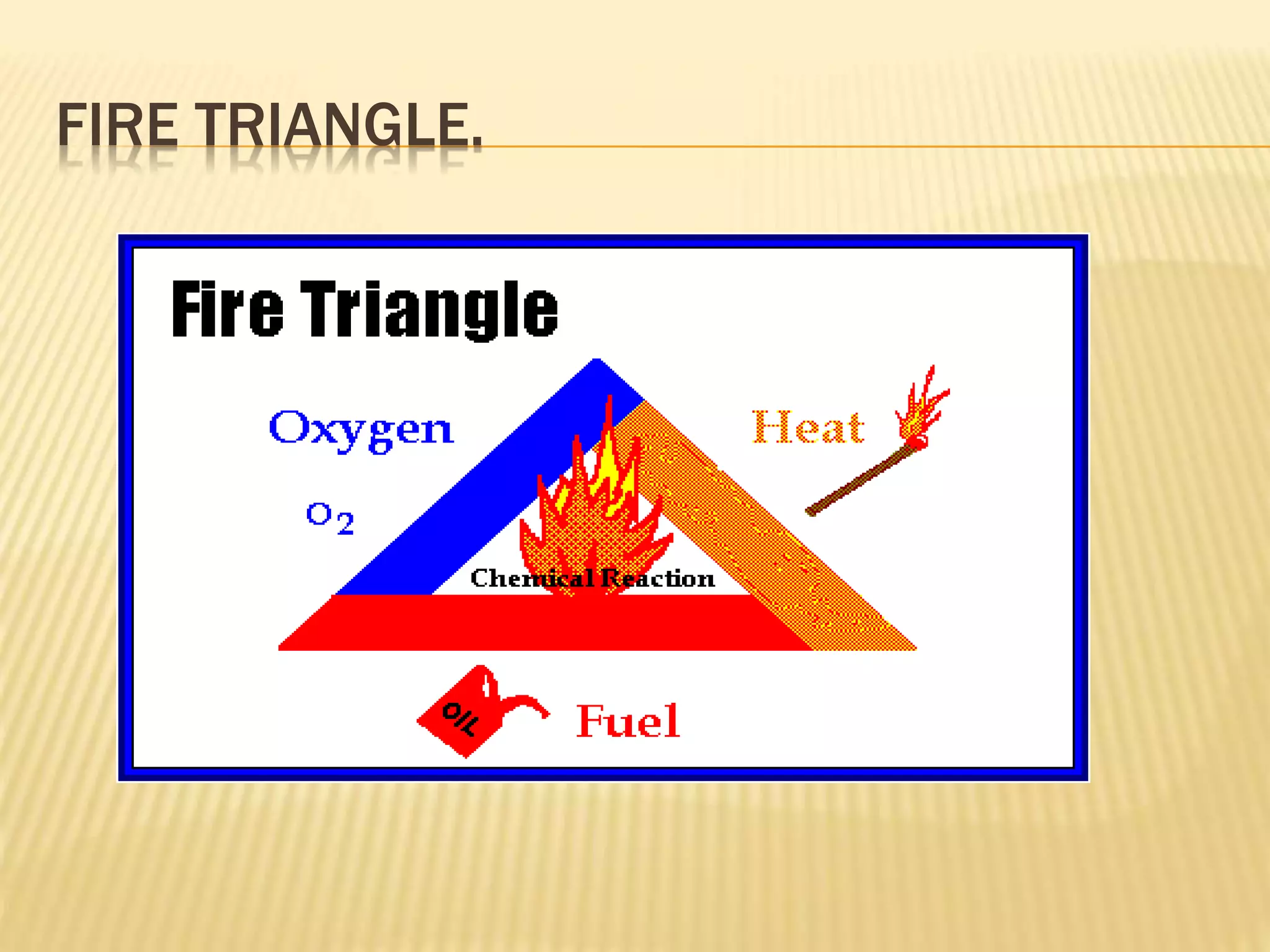
 A fire occur when a fuel comes together with oxygen
and a heat source.
 The role of fire investigator to determine how and why
these factors come together and to answer the
question “Was this an accident or intentional act?”
 it is not only the role of the fire department to supress
the fire but also to identify the cause of the fire.
CONTS…
The two primary reasons that the fire are investigated are to
determine what caused of fire and to identify and collect any
evidence related to that cause.
1. To prevent the situation from occurring again.This is
accomplished by identifying hazardous condition or
practices, product failures or other fire causes.Once the
cause is known officials can educate the public and changes
in an efforts to limit similar types of fires.
2. Investigate the fires is to obtain evidence necessary to
hold accountable the person or entity responsible for the
cause (in case of intentionally set fire) ,then investigators
will search the clues in the ashes in an effort to solve the
crime.
ARSON INVESTIGATION
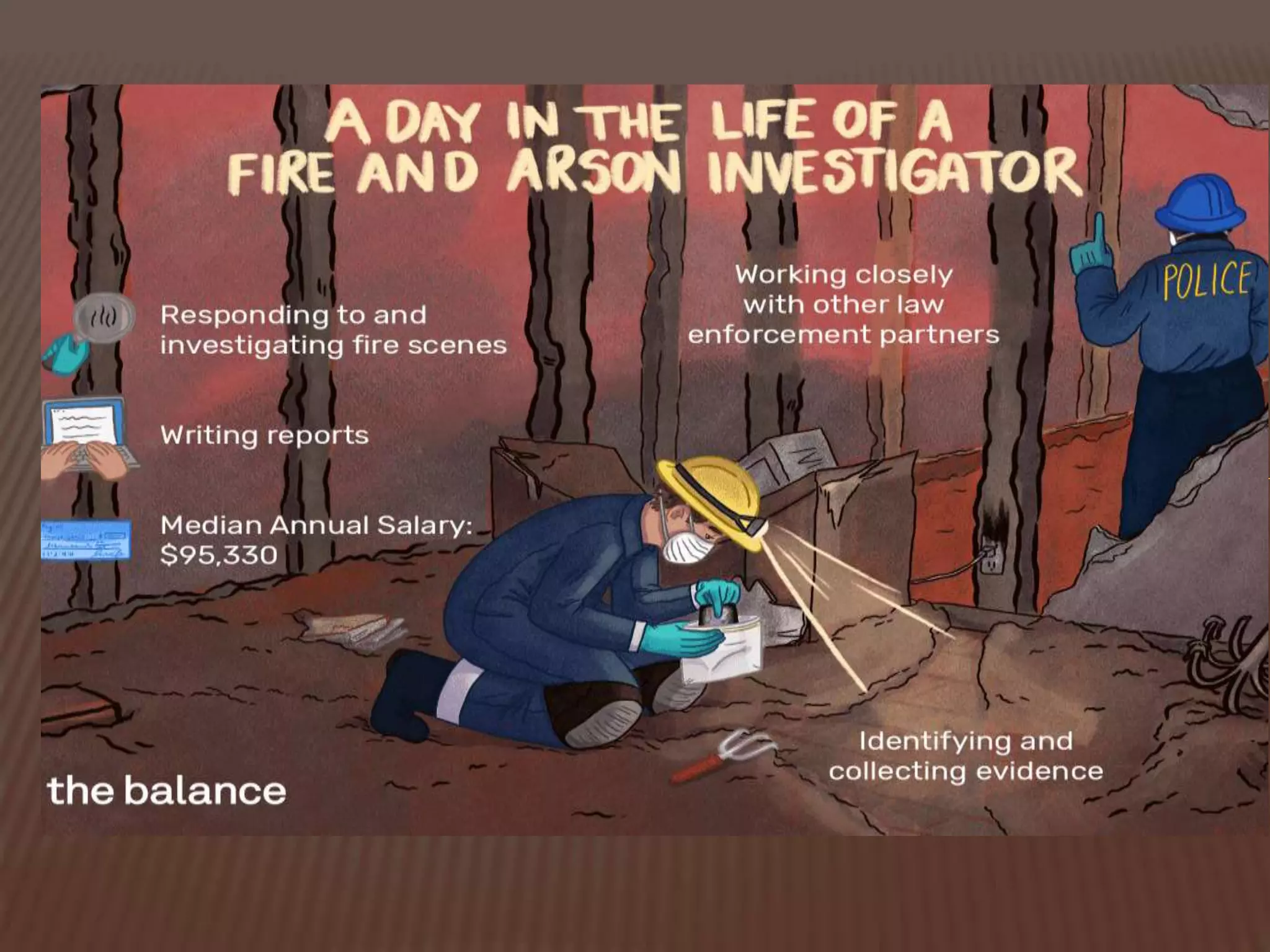
 Fire and arson investigators examine the physical
attributes of a fire scene and identify and collect
physical evidence from the scene.
 Evidence is then analysed to help determine if the
cause of the fire was accidental or
deliberate(intentionally).
 During the scene examination , investigators may find
evidence such as accelerants, tempered utilities and
specific burn patterns which may indicate criminal
activities.
 Due to more destructive powers of fire , investigators
must be aware of their surrounding.
FIRE SCENE INVESTIGATION
Scene security is the uppermost importance both during and
after firefighting operations have been completed.
The investigator must observe condition of the scene at
his/her time of arrival.Note that amount of demage as
viewed from the exterior ,as well as extension of the fire to
the interior portion.
Color of flames and smoke- flame color help to determine
the type of accelerants( diff. accelerants produce diff. color
and smoke) used to cause fire.
Speed of fire – how rapidly the flames spread may indicate
the accelerants type.
Suspect at the fire – whether or not witness saw familiar
faces at the scene of fire.
CONTS…
 Removal of property - Whether valuable or
sentimental items removed from the property just
prior to fire may indicate intent.
 SCENE EXAMINATION -
 Determining the point of origin by observe exterior fire
or heat.
 Sketching(rough sketch or final sketch) of crime
scene
 Photography(prior to sample collection)
 Evidence collection
 Documentation
 Reconstruction.
INDIAN LAWS
THE CRIME OF ARSON IN INDIAN LAWS
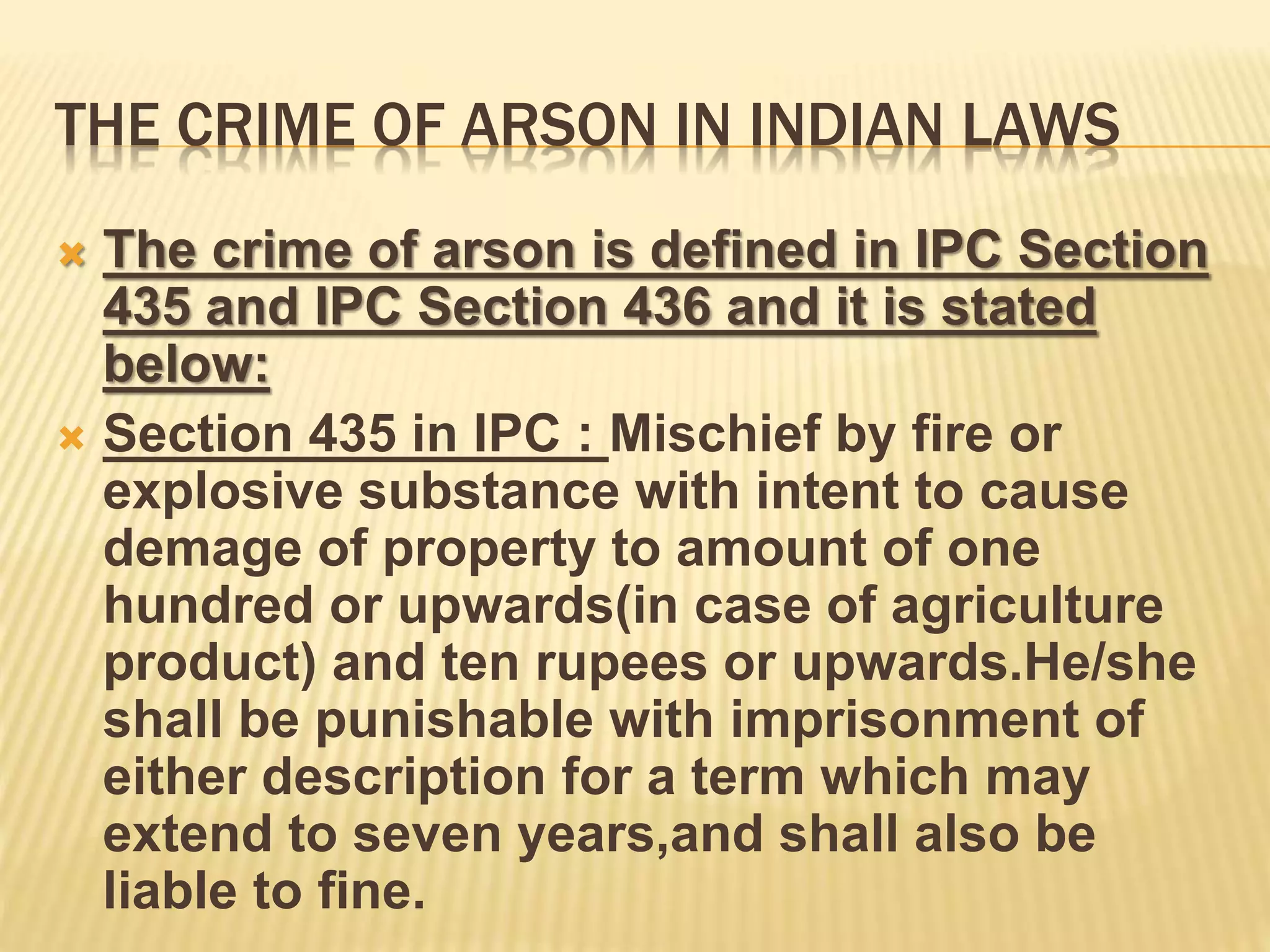
 The crime of arson is defined in IPC Section
435 and IPC Section 436 and it is stated
below:
 Section 435 in IPC : Mischief by fire or
explosive substance with intent to cause
demage of property to amount of one
hundred or upwards(in case of agriculture
product) and ten rupees or upwards.He/she
shall be punishable with imprisonment of
either description for a term which may
extend to seven years,and shall also be
liable to fine.
CONT…
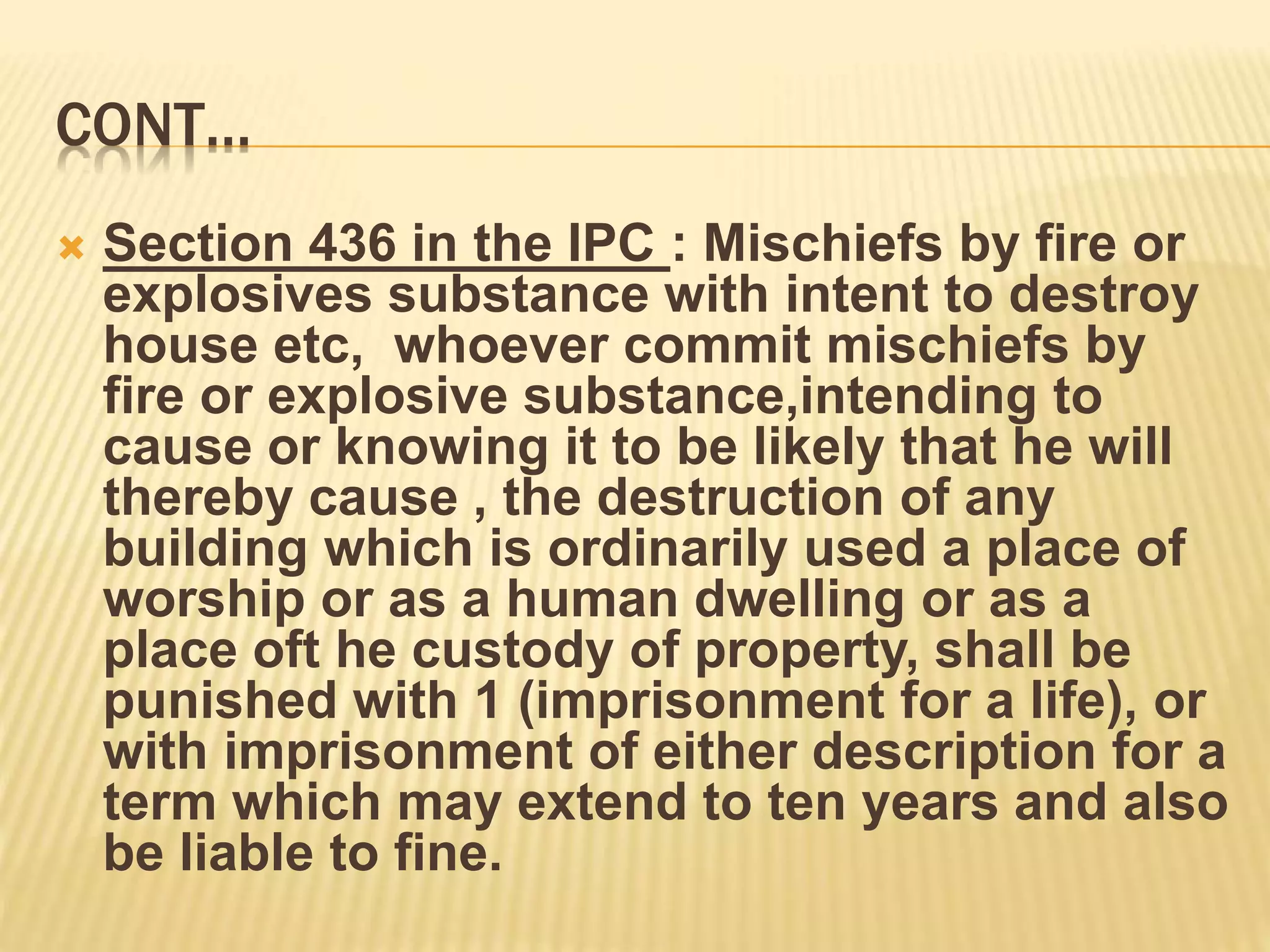
 Section 436 in the IPC : Mischiefs by fire or
explosives substance with intent to destroy
house etc, whoever commit mischiefs by
fire or explosive substance,intending to
cause or knowing it to be likely that he will
thereby cause , the destruction of any
building which is ordinarily used a place of
worship or as a human dwelling or as a
place oft he custody of property, shall be
punished with 1 (imprisonment for a life), or
with imprisonment of either description for a
term which may extend to ten years and also
be liable to fine.
ARSON STATISTICS
 Some facts and statics concerning
arson include :
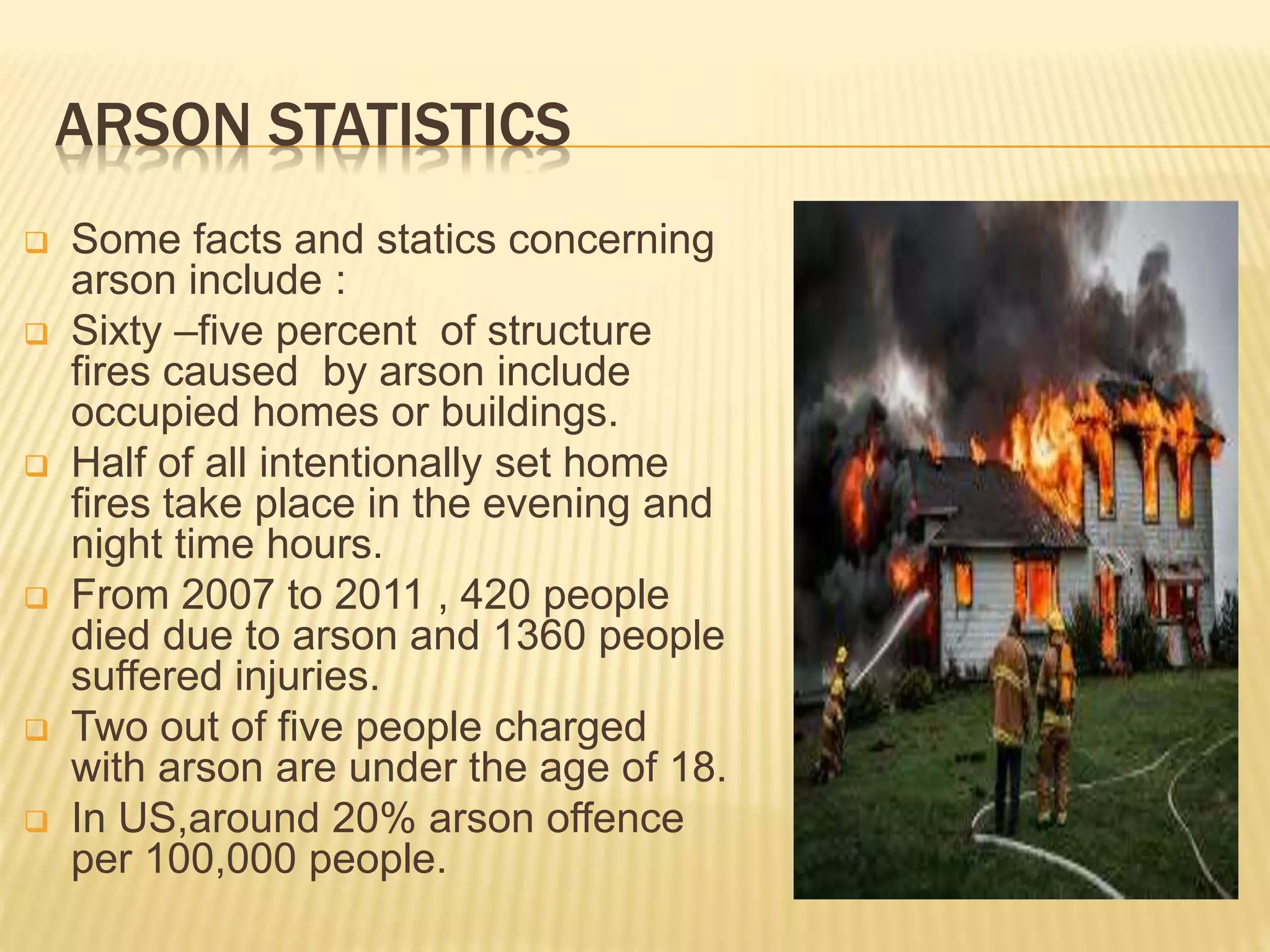
 Sixty –five percent of structure
fires caused by arson include
occupied homes or buildings.
 Half of all intentionally set home
fires take place in the evening and
night time hours.
 From 2007 to 2011 , 420 people
died due to arson and 1360 people
suffered injuries.
 Two out of five people charged
with arson are under the age of 18.
 In US,around 20% arson offence
per 100,000 people.
THANK
YOU

Intoduction and brief analysis of arson

  • 1.
  • 2.
    INTRODUCTION  Arson continuesto be a serious problem on the global scale resulting in high costs in terms of property loss,injuries ,etc.  Arson is the act of burning or charring property on purpose.  Definition : Arson is the crime of maliciously , voluntarily and unlawful act by setting fire to the building or other property of another or burning ones own property for an improper , such as to collect insurance.  Arson crimes are hard to solve,become difficult to investigate due to fact that the preparator has thoroughly planned the act destruction is extensive.
  • 3.
    CONT…  Hence thecriminalist’s function is limited to detecting and identifying relevant chemical materials collected at the scene and reconstructing and identifying ignitors or detonating mechanisms.  Only 17% of cases in 2003 ended in arrest.  Vandalism is leading cause of arson.
  • 4.
    CHEMISTRY OF ARSON Chemically, fire is type of oxidation , which is the combination of oxygen with other substances to produce new substances.  To start the fire minimum temp. is required to spontaneous ignite the fuel known as ignition temperature.  An additional factor to explain the fire rate or speed at which the oxidation reaction takes place.  A liduid burns when the temperature is high enough to vaporize it,while a solid must be hot enough to decompose into gaseous products(pyrolysis) and fuel burns with oxygen sufficient to produce a flame only when it is in gaseous state.
  • 5.
    FUEL  Organic fuels(most common): - wood & paper -petroleum products & fossils fuels -hydrocarbons.  Inorganic fuels: -elemental ( alkali metals , magnesium , hydrogen,phosphorus) -metal salts like azide.
  • 6.
    ELEMENTS OF ARSON According to common law,there is certain elements required to determine a fire to be caused by arson include :  1. the malicious  2. burning  3. of a dwelling  4. belonging to another  Legislation has expanding the definition of arson to include burning of persons own property as well as the burning of personal property,vehicles and land.
  • 7.
  • 8.
    MOTIVES FOR ARSON Typically there are different motives which responsible for causing fire: 1. Vandalism – When the goal is to mischievously or maliciously harm property such as abandoned buildings. 2. Excitement – When a fire is set to gain attention or get rush, example is fire is set so that arsonist act as hero by calling fire-fighters or helping to put fireout. 3. Revenge – When fire is set in malicious attempt to right a wrong , whether the offence is real or imagenated.This type of fire is planed by other motives as well.It may be for personal( target individual), institutional, societal or groups.
  • 9.
    CONT.. 4. Crime –concealment – When the arson is secondary to crime that has already taken place, and the fire is set to destroy evidence. 5. Profit – When a fire is set to take money either directly, such as through insurance, indirectly through jobs created in putting out the fire or rebuilding afterword. 6.Extremism – When the fire is set to promote a viewpoint. Example of targets are homes of minority groups or places of
  • 10.
    DEGREES OF ARSON Most states define different degrees of arson depending on the circumstances surrounding the act . This includes factors such as whether the building was occupied at the time of fire or whether the act was commit in order to commit fraud. Another factor taken into consideration in determination of degrees of arson is the amount of damages caused by the crime.  1.First Degree Arson – an act in which a person sets a fire to an occupied home or building.  2.Second Degree Arson – an act in which a person sets fire to an empty or abandoned structure.  3.Third Degree Arson – an act in which a person sets fire to an abandoned area of space such as a vacant lot or field.
  • 15.
    ADDITIONAL PUNISHMENTS  Ifperson commits another crime in conjunction with the arson , additional penalties may be imposed. 1 . Breaking the entry 2. Larceny 3. Arson.  Additional punishments often determined by the amount of damages caused by the fire.
  • 16.
    AGGRAVATED ARSON  Imany states, a charge of arson may be upgraded to aggravated arson which takes into account such factors was whether the accused anticipated a person being inside the building when they started the fire.  The primary consideration in classifying aggravated arson is malicious intent.Intent may be caused by financial distress ,anger and other issues fraught with emotion.  Aggravated arson is same as the First Degree Arson on some states and may include the burning building to obtained an insurance settlement or setting of a fire for the purpose of harming another person or to cause fear.
  • 17.
    CONTS…  Aggravated Arsontakes into account such factors was whether the accused anticipated a person being inside the building.
  • 18.
    RECKLESS ARSON  Whilemost people consider arson to be the intentional setting of fires, reckless behaviour that leads to the destruction of property by fire may also lead to arson charges.  Accidental arson is that the fire are started accidentally , even though the person tried to be carefully.  The investigator may prove the cause of fire its an accidental or intentional fire.
  • 20.
    WHY INVESTIGATE FIRES? As we know, fire is enormously costly to society.Fire departments across the country are required to investigate fires to determine the origin and cause.  A fire occur when a fuel comes together with oxygen and a heat source.  The role of fire investigator to determine how and why these factors come together and to answer the question “Was this an accident or intentional act?”  it is not only the role of the fire department to supress the fire but also to identify the cause of the fire.
  • 21.
    CONTS… The two primaryreasons that the fire are investigated are to determine what caused of fire and to identify and collect any evidence related to that cause. 1. To prevent the situation from occurring again.This is accomplished by identifying hazardous condition or practices, product failures or other fire causes.Once the cause is known officials can educate the public and changes in an efforts to limit similar types of fires. 2. Investigate the fires is to obtain evidence necessary to hold accountable the person or entity responsible for the cause (in case of intentionally set fire) ,then investigators will search the clues in the ashes in an effort to solve the crime.
  • 23.
    ARSON INVESTIGATION  Fireand arson investigators examine the physical attributes of a fire scene and identify and collect physical evidence from the scene.  Evidence is then analysed to help determine if the cause of the fire was accidental or deliberate(intentionally).  During the scene examination , investigators may find evidence such as accelerants, tempered utilities and specific burn patterns which may indicate criminal activities.  Due to more destructive powers of fire , investigators must be aware of their surrounding.
  • 24.
    FIRE SCENE INVESTIGATION Scenesecurity is the uppermost importance both during and after firefighting operations have been completed. The investigator must observe condition of the scene at his/her time of arrival.Note that amount of demage as viewed from the exterior ,as well as extension of the fire to the interior portion. Color of flames and smoke- flame color help to determine the type of accelerants( diff. accelerants produce diff. color and smoke) used to cause fire. Speed of fire – how rapidly the flames spread may indicate the accelerants type. Suspect at the fire – whether or not witness saw familiar faces at the scene of fire.
  • 25.
    CONTS…  Removal ofproperty - Whether valuable or sentimental items removed from the property just prior to fire may indicate intent.  SCENE EXAMINATION -  Determining the point of origin by observe exterior fire or heat.  Sketching(rough sketch or final sketch) of crime scene  Photography(prior to sample collection)  Evidence collection  Documentation  Reconstruction.
  • 26.
  • 27.
    THE CRIME OFARSON IN INDIAN LAWS  The crime of arson is defined in IPC Section 435 and IPC Section 436 and it is stated below:  Section 435 in IPC : Mischief by fire or explosive substance with intent to cause demage of property to amount of one hundred or upwards(in case of agriculture product) and ten rupees or upwards.He/she shall be punishable with imprisonment of either description for a term which may extend to seven years,and shall also be liable to fine.
  • 28.
    CONT…  Section 436in the IPC : Mischiefs by fire or explosives substance with intent to destroy house etc, whoever commit mischiefs by fire or explosive substance,intending to cause or knowing it to be likely that he will thereby cause , the destruction of any building which is ordinarily used a place of worship or as a human dwelling or as a place oft he custody of property, shall be punished with 1 (imprisonment for a life), or with imprisonment of either description for a term which may extend to ten years and also be liable to fine.
  • 29.
    ARSON STATISTICS  Somefacts and statics concerning arson include :  Sixty –five percent of structure fires caused by arson include occupied homes or buildings.  Half of all intentionally set home fires take place in the evening and night time hours.  From 2007 to 2011 , 420 people died due to arson and 1360 people suffered injuries.  Two out of five people charged with arson are under the age of 18.  In US,around 20% arson offence per 100,000 people.
  • 30.