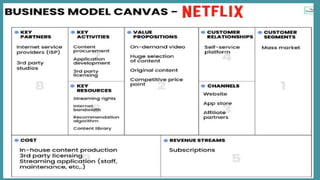
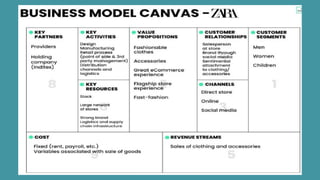
Developing
Business Model
Objectives
• 1. identify the different key components of the business
model canvas;
• 2. recognize the importance of a business model that
would help in determining the success or failure of a
business; and
• 3. create a business model canvas according to your
selected product/service.
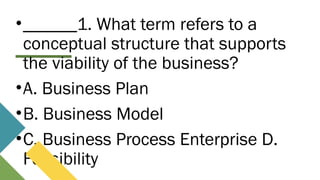
•______1. What term refers to a
conceptual structure that supports
the viability of the business?
•A. Business Plan
•B. Business Model
•C. Business Process Enterprise D.
Feasibility
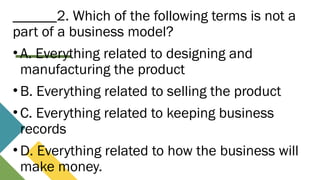
______2. Which of the following terms is not a
part of a business model?
• A. Everything related to designing and
manufacturing the product
• B. Everything related to selling the product
• C. Everything related to keeping business
records
• D. Everything related to how the business will
make money.
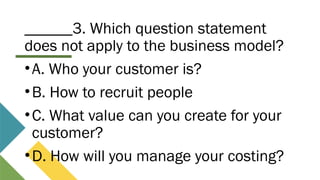
______3. Which question statement
does not apply to the business model?
•A. Who your customer is?
•B. How to recruit people
•C. What value can you create for your
customer?
•D. How will you manage your costing?
•______4. What term refers to dividing a
customer based into groups of
individuals?
A.Key Partners
B.Value Proposition
C.Key Resources
D.Customer Segments
______5. Why does an entrepreneur need to
use a business model canvas?
A. It allows everyone to get a clear idea of what
the business will likely be.
B. A mission statement for a product roadmap.
C. To quickly draw a picture of what the
business demands.
D. All of the above.
Business Model
- is a conceptual
framework that
encourages the
sustainability of a
company and describes
how it works, makes
money, and how it aims to
achieve its objectives.
According to management
expert Peter Drucker (Das
2020, 1)
“A business model is
supposed to answer who
your customer is, what
value you can create/add
for the customer and how
you can do that at
reasonable costs.”
Every business model has three parts:
1. All about product design and how to
manufacture a product.
2. Selling the product and finding the right
customer to allocate a product.
3. How the business earns money. But there is a
clearer view to present a Business Model
through a Business Model Canvas.
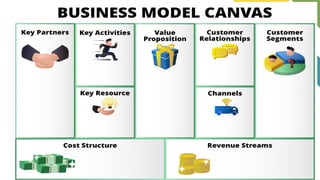
Business Model Canvas
- strategic management and a startup
template for the development of new
business models or for
documentation.
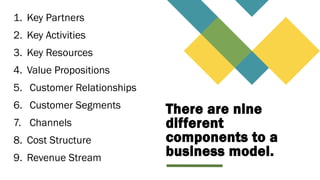
There are nine
different
components to a
business model.
1. Key Partners
2. Key Activities
3. Key Resources
4. Value Propositions
5. Customer Relationships
6. Customer Segments
7. Channels
8. Cost Structure
9. Revenue Stream
Key Partner
Your business creates strategic relationships with
other companies or with other people.
1. Who are our key partners and suppliers?
2. Which key activities do partners perform?
3. Which key resources need to acquire from
partners?
Ex. Providers, suppliers
KEY ACTIVITIES
Activities or tasks that are essential to operating your
business.
What key activities do our value
proposition, channels, customer
relationships, and revenue streams
require?
ex. Design, manufacturing, distribution
channels, retail process
VALUE PROPOSITION
The essential need that your business is trying to
fulfill for its customers.
1. What do you provide to your customers?
2. What problem are you going to solve?
3. What products or services are you offering to
each customer segment?
4. Which customer’s needs are you satisfying?
Ex. Design of accessories, e-commerce experience,
fashionable
CUSTOMER RELATIONSHIPS
The type of connections your business has with its
customers and the level of support it gives.
1. What type of relationship does each customer
segment want?
2. How costly the relationship?
3. How are you going to integrate with the rest of
your business model?
Ex. Salesperson, social media, sentimental to…
CUSTOMER SEGMENTS
A different groups of people your
business interacts with.
1. Who are your customers?
2. From whom are you creating value?
Ex. Men, women, children
KEY RESOURCES
Assets that are required to operate and
deliver your business value proposition.
• What key resources do our value
proposition, channels, customer
relationships, and revenue streams
require?
• Ex. Stocks, large network of stores
CHANNELS
Ways your business uses to deliver the product
and value proposition to customers.
1. How will you reach your customer segments?
2. Which channels are most effective?
3. Which one is most cost-efficient?
4. How channels integrated?
ex. Social media, direct store, online
COST STRUCTURE
How the business spends money on its operations.
The key cost and the level of cost-focus for your
business.
1. What are the most important cost in your
business model?
2. Which key activities and key resources are
the most expensive?
Ex. Fixed salary, rent, materials
REVENUE STREAMS
Business source of cash flow.
1. What customers are willing to pay?
2. What and how do they currently pay?
3. How much does each revenue stream contribute to
overall revenue?
Ex. Sales, subscriptions, add-ons fee,
workshop fee, customization fee, del. charges,
commission
IMPORTANCE
OF BUSINESS
MODEL
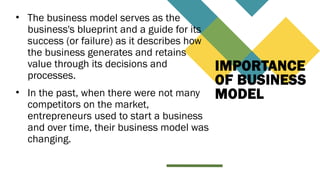
• The business model serves as the
business's blueprint and a guide for its
success (or failure) as it describes how
the business generates and retains
value through its decisions and
processes.
• In the past, when there were not many
competitors on the market,
entrepreneurs used to start a business
and over time, their business model was
changing.
IMPORTANCE
OF BUSINESS
MODEL
• With the growing number of
competitors in the market,
however, the creation of a
business model has become
almost a requirement to
determine how the company
can work, interact with
customers and distinguish
itself in the market.
quotation from
Yogi Berra,
“Without a plan, even the most
brilliant business can get lost.
You need to have a goal, create
milestones, and have a strategy
in place to set yourself up for
success.”
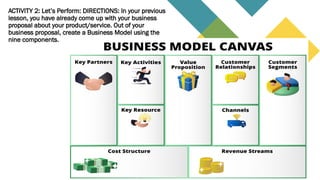
ACTIVITY 2: Let’s Perform: DIRECTIONS: In your previous
lesson, you have already come up with your business
proposal about your product/service. Out of your
business proposal, create a Business Model using the
nine components.
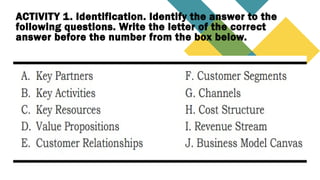
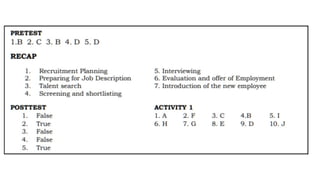
ACTIVITY 1. Identification. Identify the answer to the
following questions. Write the letter of the correct
answer before the number from the box below.
______1. It creates strategic
relationships with other
companies or with other people.
______2. A different groups of
people your business interacts
with.
______3. It is an asset that is required to
operate and deliver your business value
proposition.
______4. Tasks that is essential in
operating your business.
______5. Business sources of cash flow.
______6. It is how the business spends
money on its operation.
______7. Ways your business uses to
deliver the product and value propositions
to customers.
______8. The type of connections your
business has with its customers and the
level of support it gives.
______9. The essential need that your
business is trying to fulfill for its
customers.
_____10. It is strategic management
and a startup template for the
development of new business models
or for documentation.
Thank you

Week 1-Q2-Developing Business Model.pptx

  • 1.
  • 2.
    Objectives • 1. identifythe different key components of the business model canvas; • 2. recognize the importance of a business model that would help in determining the success or failure of a business; and • 3. create a business model canvas according to your selected product/service.
  • 3.
    •______1. What termrefers to a conceptual structure that supports the viability of the business? •A. Business Plan •B. Business Model •C. Business Process Enterprise D. Feasibility
  • 4.
    ______2. Which ofthe following terms is not a part of a business model? • A. Everything related to designing and manufacturing the product • B. Everything related to selling the product • C. Everything related to keeping business records • D. Everything related to how the business will make money.
  • 5.
    ______3. Which questionstatement does not apply to the business model? •A. Who your customer is? •B. How to recruit people •C. What value can you create for your customer? •D. How will you manage your costing?
  • 6.
    •______4. What termrefers to dividing a customer based into groups of individuals? A.Key Partners B.Value Proposition C.Key Resources D.Customer Segments
  • 7.
    ______5. Why doesan entrepreneur need to use a business model canvas? A. It allows everyone to get a clear idea of what the business will likely be. B. A mission statement for a product roadmap. C. To quickly draw a picture of what the business demands. D. All of the above.
  • 8.
    Business Model - isa conceptual framework that encourages the sustainability of a company and describes how it works, makes money, and how it aims to achieve its objectives. According to management expert Peter Drucker (Das 2020, 1) “A business model is supposed to answer who your customer is, what value you can create/add for the customer and how you can do that at reasonable costs.”
  • 9.
    Every business modelhas three parts: 1. All about product design and how to manufacture a product. 2. Selling the product and finding the right customer to allocate a product. 3. How the business earns money. But there is a clearer view to present a Business Model through a Business Model Canvas.
  • 10.
    Business Model Canvas -strategic management and a startup template for the development of new business models or for documentation.
  • 11.
    There are nine different componentsto a business model. 1. Key Partners 2. Key Activities 3. Key Resources 4. Value Propositions 5. Customer Relationships 6. Customer Segments 7. Channels 8. Cost Structure 9. Revenue Stream
  • 12.
    Key Partner Your businesscreates strategic relationships with other companies or with other people. 1. Who are our key partners and suppliers? 2. Which key activities do partners perform? 3. Which key resources need to acquire from partners? Ex. Providers, suppliers
  • 13.
    KEY ACTIVITIES Activities ortasks that are essential to operating your business. What key activities do our value proposition, channels, customer relationships, and revenue streams require? ex. Design, manufacturing, distribution channels, retail process
  • 14.
    VALUE PROPOSITION The essentialneed that your business is trying to fulfill for its customers. 1. What do you provide to your customers? 2. What problem are you going to solve? 3. What products or services are you offering to each customer segment? 4. Which customer’s needs are you satisfying? Ex. Design of accessories, e-commerce experience, fashionable
  • 15.
    CUSTOMER RELATIONSHIPS The typeof connections your business has with its customers and the level of support it gives. 1. What type of relationship does each customer segment want? 2. How costly the relationship? 3. How are you going to integrate with the rest of your business model? Ex. Salesperson, social media, sentimental to…
  • 16.
    CUSTOMER SEGMENTS A differentgroups of people your business interacts with. 1. Who are your customers? 2. From whom are you creating value? Ex. Men, women, children
  • 17.
    KEY RESOURCES Assets thatare required to operate and deliver your business value proposition. • What key resources do our value proposition, channels, customer relationships, and revenue streams require? • Ex. Stocks, large network of stores
  • 18.
    CHANNELS Ways your businessuses to deliver the product and value proposition to customers. 1. How will you reach your customer segments? 2. Which channels are most effective? 3. Which one is most cost-efficient? 4. How channels integrated? ex. Social media, direct store, online
  • 19.
    COST STRUCTURE How thebusiness spends money on its operations. The key cost and the level of cost-focus for your business. 1. What are the most important cost in your business model? 2. Which key activities and key resources are the most expensive? Ex. Fixed salary, rent, materials
  • 20.
    REVENUE STREAMS Business sourceof cash flow. 1. What customers are willing to pay? 2. What and how do they currently pay? 3. How much does each revenue stream contribute to overall revenue? Ex. Sales, subscriptions, add-ons fee, workshop fee, customization fee, del. charges, commission
  • 24.
    IMPORTANCE OF BUSINESS MODEL • Thebusiness model serves as the business's blueprint and a guide for its success (or failure) as it describes how the business generates and retains value through its decisions and processes. • In the past, when there were not many competitors on the market, entrepreneurs used to start a business and over time, their business model was changing.
  • 25.
    IMPORTANCE OF BUSINESS MODEL • Withthe growing number of competitors in the market, however, the creation of a business model has become almost a requirement to determine how the company can work, interact with customers and distinguish itself in the market.
  • 26.
    quotation from Yogi Berra, “Withouta plan, even the most brilliant business can get lost. You need to have a goal, create milestones, and have a strategy in place to set yourself up for success.”
  • 27.
    ACTIVITY 2: Let’sPerform: DIRECTIONS: In your previous lesson, you have already come up with your business proposal about your product/service. Out of your business proposal, create a Business Model using the nine components.
  • 29.
    ACTIVITY 1. Identification.Identify the answer to the following questions. Write the letter of the correct answer before the number from the box below.
  • 30.
    ______1. It createsstrategic relationships with other companies or with other people. ______2. A different groups of people your business interacts with.
  • 31.
    ______3. It isan asset that is required to operate and deliver your business value proposition. ______4. Tasks that is essential in operating your business. ______5. Business sources of cash flow.
  • 32.
    ______6. It ishow the business spends money on its operation. ______7. Ways your business uses to deliver the product and value propositions to customers. ______8. The type of connections your business has with its customers and the level of support it gives.
  • 33.
    ______9. The essentialneed that your business is trying to fulfill for its customers. _____10. It is strategic management and a startup template for the development of new business models or for documentation.
  • 35.