Lab report of Energy Engineering lab 
Cloud point and pour point 
1 
Objective 
To Determine the Cloud and Pour Point Of Given Oil Sample 
Apparatus: 
1. Given oil sample (Coconut oil) 
2. Thermometer 
3. Beaker 
4. Cooling bath 
5. Cork 
6. Testing jar 
Related Theory: 
Cloud point is the temperature at which oil becomes cloudy or hazy when an oil is cooled at 
specified rate. 
Pour Point is the temperature at which oil just ceases to flow. 
The pour point of a liquid is the lowest temperature at which it becomes semi solid and loses 
its flow characteristics. 
Cloud and pour points are related to low temperature characteristics of fuel and tells the 
behavior of fuel at low temperatures. Haziness may be due to separation of waxes or increase 
in viscosity at low temperature. Due to the separation of waxes, viscosity of fuel oil increases 
and its fluidity decreases. Te presence of solidified waxes thickens the oil and clogs fuels 
filters and injectors in engine. So, the presence of these solid waxes affects the performance 
of engines. Usually the difference between cloud and pour points is 4-60F. Pour point tells us 
the temperature below which oil cannot be used as lubricant. Cloud point indicates the 
tendency of oil to plug filters or small orifices at cold operating temperatures. So, cloud and 
pour points also tell us the suitability of lubricating oils in cold condition. 
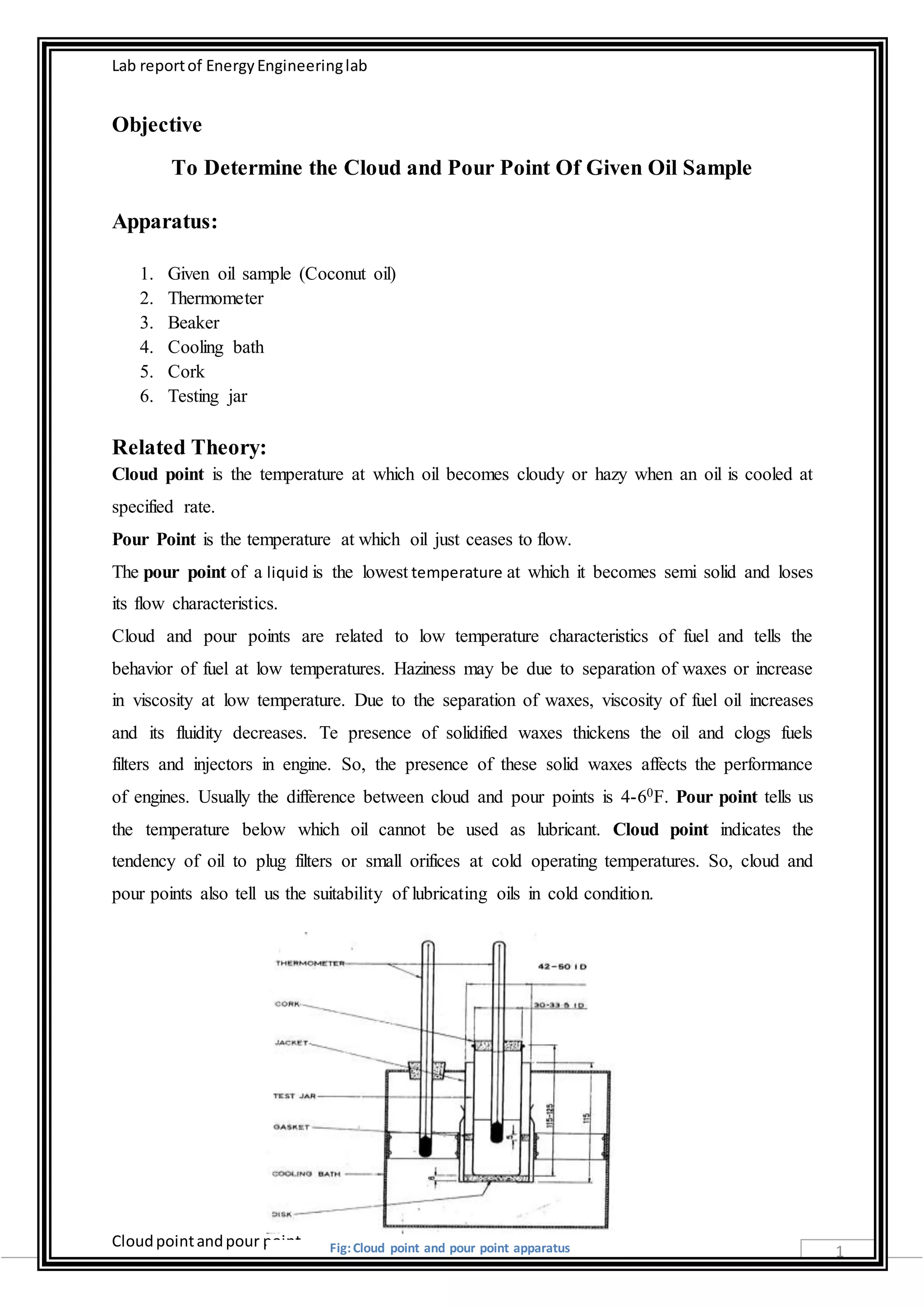
Fig: Cloud point and pour point apparatus
Lab report of Energy Engineering lab 
Cloud point and pour point 
2 
The presence of some components in the formulation can depress or increase the cloud point 
of solution/oil. For example the addition of coupler or hydrotrope can increase the cloud 
point of a solution/oil, where as builders or some other salts will decrease the cloud point 
temperature. Also microfiltration was used to separate the waxes that precipitate out at 
different temperature in waxy crude oils. 
Procedure: 
First I cooled the oil to be tested to a temperature at least 250C about the approximate cloud 
point. Then I removed moisture present by filtration through any linthless filter paper until 
the oil was perfectly clear. Then I poured the clear oil into the test jar up to the level marked. 
Then I adjusted the position of the cork carrying the test thermometer so that the cork fits 
tightly. Thermometer and jar were co-axial and thermometer bulb was heating at the bottom 
of the jar. Then I placed the ring gasket around the test jar one inch from the bottom. The disk 
gasket and inside the gasket should be clear and dry. Then I inserted the test gar in the jacket 
and maintained the temperature of cooling bath at 30-350C and put the jacket containing test 
gar in the cooling bath. After every 20C fall in temperature, I removed the test jar from the 
jacket quickly, but without disturbing the oil. Inspected for the cloud and replaced in the 
jacket. This complete operation shall not require more than three seconds. I repeated the 
procedure till inspection reveals distinct cloudiness in the bottom of test jar. Then I recorded 
the readings. 
Results: 
Cloud point of given oil sample (coconut oil) = 170C 
Pour point of given oil sample (coconut oil) = 130C 
Discussion: 
 While observing the thermometer sometime there is a sudden rise or sudden drop in 
temperature so, we should take care of it otherwise reading may alter. 
 For pour point we must check the fluidity of oil for at least 5sec. 
 Take care while observing cloud point it shows cloudy appearance in the oil while the 
cold condense water also shows cloudy appearance.

determination of Cloud point

  • 1.
    Lab report ofEnergy Engineering lab Cloud point and pour point 1 Objective To Determine the Cloud and Pour Point Of Given Oil Sample Apparatus: 1. Given oil sample (Coconut oil) 2. Thermometer 3. Beaker 4. Cooling bath 5. Cork 6. Testing jar Related Theory: Cloud point is the temperature at which oil becomes cloudy or hazy when an oil is cooled at specified rate. Pour Point is the temperature at which oil just ceases to flow. The pour point of a liquid is the lowest temperature at which it becomes semi solid and loses its flow characteristics. Cloud and pour points are related to low temperature characteristics of fuel and tells the behavior of fuel at low temperatures. Haziness may be due to separation of waxes or increase in viscosity at low temperature. Due to the separation of waxes, viscosity of fuel oil increases and its fluidity decreases. Te presence of solidified waxes thickens the oil and clogs fuels filters and injectors in engine. So, the presence of these solid waxes affects the performance of engines. Usually the difference between cloud and pour points is 4-60F. Pour point tells us the temperature below which oil cannot be used as lubricant. Cloud point indicates the tendency of oil to plug filters or small orifices at cold operating temperatures. So, cloud and pour points also tell us the suitability of lubricating oils in cold condition. Fig: Cloud point and pour point apparatus
  • 2.
    Lab report ofEnergy Engineering lab Cloud point and pour point 2 The presence of some components in the formulation can depress or increase the cloud point of solution/oil. For example the addition of coupler or hydrotrope can increase the cloud point of a solution/oil, where as builders or some other salts will decrease the cloud point temperature. Also microfiltration was used to separate the waxes that precipitate out at different temperature in waxy crude oils. Procedure: First I cooled the oil to be tested to a temperature at least 250C about the approximate cloud point. Then I removed moisture present by filtration through any linthless filter paper until the oil was perfectly clear. Then I poured the clear oil into the test jar up to the level marked. Then I adjusted the position of the cork carrying the test thermometer so that the cork fits tightly. Thermometer and jar were co-axial and thermometer bulb was heating at the bottom of the jar. Then I placed the ring gasket around the test jar one inch from the bottom. The disk gasket and inside the gasket should be clear and dry. Then I inserted the test gar in the jacket and maintained the temperature of cooling bath at 30-350C and put the jacket containing test gar in the cooling bath. After every 20C fall in temperature, I removed the test jar from the jacket quickly, but without disturbing the oil. Inspected for the cloud and replaced in the jacket. This complete operation shall not require more than three seconds. I repeated the procedure till inspection reveals distinct cloudiness in the bottom of test jar. Then I recorded the readings. Results: Cloud point of given oil sample (coconut oil) = 170C Pour point of given oil sample (coconut oil) = 130C Discussion:  While observing the thermometer sometime there is a sudden rise or sudden drop in temperature so, we should take care of it otherwise reading may alter.  For pour point we must check the fluidity of oil for at least 5sec.  Take care while observing cloud point it shows cloudy appearance in the oil while the cold condense water also shows cloudy appearance.