Flammable Aerosol Testing for
HCS 2012 (GHS)
Joe McCarthy, Lab Services Manager/Regulatory Affairs Specialist
1. THEN vs. NOW
- And why a product that was not flammable
THEN may very well be flammable NOW.
2. Performing the tests
- Catching Fire, what is sustained combustion?
3. Safety considerations
- Fire is not the only way to get burned.
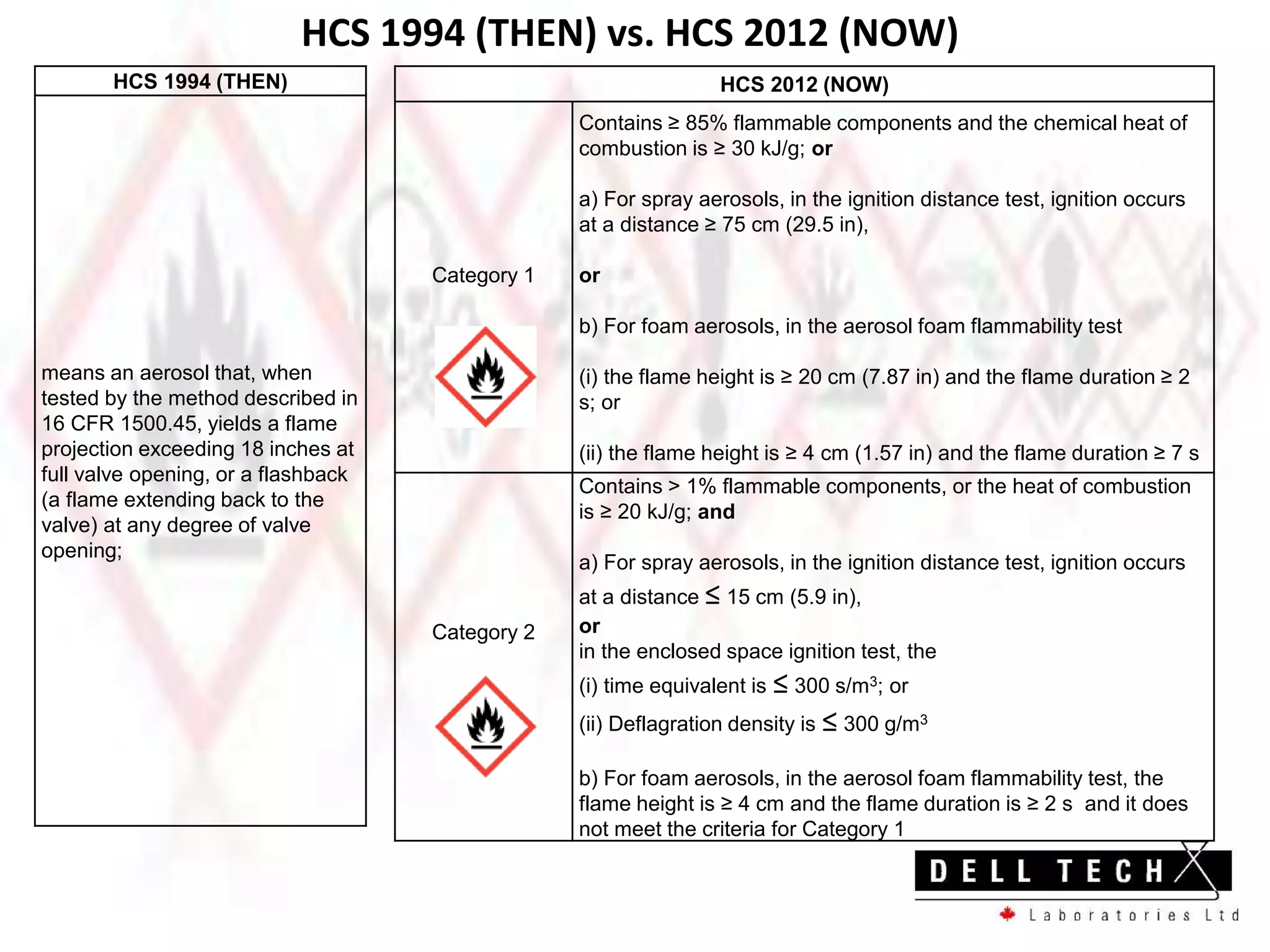
HCS 1994 (THEN) vs. HCS 2012 (NOW)
HCS 1994 (THEN)
means an aerosol that, when
tested by the method described in
16 CFR 1500.45, yields a flame
projection exceeding 18 inches at
full valve opening, or a flashback
(a flame extending back to the
valve) at any degree of valve
opening;
HCS 2012 (NOW)
Category 1
Contains ≥ 85% flammable components and the chemical heat of
combustion is ≥ 30 kJ/g; or
a) For spray aerosols, in the ignition distance test, ignition occurs
at a distance ≥ 75 cm (29.5 in),
or
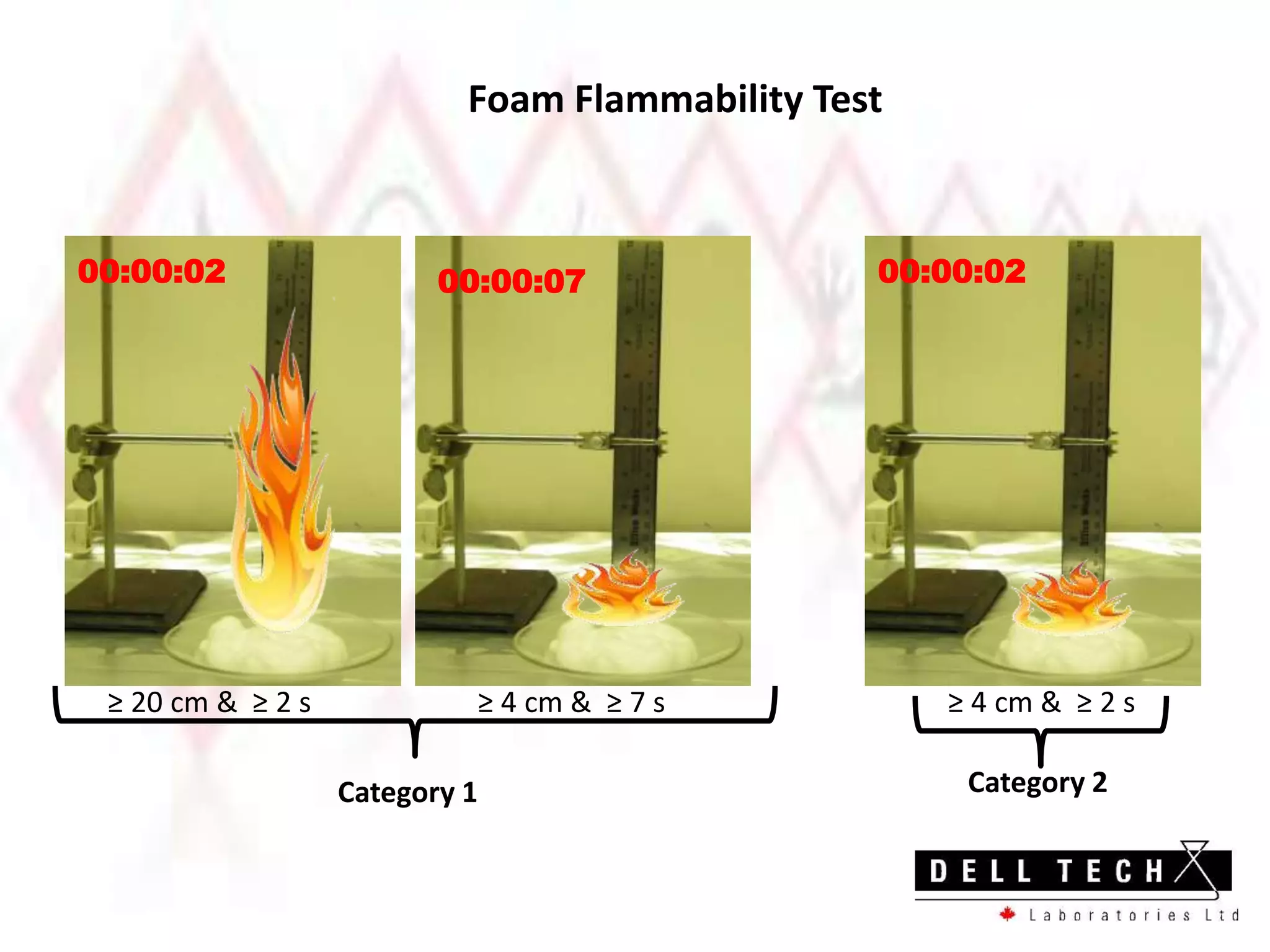
b) For foam aerosols, in the aerosol foam flammability test
(i) the flame height is ≥ 20 cm (7.87 in) and the flame duration ≥ 2
s; or
(ii) the flame height is ≥ 4 cm (1.57 in) and the flame duration ≥ 7 s
Category 2
Contains > 1% flammable components, or the heat of combustion
is ≥ 20 kJ/g; and
a) For spray aerosols, in the ignition distance test, ignition occurs
at a distance ≤ 15 cm (5.9 in),
or
in the enclosed space ignition test, the
(i) time equivalent is ≤ 300 s/m3; or
(ii) Deflagration density is ≤ 300 g/m3
b) For foam aerosols, in the aerosol foam flammability test, the
flame height is ≥ 4 cm and the flame duration is ≥ 2 s and it does
not meet the criteria for Category 1
1. Can be tested using ASTM D240-02, ISO 13943, NFPA 30B
2. Calculated as a weighted sum of the individual components.
n
ΔHc (product) = ∑ [wi% × ΔHc(i)]
i
Literature data available from: NFPA 30B, NIST, CRC, Perry’s Chemical
Engineers Handbook, etc.
Heat of Combustion (ΔHc)
THEN
1500.45 Method for determining extremely flammable and flammable contents of self-pressurized
containers.
(a) Equipment required. The test equipment consists of a base 8 inches wide, 2 feet long, marked in 6-
inch intervals. A rule 2 feet long and marked in inches is supported horizontally on the side of the
base and about 6 inches above it. A paraffin candle 1 inch or more in diameter, and of such height
that the top third of the flame is at the height of the horizontal rule, is placed at the zero point in the
base.
(b) Procedure. The test is conducted in a draft-free area that can be ventilated and cleared after each test.
Place the self-pressurized container at a distance of 6 inches from the flame source. Spray for periods
of 15 seconds to 20 seconds (one observer noting the extension of the flame and the other operating
the container) through the top third of the flame and at a right angle to the flame. The height of the
flame should be approximately 2 inches. Take three readings for each test, and average. As a
precaution do not spray large quantities in a small, confined space. Free space of previously
discharged material
Flame Projection/Flashback (THEN) vs. Ignition Distance Test (NOW)
NOW
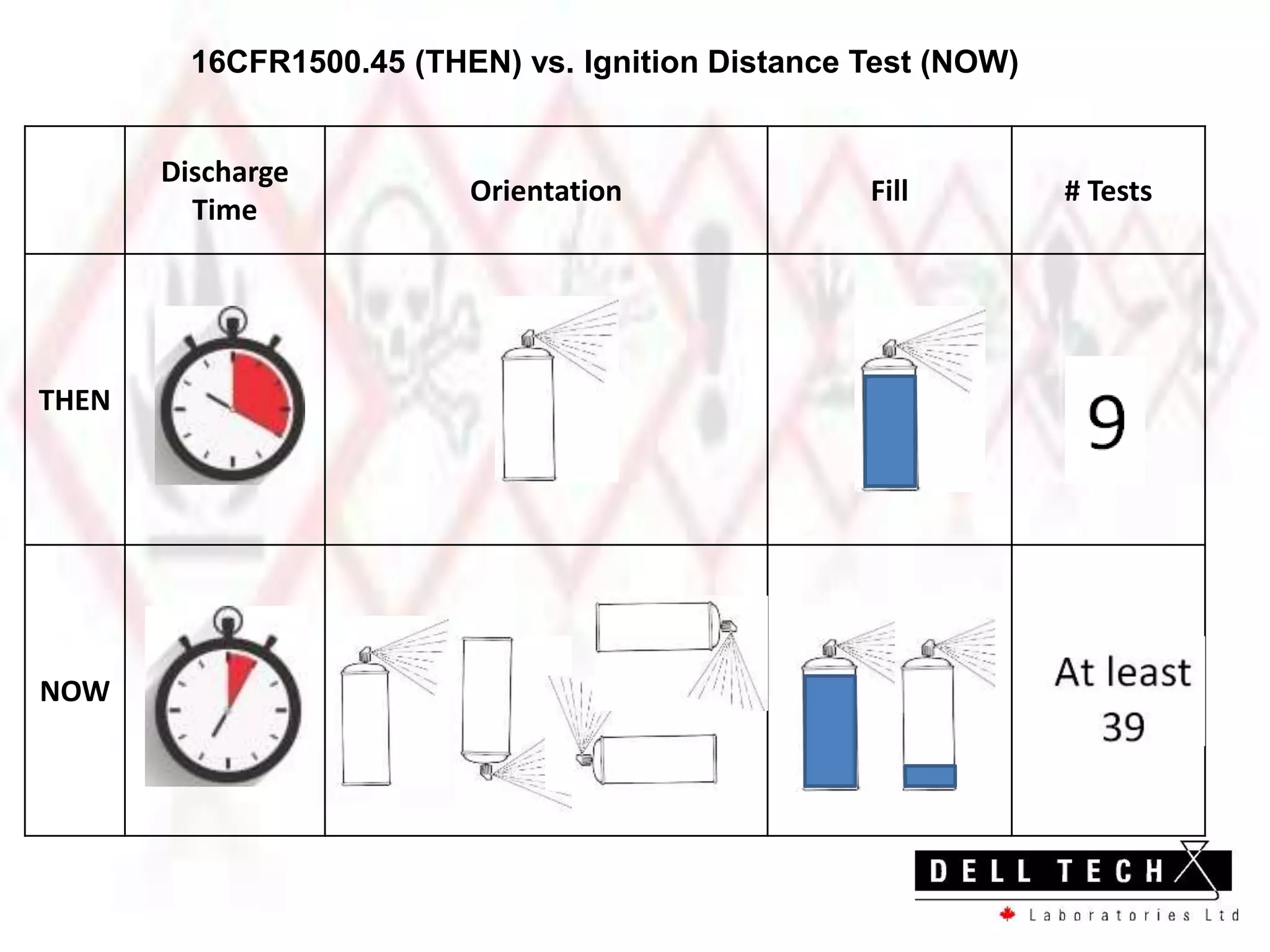
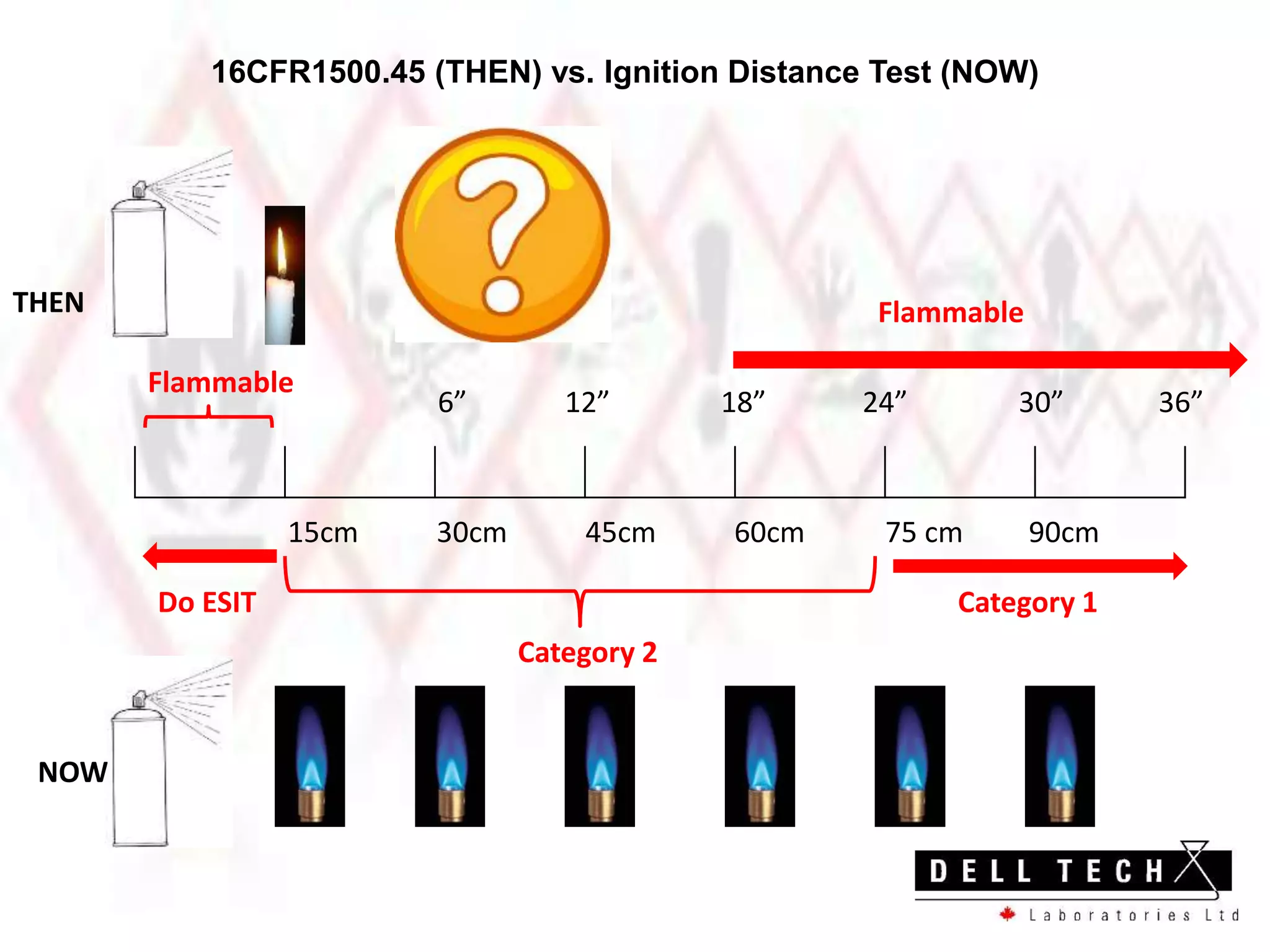
16CFR1500.45 (THEN) vs. Ignition Distance Test (NOW)
THEN
Fixed Ignition point (6”), Is the flame projection > 18”? Is there a flashback?
NOW
Increasing ignition point in 15 cm (6”) intervals. Is there sustained combustion?
16CFR1500.45 (THEN) vs. Ignition Distance Test (NOW)
THEN
1 inch candle, flame height 2”
1400°C (2550°F)
NOW
Gas burner w/ blue non-luminous
flame 4-5 cm (1-1.5”) height
Methane – 1917°C (3484°F)
Propane – 1972°C (3583°F)
Butane – 1967°C (3573°F)
Same Product: Candle vs. Gas Flame
Click on image to play
16CFR1500.45 (THEN) vs. Ignition Distance Test (NOW)
Discharge
Time
Orientation Fill # Tests
THEN
NOW
Same product: No Shaking vs. Shaking before use.
Click on image to play
16CFR1500.45 (THEN) vs. Ignition Distance Test (NOW)
6” 12” 18” 24” 30” 36”
15cm 30cm 45cm 60cm 75 cm 90cm
Flammable
Flammable
Category 2
Category 1Do ESIT
THEN
NOW
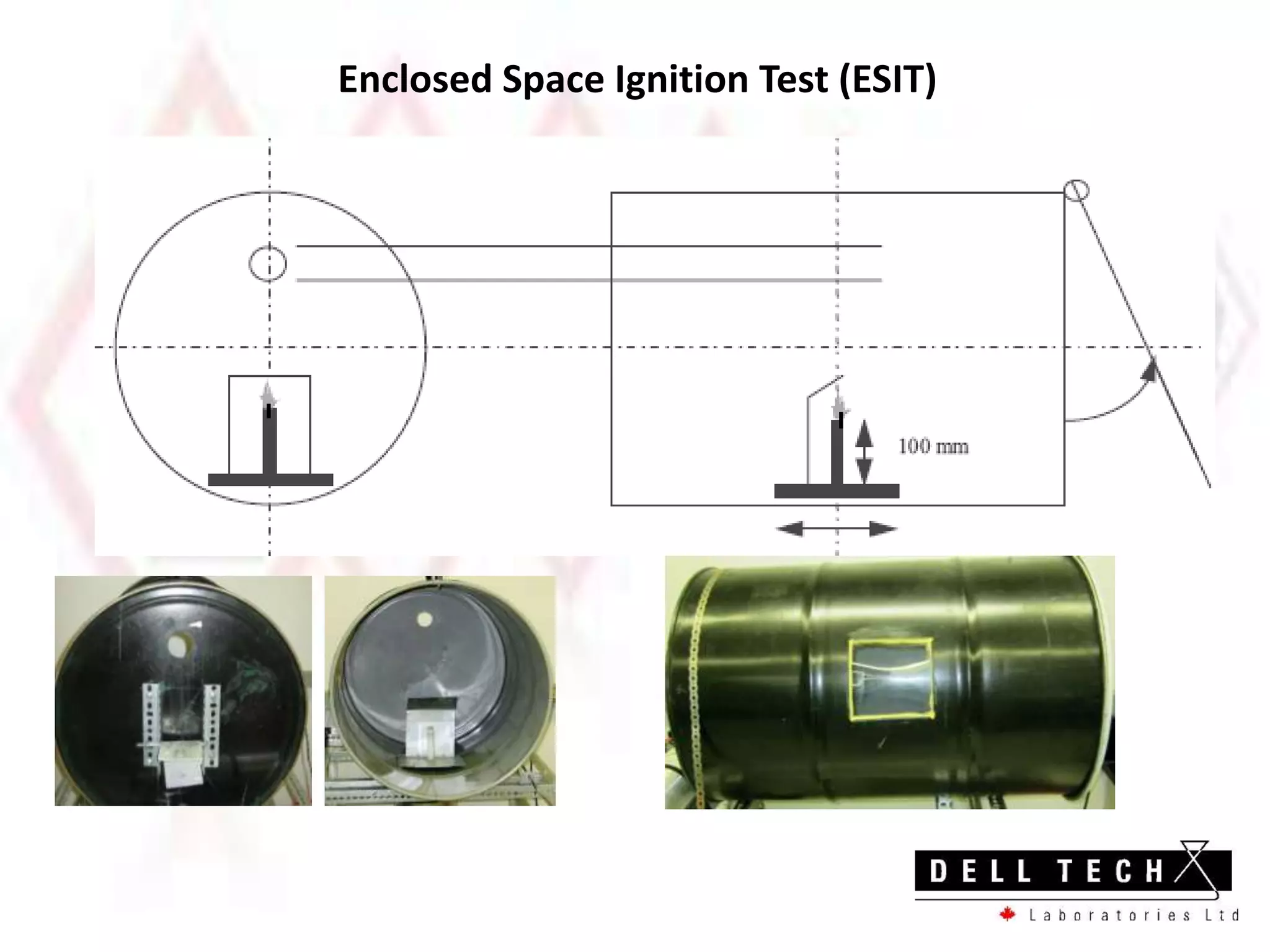
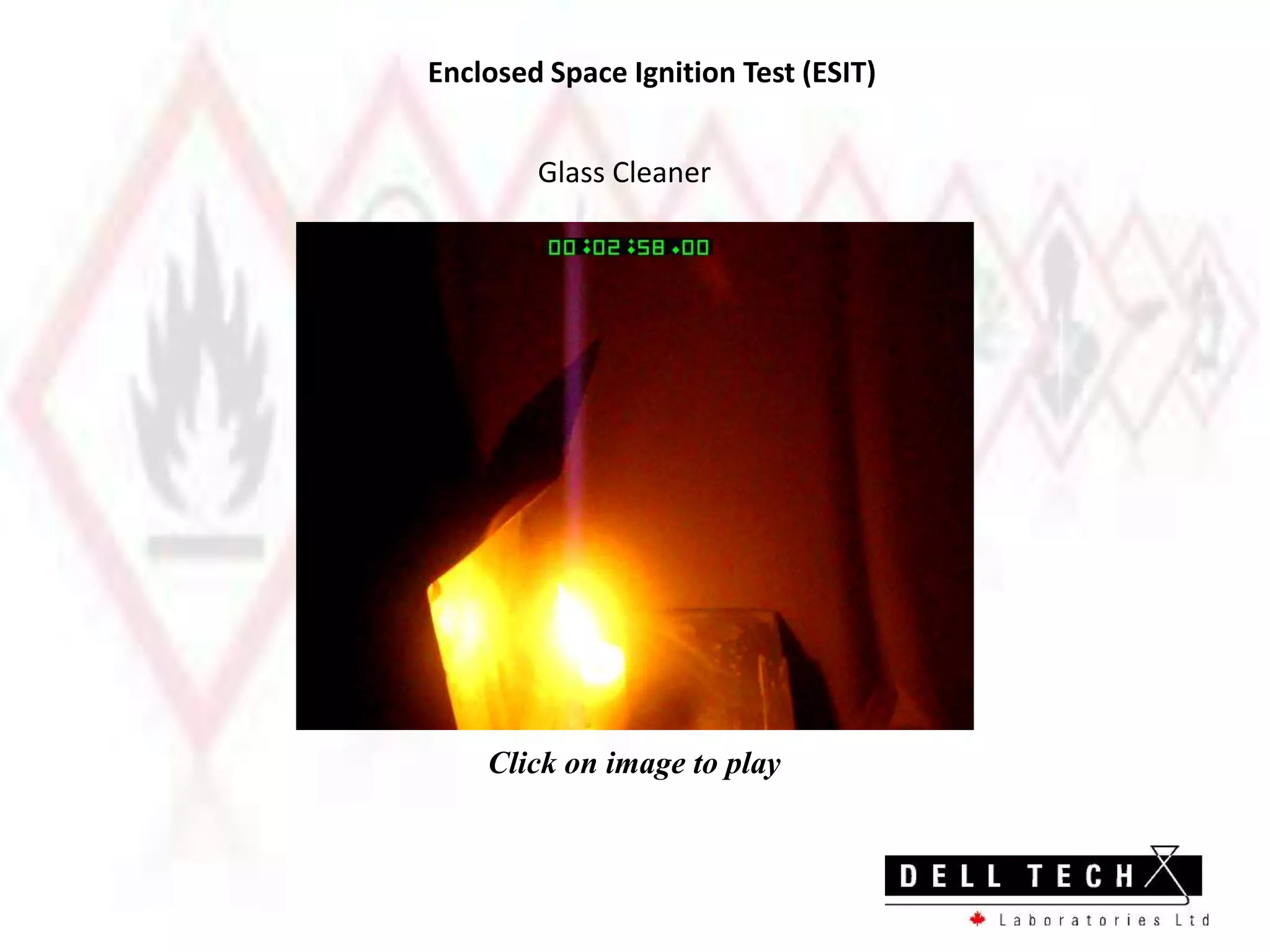
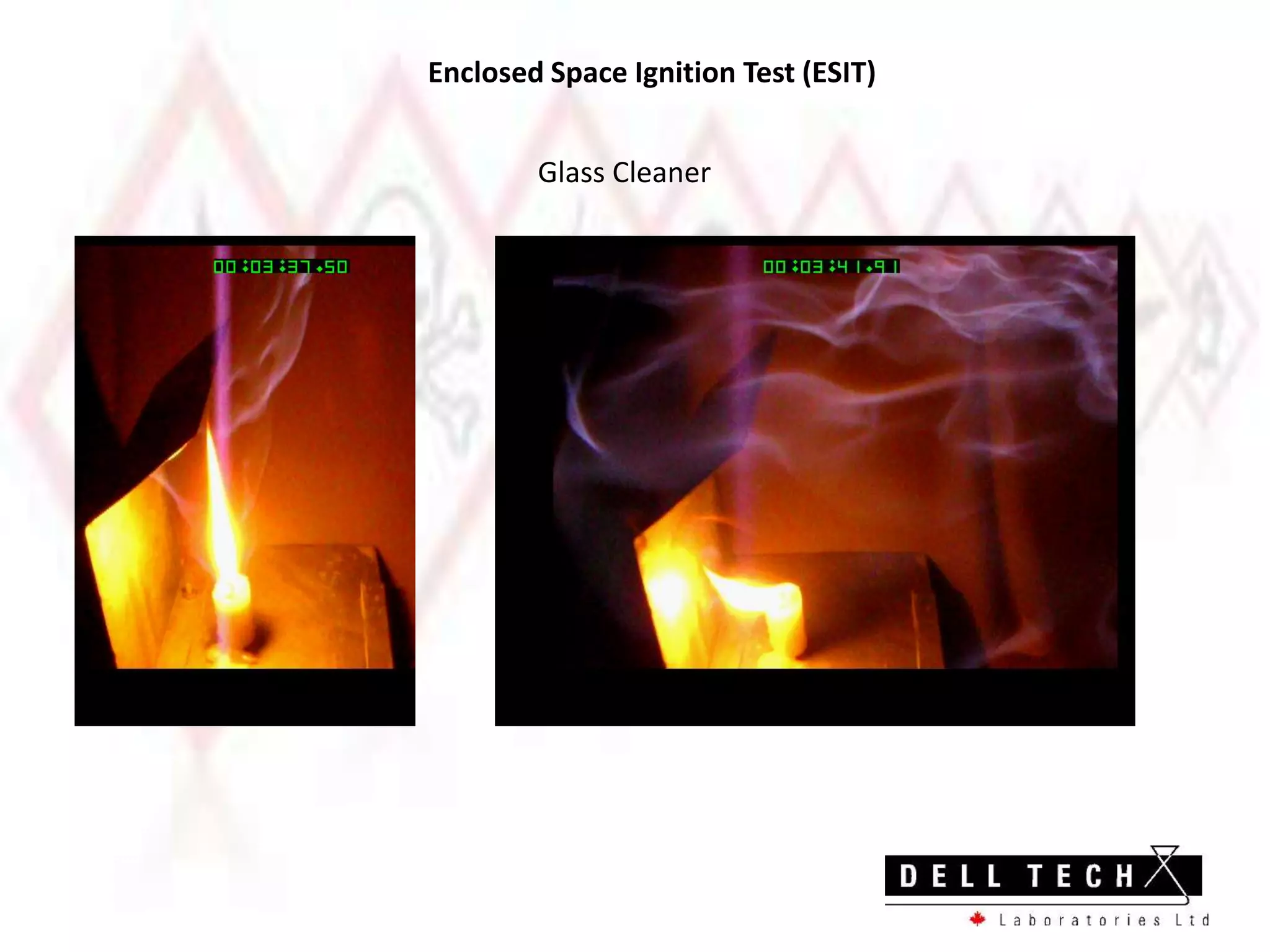
Enclosed Space Ignition Test (ESIT)
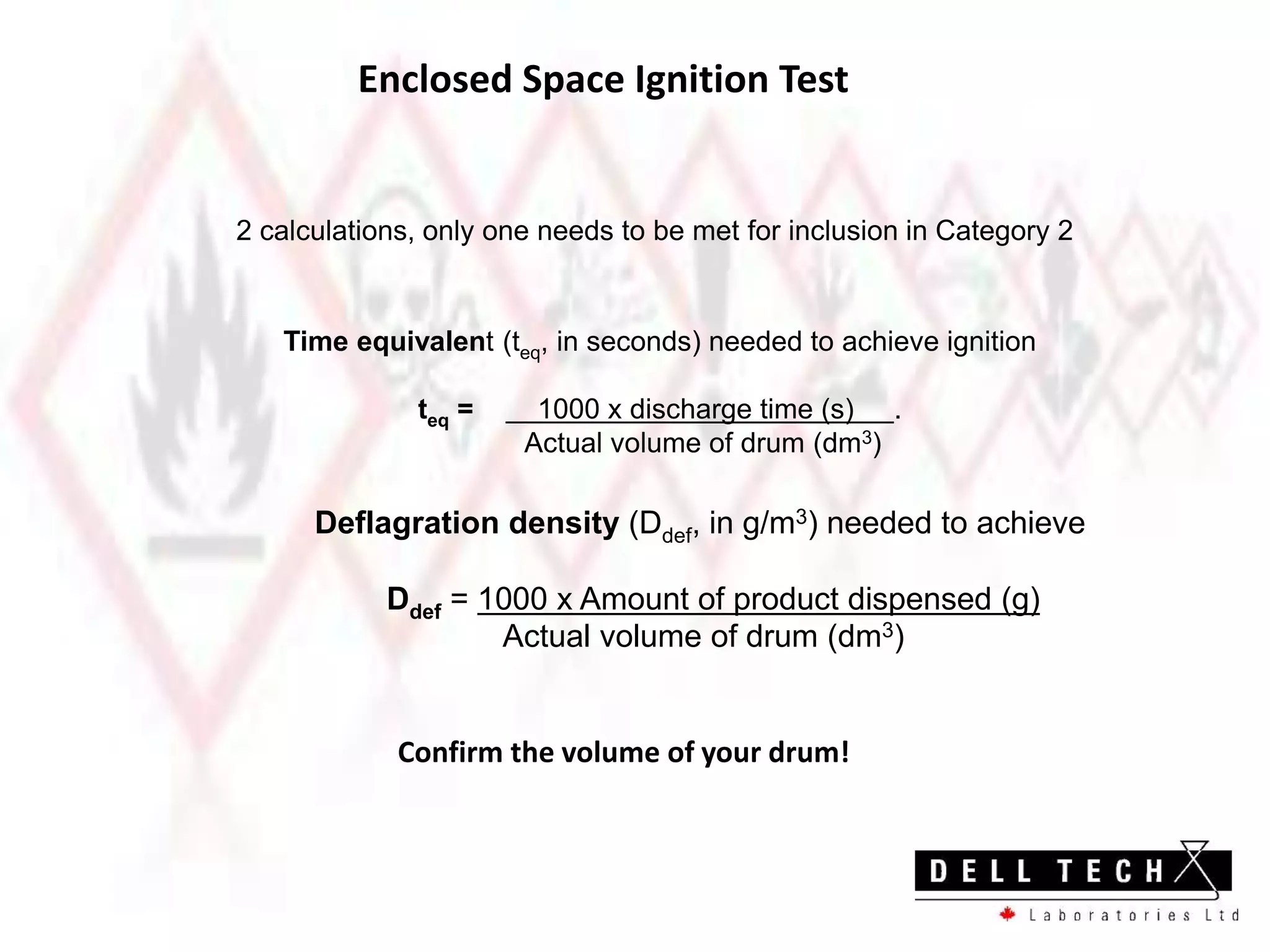
Enclosed Space Ignition Test
2 calculations, only one needs to be met for inclusion in Category 2
Time equivalent (teq, in seconds) needed to achieve ignition
teq = 1000 x discharge time (s) .
Actual volume of drum (dm3)
Confirm the volume of your drum!
Deflagration density (Ddef, in g/m3) needed to achieve
Ddef = 1000 x Amount of product dispensed (g)
Actual volume of drum (dm3)
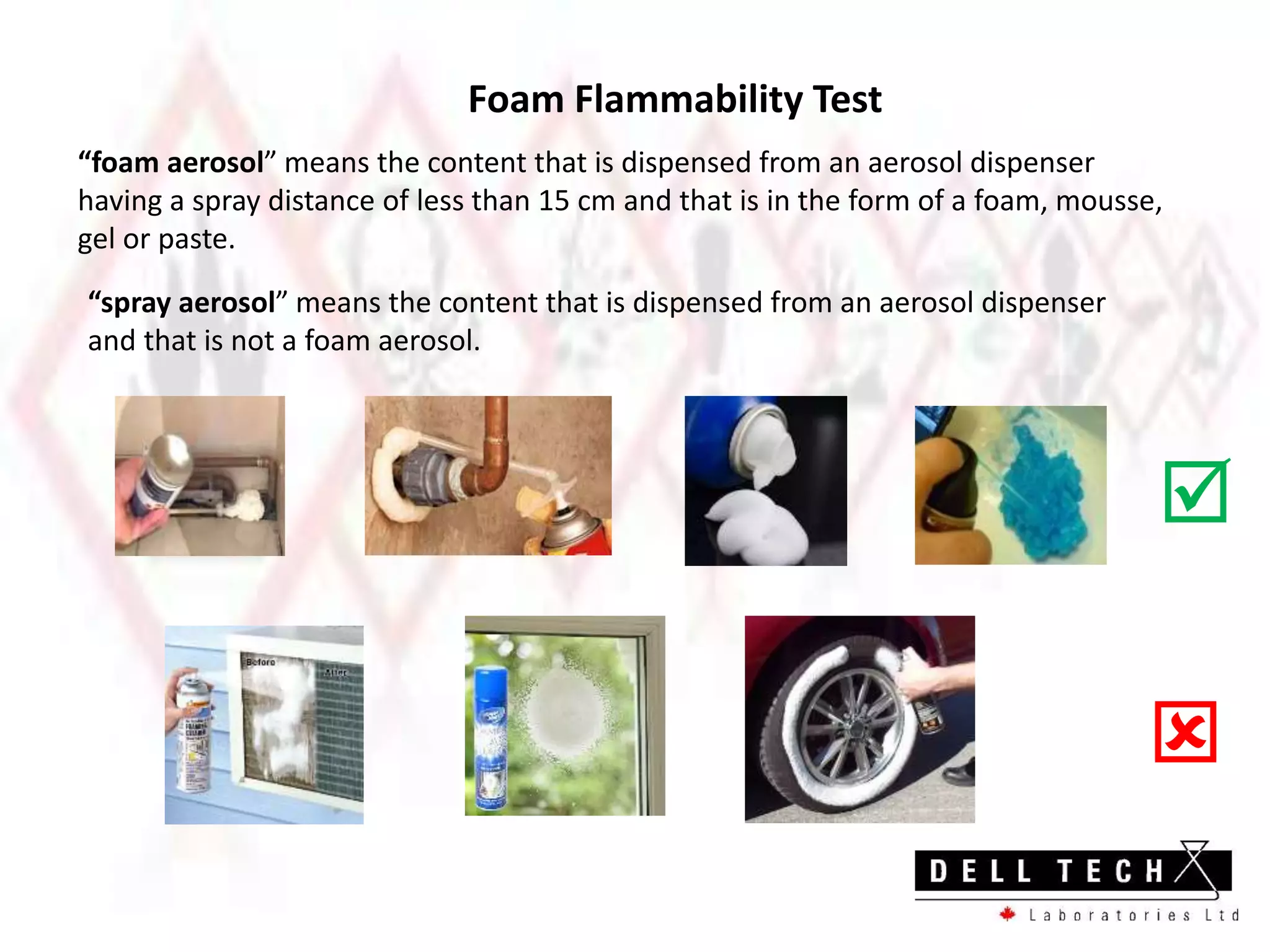
Foam Flammability Test


“foam aerosol” means the content that is dispensed from an aerosol dispenser
having a spray distance of less than 15 cm and that is in the form of a foam, mousse,
gel or paste.
“spray aerosol” means the content that is dispensed from an aerosol dispenser
and that is not a foam aerosol.
Foam Flammability Test
≥ 20 cm & ≥ 2 s ≥ 4 cm & ≥ 7 s ≥ 4 cm & ≥ 2 s
00:00:02 00:00:07 00:00:02
Category 1 Category 2
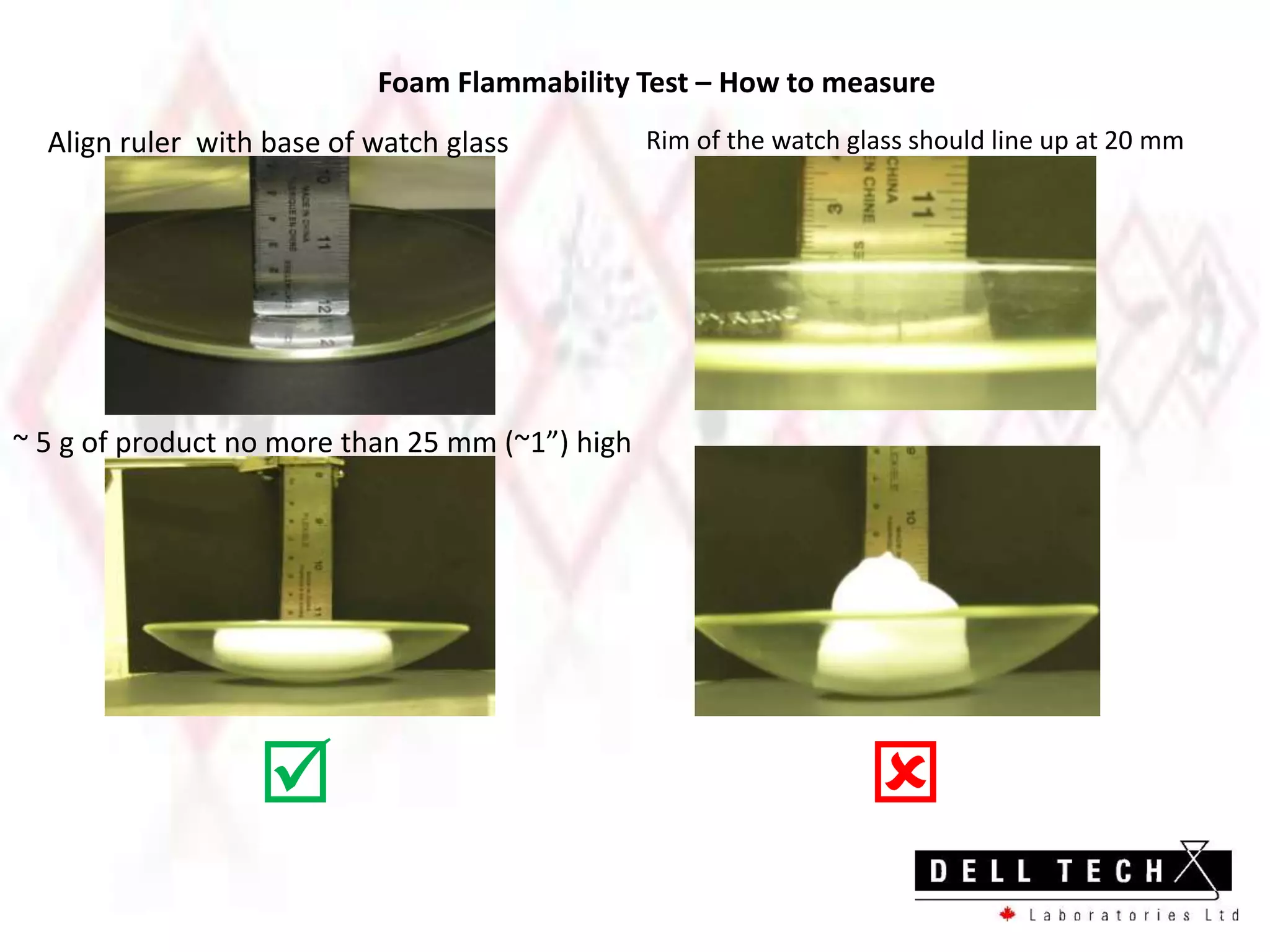
Foam Flammability Test – How to measure
Align ruler with base of watch glass Rim of the watch glass should line up at 20 mm
 
~ 5 g of product no more than 25 mm (~1”) high
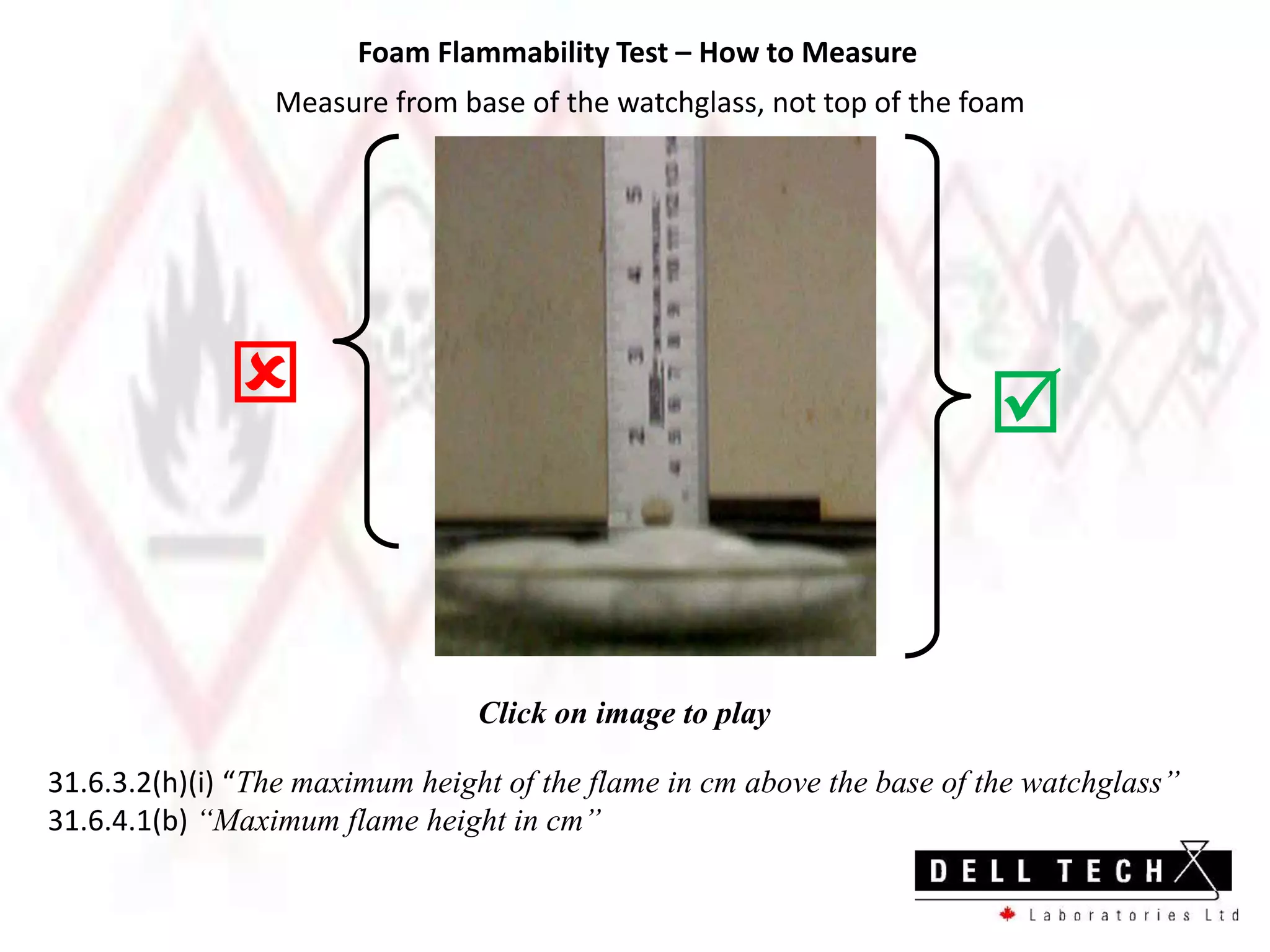
Foam Flammability Test – How to Measure
31.6.3.2(h)(i) “The maximum height of the flame in cm above the base of the watchglass”
31.6.4.1(b) “Maximum flame height in cm”

Click on image to play
Measure from base of the watchglass, not top of the foam
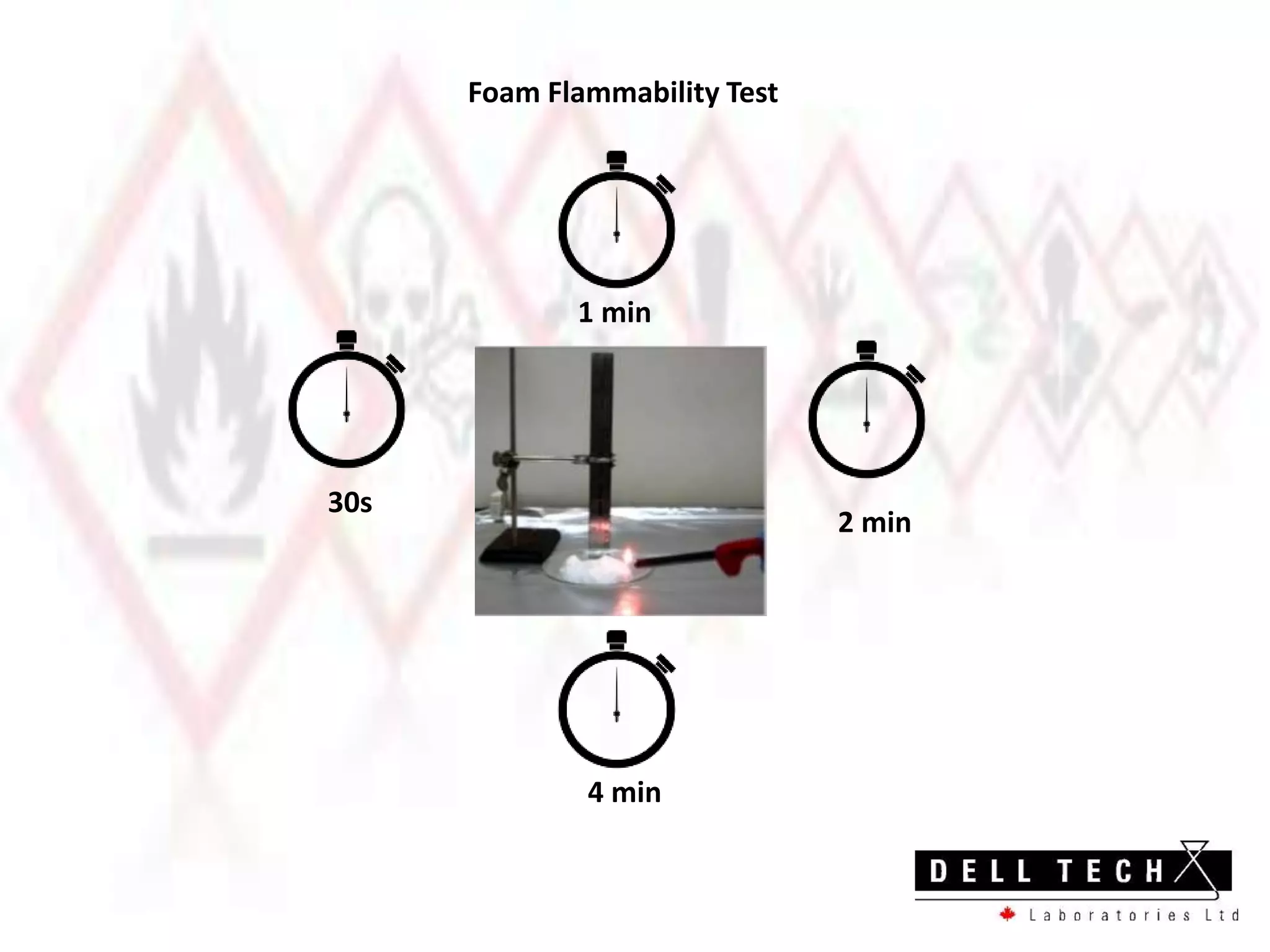
Foam Flammability Test
30s
1 min
2 min
4 min
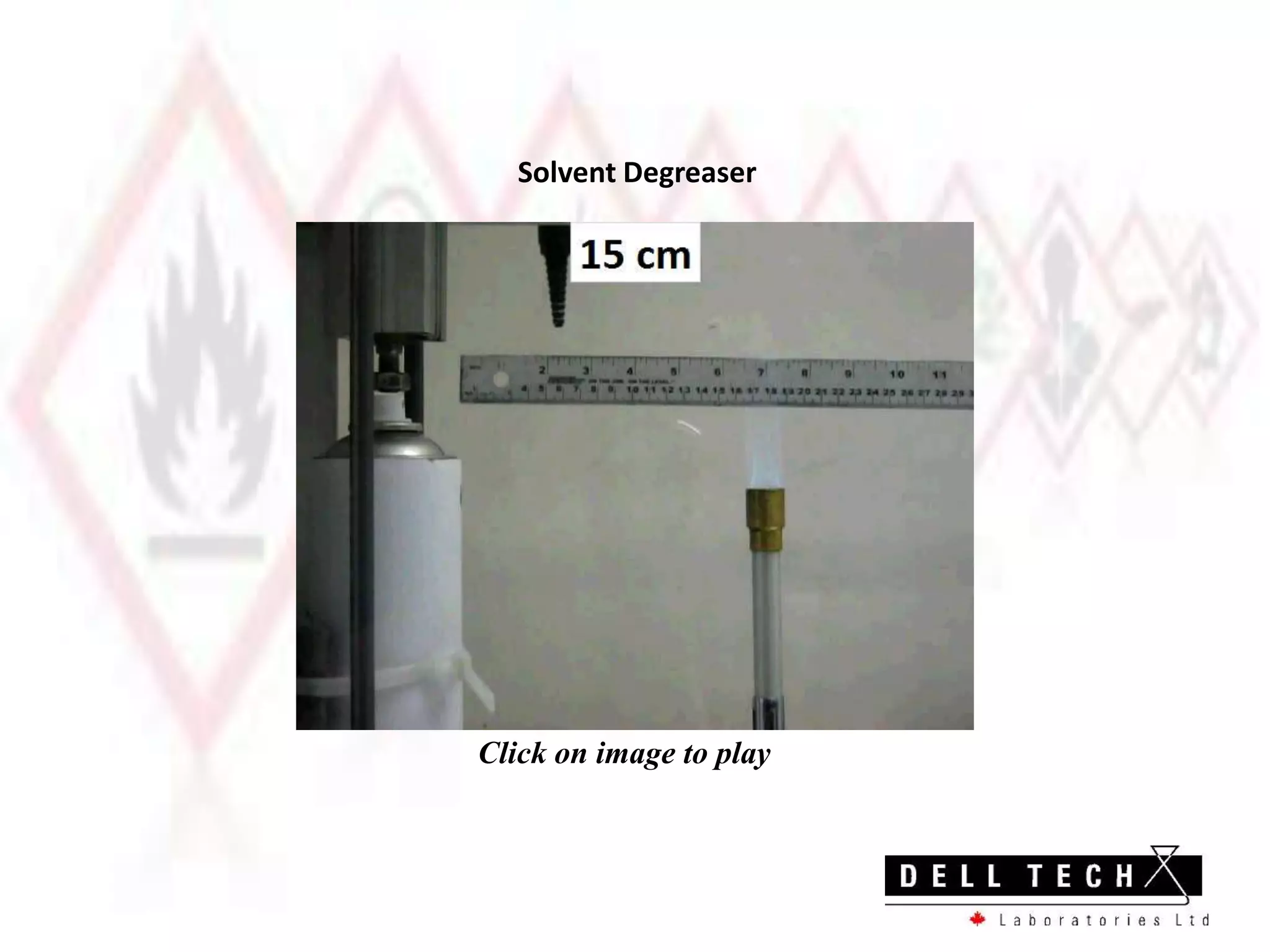
The aerosol is sprayed in the direction of an ignition source at intervals of 15 cm to
observe if ignition and sustained combustion of the spray takes place. Ignition and
sustained combustion is defined as when a stable flame is maintained for at least 5 s.
Ignition Distance Test – Sustained Combustion
Lubricant / Water Dispersant
Click on image to play
Lubricant / Water Dispersant with extension tube
Click on image to play
Solvent Degreaser
Roller Chain Lubricant
Click on image to play
Enclosed Space Ignition Test (ESIT)
Click on image to play
Air Freshener
Enclosed Space Ignition Test (ESIT)
Air Freshener
Click on image to play
Enclosed Space Ignition Test (ESIT)
Air Freshener
Click on image to play
Enclosed Space Ignition Test (ESIT)
Electronics Duster
Click on image to play
31.5.1.1 “If an observable ignition occurs, the elapsed time &
amount discharged is noted”
Enclosed Space Ignition Test (ESIT)
Click on image to play
Glass Cleaner
Enclosed Space Ignition Test (ESIT)
Glass Cleaner
Enclosed Space Ignition Test (ESIT)
Foaming Hard Surface Cleaner
Click on image to play
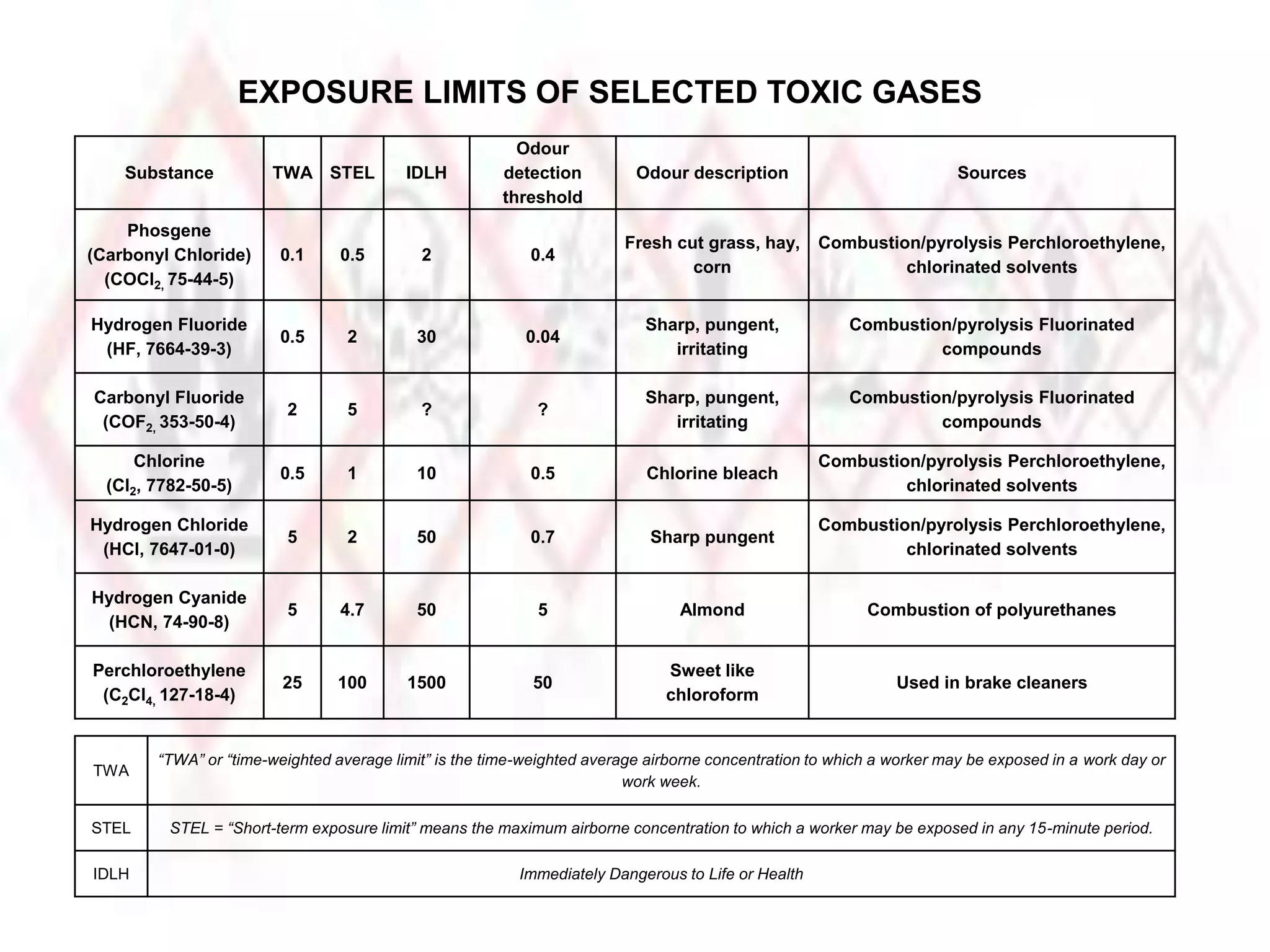
Substance TWA STEL IDLH
Odour
detection
threshold
Odour description Sources
Phosgene
(Carbonyl Chloride)
(COCl2, 75-44-5)
0.1 0.5 2 0.4
Fresh cut grass, hay,
corn
Combustion/pyrolysis Perchloroethylene,
chlorinated solvents
Hydrogen Fluoride
(HF, 7664-39-3)
0.5 2 30 0.04
Sharp, pungent,
irritating
Combustion/pyrolysis Fluorinated
compounds
Carbonyl Fluoride
(COF2, 353-50-4)
2 5 ? ?
Sharp, pungent,
irritating
Combustion/pyrolysis Fluorinated
compounds
Chlorine
(Cl2, 7782-50-5)
0.5 1 10 0.5 Chlorine bleach
Combustion/pyrolysis Perchloroethylene,
chlorinated solvents
Hydrogen Chloride
(HCl, 7647-01-0)
5 2 50 0.7 Sharp pungent
Combustion/pyrolysis Perchloroethylene,
chlorinated solvents
Hydrogen Cyanide
(HCN, 74-90-8)
5 4.7 50 5 Almond Combustion of polyurethanes
Perchloroethylene
(C2Cl4, 127-18-4)
25 100 1500 50
Sweet like
chloroform
Used in brake cleaners
TWA
“TWA” or “time-weighted average limit” is the time-weighted average airborne concentration to which a worker may be exposed in a work day or
work week.
STEL STEL = “Short-term exposure limit” means the maximum airborne concentration to which a worker may be exposed in any 15-minute period.
IDLH Immediately Dangerous to Life or Health
EXPOSURE LIMITS OF SELECTED TOXIC GASES

Aerosol Flammability Testing for HCS 2012 (GHS)

  • 1.
    Flammable Aerosol Testingfor HCS 2012 (GHS) Joe McCarthy, Lab Services Manager/Regulatory Affairs Specialist
  • 2.
    1. THEN vs.NOW - And why a product that was not flammable THEN may very well be flammable NOW. 2. Performing the tests - Catching Fire, what is sustained combustion? 3. Safety considerations - Fire is not the only way to get burned.
  • 3.
    HCS 1994 (THEN)vs. HCS 2012 (NOW) HCS 1994 (THEN) means an aerosol that, when tested by the method described in 16 CFR 1500.45, yields a flame projection exceeding 18 inches at full valve opening, or a flashback (a flame extending back to the valve) at any degree of valve opening; HCS 2012 (NOW) Category 1 Contains ≥ 85% flammable components and the chemical heat of combustion is ≥ 30 kJ/g; or a) For spray aerosols, in the ignition distance test, ignition occurs at a distance ≥ 75 cm (29.5 in), or b) For foam aerosols, in the aerosol foam flammability test (i) the flame height is ≥ 20 cm (7.87 in) and the flame duration ≥ 2 s; or (ii) the flame height is ≥ 4 cm (1.57 in) and the flame duration ≥ 7 s Category 2 Contains > 1% flammable components, or the heat of combustion is ≥ 20 kJ/g; and a) For spray aerosols, in the ignition distance test, ignition occurs at a distance ≤ 15 cm (5.9 in), or in the enclosed space ignition test, the (i) time equivalent is ≤ 300 s/m3; or (ii) Deflagration density is ≤ 300 g/m3 b) For foam aerosols, in the aerosol foam flammability test, the flame height is ≥ 4 cm and the flame duration is ≥ 2 s and it does not meet the criteria for Category 1
  • 4.
    1. Can betested using ASTM D240-02, ISO 13943, NFPA 30B 2. Calculated as a weighted sum of the individual components. n ΔHc (product) = ∑ [wi% × ΔHc(i)] i Literature data available from: NFPA 30B, NIST, CRC, Perry’s Chemical Engineers Handbook, etc. Heat of Combustion (ΔHc)
  • 5.
    THEN 1500.45 Method fordetermining extremely flammable and flammable contents of self-pressurized containers. (a) Equipment required. The test equipment consists of a base 8 inches wide, 2 feet long, marked in 6- inch intervals. A rule 2 feet long and marked in inches is supported horizontally on the side of the base and about 6 inches above it. A paraffin candle 1 inch or more in diameter, and of such height that the top third of the flame is at the height of the horizontal rule, is placed at the zero point in the base. (b) Procedure. The test is conducted in a draft-free area that can be ventilated and cleared after each test. Place the self-pressurized container at a distance of 6 inches from the flame source. Spray for periods of 15 seconds to 20 seconds (one observer noting the extension of the flame and the other operating the container) through the top third of the flame and at a right angle to the flame. The height of the flame should be approximately 2 inches. Take three readings for each test, and average. As a precaution do not spray large quantities in a small, confined space. Free space of previously discharged material Flame Projection/Flashback (THEN) vs. Ignition Distance Test (NOW) NOW
  • 6.
    16CFR1500.45 (THEN) vs.Ignition Distance Test (NOW) THEN Fixed Ignition point (6”), Is the flame projection > 18”? Is there a flashback? NOW Increasing ignition point in 15 cm (6”) intervals. Is there sustained combustion?
  • 7.
    16CFR1500.45 (THEN) vs.Ignition Distance Test (NOW) THEN 1 inch candle, flame height 2” 1400°C (2550°F) NOW Gas burner w/ blue non-luminous flame 4-5 cm (1-1.5”) height Methane – 1917°C (3484°F) Propane – 1972°C (3583°F) Butane – 1967°C (3573°F)
  • 8.
    Same Product: Candlevs. Gas Flame Click on image to play
  • 9.
    16CFR1500.45 (THEN) vs.Ignition Distance Test (NOW) Discharge Time Orientation Fill # Tests THEN NOW
  • 10.
    Same product: NoShaking vs. Shaking before use. Click on image to play
  • 11.
    16CFR1500.45 (THEN) vs.Ignition Distance Test (NOW) 6” 12” 18” 24” 30” 36” 15cm 30cm 45cm 60cm 75 cm 90cm Flammable Flammable Category 2 Category 1Do ESIT THEN NOW
  • 12.
  • 13.
    Enclosed Space IgnitionTest 2 calculations, only one needs to be met for inclusion in Category 2 Time equivalent (teq, in seconds) needed to achieve ignition teq = 1000 x discharge time (s) . Actual volume of drum (dm3) Confirm the volume of your drum! Deflagration density (Ddef, in g/m3) needed to achieve Ddef = 1000 x Amount of product dispensed (g) Actual volume of drum (dm3)
  • 14.
    Foam Flammability Test   “foamaerosol” means the content that is dispensed from an aerosol dispenser having a spray distance of less than 15 cm and that is in the form of a foam, mousse, gel or paste. “spray aerosol” means the content that is dispensed from an aerosol dispenser and that is not a foam aerosol.
  • 15.
    Foam Flammability Test ≥20 cm & ≥ 2 s ≥ 4 cm & ≥ 7 s ≥ 4 cm & ≥ 2 s 00:00:02 00:00:07 00:00:02 Category 1 Category 2
  • 16.
    Foam Flammability Test– How to measure Align ruler with base of watch glass Rim of the watch glass should line up at 20 mm   ~ 5 g of product no more than 25 mm (~1”) high
  • 17.
    Foam Flammability Test– How to Measure 31.6.3.2(h)(i) “The maximum height of the flame in cm above the base of the watchglass” 31.6.4.1(b) “Maximum flame height in cm”  Click on image to play Measure from base of the watchglass, not top of the foam
  • 18.
  • 19.
    The aerosol issprayed in the direction of an ignition source at intervals of 15 cm to observe if ignition and sustained combustion of the spray takes place. Ignition and sustained combustion is defined as when a stable flame is maintained for at least 5 s. Ignition Distance Test – Sustained Combustion Lubricant / Water Dispersant Click on image to play
  • 20.
    Lubricant / WaterDispersant with extension tube Click on image to play
  • 21.
    Click on imageto play Solvent Degreaser
  • 22.
  • 23.
    Enclosed Space IgnitionTest (ESIT) Click on image to play Air Freshener
  • 24.
    Enclosed Space IgnitionTest (ESIT) Air Freshener Click on image to play
  • 25.
    Enclosed Space IgnitionTest (ESIT) Air Freshener Click on image to play
  • 27.
    Enclosed Space IgnitionTest (ESIT) Electronics Duster Click on image to play
  • 28.
    31.5.1.1 “If anobservable ignition occurs, the elapsed time & amount discharged is noted”
  • 29.
    Enclosed Space IgnitionTest (ESIT) Click on image to play Glass Cleaner
  • 30.
    Enclosed Space IgnitionTest (ESIT) Glass Cleaner
  • 31.
    Enclosed Space IgnitionTest (ESIT) Foaming Hard Surface Cleaner Click on image to play
  • 32.
    Substance TWA STELIDLH Odour detection threshold Odour description Sources Phosgene (Carbonyl Chloride) (COCl2, 75-44-5) 0.1 0.5 2 0.4 Fresh cut grass, hay, corn Combustion/pyrolysis Perchloroethylene, chlorinated solvents Hydrogen Fluoride (HF, 7664-39-3) 0.5 2 30 0.04 Sharp, pungent, irritating Combustion/pyrolysis Fluorinated compounds Carbonyl Fluoride (COF2, 353-50-4) 2 5 ? ? Sharp, pungent, irritating Combustion/pyrolysis Fluorinated compounds Chlorine (Cl2, 7782-50-5) 0.5 1 10 0.5 Chlorine bleach Combustion/pyrolysis Perchloroethylene, chlorinated solvents Hydrogen Chloride (HCl, 7647-01-0) 5 2 50 0.7 Sharp pungent Combustion/pyrolysis Perchloroethylene, chlorinated solvents Hydrogen Cyanide (HCN, 74-90-8) 5 4.7 50 5 Almond Combustion of polyurethanes Perchloroethylene (C2Cl4, 127-18-4) 25 100 1500 50 Sweet like chloroform Used in brake cleaners TWA “TWA” or “time-weighted average limit” is the time-weighted average airborne concentration to which a worker may be exposed in a work day or work week. STEL STEL = “Short-term exposure limit” means the maximum airborne concentration to which a worker may be exposed in any 15-minute period. IDLH Immediately Dangerous to Life or Health EXPOSURE LIMITS OF SELECTED TOXIC GASES

Editor's Notes

  • #3 Discussion of how the regulation and tests of changed and how the application of the new rules change the classification of the product even when the chemistry & packaging has not changed. Some practical comments and observations for performing
  • #4 So previously the classification was based on a 1 test for the product & packaging as a whole. NOW classification takes in to consideration the formula, form and test results. App B.3 So if >85% & > 30 kJ/g, no test, you are Cat,1, The plus side is if you have no flammable components, no need to test. I’m thinking of BOV or perhaps even plastic aerosols.
  • #5 Hc data available for most hydrocarbons including propellants, alcohols glycol ethers, petroleum distillates. Challenge to find data for surfactants, perfumes. Watch units, calculations is in kJ/g, literature often gives in different units; kJ/mol, J/kmol, kcal/mol This is the 1st way a product may be more flammable, based on composition alone, where before it was based on testing
  • #7 Ignition Distance is interested in how far away the ignition source can be ignite & the spray. It does not matter if there is a flashback or flame projection
  • #8 Gas flames burns ~ 1000 °F hotter. More ignition energy, could ignite higher boiling solvents more easily. This is the 2nd way it may be more flammable. Ignition source has more energy
  • #9 Foaming engine cleaner, shake before use.
  • #10 The instruction of use shall be strictly followed, including whether the dispenser is intended to be used in the upright or inverted position. When shaking is required, shake immediately before testing 3rd way it may be more flammable , because of change in orientation, and testing partial fill containers
  • #11 Foaming engine cleaner, no instructions on label to shake.
  • #12 Interpretation of results 4th way it is more flammable. Flame projection of less 18”, would likely ignite at the 15 & 30 cm distance, Non-flammable becomes Cat2
  • #13 Is fairly simple straight forward. test conditions including requirements for room temp & humidity, recording sample weights, discharge rates, fill pressure, pre-conditioning of sample, can orientation. Test 3 cans 5th way the new rules might make a non flammable product, flammable.
  • #14 Check/confirm drum volume.
  • #15 6th way a non-flammable product may be flammable. Foam likely did not project 6 inches to reach flame.
  • #16 CAT 1 (i) the flame height is ≥ 20 cm (7.87 in) and the flame duration ≥ 2 s; or (ii) the flame height is ≥ 4 cm (1.57 in) and the flame duration ≥ 7 s CAT 2 flame height is ≥ 4 cm and the flame duration is ≥ 2 s Foam < 2.5cm, measure flame height from base of watch glass.
  • #20 Lubricant/water dispersant
  • #22 degreaser
  • #23 Chain lube
  • #26 Air freshener 2 seconds from sight to sound?
  • #28 152a duster , 1 s between site and sound
  • #29 152a, flame strectch, flame enhancement.
  • #32 Foam after burn? How do you put it out? We‘ve hooked up a CO2 tank to suffocate the drum.
  • #33 Phosgene – OSHA, NIOSH, 3M PPE Safety Solutions IDT & ESIT 3-5 ppm, where the technician stands. 30+ ppm in the drum.