
SMOKE DETECTOR
I N T R O D U C T I O N TO M E C H AT R O N I C S
1
SOURCE AND CONTROL
•Main controller is considered as the brain of
the system, provides power to the system,
monitors inputs and controls outputs through
various circuits, performs other functions as
required by the appropriate code
2
WHAT IS SMOKE DETECTOR ?
•A smoke detector is a device
that senses smoke, typically
as an indicator of fire
3
WHO INVENTED SMOKE DETECTOR ?
Inventor: Francis Upton and his partner Fernando
Dibble filed
Date of invention: March 24, 1890,
4
WHERE DO WE USE IT ?
 Detect fire in the areas.
 Notify building occupants to take evasive action to escape the dangers
of a hostile fire.
 Summon organized assistance to initiate or assist in fire control
activities.
Initiate automatic fire control & suppression systems & to sound alarm.
 Supervise fire control & suppression systems to assure operational
status is maintained Initiate auxiliary functions involving environmental,
utility & process controls
5
Smoke detector consists of two parts:
A sensor to sense the presence of smoke particles
An Actuator/Alarm to be triggered
6
TYPES OF SMOKE DETECTOR
There are two types of smoke detectors
Ionization smoke detector
Photoelectric smoke detector
Both works on different principles to sense visible or invisible
particles of combustion in air given off developing fire.
7
IONIZATION
SMOKE
DETECTOR
8
IONIZATION SMOKE DETECTOR
• The ionization smoke detector consists of an alpha particle
producing a radioactive source (americium-241), a smoke chamber,
and charged detector plates.
• The alpha source causes the air within the smoke chamber to
become ionized and conductive.
9
10
As smoke particles enter the smoke chamber, the smoke
particles attach themselves to the ionized air molecules
and the air in the chamber becomes less conductive.
When the air conductivity within the chamber drops below
a predetermined level, the alarm is triggered
11
The ionization smoke detector is widely used. Its
capability to detect smoke originating from fire is
best utilized for clean-burning fires that produce
small particles during combustion.
12
PHOTOELECTRIC
SMOKE
DETECTOR
13
PHOTOELECTRIC SMOKE DETECTOR
• The photoelectric type detector utilizes light as a detection mechanism.
• A photoelectric, or optical, smoke detector contains a source of infrared,
visible, or ultraviolet light, a lens, and a photoelectric receiver (typically a
photodiode).
14
There are two types of photoelectric smoke detectors:
• Light sensing(scattering)
• Light obscuring(blocking
15
LIGHT SCATTERING SMOKE DETECTOR
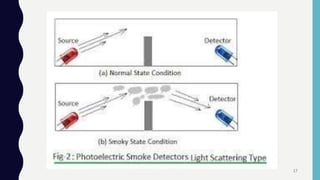
• Light scattering smoke detector depend on the ability of small
airborne particles to scatter light.
• The light emitted from the light source is not detected by the photo
sensor.
• When smoke particles enter in the chamber increases, more light is
scattered toward the sensor.
.
16
17
18
LIGHT OBSCURING SMOKE DETECTOR
(BEAM SMOKE DETECTOR)
• It consists of separate light source and a photosensitive
sensor.
• These devices are usually installed in large open areas where
there is an unobstructed line of sight between the light
source and the receiver and where the use of spot-type
detectors would be economically unfeasible due to the
number of detectors required.
19
20
21
WHERE YOU CAN PLACE A DETECTOR?
Bed
room
Basement
Hallway
22
WHICH IS THE BEST AMONG ABOVE
DISCUSSED ??
23
 US National Institute of Standards and Technology recognized
ionization smoke detector as having better response rate then others
24
THANKS
25

Smoke detector

  • 1.
    SMOKE DETECTOR I NT R O D U C T I O N TO M E C H AT R O N I C S 1
  • 2.
    SOURCE AND CONTROL •Maincontroller is considered as the brain of the system, provides power to the system, monitors inputs and controls outputs through various circuits, performs other functions as required by the appropriate code 2
  • 3.
    WHAT IS SMOKEDETECTOR ? •A smoke detector is a device that senses smoke, typically as an indicator of fire 3
  • 4.
    WHO INVENTED SMOKEDETECTOR ? Inventor: Francis Upton and his partner Fernando Dibble filed Date of invention: March 24, 1890, 4
  • 5.
    WHERE DO WEUSE IT ?  Detect fire in the areas.  Notify building occupants to take evasive action to escape the dangers of a hostile fire.  Summon organized assistance to initiate or assist in fire control activities. Initiate automatic fire control & suppression systems & to sound alarm.  Supervise fire control & suppression systems to assure operational status is maintained Initiate auxiliary functions involving environmental, utility & process controls 5
  • 6.
    Smoke detector consistsof two parts: A sensor to sense the presence of smoke particles An Actuator/Alarm to be triggered 6
  • 7.
    TYPES OF SMOKEDETECTOR There are two types of smoke detectors Ionization smoke detector Photoelectric smoke detector Both works on different principles to sense visible or invisible particles of combustion in air given off developing fire. 7
  • 8.
  • 9.
    IONIZATION SMOKE DETECTOR •The ionization smoke detector consists of an alpha particle producing a radioactive source (americium-241), a smoke chamber, and charged detector plates. • The alpha source causes the air within the smoke chamber to become ionized and conductive. 9
  • 10.
  • 11.
    As smoke particlesenter the smoke chamber, the smoke particles attach themselves to the ionized air molecules and the air in the chamber becomes less conductive. When the air conductivity within the chamber drops below a predetermined level, the alarm is triggered 11
  • 12.
    The ionization smokedetector is widely used. Its capability to detect smoke originating from fire is best utilized for clean-burning fires that produce small particles during combustion. 12
  • 13.
  • 14.
    PHOTOELECTRIC SMOKE DETECTOR •The photoelectric type detector utilizes light as a detection mechanism. • A photoelectric, or optical, smoke detector contains a source of infrared, visible, or ultraviolet light, a lens, and a photoelectric receiver (typically a photodiode). 14
  • 15.
    There are twotypes of photoelectric smoke detectors: • Light sensing(scattering) • Light obscuring(blocking 15
  • 16.
    LIGHT SCATTERING SMOKEDETECTOR • Light scattering smoke detector depend on the ability of small airborne particles to scatter light. • The light emitted from the light source is not detected by the photo sensor. • When smoke particles enter in the chamber increases, more light is scattered toward the sensor. . 16
  • 17.
  • 18.
  • 19.
    LIGHT OBSCURING SMOKEDETECTOR (BEAM SMOKE DETECTOR) • It consists of separate light source and a photosensitive sensor. • These devices are usually installed in large open areas where there is an unobstructed line of sight between the light source and the receiver and where the use of spot-type detectors would be economically unfeasible due to the number of detectors required. 19
  • 20.
  • 21.
  • 22.
    WHERE YOU CANPLACE A DETECTOR? Bed room Basement Hallway 22
  • 23.
    WHICH IS THEBEST AMONG ABOVE DISCUSSED ?? 23
  • 24.
     US NationalInstitute of Standards and Technology recognized ionization smoke detector as having better response rate then others 24
  • 25.