 Introduction
 History
 Applications
 Procedure
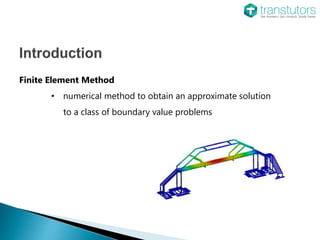
Finite Element Method
• numerical method to obtain an approximate solution
to a class of boundary value problems
Finite Element Method
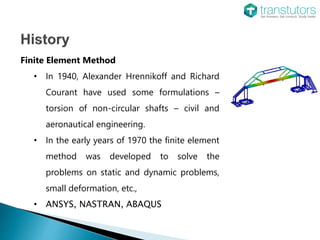
• In 1940, Alexander Hrennikoff and Richard
Courant have used some formulations –
torsion of non-circular shafts – civil and
aeronautical engineering.
• In the early years of 1970 the finite element
method was developed to solve the
problems on static and dynamic problems,
small deformation, etc.,
• ANSYS, NASTRAN, ABAQUS
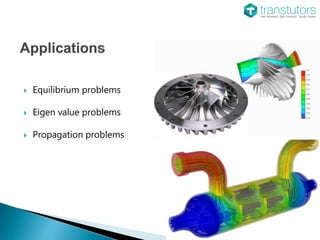
 Equilibrium problems
 Eigen value problems
 Propagation problems
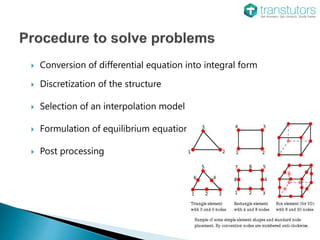
 Conversion of differential equation into integral form
 Discretization of the structure
 Selection of an interpolation model
 Formulation of equilibrium equations
 Post processing
This was just a summary on Finite Element Method (FEM). For more
detailed information on this topic, please type the link given below or copy
it from the description of this PPT and open it in a new browser window.
www.transtutors.com/homework-help/mechanical-engineering/finite-element-
method.aspx

Finite Element Method (FEM) | Mechanical Engineering

  • 2.
     Introduction  History Applications  Procedure
  • 3.
    Finite Element Method •numerical method to obtain an approximate solution to a class of boundary value problems
  • 4.
    Finite Element Method •In 1940, Alexander Hrennikoff and Richard Courant have used some formulations – torsion of non-circular shafts – civil and aeronautical engineering. • In the early years of 1970 the finite element method was developed to solve the problems on static and dynamic problems, small deformation, etc., • ANSYS, NASTRAN, ABAQUS
  • 5.
     Equilibrium problems Eigen value problems  Propagation problems
  • 6.
     Conversion ofdifferential equation into integral form  Discretization of the structure  Selection of an interpolation model  Formulation of equilibrium equations  Post processing
  • 7.
    This was justa summary on Finite Element Method (FEM). For more detailed information on this topic, please type the link given below or copy it from the description of this PPT and open it in a new browser window. www.transtutors.com/homework-help/mechanical-engineering/finite-element- method.aspx