








COMPLETE DENTURE
IMPRESSION

DR. ZAHID ALI KHAN
MDS(AIIMS)
LECTURER,
SUBSTITUTIVE DENTAL
SCEINCES
DEFINITION
o AN IMPRESSION is the negative form of the
teeth and/or other tissues of the oral cavity
made in a plastic material that becomes
relatively hard or set while in contact with these
Tissues.
oA COMPLETE DENTURE IMPRESSION

is a negative registration of the entire denture
bearing, stabilizing and border seal area
present in the edentulous mouth.
(Heartwell 5th edn.)
IMPRESSION  TYPES

PRELIMINARY (Primary)
IMPRESSION
PURPOSE
•Diagnosis
•Construction of tray

FINAL (Secondary)
IMPRESSION

• Making master casts 
used for making dentures
PRINCIPLES AND OBJECTIVES
OF IMPRESSION MAKING
The impression technique for CD must strive to accomplish the following
five primary objectives:PRESERVATION: The preservation of remaining residual ridge is one
of the important objectives of impression making.
STABILITY: It refers to the resistance against horizontal movement and forces
that tend to alter the relationship between the denture base and its supporting
foundation in a horizontal/rotatory direction.
Close adaptation to the undistorted mucosa is most important for stability.
Stability decrease with the loss of vertical height of the ridges or with increases
in flabby movable tissues
SUPPORT: It is the resistance of a denture to the vertical
components of mastication and to occlusal or other forces
applied in a direction towards basal seat.
Maximum coverage provides the ‘SNOWSHOE’
effect which distributes applied forces over as wide
an area as possible .

This helps in:oPreservation
oStability
oRetention
ESTHETICS

Border thickness should be varied with the
needs of each patient in accordance with the
extent of residual ridge loss.
The vestibular fornix should be filled but not
overfilled, to restore facial contour.
RETENTION
Retention for a denture is its resistance to removal in a
direction opposite that of its insertion or
Resistance of a denture to vertical movements away
from the tissues (Prosthetic Dent. Glossary 1995
Quintessence).
The quality inherent in the prosthesis acting to resist the
forces of dislodgment along the path of insertion. (GPT
1999 7th edn.)..
BASIC CONCEPTS TO ACHIEVE
A SUCCESSFUL IMPRESSION
The tissues of mouth must be healthy.
Impression should extend to include all of the basal seat
within the limits of the health and functions of the supporting
and limiting tissues.
Borders must be in harmony with the anatomical and
physiological limitations of the oral structures.
Proper space for selected impression material should
be provided within the impression tray.
A physiologic type of border molding procedure should
be performed by the dentist or by the patient under the
guidance of the dentist.
Selective pressure should be placed on the basal seat
during the making of impression.
The impression should be removed from the mouth
without damage to the mucous membrane of the residual
ridges.
A guiding mechanism should be provided for
positioning of impression tray in mouth.
The tray and impression material should be made of
dimensionally stable materials.
External surface of impression should be similar to the
external surface of complete denture.
AIM OF PRIMARY IMPRESSION
Record the denture bearing areas of each arch in stock
metal trays.

According to the guides to standards in prosthetic dentistry
there are basic requirements required for primary
impressions.
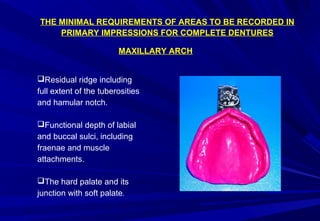
THE MINIMAL REQUIREMENTS OF AREAS TO BE RECORDED IN
PRIMARY IMPRESSIONS FOR COMPLETE DENTURES
MAXILLARY ARCH
Residual ridge including
full extent of the tuberosities
and hamular notch.
Functional depth of labial
and buccal sulci, including
fraenae and muscle
attachments.
The hard palate and its
junction with soft palate.
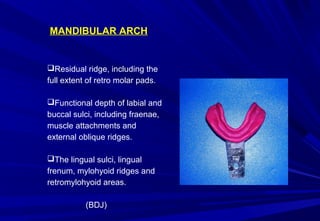
MANDIBULAR ARCH

Residual ridge, including the
full extent of retro molar pads.
Functional depth of labial and
buccal sulci, including fraenae,
muscle attachments and
external oblique ridges.
The lingual sulci, lingual
frenum, mylohyoid ridges and
retromylohyoid areas.
(BDJ)
IMPRESSION TRAYS
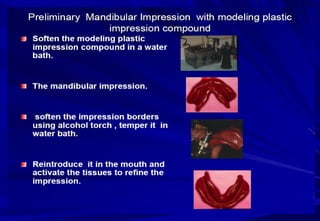
For primary impression we use stock metal/plastic trays
of varying sizes that are available.
-Trays are the most important part of impression making
procedure

Non perforated  impression compound

Perforated  alginates, silicone putty
Too large a tray will:-

Distort tissue around the border of impression.
Pull soft tissues under the impression away from
bone.
Distorting dimensions of sulcus.
Too small a tray :–

the border will collapse inward onto the residual ridge.
Distort dimensions.
Proper support of lips is lost
Preliminary impression should be as accurate as
possible
At times even a correctly selected stock tray will
not fit the denture – bearing area perfectly.
Therefore select a impression material that has
relatively high viscosity thereby allowing the
material to compensate more easily for the
deficiencies of the tray.
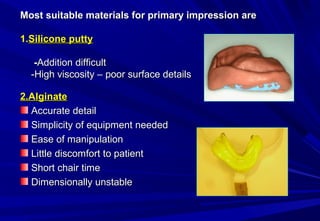
Most suitable materials for primary impression are
1.Silicone putty
-Addition difficult
-High viscosity – poor surface details
2.Alginate
Accurate detail
Simplicity of equipment needed
Ease of manipulation
Little discomfort to patient
Short chair time
Dimensionally unstable
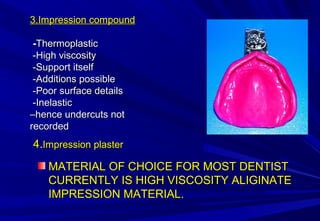
3.Impression compound
-Thermoplastic
-High viscosity
-Support itself
-Additions possible
-Poor surface details
-Inelastic
–hence undercuts not
recorded

4.Impression plaster
MATERIAL OF CHOICE FOR MOST DENTIST
CURRENTLY IS HIGH VISCOSITY ALIGINATE
IMPRESSION MATERIAL.
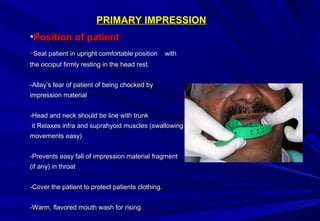
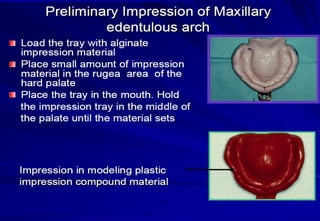
PRIMARY IMPRESSION
•Position of patient
-Seat patient in upright comfortable position

with

the occiput firmly resting in the head rest.
-Allay’s fear of patient of being chocked by
impression material
-Head and neck should be line with trunk
it Relaxes infra and suprahyoid muscles (swallowing
movements easy)
-Prevents easy fall of impression material fragment
(if any) in throat
-Cover the patient to protect patients clothing.
-Warm, flavored mouth wash for rising.
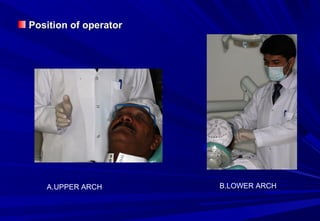
Position of operator

A.UPPER ARCH

B.LOWER ARCH
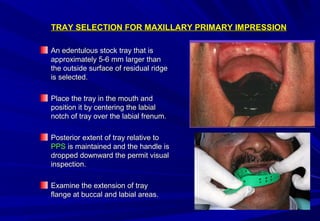
TRAY SELECTION FOR MAXILLARY PRIMARY IMPRESSION
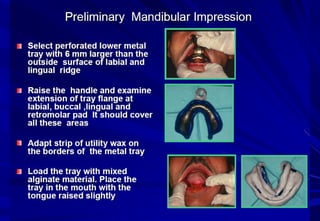
An edentulous stock tray that is
approximately 5-6 mm larger than
the outside surface of residual ridge
is selected.
Place the tray in the mouth and
position it by centering the labial
notch of tray over the labial frenum.
Posterior extent of tray relative to
PPS is maintained and the handle is
dropped downward the permit visual
inspection.
Examine the extension of tray
flange at buccal and labial areas.
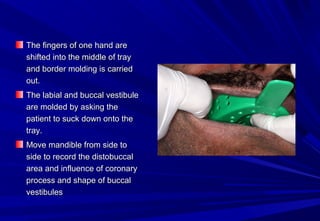
The fingers of one hand are
shifted into the middle of tray
and border molding is carried
out.
The labial and buccal vestibule
are molded by asking the
patient to suck down onto the
tray.
Move mandible from side to
side to record the distobuccal
area and influence of coronary
process and shape of buccal
vestibules
Open wide to record pterygomandibular
raphe.

Asked the patient to suck the finger of the
operator – establishes impression of posterior
aspect of upper impression
COMMON FAULTS IN UPPER IMPRESSION
1.

A crevice in the midline of palatal posterior third.
Causes
Insufficient composition in palatal area when fitting the
tray.
Insufficient pressure

2. Excessive composition extending well beyond the
posterior palatal border of tray
Causes
Excessive pressure or too prolonged pressure when
seating the tray.
Too much compound in palatal area
3. An impression short in one or more regions of sulci,
especially the areas of tuberosities or labial sulcus.
Causes
Insufficient material in tray
Failure to mold
Failure to pull upper lip out and upwards
Insufficient pressure

4. Tray flange showing through composition
Causes
Poorly selected or adapted tray
Incorrect centering of tray
Most of these deficiencies can be corrected by addition
of small amounts of composition.
FAULTS IN LOWER PRIMARY IMPRESSIONS
1. Insufficient depth, in the posterior lingual pouch
Causes
Flange of the tray short in this region
Lack of composition in the tray
To little force used in seating the tray
Tongue trapped by the tray flanges because the patient
failed to raise the tongue as the tray was seated
In some cases it is necessary to push the compound into
the lingual pouch area with the fore-finger just before the
tray is finally seated.
2. Insufficient depth in the lingual, labial and
buccal sulci.
Causes
Lack of impression material
Not seating the tray with sufficient pressure
The presence of a smooth hollow in the buccal distal
peripheral
Causes
The cheek was not released from beneath the
composition border during functional trimming.
3.Edge of the tray showing through the impression

Causes
Incorrect centering of the tray before seating.
In the anterior lingual region. The forward thrust of the
tongue not being countered by sufficient backward
pressure on the tray
Use of too large a tray for the mouth or failure to trim the
flanges adequately.
Corrections to faults (1) and (2 may be made by adding small
softened pieces of composition to the imperfect areas and
then reseating and re-molding the impression.

The error due to cheek folds, (3) should be corrected by reheating the impression in that area and re-adapting, whilst
fault number (4) usually requires an entirely new impression.
THANK YOU

Finished complete denture impression presentation final modification

  • 1.
    COMPLETE DENTURE IMPRESSION DR. ZAHIDALI KHAN MDS(AIIMS) LECTURER, SUBSTITUTIVE DENTAL SCEINCES
  • 2.
    DEFINITION o AN IMPRESSIONis the negative form of the teeth and/or other tissues of the oral cavity made in a plastic material that becomes relatively hard or set while in contact with these Tissues. oA COMPLETE DENTURE IMPRESSION is a negative registration of the entire denture bearing, stabilizing and border seal area present in the edentulous mouth. (Heartwell 5th edn.)
  • 3.
    IMPRESSION  TYPES PRELIMINARY(Primary) IMPRESSION PURPOSE •Diagnosis •Construction of tray FINAL (Secondary) IMPRESSION • Making master casts  used for making dentures
  • 4.
    PRINCIPLES AND OBJECTIVES OFIMPRESSION MAKING The impression technique for CD must strive to accomplish the following five primary objectives:PRESERVATION: The preservation of remaining residual ridge is one of the important objectives of impression making. STABILITY: It refers to the resistance against horizontal movement and forces that tend to alter the relationship between the denture base and its supporting foundation in a horizontal/rotatory direction. Close adaptation to the undistorted mucosa is most important for stability. Stability decrease with the loss of vertical height of the ridges or with increases in flabby movable tissues
  • 5.
    SUPPORT: It isthe resistance of a denture to the vertical components of mastication and to occlusal or other forces applied in a direction towards basal seat. Maximum coverage provides the ‘SNOWSHOE’ effect which distributes applied forces over as wide an area as possible . This helps in:oPreservation oStability oRetention
  • 6.
    ESTHETICS Border thickness shouldbe varied with the needs of each patient in accordance with the extent of residual ridge loss. The vestibular fornix should be filled but not overfilled, to restore facial contour.
  • 7.
    RETENTION Retention for adenture is its resistance to removal in a direction opposite that of its insertion or Resistance of a denture to vertical movements away from the tissues (Prosthetic Dent. Glossary 1995 Quintessence). The quality inherent in the prosthesis acting to resist the forces of dislodgment along the path of insertion. (GPT 1999 7th edn.)..
  • 8.
    BASIC CONCEPTS TOACHIEVE A SUCCESSFUL IMPRESSION The tissues of mouth must be healthy. Impression should extend to include all of the basal seat within the limits of the health and functions of the supporting and limiting tissues. Borders must be in harmony with the anatomical and physiological limitations of the oral structures.
  • 9.
    Proper space forselected impression material should be provided within the impression tray. A physiologic type of border molding procedure should be performed by the dentist or by the patient under the guidance of the dentist. Selective pressure should be placed on the basal seat during the making of impression.
  • 10.
    The impression shouldbe removed from the mouth without damage to the mucous membrane of the residual ridges. A guiding mechanism should be provided for positioning of impression tray in mouth. The tray and impression material should be made of dimensionally stable materials. External surface of impression should be similar to the external surface of complete denture.
  • 11.
    AIM OF PRIMARYIMPRESSION Record the denture bearing areas of each arch in stock metal trays. According to the guides to standards in prosthetic dentistry there are basic requirements required for primary impressions.
  • 12.
    THE MINIMAL REQUIREMENTSOF AREAS TO BE RECORDED IN PRIMARY IMPRESSIONS FOR COMPLETE DENTURES MAXILLARY ARCH Residual ridge including full extent of the tuberosities and hamular notch. Functional depth of labial and buccal sulci, including fraenae and muscle attachments. The hard palate and its junction with soft palate.
  • 13.
    MANDIBULAR ARCH Residual ridge,including the full extent of retro molar pads. Functional depth of labial and buccal sulci, including fraenae, muscle attachments and external oblique ridges. The lingual sulci, lingual frenum, mylohyoid ridges and retromylohyoid areas. (BDJ)
  • 14.
    IMPRESSION TRAYS For primaryimpression we use stock metal/plastic trays of varying sizes that are available. -Trays are the most important part of impression making procedure Non perforated  impression compound Perforated  alginates, silicone putty
  • 15.
    Too large atray will:- Distort tissue around the border of impression. Pull soft tissues under the impression away from bone. Distorting dimensions of sulcus.
  • 16.
    Too small atray :– the border will collapse inward onto the residual ridge. Distort dimensions. Proper support of lips is lost
  • 17.
    Preliminary impression shouldbe as accurate as possible At times even a correctly selected stock tray will not fit the denture – bearing area perfectly. Therefore select a impression material that has relatively high viscosity thereby allowing the material to compensate more easily for the deficiencies of the tray.
  • 18.
    Most suitable materialsfor primary impression are 1.Silicone putty -Addition difficult -High viscosity – poor surface details 2.Alginate Accurate detail Simplicity of equipment needed Ease of manipulation Little discomfort to patient Short chair time Dimensionally unstable
  • 19.
    3.Impression compound -Thermoplastic -High viscosity -Supportitself -Additions possible -Poor surface details -Inelastic –hence undercuts not recorded 4.Impression plaster MATERIAL OF CHOICE FOR MOST DENTIST CURRENTLY IS HIGH VISCOSITY ALIGINATE IMPRESSION MATERIAL.
  • 20.
    PRIMARY IMPRESSION •Position ofpatient -Seat patient in upright comfortable position with the occiput firmly resting in the head rest. -Allay’s fear of patient of being chocked by impression material -Head and neck should be line with trunk it Relaxes infra and suprahyoid muscles (swallowing movements easy) -Prevents easy fall of impression material fragment (if any) in throat -Cover the patient to protect patients clothing. -Warm, flavored mouth wash for rising.
  • 21.
  • 22.
    TRAY SELECTION FORMAXILLARY PRIMARY IMPRESSION An edentulous stock tray that is approximately 5-6 mm larger than the outside surface of residual ridge is selected. Place the tray in the mouth and position it by centering the labial notch of tray over the labial frenum. Posterior extent of tray relative to PPS is maintained and the handle is dropped downward the permit visual inspection. Examine the extension of tray flange at buccal and labial areas.
  • 24.
    The fingers ofone hand are shifted into the middle of tray and border molding is carried out. The labial and buccal vestibule are molded by asking the patient to suck down onto the tray. Move mandible from side to side to record the distobuccal area and influence of coronary process and shape of buccal vestibules
  • 25.
    Open wide torecord pterygomandibular raphe. Asked the patient to suck the finger of the operator – establishes impression of posterior aspect of upper impression
  • 26.
    COMMON FAULTS INUPPER IMPRESSION 1. A crevice in the midline of palatal posterior third. Causes Insufficient composition in palatal area when fitting the tray. Insufficient pressure 2. Excessive composition extending well beyond the posterior palatal border of tray Causes Excessive pressure or too prolonged pressure when seating the tray. Too much compound in palatal area
  • 27.
    3. An impressionshort in one or more regions of sulci, especially the areas of tuberosities or labial sulcus. Causes Insufficient material in tray Failure to mold Failure to pull upper lip out and upwards Insufficient pressure 4. Tray flange showing through composition Causes Poorly selected or adapted tray Incorrect centering of tray Most of these deficiencies can be corrected by addition of small amounts of composition.
  • 30.
    FAULTS IN LOWERPRIMARY IMPRESSIONS 1. Insufficient depth, in the posterior lingual pouch Causes Flange of the tray short in this region Lack of composition in the tray To little force used in seating the tray Tongue trapped by the tray flanges because the patient failed to raise the tongue as the tray was seated In some cases it is necessary to push the compound into the lingual pouch area with the fore-finger just before the tray is finally seated.
  • 31.
    2. Insufficient depthin the lingual, labial and buccal sulci. Causes Lack of impression material Not seating the tray with sufficient pressure The presence of a smooth hollow in the buccal distal peripheral Causes The cheek was not released from beneath the composition border during functional trimming.
  • 32.
    3.Edge of thetray showing through the impression Causes Incorrect centering of the tray before seating. In the anterior lingual region. The forward thrust of the tongue not being countered by sufficient backward pressure on the tray Use of too large a tray for the mouth or failure to trim the flanges adequately.
  • 33.
    Corrections to faults(1) and (2 may be made by adding small softened pieces of composition to the imperfect areas and then reseating and re-molding the impression. The error due to cheek folds, (3) should be corrected by reheating the impression in that area and re-adapting, whilst fault number (4) usually requires an entirely new impression.
  • 34.