S. M. Forhad Arefin
FCPS Trainee
Chairman of the sessionChairman of the session
Dr. Md. Mahbubur RahmanDr. Md. Mahbubur Rahman
BDS, DDS, PhDBDS, DDS, PhD
Associate Professor & ChairmanAssociate Professor & Chairman
Department of ProsthodonticsDepartment of Prosthodontics
Faculty of DentistryFaculty of Dentistry
BSMMU, DhakaBSMMU, Dhaka
Moderator
Dr. Md. Amzad Hossain
FCPS, MS, MSc,BDS
Assistant Professor
Department of Prosthodontics
Faculty of Dentistry
BSMMU, Dhaka
Special Tray
A special tray is defined as, “A custom made
device prepared for a particular patient which is
used to carry, confine and control an impression
material while making an impression’’.
Ideal characteristics of special tray:
A special tray should be
1. well adapted
2. dimensionally stable
3. free of voids and projections
4. 2-3 mm thick
5. with a handle
6. Rigid even in thin section.
Special tray should not
7. Bind to the cast and should be
easy to remove.
8. React with the impression
material.
9. The flanges should be 2-4 mm
short of the reflections.
10. The proposed denture
bearing area of the denture
should be reflected in the
tray’s extension.
Characteristics continued
Materials used to fabricate special tray:
1. Auto polymerizing acrylic resin.
2. Shellac
3. Vacuum or pressure-formed thermoplastic
resin sheets.
4. Tray compound
FABRICATION
A. Preparation of the primary cast :
1. Undercuts should be find out with the
help of surveyor and should be blocked out .
2. Out line of the border of the tray should be
marked with pencil which is 2/3 mm short
of the reflection.
3.The relief areas should also be marked in
the cast.
4. The border of the tray marked on the cast
may be grooved deeper using a carver.
B. Adapting the relief wax:
Relief wax should be adapted over the
relief areas marked on the cast.
Relief areas are:
In maxilla
Incisive papilla
Canine eminence
Mid palatine raphe
Fovea palatinae
Sharp spiny ridges
Torus palatinus
Bony prominences
Undercut ridge
In mandible
Crest of the residual ridge
Mental foramen
Genial tubercles
Torus mandibularis
Mylohyoid ridge
Materials for giving relief:
a. Baseplate wax
b. Non asbestos casting liner.
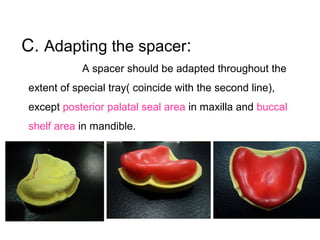
C. Adapting the spacer:
A spacer should be adapted throughout the
extent of special tray( coincide with the second line),
except posterior palatal seal area in maxilla and buccal
shelf area in mandible.
Spacer continued
Function:
a. The spacer allows the tray to be properly
positioned in the mouth during border molding procedure.
b. To allow the impression to have an even
thickness of impression material.
c. Prevent distortion of the material at final
stage.
Materials used:
a. Baseplate wax
b. Non asbestos casting liner
Thickness of the spacer for different impression
material:
Zn oxide eugenol paste
0.5 mm
Alginate
3 mm
Elastomeric
0.5-1.5 mm
Plaster
1.5 mm
Zn oxide eugenol paste
0.5 mm
Alginate
2 mm
Polysulphide, Silicones
1.3 mm, 3 mm
Plaster
2.5 mm
or
Spacer continued
Ref: J. A. Hobkirk
Ref: Finn
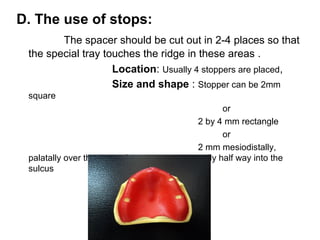
D. The use of stops:
The spacer should be cut out in 2-4 places so that
the special tray touches the ridge in these areas .
Location: Usually 4 stoppers are placed,
Size and shape : Stopper can be 2mm
square
or
2 by 4 mm rectangle
or
2 mm mesiodistally,
palatally over the crest of the ridge and buccally half way into the
sulcus
There are several ways that stops can be
produced:
1) During construction of an acrylic tray in
the laboratory
(2) At the chair side in the mouth.
(3) At the chair side on the cast
Stops continued
E. Application of separating medium
F. Acrylization:
Thickness 2-3 mm
G. Fabrication of handle:
Criteria of handle :
1. The handle should be parallel to
the long axis of the teeth that
are to be replaced.
2. The handle should not arise
horizontally from the tray
because it may interfere with lip
movements.
3. It should be 3-4 mm thick ,
8 mm long , and 8 mm high.
4. The vertical distance from
the sulcus to the handle is 2 cm
5. The handle upstand must be made
long enough for the handle to exit
through the oral commissure.
Handle criteria continued
6. For mandibular tray two posterior
handle should be given as finger rests.
The next phase is preparing the tray for border
molding procedure:
References:
1. Zarb. Bolender.: Prosthodontic
Treatment of Edentulous patient,edi 12. p225-247
3. A, Roy Macgregor.:Clinical Dental
Prosthetics, edi 3. p 55-67
4. Sheldon Winkler.: Essentials of
Complete Denture Prosthodontics,edi 2.
5. J. A. Hobkirk. A Colour Atlas of
Complete Denture.
6. R. M. Basker, J. C. Devenport.:
Prosthetic Treatment of Edentulous Patient, edi 4.
7. Deepak Nallaswamy. Textbook of
Prosthodontics.

A special tray is defined final

  • 2.
    S. M. ForhadArefin FCPS Trainee
  • 3.
    Chairman of thesessionChairman of the session Dr. Md. Mahbubur RahmanDr. Md. Mahbubur Rahman BDS, DDS, PhDBDS, DDS, PhD Associate Professor & ChairmanAssociate Professor & Chairman Department of ProsthodonticsDepartment of Prosthodontics Faculty of DentistryFaculty of Dentistry BSMMU, DhakaBSMMU, Dhaka
  • 4.
    Moderator Dr. Md. AmzadHossain FCPS, MS, MSc,BDS Assistant Professor Department of Prosthodontics Faculty of Dentistry BSMMU, Dhaka
  • 5.
    Special Tray A specialtray is defined as, “A custom made device prepared for a particular patient which is used to carry, confine and control an impression material while making an impression’’.
  • 6.
    Ideal characteristics ofspecial tray: A special tray should be 1. well adapted 2. dimensionally stable 3. free of voids and projections 4. 2-3 mm thick 5. with a handle
  • 7.
    6. Rigid evenin thin section. Special tray should not 7. Bind to the cast and should be easy to remove. 8. React with the impression material. 9. The flanges should be 2-4 mm short of the reflections. 10. The proposed denture bearing area of the denture should be reflected in the tray’s extension. Characteristics continued
  • 8.
    Materials used tofabricate special tray: 1. Auto polymerizing acrylic resin. 2. Shellac 3. Vacuum or pressure-formed thermoplastic resin sheets. 4. Tray compound
  • 9.
    FABRICATION A. Preparation ofthe primary cast : 1. Undercuts should be find out with the help of surveyor and should be blocked out .
  • 10.
    2. Out lineof the border of the tray should be marked with pencil which is 2/3 mm short of the reflection. 3.The relief areas should also be marked in the cast. 4. The border of the tray marked on the cast may be grooved deeper using a carver.
  • 11.
    B. Adapting therelief wax: Relief wax should be adapted over the relief areas marked on the cast.
  • 12.
    Relief areas are: Inmaxilla Incisive papilla Canine eminence Mid palatine raphe Fovea palatinae Sharp spiny ridges Torus palatinus Bony prominences Undercut ridge In mandible Crest of the residual ridge Mental foramen Genial tubercles Torus mandibularis Mylohyoid ridge
  • 13.
    Materials for givingrelief: a. Baseplate wax b. Non asbestos casting liner.
  • 14.
    C. Adapting thespacer: A spacer should be adapted throughout the extent of special tray( coincide with the second line), except posterior palatal seal area in maxilla and buccal shelf area in mandible.
  • 15.
    Spacer continued Function: a. Thespacer allows the tray to be properly positioned in the mouth during border molding procedure. b. To allow the impression to have an even thickness of impression material. c. Prevent distortion of the material at final stage. Materials used: a. Baseplate wax b. Non asbestos casting liner
  • 16.
    Thickness of thespacer for different impression material: Zn oxide eugenol paste 0.5 mm Alginate 3 mm Elastomeric 0.5-1.5 mm Plaster 1.5 mm Zn oxide eugenol paste 0.5 mm Alginate 2 mm Polysulphide, Silicones 1.3 mm, 3 mm Plaster 2.5 mm or Spacer continued Ref: J. A. Hobkirk Ref: Finn
  • 17.
    D. The useof stops: The spacer should be cut out in 2-4 places so that the special tray touches the ridge in these areas . Location: Usually 4 stoppers are placed, Size and shape : Stopper can be 2mm square or 2 by 4 mm rectangle or 2 mm mesiodistally, palatally over the crest of the ridge and buccally half way into the sulcus
  • 18.
    There are severalways that stops can be produced: 1) During construction of an acrylic tray in the laboratory (2) At the chair side in the mouth. (3) At the chair side on the cast Stops continued
  • 19.
    E. Application ofseparating medium
  • 20.
  • 21.
    G. Fabrication ofhandle: Criteria of handle : 1. The handle should be parallel to the long axis of the teeth that are to be replaced. 2. The handle should not arise horizontally from the tray because it may interfere with lip movements. 3. It should be 3-4 mm thick , 8 mm long , and 8 mm high.
  • 22.
    4. The verticaldistance from the sulcus to the handle is 2 cm 5. The handle upstand must be made long enough for the handle to exit through the oral commissure. Handle criteria continued
  • 23.
    6. For mandibulartray two posterior handle should be given as finger rests.
  • 24.
    The next phaseis preparing the tray for border molding procedure:
  • 26.
    References: 1. Zarb. Bolender.:Prosthodontic Treatment of Edentulous patient,edi 12. p225-247 3. A, Roy Macgregor.:Clinical Dental Prosthetics, edi 3. p 55-67 4. Sheldon Winkler.: Essentials of Complete Denture Prosthodontics,edi 2. 5. J. A. Hobkirk. A Colour Atlas of Complete Denture. 6. R. M. Basker, J. C. Devenport.: Prosthetic Treatment of Edentulous Patient, edi 4. 7. Deepak Nallaswamy. Textbook of Prosthodontics.