Impression of Complete
Denture
ILOs
INTRODUCTION
IMPRESSION
MATERIALS
IMPRESSION
TECHNIQUES
IMPRESSION
ERRORS
AREA OF
SUPPORT THEORIES
Introduction
✓Impression: is the negative form of the teeth and/or other
tissues of the oral cavity.
✓Primary impression : is an impression made for the purpose of
the diagnosis or for the construction of a special tray.
✓Secondary impression : negative likeness made for fabricating
prothesis .
Objectives of impression
1-Retention (physical, mechanical, physiological, muscular )
2-Support (large surface area, nature of supporting area,
Accuracy of fit )
3-Stability (arch form, shape of palate, height of residual ridge
,occlusal plane)
4-Esthiscs (thickness of flange )
5-Preservation(inflammation of tissues , resorption of bone )
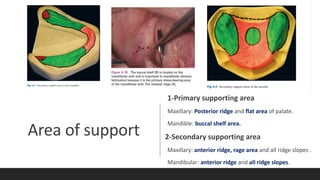
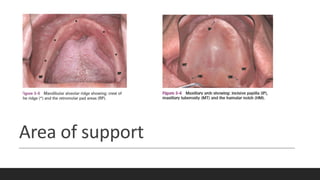
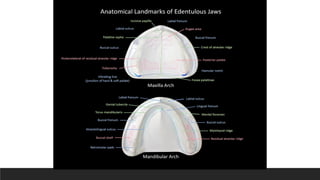
Area of support
1-Primary supporting area
Maxillary: Posterior ridge and flat area of palate.
Mandible: buccal shelf area.
2-Secondary supporting area
Maxillary: anterior ridge, rage area and all ridge slopes .
Mandibular: anterior ridge and all ridge slopes.
Area of support
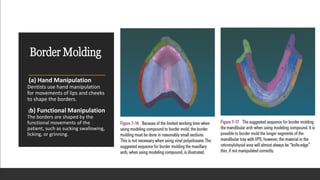
Border Molding
(a) Hand Manipulation
Dentists use hand manipulation
for movements of lips and cheeks
to shape the borders.
(b) Functional Manipulation
The borders are shaped by the
functional movements of the
patient, such as sucking swallowing,
licking, or grinning.
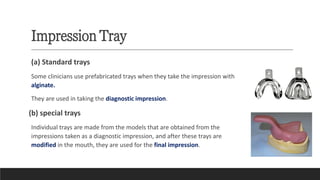
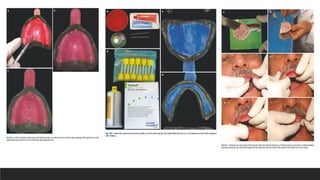
Impression Tray
(a) Standard trays
Some clinicians use prefabricated trays when they take the impression with
alginate.
They are used in taking the diagnostic impression.
(b) special trays
Individual trays are made from the models that are obtained from the
impressions taken as a diagnostic impression, and after these trays are
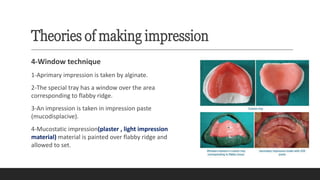
modified in the mouth, they are used for the final impression.
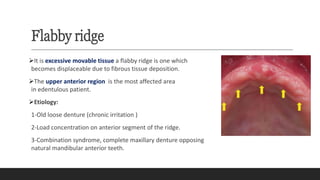
Flabby ridge
➢It is excessive movable tissue a flabby ridge is one which
becomes displaceable due to fibrous tissue deposition.
➢The upper anterior region is the most affected area
in edentulous patient.
➢Etiology:
1-Old loose denture (chronic irritation )
2-Load concentration on anterior segment of the ridge.
3-Combination syndrome, complete maxillary denture opposing
natural mandibular anterior teeth.
Impression
materials
(according to type of
impression )
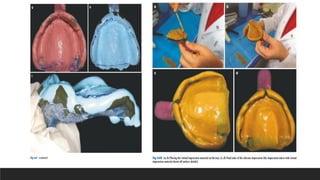
(a) Primary
1. Impression compound
2. Alginate
(b) Secondary
ZOE impression paste
Elastomers
Plaster of Paris
Impression compound
➢It softens on heating and harden on cooling.
➢Supplied as sheets ,sticks and cones.
➢The impression compound helps the prefabricated tray to become more suitable for alginate.
➢Used in border moulding. Making primary impression of edentulous mouth.
➢It can be reused several times , inaccurate portions can be remade without having to remake
the entire impression.
➢Disadvantages: 1-distortion 2-compress soft tissue when make impression 3- difficult to record
details because of high viscosity .
➢Advantages :1-record full depth of sulcus of edentulous patient accurately, so it provide
accurate denture with accurate design 2-not irritant
Alginate
➢It is an irreversible elastic hydrocolloid
➢Types: type 1 fast setting -type 2 normal setting
➢Used for making primary impression ,duplicating models
➢Advantage: 1-easy mix and manipulate
2-low cost 3- hygienic 4-give good surface detail even in presence of saliva 5-comfortable to patient
➢Disadvantages: 1-being predominantly water is that water evaporates from the surface of the
impression if it is left exposed to air which is called syneresis.
2-When the water evaporates, the impression shrinks and is no longer accurate.
3-poor adhesion with tray.
Zinc oxide
eugenol
impression
paste
➢Used as temporary relining material and as
impression material for edentulous patient.
➢Advantage: 1-record fine details.
2-low viscosity so no compression in soft tissue.
3-dimensionally stable.
➢Disadvantage: 1-Require special tray for
impression making.
2- cannot be used in deep undercut.
3-sticky and adhere to tissues.
4-Burning sensation of eugenol cause tissue
irritation.
Elastomers
➢Classification according to chemistry:
1-polysulfide 2-condensation
silicone
3-addition silicone 4-polyerther
➢Classification according to viscosity:
1-light 2- medium
3-heavy 4- putty
Elastomers
➢1-polysulfide : used in edentulous impression
Advantage: 1-high tear strength 2-flexible
Disadvantages :1-dimentionally unstable 2-bad
odor 3- least elastic recovery
➢2-condensation silicone:
1-most elastic material 2-excellent occlusal
record 3-dimenstional stable
➢3-polyether :1-dimension stable 2-accurate
3-available in Automix
disadvantage: very stiff material
➢4- Addition silicone: 1- dimensionally stable 2-
high flow
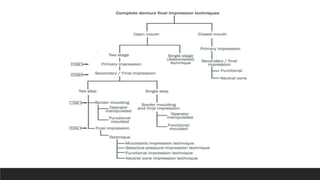
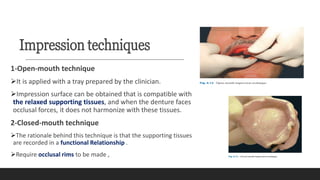
Impression techniques
1-Open-mouth technique
➢It is applied with a tray prepared by the clinician.
➢Impression surface can be obtained that is compatible with
the relaxed supporting tissues, and when the denture faces
occlusal forces, it does not harmonize with these tissues.
2-Closed-mouth technique
➢The rationale behind this technique is that the supporting tissues
are recorded in a functional Relationship .
➢Require occlusal rims to be made ,
Theories
1-Mucostatic impression
2-Pressure Impression
3-Selective Pressure Impression
4-Flabby ridge
Theories of making impression
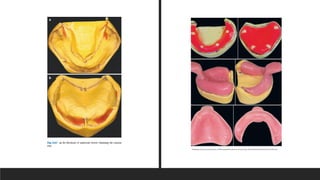
1-Mucostatic impression technique
➢Impression is made with the oral mucous membrane and the jaws in relaxed condition
➢ Done by using impression plaster
➢In the mucostatic technique, the impression can be taken with plaster, low-viscosity zinc oxide
eugenol, low-viscosity alginate, or low-viscosity elastomeric impression materials.
➢With this technique there is lack in border molding
➢The saliva layer between the tissues and the denture would be very strong because of surface
tension.
➢The adaption of the denture to the mucosa is very good, but the peripheral seal is poor.
Theories of making impression
2-Pressure Impression Technique ( Mucocompressive )
➢The mucocompressive concept is an impression technique that records the mucosa in the
functional/supportive situation .
➢In the mucodynamic technique, the impression can be taken using impression compound, high-viscosity
alginate, and high-viscosity elastomers.
➢The intention is to provide more stability for the denture by spreading the forces to a wider area under
function and adaption of the area under the denture
➢The patient applies occlusal forces in an ideal vertical dimension until the impression material is
polymerized.
➢Although the retention of the denture may prove to be very good at the beginning, resorption in alveolar
ridge would occur because of the continuous pressure.
Theories of making impression
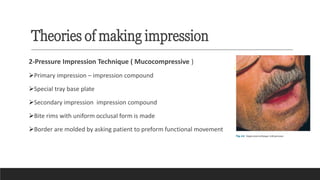
2-Pressure Impression Technique ( Mucocompressive )
➢Primary impression – impression compound
➢Special tray base plate
➢Secondary impression impression compound
➢Bite rims with uniform occlusal form is made
➢Border are molded by asking patient to preform functional movement
Theories of making impression
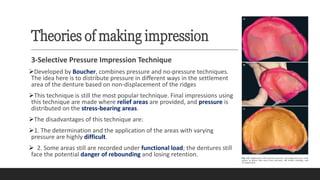
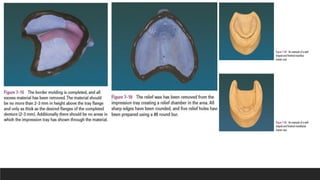
3-Selective Pressure Impression Technique
➢Developed by Boucher, combines pressure and no-pressure techniques.
The idea here is to distribute pressure in different ways in the settlement
area of the denture based on non-displacement of the ridges
➢This technique is still the most popular technique. Final impressions using
this technique are made where relief areas are provided, and pressure is
distributed on the stress-bearing areas.
➢The disadvantages of this technique are:
➢1. The determination and the application of the areas with varying
pressure are highly difficult.
➢ 2. Some areas still are recorded under functional load; the dentures still
face the potential danger of rebounding and losing retention.
Theories of making impression
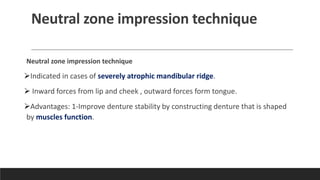
4-Window technique
1-Aprimary impression is taken by alginate.
2-The special tray has a window over the area
corresponding to flabby ridge.
3-An impression is taken in impression paste
(mucodisplacive).
4-Mucostatic impression(plaster , light impression
material) material is painted over flabby ridge and
allowed to set.
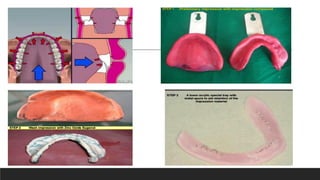
Neutral zone impression technique
➢Indicated in cases of severely atrophic mandibular ridge.
➢ Inward forces from lip and cheek , outward forces form tongue.
➢Advantages: 1-Improve denture stability by constructing denture that is shaped
by muscles function.
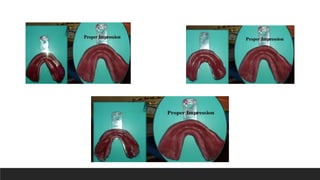
Impression
Errors
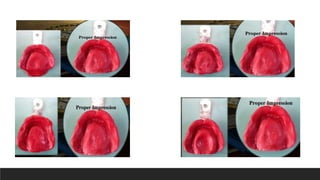
Impression Errors
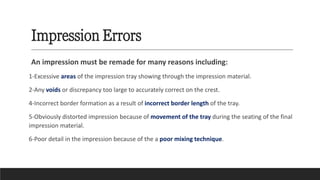
An impression must be remade for many reasons including:
1-Excessive areas of the impression tray showing through the impression material.
2-Any voids or discrepancy too large to accurately correct on the crest.
4-Incorrect border formation as a result of incorrect border length of the tray.
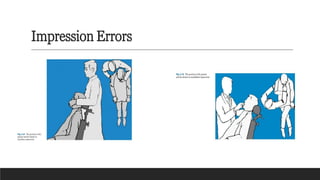
5-Obviously distorted impression because of movement of the tray during the seating of the final
impression material.
6-Poor detail in the impression because of the a poor mixing technique.
Impression Errors
Impression Errors
1-mandible:
➢Insufficient depth of posterior lingual pouch ( most occurring one )
➢Insufficient depth of lingual and buccal sulci.
➢The presence of smooth hollow in the buccal distal periphery.
➢Edge of tray showing through impression.
➢Asymmetrical impression.
Impression Errors
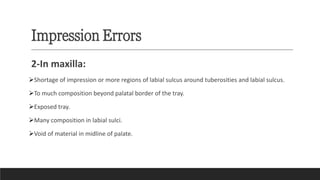
2-In maxilla:
➢Shortage of impression or more regions of labial sulcus around tuberosities and labial sulcus.
➢To much composition beyond palatal border of the tray.
➢Exposed tray.
➢Many composition in labial sulci.
➢Void of material in midline of palate.
REFERNCES
-Complete Denture Prosthodontics_ Planning and Decision-Making-
Springer International Publishing (2018)
-https://www.slideshare.net/marwanramadan1991/impression-
materials-for-complete-denture-55843743?qid=eb7d86cd-6bb5-4149-
b17d-106738ad0741&v=&b=&from_search=2
https://www.slideshare.net/NikitaChhabariya/impression-
techniques-in-complete-denture?qid=eb7d86cd-6bb5-4149-b17d-
106738ad0741&v=&b=&from_search=6
https://www.slideshare.net/AmalKaddah/ii-impression-making-for-
complete-denture?qid=eb7d86cd-6bb5-4149-b17d-
106738ad0741&v=&b=&from_search=4
“No ONE ever made a difference by being like Everyone else”
Buckminster Fuller
THANK YOU

Impression of complete denture

  • 1.
  • 2.
  • 3.
    Introduction ✓Impression: is thenegative form of the teeth and/or other tissues of the oral cavity. ✓Primary impression : is an impression made for the purpose of the diagnosis or for the construction of a special tray. ✓Secondary impression : negative likeness made for fabricating prothesis .
  • 4.
    Objectives of impression 1-Retention(physical, mechanical, physiological, muscular ) 2-Support (large surface area, nature of supporting area, Accuracy of fit ) 3-Stability (arch form, shape of palate, height of residual ridge ,occlusal plane) 4-Esthiscs (thickness of flange ) 5-Preservation(inflammation of tissues , resorption of bone )
  • 5.
    Area of support 1-Primarysupporting area Maxillary: Posterior ridge and flat area of palate. Mandible: buccal shelf area. 2-Secondary supporting area Maxillary: anterior ridge, rage area and all ridge slopes . Mandibular: anterior ridge and all ridge slopes.
  • 6.
  • 7.
    Border Molding (a) HandManipulation Dentists use hand manipulation for movements of lips and cheeks to shape the borders. (b) Functional Manipulation The borders are shaped by the functional movements of the patient, such as sucking swallowing, licking, or grinning.
  • 8.
    Impression Tray (a) Standardtrays Some clinicians use prefabricated trays when they take the impression with alginate. They are used in taking the diagnostic impression. (b) special trays Individual trays are made from the models that are obtained from the impressions taken as a diagnostic impression, and after these trays are modified in the mouth, they are used for the final impression.
  • 9.
    Flabby ridge ➢It isexcessive movable tissue a flabby ridge is one which becomes displaceable due to fibrous tissue deposition. ➢The upper anterior region is the most affected area in edentulous patient. ➢Etiology: 1-Old loose denture (chronic irritation ) 2-Load concentration on anterior segment of the ridge. 3-Combination syndrome, complete maxillary denture opposing natural mandibular anterior teeth.
  • 10.
    Impression materials (according to typeof impression ) (a) Primary 1. Impression compound 2. Alginate (b) Secondary ZOE impression paste Elastomers Plaster of Paris
  • 11.
    Impression compound ➢It softenson heating and harden on cooling. ➢Supplied as sheets ,sticks and cones. ➢The impression compound helps the prefabricated tray to become more suitable for alginate. ➢Used in border moulding. Making primary impression of edentulous mouth. ➢It can be reused several times , inaccurate portions can be remade without having to remake the entire impression. ➢Disadvantages: 1-distortion 2-compress soft tissue when make impression 3- difficult to record details because of high viscosity . ➢Advantages :1-record full depth of sulcus of edentulous patient accurately, so it provide accurate denture with accurate design 2-not irritant
  • 12.
    Alginate ➢It is anirreversible elastic hydrocolloid ➢Types: type 1 fast setting -type 2 normal setting ➢Used for making primary impression ,duplicating models ➢Advantage: 1-easy mix and manipulate 2-low cost 3- hygienic 4-give good surface detail even in presence of saliva 5-comfortable to patient ➢Disadvantages: 1-being predominantly water is that water evaporates from the surface of the impression if it is left exposed to air which is called syneresis. 2-When the water evaporates, the impression shrinks and is no longer accurate. 3-poor adhesion with tray.
  • 13.
    Zinc oxide eugenol impression paste ➢Used astemporary relining material and as impression material for edentulous patient. ➢Advantage: 1-record fine details. 2-low viscosity so no compression in soft tissue. 3-dimensionally stable. ➢Disadvantage: 1-Require special tray for impression making. 2- cannot be used in deep undercut. 3-sticky and adhere to tissues. 4-Burning sensation of eugenol cause tissue irritation.
  • 14.
    Elastomers ➢Classification according tochemistry: 1-polysulfide 2-condensation silicone 3-addition silicone 4-polyerther ➢Classification according to viscosity: 1-light 2- medium 3-heavy 4- putty
  • 15.
    Elastomers ➢1-polysulfide : usedin edentulous impression Advantage: 1-high tear strength 2-flexible Disadvantages :1-dimentionally unstable 2-bad odor 3- least elastic recovery ➢2-condensation silicone: 1-most elastic material 2-excellent occlusal record 3-dimenstional stable ➢3-polyether :1-dimension stable 2-accurate 3-available in Automix disadvantage: very stiff material ➢4- Addition silicone: 1- dimensionally stable 2- high flow
  • 17.
    Impression techniques 1-Open-mouth technique ➢Itis applied with a tray prepared by the clinician. ➢Impression surface can be obtained that is compatible with the relaxed supporting tissues, and when the denture faces occlusal forces, it does not harmonize with these tissues. 2-Closed-mouth technique ➢The rationale behind this technique is that the supporting tissues are recorded in a functional Relationship . ➢Require occlusal rims to be made ,
  • 18.
  • 19.
    Theories of makingimpression 1-Mucostatic impression technique ➢Impression is made with the oral mucous membrane and the jaws in relaxed condition ➢ Done by using impression plaster ➢In the mucostatic technique, the impression can be taken with plaster, low-viscosity zinc oxide eugenol, low-viscosity alginate, or low-viscosity elastomeric impression materials. ➢With this technique there is lack in border molding ➢The saliva layer between the tissues and the denture would be very strong because of surface tension. ➢The adaption of the denture to the mucosa is very good, but the peripheral seal is poor.
  • 23.
    Theories of makingimpression 2-Pressure Impression Technique ( Mucocompressive ) ➢The mucocompressive concept is an impression technique that records the mucosa in the functional/supportive situation . ➢In the mucodynamic technique, the impression can be taken using impression compound, high-viscosity alginate, and high-viscosity elastomers. ➢The intention is to provide more stability for the denture by spreading the forces to a wider area under function and adaption of the area under the denture ➢The patient applies occlusal forces in an ideal vertical dimension until the impression material is polymerized. ➢Although the retention of the denture may prove to be very good at the beginning, resorption in alveolar ridge would occur because of the continuous pressure.
  • 24.
    Theories of makingimpression 2-Pressure Impression Technique ( Mucocompressive ) ➢Primary impression – impression compound ➢Special tray base plate ➢Secondary impression impression compound ➢Bite rims with uniform occlusal form is made ➢Border are molded by asking patient to preform functional movement
  • 25.
    Theories of makingimpression 3-Selective Pressure Impression Technique ➢Developed by Boucher, combines pressure and no-pressure techniques. The idea here is to distribute pressure in different ways in the settlement area of the denture based on non-displacement of the ridges ➢This technique is still the most popular technique. Final impressions using this technique are made where relief areas are provided, and pressure is distributed on the stress-bearing areas. ➢The disadvantages of this technique are: ➢1. The determination and the application of the areas with varying pressure are highly difficult. ➢ 2. Some areas still are recorded under functional load; the dentures still face the potential danger of rebounding and losing retention.
  • 27.
    Theories of makingimpression 4-Window technique 1-Aprimary impression is taken by alginate. 2-The special tray has a window over the area corresponding to flabby ridge. 3-An impression is taken in impression paste (mucodisplacive). 4-Mucostatic impression(plaster , light impression material) material is painted over flabby ridge and allowed to set.
  • 28.
    Neutral zone impressiontechnique Neutral zone impression technique ➢Indicated in cases of severely atrophic mandibular ridge. ➢ Inward forces from lip and cheek , outward forces form tongue. ➢Advantages: 1-Improve denture stability by constructing denture that is shaped by muscles function.
  • 31.
  • 32.
    Impression Errors An impressionmust be remade for many reasons including: 1-Excessive areas of the impression tray showing through the impression material. 2-Any voids or discrepancy too large to accurately correct on the crest. 4-Incorrect border formation as a result of incorrect border length of the tray. 5-Obviously distorted impression because of movement of the tray during the seating of the final impression material. 6-Poor detail in the impression because of the a poor mixing technique.
  • 33.
  • 34.
    Impression Errors 1-mandible: ➢Insufficient depthof posterior lingual pouch ( most occurring one ) ➢Insufficient depth of lingual and buccal sulci. ➢The presence of smooth hollow in the buccal distal periphery. ➢Edge of tray showing through impression. ➢Asymmetrical impression.
  • 36.
    Impression Errors 2-In maxilla: ➢Shortageof impression or more regions of labial sulcus around tuberosities and labial sulcus. ➢To much composition beyond palatal border of the tray. ➢Exposed tray. ➢Many composition in labial sulci. ➢Void of material in midline of palate.
  • 38.
    REFERNCES -Complete Denture Prosthodontics_Planning and Decision-Making- Springer International Publishing (2018) -https://www.slideshare.net/marwanramadan1991/impression- materials-for-complete-denture-55843743?qid=eb7d86cd-6bb5-4149- b17d-106738ad0741&v=&b=&from_search=2 https://www.slideshare.net/NikitaChhabariya/impression- techniques-in-complete-denture?qid=eb7d86cd-6bb5-4149-b17d- 106738ad0741&v=&b=&from_search=6 https://www.slideshare.net/AmalKaddah/ii-impression-making-for- complete-denture?qid=eb7d86cd-6bb5-4149-b17d- 106738ad0741&v=&b=&from_search=4
  • 39.
    “No ONE evermade a difference by being like Everyone else” Buckminster Fuller THANK YOU