GOOD MORNING
Contents
 Introduction
 Definitions
 Historical review
 Impression theories
 Impression techniques
 Impression techniques in
compromised situations
 Conclusion
 Good impressions are basic needs of a
contented denture wearer.
 Impression making is the preliminary
step in the construction of prosthesis
 The success of a prosthesis depends on
the quality, accuracy and adequacy of
the impression
 According to Sears,
We do not TAKE impressions as
we do on a mannequin : rather we
MAKE impressions to
accommodate the tissues with
their varying degrees of
displaceability and form.
 To make an impression ,we measure
with our eyes and figures the
anatomic limits in the oral cavity and
the impression material is shaped
and molded into a negative likeness
of supporting areas.
 The impressions should cover the
maximum possible area –so
force/mm sq reduces
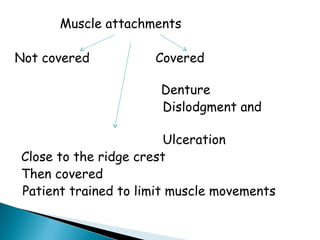
Muscle attachments
Not covered Covered
Denture
Dislodgment and
Ulceration
Close to the ridge crest
Then covered
Patient trained to limit muscle movements
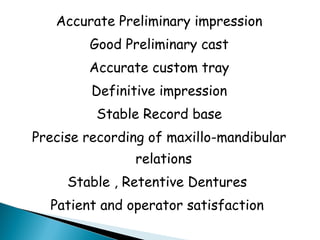
Accurate Preliminary impression
Good Preliminary cast
Accurate custom tray
Definitive impression
Stable Record base
Precise recording of maxillo-mandibular
relations
Stable , Retentive Dentures
Patient and operator satisfaction
 So it is unwise to disregard the
importance of any step in the hope
that the deficiencies will be
rectified in the later steps
Historical review
Before the middle of 18th
century
ridges painted with dye and a block of
ivory or bone was pressed on the ridge .
Marked areas were scrapped away
 Waxes – As early as 1711,bees wax were the
first used
 Plaster - 1844 by west cott ,Dwinelle Dunning
 Gutta percha - 1848,High working
temprature,stifness
 Modelling plastic - 1856 developed by
Charles stens
 Hydrocolloid materials - 1925
 First use of ZOE pastes by Ward &
Kelly -1930
 Alginate materials - 1940
 Rubber & silicone materials – more
recently
Definitions
Impression :GPT-8
A Negative likeness or copy in
reverse of the surface of an
object
An imprint of the teeth and the
teeth for the use in dentistry
According to Heartwell,
An impression is the negative form of
the teeth and/or other tissues of the
oral cavity , made in plastic material that
becomes relatively hard or set while in
contact with these tissues
Dental impression - GPT-8
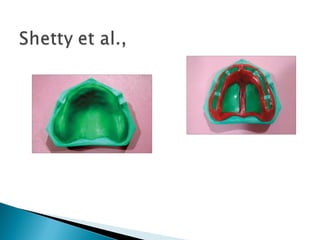
 A negative imprint of an oral
structure used to produce a positive
replica of the structure to be used as
a permanent record or in the
production of dental restoration or
prosthesis
Complete denture impression
According to heartwell
 It is a negative registration of
the entire denture
bearing ,stabilizing and border seal
areas present in the edentulous
mouth
Preliminary impression: GPT-8
 A negative likeness made for the purpose
of the diagnosis , treatment planning or
the fabrication of the tray
Final impression: GPT-8
 The impression that represents the
completion of the registration of the
surface or object.
Sectional impression:
 A negative likeness that is made in
sections
Impression technique
 A method and manner used in making
negative likeness
Impression tray
 A receptacle into which suitable
impression material is placed to make a
negative likeness
 A device that is used to carry confine and
control impression material while making
an impression
 It should be as complete as possible.
 It should be closely contacting the
tissues.
 Borders in harmony with anatomic and
physiologic limitations – Physiologic
border molding
 It should not exert pressure.
 There should be no gross surface
physical defects.
 The periphery of the impression
should be in close contact with the
resilient tissue at the height of the
vestibule.
Three M’s of successful denture
impressions
 Mold –Tray
 Method –Impression Technique
 Material Used
Impression Trays
La Vere and Freda(1976)
 Stock Trays-Extension beyond 5mm
beyond the external surface of the
residual ridges
 Customized Trays-are Individualized
Trays.
Requirements
 Rigid
 Retain shape
 Simple method of Construction
 Ease of modifying
 Smooth Edges
Materials Used
 Brass-Chrome plated
 Aluminium
 Polysterene
 Polycarbonate
 Nylon
Materials used for making impression
 Primary impression
a. Impression compound
b. Alginate
c. Waxes
 Final impression
a. Impression plaster
b. ZOE
c. Agar
d. Elastomers - regular, light body
Position of the patient and the operator
Seating of the Patient
 Upright- Occiput resting in the head rest.
 Gravity influences the position of the
Tissues.
 Patient uses dentures while in upright
position and hence tissues recorded in that
position.
If the Head bent Backwards
 Suprahyoid & Infrahyoid
Muscles get tensed
 Swallowing difficult
 Obstruction of airway
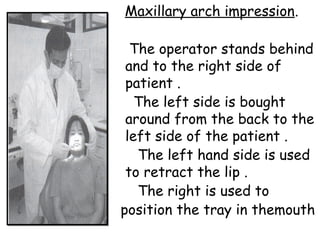
Maxillary arch impression.
The operator stands behind
and to the right side of
patient .
The left side is bought
around from the back to the
left side of the patient .
The left hand side is used
to retract the lip .
The right is used to
position the tray in themouth
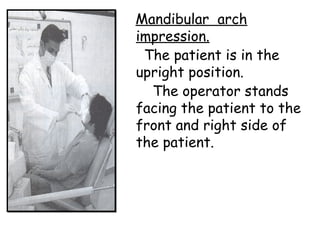
Mandibular arch
impression.
The patient is in the
upright position.
The operator stands
facing the patient to the
front and right side of
the patient.
Instruct patient the procedures prior to
impression making
 Ease of procedures
 Reduce anxiety
 Protect patients clothing
 Mouth wash before and after
 Small Napkin/Paper Towel provided
Sterilization Protocol
“Universal Precautions”
 A good impression must aid to
fulfill Muller Devan’s dictum(1952):
“The preservation of that,
which remains and not the
meticulous replacement of what is
lost”
(1) Preservation of alveolar ridges.
Impression techniques covering
maximum supporting areas and using
pressures within physiological limits of
the tissue.
Pressure in the impression technique is
reflected as pressure in the denture base
and results in soft tissue damage and
bone resorption.
(2) Retention
Retention of a denture is its
resistance to removal in a direction
opposite to that of its insertion.
Retention resists the
adhesiveness of foods, the force of
gravity and the forces associated
with the opening of the jaws
The factors of retention are:
 Physical - adhesion, cohesion,
atmospheric pressure, interfacial
surface tension etc.
 Physiological – oral and facial
musculature
 Mechanical – undercuts.
Henry A Collet (1965) -Primary
retention depends upon close
adaptation to the tissues and it is
proportional to the area covered.
(3) Stability - relationship of the denture
base to the underlying bone.
The stability of a denture is its
ability to remain securely in place when it
is subjected to horizontal movements.
 Attained by more intimate contact of
labial and buccal flanges with the labial and
buccal slopes and of the lingual flanges
with the lingual slopes of the ridge.
 Retention is the only factor of stability
that is directly related to the
impression-making phase.
 It is absolutely essential because all
other factors of stability are either
ineffective or minimal if retention is
lacking.
 Boucher – “stability requires maximum
use of all bony foundation where the
tissues are firmly attached to the bone”.
(4) Support –
Denture support is the
resistance to vertical forces of
mastication and to occlusal or
other forces applied in a
direction towards the basal seat
Maxillary and Mandibular basal
bones and their covering of the
mucosal tissue.
 Enhanced by selective placement of
pressures that are in harmony with
the resiliency of the tissues that
make up the basal seat.
5) Esthetics –
Development of the labial and
buccal borders, so that they are not
only retentive but also support the
lips.
Extent of Impressions
 Maxillary
 Residual ridges ,Tuberosities and Hamular
Notches
 Functional width and depth of Labial and
Buccal Sulci including freni
 Hard palate and Its junction with soft
palate
Mandibular Impression
 Residual ridges and retromolar pads
 Functional labial and Buccal sulci
Frena + External Oblique ridge
 Lingual sulci , Lingual Freni,
Mylohyoid ridge , retro mylohyiod
area
 According to De Van ,the difficulty in
making edentulous impression is due to
varying tissue displacibility
 Because of these variations impressions
must selectively place pressure on the
mucous membrane and the bones-
compatible with the histological tolerance
 And hence the origin of theories
 According to levin:Techniques can be classified
into 4 categories
 1.Amount of Pressure used
 …Mucocompressive ,Mucostatic and Selective
pressure
2.Open and Closed
3.Hand manipulations or Functional movement
4.Type of Tray

Amount of pressure used-
Based on theories of impression
 Pressure-Mucocompressive
Technique by Greene brother
 Minimal Pressure Technique-Page
 Selective Pressure Technique-
Boucher
Based on the technique
 Open mouth technique
 Closed mouth technique
Also
 Hand manipulations
 Functional movements
Based on the type of the tray
 Stock tray impression
 Custom tray impression
Based on the purpose of impression
on the purpose of impression
 Diagnostic impression
 Primary impression
 Secondary impression
Amount of pressure used
1.DEFINITE PRESSURE /
MUCOCOMPRESSIVE/Mucodisplaciv
e theory
 By GREEN IN 1896
 The main objective was to attain better
retention of the denture & this is
achieved by positive peripheral seal.
 Displacing the soft tissues while making
impression will result in better
distribution of occlusal forces to the
basal seat.
 It is logical to make impressions that
would press the tissues in the same
manner as chewing forces, thus ensuring
contact during chewing.
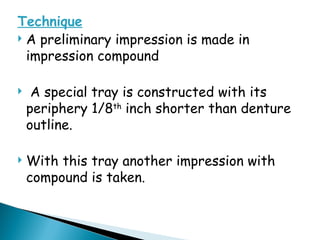
Technique
 A preliminary impression is made in
impression compound
 A special tray is constructed with its
periphery 1/8th
inch shorter than denture
outline.
 With this tray another impression with
compound is taken.
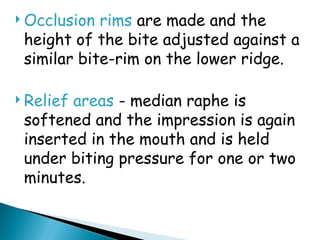
 Occlusion rims are made and the
height of the bite adjusted against a
similar bite-rim on the lower ridge.
 Relief areas - median raphe is
softened and the impression is again
inserted in the mouth and is held
under biting pressure for one or two
minutes.
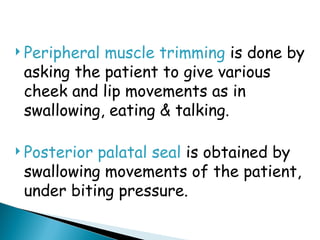
 Peripheral muscle trimming is done by
asking the patient to give various
cheek and lip movements as in
swallowing, eating & talking.
 Posterior palatal seal is obtained by
swallowing movements of the patient,
under biting pressure.
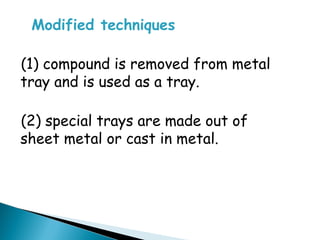
Modified techniques
(1) compound is removed from metal
tray and is used as a tray.
(2) special trays are made out of
sheet metal or cast in metal.
Disadvantages
 Displaced tissues, attempts to return
to its normal unstrained position and
so will move the denture out of its
intended position, resulting in
deflective occlusal contacts.
 Dentures will fit well during mastication
only a short period, but will not be as
closely adapted to the tissues, when the
patient is at rest. Tissues so distorted
tend to rebound.
 Advocates -were not always able to
obtain desired pressure, but tend to
create excessive pressure.
 This often resulted in good initial
retention but eventual cut off of
blood supply, tissue breakdown & bone
resorption.
 Thus the retention obtained is
transient & harmful.
 This technique does not allow for
adequate muscle trimming of the
periphery.
 So impressions are over extended
and must be arbitrarily trimmed
 According to Kawabe’s
 Indication for Mucocompressive Technique
 Ridge Shape –Flat
 Mucosa Thickness-Uneven
 Bone Surface-Smooth
 This technique does not allow for adequate
muscle trimming of periphery , so impression
are overextended and must be arbitrarily
trimmed
 “Mucostatic¨ was coined by Dr.
Carrol W. Jones,
 This principle was proposed by Mr.
Harry L. Page, an engineer, 1938.
 Mucostatic was presented as a
principle not a technique
 It follows the law of hydrostatics
 A "mucostatic impression"
“Absolute accurate negative replica
of the ridge tissues in their normal
passive form”.
 PAGE states “ interfacial surface
tension operates by virtue of a thin
fluid film between two intimately
contacted objects”
 Major factor in the retention of the
denture.
 Addison (1944) “atmospheric
pressure have nothing to do with
denture retention as it’s always
present and we adapt to it, exerting
a physiological force equal to the
pressure of the atmosphere
Mr. Page in 1946, he stated that
 “All soft tissues are chiefly fluid,
since 80% or more of the tissues are
composed of water and so behave in a
continued state
 Pascal’s law – “Pressure on a confined
liquid will be transmitted equally
throughout the liquid in all
directions.”
 Since the soft tissues are confined under a
denture, any pressure applied will be
transmitted undiminished in all directions.
 So, when denture base maintains perfect
contact with the tissues, retention is
achieved without difficulty.
 The depth, detail and outline form of flange
has no retentive value.
 Dentures made form mucostatic
impressions will have a better
prognosis than those made from
mucocompressive impressions
which will subject osseous tissues
to continuous stress.
Mucostatic school
“Soft tissue should be registered in
unstrained rest position – any other
position will compel tissue to regain
its rest position- leading to
dislodgment of the denture.”
Wilson’s rule of denture coverage
remains valid as when first presented in
1920.
“All foundation area possible should be
covered so long as the base does no
interfere with normal muscle function”.
 According to this concept interfacial
surface tension, the only major force in
denture retention acts best when the
surfaces are displaced at right angles to
each other.
 The force is diminished as it approaches a
parallel plane.
Merits
 Minimizes pressure while making
impressions & thereby maintaining
tissues in healthy conditions
 It is useful in sharp & flabby
ridges.
 Mucosal topography is not static over 24 hrs
period.
 There is difference between mucosal contours
just after raising in the morning and that exists
after 12 hrs in upright position [Stephen et. al
1966]
 so all details achieved in the impression would
be altered by the time denture was completed.
 Care taken to obtain minute details
of mucosal surface is worthless due
to dimensional changes that occur in
impression material and cast
 Factors of retention like atmospheric
pressure & orofacial musculature was
completely avoided.
It overlooked the fundamental
rules laid by FISH that
 Denture should extend maximum
with in the functional limits,
 Periphery should rest in soft tissue
at every given point ,
 There must neither be under
extension nor over extension.
 Short flanges affect stability and
retention.
 It is difficult to get an impression with out
even a thin film of saliva.
 Since stress from these dentures will not
be distributed as broadly over the basal
seal, tissue health and retention may be
compromised.
Minimal-pressure dentures gives
inadequate support to the face.
 As the denture would be small in a patient
with a severely resorbed maxillary ridge,
it would be necessary to position the
teeth over the crest of the ridge.
 Thus supporters of this theory failed to
realize, the biology of the tissues as an
important criterion.
 Advantage
 Minimizes pressure while making impression
and thereby maintaining tissues in healthy
condition.
 Avoidance of continous osseous stress as in
case of Mucocompressive technique
 Disdvantage
 Less retention because of Less ridge coverage and Border seal
 Reduced coverage,,..so no distribution of Forces over the
Basal seat area
 Acccording Fish: the form of the mucostatic denture
minimized the retentive role of the musculature
 The lack of Border seal also permits the food to slip beneath
the denture
 The shorter flanges may reduce support for the face which
can affect the aesthetics
 Very difficult to treat the patient with poor residual
ridge(Resorbed)

 Indication
 According to Kawabe
 Ridge shape-U shape
 Mucosa thickness-even
 Surface of the alveolar Bone-Smooth

 Advocated by Boucher,
 It combines the principles of both
pressure and minimal pressure
techniques.
 Indication
 According to Kawabe
 Ridge shape-V shape
 Mucosa thickness-Flabby
 Surface of the alveolar Bone-Rough Sharp
The philosophy of the selective pressure
technique
 Certain areas of the maxilla and mandible,
are by nature better adapted for
withstanding extra loads from the forces
of mastication.
 These tissues can be recorded under
slight placement of pressure while other
tissues must be recorded at rest.
Primary stress bearing areas of the
 Maxilla : crest of alveolar ridge and
horizontal plate of palatine bone,
 Mandible: is the buccal shelf area.
Secondary stress bearing areas of
 Maxilla : rugae area and all ridge slopes
 Mandible : retromolar pad area, and all
ridge slopes
 The retromolar pad area is an area
of support and so if the denture is
not extended over this area, a
typical boat-shaped resorption is
caused in the area.
RELIEF AREAS
 Maxilla- Incisive papilla,
midpalatine suture, tori.
 Mandible- Crest of the residual
ridge.
 Since this technique is based on
principle of regarding both the
biological as well as the physical
factors concerning impression
procedure, it is widely preferred in
the cases of well-formed healthy
ridges.
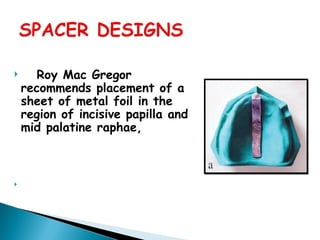
 Roy Mac Gregor
recommends placement of a
sheet of metal foil in the
region of incisive papilla and
mid palatine raphae,

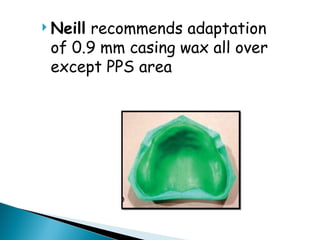
 Neill recommends adaptation
of 0.9 mm casing wax all over
except PPS area
 Heartwell
two techniques for achieving
selective pressure for maxillary
impressions
1) By scraping compound primary
impression
2) By fabrication of custom tray with
5 relief holes
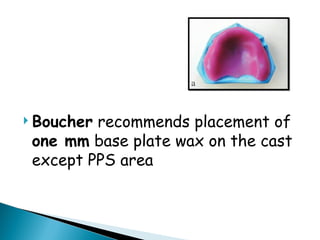
 Boucher recommends placement of
one mm base plate wax on the cast
except PPS area
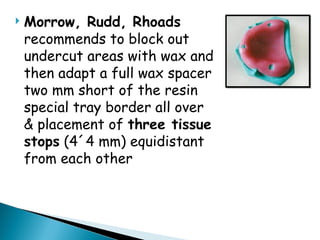
 Morrow, Rudd, Rhoads
recommends to block out
undercut areas with wax and
then adapt a full wax spacer
two mm short of the resin
special tray border all over
& placement of three tissue
stops (4´4 mm) equidistant
from each other
 Halperin recommends the 'Philosophy of the
custom impression tray with peripheral relief'.
 slopes of the ridges are considered to be the
primary stress bearing areas and therefore these
areas are functionally loaded with compound
during making of the final impression.
 there is no need to make a wash
secondary impression as he
considers the tray surface and the
border-moulded areas as the final
impression surface
 (1) Cannot be used in flabby ridge
cases
 (2) Opponents of this technique feel
that it is impossible to record some
areas with different pressure from
that applied to other areas.
Different techniques
 The patient’s mouth is partly open
and the tray is held by the dentist.
Advantage
 Operator can see whether muscle
trimming is done properly.
 The rationale- The supporting tissues
are recorded in a functional
relationship.
 The functional movements include
talking, sucking, swallowing and
eating.
 Vertical Dimension is established
before making the impression.
 Jaw relation either tentative or Final is usually
also completed at this time
 First material-Impression compound
 Second material-Flow at mouth temprature
 Recentely soft liner has been advocated
Thus according to Stanley P. Freeman,
amount of tissue compression is like
that in function.
Advantages:
 1. Interference of tray-handles and
operator’s fingers is eliminated.
 2.Time saving by obtaining the jaw relation and the
posibility of Border moulding without interferance
of Tray handle and operators fingers
 Mac milllan stated that these impression technique
are the only ones capable of adequately trimming
the lingual borders of the lower
 This is based on the belief that tongue movements
are more forceful when the teeth are together than
when the mouth is opened and tongue is
protruded
Disadvantages:
 Appointment time fatiguing of the dentist
and patient.
 Tendency for over extension and under
extension.
 Release of pressure of occlusion may
cause rebounding of denture
 Contraindicated in presence of
considerable amount of movable tissue.
 The contour of the denture borders
may be obtained by the dentist with
use of manual manipulations of the
lips and cheeks within functional
limits.
 Patient’s tongue movements record
the lingual borders.
 The denture borders may also be
formed by having the patient make
“Functions” or ”Physiological”
movements such as swallowing,
sucking, grinning, licking. Etc.
‘DYNAMIC IMPRESSION‘
Chase and Tryde et al.
Functional or physiological method of
making impressions
TECHNIQUE
 Impression materials that continue to
flow over an extended period of time
such as tissue conditioners or wax.
 This material is placed in the patient’s
transitional denture and the patient
normal activities molds the borders
Disadvantages
 Cannot be used routinely
 Not all patients truly move the
impression materials as needed,
some may use extreme
movement ,others less
Type of impression TrayBased on the type
of the tray
 Stock tray impression:
 Good impression can be obtained only if the
rides are good…Difficult if the ridges are
poorer ..severely resorbed
 Custom tray impression
 Always better
 Natural dentition lies in this zone,
and this is where the artificial teeth
should be positioned.
 This area of minimal conflict may be
located by using the neutral zone
technique.
 Techniques are modified in
compromised conditions to achieve as
much retention and stability as
possible within limits.
 Hyperactive gag reflex compromise the
quality of treatment
 As Conny D.J stated the patients problem
whether iatrogenic, physiologic,
psychological, anatomic or organic
disturbances are identified and treated
before making the impression.
 Prosthodontic Management –
 excess thickness, over extensions or
improper post dam is corrected.
 Impression materials with shorter
setting time can be used.
Limited opening of mouth following
 Radical surgery
 Sequelae to facial burns
 Scleroderma
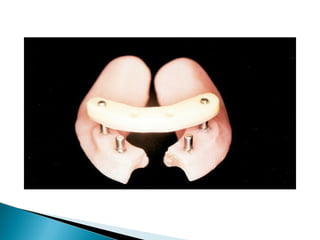
 Walter described a technique with the use of
sectional stock trays. Impressions of one side of
the jaw was made one at a time and the two halves
were joined and cast was poured
 Cura etal., describes the technique to fabricate
the maxillary and mandibular sectional trays and
folding maxillary complete denture for the limited
mouth opening.
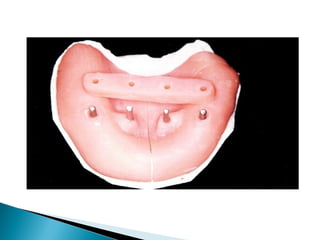
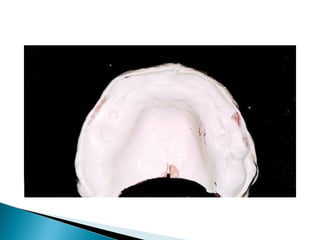
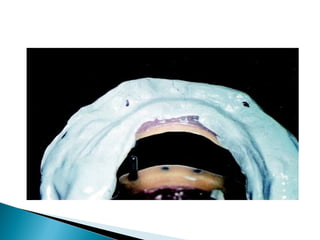
 A flabby ridge is one, which becomes
displaceable due to fibrous tissue deposition.
 Most frequently seen in the upper anterior
region.
 Usually occurs when natural teeth oppose an
edentulous ridge.
 A flabby ridge causes instability of the
denture.
Methods to overcome this problem
SURGERY
This involves removal of the fibrous
tissue to leave a firm ridge.
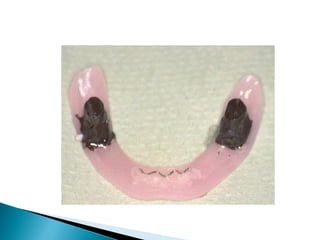
 A primary impression is taken in alginate loaded in
a stock tray.
 The impression is then poured and a special tray is
constructed on the model.
 The special tray is close fitting and has a hole or
"window" over the area corresponding to the
flabby ridge.
 An impression is taken in impression paste
(mucodisplacive).
 Once this has set it is left in place
and impression plaster (mucostatic) is
painted over the flabby ridge and
allowed to set and removed as one
impression.
 The impression is removed as one,
cast and the denture constructed on
the resulting model.
 In such situations ,lack of ideal
amount of supporting structures
decreases and the encroachment of
the surrounding mobile tissues into
the denture border reduces both
stability and retention
 Lott and Levin advocated -making impressions
of the soft structures of the mouth adjacent
to the buccal ,lingual ,labial and palatal
surfaces and incorporating the resulting
extensions or flanges in the denture
 Patient is asked to forcefully perform
functions of swallowing etc to give a border
extensions which cover maximum surface area
 Tryde in 1965 used the dynamic
impression method on the same principle
to obtain the sublingual flange
 This sublingual flange extension
increases the tissue surface
without interfering with the
functions of mastication ,
deglutition and phonation
 The active incorporating of tongue
activity also stabilizes the denture
Conclusion
 Impression visits provide us with the
opportunity to confirm the Diagnosis
and determine the degree of Patient
Compliance
 Flawed impressions account for the
majority of the Denture problems
 Though there are many techniques/
procedures available for the
dentist to make a ideal impression,
the procedures followed should be
based on sound biological principles
depending on patients oral and
systemic conditions
 Border molding is the shaping of the
peripheries of an impression material by the
manipulation or action of the tissues
adjacent to the borders of the impression .
◦ SINGLE STEP OR SIMULTANEOUS BORDER
MOULDING
◦ INCREMENTAL OR SECTIONAL BORDER
MOULDING
Materials used are
 Modelling compound sticks
 Autopolymerising acrylic resins
 Tissue conditioning materials [ modified resins]
 Metallic pastes & elastomeric materials
 Impression waxes
 In the upper tray, escape holes (1-2mm in
diameter) spaced 1cm apart is placed along the
median palatine raphe, beginning at the incisive
fossa and ending just anterior to the PPS area.
 In the lower tray, escape holes spaced ½ inch
apart are placed along the crest of the ridge.
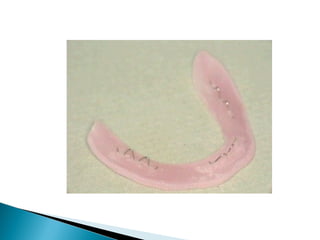
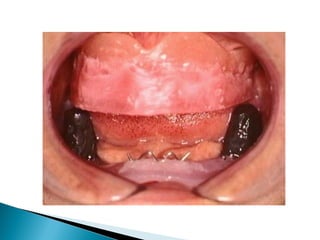
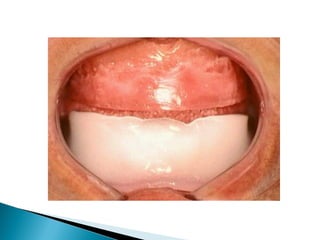
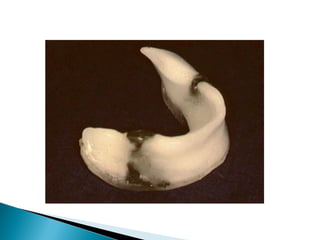
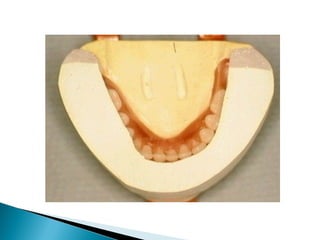
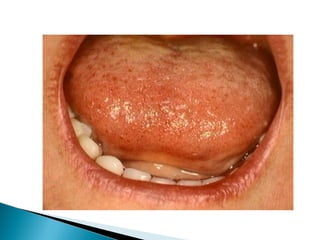
 Fibrous (unemployed) posterior
mandibular ridge:
 Flat (atrophic) mandibular ridge
covered with atrophic mucosa:

impression techniques in complete denture

  • 1.
  • 3.
    Contents  Introduction  Definitions Historical review  Impression theories  Impression techniques  Impression techniques in compromised situations  Conclusion
  • 4.
     Good impressionsare basic needs of a contented denture wearer.  Impression making is the preliminary step in the construction of prosthesis  The success of a prosthesis depends on the quality, accuracy and adequacy of the impression
  • 5.
     According toSears, We do not TAKE impressions as we do on a mannequin : rather we MAKE impressions to accommodate the tissues with their varying degrees of displaceability and form.
  • 6.
     To makean impression ,we measure with our eyes and figures the anatomic limits in the oral cavity and the impression material is shaped and molded into a negative likeness of supporting areas.  The impressions should cover the maximum possible area –so force/mm sq reduces
  • 7.
    Muscle attachments Not coveredCovered Denture Dislodgment and Ulceration Close to the ridge crest Then covered Patient trained to limit muscle movements
  • 8.
    Accurate Preliminary impression GoodPreliminary cast Accurate custom tray Definitive impression Stable Record base Precise recording of maxillo-mandibular relations Stable , Retentive Dentures Patient and operator satisfaction
  • 9.
     So itis unwise to disregard the importance of any step in the hope that the deficiencies will be rectified in the later steps
  • 10.
    Historical review Before themiddle of 18th century ridges painted with dye and a block of ivory or bone was pressed on the ridge . Marked areas were scrapped away  Waxes – As early as 1711,bees wax were the first used  Plaster - 1844 by west cott ,Dwinelle Dunning  Gutta percha - 1848,High working temprature,stifness
  • 11.
     Modelling plastic- 1856 developed by Charles stens  Hydrocolloid materials - 1925  First use of ZOE pastes by Ward & Kelly -1930  Alginate materials - 1940  Rubber & silicone materials – more recently
  • 12.
    Definitions Impression :GPT-8 A Negativelikeness or copy in reverse of the surface of an object An imprint of the teeth and the teeth for the use in dentistry
  • 13.
    According to Heartwell, Animpression is the negative form of the teeth and/or other tissues of the oral cavity , made in plastic material that becomes relatively hard or set while in contact with these tissues
  • 14.
    Dental impression -GPT-8  A negative imprint of an oral structure used to produce a positive replica of the structure to be used as a permanent record or in the production of dental restoration or prosthesis
  • 15.
    Complete denture impression Accordingto heartwell  It is a negative registration of the entire denture bearing ,stabilizing and border seal areas present in the edentulous mouth
  • 16.
    Preliminary impression: GPT-8 A negative likeness made for the purpose of the diagnosis , treatment planning or the fabrication of the tray Final impression: GPT-8  The impression that represents the completion of the registration of the surface or object. Sectional impression:  A negative likeness that is made in sections
  • 17.
    Impression technique  Amethod and manner used in making negative likeness Impression tray  A receptacle into which suitable impression material is placed to make a negative likeness  A device that is used to carry confine and control impression material while making an impression
  • 18.
     It shouldbe as complete as possible.  It should be closely contacting the tissues.  Borders in harmony with anatomic and physiologic limitations – Physiologic border molding
  • 19.
     It shouldnot exert pressure.  There should be no gross surface physical defects.  The periphery of the impression should be in close contact with the resilient tissue at the height of the vestibule.
  • 20.
    Three M’s ofsuccessful denture impressions  Mold –Tray  Method –Impression Technique  Material Used
  • 21.
    Impression Trays La Vereand Freda(1976)  Stock Trays-Extension beyond 5mm beyond the external surface of the residual ridges  Customized Trays-are Individualized Trays.
  • 22.
    Requirements  Rigid  Retainshape  Simple method of Construction  Ease of modifying  Smooth Edges
  • 23.
    Materials Used  Brass-Chromeplated  Aluminium  Polysterene  Polycarbonate  Nylon
  • 24.
    Materials used formaking impression  Primary impression a. Impression compound b. Alginate c. Waxes  Final impression a. Impression plaster b. ZOE c. Agar d. Elastomers - regular, light body
  • 25.
    Position of thepatient and the operator Seating of the Patient  Upright- Occiput resting in the head rest.  Gravity influences the position of the Tissues.  Patient uses dentures while in upright position and hence tissues recorded in that position.
  • 26.
    If the Headbent Backwards  Suprahyoid & Infrahyoid Muscles get tensed  Swallowing difficult  Obstruction of airway
  • 27.
    Maxillary arch impression. Theoperator stands behind and to the right side of patient . The left side is bought around from the back to the left side of the patient . The left hand side is used to retract the lip . The right is used to position the tray in themouth
  • 28.
    Mandibular arch impression. The patientis in the upright position. The operator stands facing the patient to the front and right side of the patient.
  • 29.
    Instruct patient theprocedures prior to impression making  Ease of procedures  Reduce anxiety  Protect patients clothing  Mouth wash before and after  Small Napkin/Paper Towel provided Sterilization Protocol “Universal Precautions”
  • 30.
     A goodimpression must aid to fulfill Muller Devan’s dictum(1952): “The preservation of that, which remains and not the meticulous replacement of what is lost”
  • 31.
    (1) Preservation ofalveolar ridges. Impression techniques covering maximum supporting areas and using pressures within physiological limits of the tissue. Pressure in the impression technique is reflected as pressure in the denture base and results in soft tissue damage and bone resorption.
  • 32.
    (2) Retention Retention ofa denture is its resistance to removal in a direction opposite to that of its insertion. Retention resists the adhesiveness of foods, the force of gravity and the forces associated with the opening of the jaws
  • 33.
    The factors ofretention are:  Physical - adhesion, cohesion, atmospheric pressure, interfacial surface tension etc.  Physiological – oral and facial musculature  Mechanical – undercuts.
  • 34.
    Henry A Collet(1965) -Primary retention depends upon close adaptation to the tissues and it is proportional to the area covered.
  • 35.
    (3) Stability -relationship of the denture base to the underlying bone. The stability of a denture is its ability to remain securely in place when it is subjected to horizontal movements.  Attained by more intimate contact of labial and buccal flanges with the labial and buccal slopes and of the lingual flanges with the lingual slopes of the ridge.
  • 36.
     Retention isthe only factor of stability that is directly related to the impression-making phase.  It is absolutely essential because all other factors of stability are either ineffective or minimal if retention is lacking.  Boucher – “stability requires maximum use of all bony foundation where the tissues are firmly attached to the bone”.
  • 37.
    (4) Support – Denturesupport is the resistance to vertical forces of mastication and to occlusal or other forces applied in a direction towards the basal seat
  • 38.
    Maxillary and Mandibularbasal bones and their covering of the mucosal tissue.  Enhanced by selective placement of pressures that are in harmony with the resiliency of the tissues that make up the basal seat.
  • 39.
    5) Esthetics – Developmentof the labial and buccal borders, so that they are not only retentive but also support the lips.
  • 40.
    Extent of Impressions Maxillary  Residual ridges ,Tuberosities and Hamular Notches  Functional width and depth of Labial and Buccal Sulci including freni  Hard palate and Its junction with soft palate
  • 41.
    Mandibular Impression  Residualridges and retromolar pads  Functional labial and Buccal sulci Frena + External Oblique ridge  Lingual sulci , Lingual Freni, Mylohyoid ridge , retro mylohyiod area
  • 42.
     According toDe Van ,the difficulty in making edentulous impression is due to varying tissue displacibility  Because of these variations impressions must selectively place pressure on the mucous membrane and the bones- compatible with the histological tolerance  And hence the origin of theories
  • 43.
     According tolevin:Techniques can be classified into 4 categories  1.Amount of Pressure used  …Mucocompressive ,Mucostatic and Selective pressure 2.Open and Closed 3.Hand manipulations or Functional movement 4.Type of Tray 
  • 45.
    Amount of pressureused- Based on theories of impression  Pressure-Mucocompressive Technique by Greene brother  Minimal Pressure Technique-Page  Selective Pressure Technique- Boucher
  • 46.
    Based on thetechnique  Open mouth technique  Closed mouth technique Also  Hand manipulations  Functional movements
  • 47.
    Based on thetype of the tray  Stock tray impression  Custom tray impression Based on the purpose of impression on the purpose of impression  Diagnostic impression  Primary impression  Secondary impression
  • 48.
    Amount of pressureused 1.DEFINITE PRESSURE / MUCOCOMPRESSIVE/Mucodisplaciv e theory  By GREEN IN 1896  The main objective was to attain better retention of the denture & this is achieved by positive peripheral seal.
  • 49.
     Displacing thesoft tissues while making impression will result in better distribution of occlusal forces to the basal seat.  It is logical to make impressions that would press the tissues in the same manner as chewing forces, thus ensuring contact during chewing.
  • 50.
    Technique  A preliminaryimpression is made in impression compound  A special tray is constructed with its periphery 1/8th inch shorter than denture outline.  With this tray another impression with compound is taken.
  • 51.
     Occlusion rimsare made and the height of the bite adjusted against a similar bite-rim on the lower ridge.  Relief areas - median raphe is softened and the impression is again inserted in the mouth and is held under biting pressure for one or two minutes.
  • 52.
     Peripheral muscletrimming is done by asking the patient to give various cheek and lip movements as in swallowing, eating & talking.  Posterior palatal seal is obtained by swallowing movements of the patient, under biting pressure.
  • 53.
    Modified techniques (1) compoundis removed from metal tray and is used as a tray. (2) special trays are made out of sheet metal or cast in metal.
  • 54.
    Disadvantages  Displaced tissues,attempts to return to its normal unstrained position and so will move the denture out of its intended position, resulting in deflective occlusal contacts.
  • 55.
     Dentures willfit well during mastication only a short period, but will not be as closely adapted to the tissues, when the patient is at rest. Tissues so distorted tend to rebound.
  • 56.
     Advocates -werenot always able to obtain desired pressure, but tend to create excessive pressure.  This often resulted in good initial retention but eventual cut off of blood supply, tissue breakdown & bone resorption.  Thus the retention obtained is transient & harmful.
  • 57.
     This techniquedoes not allow for adequate muscle trimming of the periphery.  So impressions are over extended and must be arbitrarily trimmed
  • 58.
     According toKawabe’s  Indication for Mucocompressive Technique  Ridge Shape –Flat  Mucosa Thickness-Uneven  Bone Surface-Smooth  This technique does not allow for adequate muscle trimming of periphery , so impression are overextended and must be arbitrarily trimmed
  • 59.
     “Mucostatic¨ wascoined by Dr. Carrol W. Jones,  This principle was proposed by Mr. Harry L. Page, an engineer, 1938.  Mucostatic was presented as a principle not a technique
  • 60.
     It followsthe law of hydrostatics  A "mucostatic impression" “Absolute accurate negative replica of the ridge tissues in their normal passive form”.
  • 61.
     PAGE states“ interfacial surface tension operates by virtue of a thin fluid film between two intimately contacted objects”  Major factor in the retention of the denture.
  • 62.
     Addison (1944)“atmospheric pressure have nothing to do with denture retention as it’s always present and we adapt to it, exerting a physiological force equal to the pressure of the atmosphere
  • 63.
    Mr. Page in1946, he stated that  “All soft tissues are chiefly fluid, since 80% or more of the tissues are composed of water and so behave in a continued state  Pascal’s law – “Pressure on a confined liquid will be transmitted equally throughout the liquid in all directions.”
  • 64.
     Since thesoft tissues are confined under a denture, any pressure applied will be transmitted undiminished in all directions.  So, when denture base maintains perfect contact with the tissues, retention is achieved without difficulty.  The depth, detail and outline form of flange has no retentive value.
  • 65.
     Dentures madeform mucostatic impressions will have a better prognosis than those made from mucocompressive impressions which will subject osseous tissues to continuous stress.
  • 66.
    Mucostatic school “Soft tissueshould be registered in unstrained rest position – any other position will compel tissue to regain its rest position- leading to dislodgment of the denture.”
  • 67.
    Wilson’s rule ofdenture coverage remains valid as when first presented in 1920. “All foundation area possible should be covered so long as the base does no interfere with normal muscle function”.
  • 68.
     According tothis concept interfacial surface tension, the only major force in denture retention acts best when the surfaces are displaced at right angles to each other.  The force is diminished as it approaches a parallel plane.
  • 69.
    Merits  Minimizes pressurewhile making impressions & thereby maintaining tissues in healthy conditions  It is useful in sharp & flabby ridges.
  • 70.
     Mucosal topographyis not static over 24 hrs period.  There is difference between mucosal contours just after raising in the morning and that exists after 12 hrs in upright position [Stephen et. al 1966]  so all details achieved in the impression would be altered by the time denture was completed.
  • 71.
     Care takento obtain minute details of mucosal surface is worthless due to dimensional changes that occur in impression material and cast  Factors of retention like atmospheric pressure & orofacial musculature was completely avoided.
  • 72.
    It overlooked thefundamental rules laid by FISH that  Denture should extend maximum with in the functional limits,  Periphery should rest in soft tissue at every given point ,  There must neither be under extension nor over extension.
  • 73.
     Short flangesaffect stability and retention.  It is difficult to get an impression with out even a thin film of saliva.  Since stress from these dentures will not be distributed as broadly over the basal seal, tissue health and retention may be compromised.
  • 74.
    Minimal-pressure dentures gives inadequatesupport to the face.  As the denture would be small in a patient with a severely resorbed maxillary ridge, it would be necessary to position the teeth over the crest of the ridge.  Thus supporters of this theory failed to realize, the biology of the tissues as an important criterion.
  • 75.
     Advantage  Minimizespressure while making impression and thereby maintaining tissues in healthy condition.  Avoidance of continous osseous stress as in case of Mucocompressive technique
  • 76.
     Disdvantage  Lessretention because of Less ridge coverage and Border seal  Reduced coverage,,..so no distribution of Forces over the Basal seat area  Acccording Fish: the form of the mucostatic denture minimized the retentive role of the musculature  The lack of Border seal also permits the food to slip beneath the denture  The shorter flanges may reduce support for the face which can affect the aesthetics  Very difficult to treat the patient with poor residual ridge(Resorbed) 
  • 77.
     Indication  Accordingto Kawabe  Ridge shape-U shape  Mucosa thickness-even  Surface of the alveolar Bone-Smooth 
  • 78.
     Advocated byBoucher,  It combines the principles of both pressure and minimal pressure techniques.
  • 79.
     Indication  Accordingto Kawabe  Ridge shape-V shape  Mucosa thickness-Flabby  Surface of the alveolar Bone-Rough Sharp
  • 80.
    The philosophy ofthe selective pressure technique  Certain areas of the maxilla and mandible, are by nature better adapted for withstanding extra loads from the forces of mastication.  These tissues can be recorded under slight placement of pressure while other tissues must be recorded at rest.
  • 81.
    Primary stress bearingareas of the  Maxilla : crest of alveolar ridge and horizontal plate of palatine bone,  Mandible: is the buccal shelf area. Secondary stress bearing areas of  Maxilla : rugae area and all ridge slopes  Mandible : retromolar pad area, and all ridge slopes
  • 82.
     The retromolarpad area is an area of support and so if the denture is not extended over this area, a typical boat-shaped resorption is caused in the area.
  • 83.
    RELIEF AREAS  Maxilla-Incisive papilla, midpalatine suture, tori.  Mandible- Crest of the residual ridge.
  • 84.
     Since thistechnique is based on principle of regarding both the biological as well as the physical factors concerning impression procedure, it is widely preferred in the cases of well-formed healthy ridges.
  • 85.
     Roy MacGregor recommends placement of a sheet of metal foil in the region of incisive papilla and mid palatine raphae, 
  • 86.
     Neill recommendsadaptation of 0.9 mm casing wax all over except PPS area
  • 87.
     Heartwell two techniquesfor achieving selective pressure for maxillary impressions 1) By scraping compound primary impression 2) By fabrication of custom tray with 5 relief holes
  • 88.
     Boucher recommendsplacement of one mm base plate wax on the cast except PPS area
  • 89.
     Morrow, Rudd,Rhoads recommends to block out undercut areas with wax and then adapt a full wax spacer two mm short of the resin special tray border all over & placement of three tissue stops (4´4 mm) equidistant from each other
  • 90.
     Halperin recommendsthe 'Philosophy of the custom impression tray with peripheral relief'.  slopes of the ridges are considered to be the primary stress bearing areas and therefore these areas are functionally loaded with compound during making of the final impression.
  • 91.
     there isno need to make a wash secondary impression as he considers the tray surface and the border-moulded areas as the final impression surface
  • 93.
     (1) Cannotbe used in flabby ridge cases  (2) Opponents of this technique feel that it is impossible to record some areas with different pressure from that applied to other areas.
  • 94.
  • 95.
     The patient’smouth is partly open and the tray is held by the dentist. Advantage  Operator can see whether muscle trimming is done properly.
  • 96.
     The rationale-The supporting tissues are recorded in a functional relationship.  The functional movements include talking, sucking, swallowing and eating.  Vertical Dimension is established before making the impression.
  • 97.
     Jaw relationeither tentative or Final is usually also completed at this time  First material-Impression compound  Second material-Flow at mouth temprature  Recentely soft liner has been advocated
  • 98.
    Thus according toStanley P. Freeman, amount of tissue compression is like that in function. Advantages:  1. Interference of tray-handles and operator’s fingers is eliminated.
  • 99.
     2.Time savingby obtaining the jaw relation and the posibility of Border moulding without interferance of Tray handle and operators fingers  Mac milllan stated that these impression technique are the only ones capable of adequately trimming the lingual borders of the lower  This is based on the belief that tongue movements are more forceful when the teeth are together than when the mouth is opened and tongue is protruded
  • 100.
    Disadvantages:  Appointment timefatiguing of the dentist and patient.  Tendency for over extension and under extension.  Release of pressure of occlusion may cause rebounding of denture  Contraindicated in presence of considerable amount of movable tissue.
  • 101.
     The contourof the denture borders may be obtained by the dentist with use of manual manipulations of the lips and cheeks within functional limits.  Patient’s tongue movements record the lingual borders.
  • 102.
     The dentureborders may also be formed by having the patient make “Functions” or ”Physiological” movements such as swallowing, sucking, grinning, licking. Etc.
  • 103.
    ‘DYNAMIC IMPRESSION‘ Chase andTryde et al. Functional or physiological method of making impressions
  • 104.
    TECHNIQUE  Impression materialsthat continue to flow over an extended period of time such as tissue conditioners or wax.  This material is placed in the patient’s transitional denture and the patient normal activities molds the borders
  • 105.
    Disadvantages  Cannot beused routinely  Not all patients truly move the impression materials as needed, some may use extreme movement ,others less
  • 106.
    Type of impressionTrayBased on the type of the tray  Stock tray impression:  Good impression can be obtained only if the rides are good…Difficult if the ridges are poorer ..severely resorbed  Custom tray impression  Always better
  • 107.
     Natural dentitionlies in this zone, and this is where the artificial teeth should be positioned.  This area of minimal conflict may be located by using the neutral zone technique.
  • 115.
     Techniques aremodified in compromised conditions to achieve as much retention and stability as possible within limits.
  • 116.
     Hyperactive gagreflex compromise the quality of treatment  As Conny D.J stated the patients problem whether iatrogenic, physiologic, psychological, anatomic or organic disturbances are identified and treated before making the impression.
  • 117.
     Prosthodontic Management–  excess thickness, over extensions or improper post dam is corrected.  Impression materials with shorter setting time can be used.
  • 118.
    Limited opening ofmouth following  Radical surgery  Sequelae to facial burns  Scleroderma
  • 119.
     Walter describeda technique with the use of sectional stock trays. Impressions of one side of the jaw was made one at a time and the two halves were joined and cast was poured  Cura etal., describes the technique to fabricate the maxillary and mandibular sectional trays and folding maxillary complete denture for the limited mouth opening.
  • 124.
     A flabbyridge is one, which becomes displaceable due to fibrous tissue deposition.  Most frequently seen in the upper anterior region.  Usually occurs when natural teeth oppose an edentulous ridge.  A flabby ridge causes instability of the denture.
  • 125.
    Methods to overcomethis problem SURGERY This involves removal of the fibrous tissue to leave a firm ridge.
  • 126.
     A primaryimpression is taken in alginate loaded in a stock tray.  The impression is then poured and a special tray is constructed on the model.  The special tray is close fitting and has a hole or "window" over the area corresponding to the flabby ridge.  An impression is taken in impression paste (mucodisplacive).
  • 127.
     Once thishas set it is left in place and impression plaster (mucostatic) is painted over the flabby ridge and allowed to set and removed as one impression.  The impression is removed as one, cast and the denture constructed on the resulting model.
  • 128.
     In suchsituations ,lack of ideal amount of supporting structures decreases and the encroachment of the surrounding mobile tissues into the denture border reduces both stability and retention
  • 129.
     Lott andLevin advocated -making impressions of the soft structures of the mouth adjacent to the buccal ,lingual ,labial and palatal surfaces and incorporating the resulting extensions or flanges in the denture  Patient is asked to forcefully perform functions of swallowing etc to give a border extensions which cover maximum surface area
  • 130.
     Tryde in1965 used the dynamic impression method on the same principle to obtain the sublingual flange
  • 131.
     This sublingualflange extension increases the tissue surface without interfering with the functions of mastication , deglutition and phonation  The active incorporating of tongue activity also stabilizes the denture
  • 132.
    Conclusion  Impression visitsprovide us with the opportunity to confirm the Diagnosis and determine the degree of Patient Compliance  Flawed impressions account for the majority of the Denture problems
  • 133.
     Though thereare many techniques/ procedures available for the dentist to make a ideal impression, the procedures followed should be based on sound biological principles depending on patients oral and systemic conditions
  • 137.
     Border moldingis the shaping of the peripheries of an impression material by the manipulation or action of the tissues adjacent to the borders of the impression .
  • 138.
    ◦ SINGLE STEPOR SIMULTANEOUS BORDER MOULDING ◦ INCREMENTAL OR SECTIONAL BORDER MOULDING
  • 139.
    Materials used are Modelling compound sticks  Autopolymerising acrylic resins  Tissue conditioning materials [ modified resins]  Metallic pastes & elastomeric materials  Impression waxes
  • 140.
     In theupper tray, escape holes (1-2mm in diameter) spaced 1cm apart is placed along the median palatine raphe, beginning at the incisive fossa and ending just anterior to the PPS area.  In the lower tray, escape holes spaced ½ inch apart are placed along the crest of the ridge.
  • 141.
     Fibrous (unemployed)posterior mandibular ridge:  Flat (atrophic) mandibular ridge covered with atrophic mucosa:

Editor's Notes