Dr. Sangeetha Balakrishnan
PG Department of Chemistry
Women’s Christian College
Chennai – 600 006
rensic Science
PCH/NM/01
16 December, 2016
Fingerprints
Forensic Science
PCH/NM/01
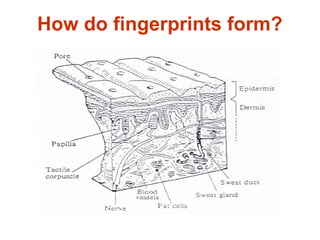
How do fingerprints form?
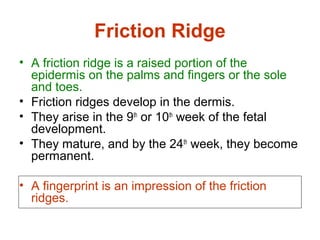
Friction Ridge
• A friction ridge is a raised portion of the
epidermis on the palms and fingers or the sole
and toes.
• Friction ridges develop in the dermis.
• They arise in the 9th
or 10th
week of the fetal
development.
• They mature, and by the 24th
week, they become
permanent.
• A fingerprint is an impression of the friction
ridges.
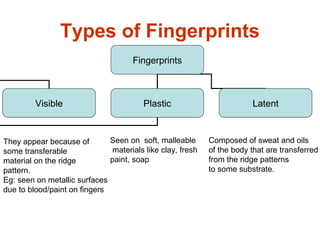
Types of Fingerprints
Fingerprints
Visible Plastic Latent
They appear because of
some transferable
material on the ridge
pattern.
Eg: seen on metallic surfaces
due to blood/paint on fingers
Seen on soft, malleable
materials like clay, fresh
paint, soap
Composed of sweat and oils
of the body that are transferred
from the ridge patterns
to some substrate.
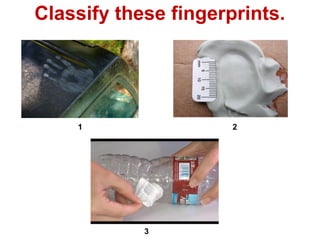
Classify these fingerprints.
1 2
3
Detection and Visualisation of
Latent Fingerprints
• Use of fingerprint powders.
• These can be coloured (black, white or metallic),
fluorescent or magnetic materials that are finely
ground.
• They are brushed slightly over a suspected print.
• This produces a contrast between the background
and the now-visible print.
• Photograph this!
• Magnetic powders work best on coated or shiny
surfaces.
What does
this imply?
…cont’d.
• Powders are applied with a soft fiberglass
brush with long, fine bristles.
• These bristles are usually made of camel
hair.
• Brush is dipped into the powder and gently
applied to the fingerprint with a light touch.
• Magnetic powders require a magnetic
applicator.
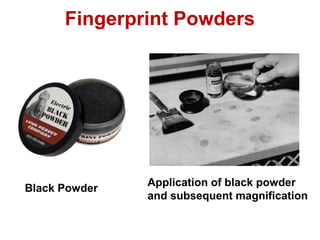
Fingerprint Powders
Black Powder
Application of black powder
and subsequent magnification
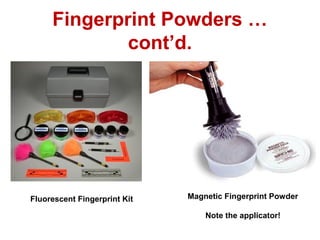
Fluorescent Fingerprint Kit Magnetic Fingerprint Powder
Note the applicator!
Fingerprint Powders …
cont’d.
Chemical Methods of Development
of Latent Fingerprints
1. Iodine Fumigation
• Iodine is a solid at room temperature.
• It sublimes.
• When iodine vapours are exposed to
fingerprint residues, they react to form a
reddish image of the fingerprint.
• This image is temporary.
• Visualised image must be photographed.
What does
this mean?
Fingerprint developed with iodine,
the right part is fixed with benzoflavone.
Development of Latent Fingerprints by Iodine
Fumigation
2. Silver nitrate method
• Finger print residues contain chloride ions.
• These ions when reacted with silver ions, form
silver chloride, which is a white, insoluble
powder.
Ag+
+ Cl-
 AgCl (white)
• Silver chloride is reduced to silver metal in light.
This is a grayish solid.
AgCl  Ag (gray)
• Disadvantage: Silver nitrate is used as an
aqueous solution; cannot be used on surfaces
which can be damaged by water.
Where do
these ions
come from?
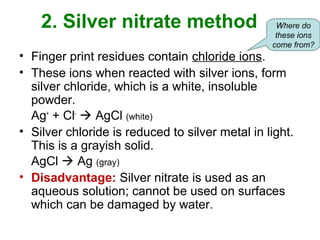
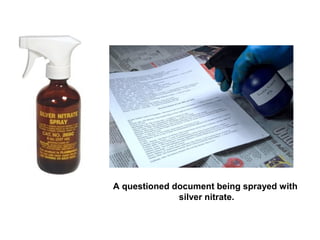
A questioned document being sprayed with
silver nitrate.
3. Ninhydrin Method
• Used for developing fingerprints on porous
surfaces like paper.
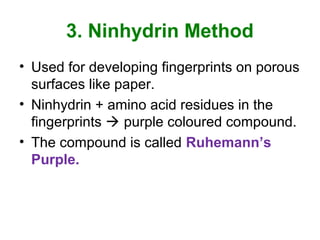
• Ninhydrin + amino acid residues in the
fingerprints  purple coloured compound.
• The compound is called Ruhemann’s
Purple.
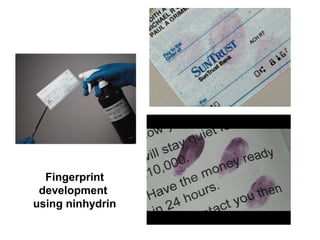
Fingerprint
development
using ninhydrin
4. Cyanoacrylate (Superglue) Fuming
• Serendipitous discovery!
• Japanese scientists testing a cyanoacylate ester
to make a new glue.
• The ester was heated in the fume hood; left for a
while.
• After some time, the glassware in the hood had
visible fingerprints.
• Used these days to fume small, confined areas.
• Prints formed are permanent!
What is
serendipity?
What type of fingerprints
are initially formed on
glassware?
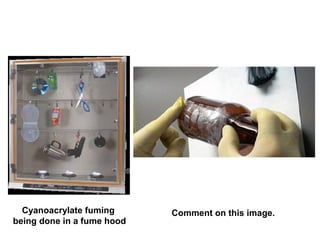
Cyanoacrylate fuming
being done in a fume hood
Comment on this image.

Fingerprints

  • 1.
    Dr. Sangeetha Balakrishnan PGDepartment of Chemistry Women’s Christian College Chennai – 600 006 rensic Science PCH/NM/01 16 December, 2016 Fingerprints Forensic Science PCH/NM/01
  • 2.
  • 3.
    Friction Ridge • Afriction ridge is a raised portion of the epidermis on the palms and fingers or the sole and toes. • Friction ridges develop in the dermis. • They arise in the 9th or 10th week of the fetal development. • They mature, and by the 24th week, they become permanent. • A fingerprint is an impression of the friction ridges.
  • 4.
    Types of Fingerprints Fingerprints VisiblePlastic Latent They appear because of some transferable material on the ridge pattern. Eg: seen on metallic surfaces due to blood/paint on fingers Seen on soft, malleable materials like clay, fresh paint, soap Composed of sweat and oils of the body that are transferred from the ridge patterns to some substrate.
  • 5.
  • 6.
    Detection and Visualisationof Latent Fingerprints • Use of fingerprint powders. • These can be coloured (black, white or metallic), fluorescent or magnetic materials that are finely ground. • They are brushed slightly over a suspected print. • This produces a contrast between the background and the now-visible print. • Photograph this! • Magnetic powders work best on coated or shiny surfaces. What does this imply?
  • 7.
    …cont’d. • Powders areapplied with a soft fiberglass brush with long, fine bristles. • These bristles are usually made of camel hair. • Brush is dipped into the powder and gently applied to the fingerprint with a light touch. • Magnetic powders require a magnetic applicator.
  • 8.
    Fingerprint Powders Black Powder Applicationof black powder and subsequent magnification
  • 9.
    Fluorescent Fingerprint KitMagnetic Fingerprint Powder Note the applicator! Fingerprint Powders … cont’d.
  • 10.
    Chemical Methods ofDevelopment of Latent Fingerprints 1. Iodine Fumigation • Iodine is a solid at room temperature. • It sublimes. • When iodine vapours are exposed to fingerprint residues, they react to form a reddish image of the fingerprint. • This image is temporary. • Visualised image must be photographed. What does this mean?
  • 11.
    Fingerprint developed withiodine, the right part is fixed with benzoflavone. Development of Latent Fingerprints by Iodine Fumigation
  • 12.
    2. Silver nitratemethod • Finger print residues contain chloride ions. • These ions when reacted with silver ions, form silver chloride, which is a white, insoluble powder. Ag+ + Cl-  AgCl (white) • Silver chloride is reduced to silver metal in light. This is a grayish solid. AgCl  Ag (gray) • Disadvantage: Silver nitrate is used as an aqueous solution; cannot be used on surfaces which can be damaged by water. Where do these ions come from?
  • 13.
    A questioned documentbeing sprayed with silver nitrate.
  • 14.
    3. Ninhydrin Method •Used for developing fingerprints on porous surfaces like paper. • Ninhydrin + amino acid residues in the fingerprints  purple coloured compound. • The compound is called Ruhemann’s Purple.
  • 15.
  • 16.
    4. Cyanoacrylate (Superglue)Fuming • Serendipitous discovery! • Japanese scientists testing a cyanoacylate ester to make a new glue. • The ester was heated in the fume hood; left for a while. • After some time, the glassware in the hood had visible fingerprints. • Used these days to fume small, confined areas. • Prints formed are permanent! What is serendipity? What type of fingerprints are initially formed on glassware?
  • 17.
    Cyanoacrylate fuming being donein a fume hood Comment on this image.