Introduction to Forensic Sciences
Fingerprints
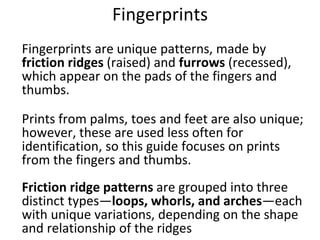
Fingerprints are unique patterns, made by
friction ridges (raised) and furrows (recessed),
which appear on the pads of the fingers and
thumbs.
Prints from palms, toes and feet are also unique;
however, these are used less often for
identification, so this guide focuses on prints
from the fingers and thumbs.
Friction ridge patterns are grouped into three
distinct types—loops, whorls, and arches—each
with unique variations, depending on the shape
and relationship of the ridges
Principles of Fingerprinting
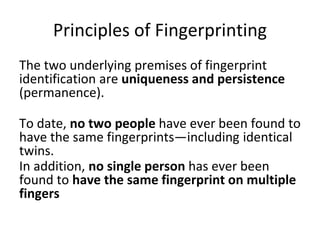
The two underlying premises of fingerprint
identification are uniqueness and persistence
(permanence).
To date, no two people have ever been found to
have the same fingerprints—including identical
twins.
In addition, no single person has ever been
found to have the same fingerprint on multiple
fingers
Types of Finger Ridge Patterns
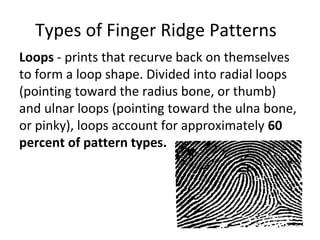
Loops - prints that recurve back on themselves
to form a loop shape. Divided into radial loops
(pointing toward the radius bone, or thumb)
and ulnar loops (pointing toward the ulna bone,
or pinky), loops account for approximately 60
percent of pattern types.
Types of Finger Ridge Patterns
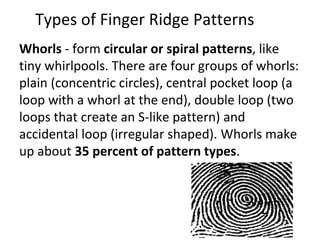
Whorls - form circular or spiral patterns, like
tiny whirlpools. There are four groups of whorls:
plain (concentric circles), central pocket loop (a
loop with a whorl at the end), double loop (two
loops that create an S-like pattern) and
accidental loop (irregular shaped). Whorls make
up about 35 percent of pattern types.
Types of Finger Ridge Patterns
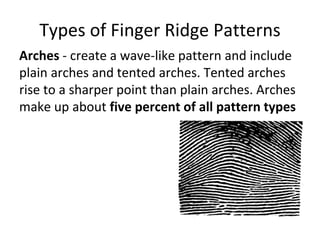
Arches - create a wave-like pattern and include
plain arches and tented arches. Tented arches
rise to a sharper point than plain arches. Arches
make up about five percent of all pattern types
When and where is fingerprint analysis
used?
• Providing biometric security (for example, to control
access to secure areas or systems)
• Identifying amnesia victims and unknown deceased
(such as victims of major disasters, if their fingerprints
are on file)
• Conducting background checks (including
applications for government employment, defense
security clearance, concealed weapon permits, etc.).
When and where is fingerprint analysis
used?
ā– Fingerprints are especially important in the criminal justice
realm. Investigators and analysts can compare unknown
prints collected from a crime scene to the known prints
of victims, witnesses and potential suspects to assist in
criminal cases. For example:
• A killer may leave their fingerprints on the suspected
murder weapon
• A bank robber’s fingerprints may be found on a robbery
note
• In an assault case, the perpetrator may have left
fingerprints on the victim’s skin
• A burglar may leave fingerprints on a broken window pane
• A thief’s fingerprints may be found on a safe
In the absence of DNA, fingerprints are used by
the criminal justice system to verify a convicted
offender’s identity and track their previous
arrests and convictions, criminal tendencies,
known associates and other useful information.
Officers of the court can also use these records
to help make decisions regarding a criminal’s
sentence, probation, parole or pardon.
Fingerprint Analysis
• Analysts use the general pattern type (loop,
whorl or arch) to make initial comparisons
and include or exclude a known fingerprint
from further analysis.
• To match a print, the analyst uses the ridge
characteristics, to identify specific points on a
suspect fingerprint with the same
information in a known fingerprint
Fingerprint Classification
Analysts classify fingerprints into three
categories according to the type of surface on
which they are found and whether they are
visible or not: Fingerprints on soft surfaces
(such as soap, wax, wet paint, fresh caulk, etc.)
are likely to be three-dimensional plastic prints;
those on hard surfaces are either patent
(visible) or latent (invisible) prints.
• Visible/patent prints are formed when blood, dirt,
ink, paint, etc., is transferred from a finger or thumb
to a surface. Patent prints can be found on a wide
variety of surfaces: smooth or rough, porous (such as
paper, cloth or wood) or nonporous (such as metal,
glass or plastic).
• Latent/invisible prints are formed when the body’s
natural oils and sweat on the skin are deposited onto
another surface. Latent prints can be found on a
variety of surfaces; however, they are not readily
visible and detection often requires the use of
fingerprint powders, chemical reagents or alternate
light sources. Generally speaking, the smoother and
less porous a surface is, the greater the potential
that any latent prints present can be found and
developed.
How Fingerprints are Collected
• Patent Print Collection: Photographed in high resolution with forensic
measurement scale for reference.
• Latent Print Collection: Commonly done by dusting surfaces with fingerprint
powder, then lifting prints with adhesive tape onto a latent lift card.
• Concerns with Fingerprint Powders: They can contaminate evidence and hinder
other techniques. Alternatives include alternate light sources (ALS),
cyanoacrylate (super glue) fuming, and chemical developers.
• Alternate Light Source (ALS): Laser or LED devices emitting specific wavelengths
to enhance visibility of prints on surfaces.
• Cyanoacrylate (Super Glue) Fuming: Exposure of surfaces to cyanoacrylate
vapors, which adhere to prints, making them visible under ambient or white
light.
• Chemical Developers: Used on porous surfaces like paper, reacting with latent
print residue to reveal prints. Examples include ninhydrin and DFO.
• Other Collection Methods: Special techniques for skin, clothing, and difficult
surfaces, including Amido Black for bloody impressions, vacuum metal
deposition for clothing, and AccuTransĀ® for rough surfaces.
Precautions: Nondestructive investigations are prioritized before chemical
treatments to preserve evidence integrity. For example, examining documents
before applying ninhydrin to avoid ink damage.
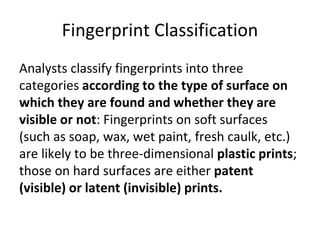
Paper treated with ninhydrin reagent
reveals latent prints after being
processed with a household steam iron.
(Courtesy of NFSTC)
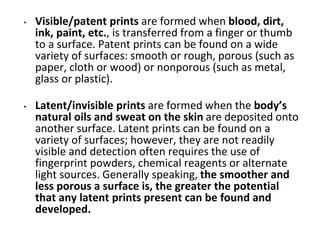
Using a fluorescent dye stain and an
orange alternate light source helps
this latent print appear clearly so
that it can be documented
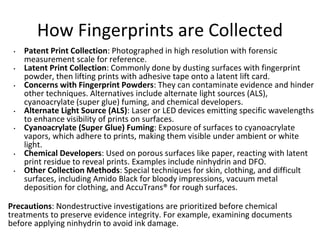
A chamber specially designed for
exposing latent prints to super glue
fumes. Cyanoacrylate
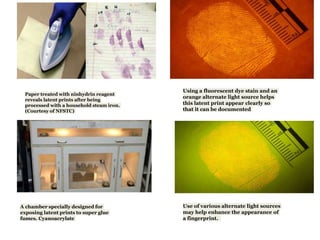
Use of various alternate light sources
may help enhance the appearance of
a fingerprint.
The Development of Forensic Science
Laboratory
Forensic science in Pakistan has been a key pillar in the
criminal justice system. The development of forensic
science laboratories in the country has been ongoing
since 2001, with authorities revamping forensic science
infrastructure across the country to aid crime
investigation.
Forensic science laboratories have evolved over time,
incorporating new technologies and methods. For
instance, they now use high-tech robotic workstations to
process large numbers of DNA samples simultaneously,
allowing for more efficient work (outside of pakistan)
Pakistan, key developments:
• Punjab Forensic Science Agency (PFSA): Located in Lahore, the PFSA is the
largest forensic DNA laboratory in Pakistan12. It has been helping in solving
various cases such as rape, murder, dead body identification, sibship, and
parentage2.
• National Forensic Science Agency (NFSA): Approved by the Executive Committee
of the National Economic Council (ECNEC) as an autonomous body in 2002, the
NFSA has departments of crime scene Investigation, trace chemistry, questioned
documents, and digital forensics.
• Forensic Science Laboratory in Peshawar: Established by the Khyber
Pakhtunkhwa police in December 2017, this laboratory provides preliminary
forensic facilities.
• Forensic DNA Testing Laboratory in Karachi University: The government of Sindh
is making efforts for the establishment of this laboratory.
• DNA Testing Facility in Jamshoro, Sindh: This facility provides research as well as
forensic DNA testing.
• Forensic Science Laboratory in Swat: A state-of-the-art Regional Forensic Science
Laboratory (FSL) has been established at Landaki Swat, with the support from
Swiss Development Cooperation (SDC) and the Bureau of International Narcotics
and Law Enforcement Affairs (INL)2.
Mateen, R.M., Tariq, A. & Rasool, N. Forensic science in Pakistan; present and future. Egypt J Forensic Sci 8, 45
(2018). https://doi.org/10.1186/s41935-018-0077-3
Physical Science
Physical science is a branch of natural science that studies non-living systems,
the study of the inorganic world and how physical objects behave.
It has two main areas: physics and chemistry, with several subgroups, including
astronomy and geology.
Forensic scientists apply principles of physical science to analyze various types of physical
evidence. For example,
• They may use spectroscopy techniques to check the purity of materials or detect illegal drugs.
• Ballistics: Physics principles are used to analyze firearms, bullets, and cartridge cases to
determine the type of weapon, distance, and angle of a shot.
• Bloodstain pattern : Physics is used to analyze blood spatter patterns to determine the
direction, angle, and velocity of blood spatter.
• Forensic engineering: Physics principles are used to investigate accidents, structural
failures, and other incidents.
• Crime scene reconstruction: Physics is used to analyze accidents, suicides, homicides, and
other crime scenes.
• Density and refractive index measurements: Physics is used to measure density and
refractive index in soil, glass, and paint examinations.
Biology
Biology is the scientific study of living organisms
and their interactions with each other and their
environments.
It encompasses a wide range of topics, including
the structure, function, growth, evolution,
distribution, and taxonomy of living organisms.
Biology provides forensic scientists with
valuable tools and techniques to analyze
evidence and aid in criminal investigations,
helping to bring perpetrators to justice.
Document Analysis
• Document analysis in forensic science, also known as
Forensic Document Examination (FDE), is a critical
aspect of investigative procedures. It involves the
scientific analysis of documents to establish their
authenticity, origin, and potential alterations.
• Documentsā€ may be defined broadly as being any
material bearing marks, signs or symbols intended to
convey a message or meaning to someone.
Photographic Analysis
ā— Photographic analysis in forensic sciences is a
crucial tool that provides investigators with a
visual record of the crime scene, serving as a
foundation for further examination and
analysis
ā— Forensic image analysis is the systematic
examination of visual evidence, such as
photographs, videos, and digital images, to
find relevant information that can help with
investigations and legal proceedings
Methods used to compare Printers,
Copiers and Fax machines
• Microscopical Reflection-Absorption Infrared
Spectroscopy (R-A IR): This technique is used for analyzing
the polymer resins contained in dry, black photocopy and
printer toners. The sampling technique involves a heat
transfer of the toner from a document to the reflective
surface of aluminum foil followed by analysis by R-A IR1. A
searchable spectral library was created that contains 807
toner samples analyzed by R-A IR1.
• Machine Identification Code Technology: This technology
is used in color laser printers. It helps in identifying the
source of a document.
• Visual Examination and Optical Microscopy: These
techniques are used to characterize toners.
• Scanning Electron Microscopy (SEM): SEM is used to
analyze the physical and chemical properties of toners.
• Infrared Spectroscopy (IR): IR is used to identify the
chemical composition of toners.
• Pyrolysis Gas Chromatography and/or Mass
Spectrometry (Py-GC, Py-GC/MS, Py-MS): These
techniques are used to analyze the chemical properties of
toners.
• Differential Scanning Calorimetry (DSC): DSC is used to
measure the heat flow associated with phase transitions in
toners1.
THANK YOU

1. Introduction to Forensic Sciences.pptx

  • 1.
  • 2.
    Fingerprints Fingerprints are uniquepatterns, made by friction ridges (raised) and furrows (recessed), which appear on the pads of the fingers and thumbs. Prints from palms, toes and feet are also unique; however, these are used less often for identification, so this guide focuses on prints from the fingers and thumbs. Friction ridge patterns are grouped into three distinct types—loops, whorls, and arches—each with unique variations, depending on the shape and relationship of the ridges
  • 3.
    Principles of Fingerprinting Thetwo underlying premises of fingerprint identification are uniqueness and persistence (permanence). To date, no two people have ever been found to have the same fingerprints—including identical twins. In addition, no single person has ever been found to have the same fingerprint on multiple fingers
  • 4.
    Types of FingerRidge Patterns Loops - prints that recurve back on themselves to form a loop shape. Divided into radial loops (pointing toward the radius bone, or thumb) and ulnar loops (pointing toward the ulna bone, or pinky), loops account for approximately 60 percent of pattern types.
  • 5.
    Types of FingerRidge Patterns Whorls - form circular or spiral patterns, like tiny whirlpools. There are four groups of whorls: plain (concentric circles), central pocket loop (a loop with a whorl at the end), double loop (two loops that create an S-like pattern) and accidental loop (irregular shaped). Whorls make up about 35 percent of pattern types.
  • 6.
    Types of FingerRidge Patterns Arches - create a wave-like pattern and include plain arches and tented arches. Tented arches rise to a sharper point than plain arches. Arches make up about five percent of all pattern types
  • 7.
    When and whereis fingerprint analysis used? • Providing biometric security (for example, to control access to secure areas or systems) • Identifying amnesia victims and unknown deceased (such as victims of major disasters, if their fingerprints are on file) • Conducting background checks (including applications for government employment, defense security clearance, concealed weapon permits, etc.).
  • 8.
    When and whereis fingerprint analysis used? ā– Fingerprints are especially important in the criminal justice realm. Investigators and analysts can compare unknown prints collected from a crime scene to the known prints of victims, witnesses and potential suspects to assist in criminal cases. For example: • A killer may leave their fingerprints on the suspected murder weapon • A bank robber’s fingerprints may be found on a robbery note • In an assault case, the perpetrator may have left fingerprints on the victim’s skin • A burglar may leave fingerprints on a broken window pane • A thief’s fingerprints may be found on a safe
  • 9.
    In the absenceof DNA, fingerprints are used by the criminal justice system to verify a convicted offender’s identity and track their previous arrests and convictions, criminal tendencies, known associates and other useful information. Officers of the court can also use these records to help make decisions regarding a criminal’s sentence, probation, parole or pardon.
  • 10.
    Fingerprint Analysis • Analystsuse the general pattern type (loop, whorl or arch) to make initial comparisons and include or exclude a known fingerprint from further analysis. • To match a print, the analyst uses the ridge characteristics, to identify specific points on a suspect fingerprint with the same information in a known fingerprint
  • 11.
    Fingerprint Classification Analysts classifyfingerprints into three categories according to the type of surface on which they are found and whether they are visible or not: Fingerprints on soft surfaces (such as soap, wax, wet paint, fresh caulk, etc.) are likely to be three-dimensional plastic prints; those on hard surfaces are either patent (visible) or latent (invisible) prints.
  • 12.
    • Visible/patent printsare formed when blood, dirt, ink, paint, etc., is transferred from a finger or thumb to a surface. Patent prints can be found on a wide variety of surfaces: smooth or rough, porous (such as paper, cloth or wood) or nonporous (such as metal, glass or plastic). • Latent/invisible prints are formed when the body’s natural oils and sweat on the skin are deposited onto another surface. Latent prints can be found on a variety of surfaces; however, they are not readily visible and detection often requires the use of fingerprint powders, chemical reagents or alternate light sources. Generally speaking, the smoother and less porous a surface is, the greater the potential that any latent prints present can be found and developed.
  • 13.
    How Fingerprints areCollected • Patent Print Collection: Photographed in high resolution with forensic measurement scale for reference. • Latent Print Collection: Commonly done by dusting surfaces with fingerprint powder, then lifting prints with adhesive tape onto a latent lift card. • Concerns with Fingerprint Powders: They can contaminate evidence and hinder other techniques. Alternatives include alternate light sources (ALS), cyanoacrylate (super glue) fuming, and chemical developers. • Alternate Light Source (ALS): Laser or LED devices emitting specific wavelengths to enhance visibility of prints on surfaces. • Cyanoacrylate (Super Glue) Fuming: Exposure of surfaces to cyanoacrylate vapors, which adhere to prints, making them visible under ambient or white light. • Chemical Developers: Used on porous surfaces like paper, reacting with latent print residue to reveal prints. Examples include ninhydrin and DFO. • Other Collection Methods: Special techniques for skin, clothing, and difficult surfaces, including Amido Black for bloody impressions, vacuum metal deposition for clothing, and AccuTransĀ® for rough surfaces. Precautions: Nondestructive investigations are prioritized before chemical treatments to preserve evidence integrity. For example, examining documents before applying ninhydrin to avoid ink damage.
  • 14.
    Paper treated withninhydrin reagent reveals latent prints after being processed with a household steam iron. (Courtesy of NFSTC) Using a fluorescent dye stain and an orange alternate light source helps this latent print appear clearly so that it can be documented A chamber specially designed for exposing latent prints to super glue fumes. Cyanoacrylate Use of various alternate light sources may help enhance the appearance of a fingerprint.
  • 15.
    The Development ofForensic Science Laboratory Forensic science in Pakistan has been a key pillar in the criminal justice system. The development of forensic science laboratories in the country has been ongoing since 2001, with authorities revamping forensic science infrastructure across the country to aid crime investigation. Forensic science laboratories have evolved over time, incorporating new technologies and methods. For instance, they now use high-tech robotic workstations to process large numbers of DNA samples simultaneously, allowing for more efficient work (outside of pakistan)
  • 16.
    Pakistan, key developments: •Punjab Forensic Science Agency (PFSA): Located in Lahore, the PFSA is the largest forensic DNA laboratory in Pakistan12. It has been helping in solving various cases such as rape, murder, dead body identification, sibship, and parentage2. • National Forensic Science Agency (NFSA): Approved by the Executive Committee of the National Economic Council (ECNEC) as an autonomous body in 2002, the NFSA has departments of crime scene Investigation, trace chemistry, questioned documents, and digital forensics. • Forensic Science Laboratory in Peshawar: Established by the Khyber Pakhtunkhwa police in December 2017, this laboratory provides preliminary forensic facilities. • Forensic DNA Testing Laboratory in Karachi University: The government of Sindh is making efforts for the establishment of this laboratory. • DNA Testing Facility in Jamshoro, Sindh: This facility provides research as well as forensic DNA testing. • Forensic Science Laboratory in Swat: A state-of-the-art Regional Forensic Science Laboratory (FSL) has been established at Landaki Swat, with the support from Swiss Development Cooperation (SDC) and the Bureau of International Narcotics and Law Enforcement Affairs (INL)2. Mateen, R.M., Tariq, A. & Rasool, N. Forensic science in Pakistan; present and future. Egypt J Forensic Sci 8, 45 (2018). https://doi.org/10.1186/s41935-018-0077-3
  • 17.
    Physical Science Physical scienceis a branch of natural science that studies non-living systems, the study of the inorganic world and how physical objects behave. It has two main areas: physics and chemistry, with several subgroups, including astronomy and geology. Forensic scientists apply principles of physical science to analyze various types of physical evidence. For example, • They may use spectroscopy techniques to check the purity of materials or detect illegal drugs. • Ballistics: Physics principles are used to analyze firearms, bullets, and cartridge cases to determine the type of weapon, distance, and angle of a shot. • Bloodstain pattern : Physics is used to analyze blood spatter patterns to determine the direction, angle, and velocity of blood spatter. • Forensic engineering: Physics principles are used to investigate accidents, structural failures, and other incidents. • Crime scene reconstruction: Physics is used to analyze accidents, suicides, homicides, and other crime scenes. • Density and refractive index measurements: Physics is used to measure density and refractive index in soil, glass, and paint examinations.
  • 18.
    Biology Biology is thescientific study of living organisms and their interactions with each other and their environments. It encompasses a wide range of topics, including the structure, function, growth, evolution, distribution, and taxonomy of living organisms. Biology provides forensic scientists with valuable tools and techniques to analyze evidence and aid in criminal investigations, helping to bring perpetrators to justice.
  • 19.
    Document Analysis • Documentanalysis in forensic science, also known as Forensic Document Examination (FDE), is a critical aspect of investigative procedures. It involves the scientific analysis of documents to establish their authenticity, origin, and potential alterations. • Documentsā€ may be defined broadly as being any material bearing marks, signs or symbols intended to convey a message or meaning to someone.
  • 20.
    Photographic Analysis ā— Photographicanalysis in forensic sciences is a crucial tool that provides investigators with a visual record of the crime scene, serving as a foundation for further examination and analysis ā— Forensic image analysis is the systematic examination of visual evidence, such as photographs, videos, and digital images, to find relevant information that can help with investigations and legal proceedings
  • 21.
    Methods used tocompare Printers, Copiers and Fax machines • Microscopical Reflection-Absorption Infrared Spectroscopy (R-A IR): This technique is used for analyzing the polymer resins contained in dry, black photocopy and printer toners. The sampling technique involves a heat transfer of the toner from a document to the reflective surface of aluminum foil followed by analysis by R-A IR1. A searchable spectral library was created that contains 807 toner samples analyzed by R-A IR1. • Machine Identification Code Technology: This technology is used in color laser printers. It helps in identifying the source of a document. • Visual Examination and Optical Microscopy: These techniques are used to characterize toners.
  • 22.
    • Scanning ElectronMicroscopy (SEM): SEM is used to analyze the physical and chemical properties of toners. • Infrared Spectroscopy (IR): IR is used to identify the chemical composition of toners. • Pyrolysis Gas Chromatography and/or Mass Spectrometry (Py-GC, Py-GC/MS, Py-MS): These techniques are used to analyze the chemical properties of toners. • Differential Scanning Calorimetry (DSC): DSC is used to measure the heat flow associated with phase transitions in toners1.
  • 23.