Fingerprint Identification
Chapter 10 Fingerprint Classification
Systems
LawTech Custom Publishing, Inc.
Copyright 2005
Overview
 Fingerprint

classification describes an
individual’s fingerprints
 Fingerprint classifications use codes on
fingerprint cards to file and retrieve
manual filing system

Fingerprint
Identification
Chapter Objectives
 Understand

classification of fingerprint
card using Henry system
 Understand classification of fingerprint
card using NCIC system

Fingerprint
Identification
Introduction
 Henry

System of Classification used
for most of 20th Century in U.S. and
most English speaking countries
Named after Sir Edward Henry of
England
 Developed system during late 1800s and
early 1900s


Fingerprint
Identification
Introduction (cont.)
 National

Crime Information Center
(NCIC) Classification System
Computerized database used in U.S.
 Allows law enforcement agencies
nationwide access to wanted bulletins
and warrants for outstanding suspects and
fugitives


Fingerprint
Identification
Introduction (cont.)
 NCIC

Classification System (cont.)

Short cut to Henry System for quick
evaluation and possible elimination of
individuals as suspects
 Further investigation required for
individuals that match NCIC
classification including a full fingerprint
search


Fingerprint
Identification
Introduction (cont.)
Both classification systems based on 10
fingers
 Automation of fingerprint files will render
manual classification filing systems
obsolete
 Knowledge of fingerprint patterns and
anatomy of hand useful and valuable
information for fingerprint examiner


Fingerprint
Identification
Introduction (cont.)



Fingerprint classification not the same as
fingerprint identification
Classification uses class characteristics to group
like fingerprints for filing and retrieval




Many people have same fingerprint classification

Fingerprint identification uses individual
characteristics to individualize a print to a specific
person
Fingerprint
Identification
Introduction (cont.)



Fingerprint classification of suspect may appear
on wanted bulletins and arrest warrants
Law enforcement can use information as a
screening tool to eliminate persons being sought




Classifications that are quite different could be used to
exclude suspected individuals
Classifications that are similar or match would be
submitted to agency holding warrant to compare to
actual fingerprints
Fingerprint
Identification
The Henry System of Classification


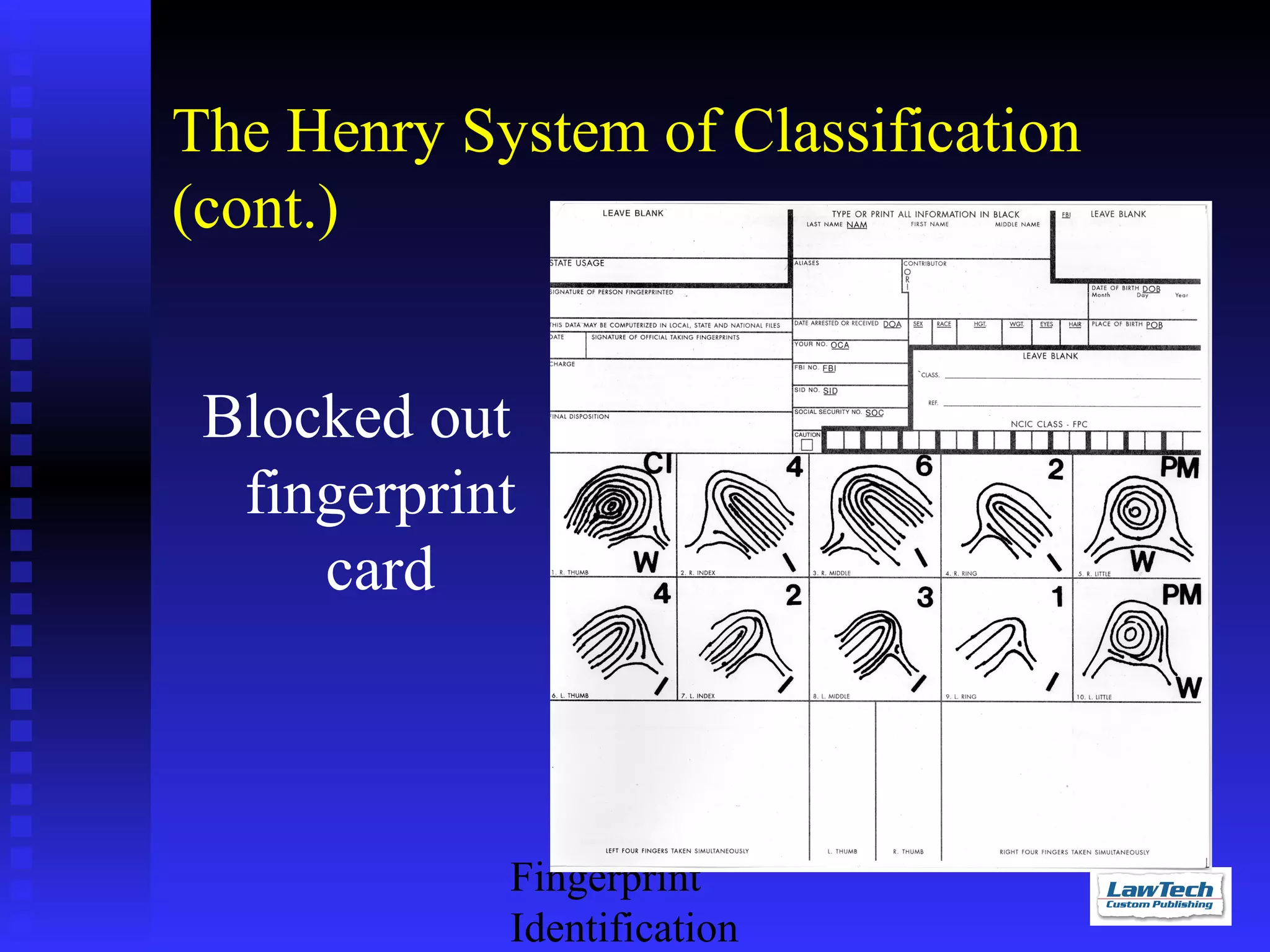
Blocking Out the Fingerprint Card



Determine pattern type in each finger block
Indicate pattern using symbols at the bottom middle or
right side of each finger box on fingerprint card
 Plain Arch → A
 Tented Arch → T
 Ulnar Loop → / in direction of the loop
 Radial Loop → R
 All Whorls → W
Fingerprint
Identification
The Henry System of Classification
(cont.)
 Index

finger boxes

Use capital letter of pattern type, except
for ulnar loop
 Ulnar loops designated by a diagonal line
slanting in the direction of loop


 All


other finger boxes

Use small letter to indicate pattern type,
except for ulnar loop (same as above)
Fingerprint
Identification
The Henry System of Classification
(cont.)


Loop type patterns




Place ridge count in top right hand corner of finger box

Whorl patterns




Indicate type in upper right corner of finger box
 P – plain
 C – central pocket
 Small d – double loop
 X – accidental whorl
Indicate tracing (I, M, O) next to letter designating
whorl pattern in top right corner of finger box
Fingerprint
Identification
The Henry System of Classification
(cont.)
Blocked out
fingerprint
card

Fingerprint
Identification
Six Divisions of Fingerprint
Classification
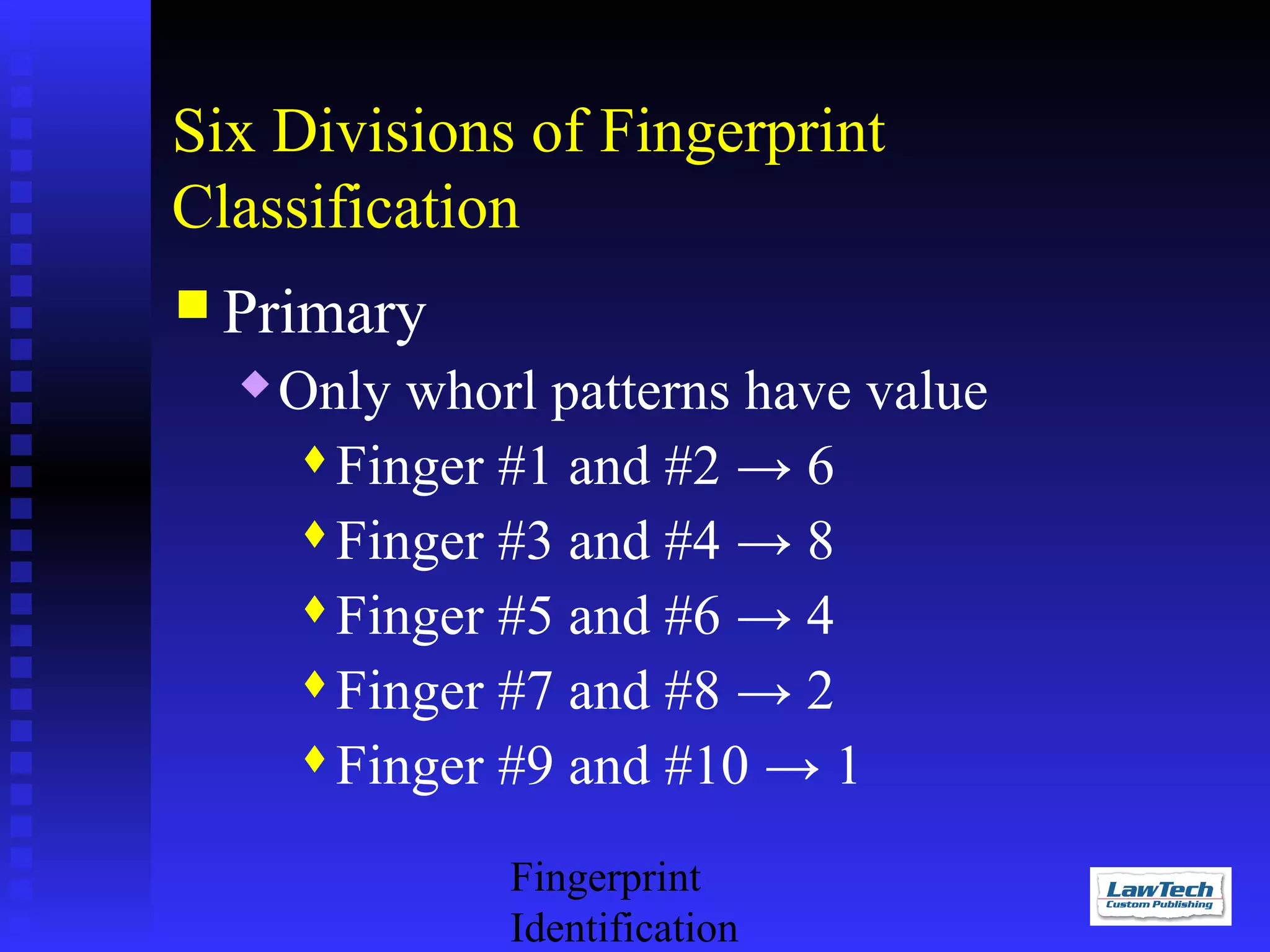
 Primary


Only whorl patterns have value
Finger #1 and #2 → 6
Finger #3 and #4 → 8
Finger #5 and #6 → 4
Finger #7 and #8 → 2
Finger #9 and #10 → 1
Fingerprint
Identification
Six Divisions of Fingerprint
Classification (cont.)
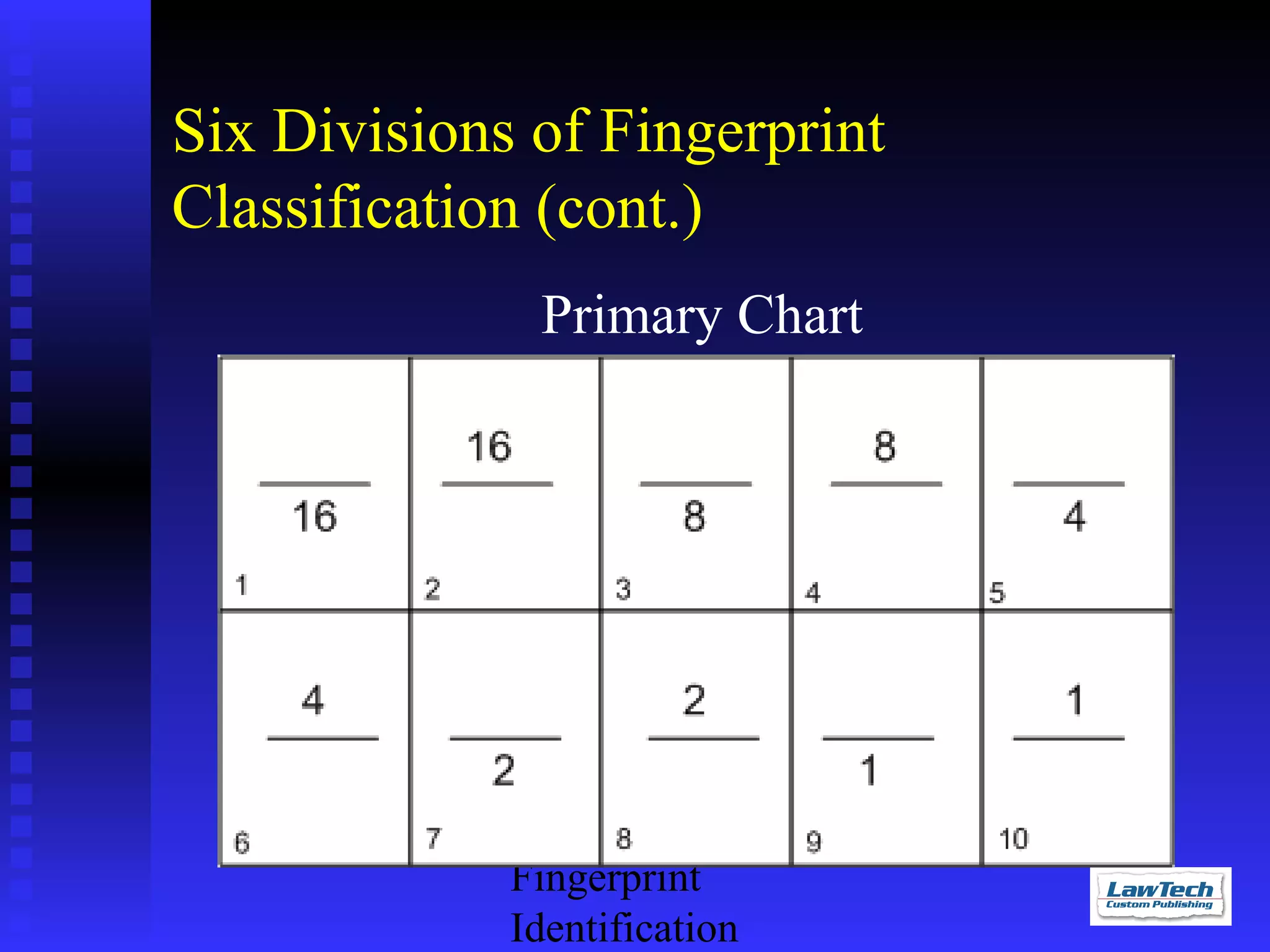
Primary Chart

Fingerprint
Identification
Six Divisions of Fingerprint
Classification (cont.)
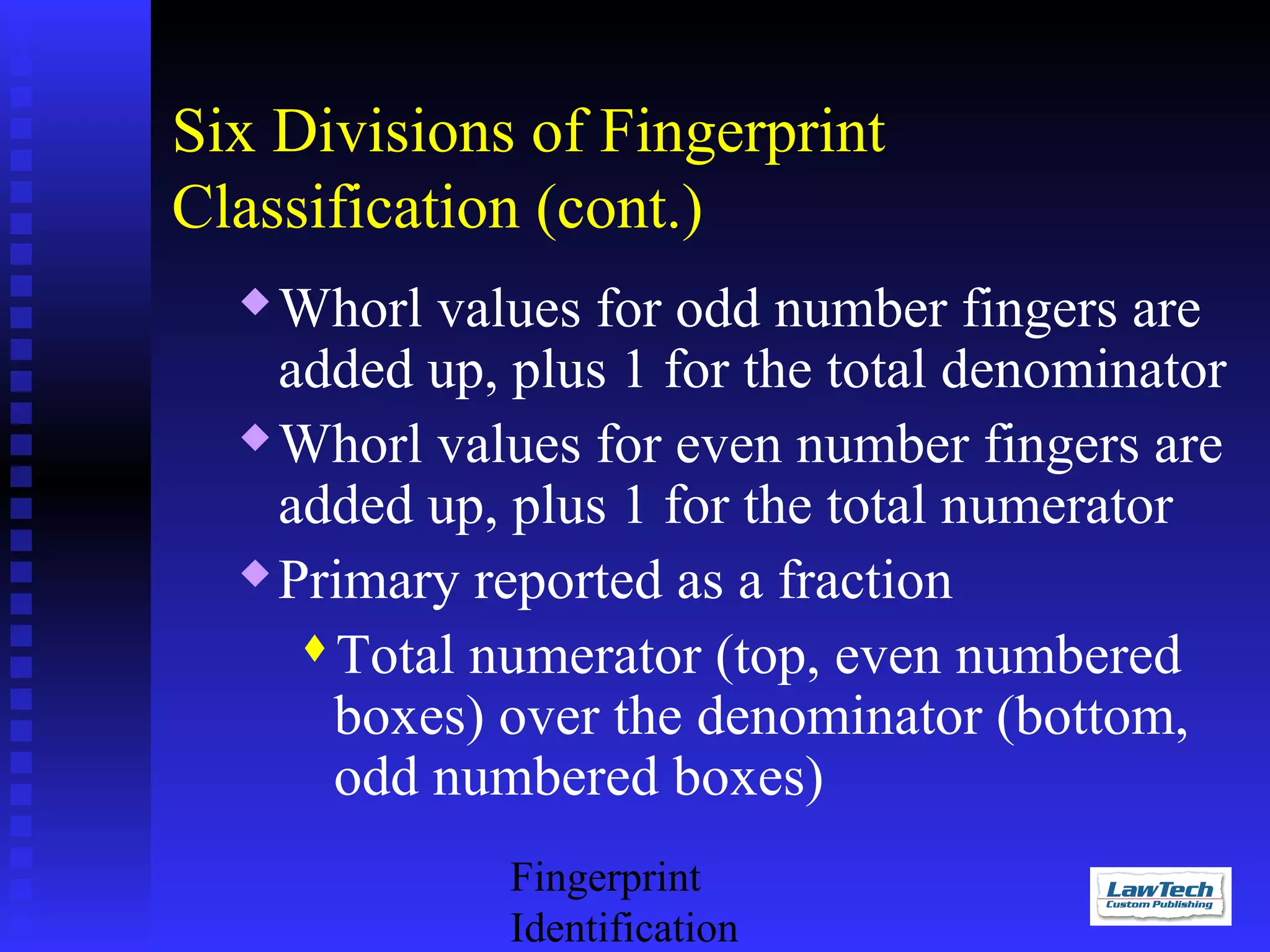
Whorl values for odd number fingers are
added up, plus 1 for the total denominator
 Whorl values for even number fingers are
added up, plus 1 for the total numerator
 Primary reported as a fraction
Total numerator (top, even numbered
boxes) over the denominator (bottom,
odd numbered boxes)


Fingerprint
Identification
Six Divisions of Fingerprint
Classification (cont.)
Primary = 1 indicates no whorl patterns
 Primary = 32 and over indicates all whorl
patterns
 Total of 1,024 possible primary
classifications


Fingerprint
Identification
Six Divisions of Fingerprint
Classification (cont.)
 Secondary

Indicated in fraction form
Capital letter of pattern type for right
index (#2) over left index (#7) fingers
 U – ulnar loops
 Example: W/U indicates right index
finger is whorl, and left index finger is
ulanr loop


Fingerprint
Identification
Six Divisions of Fingerprint
Classification (cont.)


Small Letter Group Secondary
Applies to fingerprint cards that have a plain
arch, tented arch, or radial loop
 Excludes index fingers
 Location of plain arch, tented arch or radial
loops by small letter a, t, or r indicated to right
or left of secondary
 Example: small letter a to the left of the top
capital letter of the secondary indicates that a
plain arch is in right thumb


Fingerprint
Identification
Six Divisions of Fingerprint
Classification (cont.)


Dashes used to indicate position of
fingers not containing a plain arch, tented
arch or radial loop in the middle, ring or
little fingers to the left of the secondary
Example: - a in the denominator
(lower) line of the fraction to the right
of the capital letter secondary indicate
a plain arch in left little finger
Fingerprint
Identification
Six Divisions of Fingerprint
Classification (cont.)




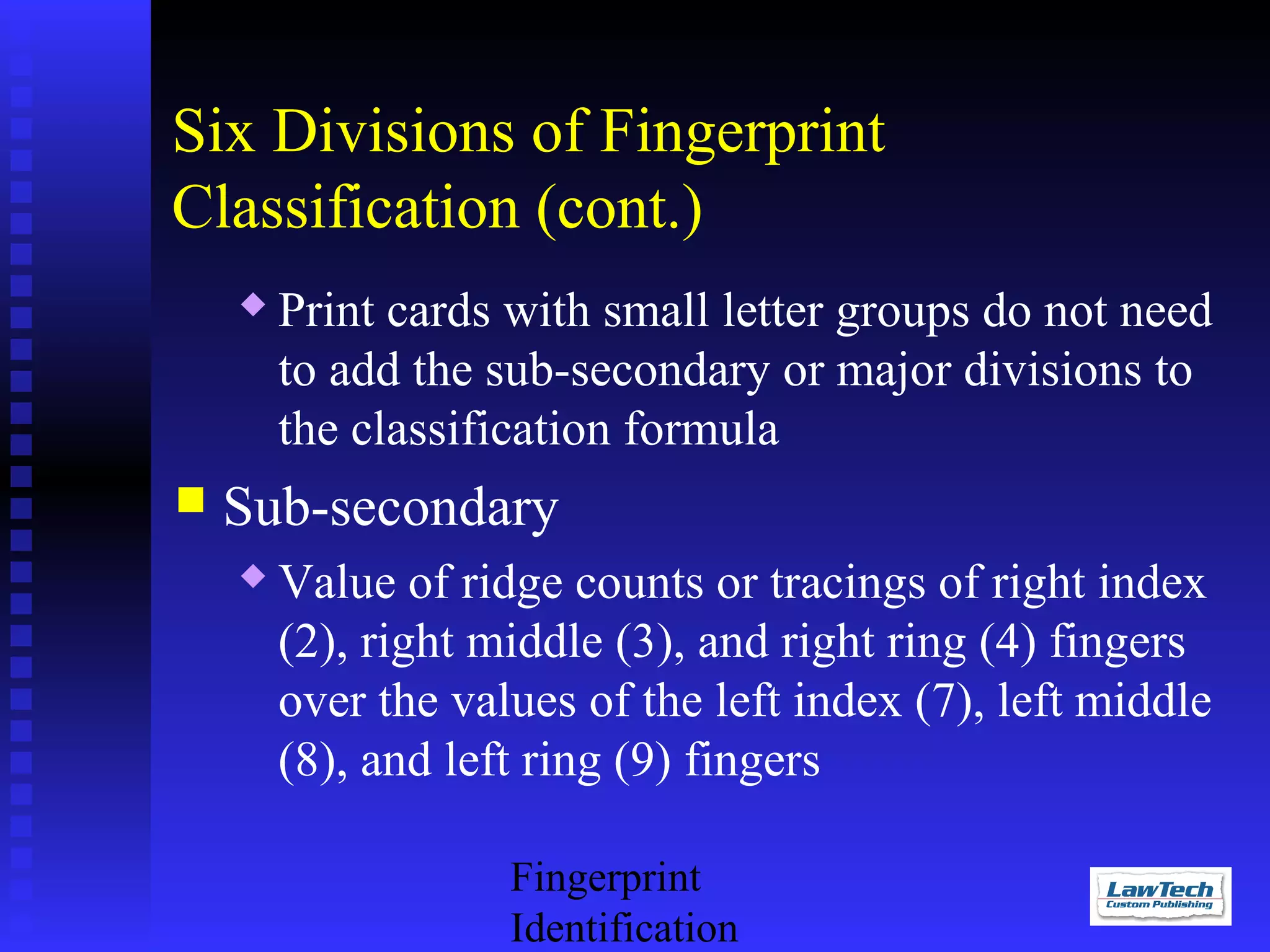
Print cards with small letter groups do not need
to add the sub-secondary or major divisions to
the classification formula

Sub-secondary


Value of ridge counts or tracings of right index
(2), right middle (3), and right ring (4) fingers
over the values of the left index (7), left middle
(8), and left ring (9) fingers
Fingerprint
Identification
Six Divisions of Fingerprint
Classification (cont.)
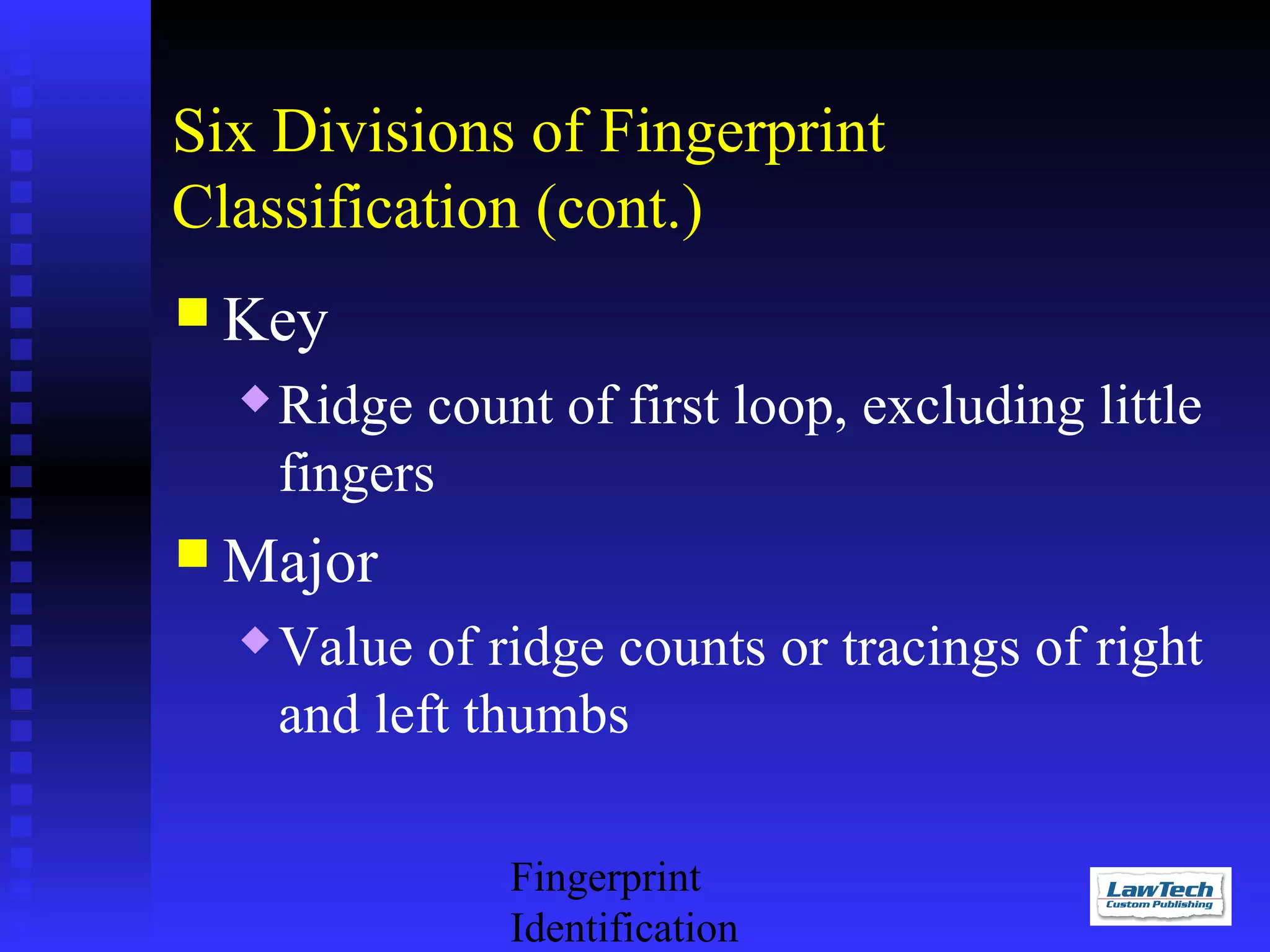
 Key


Ridge count of first loop, excluding little
fingers

 Major


Value of ridge counts or tracings of right
and left thumbs
Fingerprint
Identification
Six Divisions of Fingerprint
Classification (cont.)
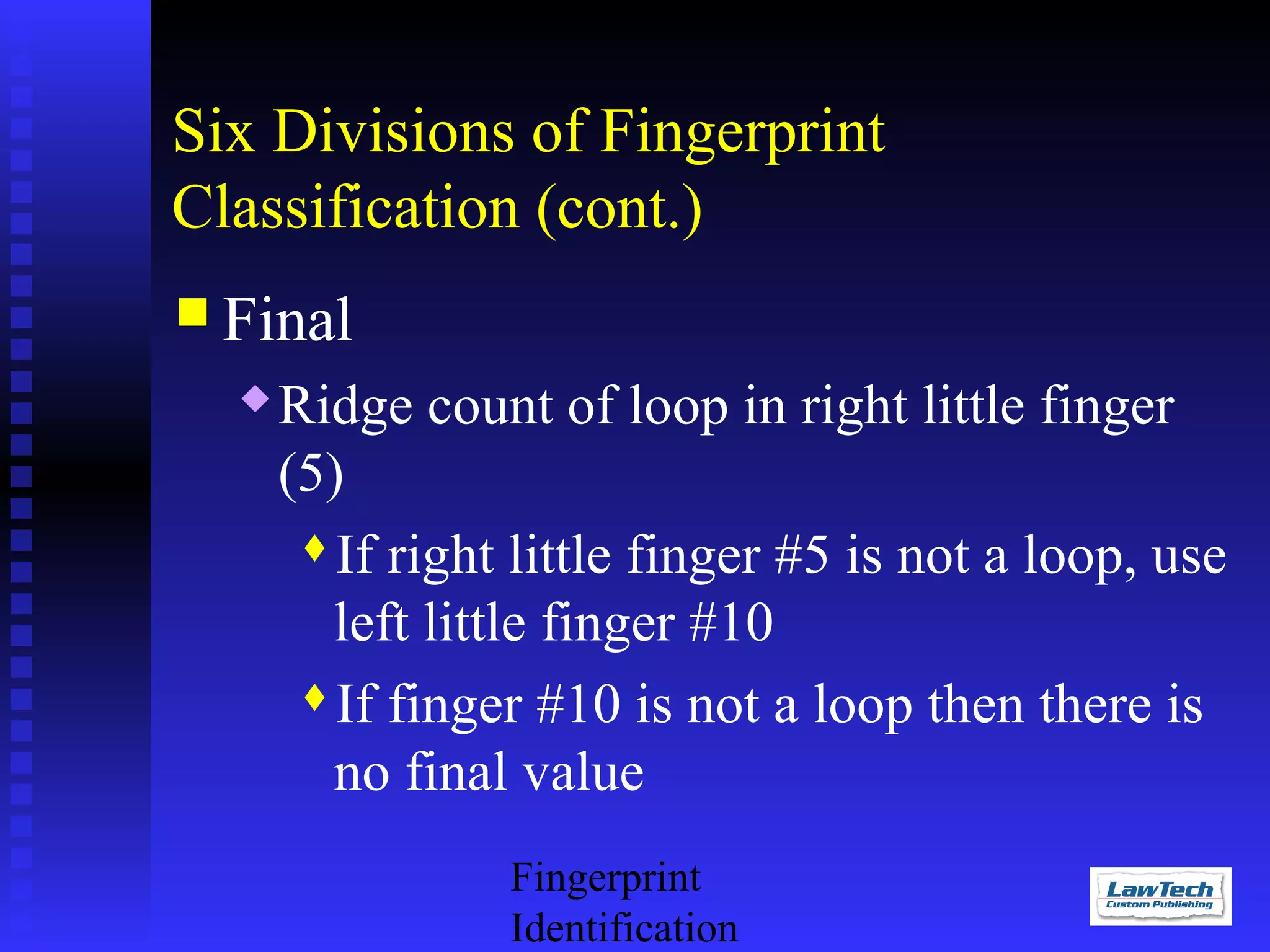
 Final


Ridge count of loop in right little finger
(5)
If right little finger #5 is not a loop, use
left little finger #10
If finger #10 is not a loop then there is
no final value
Fingerprint
Identification
Six Divisions of Fingerprint
Classification (cont.)


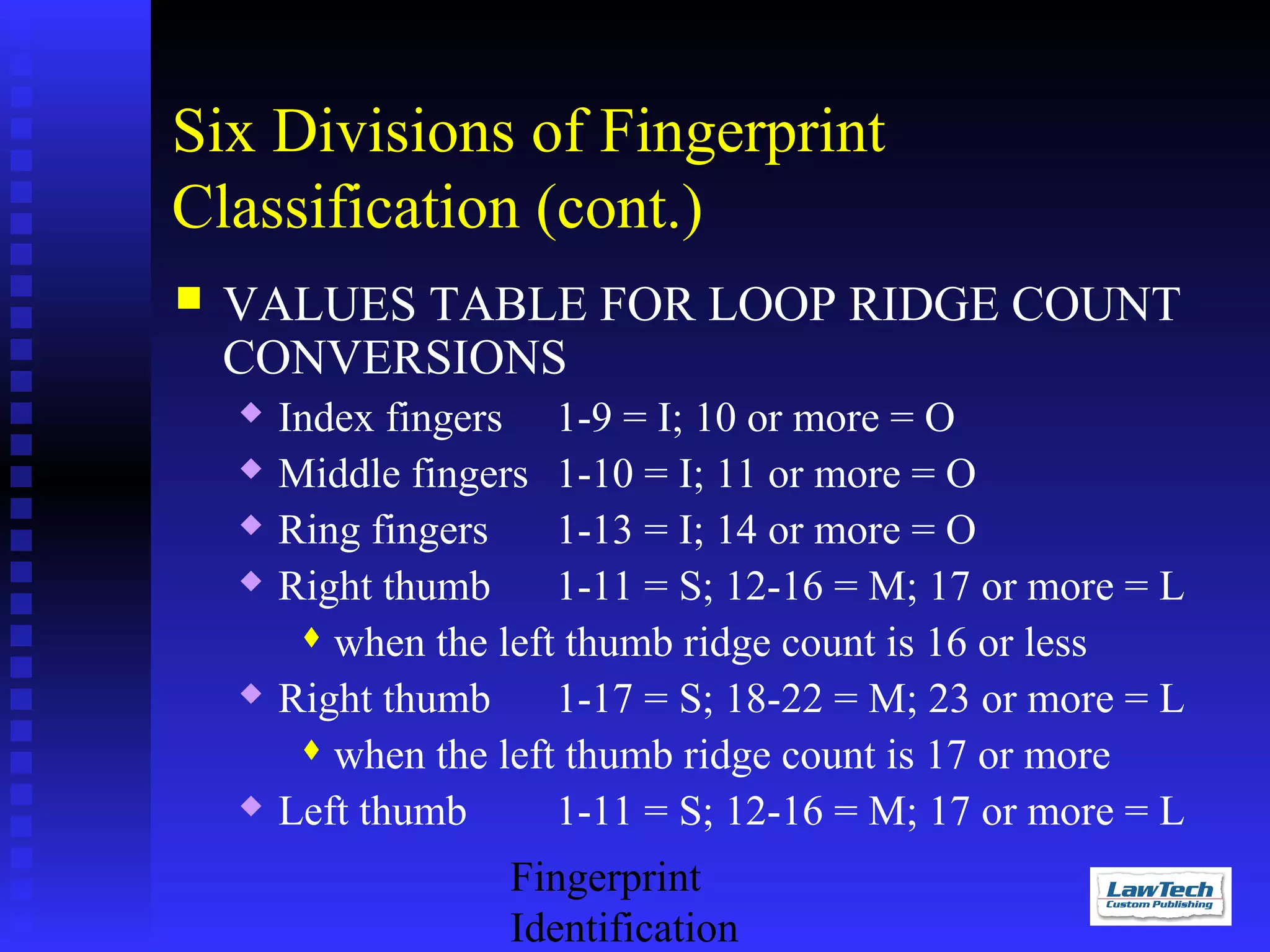
VALUES TABLE FOR LOOP RIDGE COUNT
CONVERSIONS









Index fingers 1-9 = I; 10 or more = O
Middle fingers 1-10 = I; 11 or more = O
Ring fingers
1-13 = I; 14 or more = O
Right thumb
1-11 = S; 12-16 = M; 17 or more = L
 when the left thumb ridge count is 16 or less
Right thumb
1-17 = S; 18-22 = M; 23 or more = L
 when the left thumb ridge count is 17 or more
Left thumb
1-11 = S; 12-16 = M; 17 or more = L
Fingerprint
Identification
Six Divisions of Fingerprint
Classification (cont.)

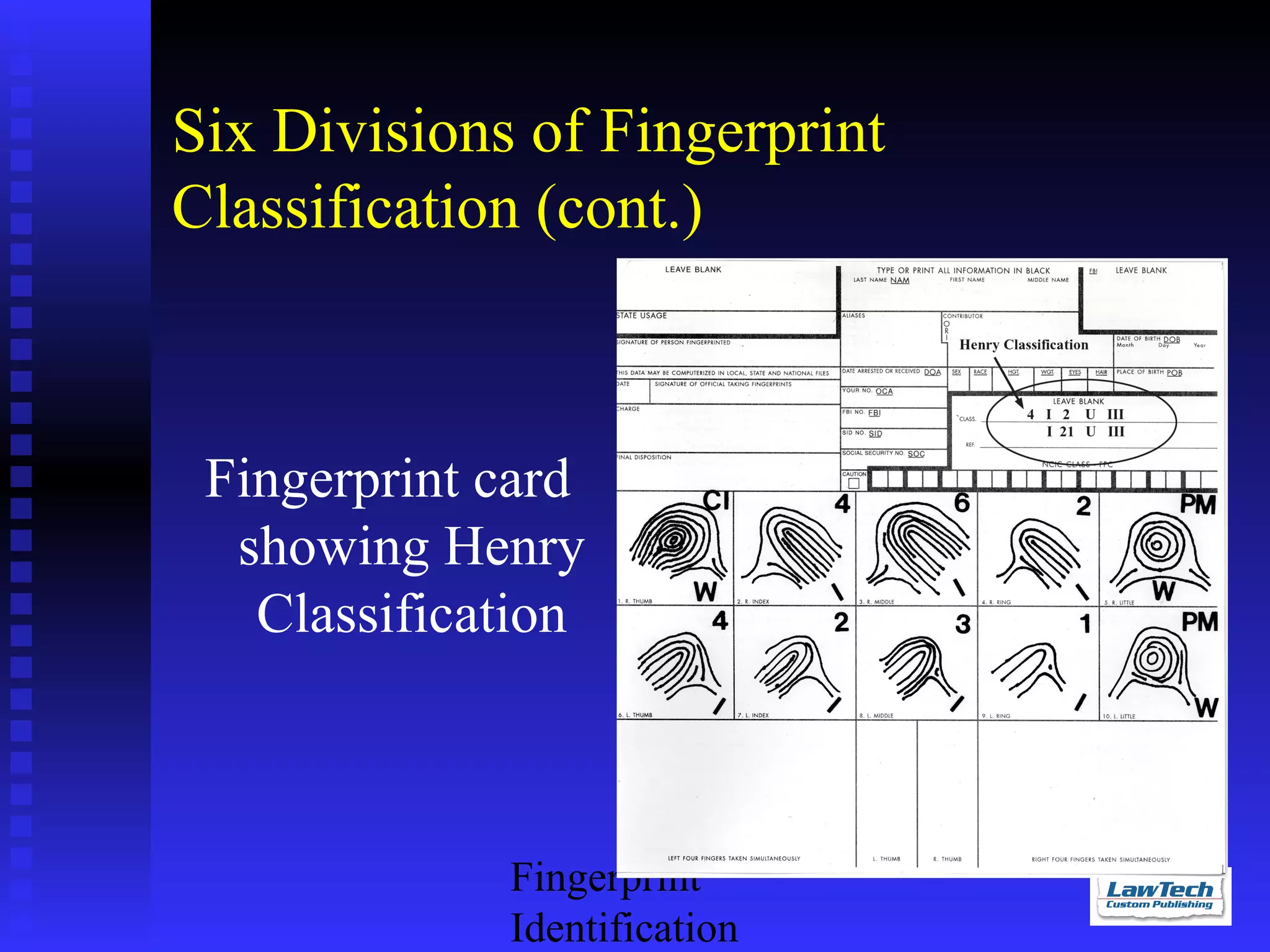
Fingerprint card
showing Henry
Classification

Fingerprint
Identification
The NCIC Classification System


Two letter or number codes used to identify
fingerprint pattern type
Plain arch → AA
 Tented arch → TT
 Ulnar loop → ridge count
 Radial loop → ridge count plus 50
 Plain whorl → P, plus the tracing I,M, or O


Fingerprint
Identification
The NCIC Classification System (cont.)


Two letter or number codes (cont.)
Central Pocket → loop C, plus the tracing I, M,
or O
 Double loop whorl → small d plus tracing I, M,
or O
 Accidental → X, plus the tracing I, M, or O
 Missing finger → XX
 Scar or mutilation → SR


Fingerprint
Identification
The NCIC Classification System (cont.)
 Fingers

listed in order of finger
numbers on a ten-finger fingerprint
card
Right thumb is number 1
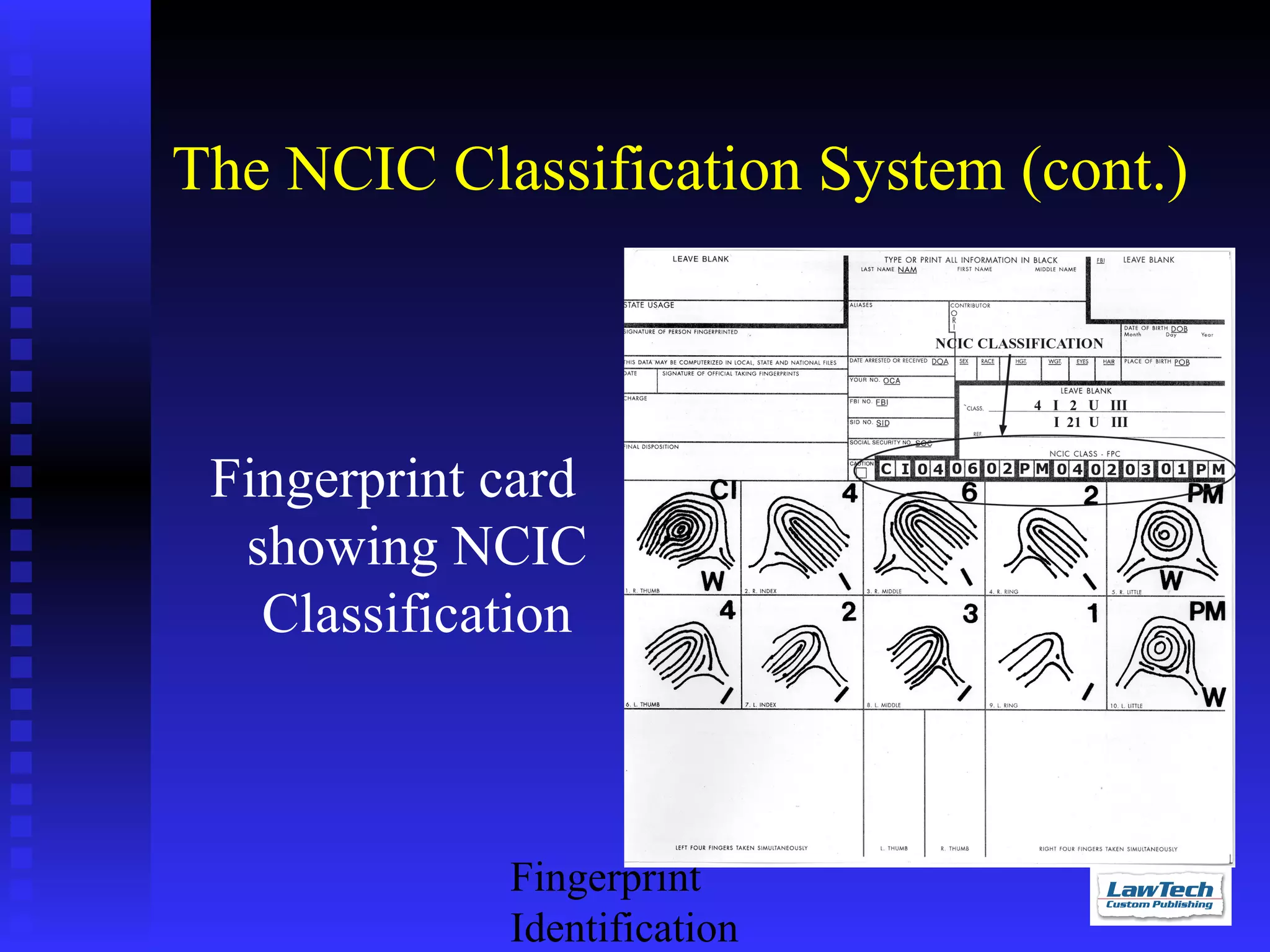
 Example: A5612CIPM dM661415XX
 Classification placed in twenty small
boxes that appear just above the
fingerprint boxes


Fingerprint
Identification
The NCIC Classification System (cont.)

Fingerprint card
showing NCIC
Classification

Fingerprint
Identification
Discussion Questions
“Blocking out” refers to the marking pattern
types, ridge counts, and whorl type and
tracing on a fingerprint card. True or False?
 A fingerprint card with a primary
classification of 1 over 1 would contain no
whorls. True or False?
 What fingerprint classification is used for
an electronic warrant?


Fingerprint
Identification

fingerprint classification systems Henry and NCIC

  • 1.
    Fingerprint Identification Chapter 10Fingerprint Classification Systems LawTech Custom Publishing, Inc. Copyright 2005
  • 2.
    Overview  Fingerprint classification describesan individual’s fingerprints  Fingerprint classifications use codes on fingerprint cards to file and retrieve manual filing system Fingerprint Identification
  • 3.
    Chapter Objectives  Understand classificationof fingerprint card using Henry system  Understand classification of fingerprint card using NCIC system Fingerprint Identification
  • 4.
    Introduction  Henry System ofClassification used for most of 20th Century in U.S. and most English speaking countries Named after Sir Edward Henry of England  Developed system during late 1800s and early 1900s  Fingerprint Identification
  • 5.
    Introduction (cont.)  National CrimeInformation Center (NCIC) Classification System Computerized database used in U.S.  Allows law enforcement agencies nationwide access to wanted bulletins and warrants for outstanding suspects and fugitives  Fingerprint Identification
  • 6.
    Introduction (cont.)  NCIC ClassificationSystem (cont.) Short cut to Henry System for quick evaluation and possible elimination of individuals as suspects  Further investigation required for individuals that match NCIC classification including a full fingerprint search  Fingerprint Identification
  • 7.
    Introduction (cont.) Both classificationsystems based on 10 fingers  Automation of fingerprint files will render manual classification filing systems obsolete  Knowledge of fingerprint patterns and anatomy of hand useful and valuable information for fingerprint examiner  Fingerprint Identification
  • 8.
    Introduction (cont.)   Fingerprint classificationnot the same as fingerprint identification Classification uses class characteristics to group like fingerprints for filing and retrieval   Many people have same fingerprint classification Fingerprint identification uses individual characteristics to individualize a print to a specific person Fingerprint Identification
  • 9.
    Introduction (cont.)   Fingerprint classificationof suspect may appear on wanted bulletins and arrest warrants Law enforcement can use information as a screening tool to eliminate persons being sought   Classifications that are quite different could be used to exclude suspected individuals Classifications that are similar or match would be submitted to agency holding warrant to compare to actual fingerprints Fingerprint Identification
  • 10.
    The Henry Systemof Classification  Blocking Out the Fingerprint Card   Determine pattern type in each finger block Indicate pattern using symbols at the bottom middle or right side of each finger box on fingerprint card  Plain Arch → A  Tented Arch → T  Ulnar Loop → / in direction of the loop  Radial Loop → R  All Whorls → W Fingerprint Identification
  • 11.
    The Henry Systemof Classification (cont.)  Index finger boxes Use capital letter of pattern type, except for ulnar loop  Ulnar loops designated by a diagonal line slanting in the direction of loop   All  other finger boxes Use small letter to indicate pattern type, except for ulnar loop (same as above) Fingerprint Identification
  • 12.
    The Henry Systemof Classification (cont.)  Loop type patterns   Place ridge count in top right hand corner of finger box Whorl patterns   Indicate type in upper right corner of finger box  P – plain  C – central pocket  Small d – double loop  X – accidental whorl Indicate tracing (I, M, O) next to letter designating whorl pattern in top right corner of finger box Fingerprint Identification
  • 13.
    The Henry Systemof Classification (cont.) Blocked out fingerprint card Fingerprint Identification
  • 14.
    Six Divisions ofFingerprint Classification  Primary  Only whorl patterns have value Finger #1 and #2 → 6 Finger #3 and #4 → 8 Finger #5 and #6 → 4 Finger #7 and #8 → 2 Finger #9 and #10 → 1 Fingerprint Identification
  • 15.
    Six Divisions ofFingerprint Classification (cont.) Primary Chart Fingerprint Identification
  • 16.
    Six Divisions ofFingerprint Classification (cont.) Whorl values for odd number fingers are added up, plus 1 for the total denominator  Whorl values for even number fingers are added up, plus 1 for the total numerator  Primary reported as a fraction Total numerator (top, even numbered boxes) over the denominator (bottom, odd numbered boxes)  Fingerprint Identification
  • 17.
    Six Divisions ofFingerprint Classification (cont.) Primary = 1 indicates no whorl patterns  Primary = 32 and over indicates all whorl patterns  Total of 1,024 possible primary classifications  Fingerprint Identification
  • 18.
    Six Divisions ofFingerprint Classification (cont.)  Secondary Indicated in fraction form Capital letter of pattern type for right index (#2) over left index (#7) fingers  U – ulnar loops  Example: W/U indicates right index finger is whorl, and left index finger is ulanr loop  Fingerprint Identification
  • 19.
    Six Divisions ofFingerprint Classification (cont.)  Small Letter Group Secondary Applies to fingerprint cards that have a plain arch, tented arch, or radial loop  Excludes index fingers  Location of plain arch, tented arch or radial loops by small letter a, t, or r indicated to right or left of secondary  Example: small letter a to the left of the top capital letter of the secondary indicates that a plain arch is in right thumb  Fingerprint Identification
  • 20.
    Six Divisions ofFingerprint Classification (cont.)  Dashes used to indicate position of fingers not containing a plain arch, tented arch or radial loop in the middle, ring or little fingers to the left of the secondary Example: - a in the denominator (lower) line of the fraction to the right of the capital letter secondary indicate a plain arch in left little finger Fingerprint Identification
  • 21.
    Six Divisions ofFingerprint Classification (cont.)   Print cards with small letter groups do not need to add the sub-secondary or major divisions to the classification formula Sub-secondary  Value of ridge counts or tracings of right index (2), right middle (3), and right ring (4) fingers over the values of the left index (7), left middle (8), and left ring (9) fingers Fingerprint Identification
  • 22.
    Six Divisions ofFingerprint Classification (cont.)  Key  Ridge count of first loop, excluding little fingers  Major  Value of ridge counts or tracings of right and left thumbs Fingerprint Identification
  • 23.
    Six Divisions ofFingerprint Classification (cont.)  Final  Ridge count of loop in right little finger (5) If right little finger #5 is not a loop, use left little finger #10 If finger #10 is not a loop then there is no final value Fingerprint Identification
  • 24.
    Six Divisions ofFingerprint Classification (cont.)  VALUES TABLE FOR LOOP RIDGE COUNT CONVERSIONS       Index fingers 1-9 = I; 10 or more = O Middle fingers 1-10 = I; 11 or more = O Ring fingers 1-13 = I; 14 or more = O Right thumb 1-11 = S; 12-16 = M; 17 or more = L  when the left thumb ridge count is 16 or less Right thumb 1-17 = S; 18-22 = M; 23 or more = L  when the left thumb ridge count is 17 or more Left thumb 1-11 = S; 12-16 = M; 17 or more = L Fingerprint Identification
  • 25.
    Six Divisions ofFingerprint Classification (cont.) Fingerprint card showing Henry Classification Fingerprint Identification
  • 26.
    The NCIC ClassificationSystem  Two letter or number codes used to identify fingerprint pattern type Plain arch → AA  Tented arch → TT  Ulnar loop → ridge count  Radial loop → ridge count plus 50  Plain whorl → P, plus the tracing I,M, or O  Fingerprint Identification
  • 27.
    The NCIC ClassificationSystem (cont.)  Two letter or number codes (cont.) Central Pocket → loop C, plus the tracing I, M, or O  Double loop whorl → small d plus tracing I, M, or O  Accidental → X, plus the tracing I, M, or O  Missing finger → XX  Scar or mutilation → SR  Fingerprint Identification
  • 28.
    The NCIC ClassificationSystem (cont.)  Fingers listed in order of finger numbers on a ten-finger fingerprint card Right thumb is number 1  Example: A5612CIPM dM661415XX  Classification placed in twenty small boxes that appear just above the fingerprint boxes  Fingerprint Identification
  • 29.
    The NCIC ClassificationSystem (cont.) Fingerprint card showing NCIC Classification Fingerprint Identification
  • 30.
    Discussion Questions “Blocking out”refers to the marking pattern types, ridge counts, and whorl type and tracing on a fingerprint card. True or False?  A fingerprint card with a primary classification of 1 over 1 would contain no whorls. True or False?  What fingerprint classification is used for an electronic warrant?  Fingerprint Identification