BUDGET, DEFICIT
AND DEFICIT
FINANCING
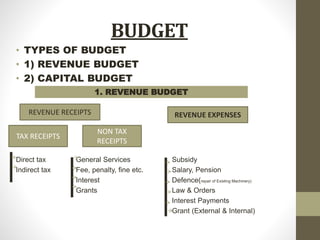
BUDGET
• TYPES OF BUDGET
• 1) REVENUE BUDGET
• 2) CAPITAL BUDGET
Direct tax General Services Subsidy
Indirect tax Fee, penalty, fine etc. Salary, Pension
Interest Defence(repair of Existing Machinery)
Grants Law & Orders
Interest Payments
Grant (External & Internal)
1. REVENUE BUDGET
REVENUE RECEIPTS REVENUE EXPENSES
TAX RECEIPTS
NON TAX
RECEIPTS
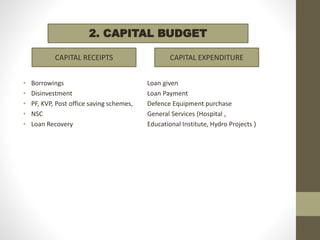
• Borrowings Loan given
• Disinvestment Loan Payment
• PF, KVP, Post office saving schemes, Defence Equipment purchase
• NSC General Services (Hospital ,
• Loan Recovery Educational Institute, Hydro Projects )
2. CAPITAL BUDGET
CAPITAL RECEIPTS CAPITAL EXPENDITURE
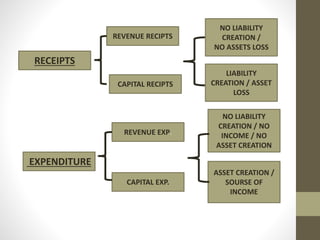
RECEIPTS
CAPITAL RECIPTS
REVENUE RECIPTS
CAPITAL EXP.
REVENUE EXP.
EXPENDITURE
NO LIABILITY
CREATION /
NO ASSETS LOSS
LIABILITY
CREATION / ASSET
LOSS
NO LIABILITY
CREATION / NO
INCOME / NO
ASSET CREATION
ASSET CREATION /
SOURSE OF
INCOME
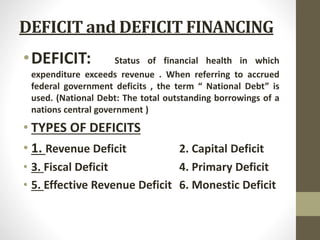
DEFICIT and DEFICIT FINANCING
•DEFICIT: Status of financial health in which
expenditure exceeds revenue . When referring to accrued
federal government deficits , the term “ National Debt” is
used. (National Debt: The total outstanding borrowings of a
nations central government )
• TYPES OF DEFICITS
• 1. Revenue Deficit 2. Capital Deficit
• 3. Fiscal Deficit 4. Primary Deficit
• 5. Effective Revenue Deficit 6. Monestic Deficit
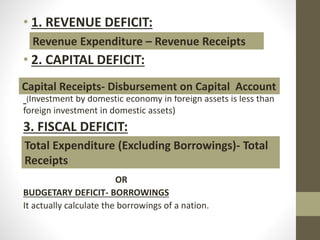
• 1. REVENUE DEFICIT:
• 2. CAPITAL DEFICIT:
(Investment by domestic economy in foreign assets is less than
foreign investment in domestic assets)
3. FISCAL DEFICIT:
OR
BUDGETARY DEFICIT- BORROWINGS
It actually calculate the borrowings of a nation.
Revenue Expenditure – Revenue Receipts
Capital Receipts- Disbursement on Capital Account
Total Expenditure (Excluding Borrowings)- Total
Receipts
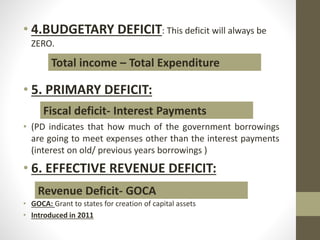
• 4.BUDGETARY DEFICIT: This deficit will always be
ZERO.
• 5. PRIMARY DEFICIT:
• (PD indicates that how much of the government borrowings
are going to meet expenses other than the interest payments
(interest on old/ previous years borrowings )
• 6. EFFECTIVE REVENUE DEFICIT:
• GOCA: Grant to states for creation of capital assets
• Introduced in 2011
Total income – Total Expenditure
Fiscal deficit- Interest Payments
Revenue Deficit- GOCA
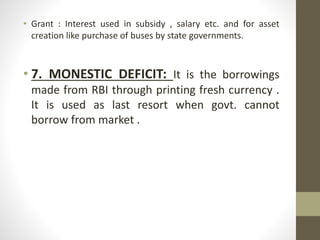
• Grant : Interest used in subsidy , salary etc. and for asset
creation like purchase of buses by state governments.
• 7. MONESTIC DEFICIT: It is the borrowings
made from RBI through printing fresh currency .
It is used as last resort when govt. cannot
borrow from market .
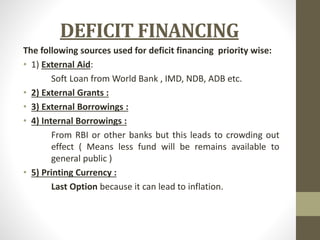
DEFICIT FINANCING
The following sources used for deficit financing priority wise:
• 1) External Aid:
Soft Loan from World Bank , IMD, NDB, ADB etc.
• 2) External Grants :
• 3) External Borrowings :
• 4) Internal Borrowings :
From RBI or other banks but this leads to crowding out
effect ( Means less fund will be remains available to
general public )
• 5) Printing Currency :
Last Option because it can lead to inflation.
THANKING YOU
SUNEHA SHARMA
COMPANY SECRETARY , LL.B ,
MCOM

Budget, deficit and deficit financing

  • 1.
  • 2.
    BUDGET • TYPES OFBUDGET • 1) REVENUE BUDGET • 2) CAPITAL BUDGET Direct tax General Services Subsidy Indirect tax Fee, penalty, fine etc. Salary, Pension Interest Defence(repair of Existing Machinery) Grants Law & Orders Interest Payments Grant (External & Internal) 1. REVENUE BUDGET REVENUE RECEIPTS REVENUE EXPENSES TAX RECEIPTS NON TAX RECEIPTS
  • 3.
    • Borrowings Loangiven • Disinvestment Loan Payment • PF, KVP, Post office saving schemes, Defence Equipment purchase • NSC General Services (Hospital , • Loan Recovery Educational Institute, Hydro Projects ) 2. CAPITAL BUDGET CAPITAL RECEIPTS CAPITAL EXPENDITURE
  • 4.
    RECEIPTS CAPITAL RECIPTS REVENUE RECIPTS CAPITALEXP. REVENUE EXP. EXPENDITURE NO LIABILITY CREATION / NO ASSETS LOSS LIABILITY CREATION / ASSET LOSS NO LIABILITY CREATION / NO INCOME / NO ASSET CREATION ASSET CREATION / SOURSE OF INCOME
  • 5.
    DEFICIT and DEFICITFINANCING •DEFICIT: Status of financial health in which expenditure exceeds revenue . When referring to accrued federal government deficits , the term “ National Debt” is used. (National Debt: The total outstanding borrowings of a nations central government ) • TYPES OF DEFICITS • 1. Revenue Deficit 2. Capital Deficit • 3. Fiscal Deficit 4. Primary Deficit • 5. Effective Revenue Deficit 6. Monestic Deficit
  • 6.
    • 1. REVENUEDEFICIT: • 2. CAPITAL DEFICIT: (Investment by domestic economy in foreign assets is less than foreign investment in domestic assets) 3. FISCAL DEFICIT: OR BUDGETARY DEFICIT- BORROWINGS It actually calculate the borrowings of a nation. Revenue Expenditure – Revenue Receipts Capital Receipts- Disbursement on Capital Account Total Expenditure (Excluding Borrowings)- Total Receipts
  • 7.
    • 4.BUDGETARY DEFICIT:This deficit will always be ZERO. • 5. PRIMARY DEFICIT: • (PD indicates that how much of the government borrowings are going to meet expenses other than the interest payments (interest on old/ previous years borrowings ) • 6. EFFECTIVE REVENUE DEFICIT: • GOCA: Grant to states for creation of capital assets • Introduced in 2011 Total income – Total Expenditure Fiscal deficit- Interest Payments Revenue Deficit- GOCA
  • 8.
    • Grant :Interest used in subsidy , salary etc. and for asset creation like purchase of buses by state governments. • 7. MONESTIC DEFICIT: It is the borrowings made from RBI through printing fresh currency . It is used as last resort when govt. cannot borrow from market .
  • 9.
    DEFICIT FINANCING The followingsources used for deficit financing priority wise: • 1) External Aid: Soft Loan from World Bank , IMD, NDB, ADB etc. • 2) External Grants : • 3) External Borrowings : • 4) Internal Borrowings : From RBI or other banks but this leads to crowding out effect ( Means less fund will be remains available to general public ) • 5) Printing Currency : Last Option because it can lead to inflation.
  • 10.
    THANKING YOU SUNEHA SHARMA COMPANYSECRETARY , LL.B , MCOM