ACCOUNTING FOR
MANAGERS
Dr.R.Vasanthagopal
University of Kerala
Accounting-Introduction
Accounting is the art of recording, classifying and
summarizing in a significant manner and in terms of money,
transactions and events which are, in part at least, of
financial character and interpreting the results thereof
(American Institute of Certified Public Accountants
(AICPA))
Purpose of Accounting
 To provide the means of guiding and controlling the
business activities
 To analyze and interpret the results enabling the
management to find out the past, present and future
 To provide guidelines for making wise decisions to achieve
the corporate objectives
Book Keeping Vs. Accounting
 Book keeping is the art and science of recording business
transactions in a systematic manner
 The scope of book keeping is confined to recording of
business transactions only.
 Accounting on the other hand processes, analyses and
interprets the data for the purpose of meeting the
requirements of different users.
 Thus, book keeping represents only a part of total
accounting system
 However, book keeping serves as the base for accounting.
Branches of Accounting
 Financial Accounting
 Cost Accounting
 Management Accounting
 Each branch emerged owing to the developments in
the corporate world
 Cost accounting and management accounting cannot
exist without a suitable system of financial accounting
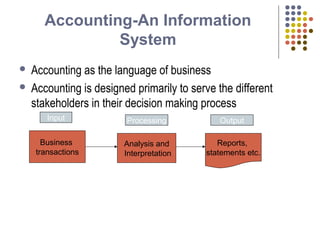
Accounting-An Information
System
 Accounting as the language of business
 Accounting is designed primarily to serve the different
stakeholders in their decision making process
Business
transactions
Analysis and
Interpretation
Reports,
statements etc.
Input Processing Output
Users of Accounting Information
 Internal parties
 Top management
 Middle managers
 Lower level managers
 External parties
 Share holders
 Debenture holders
 Other financiers
 Govt. and tax authorities
 General public
Uses of Accounting Information
 Managerial decisions
 Managerial planning
 Managerial control
 Evaluation of performance
 Assistance to external parties
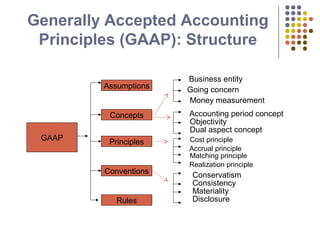
Generally Accepted Accounting
Principles (GAAP)
 GAAPs guide an govern the accountants in their
functions of preparing the Accounting reports.
 GAAPs comprise of
 Assumptions
 Concepts
 Principles
 Conventions and
 Rules
Generally Accepted Accounting
Principles (GAAP): Structure
GAAP
Assumptions
Concepts
Principles
Conventions
Rules
Cost principle
Business entity
Going concern
Money measurement
Accounting period concept
Objectivity
Dual aspect concept
Accrual principle
Matching principle
Realization principle
Conservatism
Consistency
Materiality
Disclosure
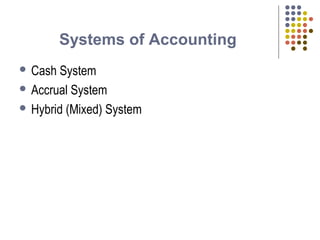
Systems of Accounting
 Cash System
 Accrual System
 Hybrid (Mixed) System
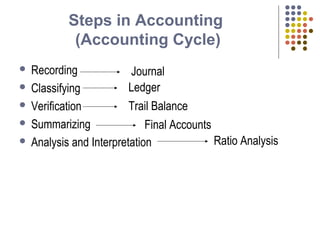
Steps in Accounting
(Accounting Cycle)
 Recording
 Classifying
 Verification
 Summarizing
 Analysis and Interpretation
Journal
Ledger
Final Accounts
Ratio Analysis
Trail Balance
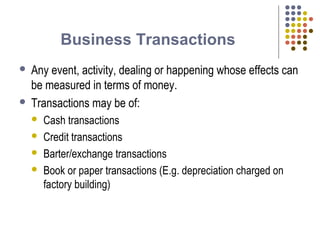
Business Transactions
 Any event, activity, dealing or happening whose effects can
be measured in terms of money.
 Transactions may be of:
 Cash transactions
 Credit transactions
 Barter/exchange transactions
 Book or paper transactions (E.g. depreciation charged on
factory building)
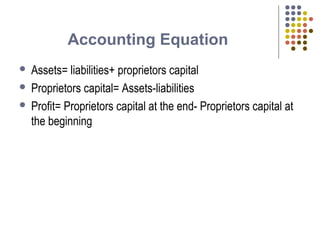
Accounting Equation
 Assets= liabilities+ proprietors capital
 Proprietors capital= Assets-liabilities
 Profit= Proprietors capital at the end- Proprietors capital at
the beginning
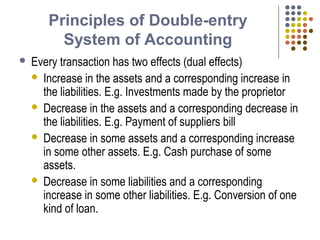
Principles of Double-entry
System of Accounting
 Every transaction has two effects (dual effects)
 Increase in the assets and a corresponding increase in
the liabilities. E.g. Investments made by the proprietor
 Decrease in the assets and a corresponding decrease in
the liabilities. E.g. Payment of suppliers bill
 Decrease in some assets and a corresponding increase
in some other assets. E.g. Cash purchase of some
assets.
 Decrease in some liabilities and a corresponding
increase in some other liabilities. E.g. Conversion of one
kind of loan.
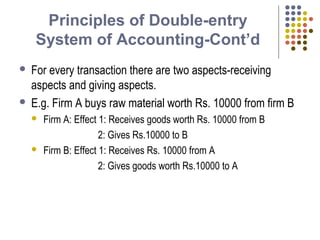
Principles of Double-entry
System of Accounting-Cont’d
 For every transaction there are two aspects-receiving
aspects and giving aspects.
 E.g. Firm A buys raw material worth Rs. 10000 from firm B
 Firm A: Effect 1: Receives goods worth Rs. 10000 from B
2: Gives Rs.10000 to B
 Firm B: Effect 1: Receives Rs. 10000 from A
2: Gives goods worth Rs.10000 to A
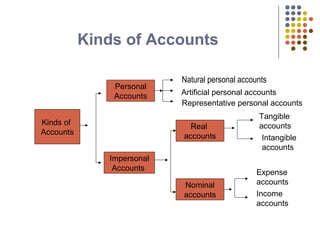
Kinds of Accounts
Kinds of
Accounts
Personal
Accounts
Impersonal
Accounts
Real
accounts
Nominal
accounts
Natural personal accounts
Artificial personal accounts
Representative personal accounts
Tangible
accounts
Intangible
accounts
Expense
accounts
Income
accounts
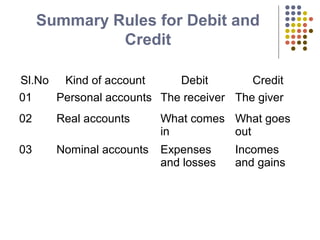
Summary Rules for Debit and
Credit
Sl.No Kind of account Debit Credit
01 Personal accounts The receiver The giver
02 Real accounts What comes
in
What goes
out
03 Nominal accounts Expenses
and losses
Incomes
and gains
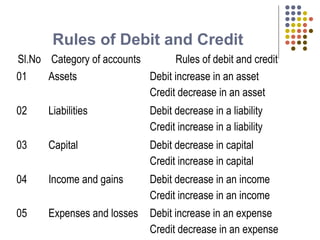
Rules of Debit and Credit
Sl.No Category of accounts Rules of debit and credit
01 Assets Debit increase in an asset
Credit decrease in an asset
02 Liabilities Debit decrease in a liability
Credit increase in a liability
03 Capital Debit decrease in capital
Credit increase in capital
04 Income and gains Debit decrease in an income
Credit increase in an income
05 Expenses and losses Debit increase in an expense
Credit decrease in an expense
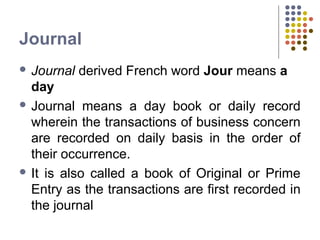
Journal
 Journal derived French word Jour means a
day
 Journal means a day book or daily record
wherein the transactions of business concern
are recorded on daily basis in the order of
their occurrence.
 It is also called a book of Original or Prime
Entry as the transactions are first recorded in
the journal
Ledger
 Ledger is derived from the Dutch word
Lagger means Lie (kept).
 It refers to a book wherein different accounts
of all persons, assets, expenses,
incomes,etc.are kept and maintained.
 It is also called Book of Secondary or Final
Entry.
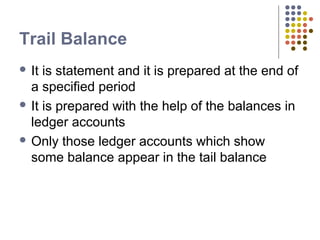
Trail Balance
 It is statement and it is prepared at the end of
a specified period
 It is prepared with the help of the balances in
ledger accounts
 Only those ledger accounts which show
some balance appear in the tail balance

Accounting for managers

  • 1.
  • 2.
    Accounting-Introduction Accounting is theart of recording, classifying and summarizing in a significant manner and in terms of money, transactions and events which are, in part at least, of financial character and interpreting the results thereof (American Institute of Certified Public Accountants (AICPA))
  • 3.
    Purpose of Accounting To provide the means of guiding and controlling the business activities  To analyze and interpret the results enabling the management to find out the past, present and future  To provide guidelines for making wise decisions to achieve the corporate objectives
  • 4.
    Book Keeping Vs.Accounting  Book keeping is the art and science of recording business transactions in a systematic manner  The scope of book keeping is confined to recording of business transactions only.  Accounting on the other hand processes, analyses and interprets the data for the purpose of meeting the requirements of different users.  Thus, book keeping represents only a part of total accounting system  However, book keeping serves as the base for accounting.
  • 5.
    Branches of Accounting Financial Accounting  Cost Accounting  Management Accounting  Each branch emerged owing to the developments in the corporate world  Cost accounting and management accounting cannot exist without a suitable system of financial accounting
  • 6.
    Accounting-An Information System  Accountingas the language of business  Accounting is designed primarily to serve the different stakeholders in their decision making process Business transactions Analysis and Interpretation Reports, statements etc. Input Processing Output
  • 7.
    Users of AccountingInformation  Internal parties  Top management  Middle managers  Lower level managers  External parties  Share holders  Debenture holders  Other financiers  Govt. and tax authorities  General public
  • 8.
    Uses of AccountingInformation  Managerial decisions  Managerial planning  Managerial control  Evaluation of performance  Assistance to external parties
  • 9.
    Generally Accepted Accounting Principles(GAAP)  GAAPs guide an govern the accountants in their functions of preparing the Accounting reports.  GAAPs comprise of  Assumptions  Concepts  Principles  Conventions and  Rules
  • 10.
    Generally Accepted Accounting Principles(GAAP): Structure GAAP Assumptions Concepts Principles Conventions Rules Cost principle Business entity Going concern Money measurement Accounting period concept Objectivity Dual aspect concept Accrual principle Matching principle Realization principle Conservatism Consistency Materiality Disclosure
  • 11.
    Systems of Accounting Cash System  Accrual System  Hybrid (Mixed) System
  • 12.
    Steps in Accounting (AccountingCycle)  Recording  Classifying  Verification  Summarizing  Analysis and Interpretation Journal Ledger Final Accounts Ratio Analysis Trail Balance
  • 13.
    Business Transactions  Anyevent, activity, dealing or happening whose effects can be measured in terms of money.  Transactions may be of:  Cash transactions  Credit transactions  Barter/exchange transactions  Book or paper transactions (E.g. depreciation charged on factory building)
  • 14.
    Accounting Equation  Assets=liabilities+ proprietors capital  Proprietors capital= Assets-liabilities  Profit= Proprietors capital at the end- Proprietors capital at the beginning
  • 15.
    Principles of Double-entry Systemof Accounting  Every transaction has two effects (dual effects)  Increase in the assets and a corresponding increase in the liabilities. E.g. Investments made by the proprietor  Decrease in the assets and a corresponding decrease in the liabilities. E.g. Payment of suppliers bill  Decrease in some assets and a corresponding increase in some other assets. E.g. Cash purchase of some assets.  Decrease in some liabilities and a corresponding increase in some other liabilities. E.g. Conversion of one kind of loan.
  • 16.
    Principles of Double-entry Systemof Accounting-Cont’d  For every transaction there are two aspects-receiving aspects and giving aspects.  E.g. Firm A buys raw material worth Rs. 10000 from firm B  Firm A: Effect 1: Receives goods worth Rs. 10000 from B 2: Gives Rs.10000 to B  Firm B: Effect 1: Receives Rs. 10000 from A 2: Gives goods worth Rs.10000 to A
  • 17.
    Kinds of Accounts Kindsof Accounts Personal Accounts Impersonal Accounts Real accounts Nominal accounts Natural personal accounts Artificial personal accounts Representative personal accounts Tangible accounts Intangible accounts Expense accounts Income accounts
  • 18.
    Summary Rules forDebit and Credit Sl.No Kind of account Debit Credit 01 Personal accounts The receiver The giver 02 Real accounts What comes in What goes out 03 Nominal accounts Expenses and losses Incomes and gains
  • 19.
    Rules of Debitand Credit Sl.No Category of accounts Rules of debit and credit 01 Assets Debit increase in an asset Credit decrease in an asset 02 Liabilities Debit decrease in a liability Credit increase in a liability 03 Capital Debit decrease in capital Credit increase in capital 04 Income and gains Debit decrease in an income Credit increase in an income 05 Expenses and losses Debit increase in an expense Credit decrease in an expense
  • 20.
    Journal  Journal derivedFrench word Jour means a day  Journal means a day book or daily record wherein the transactions of business concern are recorded on daily basis in the order of their occurrence.  It is also called a book of Original or Prime Entry as the transactions are first recorded in the journal
  • 21.
    Ledger  Ledger isderived from the Dutch word Lagger means Lie (kept).  It refers to a book wherein different accounts of all persons, assets, expenses, incomes,etc.are kept and maintained.  It is also called Book of Secondary or Final Entry.
  • 22.
    Trail Balance  Itis statement and it is prepared at the end of a specified period  It is prepared with the help of the balances in ledger accounts  Only those ledger accounts which show some balance appear in the tail balance