Meaning
• Financial ManagementFinancial management
is mainly concerned with the proper
management of funds. The finance manager
must see that funds are procured in such a
manner that risk, cost and control
considerations are properly balanced and
there is optimum utilization of fund
3.
Meaning of FinancialManagement
• Financial Management means planning,
organizing, directing and controlling the
financial activities such as procurement and
utilization of funds of the enterprise. It means
applying general management principles to
financial resources of the enterprise.
4.
Defination
• According toSoloman , “Financial
management is concerned with the efficient
use of economic resources”.
• According to Phillippatus , “Financial
management is concerned with management
decision that result in acquisition and
financing of long-term and short-term credits
for the firm
6.
Scope of financialmanagement
• The scope and functions of financial
management is classified in two categories.
• - Traditional approach
• - Modern approach
7.
Traditional approach
• Thetraditional approach Evolved during the
1920’s and 1930’s known as ‘Corporation
Finance’.
• According to this approach, the scope of the
finance function is restricted to “procurement of
funds by corporate enterprise to meet their
financial needs.
• The term ‘procurement’ refers to raising of funds
externally as well as the inter related aspects of
raising funds.
8.
Traditional approach
• Intraditional approach the resources could be
raised from the combination of the available
sources.
• The inter related aspects are the institutional
arrangement for finance, financial instruments
through which funds are raised and legal and
accounting aspects between the firm and its
sources of funds.
9.
Limitations of traditionalapproach
• This approach is confirmed to ‘procurement of funds’ only.
• It fails to consider an important aspects i.e. allocation of
funds.
• It deals with only outside I.e. investors, investment bankers.
• The internal decision making is completely ignored in this
approach.
• The traditional approach fails to consider the problems
involved in working capital management.
• The traditional approach neglected the issues relating to the
allocation and management of funds and failed to make
financial decisions.
10.
Modern approach
• Themodern approach is an analytical way of
looking into financial problems of the firm.
According to this approach, the finance
function covers both acquisition of funds as
well as the allocation of funds to various uses.
Financial management is concerned with the
issues involved in raising of funds and efficient
and wise allocation of funds
11.
Main Contents ofModern approach
• How large should an enterprise be and how
far it should grow?
• In what form should it hold its assets?
• How should the funds required be raised?
• Financial management is concerned with
finding answer to the above problems.
12.
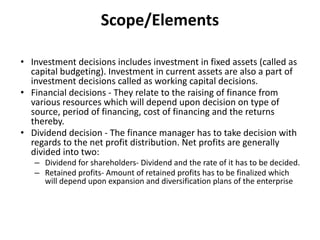
Scope/Elements
• Investment decisionsincludes investment in fixed assets (called as
capital budgeting). Investment in current assets are also a part of
investment decisions called as working capital decisions.
• Financial decisions - They relate to the raising of finance from
various resources which will depend upon decision on type of
source, period of financing, cost of financing and the returns
thereby.
• Dividend decision - The finance manager has to take decision with
regards to the net profit distribution. Net profits are generally
divided into two:
– Dividend for shareholders- Dividend and the rate of it has to be decided.
– Retained profits- Amount of retained profits has to be finalized which
will depend upon expansion and diversification plans of the enterprise
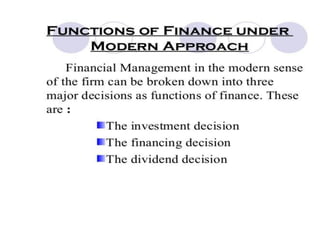
14.
Investment Decision
• Oneof the most important finance functions is to intelligently
allocate capital to long term assets. This activity is also known as
capital budgeting. It is important to allocate capital in those long
term assets so as to get maximum yield in future. Following are
the two aspects of investment decision
• Evaluation of new investment in terms of profitability
• Comparison of cut off rate against new investment and prevailing
investment.
• Since the future is uncertain therefore there are difficulties in
calculation of expected return. Along with uncertainty comes the
risk factor which has to be taken into consideration. This risk factor
plays a very significant role in calculating the expected return of
the prospective investment. Therefore while considering
investment proposal it is important to take into consideration both
expected return and the risk involved.
15.
Financial Decision
• Financialdecision is yet another important function which a financial
manger must perform. It is important to make wise decisions about when,
where and how should a business acquire funds. Funds can be acquired
through many ways and channels. Broadly speaking a correct ratio of an
equity and debt has to be maintained. This mix of equity capital and debt
is known as a firm’s capital structure.
• A firm tends to benefit most when the market value of a company’s share
maximizes this not only is a sign of growth for the firm but also maximizes
shareholders wealth. On the other hand the use of debt affects the risk
and return of a shareholder. It is more risky though it may increase the
return on equity funds.
• A sound financial structure is said to be one which aims at maximizing
shareholders return with minimum risk. In such a scenario the market
value of the firm will maximize and hence an optimum capital structure
would be achieved. Other than equity and debt there are several other
tools which are used in deciding a firm capital structure.
16.
Dividend Decision
• Earningprofit or a positive return is a common aim of
all the businesses. But the key function a financial
manger performs in case of profitability is to decide
whether to distribute all the profits to the shareholder
or retain all the profits or distribute part of the profits
to the shareholder and retain the other half in the
business.
• It’s the financial manager’s responsibility to decide a
optimum dividend policy which maximizes the market
value of the firm. Hence an optimum dividend payout
ratio is calculated. It is a common practice to pay
regular dividends in case of profitability Another way is
to issue bonus shares to existing shareholders.
17.
Objectives of Financialmanagement
• The objective provide a framework for
optimum financial decision making. They are
concerned with designing a method of
operating the internal investment and
financing of a firm.there are two widely
discussed approaches under this, these are:
Profit Maximisation Wealth Maximisation
18.
Profit Maximisation
• ProfitMaximisation Profit /EPS maximisation
should be undertaken and those that decrease
profits or EPS are to be avoided. Profit is the test
of economic efficiency. It leads to efficient
allocation of resources, as resources tend to be
directed to uses which in terms of profitability are
the most desirable. Financial management is
mainly concerned with the efficient economic
resources namely capital. The main technical flaws
of this criteria are : Ambiguity Timing of
benefits Quality of benefits
19.
Wealth Maximisation
• Wealthmaximisation is also known as Value or Net
present worth maximisation. Its operational features
satisfy all the three requirements of the operational of
the financial course of action namely, exactness,
quality of benefits, and the time value of money. Two
important issues related to the value/share price
maximisation are: Focus on stakeholders ,stakeholders
include groups such as employees, customers,
suppliers, creditors, owners and others who have a
direct link to the firm.
• EVA (Economic Value Added) –EVA is equal to the
after-tax operating profits of a firm less the cost of the
firm to finance investments.
20.
Wealth maximization vsprofit
maximization
• The financial management has come a long
way by shifting its focus from traditional
approach to modern approach.
The modern approach focuses on wealth
maximization rather than profit maximization.
This gives a longer term horizon for
assessment, making way for sustainable
performance by businesses.
21.
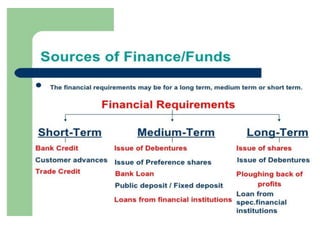
Sources Of Finance
•Sources of Finance :Capital required for a business
can be classified under two main categories, viz
• Fixed Capital, and - Working Capital. - every
business needs funds for two purposes. - for its
establishment and to carry out its day-to-day
operations.
• Long term funds are required to create production
facilities through purchase of fixed assets such as
:plant, - machinery, - land, - building, - furniture,
etc.
22.
Cont---
• Investment inthese asset represent that part
of firm’s capital which is blocked on
permanent or fixed basis and is called fixed
capital.
• Funds are also needed for short-term
purposes for the purchase of raw materials,
payment of wages and other day to day
expenses, etc. These funds are known as
working capital
23.
Cont---
• In factfinance is so indispensable today that is
rightly said that it is the life blood of
enterprise.
• With out adequate finance, no enterprise can
possibly accomplish its objectives.
• In every concern there are two methods of
raising finance, viz.,
• Raising of owned capital,
• Rising of borrowed capital
25.
Issue of shares
•The company’s owned capital is split into large
number of equal parts,such a part being called
a “share”.
• The person holding the share as shareholder
and becomes part-owner of the company.
• For this reason, the capital so raised is known
as “owned capital” and the shares are called
“ownership securities”.
26.
Issue of shares
•The share capital of the company is ideal for
meeting the long term requirements.
• It need not be paid back to the shareholders
within the life time of the company.
• The only exception is the sum raised by the
issue of redeemable preference shares.
27.
Types of shares
•A public company can issue two types of
share.
• Equity share
• Preference share
28.
Equity share
• Equityshare has number of special features
• The dividend on these shares are paid after
the dividend on preference share has been
paid.
• The rate of dividend depends upon the
amount of profits available and the intention
of directors
29.
Equity share
• TheEquity shareholders have the chance of
earning good dividends in times of prosperity
and run the risk of earning nothing in times of
adversity .
• The equity shareholders have a residual claim
on the company’s asset in case of liquidation.
• The company is controlled by the equity
shareholders and they are entitled to vote in
the meetings of the company.
30.
Preference shares
• Preferenceshares are those which carry preferential
right over other class of shares with regard to payment
of dividend and repayment of capital.
• The rate of dividend on preference share is a fixed one
• Preference Share are not traded on secondary market
but they are one of the best primary market
instrument for investors. 1. There are not easily
available: Usually, preference shares are most
commonly issued by companies to institutions.
31.
• Section 55of Companies Act, 2013 read with
rule 9 of the Companies (Share Capital and
Debentures) Rules, 2014 deals with issue &
redemption of preference share.
32.
Procedure of theissue:-
• Check whether issuing preference shares is authorized under the
Articles of the Company or not, if it is not so authorized then first
needs to amend the Articles of the Company.
• Conduct Board Meeting and call the General Meeting for this
purpose.
• An Explanatory Statement shall annexed with Notice calling the
General Meeting, and it shall contain the relevant facts regarding
the issue such as:-
– Size of the Issue, No. of Preference Shares, Nominal Value of the Shares
– Nature of the shares i.e. Cumulative/Non-cumulative,
Participating/Non-participating, Convertible/Non-convertible etc.
– Objective & Manner of the issue.
– Price at which shares are proposed to be issued & basis on which price
33.
• Terms ofissue, rate of dividend, terms &
tenure of redemption.
• Current shareholding pattern of the Company
• Expected dilution of Equity Shares upon
conversion (only if the nature of the issue is
convertible preference shares).
34.
Restrictions on issueof Preference
Shares under the Act:-
• There is a clear restriction on the Company to issue
irredeemable preference shares. A Company shall
redeem its preference shares within the time period of
20 years from the date of issue.
• However if a Company could not redeem its
preference share with-in this time period due to
unavoidable reasons then it may pass Special
Resolution with 3/4th Majority and file petition to the
NCLT and on the order of NCLT may issue preference
shares of same kind with similar rate of dividend for
some time period instead of redemption of existing
one.




![5) capital_budgeting_(1)_-(2)[1].ppt.pdf](https://cdn.slidesharecdn.com/ss_thumbnails/5capitalbudgeting121-250323135834-146732f6-thumbnail.jpg?width=640&height=640&fit=bounds)


