FINANCIAL MANAGEMENT:
Finance is defined as the provision of money at the time when it is required. Every
enterprise,
whether big, medium, small, needs finance to carry on its operations and to
achieve its target. In
fact, finance is so indispensable today that it is rightly said to be the blood of an
enterprise.
Without adequate finance, no enterprise can possibly accomplish its objectives.
Why there is a need for Finance: Every business needs funds both for short
term and long
term. They may need working capital, or, fixed capital. The finance may be
obtained from the
varied sources and through various instruments. The various sources of finance
include
shareholders, financial instruments, and financial institutions and so on. The
funds can be
collected through various instruments such as equity shares, debentures, fixed
deposits, loan agreements, and so on. The finance is needed at various stages and
for various purposes like promoting a business, smooth conduct of business
activities.
Meaning of Financial Management: Financial management refers to that part
of the
management activity, which is concerned with the planning, & controlling of
firm’s financial
resources. It deals with finding out various sources for raising funds for the firm.
Financial
management is practiced by many corporatefirms and can be called Corporation
finance or
Business Finance.
According to Guthmann and Dougall: “Business finance can be broadly
defined as the activity
concerned with the planning, raising controlling and administrating the funds
used in the
business.”
According to Joseph & Massie: “Financial Management is the operational
activity of a
business that is responsible for obtaining and effectively utilizing the funds
necessary for
efficient operations”
FUNCTIONS OF FINANCIAL MANAGEMENT
A financial manager has to concentrate on the following areas of the finance
function.
• FUNCTIONS
• FINANCING
• INVESTING
• DIVIDEND
Which can be explained in detail as follows:
1. Estimating Financial Requirements: The first task of the financial manager
is to estimate short term and long-term financial requirement of his business. For
this purpose,he will prepare a financial plan for present as well as future. The
amount required for purchasing fixed assets as well as the needs of funds for
working capital has to be ascertained. The estimation should be based on the
sound financial principles so that neither there are inadequate or excess funds
with the concern.
2. Deciding Capital Structure: The capital structure refers to the kind and
proportion of the different securities for raising funds. After deciding about the
quantum of funds required it should be decided which type of security should be
raised. Decision aboutvarious sources offunds should belinked to costofraising
funds. If cost of rising funds is high, then such sources may not be useful.A
decision about the kind of the securities to be employed and the proportion in
which these should be used is an important decision which influences the short
term and the long term planning of the enterprise.
3. Selecting a Source of Finance: After preparing a capital structure, an
appropriate source of finance is selected. Various sources from which finance
may beraised, includes share capital, debentures, financial deposits etc. Iffinance
is needed for short periods then banks, public’s deposits, financial institutions
may be appropriate. If long-term finance is required the share capital, debentures
may be useful.
4. Selecting a Pattern of Investment: When fund have been procured then a
decision about investment pattern is to be taken. The selection of investment
pattern is related to the use of the funds. A decision has to be taken as to which
assets are to be purchased? The fund will have to be spent first. Fixed asset and
the appropriate portion will be retained for the working capital.
5. Proper Cash Management: Cash management is an important task of
financial manager. He has to assess the various cash needs at different times and
then make arrangements for arranging cash. Cash may be required to make
payments to creditors,purchasing raw material, meet wage bills, and meet day to
day expenses. The sources of cashmay be Cashsales, Collection of debts, Short-
term arrangement with the banks. The cash management should be such that
neither there is shortage of it and nor it is idle. Any shortage of cashwill damage
the creditworthiness of the enterprise. The idle cash with the business mean that
it is not properly used.
6. Implementing Financial Controls: An efficient system of financial
management necessitates the use of various control devices. Financial control
device generally used are;
a. Return Investment
b. Ratio analysis
c. Break even analysis
d. Cost control
e. Cost and internal audit.
7. The use of various control techniques: This will help the financial manager
in evaluating the performance in various Areas and take corrective measures
whenever needed.
8. Proper use of Surpluses: The utilization of profits or surpluses as also an
important factor in financial management. A judicious use of surpluses is
essential for the expansion and diversification plans and also protecting the
interest of the shareholders.
Scope of Financial Management:
◦ Traditional Approach:
Traditionally the Focus was on Planning and raising of funds which was
viewed as a very narrow approach. Therefore Financial Management was earlier
called corporationfinance. This Approachdid notfocus on how the finance raised
can be used.
Drawbacks of this Approach:
i. Outsider looking Approach- here focus was on procurement of fund /
investors, banks, financial institutions and was mainly focussing on
outsiders for raising funds
ii. Internal financing decision making aspect ignored
iii. Focus was onepisodicalevents like merger, acquisitionandnot on day
to day financial aspects
iv. Long term financial problem was the focus and not on working capital
◦ Modern Approach
Modern Approach the focus was on Planning Raising and utilisation of
funds. Therefore the Focus of financial management is now focussed on
different financial areas i.e. investment, dividend, financing decision
Objectives/Goals of Financial Management:
The objective of financial management can be divided as Basic and other
objectives
1) BASIC OBJECTIVES
a) Profit Maximization (Traditional Approach)
Profit earning is the main aim of every economic activity. A business being an
economic institution must earn profit to cover its costs and provide funds for
growth. No business ca survives without earning profit. Profit is a measure of
efficiency of a business
enterprise. Profit also serves as a protection against risks which cannot be
ensured.
Arguments in favor of Profit Maximization
1. When profit earning is the aim of the business then the profit maximization
should be the
obvious objective.
2. Profitability is the barometer for measuring the efficiency and economic
prosperity of a
business enterprise, thus profit maximization is justified on the ground of the
rationality.
3. Profits are the main source of finance for the growth of the business. So a
business should
aim at maximization of the profits for enabling its growth and development.
4. Profitability is essential for fulfilling the social goals also. A firm by pursuing
the
objectives of profits maximization also maximizes the socio economic welfare.
5. A business may be able to survive under unfavorable condition only if it had
some past
earnings to rely upon.
Arguments against of Profit Maximization
1. It is precisely defined. It means different things for different people. The term
‘Profit’ is
vague and it cannot be precisely defined. It means different things for different
people.
Should we mean (i) Short term profit or long term profit? (ii) Total profit or
earning per
share? (iii) Profit before tax or after tax? (iv) Operating profit or profit available
for the
shareholders?
2. It ignores the time value of money and does not consider the magnitude and
the timing of
earnings. It treats all the earnings as equal though they occur in different time
periods. It
ignores the fact that the cash received today is more important than the same
amount if
cash received after, say, three years.
3. It does not take into consideration the risk of the prospective earning stream.
Some
projects are more risky than others.
Wealth Maximisation:
Financial theory asserts that the wealth maximization is the single substitute for
a stake holder’s utility. When the firm maximizes the shareholder’s wealth, the
individual stakeholders can use this wealth to maximize his individual utility. It
means that by maximizing stakeholder’s wealth the firm is operating consistently
toward maximizing
stakeholder’s utility. A stake solder’s wealth in the firm is the product of the
numbers of the
shares owned, multiplied within the current stock price per share.
Stockholder’s currentwealthin the firm = (No. Ofshares owned)* (Current
stock price
per share)
Higher the stockpricepershare, the greater will bethe shareholder’s wealth. Thus
a firm should
aim at maximizing its current stockprice, which helps in increasing the value of
shares in the
market.
Implication of the wealth maximization:
1. The Conceptof wealth maximization is universally accepted, because it takes
care of interest of financial institution, owners, employees and society at large.
2. Wealth maximization guides the management in framing the consistent strong
dividend policy to reach maximum returns to the equity holders.
3. Wealth maximization objective notonly serves the interest of the shareholder’s
by increasing the value of their holdings but also ensures the security to the
lenders.
Criticism of wealth maximization:
1. It is a prescriptive idea. The objective is not descriptive of what the firm
actually does.
2. The objective of wealth maximization is not necessarily socially desirable.
3. There is some controversy as to whether the objective is to maximize the
stockholder’s wealth or the wealth of the firm, which includes other financial
claimholder’s such as debenture holders, preference shareholders.
OTHER OBJECTIVES:
a. Return Maximization: safeguarding the interests of stakeholders
and providing maximum return to their contributions.
b. Provide support fordecisionmaking : helps financial managers in
decision making by providing them with information and knowledge
c. Manage Risk: help the firm to identify financial consequences
which effect the objectives and resources
d. Use resources effectively, efficiently and economically
e. Provide a supportive control environment: helps in promoting an
organisation climate which includes commitment from senior
management, shared values etc
f. Comply with authorities and safeguard assets: makes sure that
the firm carries out activities in accordance with legislation,
regulations etc
ROLE OF FINANCIAL MANAGER
• Forecasting Financial Requirements-making sure what type of financial
requirement whether it is for short term or long term and forecasting the
same
• Financing Decision- help the management regarding the various sources
from which funds can be raised, identify the short term and long term
requirements in order to meet contingencies
• Investment decisionhelp the management regarding where to invest funds
whether to purchase fixed or current assets or go for long term investment
decision or short term investment decision
• Dividend decision: assist top management regarding what to pay to
shareholders and what to retain
• Deciding overall objectives: determine the goals of the finance
department and help achieve the same.
• Supply funds to all parts of the organisation
• Evaluating financialperformance:byusing return on investment method
and analyse the performance and suggest steps to improve it
• Financial negotiations: To have financial negotiations with banks and
financial institutions make sure funds are raised as per provisions
• Keeping in touch with stock exchange and behaviour of share prices
SOURCES OF FINANCE:
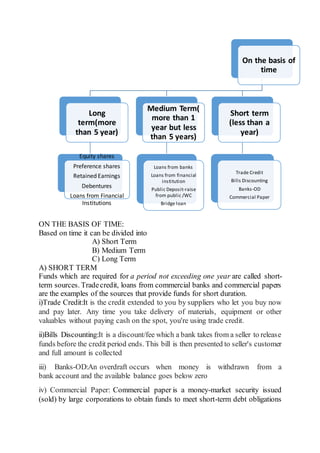
ON THE BASIS OF TIME:
Based on time it can be divided into
A) Short Term
B) Medium Term
C) Long Term
A) SHORT TERM
Funds which are required for a period not exceeding one year are called short-
term sources. Tradecredit, loans from commercial banks and commercial papers
are the examples of the sources that provide funds for short duration.
i)Trade Credit:It is the credit extended to you by suppliers who let you buy now
and pay later. Any time you take delivery of materials, equipment or other
valuables without paying cash on the spot, you're using trade credit.
ii)Bills Discounting:It is a discount/fee which a bank takes from a seller to release
funds before the credit period ends. This bill is then presented to seller's customer
and full amount is collected
iii) Banks-OD:An overdraft occurs when money is withdrawn from a
bank account and the available balance goes below zero
iv) Commercial Paper: Commercial paper is a money-market security issued
(sold) by large corporations to obtain funds to meet short-term debt obligations
On the basis of
time
Long
term(more
than 5 year)
Equity shares
Preference shares
Retained Earnings
Debentures
Loans from Financial
Institutions
Medium Term(
more than 1
year but less
than 5 years)
Loans from banks
Loans from financial
institution
Public Deposit-raise
from public /WC
Bridge loan
Short term
(less than a
year)
Trade Credit
Bills Discounting
Banks-OD
Commercial Paper
(for example, payroll) and is backed only by an issuing bank orcompany promise
to pay the face amount on the maturity date specified on the note.
B)MEDIUM-TERM SOURCES are the sources where the funds are required
for a period of more than one year but less than five years. The sources of the
medium term include borrowings from commercial banks, public deposits, lease
financing and loans from financial institutions.
i) Loans from banks/Loans from financial institution
ii) Public Deposit-deposits raised fromthe public to finance working capital needs
iii)Bridge Loan-A bridge loan is a short-term loan used until a personor company
secures permanent financing or removes an existing obligation
C)LONG-TERM SOURCES fulfil the financial requirements of a business for a
period more than 5 years. It includes various other sources such as shares and
debentures, long-term borrowings and loans from financial institutions. Such
financing is generally required for the procurement of fixed assets such as plant,
equipment, machinery etc.
1)Equity Shares: Shares which enjoy dividend and right to participate in the
management of Joint Stock Company are called equity shares, or, ordinary
shares. They are the owners and real riskbearers of the company.Equity
shareholders are the real owners of the company and, therefore, they are eligible
to share the profits of the company. The share given to equity shareholders in
profits is called “Dividend”. At the time of winding of company, the capital is
paid back last to them after all other claims have been paid in full.
2. Preference Shares: Shares which enjoy preference as regards dividend
payment and capital repayment are called “Preference Shares”. They get
dividend before equity holders. They get back their capital before equity holders
in the event of winding up of the company. The owners of these shares have a
preference for dividend and a first claim for return of capital; when the
company is closed down. But, their dividend rate is fixed. Preference share can
be of following types:
a) Cumulative Preference Shares: Such shareholders have a right to claim the
dividend. If, dividend is not paid to them, then, such dividend gets accumulated,
and, therefore, they are called as “Cumulative Preference shares”.
b) Non- Cumulative Preference Shares: They are exactly oppositeto cumulative
preference shares. Their right to get dividend lapses if, they are not paid
dividend and it does not get accumulated. Thus, their right to claim dividend for
the past years will lapse and will not be accumulated.
c) Participating Preference Shares: Such shareholders have a right to participate
in the excess profits of the company, in addition to their usual dividend. Thus,
if, there are excess profits and huge dividends, are declared in the equity shares,
the holders of these all shares get a second round of dividend along with equity
shareholders; after a dividend at a certain rate has been paid to equity
shareholders.
d) Non- Participating Preference Shares: Such shareholders do not have any
right to share excess profits. They get only fixed dividend.
e) Convertible Preference Shares: Such shares can be converted into equity
shares, at the option of the company.
f) Redeemable Preference Shares: Such shares are to be redeemed, or, paid back
in cash to the holders after a period of time.
g) Non- Redeemable Preference Shares: Such shares are not paid in cash during
the life of the company.
III) Retained Earnings: the portion of profit which is not distributed but retained
by the company so as to finance some other purpose. The Company often
resorts to ploughing back of profits that, is, retaining a part of profits instead of
distributing the entire amount to shareholders by way of dividend. Such
accumulated earnings are very useful at the time of replacements, or, purchases
of additional fixed assets.
IV)Debentures :When borrowed capital is divided into equal parts, then, each
part is called as a debenture. Debenture represents debt. Forsuch debts,
company pays interest at regular intervals. It represents borrowed capital and a
debenture holder is the creditor of the company. Debenture holder provides loan
to the company and he has nothing to do with the management of the company.
Kinds of Debentures: A company can issue different kinds of debentures.
a) Registered and Bearer Debentures: This classification of debentures is made
on the basis of transferability of debentures. Registered debentures are those in
respect of which the names, addresses, and particulars of the holdings of
debenture holders are entered in a register kept by the company. The transfer of
ownership of such debentures is possible through a regular instrument of
transfer which is duly signed by the transferee and the transferor. However, the
transfers are freely allowed through the execution of a regular Transfer Deed.
Only formal approval of the Board is necessary. Interest on suchdebentures is
paid through interest warrants. Bearer debentures are transferable by mere
delivery. They are freely negotiable instruments. The company keeps no records
of the debenture- holders in the caseof bearer debentures.
b) Secured and Unsecured Debentures: This classification is made on the basis
of security offered to debenture-holders. Secured debentures are those which are
secured by some safe charge on the property of the company. The charge or,
mortgage may be “Fixed”, or,“Floating”, and thus, there may be “Fixed
Mortgage Debentures”, or, “Floating Mortgage Debentures” depending upon
the nature of charge under the category of Secured Debentures. Unsecured, or,
Naked Debentures are those that, are secured by any charge on the assets of the
company. The holders of such debentures are like ordinary creditors
of the company. The general solvency of the company is the only security
available to unsecured or, naked debentures.
c) Redeemable And Irredeemable Debentures: This classification is made on the
basis of terms of repayment. Redeemable Debentures are for fixed period and
they provide for payment of the principal sum on specified date, or, on demand,
or, notice. Irredeemable Debentures are not issued for a fixed period. The
issuing company does not fix any date by which the principal would be paid
back. The holders of such debentures cannot demand payment from the
company so long as it is a going concern. Such debentures are Perpetual in
nature as they are payable after a long time, or, on winding up of the
company.
d) Convertible And Non- Convertible Debentures: This classification is made
on the convertibility of the debentures. Convertible Debentures are those which
are convertible into Equity Shares on maturity as per the terms of issue.
Convertible Debentures are those which are convertible into equity shares on
maturity as per the terms of issue. The rate of exchange of debentures into
shares is also decided at the time of issue of debentures. Interest is paid on such
debentures till conversion. Non- Convertible Debentures are not convertible into
Equity Shares after some period, or, on maturity. Prior approval of the
shareholders is necessary for the issue of convertible debentures. It
also requires sanction of the central government.
4)Long Term Loans: The company may also obtain long term loans from banks
and financial institutions like I.D.B.I., I.C.I.C.I., and so on. The funding of term
loans by financial institutions often acts as an inducement for the investors to
sub- scribe for the shares of the company. This is, because, the financial
institutions study the project report of the company before sanctioning loans.
This creates confidence in the investors, and they too, lend money to the
company in form of shares, debentures, fixed deposits, and so on.
OWNERSHIP BASIS SOURCES
• OWNERS FUND
(PROCURED BY THE OWNERS OF BUSINESS)
• EQUITY SHARES
• RETAINED EARNINGS
• BORROWED FUND
• LOANS FROM BANKS
• LOANS FROM FINANCIAL INSTITUTION
• ISSUE OF DEBENTURES
• PUBLIC DEPOSIT
SOURCE OF GENERATION
• INTERNAL SOURCES
• EQUITY SHARES
• RETAINED EARNINGS
• EXTERNAL SOURCES
• LOANS FROM BANKS
• LOANS FROM FINANCIAL INSTITUTION
• COMMERCIAL PAPERS
• FACTORING
Factoring is a financial transaction and a type of debtorfinance in which a
business sells its accounts receivable to a third party at a discount. On maturity
the third party collects the accounts receivable from the buyer
• TRADE CREDIT
• ISSUE OF DEBENTURES
• PUBLIC DEPOSIT

Financial management notes

  • 1.
    FINANCIAL MANAGEMENT: Finance isdefined as the provision of money at the time when it is required. Every enterprise, whether big, medium, small, needs finance to carry on its operations and to achieve its target. In fact, finance is so indispensable today that it is rightly said to be the blood of an enterprise. Without adequate finance, no enterprise can possibly accomplish its objectives. Why there is a need for Finance: Every business needs funds both for short term and long term. They may need working capital, or, fixed capital. The finance may be obtained from the varied sources and through various instruments. The various sources of finance include shareholders, financial instruments, and financial institutions and so on. The funds can be collected through various instruments such as equity shares, debentures, fixed deposits, loan agreements, and so on. The finance is needed at various stages and for various purposes like promoting a business, smooth conduct of business activities. Meaning of Financial Management: Financial management refers to that part of the management activity, which is concerned with the planning, & controlling of firm’s financial resources. It deals with finding out various sources for raising funds for the firm. Financial management is practiced by many corporatefirms and can be called Corporation finance or Business Finance. According to Guthmann and Dougall: “Business finance can be broadly defined as the activity concerned with the planning, raising controlling and administrating the funds used in the business.” According to Joseph & Massie: “Financial Management is the operational activity of a business that is responsible for obtaining and effectively utilizing the funds necessary for efficient operations” FUNCTIONS OF FINANCIAL MANAGEMENT
  • 2.
    A financial managerhas to concentrate on the following areas of the finance function. • FUNCTIONS • FINANCING • INVESTING • DIVIDEND Which can be explained in detail as follows: 1. Estimating Financial Requirements: The first task of the financial manager is to estimate short term and long-term financial requirement of his business. For this purpose,he will prepare a financial plan for present as well as future. The amount required for purchasing fixed assets as well as the needs of funds for working capital has to be ascertained. The estimation should be based on the sound financial principles so that neither there are inadequate or excess funds with the concern. 2. Deciding Capital Structure: The capital structure refers to the kind and proportion of the different securities for raising funds. After deciding about the quantum of funds required it should be decided which type of security should be raised. Decision aboutvarious sources offunds should belinked to costofraising funds. If cost of rising funds is high, then such sources may not be useful.A decision about the kind of the securities to be employed and the proportion in which these should be used is an important decision which influences the short term and the long term planning of the enterprise. 3. Selecting a Source of Finance: After preparing a capital structure, an appropriate source of finance is selected. Various sources from which finance may beraised, includes share capital, debentures, financial deposits etc. Iffinance is needed for short periods then banks, public’s deposits, financial institutions may be appropriate. If long-term finance is required the share capital, debentures may be useful. 4. Selecting a Pattern of Investment: When fund have been procured then a decision about investment pattern is to be taken. The selection of investment pattern is related to the use of the funds. A decision has to be taken as to which assets are to be purchased? The fund will have to be spent first. Fixed asset and the appropriate portion will be retained for the working capital. 5. Proper Cash Management: Cash management is an important task of financial manager. He has to assess the various cash needs at different times and then make arrangements for arranging cash. Cash may be required to make payments to creditors,purchasing raw material, meet wage bills, and meet day to day expenses. The sources of cashmay be Cashsales, Collection of debts, Short- term arrangement with the banks. The cash management should be such that neither there is shortage of it and nor it is idle. Any shortage of cashwill damage the creditworthiness of the enterprise. The idle cash with the business mean that it is not properly used.
  • 3.
    6. Implementing FinancialControls: An efficient system of financial management necessitates the use of various control devices. Financial control device generally used are; a. Return Investment b. Ratio analysis c. Break even analysis d. Cost control e. Cost and internal audit. 7. The use of various control techniques: This will help the financial manager in evaluating the performance in various Areas and take corrective measures whenever needed. 8. Proper use of Surpluses: The utilization of profits or surpluses as also an important factor in financial management. A judicious use of surpluses is essential for the expansion and diversification plans and also protecting the interest of the shareholders. Scope of Financial Management: ◦ Traditional Approach: Traditionally the Focus was on Planning and raising of funds which was viewed as a very narrow approach. Therefore Financial Management was earlier called corporationfinance. This Approachdid notfocus on how the finance raised can be used. Drawbacks of this Approach: i. Outsider looking Approach- here focus was on procurement of fund / investors, banks, financial institutions and was mainly focussing on outsiders for raising funds ii. Internal financing decision making aspect ignored iii. Focus was onepisodicalevents like merger, acquisitionandnot on day to day financial aspects iv. Long term financial problem was the focus and not on working capital ◦ Modern Approach Modern Approach the focus was on Planning Raising and utilisation of funds. Therefore the Focus of financial management is now focussed on different financial areas i.e. investment, dividend, financing decision Objectives/Goals of Financial Management: The objective of financial management can be divided as Basic and other objectives 1) BASIC OBJECTIVES a) Profit Maximization (Traditional Approach)
  • 4.
    Profit earning isthe main aim of every economic activity. A business being an economic institution must earn profit to cover its costs and provide funds for growth. No business ca survives without earning profit. Profit is a measure of efficiency of a business enterprise. Profit also serves as a protection against risks which cannot be ensured. Arguments in favor of Profit Maximization 1. When profit earning is the aim of the business then the profit maximization should be the obvious objective. 2. Profitability is the barometer for measuring the efficiency and economic prosperity of a business enterprise, thus profit maximization is justified on the ground of the rationality. 3. Profits are the main source of finance for the growth of the business. So a business should aim at maximization of the profits for enabling its growth and development. 4. Profitability is essential for fulfilling the social goals also. A firm by pursuing the objectives of profits maximization also maximizes the socio economic welfare. 5. A business may be able to survive under unfavorable condition only if it had some past earnings to rely upon. Arguments against of Profit Maximization 1. It is precisely defined. It means different things for different people. The term ‘Profit’ is vague and it cannot be precisely defined. It means different things for different people. Should we mean (i) Short term profit or long term profit? (ii) Total profit or earning per share? (iii) Profit before tax or after tax? (iv) Operating profit or profit available for the shareholders? 2. It ignores the time value of money and does not consider the magnitude and the timing of earnings. It treats all the earnings as equal though they occur in different time periods. It ignores the fact that the cash received today is more important than the same amount if cash received after, say, three years. 3. It does not take into consideration the risk of the prospective earning stream. Some
  • 5.
    projects are morerisky than others. Wealth Maximisation: Financial theory asserts that the wealth maximization is the single substitute for a stake holder’s utility. When the firm maximizes the shareholder’s wealth, the individual stakeholders can use this wealth to maximize his individual utility. It means that by maximizing stakeholder’s wealth the firm is operating consistently toward maximizing stakeholder’s utility. A stake solder’s wealth in the firm is the product of the numbers of the shares owned, multiplied within the current stock price per share. Stockholder’s currentwealthin the firm = (No. Ofshares owned)* (Current stock price per share) Higher the stockpricepershare, the greater will bethe shareholder’s wealth. Thus a firm should aim at maximizing its current stockprice, which helps in increasing the value of shares in the market. Implication of the wealth maximization: 1. The Conceptof wealth maximization is universally accepted, because it takes care of interest of financial institution, owners, employees and society at large. 2. Wealth maximization guides the management in framing the consistent strong dividend policy to reach maximum returns to the equity holders. 3. Wealth maximization objective notonly serves the interest of the shareholder’s by increasing the value of their holdings but also ensures the security to the lenders. Criticism of wealth maximization: 1. It is a prescriptive idea. The objective is not descriptive of what the firm actually does. 2. The objective of wealth maximization is not necessarily socially desirable. 3. There is some controversy as to whether the objective is to maximize the stockholder’s wealth or the wealth of the firm, which includes other financial claimholder’s such as debenture holders, preference shareholders. OTHER OBJECTIVES: a. Return Maximization: safeguarding the interests of stakeholders and providing maximum return to their contributions.
  • 6.
    b. Provide supportfordecisionmaking : helps financial managers in decision making by providing them with information and knowledge c. Manage Risk: help the firm to identify financial consequences which effect the objectives and resources d. Use resources effectively, efficiently and economically e. Provide a supportive control environment: helps in promoting an organisation climate which includes commitment from senior management, shared values etc f. Comply with authorities and safeguard assets: makes sure that the firm carries out activities in accordance with legislation, regulations etc ROLE OF FINANCIAL MANAGER • Forecasting Financial Requirements-making sure what type of financial requirement whether it is for short term or long term and forecasting the same • Financing Decision- help the management regarding the various sources from which funds can be raised, identify the short term and long term requirements in order to meet contingencies • Investment decisionhelp the management regarding where to invest funds whether to purchase fixed or current assets or go for long term investment decision or short term investment decision • Dividend decision: assist top management regarding what to pay to shareholders and what to retain • Deciding overall objectives: determine the goals of the finance department and help achieve the same. • Supply funds to all parts of the organisation • Evaluating financialperformance:byusing return on investment method and analyse the performance and suggest steps to improve it • Financial negotiations: To have financial negotiations with banks and financial institutions make sure funds are raised as per provisions • Keeping in touch with stock exchange and behaviour of share prices SOURCES OF FINANCE:
  • 7.
    ON THE BASISOF TIME: Based on time it can be divided into A) Short Term B) Medium Term C) Long Term A) SHORT TERM Funds which are required for a period not exceeding one year are called short- term sources. Tradecredit, loans from commercial banks and commercial papers are the examples of the sources that provide funds for short duration. i)Trade Credit:It is the credit extended to you by suppliers who let you buy now and pay later. Any time you take delivery of materials, equipment or other valuables without paying cash on the spot, you're using trade credit. ii)Bills Discounting:It is a discount/fee which a bank takes from a seller to release funds before the credit period ends. This bill is then presented to seller's customer and full amount is collected iii) Banks-OD:An overdraft occurs when money is withdrawn from a bank account and the available balance goes below zero iv) Commercial Paper: Commercial paper is a money-market security issued (sold) by large corporations to obtain funds to meet short-term debt obligations On the basis of time Long term(more than 5 year) Equity shares Preference shares Retained Earnings Debentures Loans from Financial Institutions Medium Term( more than 1 year but less than 5 years) Loans from banks Loans from financial institution Public Deposit-raise from public /WC Bridge loan Short term (less than a year) Trade Credit Bills Discounting Banks-OD Commercial Paper
  • 8.
    (for example, payroll)and is backed only by an issuing bank orcompany promise to pay the face amount on the maturity date specified on the note. B)MEDIUM-TERM SOURCES are the sources where the funds are required for a period of more than one year but less than five years. The sources of the medium term include borrowings from commercial banks, public deposits, lease financing and loans from financial institutions. i) Loans from banks/Loans from financial institution ii) Public Deposit-deposits raised fromthe public to finance working capital needs iii)Bridge Loan-A bridge loan is a short-term loan used until a personor company secures permanent financing or removes an existing obligation C)LONG-TERM SOURCES fulfil the financial requirements of a business for a period more than 5 years. It includes various other sources such as shares and debentures, long-term borrowings and loans from financial institutions. Such financing is generally required for the procurement of fixed assets such as plant, equipment, machinery etc. 1)Equity Shares: Shares which enjoy dividend and right to participate in the management of Joint Stock Company are called equity shares, or, ordinary shares. They are the owners and real riskbearers of the company.Equity shareholders are the real owners of the company and, therefore, they are eligible to share the profits of the company. The share given to equity shareholders in profits is called “Dividend”. At the time of winding of company, the capital is paid back last to them after all other claims have been paid in full. 2. Preference Shares: Shares which enjoy preference as regards dividend payment and capital repayment are called “Preference Shares”. They get dividend before equity holders. They get back their capital before equity holders in the event of winding up of the company. The owners of these shares have a preference for dividend and a first claim for return of capital; when the company is closed down. But, their dividend rate is fixed. Preference share can be of following types: a) Cumulative Preference Shares: Such shareholders have a right to claim the dividend. If, dividend is not paid to them, then, such dividend gets accumulated, and, therefore, they are called as “Cumulative Preference shares”. b) Non- Cumulative Preference Shares: They are exactly oppositeto cumulative preference shares. Their right to get dividend lapses if, they are not paid
  • 9.
    dividend and itdoes not get accumulated. Thus, their right to claim dividend for the past years will lapse and will not be accumulated. c) Participating Preference Shares: Such shareholders have a right to participate in the excess profits of the company, in addition to their usual dividend. Thus, if, there are excess profits and huge dividends, are declared in the equity shares, the holders of these all shares get a second round of dividend along with equity shareholders; after a dividend at a certain rate has been paid to equity shareholders. d) Non- Participating Preference Shares: Such shareholders do not have any right to share excess profits. They get only fixed dividend. e) Convertible Preference Shares: Such shares can be converted into equity shares, at the option of the company. f) Redeemable Preference Shares: Such shares are to be redeemed, or, paid back in cash to the holders after a period of time. g) Non- Redeemable Preference Shares: Such shares are not paid in cash during the life of the company. III) Retained Earnings: the portion of profit which is not distributed but retained by the company so as to finance some other purpose. The Company often resorts to ploughing back of profits that, is, retaining a part of profits instead of distributing the entire amount to shareholders by way of dividend. Such accumulated earnings are very useful at the time of replacements, or, purchases of additional fixed assets. IV)Debentures :When borrowed capital is divided into equal parts, then, each part is called as a debenture. Debenture represents debt. Forsuch debts, company pays interest at regular intervals. It represents borrowed capital and a debenture holder is the creditor of the company. Debenture holder provides loan to the company and he has nothing to do with the management of the company. Kinds of Debentures: A company can issue different kinds of debentures. a) Registered and Bearer Debentures: This classification of debentures is made on the basis of transferability of debentures. Registered debentures are those in respect of which the names, addresses, and particulars of the holdings of debenture holders are entered in a register kept by the company. The transfer of ownership of such debentures is possible through a regular instrument of transfer which is duly signed by the transferee and the transferor. However, the transfers are freely allowed through the execution of a regular Transfer Deed.
  • 10.
    Only formal approvalof the Board is necessary. Interest on suchdebentures is paid through interest warrants. Bearer debentures are transferable by mere delivery. They are freely negotiable instruments. The company keeps no records of the debenture- holders in the caseof bearer debentures. b) Secured and Unsecured Debentures: This classification is made on the basis of security offered to debenture-holders. Secured debentures are those which are secured by some safe charge on the property of the company. The charge or, mortgage may be “Fixed”, or,“Floating”, and thus, there may be “Fixed Mortgage Debentures”, or, “Floating Mortgage Debentures” depending upon the nature of charge under the category of Secured Debentures. Unsecured, or, Naked Debentures are those that, are secured by any charge on the assets of the company. The holders of such debentures are like ordinary creditors of the company. The general solvency of the company is the only security available to unsecured or, naked debentures. c) Redeemable And Irredeemable Debentures: This classification is made on the basis of terms of repayment. Redeemable Debentures are for fixed period and they provide for payment of the principal sum on specified date, or, on demand, or, notice. Irredeemable Debentures are not issued for a fixed period. The issuing company does not fix any date by which the principal would be paid back. The holders of such debentures cannot demand payment from the company so long as it is a going concern. Such debentures are Perpetual in nature as they are payable after a long time, or, on winding up of the company. d) Convertible And Non- Convertible Debentures: This classification is made on the convertibility of the debentures. Convertible Debentures are those which are convertible into Equity Shares on maturity as per the terms of issue. Convertible Debentures are those which are convertible into equity shares on maturity as per the terms of issue. The rate of exchange of debentures into shares is also decided at the time of issue of debentures. Interest is paid on such debentures till conversion. Non- Convertible Debentures are not convertible into Equity Shares after some period, or, on maturity. Prior approval of the shareholders is necessary for the issue of convertible debentures. It also requires sanction of the central government. 4)Long Term Loans: The company may also obtain long term loans from banks and financial institutions like I.D.B.I., I.C.I.C.I., and so on. The funding of term loans by financial institutions often acts as an inducement for the investors to sub- scribe for the shares of the company. This is, because, the financial institutions study the project report of the company before sanctioning loans. This creates confidence in the investors, and they too, lend money to the company in form of shares, debentures, fixed deposits, and so on.
  • 11.
    OWNERSHIP BASIS SOURCES •OWNERS FUND (PROCURED BY THE OWNERS OF BUSINESS) • EQUITY SHARES • RETAINED EARNINGS • BORROWED FUND • LOANS FROM BANKS • LOANS FROM FINANCIAL INSTITUTION • ISSUE OF DEBENTURES • PUBLIC DEPOSIT SOURCE OF GENERATION • INTERNAL SOURCES • EQUITY SHARES • RETAINED EARNINGS • EXTERNAL SOURCES • LOANS FROM BANKS • LOANS FROM FINANCIAL INSTITUTION • COMMERCIAL PAPERS • FACTORING Factoring is a financial transaction and a type of debtorfinance in which a business sells its accounts receivable to a third party at a discount. On maturity the third party collects the accounts receivable from the buyer • TRADE CREDIT • ISSUE OF DEBENTURES • PUBLIC DEPOSIT