FINANCIAL STATEMENT
INTRODUCTION:-
 The primary purpose of financial statement is to
summarize the financial information of a company and
comply with the law by providing an honest and
transparent view of the financial situation and
performance of the company. As a company is a
complex thing to summarize, it cannot be done on a
single document. And this is why four documents are
needed.
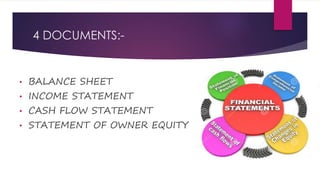
4 DOCUMENTS:-
• BALANCE SHEET
• INCOME STATEMENT
• CASH FLOW STATEMENT
• STATEMENT OF OWNER EQUITY
BALANCE SHEET:-
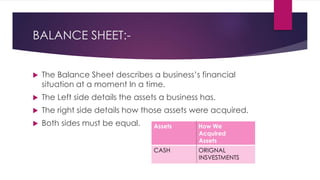
 The Balance Sheet describes a business’s financial
situation at a moment In a time.
 The Left side details the assets a business has.
 The right side details how those assets were acquired.
 Both sides must be equal. Assets How We
Acquired
Assets
CASH ORIGNAL
INSVESTMENTS
How to understand the balance sheet:-
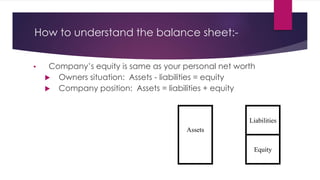
• Company’s equity is same as your personal net worth
 Owners situation: Assets - liabilities = equity
 Company position: Assets = liabilities + equity
Assets
Liabilities
Equity
What to focus on when presenting the
balance sheet:-
1. Liquidity – near term financial situation
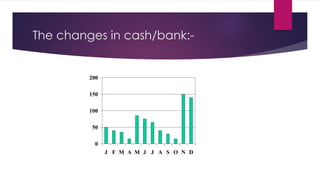
2. Changes in cash/bank
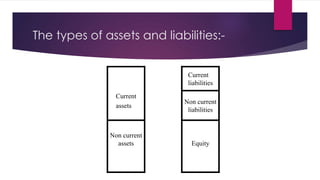
3. Types of assets and liabilities
4. Individual line items
The liquidity issues:-
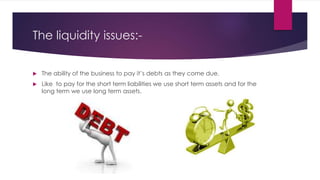
 The ability of the business to pay it’s debts as they come due.
 Like to pay for the short term liabilities we use short term assets and for the
long term we use long term assets.
The changes in cash/bank:-
0
50
100
150
200
J F M A M J J A S O N D
The types of assets and liabilities:-
Current
liabilities
Current
assets
Non current
liabilities
Non current
assets Equity
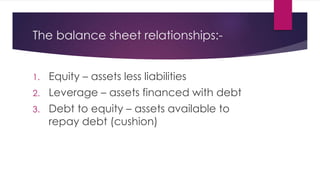
The balance sheet relationships:-
1. Equity – assets less liabilities
2. Leverage – assets financed with debt
3. Debt to equity – assets available to
repay debt (cushion)
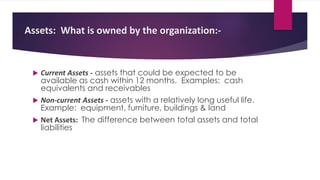
Assets: What is owned by the organization:-
 Current Assets - assets that could be expected to be
available as cash within 12 months. Examples: cash
equivalents and receivables
 Non-current Assets - assets with a relatively long useful life.
Example: equipment, furniture, buildings & land
 Net Assets: The difference between total assets and total
liabilities
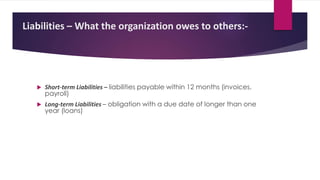
Liabilities – What the organization owes to others:-
 Short-term Liabilities – liabilities payable within 12 months (invoices,
payroll)
 Long-term Liabilities – obligation with a due date of longer than one
year (loans)
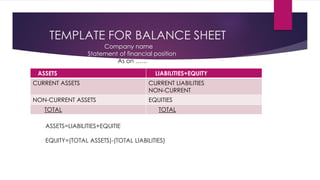
TEMPLATE FOR BALANCE SHEET
ASSETS LIABILITIES+EQUITY
CURRENT ASSETS CURRENT LIABILITIES
NON-CURRENT
NON-CURRENT ASSETS EQUITIES
TOTAL TOTAL
ASSETS=LIABILITIES+EQUITIE
EQUITY=(TOTAL ASSETS)-(TOTAL LIABILITIES)
Company name
Statement of financial position
As on ……
INCOME STATEMENT:-
 Income reported on income statement
is based on Accrual(note) Accounting, all revenues
earned in the year & all expenses occurred in that year
(NOT on the cash generated or cash paid during
accounting period)
 A summary of a company’s profit and loss over a
specific time period(usually a full year or a part of a
year).
 The format of the income statement or
the profit and loss statement will vary
according to the complexity of the
business activities. However, most
companies will have the following
elements in their income statements:
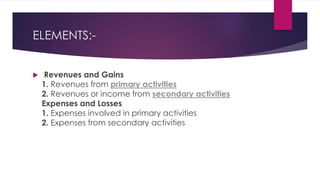
ELEMENTS:-
 Revenues and Gains
1. Revenues from primary activities
2. Revenues or income from secondary activities
Expenses and Losses
1. Expenses involved in primary activities
2. Expenses from secondary activities
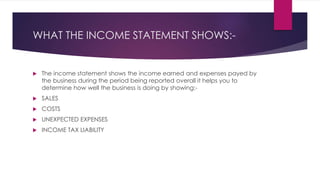
WHAT THE INCOME STATEMENT SHOWS:-
 The income statement shows the income earned and expenses payed by
the business during the period being reported overall it helps you to
determine how well the business is doing by showing:-
 SALES
 COSTS
 UNEXPECTED EXPENSES
 INCOME TAX LIABILITY
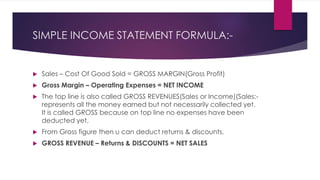
SIMPLE INCOME STATEMENT FORMULA:-
 Sales – Cost Of Good Sold = GROSS MARGIN(Gross Profit)
 Gross Margin – Operating Expenses = NET INCOME
 The top line is also called GROSS REVENUES(Sales or Income)(Sales:-
represents all the money earned but not necessarily collected yet.
It is called GROSS because on top line no expenses have been
deducted yet.
 From Gross figure then u can deduct returns & discounts.
 GROSS REVENUE – Returns & DISCOUNTS = NET SALES
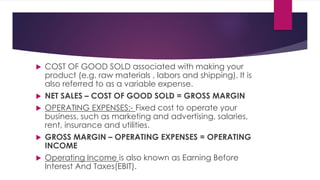
 COST OF GOOD SOLD associated with making your
product (e.g. raw materials , labors and shipping). It is
also referred to as a variable expense.
 NET SALES – COST OF GOOD SOLD = GROSS MARGIN
 OPERATING EXPENSES:- Fixed cost to operate your
business, such as marketing and advertising, salaries,
rent, insurance and utilities.
 GROSS MARGIN – OPERATING EXPENSES = OPERATING
INCOME
 Operating Income is also known as Earning Before
Interest And Taxes(EBIT).
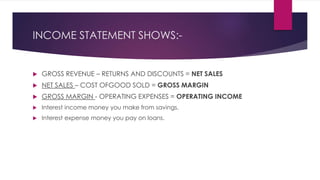
INCOME STATEMENT SHOWS:-
 GROSS REVENUE – RETURNS AND DISCOUNTS = NET SALES
 NET SALES – COST OFGOOD SOLD = GROSS MARGIN
 GROSS MARGIN - OPERATING EXPENSES = OPERATING INCOME
 Interest income money you make from savings.
 Interest expense money you pay on loans.
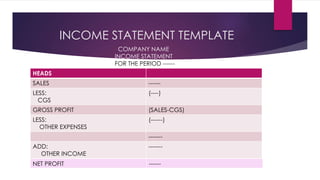
INCOME STATEMENT TEMPLATE
HEADS
SALES ------
LESS:
CGS
(----)
GROSS PROFIT (SALES-CGS)
LESS:
OTHER EXPENSES
(------)
-------
ADD:
OTHER INCOME
-------
NET PROFIT ------
COMPANY NAME
INCOME STATEMENT
FOR THE PERIOD ------
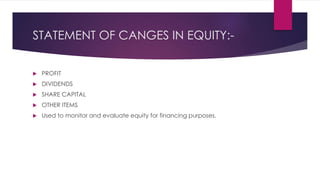
STATEMENT OF CANGES IN EQUITY:-
 PROFIT
 DIVIDENDS
 SHARE CAPITAL
 OTHER ITEMS
 Used to monitor and evaluate equity for financing purposes.
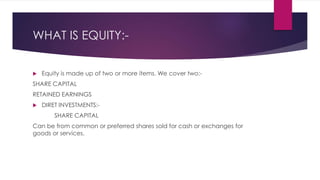
WHAT IS EQUITY:-
 Equity is made up of two or more items. We cover two:-
SHARE CAPITAL
RETAINED EARNINGS
 DIRET INVESTMENTS:-
SHARE CAPITAL
Can be from common or preferred shares sold for cash or exchanges for
goods or services.
INDIRECT INVESTMENTS:-
 RETAINED EARNINGS:-
Increased by profits, decreased by dividends and loses.
Represent profits retained by business for future growth and expansion.
USES OF SATEMENT OF CHANGES IN EQUITY
(RETAINED EARNINGS):-
 INVESTORS:-
used past dividends payouts to predict future dividends.
is company reinvesting enough profit to support future growth?
 LENDERS:-
are dividends payouts reasonable, leaving enough cash to repay
debts?
 OTHER CREDITORS:-
is the company reinvesting enough profit to ensure future growth?
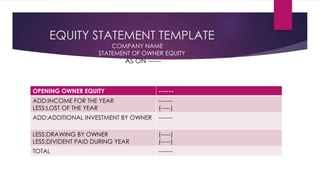
EQUITY STATEMENT TEMPLATE
OPENING OWNER EQUITY ------
ADD:INCOME FOR THE YEAR
LESS:LOST OF THE YEAR
-------
(-----)
ADD:ADDITIONAL INVESTMENT BY OWNER -------
LESS:DRAWING BY OWNER
LESS:DIVIDENT PAID DURING YEAR
(-----)
(-----)
TOTAL -------
COMPANY NAME
STATEMENT OF OWNER EQUITY
AS ON ------
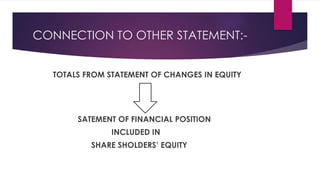
CONNECTION TO OTHER STATEMENT:-
TOTALS FROM STATEMENT OF CHANGES IN EQUITY
SATEMENT OF FINANCIAL POSITION
INCLUDED IN
SHARE SHOLDERS’ EQUITY
INCOME STATEMENT, EQUITY STATEMENT
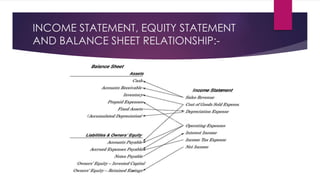
AND BALANCE SHEET RELATIONSHIP:-
Financial statement

Financial statement

  • 1.
  • 2.
    INTRODUCTION:-  The primarypurpose of financial statement is to summarize the financial information of a company and comply with the law by providing an honest and transparent view of the financial situation and performance of the company. As a company is a complex thing to summarize, it cannot be done on a single document. And this is why four documents are needed.
  • 3.
    4 DOCUMENTS:- • BALANCESHEET • INCOME STATEMENT • CASH FLOW STATEMENT • STATEMENT OF OWNER EQUITY
  • 4.
    BALANCE SHEET:-  TheBalance Sheet describes a business’s financial situation at a moment In a time.  The Left side details the assets a business has.  The right side details how those assets were acquired.  Both sides must be equal. Assets How We Acquired Assets CASH ORIGNAL INSVESTMENTS
  • 5.
    How to understandthe balance sheet:- • Company’s equity is same as your personal net worth  Owners situation: Assets - liabilities = equity  Company position: Assets = liabilities + equity Assets Liabilities Equity
  • 6.
    What to focuson when presenting the balance sheet:- 1. Liquidity – near term financial situation 2. Changes in cash/bank 3. Types of assets and liabilities 4. Individual line items
  • 7.
    The liquidity issues:- The ability of the business to pay it’s debts as they come due.  Like to pay for the short term liabilities we use short term assets and for the long term we use long term assets.
  • 8.
    The changes incash/bank:- 0 50 100 150 200 J F M A M J J A S O N D
  • 9.
    The types ofassets and liabilities:- Current liabilities Current assets Non current liabilities Non current assets Equity
  • 10.
    The balance sheetrelationships:- 1. Equity – assets less liabilities 2. Leverage – assets financed with debt 3. Debt to equity – assets available to repay debt (cushion)
  • 11.
    Assets: What isowned by the organization:-  Current Assets - assets that could be expected to be available as cash within 12 months. Examples: cash equivalents and receivables  Non-current Assets - assets with a relatively long useful life. Example: equipment, furniture, buildings & land  Net Assets: The difference between total assets and total liabilities
  • 12.
    Liabilities – Whatthe organization owes to others:-  Short-term Liabilities – liabilities payable within 12 months (invoices, payroll)  Long-term Liabilities – obligation with a due date of longer than one year (loans)
  • 13.
    TEMPLATE FOR BALANCESHEET ASSETS LIABILITIES+EQUITY CURRENT ASSETS CURRENT LIABILITIES NON-CURRENT NON-CURRENT ASSETS EQUITIES TOTAL TOTAL ASSETS=LIABILITIES+EQUITIE EQUITY=(TOTAL ASSETS)-(TOTAL LIABILITIES) Company name Statement of financial position As on ……
  • 14.
    INCOME STATEMENT:-  Incomereported on income statement is based on Accrual(note) Accounting, all revenues earned in the year & all expenses occurred in that year (NOT on the cash generated or cash paid during accounting period)  A summary of a company’s profit and loss over a specific time period(usually a full year or a part of a year).
  • 15.
     The formatof the income statement or the profit and loss statement will vary according to the complexity of the business activities. However, most companies will have the following elements in their income statements:
  • 16.
    ELEMENTS:-  Revenues andGains 1. Revenues from primary activities 2. Revenues or income from secondary activities Expenses and Losses 1. Expenses involved in primary activities 2. Expenses from secondary activities
  • 17.
    WHAT THE INCOMESTATEMENT SHOWS:-  The income statement shows the income earned and expenses payed by the business during the period being reported overall it helps you to determine how well the business is doing by showing:-  SALES  COSTS  UNEXPECTED EXPENSES  INCOME TAX LIABILITY
  • 18.
    SIMPLE INCOME STATEMENTFORMULA:-  Sales – Cost Of Good Sold = GROSS MARGIN(Gross Profit)  Gross Margin – Operating Expenses = NET INCOME  The top line is also called GROSS REVENUES(Sales or Income)(Sales:- represents all the money earned but not necessarily collected yet. It is called GROSS because on top line no expenses have been deducted yet.  From Gross figure then u can deduct returns & discounts.  GROSS REVENUE – Returns & DISCOUNTS = NET SALES
  • 19.
     COST OFGOOD SOLD associated with making your product (e.g. raw materials , labors and shipping). It is also referred to as a variable expense.  NET SALES – COST OF GOOD SOLD = GROSS MARGIN  OPERATING EXPENSES:- Fixed cost to operate your business, such as marketing and advertising, salaries, rent, insurance and utilities.  GROSS MARGIN – OPERATING EXPENSES = OPERATING INCOME  Operating Income is also known as Earning Before Interest And Taxes(EBIT).
  • 20.
    INCOME STATEMENT SHOWS:- GROSS REVENUE – RETURNS AND DISCOUNTS = NET SALES  NET SALES – COST OFGOOD SOLD = GROSS MARGIN  GROSS MARGIN - OPERATING EXPENSES = OPERATING INCOME  Interest income money you make from savings.  Interest expense money you pay on loans.
  • 21.
    INCOME STATEMENT TEMPLATE HEADS SALES------ LESS: CGS (----) GROSS PROFIT (SALES-CGS) LESS: OTHER EXPENSES (------) ------- ADD: OTHER INCOME ------- NET PROFIT ------ COMPANY NAME INCOME STATEMENT FOR THE PERIOD ------
  • 22.
    STATEMENT OF CANGESIN EQUITY:-  PROFIT  DIVIDENDS  SHARE CAPITAL  OTHER ITEMS  Used to monitor and evaluate equity for financing purposes.
  • 23.
    WHAT IS EQUITY:- Equity is made up of two or more items. We cover two:- SHARE CAPITAL RETAINED EARNINGS  DIRET INVESTMENTS:- SHARE CAPITAL Can be from common or preferred shares sold for cash or exchanges for goods or services.
  • 24.
    INDIRECT INVESTMENTS:-  RETAINEDEARNINGS:- Increased by profits, decreased by dividends and loses. Represent profits retained by business for future growth and expansion.
  • 25.
    USES OF SATEMENTOF CHANGES IN EQUITY (RETAINED EARNINGS):-  INVESTORS:- used past dividends payouts to predict future dividends. is company reinvesting enough profit to support future growth?  LENDERS:- are dividends payouts reasonable, leaving enough cash to repay debts?  OTHER CREDITORS:- is the company reinvesting enough profit to ensure future growth?
  • 26.
    EQUITY STATEMENT TEMPLATE OPENINGOWNER EQUITY ------ ADD:INCOME FOR THE YEAR LESS:LOST OF THE YEAR ------- (-----) ADD:ADDITIONAL INVESTMENT BY OWNER ------- LESS:DRAWING BY OWNER LESS:DIVIDENT PAID DURING YEAR (-----) (-----) TOTAL ------- COMPANY NAME STATEMENT OF OWNER EQUITY AS ON ------
  • 27.
    CONNECTION TO OTHERSTATEMENT:- TOTALS FROM STATEMENT OF CHANGES IN EQUITY SATEMENT OF FINANCIAL POSITION INCLUDED IN SHARE SHOLDERS’ EQUITY
  • 28.
    INCOME STATEMENT, EQUITYSTATEMENT AND BALANCE SHEET RELATIONSHIP:-

Editor's Notes

  • #8 In finance, liquidity risk is the risk that a given security or asset cannot be traded quickly enough in the market to prevent a loss (or make the required profit).