Characteristics of common stocks
Hafsa Khan
2k13/BPA/78
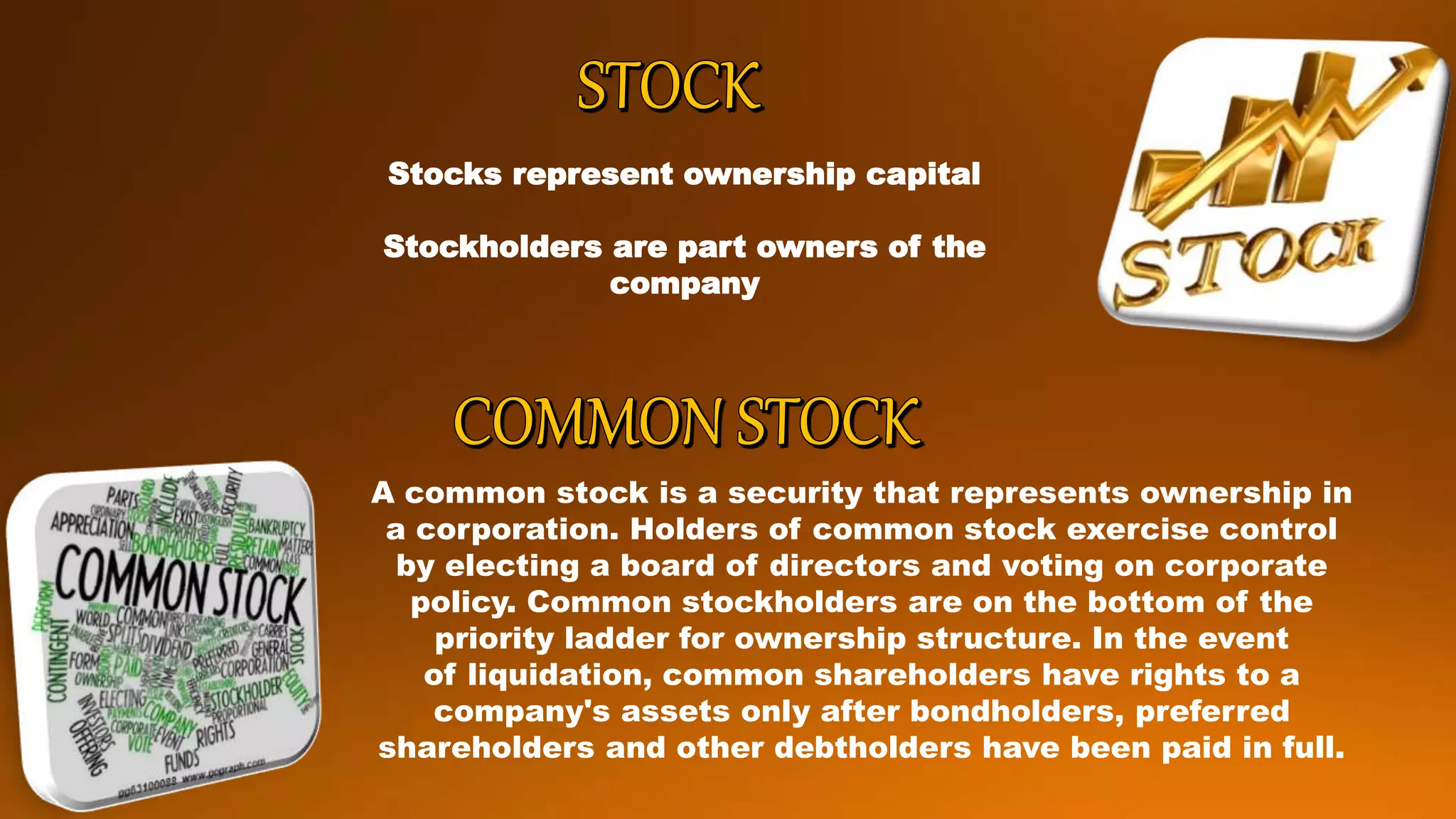
Stocks represent ownership capital
Stockholders are part owners of the
company
A common stock is a security that represents ownership in
a corporation. Holders of common stock exercise control
by electing a board of directors and voting on corporate
policy. Common stockholders are on the bottom of the
priority ladder for ownership structure. In the event
of liquidation, common shareholders have rights to a
company's assets only after bondholders, preferred
shareholders and other debtholders have been paid in full.
A corporate exists only when it has been granted a character, or
certificates of incorporations, by a state. This document specifies he rights
and obligations of stockholders.
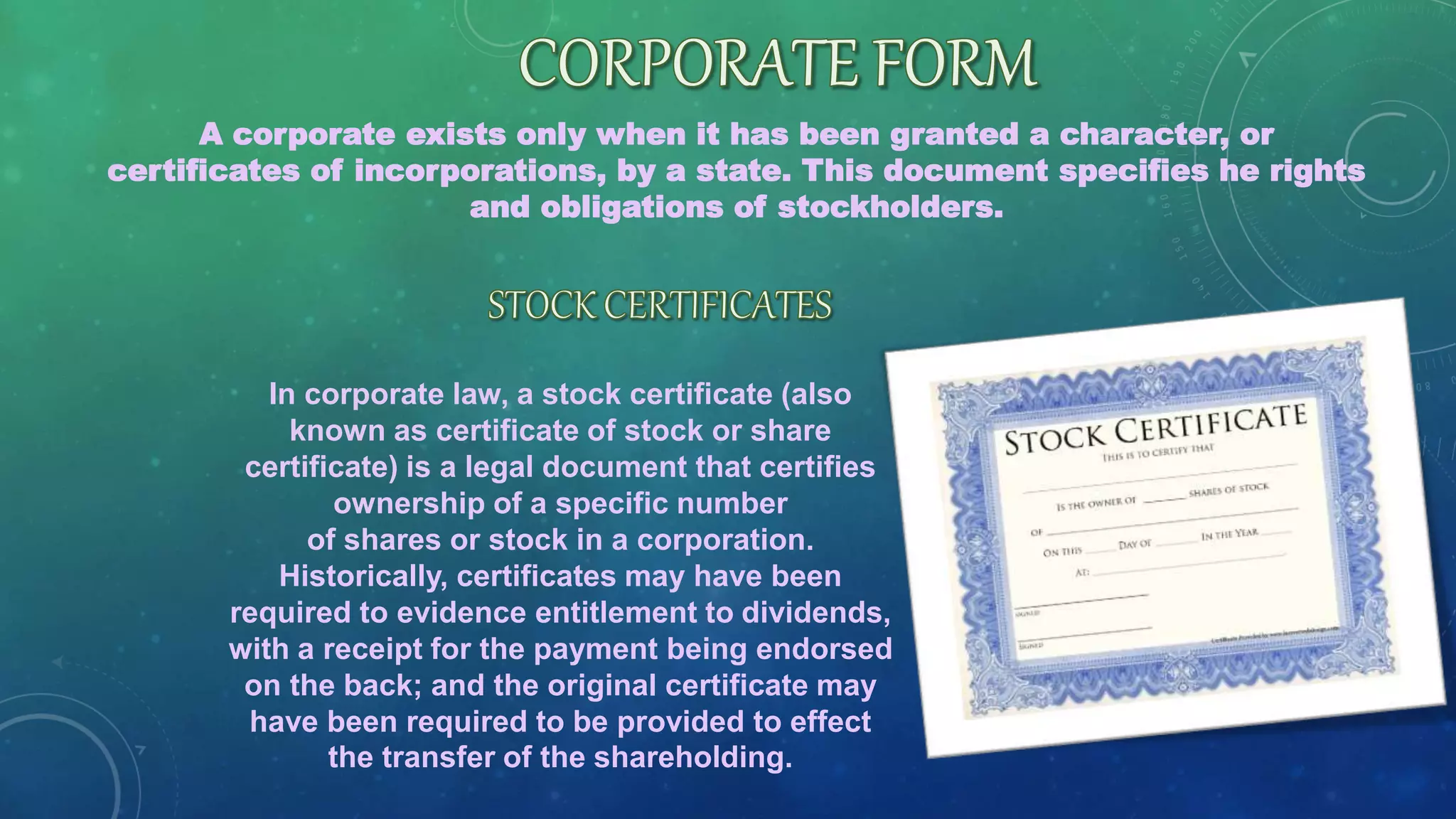
In corporate law, a stock certificate (also
known as certificate of stock or share
certificate) is a legal document that certifies
ownership of a specific number
of shares or stock in a corporation.
Historically, certificates may have been
required to evidence entitlement to dividends,
with a receipt for the payment being endorsed
on the back; and the original certificate may
have been required to be provided to effect
the transfer of the shareholding.
Voting shares are shares that give the stockholder the right to vote on
matters of corporate policy making as well as who will compose the
members of the board of directors. In general, common shareholders
are the only security holders given the right to vote. Some firms have
multiple classes of stock with different voting rights. Most shareholders
vote by proxy.
A proxy fight is when a group of shareholders are persuaded to
join forces and gather enough shareholder proxies to win a
corporate vote.
There are two commonly used procedures for voting:
 majority voting
 cumulative voting.
A change in the control of a company, accompanied usually by a
changed in the board of directors and senior management if the
takeover is hostile. In a friendly takeover, the management doesn't
usually change, and the takeover works to the benefit of the target
company. In a hostile takeover there may be an attractive public offer
for the shares, or unsolicited merger proposals for the management,
accumulation of controlling shares through buying in the open market,
or proxy fights. There are various methods of fighting off hostile
takeover bids, with colourful names
Corporate management team in a corporation, ownership& direct
control are typically separate. BODs elected by shareholders
have ultimate decision making authority. Ethics and Incentives
within Corporations Agency Problems, Managers may act in their
own interest rather than in the best interest of the shareholders.
One potential solution is to tie management’s compensation to
firm performance.
The stakeholders may own the company, but they usually don’t manage it.
Generally, management is delegated to a team of professionals. Though the
details of corporate governance vary somewhat, this principal of separation of
ownership and control of a firm is found around the world. Several mechanisms
have evolved to mitigate this conflict: The Board oversees management and can
fire them. Management remuneration can be tied to performance. Poorly
performing firms may be taken over and the managers replaced by a new team.
Stockholders' equity is the portion of the balance sheet that
represents the capital received from investors in exchange for
stock (paid-in capital), donated capital and retained earnings.
Stockholders' equity represents the equity stake currently held
on the books by a firm's equity investors.
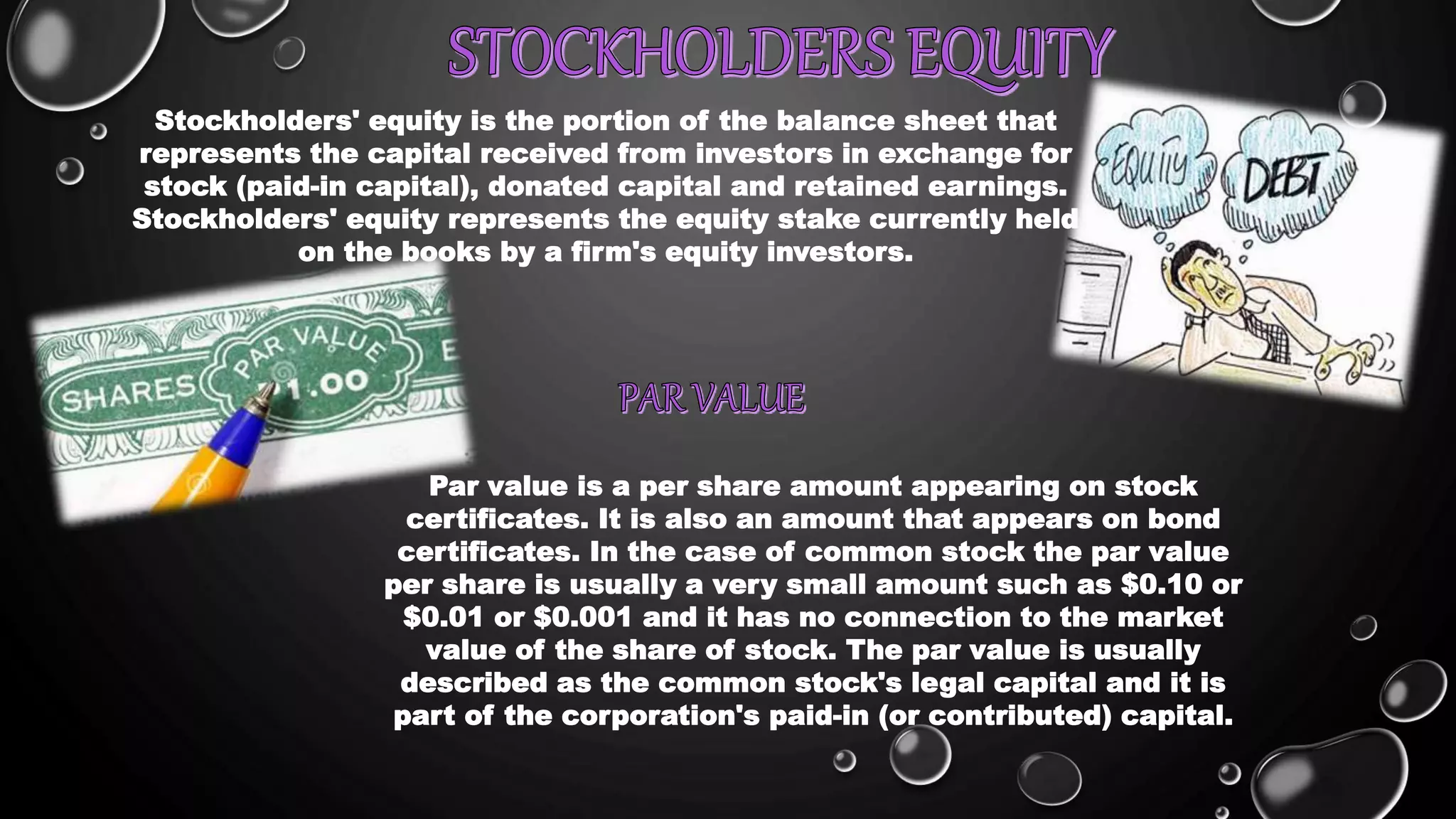
Par value is a per share amount appearing on stock
certificates. It is also an amount that appears on bond
certificates. In the case of common stock the par value
per share is usually a very small amount such as $0.10 or
$0.01 or $0.001 and it has no connection to the market
value of the share of stock. The par value is usually
described as the common stock's legal capital and it is
part of the corporation's paid-in (or contributed) capital.
A corporation will generate income, much of which is paid out to creditors
(as interest)
& to stockholders (dividend). Any remainder is added to the amount shown
as
Cumulative retained earning on the corporation’s book. The sum of
cumulative retained
Earning or other entries under stockholders equity is the book value of
equity. Book value is the amount that would be left for common shareholders
if all the tangible and intangible assets of a company could be liquidated and
all the long and short-term debt, taxes, and preferred shareholders were
paid.
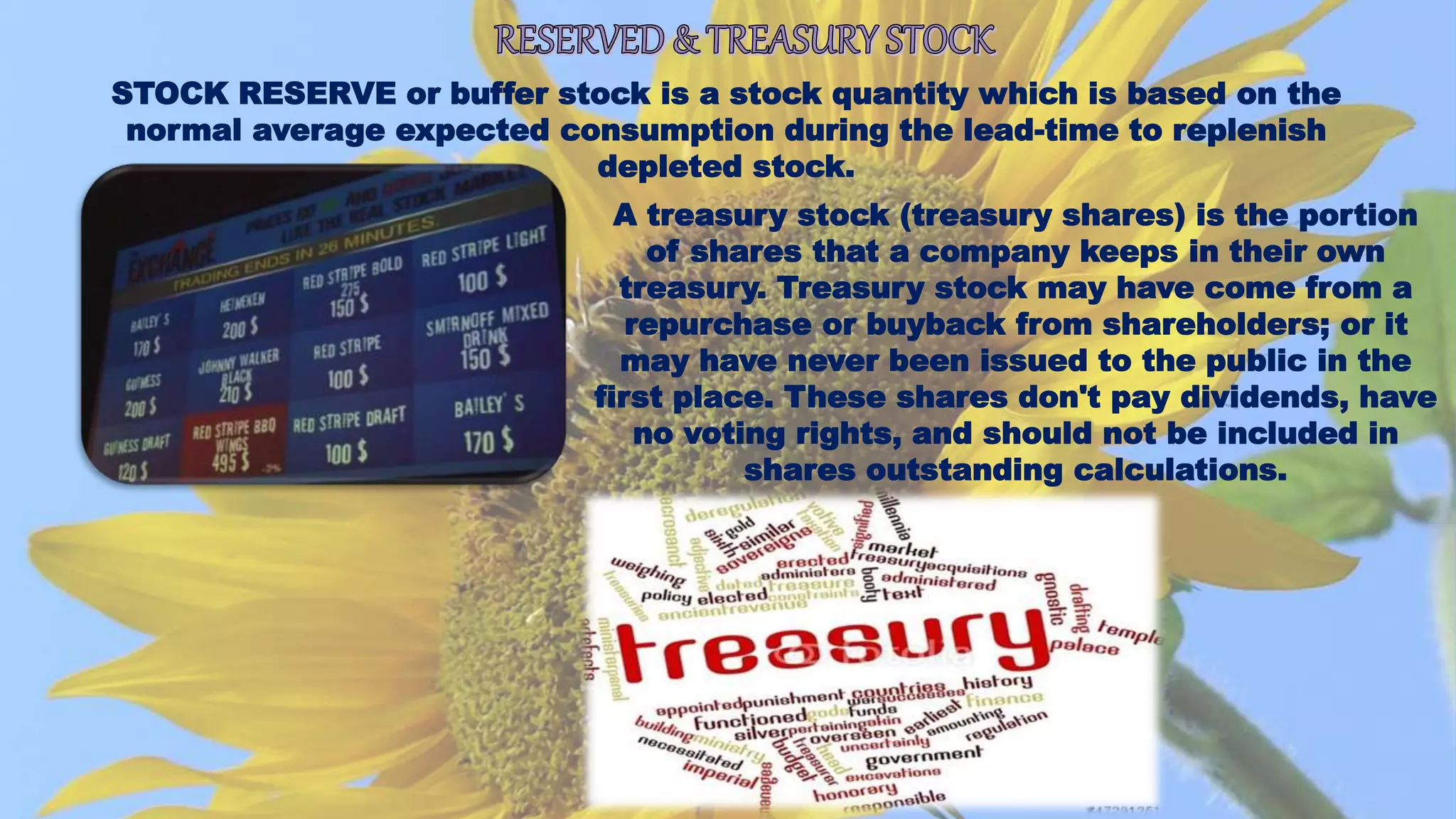
STOCK RESERVE or buffer stock is a stock quantity which is based on the
normal average expected consumption during the lead-time to replenish
depleted stock.
A treasury stock (treasury shares) is the portion
of shares that a company keeps in their own
treasury. Treasury stock may have come from a
repurchase or buyback from shareholders; or it
may have never been issued to the public in the
first place. These shares don't pay dividends, have
no voting rights, and should not be included in
shares outstanding calculations.
A cash dividend is money paid to stockholders, normally out of
the corporation's current earnings or accumulated profits. Not
all companies pay a dividend. Usually, the board of directors
determines if a dividend is desirable for their particular
company based upon various financial and economic factors.
Dividends are commonly paid in the form of cash distributions
to the shareholders on a monthly, quarterly or yearly basis. All
dividends are taxable as income to the recipients.
Process of payment:
 Declaration date
 Date of record
 Ex- dividend date
 Payment date
Like cash dividends, stock dividends and stock splits also have effects on a company's stock
price.
Stock dividend issued in place of a cash payment. A 5% stock dividend results in,
Example: 5% of 100 shares = 5 shares
Stock splits occur when a company perceives that its stock price may be too high.
Stock splits are usually done to increase the liquidity of the stock (more shares
outstanding) and to make it more affordable for investors to buy regular lots (a
regular lot = 100 shares). New shares issue after the split,
Example: a 2 for 1 split (par = $1)
A 200 share holder receive 400 new share at $.50 par
Thus, there is no dilution of shareholder’s equity position.
The right of current shareholders to maintain their fractional ownership of
a company by buying a proportional number of shares of any future issue of common
stock. Most states consider preemptive rights valid only if made explicit in
a corporation's charter. Provided for in the articles of incorporations.
In finance, the beta (β or beta coefficient) of an investment indicates whether the investment
is more or less volatile than the market. In general, a beta less than 1 indicates that the
investment is less volatile than the market. It is a measure of a stock’s sensitivity of future
market movements.
Calculation using linear regression the model equation is specified
ri = α + β ri + εi
ri is the return of stock I
α is the average return of stock I
β is the stock I’s beta
ri is the return of index
εi is the error term
The standard error of beta indicates the extent of standard deviation of the estimates.
In general, growth stocks are stocks of companies that have experienced, or are
expected, or are expected to experience, rapid increases in earnings. Whereas,
value socks are stocks whose market price seems to be low relative to measure of
their worth.
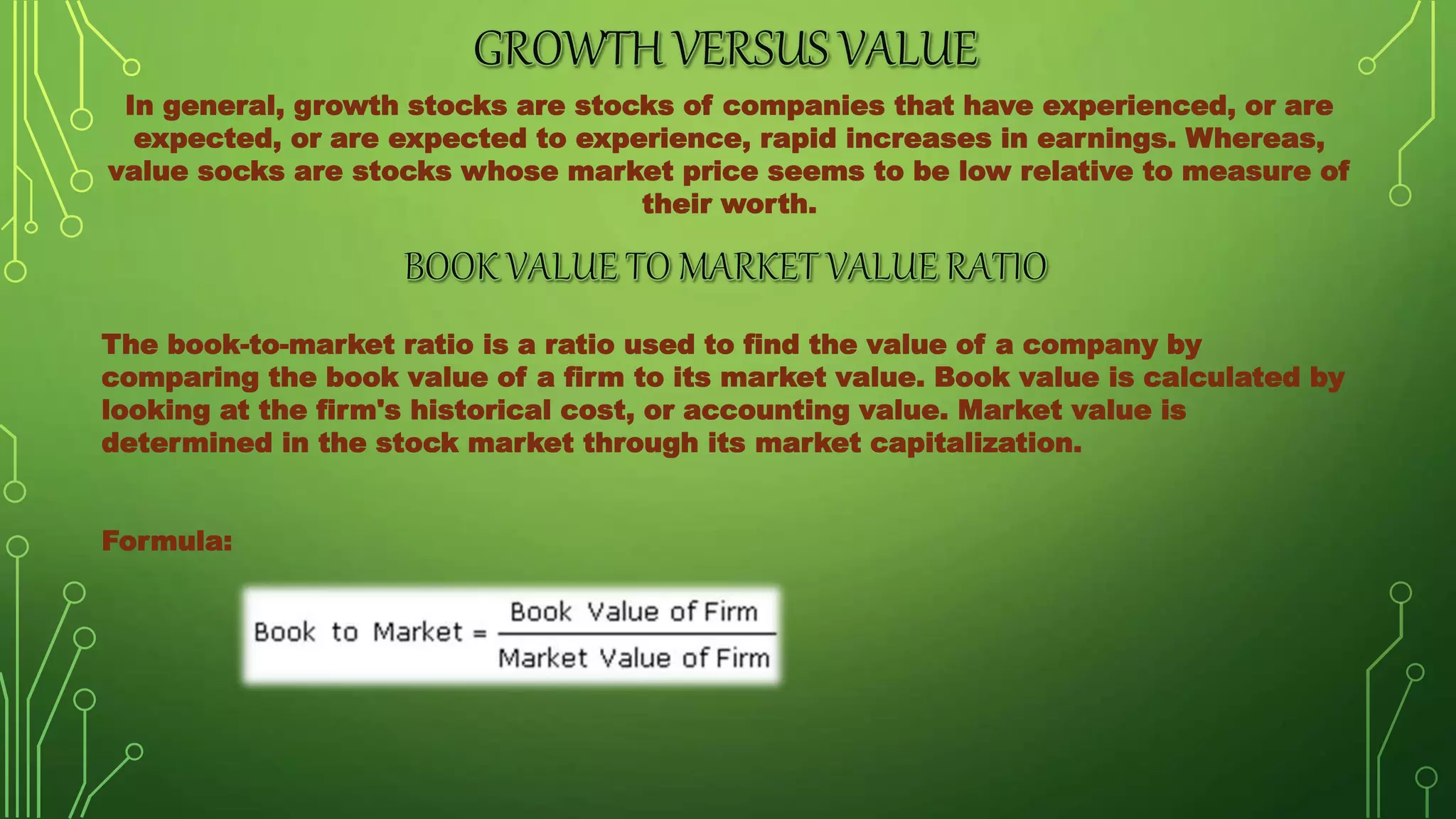
The book-to-market ratio is a ratio used to find the value of a company by
comparing the book value of a firm to its market value. Book value is calculated by
looking at the firm's historical cost, or accounting value. Market value is
determined in the stock market through its market capitalization.
Formula:
The earnings yield (aka earnings-price ratio, E/P ratio) for stocks is the inverse of the price-
earnings ratio (P/E) of stocks, and is equal to the earnings per share of common stock
divided by the market price of the stock. The E/P ratio increases with earnings and
decreases with increases in the stock price.
Earnings Yield = Earnings per Share of Common Stock / Stock Price
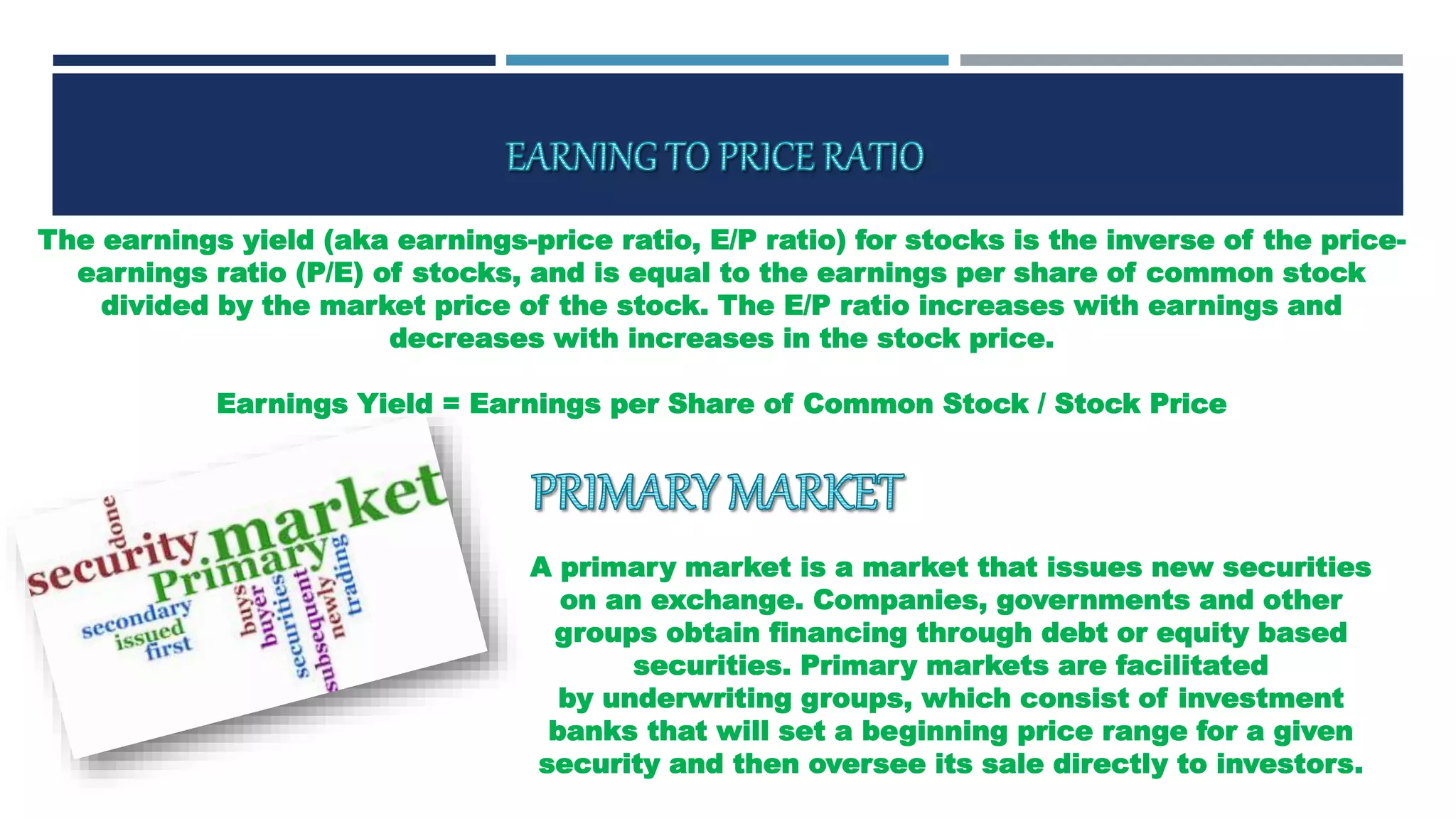
A primary market is a market that issues new securities
on an exchange. Companies, governments and other
groups obtain financing through debt or equity based
securities. Primary markets are facilitated
by underwriting groups, which consist of investment
banks that will set a beginning price range for a given
security and then oversee its sale directly to investors.
A private placement is the sale of securities to a relatively small
number of select investors as a way of raising capital. Investors
involved in private placements are usually large banks, mutual
funds, insurance companies and pension funds.
Private placement is the opposite of a public issue, in which
securities are made available for sale on the open market.
When public sale is much more must be done then with
private placements. Many firms may servers as
intermediaries in the process. One acting as the “lead”
investment banker, puts together a syndicate (or purchase
group) and a selling group. The syndicate includes firms
that purchase the securities from the issuing corporation
and are said to underwrite the offering. The selling group
includes firms that contact potential buyers and do the
actual selling, usually on a commission basis.
A competitive bid is a step in the initial public offering process whereby
an underwriter submits a sealed bid to a company that is making its
first issue of stock. A process by which a contracting firm selects from
among competing vendors or contractors who have submitted bids at
the request of the firm. Bids are usually sealed and selection occurs
through either an open bidding process, in which they are revealed
in view of the bidders, or a closed bidding process, in which they are
opened in a closed session. The process is designed
to increase the competitiveness of pricing and minimize
the preferential treatment.
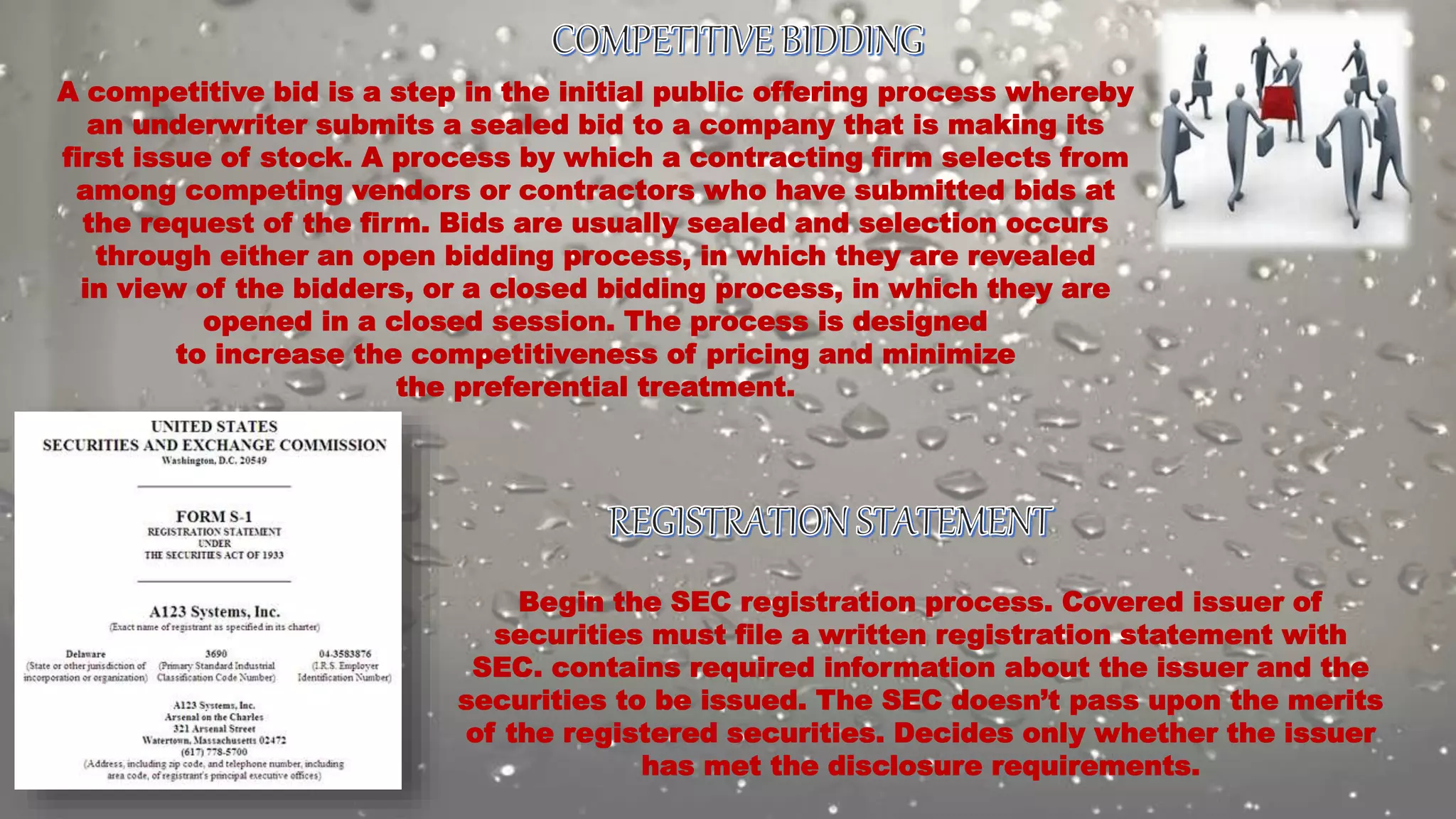
Begin the SEC registration process. Covered issuer of
securities must file a written registration statement with
SEC. contains required information about the issuer and the
securities to be issued. The SEC doesn’t pass upon the merits
of the registered securities. Decides only whether the issuer
has met the disclosure requirements.
A firm commitment is a lending institution's promise to enter into a loan
agreement with a specific entity within a certain period of time.
A firm commitment underwriting agreement is the most desirable for the
issuer because it guarantees them all of their money right away. The
more in demand the offering is, the more likely it is that it will be done on
a firm commitment basis. In a firm commitment, the underwriter puts
their own money at risk if they can’t sell the securities to investors.
A standby underwriting agreement will be used in conjunction with a preemptive rights
offering. All standby underwritings are done on a firm commitment basis. The standby
underwriter agrees to purchase any shares that current shareholders do not purchase. The
standby underwriter will then resell the securities to the public.
A method of stabilizing a country's currency by fixing
its exchange rate to that of another country. A practice of
an investor buying large amounts of an underlying
commodity or security close to the expiry date of a
derivative held by the investor.
Underpricing is the pricing of an initial public offering (IPO) below its market
value. When the offer price is lower than the price of the first trade, the stock is
considered to be underpriced. A stock is usually only underpriced temporarily
because the laws of supply and demand will eventually drive it toward its intrinsic
value.
A seasoned offering is a new issue of security that has previously been placed in the
market through a prior issuance. Although an SEO is a primary market transaction, it
is not the first time that the security will actually be held by the general investing
public; it simply adds to the number of outstanding shares.
Common stock

Common stock

  • 2.
    Characteristics of commonstocks Hafsa Khan 2k13/BPA/78
  • 3.
    Stocks represent ownershipcapital Stockholders are part owners of the company A common stock is a security that represents ownership in a corporation. Holders of common stock exercise control by electing a board of directors and voting on corporate policy. Common stockholders are on the bottom of the priority ladder for ownership structure. In the event of liquidation, common shareholders have rights to a company's assets only after bondholders, preferred shareholders and other debtholders have been paid in full.
  • 4.
    A corporate existsonly when it has been granted a character, or certificates of incorporations, by a state. This document specifies he rights and obligations of stockholders. In corporate law, a stock certificate (also known as certificate of stock or share certificate) is a legal document that certifies ownership of a specific number of shares or stock in a corporation. Historically, certificates may have been required to evidence entitlement to dividends, with a receipt for the payment being endorsed on the back; and the original certificate may have been required to be provided to effect the transfer of the shareholding.
  • 5.
    Voting shares areshares that give the stockholder the right to vote on matters of corporate policy making as well as who will compose the members of the board of directors. In general, common shareholders are the only security holders given the right to vote. Some firms have multiple classes of stock with different voting rights. Most shareholders vote by proxy. A proxy fight is when a group of shareholders are persuaded to join forces and gather enough shareholder proxies to win a corporate vote. There are two commonly used procedures for voting:  majority voting  cumulative voting.
  • 6.
    A change inthe control of a company, accompanied usually by a changed in the board of directors and senior management if the takeover is hostile. In a friendly takeover, the management doesn't usually change, and the takeover works to the benefit of the target company. In a hostile takeover there may be an attractive public offer for the shares, or unsolicited merger proposals for the management, accumulation of controlling shares through buying in the open market, or proxy fights. There are various methods of fighting off hostile takeover bids, with colourful names Corporate management team in a corporation, ownership& direct control are typically separate. BODs elected by shareholders have ultimate decision making authority. Ethics and Incentives within Corporations Agency Problems, Managers may act in their own interest rather than in the best interest of the shareholders. One potential solution is to tie management’s compensation to firm performance.
  • 7.
    The stakeholders mayown the company, but they usually don’t manage it. Generally, management is delegated to a team of professionals. Though the details of corporate governance vary somewhat, this principal of separation of ownership and control of a firm is found around the world. Several mechanisms have evolved to mitigate this conflict: The Board oversees management and can fire them. Management remuneration can be tied to performance. Poorly performing firms may be taken over and the managers replaced by a new team.
  • 8.
    Stockholders' equity isthe portion of the balance sheet that represents the capital received from investors in exchange for stock (paid-in capital), donated capital and retained earnings. Stockholders' equity represents the equity stake currently held on the books by a firm's equity investors. Par value is a per share amount appearing on stock certificates. It is also an amount that appears on bond certificates. In the case of common stock the par value per share is usually a very small amount such as $0.10 or $0.01 or $0.001 and it has no connection to the market value of the share of stock. The par value is usually described as the common stock's legal capital and it is part of the corporation's paid-in (or contributed) capital.
  • 9.
    A corporation willgenerate income, much of which is paid out to creditors (as interest) & to stockholders (dividend). Any remainder is added to the amount shown as Cumulative retained earning on the corporation’s book. The sum of cumulative retained Earning or other entries under stockholders equity is the book value of equity. Book value is the amount that would be left for common shareholders if all the tangible and intangible assets of a company could be liquidated and all the long and short-term debt, taxes, and preferred shareholders were paid.
  • 10.
    STOCK RESERVE orbuffer stock is a stock quantity which is based on the normal average expected consumption during the lead-time to replenish depleted stock. A treasury stock (treasury shares) is the portion of shares that a company keeps in their own treasury. Treasury stock may have come from a repurchase or buyback from shareholders; or it may have never been issued to the public in the first place. These shares don't pay dividends, have no voting rights, and should not be included in shares outstanding calculations.
  • 11.
    A cash dividendis money paid to stockholders, normally out of the corporation's current earnings or accumulated profits. Not all companies pay a dividend. Usually, the board of directors determines if a dividend is desirable for their particular company based upon various financial and economic factors. Dividends are commonly paid in the form of cash distributions to the shareholders on a monthly, quarterly or yearly basis. All dividends are taxable as income to the recipients. Process of payment:  Declaration date  Date of record  Ex- dividend date  Payment date Like cash dividends, stock dividends and stock splits also have effects on a company's stock price. Stock dividend issued in place of a cash payment. A 5% stock dividend results in, Example: 5% of 100 shares = 5 shares
  • 12.
    Stock splits occurwhen a company perceives that its stock price may be too high. Stock splits are usually done to increase the liquidity of the stock (more shares outstanding) and to make it more affordable for investors to buy regular lots (a regular lot = 100 shares). New shares issue after the split, Example: a 2 for 1 split (par = $1) A 200 share holder receive 400 new share at $.50 par Thus, there is no dilution of shareholder’s equity position. The right of current shareholders to maintain their fractional ownership of a company by buying a proportional number of shares of any future issue of common stock. Most states consider preemptive rights valid only if made explicit in a corporation's charter. Provided for in the articles of incorporations.
  • 13.
    In finance, thebeta (β or beta coefficient) of an investment indicates whether the investment is more or less volatile than the market. In general, a beta less than 1 indicates that the investment is less volatile than the market. It is a measure of a stock’s sensitivity of future market movements. Calculation using linear regression the model equation is specified ri = α + β ri + εi ri is the return of stock I α is the average return of stock I β is the stock I’s beta ri is the return of index εi is the error term The standard error of beta indicates the extent of standard deviation of the estimates.
  • 14.
    In general, growthstocks are stocks of companies that have experienced, or are expected, or are expected to experience, rapid increases in earnings. Whereas, value socks are stocks whose market price seems to be low relative to measure of their worth. The book-to-market ratio is a ratio used to find the value of a company by comparing the book value of a firm to its market value. Book value is calculated by looking at the firm's historical cost, or accounting value. Market value is determined in the stock market through its market capitalization. Formula:
  • 15.
    The earnings yield(aka earnings-price ratio, E/P ratio) for stocks is the inverse of the price- earnings ratio (P/E) of stocks, and is equal to the earnings per share of common stock divided by the market price of the stock. The E/P ratio increases with earnings and decreases with increases in the stock price. Earnings Yield = Earnings per Share of Common Stock / Stock Price A primary market is a market that issues new securities on an exchange. Companies, governments and other groups obtain financing through debt or equity based securities. Primary markets are facilitated by underwriting groups, which consist of investment banks that will set a beginning price range for a given security and then oversee its sale directly to investors.
  • 16.
    A private placementis the sale of securities to a relatively small number of select investors as a way of raising capital. Investors involved in private placements are usually large banks, mutual funds, insurance companies and pension funds. Private placement is the opposite of a public issue, in which securities are made available for sale on the open market. When public sale is much more must be done then with private placements. Many firms may servers as intermediaries in the process. One acting as the “lead” investment banker, puts together a syndicate (or purchase group) and a selling group. The syndicate includes firms that purchase the securities from the issuing corporation and are said to underwrite the offering. The selling group includes firms that contact potential buyers and do the actual selling, usually on a commission basis.
  • 17.
    A competitive bidis a step in the initial public offering process whereby an underwriter submits a sealed bid to a company that is making its first issue of stock. A process by which a contracting firm selects from among competing vendors or contractors who have submitted bids at the request of the firm. Bids are usually sealed and selection occurs through either an open bidding process, in which they are revealed in view of the bidders, or a closed bidding process, in which they are opened in a closed session. The process is designed to increase the competitiveness of pricing and minimize the preferential treatment. Begin the SEC registration process. Covered issuer of securities must file a written registration statement with SEC. contains required information about the issuer and the securities to be issued. The SEC doesn’t pass upon the merits of the registered securities. Decides only whether the issuer has met the disclosure requirements.
  • 18.
    A firm commitmentis a lending institution's promise to enter into a loan agreement with a specific entity within a certain period of time. A firm commitment underwriting agreement is the most desirable for the issuer because it guarantees them all of their money right away. The more in demand the offering is, the more likely it is that it will be done on a firm commitment basis. In a firm commitment, the underwriter puts their own money at risk if they can’t sell the securities to investors. A standby underwriting agreement will be used in conjunction with a preemptive rights offering. All standby underwritings are done on a firm commitment basis. The standby underwriter agrees to purchase any shares that current shareholders do not purchase. The standby underwriter will then resell the securities to the public. A method of stabilizing a country's currency by fixing its exchange rate to that of another country. A practice of an investor buying large amounts of an underlying commodity or security close to the expiry date of a derivative held by the investor.
  • 19.
    Underpricing is thepricing of an initial public offering (IPO) below its market value. When the offer price is lower than the price of the first trade, the stock is considered to be underpriced. A stock is usually only underpriced temporarily because the laws of supply and demand will eventually drive it toward its intrinsic value. A seasoned offering is a new issue of security that has previously been placed in the market through a prior issuance. Although an SEO is a primary market transaction, it is not the first time that the security will actually be held by the general investing public; it simply adds to the number of outstanding shares.