Chapter Four 
Financial Planning and 
Forecasting 
Principles of Managerial Finance 
First Canadian Edition 
Lawrence J. Gitman and Sean Hennessey 
© 2004 Pearson 
4-1
Learning Goals 
LG1 – Understand the financial planning 
process, including long-term (strategic) 
and short-term (operational) plans. 
LG2 – Discuss the cash budget, importance of 
sales forecasts, procedures to prepare 
cash budgets, and coping with 
uncertainty when preparing a cash 
budget. 
© 2004 Pearson 
4-2
Learning Goals (continued) 
LG3 – Discuss fundamentals associated with 
preparing pro forma income statements 
and balance sheets. 
LG4 – Discuss and illustrate three approaches to 
preparing pro forma income statements. 
LG5 – Discuss and illustrate judgmental 
approach to preparing pro forma balance 
sheets, and determine amount of external 
financing required to operate during the 
forecast year. 
© 2004 Pearson 
4-3
Financial Planning Process 
• There are three key aspects to the financial 
planning process. 
– Cash Planning, forecasting the need for cash. 
– Forecasting future profitability. 
– Forecasting the need for financing. 
• These are prepared as “Pro Forma” income 
statements and balance sheets. 
© 2004 Pearson 
4-4
Long-Term Strategic Plans 
• Long-term financial plans are the planned 
financial actions and the anticipated financial 
impact of those actions over periods ranging 
from 2 to 10 years. 
• Such planning projections may be carried out 
as a regular function of the firm’s operations, 
or in conjunction with corporate strategic 
planning efforts. 
© 2004 Pearson 
4-5
Short-Term Operating Plans 
• Short-term financial plans are those planned 
financial actions and the anticipated impact 
of those actions over periods ranging from 
one to two years. 
• Because of their relevance to immediate 
operations, such plans form a regular and 
needed function to the firm. 
© 2004 Pearson 
4-6
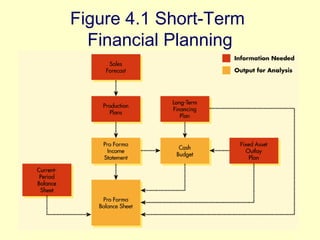
Figure 4.1 Short-Term 
Financial Planning 
© 2004 Pearson 
4-7
Cash Planning: Cash Budget 
• The Cash Budget or cash forecast is a 
statement of the firm’s planned inflows and 
outflows of cash that is used to estimate its 
short-term cash requirements. 
© 2004 Pearson 
4-8
Sales Forecast 
• The prediction of the firm’s sales over a given 
period, based on external and internal data, and 
used as the key input to the financial planning 
process. 
– External forecasts involve the use of general 
economic data such as GDP, interest rates, 
disposable personal income, and other similar 
data. 
– Internal forecasts utilize data internal to the firm, 
such as sales force surveys, order buildups, and 
other sales channel information. 
© 2004 Pearson 
4-9
Preparing Cash Budgets 
• Two basic categories of data are required to 
develop the Cash Budget: 
– Cash Receipts, including cash sales, collections 
of accounts receivable, and other cash receipts. 
– Cash Disbursements, including cash dividends, 
principal repayment, purchases, payment of 
accounts payable, wages, salaries, and taxes. 
© 2004 Pearson 
4-10
Preparing Cash Budgets 
(continued) 
• Given the Cash Receipts and Cash 
Disbursements the Cash Budget produces: 
– Net Cash Flows, 
– Ending period cash, and 
– Any required total financing needs or excess 
cash balances. 
© 2004 Pearson 
4-11
Evaluating Cash Budget 
• The Cash budget provides the firm with 
figures indicating whether a cash shortage 
or surplus is expected to result in each 
month covered by the forecast. 
© 2004 Pearson 
4-12
Coping with Budget Uncertainty 
• There are two basic ways of coping with 
uncertainty for the cash budget: 
– Prepare several cash budgets based on 
pessimistic, most likely, and optimistic 
forecasts of cash receipts and disbursements. 
– Develop a cash budget simulation with detailed 
assumptions of possible outcomes and their 
underlying probability distributions. 
© 2004 Pearson 
4-13
Cash Flows within the Month 
• While the cash budget generally shows cash 
flows on a monthly basis, this may not 
ensure that the firm is able to meet daily 
cash requirements. 
• Effective cash planning requires a look 
beyond the cash budget. 
© 2004 Pearson 
4-14
Fundamentals of 
Pro Forma Statements 
• Pro Forma statements are vital for 
– Management to evaluate the future expected 
financial position, and 
– Investors and Creditors to evaluate the firm’s 
ability to provide a return on funds invested. 
• Three key outputs of forecasting: 
– Pro forma income statement, 
– Pro forma balance sheet, and 
– Statement of external financing requirements. 
© 2004 Pearson 
4-15
Items Required for Forecasting 
• Preparing Pro Forma statements require: 
– Financial statements from the previous year, 
– Sales forecast for the forecast year, and 
– Forecasts for all other financial statement 
accounts. 
© 2004 Pearson 
4-16
Pro Forma Income Statement 
• Like the Cash Budget, Pro Forma Income 
Statements are based on the sales forecast. 
• One approach to forecasting expenses is to 
project them as their historical “percentage 
of sales.” 
© 2004 Pearson 
4-17
Weaknesses of Percent-of-Sales 
• There are three weaknesses of the percent-of- 
sales approach: 
– It is unrealistic to assume all expenses will 
remain exactly the same percentage from year 
to year. 
– It essentially locks in a fixed profit margin. 
– It assumes all costs are variable. 
• Basing forecasts solely on past data tends to 
understate profits when sales increase, and 
overstate profits when sales decline. 
© 2004 Pearson 
4-18
Pro Forma Balance Sheet 
• The Judgmental Approach is a method for 
developing the Pro Forma Balance Sheet 
where values of certain balance sheet 
accounts are estimated, and others are 
calculated, based on a ratio analysis. 
• Projected changes in assets from the latest 
fiscal year to the forecast year determines 
the Total Financing Required (TFR). 
© 2004 Pearson 
4-19
Pro Forma Balance Sheet 
(continued) 
• Increases in accounts payable and accruals 
generate the internal “spontaneous sources 
of financing.” 
• When internal financing is less than the 
Total Financing Required, the Pro Forma 
Balance Sheet will determine the External 
Financing Required (EFR). 
© 2004 Pearson 
4-20
Using Pro Forma Statements 
• Both financial managers and lenders can 
analyze the firm’s expected financial 
performance. 
• After analyzing pro forma statements, 
managers can take steps to adjust planned 
operations to better achieve short-term 
financial goals. 
© 2004 Pearson 
4-21

Financial Planning and Forecasting

  • 1.
    Chapter Four FinancialPlanning and Forecasting Principles of Managerial Finance First Canadian Edition Lawrence J. Gitman and Sean Hennessey © 2004 Pearson 4-1
  • 2.
    Learning Goals LG1– Understand the financial planning process, including long-term (strategic) and short-term (operational) plans. LG2 – Discuss the cash budget, importance of sales forecasts, procedures to prepare cash budgets, and coping with uncertainty when preparing a cash budget. © 2004 Pearson 4-2
  • 3.
    Learning Goals (continued) LG3 – Discuss fundamentals associated with preparing pro forma income statements and balance sheets. LG4 – Discuss and illustrate three approaches to preparing pro forma income statements. LG5 – Discuss and illustrate judgmental approach to preparing pro forma balance sheets, and determine amount of external financing required to operate during the forecast year. © 2004 Pearson 4-3
  • 4.
    Financial Planning Process • There are three key aspects to the financial planning process. – Cash Planning, forecasting the need for cash. – Forecasting future profitability. – Forecasting the need for financing. • These are prepared as “Pro Forma” income statements and balance sheets. © 2004 Pearson 4-4
  • 5.
    Long-Term Strategic Plans • Long-term financial plans are the planned financial actions and the anticipated financial impact of those actions over periods ranging from 2 to 10 years. • Such planning projections may be carried out as a regular function of the firm’s operations, or in conjunction with corporate strategic planning efforts. © 2004 Pearson 4-5
  • 6.
    Short-Term Operating Plans • Short-term financial plans are those planned financial actions and the anticipated impact of those actions over periods ranging from one to two years. • Because of their relevance to immediate operations, such plans form a regular and needed function to the firm. © 2004 Pearson 4-6
  • 7.
    Figure 4.1 Short-Term Financial Planning © 2004 Pearson 4-7
  • 8.
    Cash Planning: CashBudget • The Cash Budget or cash forecast is a statement of the firm’s planned inflows and outflows of cash that is used to estimate its short-term cash requirements. © 2004 Pearson 4-8
  • 9.
    Sales Forecast •The prediction of the firm’s sales over a given period, based on external and internal data, and used as the key input to the financial planning process. – External forecasts involve the use of general economic data such as GDP, interest rates, disposable personal income, and other similar data. – Internal forecasts utilize data internal to the firm, such as sales force surveys, order buildups, and other sales channel information. © 2004 Pearson 4-9
  • 10.
    Preparing Cash Budgets • Two basic categories of data are required to develop the Cash Budget: – Cash Receipts, including cash sales, collections of accounts receivable, and other cash receipts. – Cash Disbursements, including cash dividends, principal repayment, purchases, payment of accounts payable, wages, salaries, and taxes. © 2004 Pearson 4-10
  • 11.
    Preparing Cash Budgets (continued) • Given the Cash Receipts and Cash Disbursements the Cash Budget produces: – Net Cash Flows, – Ending period cash, and – Any required total financing needs or excess cash balances. © 2004 Pearson 4-11
  • 12.
    Evaluating Cash Budget • The Cash budget provides the firm with figures indicating whether a cash shortage or surplus is expected to result in each month covered by the forecast. © 2004 Pearson 4-12
  • 13.
    Coping with BudgetUncertainty • There are two basic ways of coping with uncertainty for the cash budget: – Prepare several cash budgets based on pessimistic, most likely, and optimistic forecasts of cash receipts and disbursements. – Develop a cash budget simulation with detailed assumptions of possible outcomes and their underlying probability distributions. © 2004 Pearson 4-13
  • 14.
    Cash Flows withinthe Month • While the cash budget generally shows cash flows on a monthly basis, this may not ensure that the firm is able to meet daily cash requirements. • Effective cash planning requires a look beyond the cash budget. © 2004 Pearson 4-14
  • 15.
    Fundamentals of ProForma Statements • Pro Forma statements are vital for – Management to evaluate the future expected financial position, and – Investors and Creditors to evaluate the firm’s ability to provide a return on funds invested. • Three key outputs of forecasting: – Pro forma income statement, – Pro forma balance sheet, and – Statement of external financing requirements. © 2004 Pearson 4-15
  • 16.
    Items Required forForecasting • Preparing Pro Forma statements require: – Financial statements from the previous year, – Sales forecast for the forecast year, and – Forecasts for all other financial statement accounts. © 2004 Pearson 4-16
  • 17.
    Pro Forma IncomeStatement • Like the Cash Budget, Pro Forma Income Statements are based on the sales forecast. • One approach to forecasting expenses is to project them as their historical “percentage of sales.” © 2004 Pearson 4-17
  • 18.
    Weaknesses of Percent-of-Sales • There are three weaknesses of the percent-of- sales approach: – It is unrealistic to assume all expenses will remain exactly the same percentage from year to year. – It essentially locks in a fixed profit margin. – It assumes all costs are variable. • Basing forecasts solely on past data tends to understate profits when sales increase, and overstate profits when sales decline. © 2004 Pearson 4-18
  • 19.
    Pro Forma BalanceSheet • The Judgmental Approach is a method for developing the Pro Forma Balance Sheet where values of certain balance sheet accounts are estimated, and others are calculated, based on a ratio analysis. • Projected changes in assets from the latest fiscal year to the forecast year determines the Total Financing Required (TFR). © 2004 Pearson 4-19
  • 20.
    Pro Forma BalanceSheet (continued) • Increases in accounts payable and accruals generate the internal “spontaneous sources of financing.” • When internal financing is less than the Total Financing Required, the Pro Forma Balance Sheet will determine the External Financing Required (EFR). © 2004 Pearson 4-20
  • 21.
    Using Pro FormaStatements • Both financial managers and lenders can analyze the firm’s expected financial performance. • After analyzing pro forma statements, managers can take steps to adjust planned operations to better achieve short-term financial goals. © 2004 Pearson 4-21