Chapter Three 
Financial Statement Analysis 
Principles of Managerial Finance 
First Canadian Edition 
Lawrence J. Gitman and Sean Hennessey 
© 2004 Pearson 
3-1
Learning Goals 
LG1 – Introduce financial ratio analysis, three types of 
ratio comparisons, and four categories of ratios. 
LG2 – Analyze liquidity and effectiveness at managing 
inventory, accounts receivable, accounts 
payable, fixed and total assets. 
LG3 – Discuss financial leverage, ratios used to assess 
how assets were financed, and ability to cover 
financing charges. 
© 2004 Pearson 
3-2
Learning Goals (continued) 
LG4 – Evaluate profitability using common-size 
analysis, and relative to sales, total assets, 
common equity, and common share price. 
LG5 – Explore link between various categories of 
ratios, liquidity and activity ratios, leverage, 
and profitability ratios. 
LG6 – Use DuPont system and summary of financial 
ratios to perform complete ratio analysis, with 
caution. 
© 2004 Pearson 
3-3
Using Financial Ratios 
• Financial Ratios are measures of relative 
values of key financial information. 
• Ratio Analysis involves methods of 
calculating and interpreting financial ratios to 
assess the firm’s performance. 
• Ratios are measured as (1) percentages; (2) 
times or multiples; and (3) number of days. 
© 2004 Pearson 
3-4
Parties interested in Ratios 
• Ratios are of interest as key indicators of 
financial health to: 
– shareholders, 
– creditors, 
– management, and 
– prospective investors. 
• Ratio analysis directs attention to potential 
areas of concern, but are not conclusive 
evidence of problems. 
© 2004 Pearson 
3-5
Types of Ratio Comparisons 
• Cross-Sectional Analysis involves the 
comparison of different firms at the same time. 
– Benchmarking firm performance against industry 
averages is very popular. 
• Time-Series Analysis evaluates performance 
over time, allowing for comparisons of current 
and past ratio values. 
• Combined Analysis mixes both features of 
Cross-Sectional and Time Series Analysis. 
© 2004 Pearson 
3-6
Categories of Financial Ratios 
• Ratios are grouped into four basic 
categories: 
– liquidity ratios, 
– activity ratios, 
– leverage ratios, and 
– profitability ratios. 
© 2004 Pearson 
3-7
Analyzing Liquidity 
• Liquidity refers to the firm’s ability to 
satisfy its short-term obligations as they 
come due. 
• Three areas are of particular concern: 
– Net Working Capital, 
– The Current Ratio, and 
– The Quick (Acid-Test) Ratio. 
© 2004 Pearson 
3-8
Net Working Capital 
• This measure of liquidity is simply a measure of 
current assets minus liabilities. 
Net Working Capital = Current Assets – Current 
Liabilities 
© 2004 Pearson 
3-9
Current Ratio 
• Commonly used, the Current Ratio measures the 
ability to meet short-term obligations. 
Current Ratio = Current Assets/Current Liabilities 
© 2004 Pearson 
3-10
Quick (Acid Test) Ratio 
• The Quick Ration focuses on only the most 
liquid of the firm’s current assets: cash, 
marketable securities, and accounts receivable. 
Quick Ratio = 
Cash+Marketable Securities+Accounts Receivable 
Current Liabilities 
© 2004 Pearson 
3-11
Analyzing Activity 
• Activity Ratios measure the effectiveness of 
managing accounts receivable, inventory, 
accounts payable, fixed assets, and total 
assets. 
• There are Activity Ratios for each of these 
management issues. 
© 2004 Pearson 
3-12
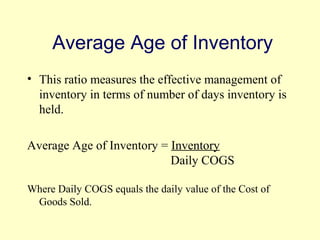
Average Age of Inventory 
• This ratio measures the effective management of 
inventory in terms of number of days inventory is 
held. 
Average Age of Inventory = Inventory 
Daily COGS 
Where Daily COGS equals the daily value of the Cost of 
Goods Sold. 
© 2004 Pearson 
3-13
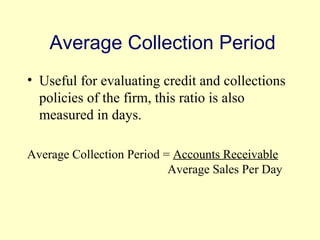
Average Collection Period 
• Useful for evaluating credit and collections 
policies of the firm, this ratio is also 
measured in days. 
Average Collection Period = Accounts Receivable 
Average Sales Per Day 
© 2004 Pearson 
3-14
Average Payment Period 
• This ratio evaluates the speed of satisfying the 
Accounts Payable for the firm. 
Average Payment Period = Accounts Payable 
Average Purchase Per Day 
© 2004 Pearson 
3-15
Fixed and Total Asset Turnover 
• These ratios evaluate the use of Fixed and 
Total Assets to generate Sales. 
Fixed Asset Turnover = Sales 
Net Fixed Assets 
Total Asset Turnover = Sales 
Total Assets 
© 2004 Pearson 
3-16
Analyzing Leverage 
• Leverage measures the amounts of 
borrowed money being used by the firm. 
• Leverage Ratios are classified as either 
– Capitalization Ratios, focusing on how 
investments are financed; or 
– Coverage Ratios, focusing on the ability to 
service the firm’s sources of financing. 
© 2004 Pearson 
3-17
Debt Ratio 
• The Debt Ratio measures the proportion of total 
assets financed by creditors. 
Debt Ratio = Total Liabilities/Total Assets 
• The Preferred Equity Ratio shows only that 
portion of total assets financed by preferred 
shareholders. 
• The Common Equity Ratio shows only that 
portion of total assets financed by common 
shareholders. 
© 2004 Pearson 
3-18
Debt/Equity Ratio 
• The popularly mentioned Debt/Equity Ratio 
measures the proportion of long-term debt 
to common equity of the firm. 
Debt/Equity Ratio = Long-Term Debt 
Common Equity 
© 2004 Pearson 
3-19
Times Interest Earned Ratio 
• Also called the Interest Coverage Ratio, measures 
the ability to make contractual interest payments. 
Times Interest Earned = EBIT 
Interest 
Recall that EBIT stands for Earnings Before Interest and Taxes. 
© 2004 Pearson 
3-20
Fixed-Charge Coverage Ratio 
• This ratio measures the ability to meet all fixed 
financial payments. 
EBIT + Lease Payments 
Interest + Lease Payments + ((1-T)*(Principal + Dividends)) 
Where T is the corporate tax rate. 
© 2004 Pearson 
3-21
Analyzing Profitability 
• There are many measures of the bottom-line, 
the profitability of the firm. 
• Four main measures examined here are: 
– Common-Size Income Statements, 
– Return on Total Assets, 
– Return on Equity, and 
– Price/Earnings Ratio. 
© 2004 Pearson 
3-22
Common Size Income Statements 
• Gross Margin measures the percentage of each sales 
dollar after direct cost of goods have been paid. 
• Operating Margin measures the percentage of each 
sales dollar after all expenses associated with 
producing, selling, and operating the company have 
bee deducted (EBIT). 
• Profit Margin measures the percentage of each sales 
dollar after all expenses, including interest and taxes, 
have been paid. 
© 2004 Pearson 
3-23
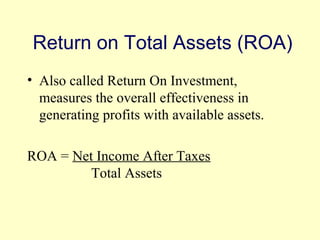
Return on Total Assets (ROA) 
• Also called Return On Investment, 
measures the overall effectiveness in 
generating profits with available assets. 
ROA = Net Income After Taxes 
Total Assets 
© 2004 Pearson 
3-24
Return on Equity (ROE) 
• Measures the return earned on the owners’ 
investment in the firm. 
ROE = Earnings Available for Common Shareholders 
Common Equity 
© 2004 Pearson 
3-25
Earnings per Share (EPS) 
• Represents the number of dollars earned on 
behalf of each outstanding common share. 
EPS = Earnings Available for Common Shareholders 
Number of Common Shares Outstanding 
© 2004 Pearson 
3-26
Price/Earnings (P/E) Ratio 
• This commonly used ratio is more an 
appraisal of share value than directly of 
profitability. 
P/E Ratio = Market Price Per Common Share 
Earnings Per Share 
© 2004 Pearson 
3-27
Leverage and Profitability 
• Leverage is the advantage gained by using a 
lever. In finance, debt financing is the 
financial lever. 
• Financial leverage allows the firm to 
acquire assets beyond those available 
through pure equity financing 
arrangements. 
© 2004 Pearson 
3-28
Complete Ratio Analysis 
• Investors and Analysts want to get a global 
view of the various ratios in order to make 
their overall assessment of a firm’s health. 
• Two popular approaches are: 
– The DuPont System of Analysis, and 
– A summary analysis of all key ratios. 
© 2004 Pearson 
3-29
DuPont System of Analysis 
• Developed by the DuPont Corporation. 
• The DuPont System merges Income 
Statement and Balance Sheet into two 
summary measures of profitability: ROA 
and ROE. 
© 2004 Pearson 
3-30
DuPont Formula 
• The DuPont Formula links the Profit Margin 
with Total Asset Turnover, as their underlying 
formulas will summarize Return on Assets. 
ROA = Profit Margin * Total Asset Turnover 
• Since, 
ROA = Net Income After Taxes * Sales 
Sales Total Assets 
© 2004 Pearson 
3-31
Modified DuPont Formula 
• The Financial Leverage Multiplier (FLM) is the 
ratio of Total Assets to Shareholders’ Equity. 
• The FLM transforms ROA into ROE. 
ROE = ROA * FLM 
• Since, 
ROE = Net Income After Taxes * Total Assets 
Total Assets Shareholders’ Equity 
© 2004 Pearson 
3-32
Summarizing All Ratios 
• Simply preparing a table of the ratios from 
the four key categories (liquidity, activity, 
leverage, and profitability) over a multi-year 
period allows for a quick and comprehensive 
review of the firm’s performance. 
© 2004 Pearson 
3-33
Table 3.7 Summary of Barlett 
Company Liquidity Ratios 
Ratio 2000 2001 2002 Industry Ave. 
2002 
Net Working 
Capital 
$583,000 $521,000 $603,000 $427,000 
Current Ratio 2.04 2.08 1.97 2.05 
Quick Ratio 1.32 1.46 1.51 1.43 
© 2004 Pearson 
3-34
Table 3.7 Summary of Barlett 
Company Activity Ratios 
Ratio 2000 2001 2002 Industry Ave. 
2002 
Ave. Age 
Inventory 
71.6 
days 
64 
days 
50.7 
days 
55.3 days 
Ave. 
Collection 
Period 
44.5 
days 
51.9 
days 
59.7 
days 
44.9 days 
Ave. 
Payment 
Period 
76.9 
days 
82.3 
days 
95.4 
days 
67.4 days 
Total Asset 
Turnover 
0.94 0.79 0.85 0.75 
© 2004 Pearson 
3-35
Table 3.7 Summary of Barlett 
Company Leverage Ratios 
Ratio 2000 2001 2002 Industry Ave. 
2002 
Debt Ratio 36.8% 44.3% 45.7% 40.0% 
Debt/Equity 
43.5% 59.7% 58.3% 47.4% 
Ratio 
Times Interest 
Earned 
5.6 3.3 4.5 4.3 
Fixed Charge 
Coverage 
2.4 1.4 1.9 1.5 
© 2004 Pearson 
3-36
Table 3.7 Summary of Barlett 
Company Profitability Ratios 
Ratio 2000 2001 2002 Industry Ave. 
2002 
Gross Margin 31.4% 33.3% 32.1% 30.0% 
Operating Margin 14.6% 11.8% 13.6% 11.0% 
Profit Margin 8.8% 5.8% 7.5% 6.4% 
ROA 8.3% 4.5% 6.4% 4.8% 
ROE 14.1% 8.5% 12.6% 8.0% 
EPS $3.26 $1.81 $2.90 $2.26 
P/E Ratio 10.5 10.0 11.1 12.5 
© 2004 Pearson 
3-37
Cautions about Ratio Analysis 
• A single ratio does not provide sufficient 
information to judge overall performance. 
• Financial statement comparisons should be dated 
at the same point during the year. 
• Audited Financial statements should be used for 
calculating ratios. 
• Data being compared should use the same 
accounting rules applied. 
• Time series comparisons of ratios may be 
distorted by inflation. 
• It is difficult to define categorically what a good 
or bad ratio value should be. 
© 2004 Pearson 
3-38

Financial Statement Analysis

  • 1.
    Chapter Three FinancialStatement Analysis Principles of Managerial Finance First Canadian Edition Lawrence J. Gitman and Sean Hennessey © 2004 Pearson 3-1
  • 2.
    Learning Goals LG1– Introduce financial ratio analysis, three types of ratio comparisons, and four categories of ratios. LG2 – Analyze liquidity and effectiveness at managing inventory, accounts receivable, accounts payable, fixed and total assets. LG3 – Discuss financial leverage, ratios used to assess how assets were financed, and ability to cover financing charges. © 2004 Pearson 3-2
  • 3.
    Learning Goals (continued) LG4 – Evaluate profitability using common-size analysis, and relative to sales, total assets, common equity, and common share price. LG5 – Explore link between various categories of ratios, liquidity and activity ratios, leverage, and profitability ratios. LG6 – Use DuPont system and summary of financial ratios to perform complete ratio analysis, with caution. © 2004 Pearson 3-3
  • 4.
    Using Financial Ratios • Financial Ratios are measures of relative values of key financial information. • Ratio Analysis involves methods of calculating and interpreting financial ratios to assess the firm’s performance. • Ratios are measured as (1) percentages; (2) times or multiples; and (3) number of days. © 2004 Pearson 3-4
  • 5.
    Parties interested inRatios • Ratios are of interest as key indicators of financial health to: – shareholders, – creditors, – management, and – prospective investors. • Ratio analysis directs attention to potential areas of concern, but are not conclusive evidence of problems. © 2004 Pearson 3-5
  • 6.
    Types of RatioComparisons • Cross-Sectional Analysis involves the comparison of different firms at the same time. – Benchmarking firm performance against industry averages is very popular. • Time-Series Analysis evaluates performance over time, allowing for comparisons of current and past ratio values. • Combined Analysis mixes both features of Cross-Sectional and Time Series Analysis. © 2004 Pearson 3-6
  • 7.
    Categories of FinancialRatios • Ratios are grouped into four basic categories: – liquidity ratios, – activity ratios, – leverage ratios, and – profitability ratios. © 2004 Pearson 3-7
  • 8.
    Analyzing Liquidity •Liquidity refers to the firm’s ability to satisfy its short-term obligations as they come due. • Three areas are of particular concern: – Net Working Capital, – The Current Ratio, and – The Quick (Acid-Test) Ratio. © 2004 Pearson 3-8
  • 9.
    Net Working Capital • This measure of liquidity is simply a measure of current assets minus liabilities. Net Working Capital = Current Assets – Current Liabilities © 2004 Pearson 3-9
  • 10.
    Current Ratio •Commonly used, the Current Ratio measures the ability to meet short-term obligations. Current Ratio = Current Assets/Current Liabilities © 2004 Pearson 3-10
  • 11.
    Quick (Acid Test)Ratio • The Quick Ration focuses on only the most liquid of the firm’s current assets: cash, marketable securities, and accounts receivable. Quick Ratio = Cash+Marketable Securities+Accounts Receivable Current Liabilities © 2004 Pearson 3-11
  • 12.
    Analyzing Activity •Activity Ratios measure the effectiveness of managing accounts receivable, inventory, accounts payable, fixed assets, and total assets. • There are Activity Ratios for each of these management issues. © 2004 Pearson 3-12
  • 13.
    Average Age ofInventory • This ratio measures the effective management of inventory in terms of number of days inventory is held. Average Age of Inventory = Inventory Daily COGS Where Daily COGS equals the daily value of the Cost of Goods Sold. © 2004 Pearson 3-13
  • 14.
    Average Collection Period • Useful for evaluating credit and collections policies of the firm, this ratio is also measured in days. Average Collection Period = Accounts Receivable Average Sales Per Day © 2004 Pearson 3-14
  • 15.
    Average Payment Period • This ratio evaluates the speed of satisfying the Accounts Payable for the firm. Average Payment Period = Accounts Payable Average Purchase Per Day © 2004 Pearson 3-15
  • 16.
    Fixed and TotalAsset Turnover • These ratios evaluate the use of Fixed and Total Assets to generate Sales. Fixed Asset Turnover = Sales Net Fixed Assets Total Asset Turnover = Sales Total Assets © 2004 Pearson 3-16
  • 17.
    Analyzing Leverage •Leverage measures the amounts of borrowed money being used by the firm. • Leverage Ratios are classified as either – Capitalization Ratios, focusing on how investments are financed; or – Coverage Ratios, focusing on the ability to service the firm’s sources of financing. © 2004 Pearson 3-17
  • 18.
    Debt Ratio •The Debt Ratio measures the proportion of total assets financed by creditors. Debt Ratio = Total Liabilities/Total Assets • The Preferred Equity Ratio shows only that portion of total assets financed by preferred shareholders. • The Common Equity Ratio shows only that portion of total assets financed by common shareholders. © 2004 Pearson 3-18
  • 19.
    Debt/Equity Ratio •The popularly mentioned Debt/Equity Ratio measures the proportion of long-term debt to common equity of the firm. Debt/Equity Ratio = Long-Term Debt Common Equity © 2004 Pearson 3-19
  • 20.
    Times Interest EarnedRatio • Also called the Interest Coverage Ratio, measures the ability to make contractual interest payments. Times Interest Earned = EBIT Interest Recall that EBIT stands for Earnings Before Interest and Taxes. © 2004 Pearson 3-20
  • 21.
    Fixed-Charge Coverage Ratio • This ratio measures the ability to meet all fixed financial payments. EBIT + Lease Payments Interest + Lease Payments + ((1-T)*(Principal + Dividends)) Where T is the corporate tax rate. © 2004 Pearson 3-21
  • 22.
    Analyzing Profitability •There are many measures of the bottom-line, the profitability of the firm. • Four main measures examined here are: – Common-Size Income Statements, – Return on Total Assets, – Return on Equity, and – Price/Earnings Ratio. © 2004 Pearson 3-22
  • 23.
    Common Size IncomeStatements • Gross Margin measures the percentage of each sales dollar after direct cost of goods have been paid. • Operating Margin measures the percentage of each sales dollar after all expenses associated with producing, selling, and operating the company have bee deducted (EBIT). • Profit Margin measures the percentage of each sales dollar after all expenses, including interest and taxes, have been paid. © 2004 Pearson 3-23
  • 24.
    Return on TotalAssets (ROA) • Also called Return On Investment, measures the overall effectiveness in generating profits with available assets. ROA = Net Income After Taxes Total Assets © 2004 Pearson 3-24
  • 25.
    Return on Equity(ROE) • Measures the return earned on the owners’ investment in the firm. ROE = Earnings Available for Common Shareholders Common Equity © 2004 Pearson 3-25
  • 26.
    Earnings per Share(EPS) • Represents the number of dollars earned on behalf of each outstanding common share. EPS = Earnings Available for Common Shareholders Number of Common Shares Outstanding © 2004 Pearson 3-26
  • 27.
    Price/Earnings (P/E) Ratio • This commonly used ratio is more an appraisal of share value than directly of profitability. P/E Ratio = Market Price Per Common Share Earnings Per Share © 2004 Pearson 3-27
  • 28.
    Leverage and Profitability • Leverage is the advantage gained by using a lever. In finance, debt financing is the financial lever. • Financial leverage allows the firm to acquire assets beyond those available through pure equity financing arrangements. © 2004 Pearson 3-28
  • 29.
    Complete Ratio Analysis • Investors and Analysts want to get a global view of the various ratios in order to make their overall assessment of a firm’s health. • Two popular approaches are: – The DuPont System of Analysis, and – A summary analysis of all key ratios. © 2004 Pearson 3-29
  • 30.
    DuPont System ofAnalysis • Developed by the DuPont Corporation. • The DuPont System merges Income Statement and Balance Sheet into two summary measures of profitability: ROA and ROE. © 2004 Pearson 3-30
  • 31.
    DuPont Formula •The DuPont Formula links the Profit Margin with Total Asset Turnover, as their underlying formulas will summarize Return on Assets. ROA = Profit Margin * Total Asset Turnover • Since, ROA = Net Income After Taxes * Sales Sales Total Assets © 2004 Pearson 3-31
  • 32.
    Modified DuPont Formula • The Financial Leverage Multiplier (FLM) is the ratio of Total Assets to Shareholders’ Equity. • The FLM transforms ROA into ROE. ROE = ROA * FLM • Since, ROE = Net Income After Taxes * Total Assets Total Assets Shareholders’ Equity © 2004 Pearson 3-32
  • 33.
    Summarizing All Ratios • Simply preparing a table of the ratios from the four key categories (liquidity, activity, leverage, and profitability) over a multi-year period allows for a quick and comprehensive review of the firm’s performance. © 2004 Pearson 3-33
  • 34.
    Table 3.7 Summaryof Barlett Company Liquidity Ratios Ratio 2000 2001 2002 Industry Ave. 2002 Net Working Capital $583,000 $521,000 $603,000 $427,000 Current Ratio 2.04 2.08 1.97 2.05 Quick Ratio 1.32 1.46 1.51 1.43 © 2004 Pearson 3-34
  • 35.
    Table 3.7 Summaryof Barlett Company Activity Ratios Ratio 2000 2001 2002 Industry Ave. 2002 Ave. Age Inventory 71.6 days 64 days 50.7 days 55.3 days Ave. Collection Period 44.5 days 51.9 days 59.7 days 44.9 days Ave. Payment Period 76.9 days 82.3 days 95.4 days 67.4 days Total Asset Turnover 0.94 0.79 0.85 0.75 © 2004 Pearson 3-35
  • 36.
    Table 3.7 Summaryof Barlett Company Leverage Ratios Ratio 2000 2001 2002 Industry Ave. 2002 Debt Ratio 36.8% 44.3% 45.7% 40.0% Debt/Equity 43.5% 59.7% 58.3% 47.4% Ratio Times Interest Earned 5.6 3.3 4.5 4.3 Fixed Charge Coverage 2.4 1.4 1.9 1.5 © 2004 Pearson 3-36
  • 37.
    Table 3.7 Summaryof Barlett Company Profitability Ratios Ratio 2000 2001 2002 Industry Ave. 2002 Gross Margin 31.4% 33.3% 32.1% 30.0% Operating Margin 14.6% 11.8% 13.6% 11.0% Profit Margin 8.8% 5.8% 7.5% 6.4% ROA 8.3% 4.5% 6.4% 4.8% ROE 14.1% 8.5% 12.6% 8.0% EPS $3.26 $1.81 $2.90 $2.26 P/E Ratio 10.5 10.0 11.1 12.5 © 2004 Pearson 3-37
  • 38.
    Cautions about RatioAnalysis • A single ratio does not provide sufficient information to judge overall performance. • Financial statement comparisons should be dated at the same point during the year. • Audited Financial statements should be used for calculating ratios. • Data being compared should use the same accounting rules applied. • Time series comparisons of ratios may be distorted by inflation. • It is difficult to define categorically what a good or bad ratio value should be. © 2004 Pearson 3-38