Chapter 4
Financial Forecasting
and Planning
Learning Objectives
1. Understand the goals of financial planning.
2. Use the percent of sales method to forecast the
financing requirements of a firm including its
discretionary financing needs.
3. Prepare a cash budget and use it to evaluate the
amount and timing of a firm’s short-term
financing requirements.
An Overview of Financial Planning
 What is the primary objective of preparing financial
plans?
 To estimate the future financing requirements in advance of
when the financing will be needed.
 The process of planning is critical to force
managers to think systematically about the future,
despite the uncertainty of future.
An Overview of Financial Planning (cont.)
 Most firms engage in three types of planning:
 Strategic planning,
 Long-term financial planning, and
 Short-term financial planning
 Strategic plan defines, in very general terms, how
the firm plans to make money in the future. It
serves as a guide for all other plans.
An Overview of Financial Planning (cont.)
 The long-term financial plan generally
encompasses a period of three to five years and
incorporates estimates of the firm’s income
statements and balance sheets for each year of the
planning horizon.
An Overview of Financial Planning (cont.)
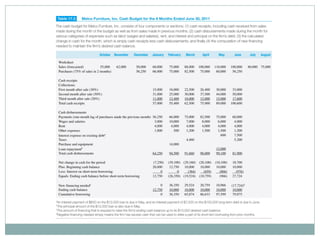
 The short-term financial plan spans a period of
one year or less and is a very detailed description of
the firm’s anticipated cash flows.
 The format typically used is a cash budget, which
contains detailed revenue projections and expenses
in the month in which they are expected to occur
for each operating unit of the company.
Developing a Long-Term Financial Plan
 Forecasting a firm’s future financing needs using a
long-term financial plan can be thought of in
terms of three basic steps:
1. Construct a sales forecast
2. Prepare pro-forma financial statements
3. Estimate the firm’s financing needs
Developing a Long-Term Financial Plan (cont.)
 Step 1: Construct a Sales Forecast
 Sales forecast is generally based on:
1. past trend in sales; and
2. the influence of any anticipated events that might
materially affect that trend.
Developing a Long-Term Financial Plan (cont.)
 Step 2: Prepare Pro Forma Financial Statements
 Pro forma financial statements help forecast a firm’s asset
requirements needed to support the forecast of revenues
(step 1).
 The most common technique is percent of sales method
that expresses expenses, assets, and liabilities for a future
period as a percentage of sales.
Developing a Long-Term Financial Plan (cont.)
 Step 3: Estimate the Firm’s Financing Needs
 Using the pro forma statements we can extract the cash flow
requirements of the firm.
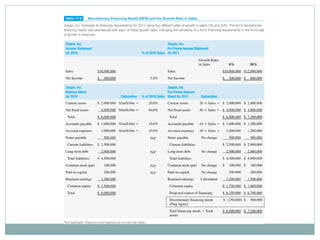
Financial Forecasting Example
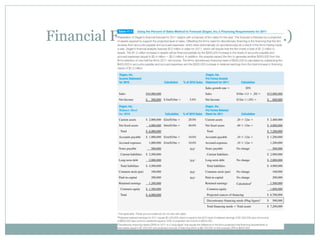
 Step 1: Forecast Revenues and Expenses
 Zeigen’s financial analyst estimate the firm will earn 5% on
the projected sales of $12 million in 2010.
 Zeigen plans to retain half of its earnings and distribute the
other half as dividends.
Financial Forecasting Example (cont.)
 Step 2: Prepare Pro Forma Financial Statements
 The firm’s need for assets to support firm sales is forecasted
using percent of sales method, where each item in the
balance sheet is assumed to vary in accordance with its
percent of sales for 2010.
Financial Forecasting Example (cont.)
 Step 3: Estimate the Firm’s Financing
Requirements
 This involves comparing the projected level of assets needed
to support the sales forecast to the available sources of
financing.
 In essence, we now forecast the liabilities and owner’s equity
section of the pro forma balance sheet.
Sources of Spontaneous Financing – Accounts
Payable and Accrued Expenses
 Accounts payable and accrued expenses are
typically the only liabilities that vary directly with
sales.
 Accounts payable and accrued expenses are
referred to as sources of spontaneous financing.
The percent of sales method can be used to forecast
the levels of both these sources of financing.
Sources of Discretionary Financing
 Raising financing with notes payable, long-term
debt and common stock requires managerial
discretion and hence these sources of financing are
called discretionary sources of financing.
 The retention of earnings is also a discretionary
source as it is the result of firm’s discretionary
dividend policy.
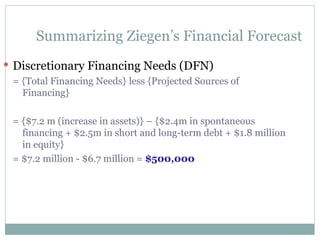
Summarizing Ziegen’s Financial Forecast
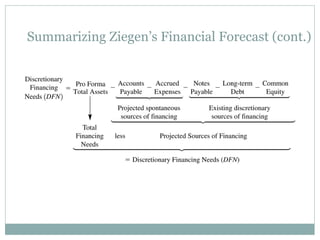
 Discretionary Financing Needs (DFN)
= {Total Financing Needs} less {Projected Sources of
Financing}
= {$7.2 m (increase in assets)} – {$2.4m in spontaneous
financing + $2.5m in short and long-term debt + $1.8 million
in equity}
= $7.2 million - $6.7 million = $500,000
Summarizing Ziegen’s Financial Forecast (cont.)
 The firm has to raise $500,000 with some
combination of borrowing (short-term or long-
term) or the issuance of stock.
 Since they require a managerial decision, they are
referred to as the firm’s discretionary financing
needs (DFN).
Summarizing Ziegen’s Financial Forecast (cont.)
Analyzing the Effects of Profitability and Dividend
Policy on the Firm’s DFN
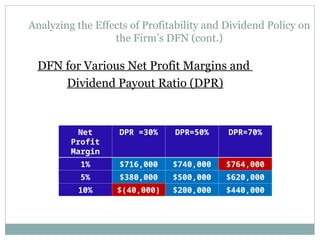
 After projecting DFN, we can easily evaluate the
sensitivity of DFN to changes in key variables.
 The table (on next slide) shows that as dividend
payout ratios and net profit margin vary, DFN also
changes significantly from a negative $40,000 to
$764,000.
Analyzing the Effects of Profitability and Dividend Policy on
the Firm’s DFN (cont.)
DFN for Various Net Profit Margins and
Dividend Payout Ratio (DPR)
Net
Profit
Margin
DPR =30% DPR=50% DPR=70%
1% $716,000 $740,000 $764,000
5% $380,000 $500,000 $620,000
10% $(40,000) $200,000 $440,000
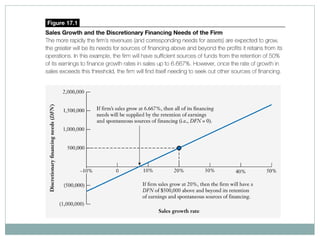
Analyzing the Effects of Sales Growth on a Firm’s
DFN
 Consider the impact of sales growth rates of 0%,
20% and 40% on DFN.
 It is observed that DFN ranges from ($250,000) at
0% growth rate to $1,250,000 at 40% growth rate.
A negative DFN indicates that the firm has surplus
dollars in financing.
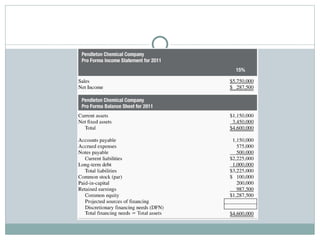
Estimating Discretionary Financing Needs
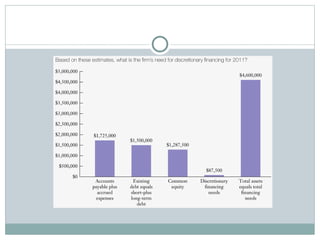
The Pendleton Chemical Company manufactures a line of personal health
care products used in preventing the spread of infectious diseases. The
company’s principal product is a germ-killing hand sanitizer called
“Bacteria-X”. In 2010, Pendleton had $5 million in sales, and anticipates
an increase of 15% in 2011. After performing an analysis of the firm’s
balance sheet, the firm’s financial manager prepared the following pro
forma income statement and balance sheet for next year:
Check Yourself
• Pendleton’s management estimates that
under the most optimistic circumstances it
might experience a 40% rate of growth of
sales in 2011. Assuming that net income
is 5% of firm sales and that both current
and fixed assets are equal to a fixed
percent of sales (as found in the above
forecast), what do you estimate the firm’s
DFN to be under these optimistic
circumstances?
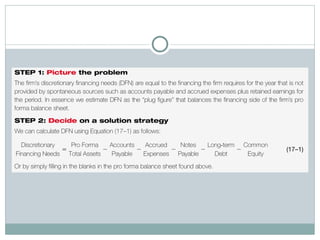
Step 1: Picture the Problem
 The firm’s DFN is equal to the financing the firm
requires for the year that is not provided by
spontaneous sources such as accounts payable and
accrued expenses plus retained earnings for the
period.
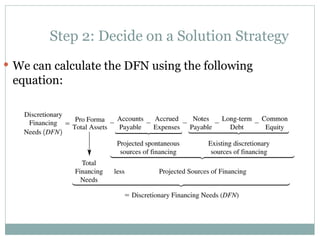
Step 2: Decide on a Solution Strategy
 We can calculate the DFN using the following
equation:
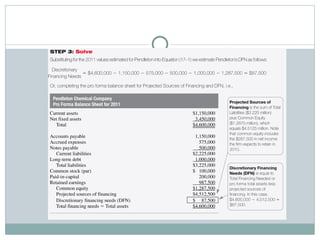
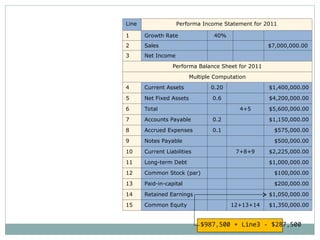
Step 3: Solve
$987,500 + Line3 - $287,500
Line Performa Income Statement for 2011
1 Growth Rate 40%
2 Sales $7,000,000.00
3 Net Income
Performa Balance Sheet for 2011
Multiple Computation
4 Current Assets 0.20 $1,400,000.00
5 Net Fixed Assets 0.6 $4,200,000.00
6 Total 4+5 $5,600,000.00
7 Accounts Payable 0.2 $1,150,000.00
8 Accrued Expenses 0.1 $575,000.00
9 Notes Payable $500,000.00
10 Current Liabilities 7+8+9 $2,225,000.00
11 Long-term Debt $1,000,000.00
12 Common Stock (par) $100,000.00
13 Paid-in-capital $200,000.00
14 Retained Earnings $1,050,000.00
15 Common Equity 12+13+14 $1,350,000.00
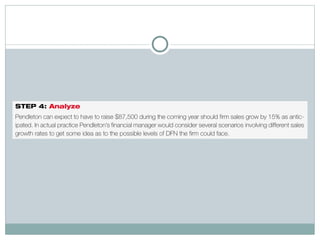
Step 4: Analyze
 If the firm experiences a 40% growth rate in sales,
Pendleton can expect to raise $1,025,000 during
the coming year.
Developing a Short-Term Financial Plan
 Unlike a long-term financial plan that is prepared
using pro forma income statements and balance
sheets, short-term financial plan is typically
presented in the form of a cash budget that
contains details concerning the firm’s cash receipts
and disbursements.
Developing a Short-Term Financial Plan (cont.)
 Cash budget includes the following main elements:
 Cash receipts,
 Cash disbursements,
 Net change in cash, and
 New financing needed.
Uses of the Cash Budget
1. It is a useful tool for predicting the amount and
timing of the firm’s future financing
requirements.
2. It is a useful tool to monitor and control the firm’s
operations.
Uses of the Cash Budget (cont.)
 The actual cash receipts and disbursements can be
compared to budgeted estimates, bringing to light
any significant differences.
 In some cases, the differences may be caused by
cost overruns or poor collection from credit
customers. Remedial action can then be taken.

chapter4financialforecastingandplanning-130320131332-phpapp01(1).ppt

  • 1.
  • 2.
    Learning Objectives 1. Understandthe goals of financial planning. 2. Use the percent of sales method to forecast the financing requirements of a firm including its discretionary financing needs. 3. Prepare a cash budget and use it to evaluate the amount and timing of a firm’s short-term financing requirements.
  • 3.
    An Overview ofFinancial Planning  What is the primary objective of preparing financial plans?  To estimate the future financing requirements in advance of when the financing will be needed.  The process of planning is critical to force managers to think systematically about the future, despite the uncertainty of future.
  • 4.
    An Overview ofFinancial Planning (cont.)  Most firms engage in three types of planning:  Strategic planning,  Long-term financial planning, and  Short-term financial planning  Strategic plan defines, in very general terms, how the firm plans to make money in the future. It serves as a guide for all other plans.
  • 5.
    An Overview ofFinancial Planning (cont.)  The long-term financial plan generally encompasses a period of three to five years and incorporates estimates of the firm’s income statements and balance sheets for each year of the planning horizon.
  • 6.
    An Overview ofFinancial Planning (cont.)  The short-term financial plan spans a period of one year or less and is a very detailed description of the firm’s anticipated cash flows.  The format typically used is a cash budget, which contains detailed revenue projections and expenses in the month in which they are expected to occur for each operating unit of the company.
  • 7.
    Developing a Long-TermFinancial Plan  Forecasting a firm’s future financing needs using a long-term financial plan can be thought of in terms of three basic steps: 1. Construct a sales forecast 2. Prepare pro-forma financial statements 3. Estimate the firm’s financing needs
  • 8.
    Developing a Long-TermFinancial Plan (cont.)  Step 1: Construct a Sales Forecast  Sales forecast is generally based on: 1. past trend in sales; and 2. the influence of any anticipated events that might materially affect that trend.
  • 9.
    Developing a Long-TermFinancial Plan (cont.)  Step 2: Prepare Pro Forma Financial Statements  Pro forma financial statements help forecast a firm’s asset requirements needed to support the forecast of revenues (step 1).  The most common technique is percent of sales method that expresses expenses, assets, and liabilities for a future period as a percentage of sales.
  • 10.
    Developing a Long-TermFinancial Plan (cont.)  Step 3: Estimate the Firm’s Financing Needs  Using the pro forma statements we can extract the cash flow requirements of the firm.
  • 11.
    Financial Forecasting Example Step 1: Forecast Revenues and Expenses  Zeigen’s financial analyst estimate the firm will earn 5% on the projected sales of $12 million in 2010.  Zeigen plans to retain half of its earnings and distribute the other half as dividends.
  • 12.
  • 13.
    Financial Forecasting Example(cont.)  Step 2: Prepare Pro Forma Financial Statements  The firm’s need for assets to support firm sales is forecasted using percent of sales method, where each item in the balance sheet is assumed to vary in accordance with its percent of sales for 2010.
  • 14.
    Financial Forecasting Example(cont.)  Step 3: Estimate the Firm’s Financing Requirements  This involves comparing the projected level of assets needed to support the sales forecast to the available sources of financing.  In essence, we now forecast the liabilities and owner’s equity section of the pro forma balance sheet.
  • 15.
    Sources of SpontaneousFinancing – Accounts Payable and Accrued Expenses  Accounts payable and accrued expenses are typically the only liabilities that vary directly with sales.  Accounts payable and accrued expenses are referred to as sources of spontaneous financing. The percent of sales method can be used to forecast the levels of both these sources of financing.
  • 16.
    Sources of DiscretionaryFinancing  Raising financing with notes payable, long-term debt and common stock requires managerial discretion and hence these sources of financing are called discretionary sources of financing.  The retention of earnings is also a discretionary source as it is the result of firm’s discretionary dividend policy.
  • 17.
    Summarizing Ziegen’s FinancialForecast  Discretionary Financing Needs (DFN) = {Total Financing Needs} less {Projected Sources of Financing} = {$7.2 m (increase in assets)} – {$2.4m in spontaneous financing + $2.5m in short and long-term debt + $1.8 million in equity} = $7.2 million - $6.7 million = $500,000
  • 18.
    Summarizing Ziegen’s FinancialForecast (cont.)  The firm has to raise $500,000 with some combination of borrowing (short-term or long- term) or the issuance of stock.  Since they require a managerial decision, they are referred to as the firm’s discretionary financing needs (DFN).
  • 19.
  • 20.
    Analyzing the Effectsof Profitability and Dividend Policy on the Firm’s DFN  After projecting DFN, we can easily evaluate the sensitivity of DFN to changes in key variables.  The table (on next slide) shows that as dividend payout ratios and net profit margin vary, DFN also changes significantly from a negative $40,000 to $764,000.
  • 21.
    Analyzing the Effectsof Profitability and Dividend Policy on the Firm’s DFN (cont.) DFN for Various Net Profit Margins and Dividend Payout Ratio (DPR) Net Profit Margin DPR =30% DPR=50% DPR=70% 1% $716,000 $740,000 $764,000 5% $380,000 $500,000 $620,000 10% $(40,000) $200,000 $440,000
  • 22.
    Analyzing the Effectsof Sales Growth on a Firm’s DFN  Consider the impact of sales growth rates of 0%, 20% and 40% on DFN.  It is observed that DFN ranges from ($250,000) at 0% growth rate to $1,250,000 at 40% growth rate. A negative DFN indicates that the firm has surplus dollars in financing.
  • 25.
    Estimating Discretionary FinancingNeeds The Pendleton Chemical Company manufactures a line of personal health care products used in preventing the spread of infectious diseases. The company’s principal product is a germ-killing hand sanitizer called “Bacteria-X”. In 2010, Pendleton had $5 million in sales, and anticipates an increase of 15% in 2011. After performing an analysis of the firm’s balance sheet, the firm’s financial manager prepared the following pro forma income statement and balance sheet for next year:
  • 31.
    Check Yourself • Pendleton’smanagement estimates that under the most optimistic circumstances it might experience a 40% rate of growth of sales in 2011. Assuming that net income is 5% of firm sales and that both current and fixed assets are equal to a fixed percent of sales (as found in the above forecast), what do you estimate the firm’s DFN to be under these optimistic circumstances?
  • 32.
    Step 1: Picturethe Problem  The firm’s DFN is equal to the financing the firm requires for the year that is not provided by spontaneous sources such as accounts payable and accrued expenses plus retained earnings for the period.
  • 33.
    Step 2: Decideon a Solution Strategy  We can calculate the DFN using the following equation:
  • 34.
    Step 3: Solve $987,500+ Line3 - $287,500 Line Performa Income Statement for 2011 1 Growth Rate 40% 2 Sales $7,000,000.00 3 Net Income Performa Balance Sheet for 2011 Multiple Computation 4 Current Assets 0.20 $1,400,000.00 5 Net Fixed Assets 0.6 $4,200,000.00 6 Total 4+5 $5,600,000.00 7 Accounts Payable 0.2 $1,150,000.00 8 Accrued Expenses 0.1 $575,000.00 9 Notes Payable $500,000.00 10 Current Liabilities 7+8+9 $2,225,000.00 11 Long-term Debt $1,000,000.00 12 Common Stock (par) $100,000.00 13 Paid-in-capital $200,000.00 14 Retained Earnings $1,050,000.00 15 Common Equity 12+13+14 $1,350,000.00
  • 35.
    Step 4: Analyze If the firm experiences a 40% growth rate in sales, Pendleton can expect to raise $1,025,000 during the coming year.
  • 36.
    Developing a Short-TermFinancial Plan  Unlike a long-term financial plan that is prepared using pro forma income statements and balance sheets, short-term financial plan is typically presented in the form of a cash budget that contains details concerning the firm’s cash receipts and disbursements.
  • 37.
    Developing a Short-TermFinancial Plan (cont.)  Cash budget includes the following main elements:  Cash receipts,  Cash disbursements,  Net change in cash, and  New financing needed.
  • 39.
    Uses of theCash Budget 1. It is a useful tool for predicting the amount and timing of the firm’s future financing requirements. 2. It is a useful tool to monitor and control the firm’s operations.
  • 40.
    Uses of theCash Budget (cont.)  The actual cash receipts and disbursements can be compared to budgeted estimates, bringing to light any significant differences.  In some cases, the differences may be caused by cost overruns or poor collection from credit customers. Remedial action can then be taken.