WHAT IS FINANCIAL
FORECASTING?
Afinancial forecast is a fiscal management tool
that presents estimated information based on
past, current, and projected financial conditions.
3
4.
OBJECTIVES OF FORECASTING
●To reduce cost of responding to emergencies by
anticipating the future occurrences
● Prepare to take advantage of future
opportunities
● Prepare contingency and emergency plans
● Prepare to deal with the possible outcomes
4
6
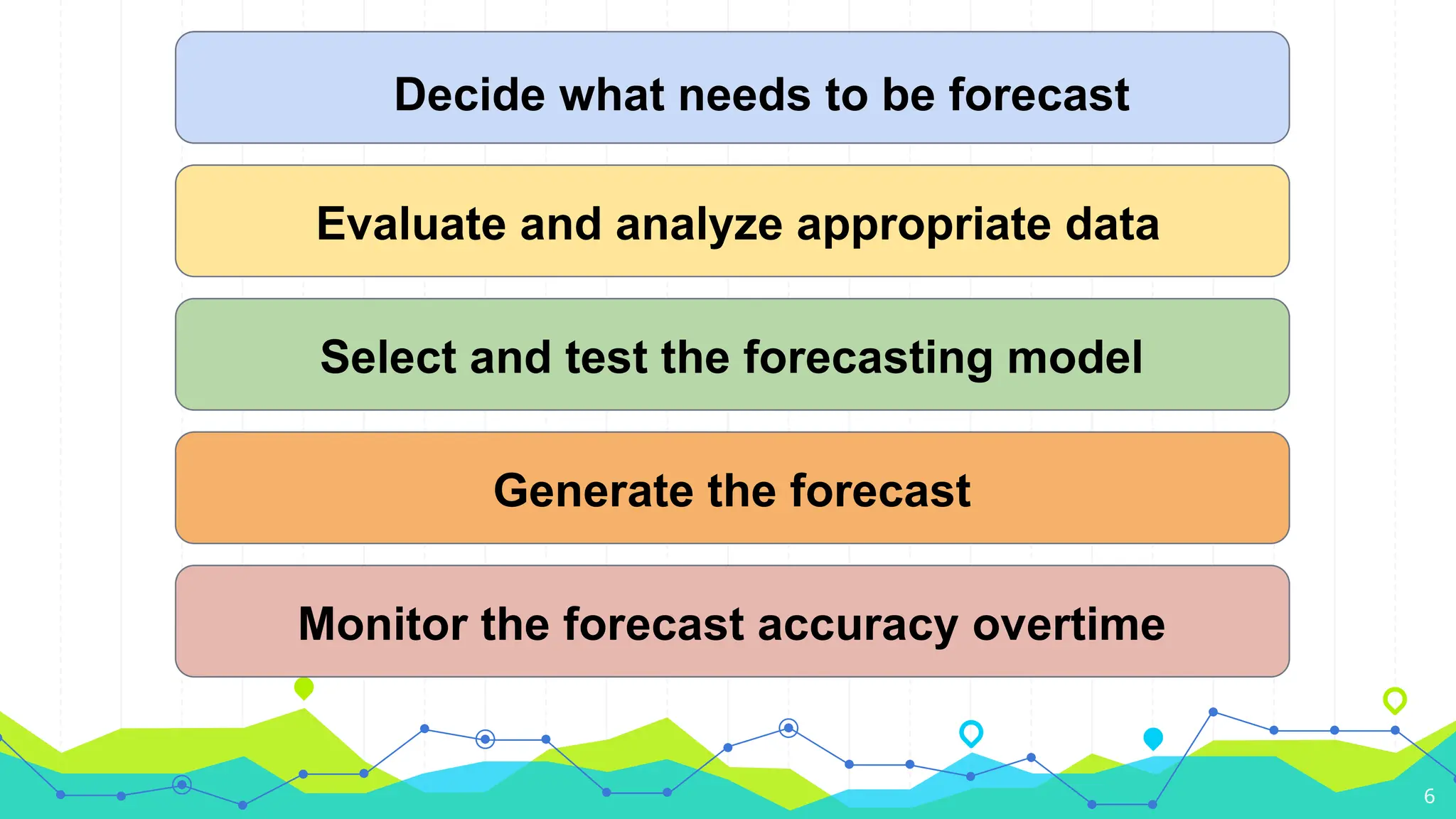
Decide what needsto be forecast
Evaluate and analyze appropriate data
Select and test the forecasting model
Generate the forecast
Monitor the forecast accuracy overtime
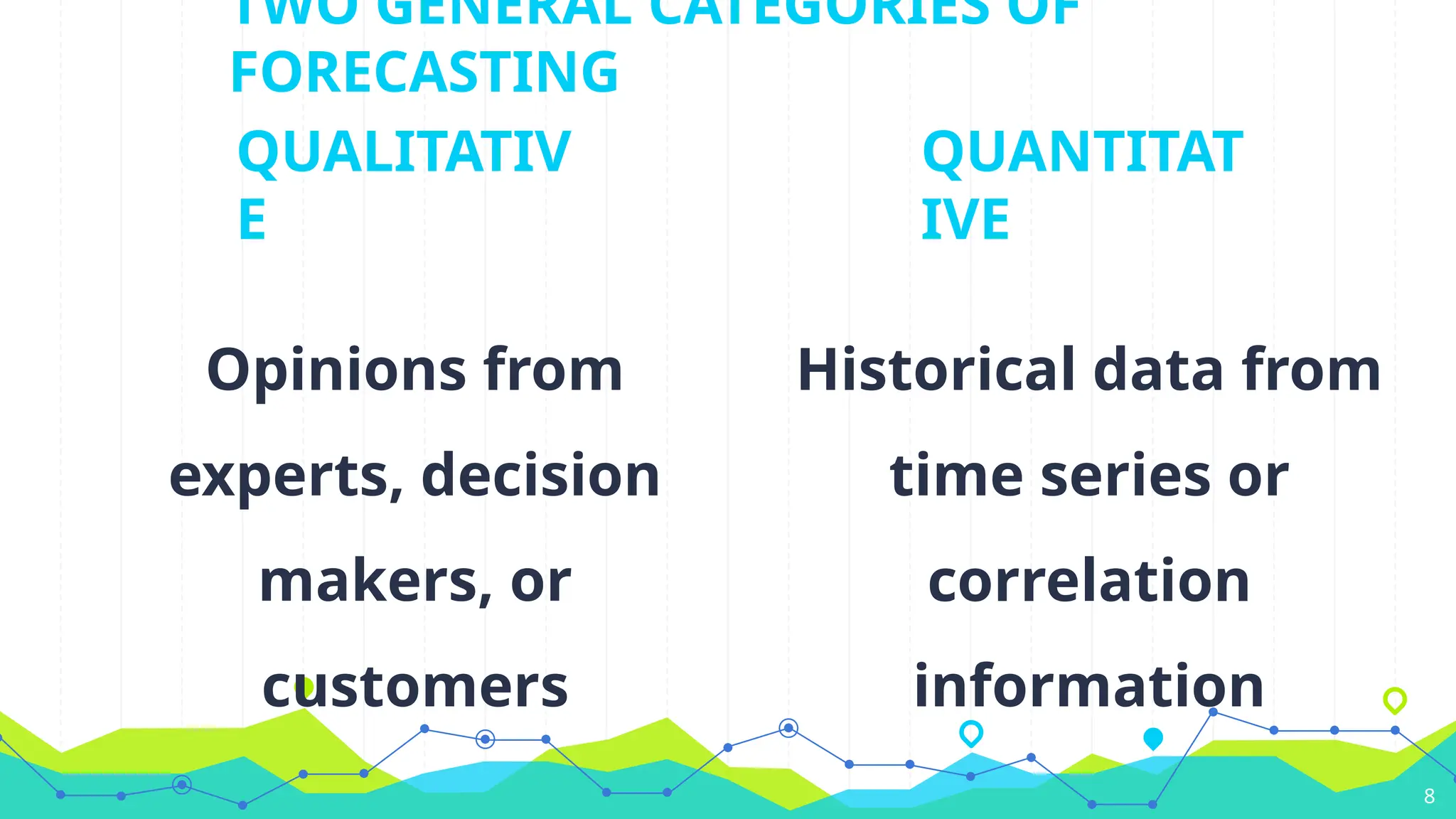
Historical data from
timeseries or
correlation
information
8
Opinions from
experts, decision
makers, or
customers
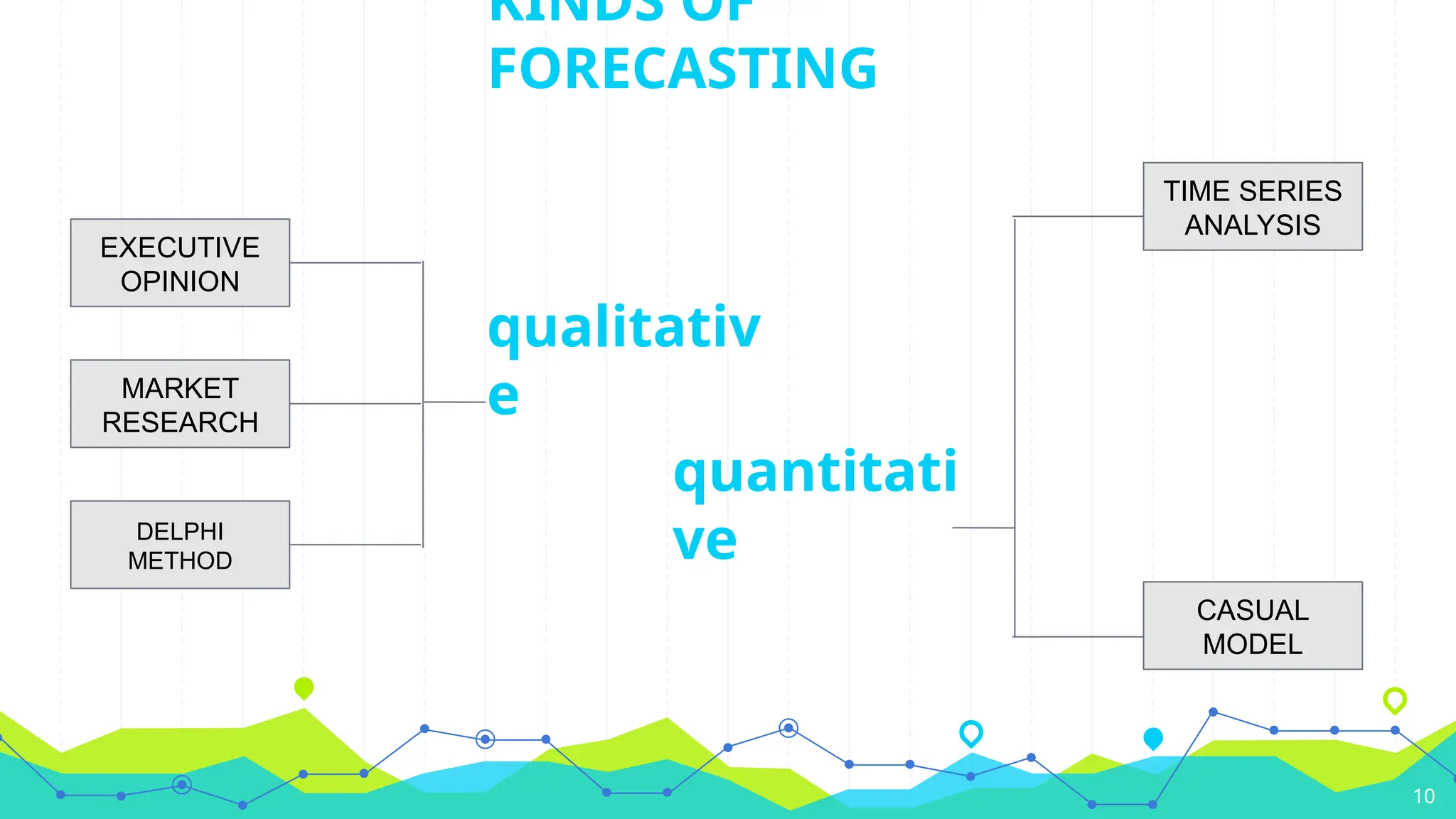
QUANTITAT
IVE
QUALITATIV
E
TWO GENERAL CATEGORIES OF
FORECASTING
9.
9
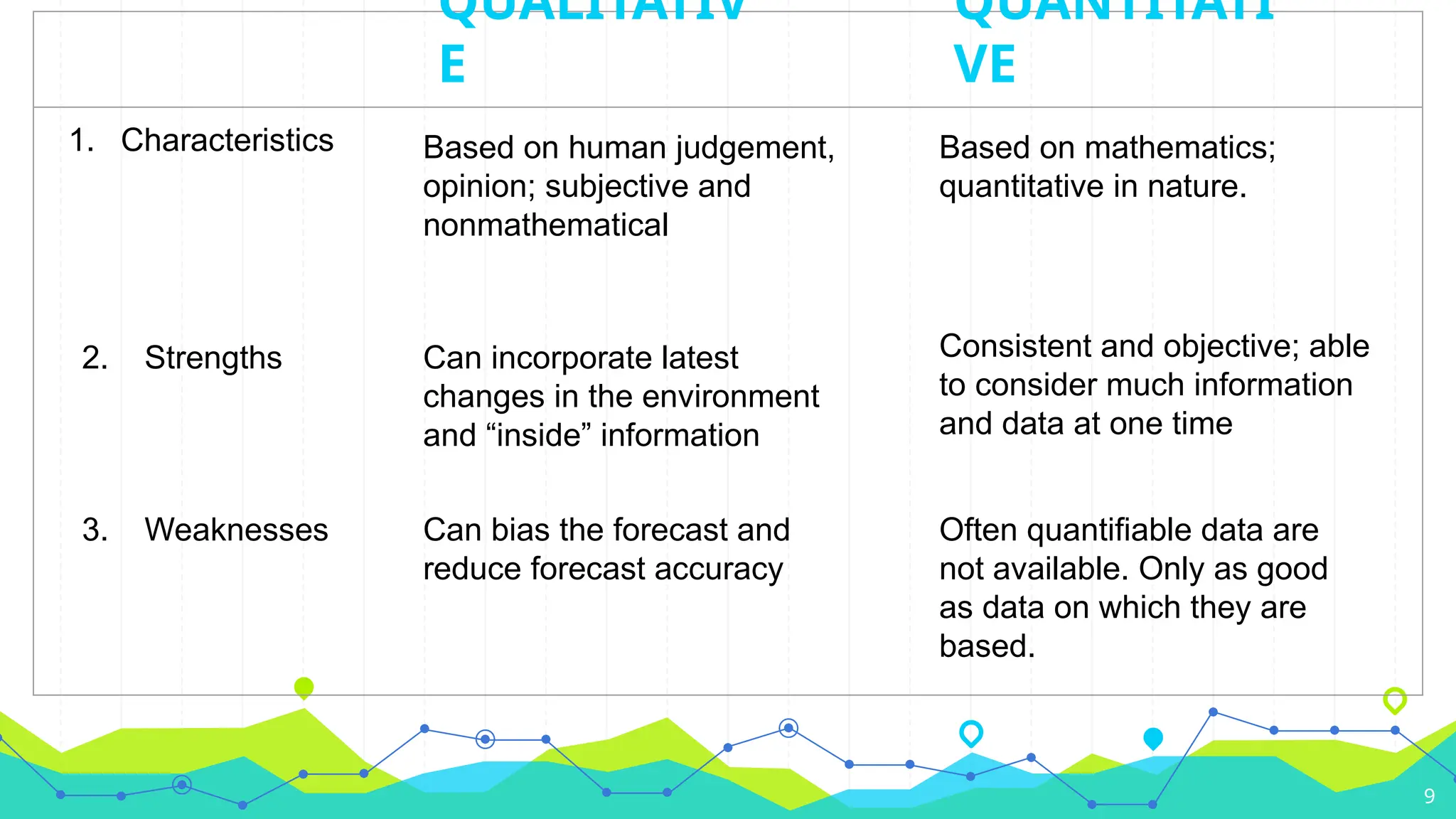
1. Characteristics Basedon human judgement,
opinion; subjective and
nonmathematical
Based on mathematics;
quantitative in nature.
2. Strengths Can incorporate latest
changes in the environment
and “inside” information
Consistent and objective; able
to consider much information
and data at one time
3. Weaknesses Can bias the forecast and
reduce forecast accuracy
Often quantifiable data are
not available. Only as good
as data on which they are
based.
QUANTITATI
VE
QUALITATIV
E
11
QUALITATIVE
METHODS
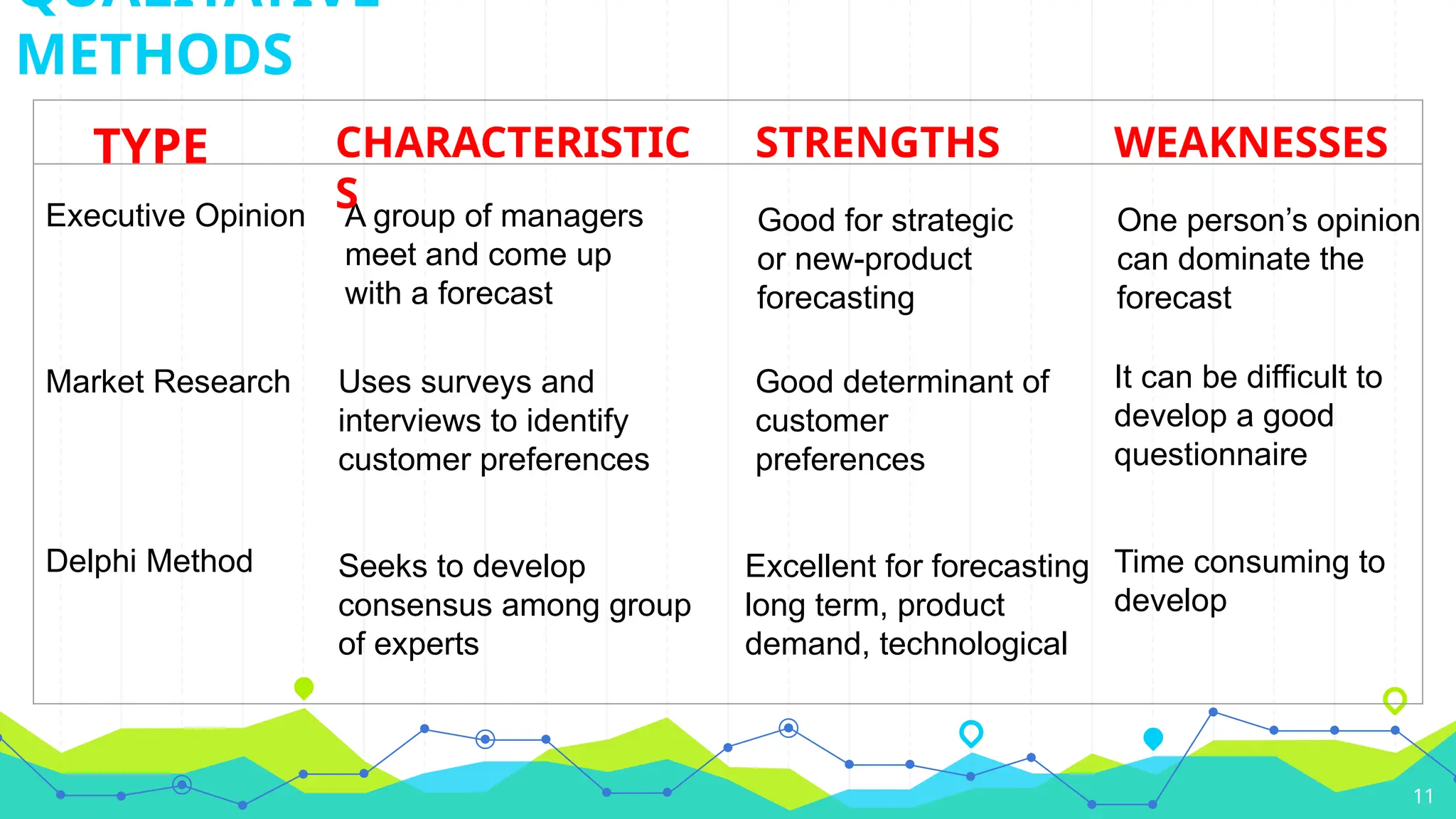
A group ofmanagers
meet and come up
with a forecast
Good for strategic
or new-product
forecasting
Market Research Uses surveys and
interviews to identify
customer preferences
Good determinant of
customer
preferences
Delphi Method Seeks to develop
consensus among group
of experts
Excellent for forecasting
long term, product
demand, technological
TYPE CHARACTERISTIC
S
STRENGTHS WEAKNESSES
Executive Opinion One person’s opinion
can dominate the
forecast
It can be difficult to
develop a good
questionnaire
Time consuming to
develop
12.
12
QUANTITATIVE
METHOD
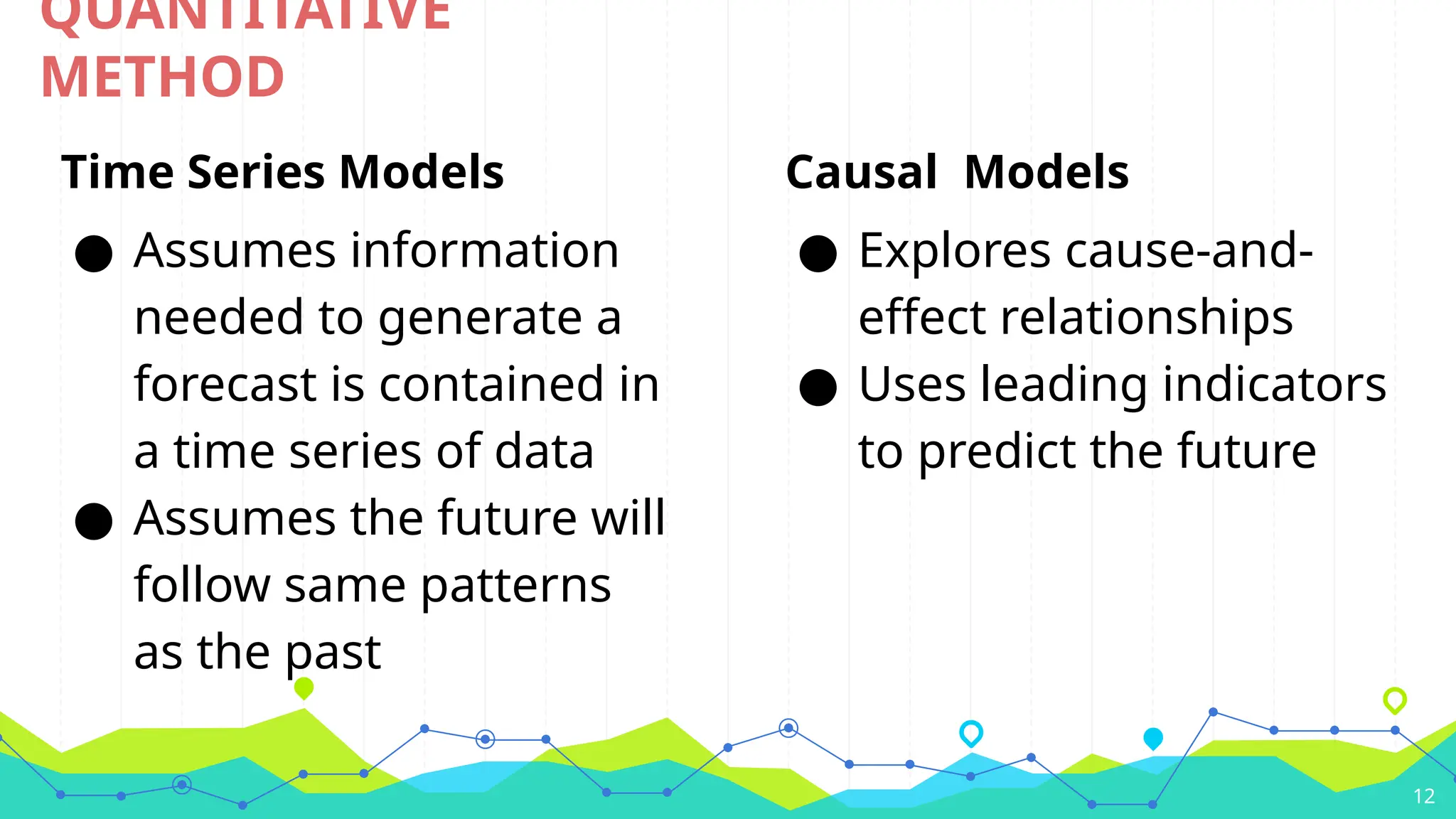
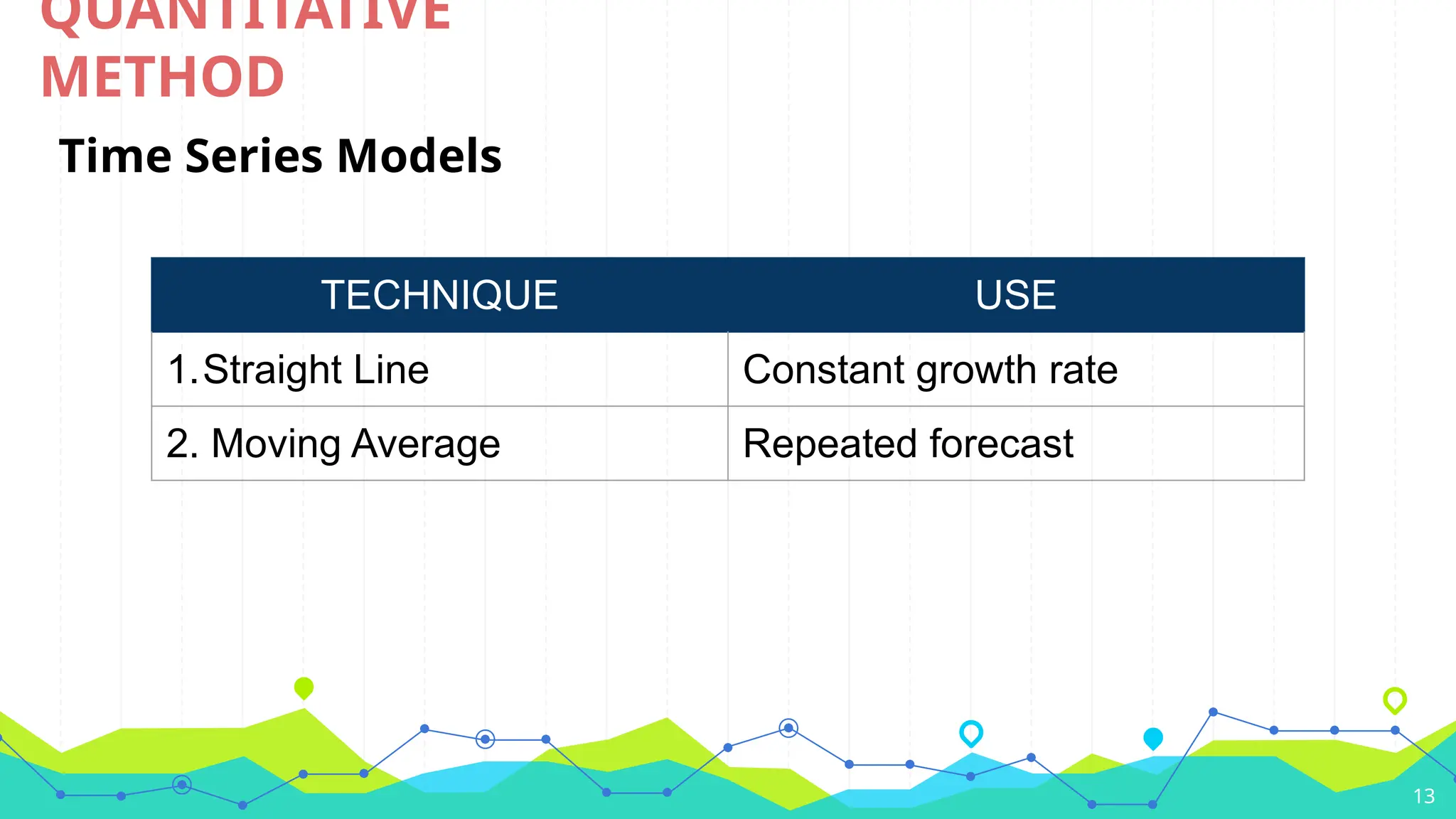
Time Series Models
●Assumes information
needed to generate a
forecast is contained in
a time series of data
● Assumes the future will
follow same patterns
as the past
Causal Models
● Explores cause-and-
effect relationships
● Uses leading indicators
to predict the future
15
QUANTITATIVE
METHOD Time SeriesModels
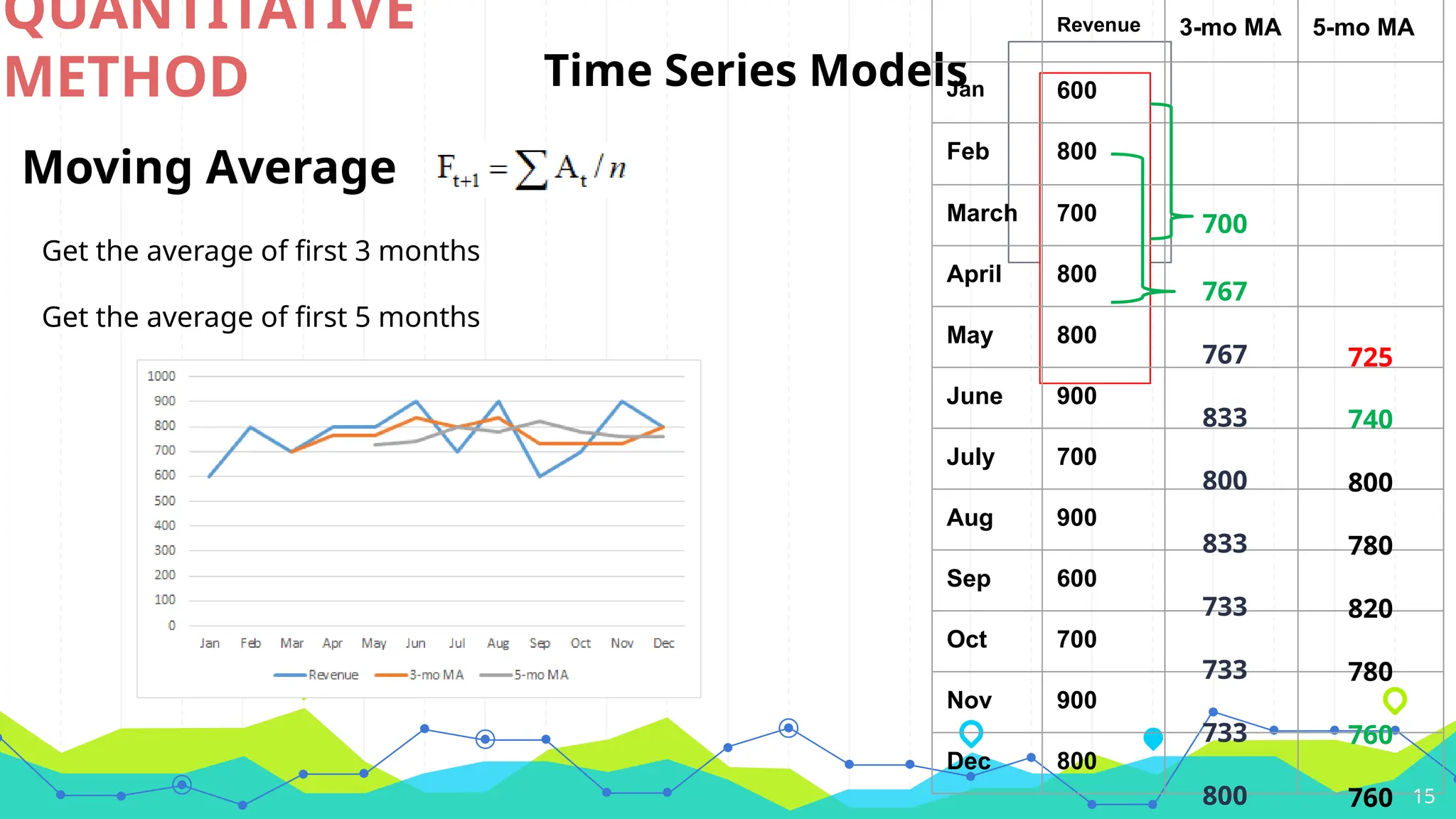
Moving Average
Revenue 3-mo MA 5-mo MA
Jan 600
Feb 800
March 700
April 800
May 800
June 900
July 700
Aug 900
Sep 600
Oct 700
Nov 900
Dec 800
Get the average of first 3 months
700
Get the average of first 5 months
725
767
767
833
800
833
733
733
733
800
740
800
780
820
780
760
760
16.
16
QUANTITATIVE
METHOD
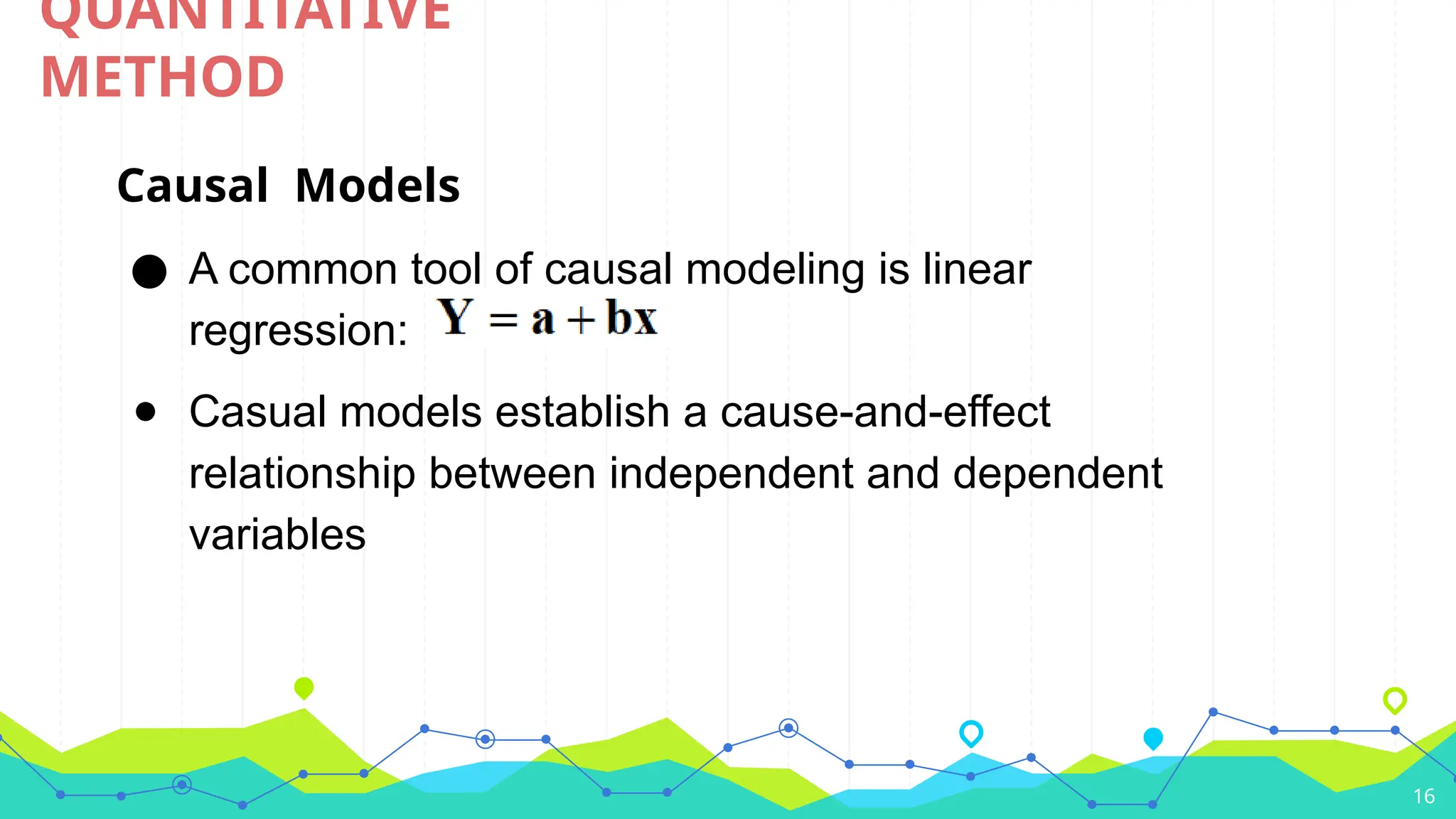
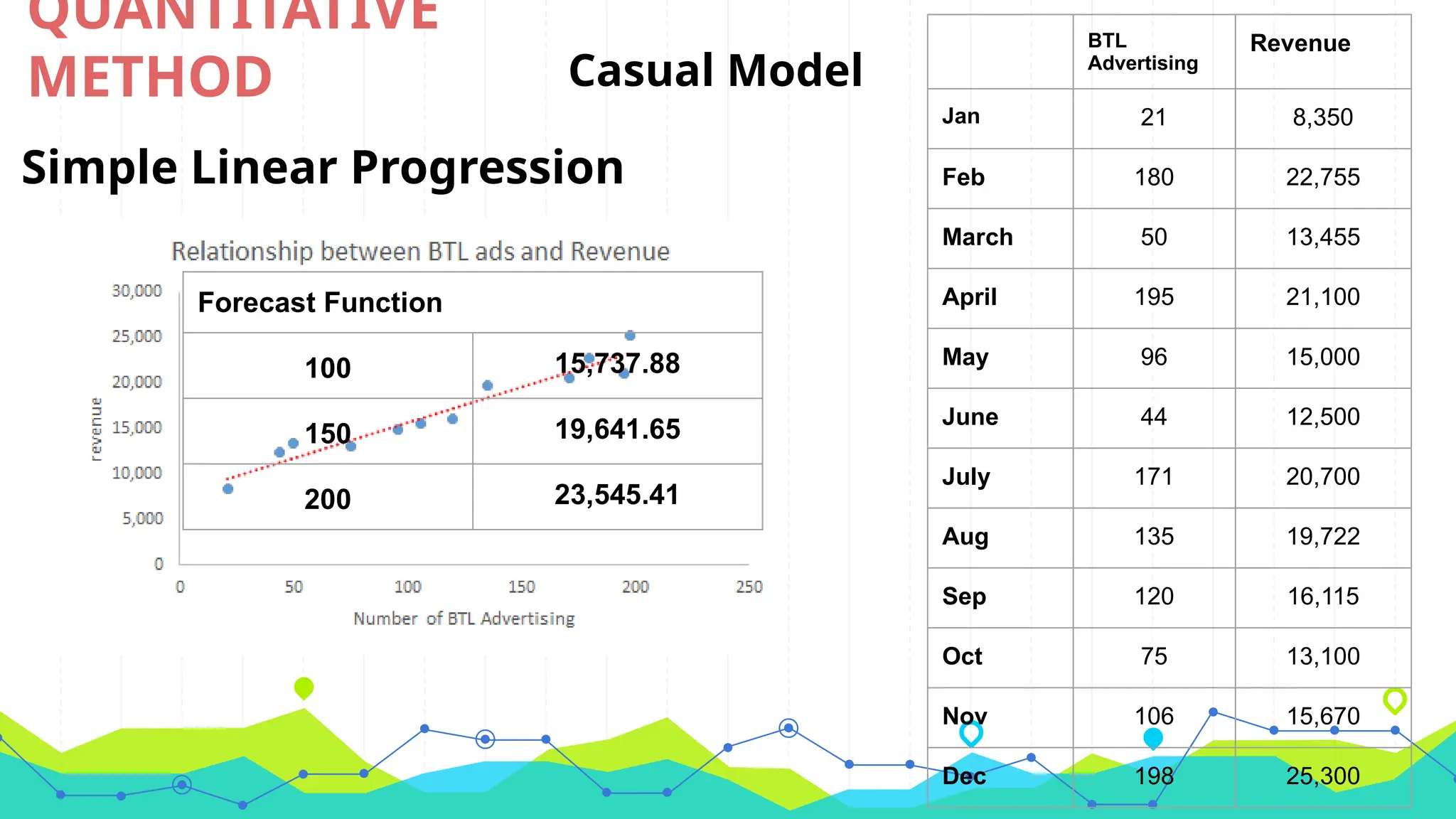
Causal Models
● Acommon tool of causal modeling is linear
regression:
● Casual models establish a cause-and-effect
relationship between independent and dependent
variables
17.
QUANTITATIVE
METHOD Casual Model
SimpleLinear Progression
BTL
Advertising
Revenue
Jan 21 8,350
Feb 180 22,755
March 50 13,455
April 195 21,100
May 96 15,000
June 44 12,500
July 171 20,700
Aug 135 19,722
Sep 120 16,115
Oct 75 13,100
Nov 106 15,670
Dec 198 25,300
Forecast Function
100 15,737.88
150 19,641.65
200 23,545.41
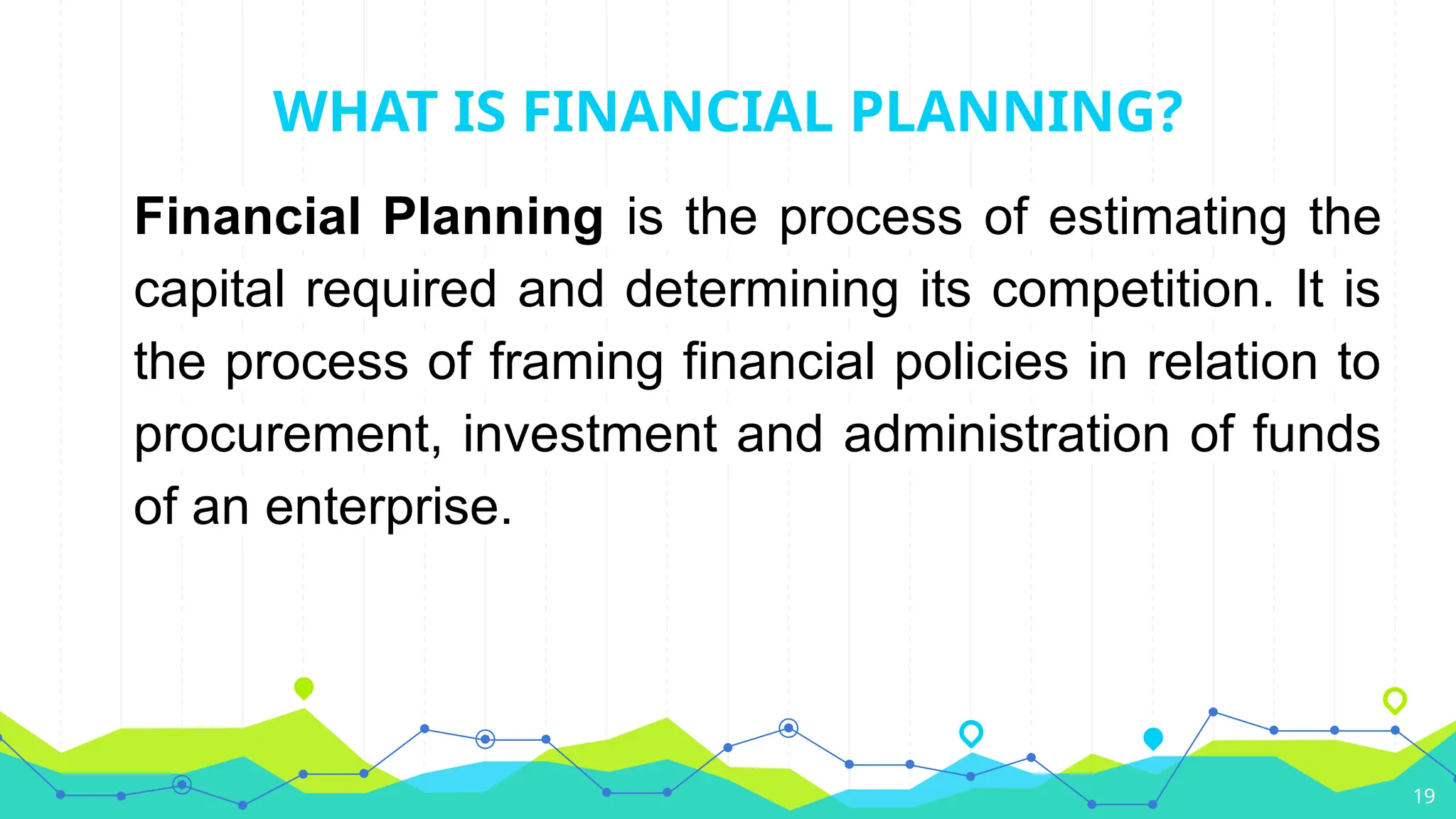
WHAT IS FINANCIALPLANNING?
Financial Planning is the process of estimating the
capital required and determining its competition. It is
the process of framing financial policies in relation to
procurement, investment and administration of funds
of an enterprise.
19
20.
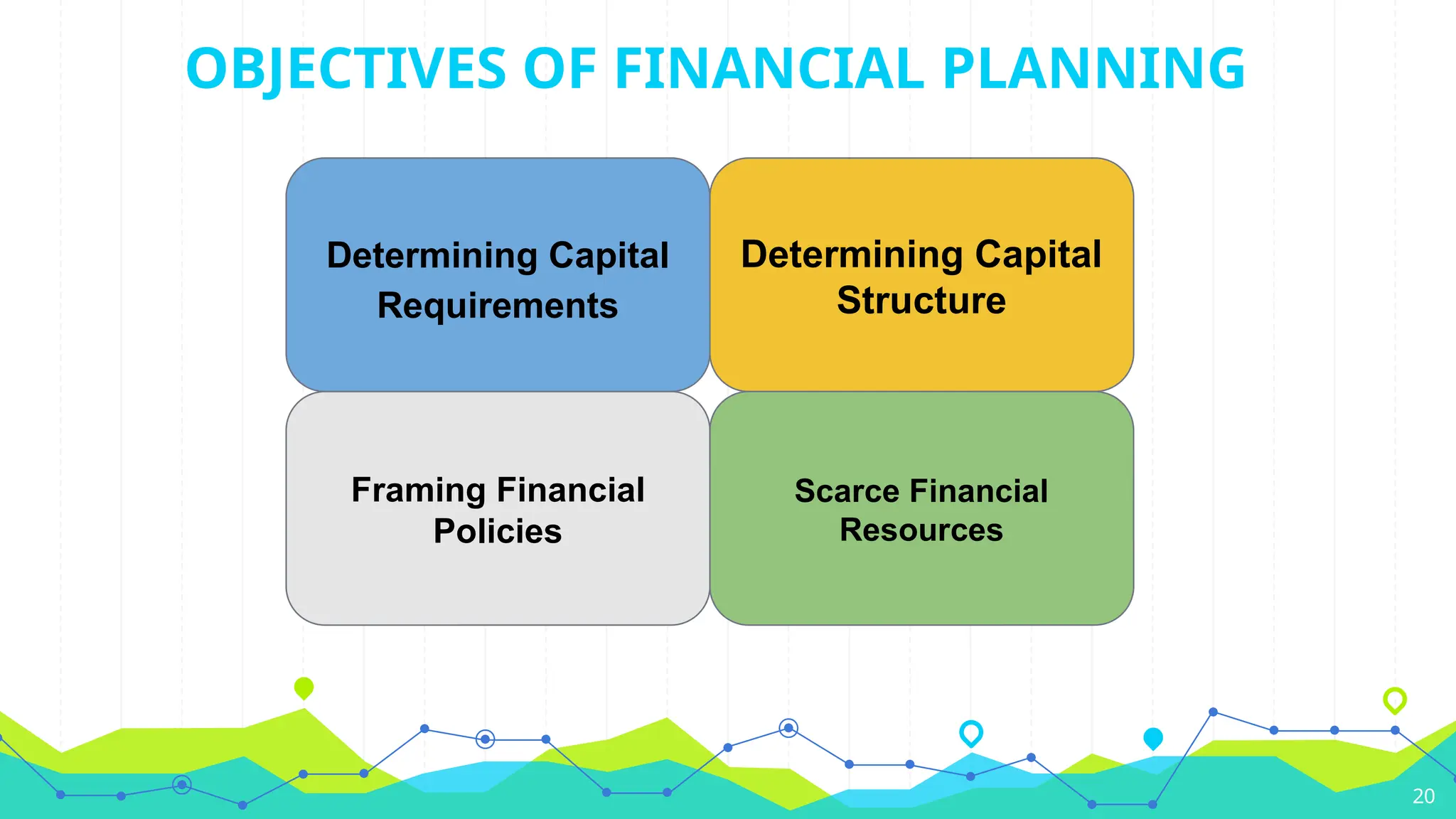
OBJECTIVES OF FINANCIALPLANNING
20
Determining Capital
Requirements
Determining Capital
Structure
Framing Financial
Policies
Scarce Financial
Resources
21.
IMPORTANCE OF FINANCIAL
PLANNING
1.Adequate funds have to be ensured.
2. Helps in ensuring a reasonable balance between outflow
and inflow of funds so that stability is maintained.
3. Ensures that the suppliers of funds are easily investing
in companies which exercise financial planning.
21
22.
IMPORTANCE OF FINANCIAL
PLANNING
4.Helps in making growth and expansion programmes which
helps in long-run survival of the company.
5. Reduces uncertainties with regards to changing market trends
which can be faced easily through enough funds.
6. Helps in reducing the uncertainties which can be a hindrance
to growth of the company. This helps in ensuring stability and
profitability in concern.
22
24
WHAT IS FINANCIALPROCEDURES?
Financial procedures are a set of instructions that any
stakeholder, including new members of the committee or staff,
can use to find out exactly: what tasks need to be done; who will
do these tasks; and who will ensure the tasks are done properly.
25.
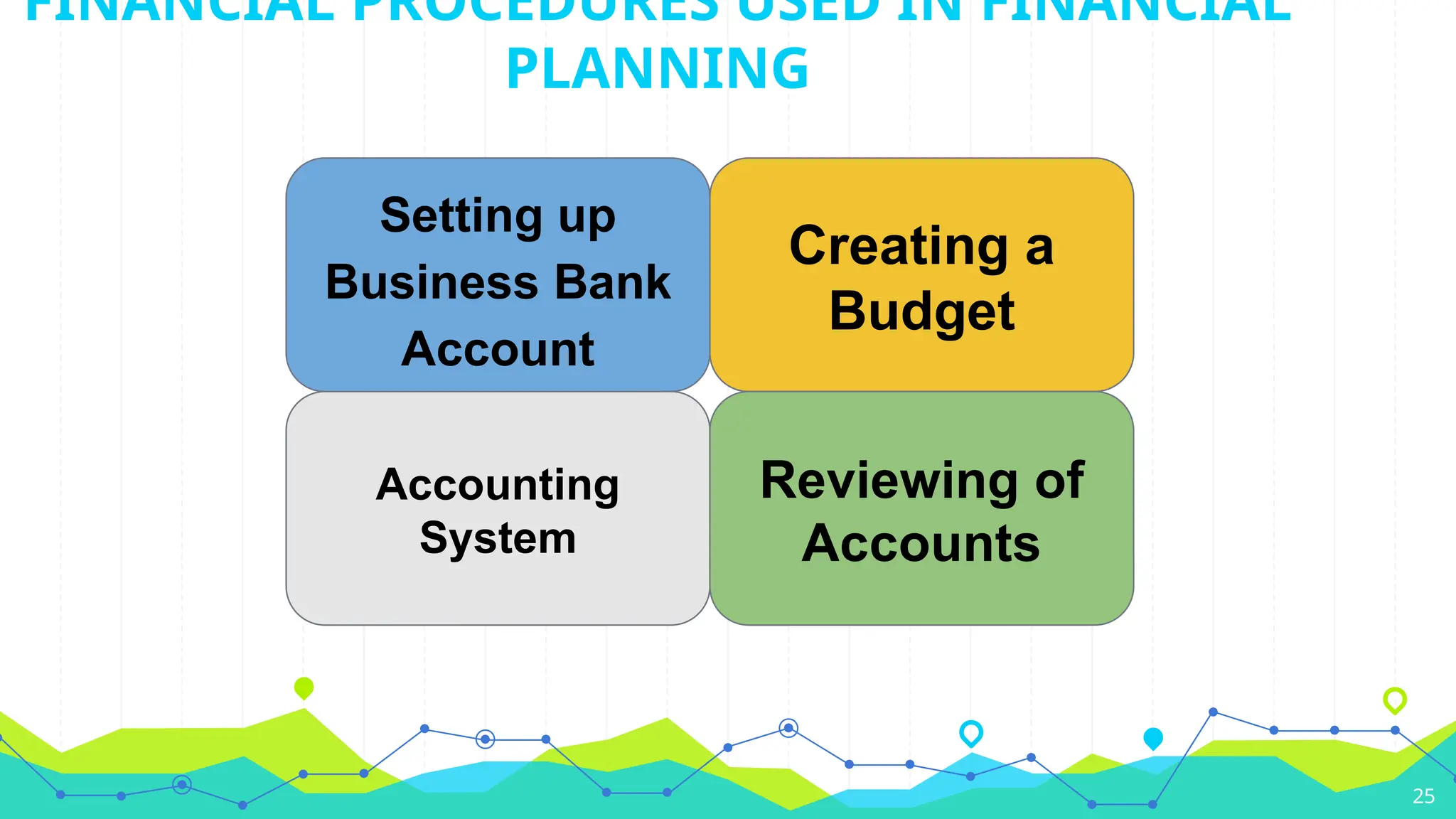
FINANCIAL PROCEDURES USEDIN FINANCIAL
PLANNING
25
Setting up
Business Bank
Account
Creating a
Budget
Accounting
System
Reviewing of
Accounts
27
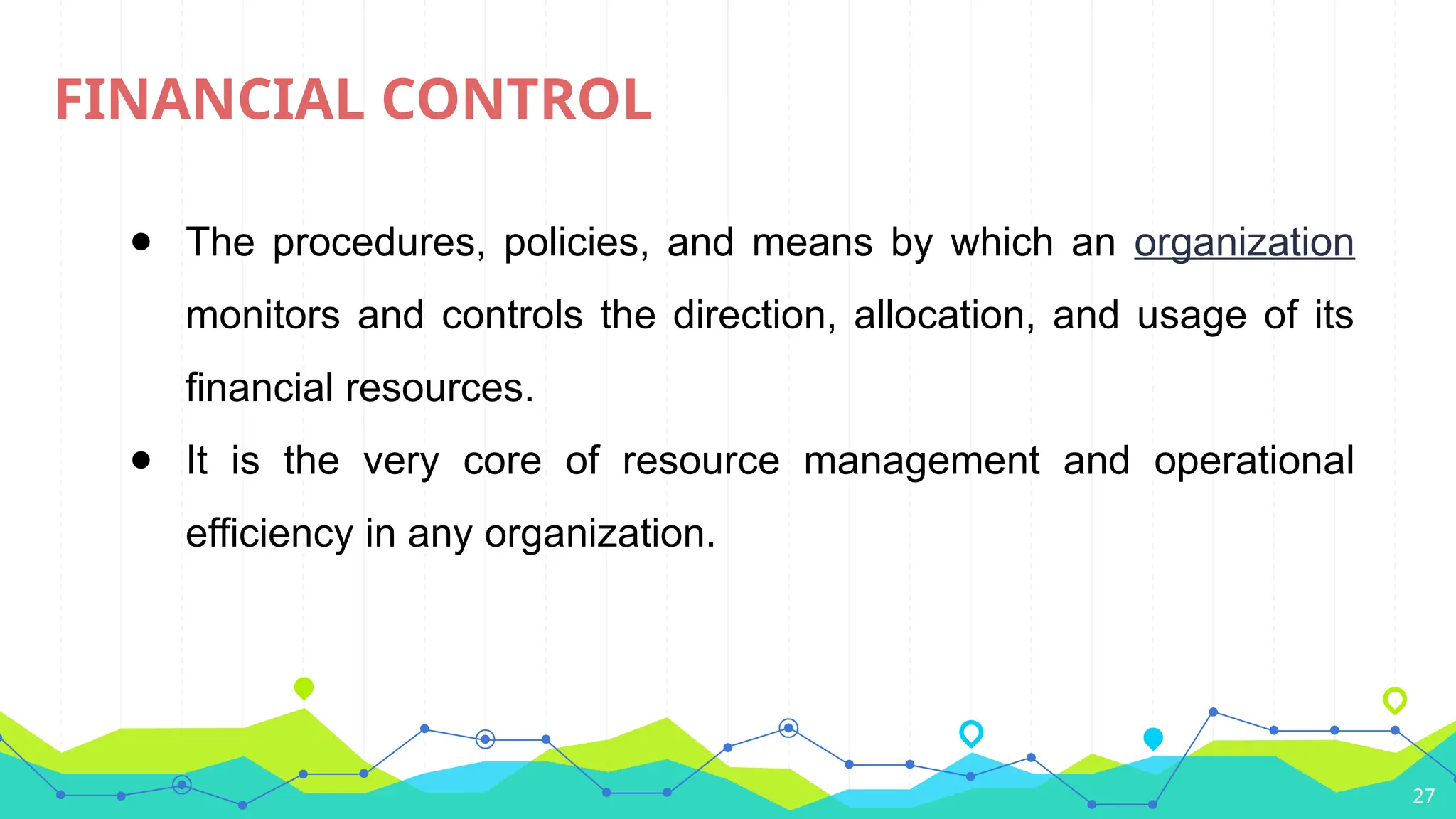
FINANCIAL CONTROL
● Theprocedures, policies, and means by which an organization
monitors and controls the direction, allocation, and usage of its
financial resources.
● It is the very core of resource management and operational
efficiency in any organization.
30
KINDS OF FINANCIAL
CONTROL
1.Overall financial management and implementation
● Placing certain qualification restrictions
● Establishing an efficient, direct chain of communication among the
accounting staff, financial managers, and senior-level managers
● Periodic training sessions and information sessions among accounting staff
● Periodic, thorough financial analysis and evaluation of financial ratios and
statements
● Delegation of financial duties in a segregated and hierarchical fashion
★ Balance Sheet
★ Income Statement
31.
2. Cash Inflows
●Stringent credit reporting policy for all customers before entering
into a creditor-debtor relationship.
● Periodic reconciliation of bank statements to the general ledger.
● Establishing a periodic review policy with all existing customers that
the business establishes a creditor-debtor relationship.
● Support files and backups for all financial data.
31
KINDS OF FINANCIAL
CONTROL
32.
3. Cash Outflow
●Automatic/subscription payments to be monitored and requiring
proper authorization
● Maintaining a vendor database with detailed purchase records
● Periodic reconciliation of bank statements to the general ledger
● Clear and precise expense reimbursement policy to be maintained,
including detailed expense reports and receipt verifications
★ Cash Flow Statement
32
KINDS OF FINANCIAL
CONTROL
EFFICIENT FINANCIAL FORECASTING
SHOULDCONSISTS OF THE FF:
1. Setting up projected income statement and balance sheet so that
the effect of operating plan on firm's future profit and other
indicator of financial performance can be analyzed.
2. Determining need of financing to support firm's growth in sales
and other investment opportunities.
3. Forecasting appropriate sources of financing that can be
generated internally as well as externally.
4. Setting up proper mechanism of control relating to allocation and
utilization of funds
36
37.
● The appropriategoal for the financial manager is
to increase the market value of the owner’s equity
and not just growth.
● Growth may thus be a desirable consequence of
good decision making but it is not an end unto
itself.
37
GROWTH AS FINANCIAL
MANAGEMENT GOAL
38.
● It helpsto set the standard of performances and act as a
base to evaluate real-time results.
● It helps in the timely arrangement of funds as a result of
the financial projection of funds needs and revenue
potential.
● It helps in the optimum utilization of resources and reduces
the non-performing resources of the organization.
38
BENEFITS OF FINANCIAL
FORECASTING
● Forecasting providesrelevant and reliable information about the past
and present events and likely the future events.
● It gives confidence to the managers for making important decisions.
● It is the basis for making planning premises.
● It keeps managers active and alert to face the challenges of the
future events and the changes in environment.
40
41.
1. Financial ForecastsCreate a Clear Path to Achieve
Your Goals
2. A Financial Forecast Creates Trust and Confidence
in Raising Funds
3. A Financial Forecast Tells you What Resources
You Need (and When)
41
3 REASONS WHY YOU NEED A FINANCIAL
FORECAST:
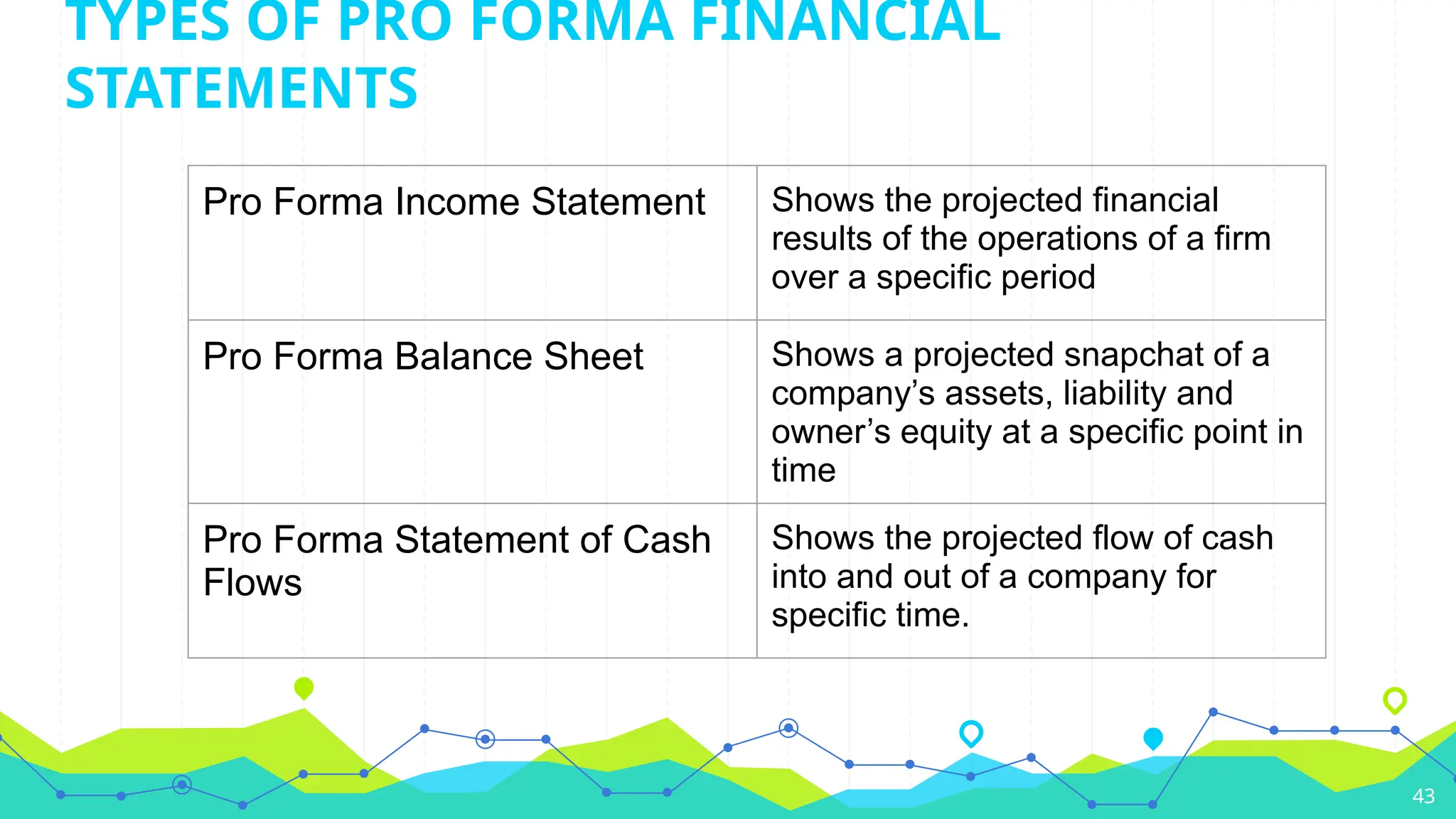
43
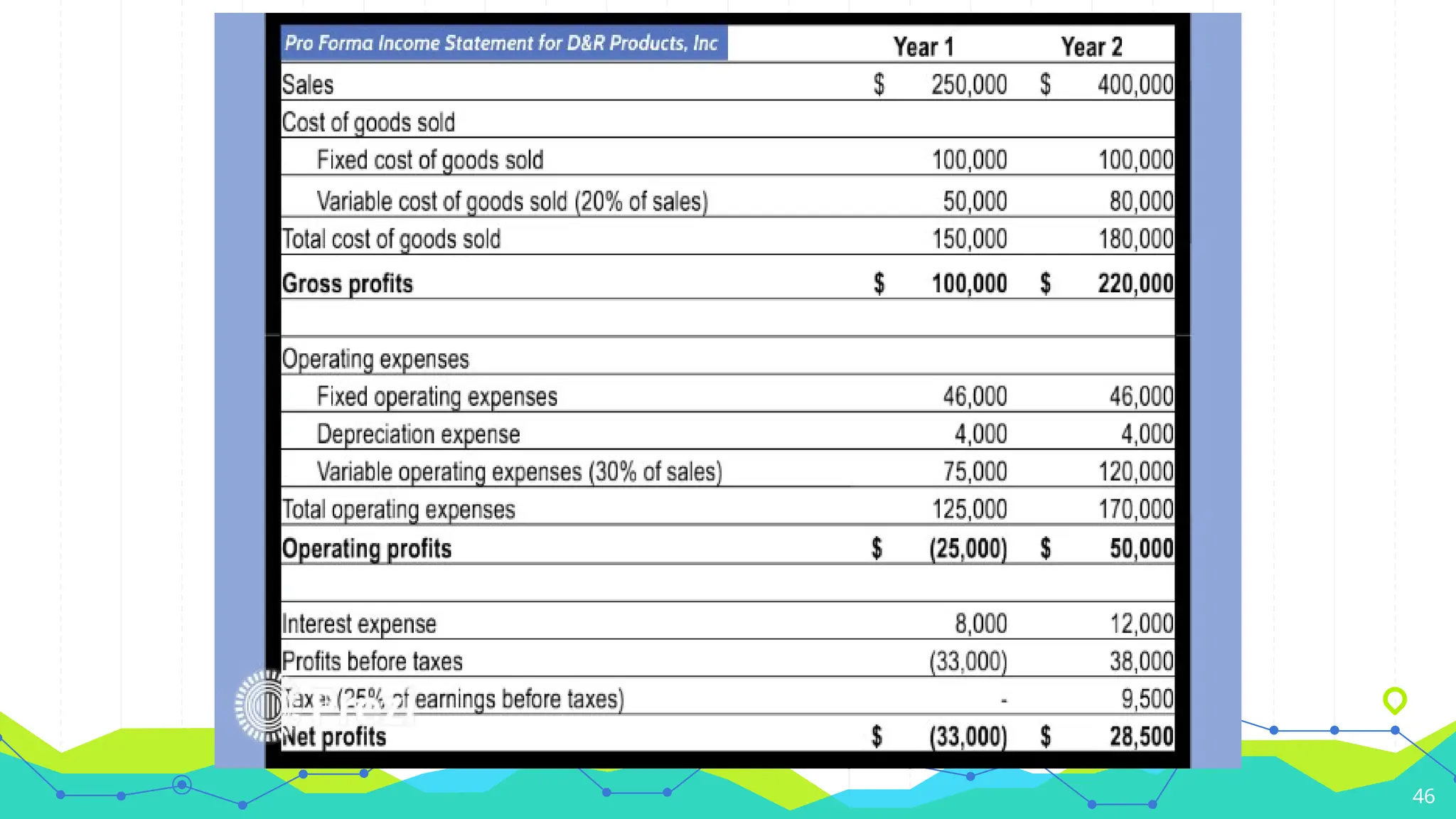
Pro Forma IncomeStatement Shows the projected financial
results of the operations of a firm
over a specific period
Pro Forma Balance Sheet Shows a projected snapchat of a
company’s assets, liability and
owner’s equity at a specific point in
time
Pro Forma Statement of Cash
Flows
Shows the projected flow of cash
into and out of a company for
specific time.
TYPES OF PRO FORMA FINANCIAL
STATEMENTS
44.
1. The futureprofitability based on projected sales level
2. How much and what type financing will be needed.
3. Whether the firm will have adequate cash flows.
44
PURPOSE OF PRO FORMA FINANCIAL
STATEMENTS
45.
45
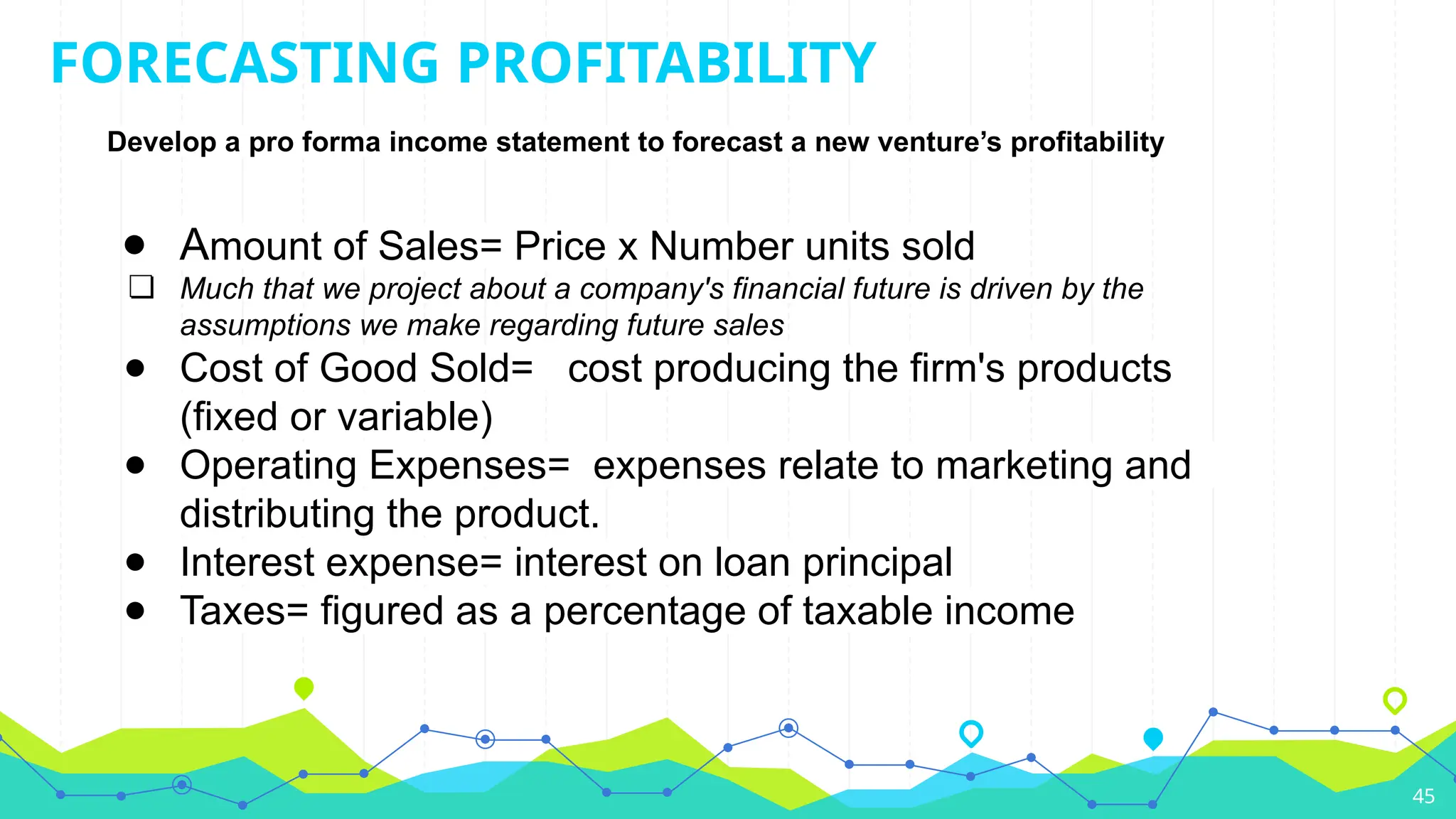
Develop a proforma income statement to forecast a new venture’s profitability
● Amount of Sales= Price x Number units sold
❏ Much that we project about a company's financial future is driven by the
assumptions we make regarding future sales
● Cost of Good Sold= cost producing the firm's products
(fixed or variable)
● Operating Expenses= expenses relate to marketing and
distributing the product.
● Interest expense= interest on loan principal
● Taxes= figured as a percentage of taxable income
FORECASTING PROFITABILITY
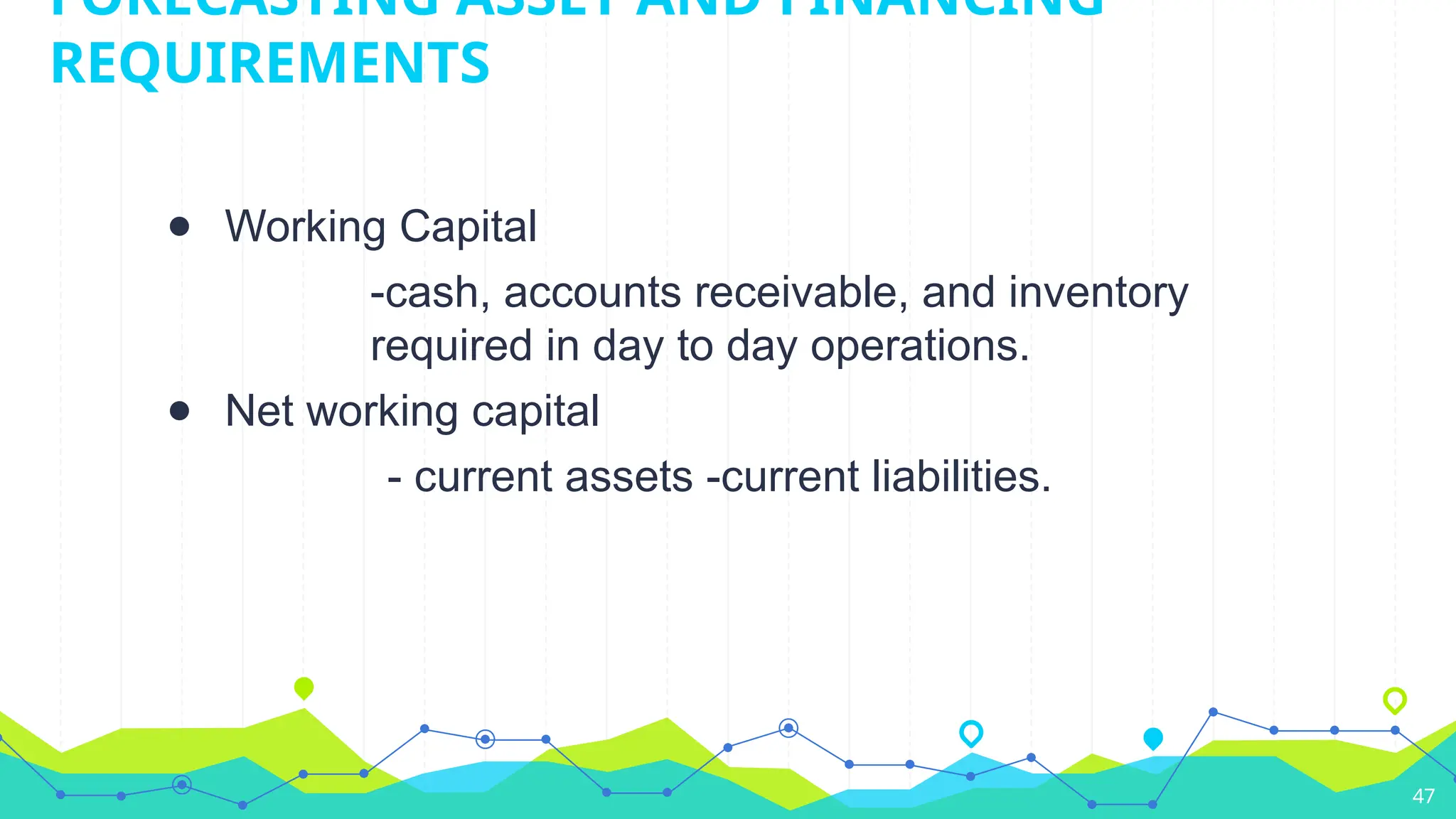
● Working Capital
-cash,accounts receivable, and inventory
required in day to day operations.
● Net working capital
- current assets -current liabilities.
47
FORECASTING ASSET AND FINANCING
REQUIREMENTS
49
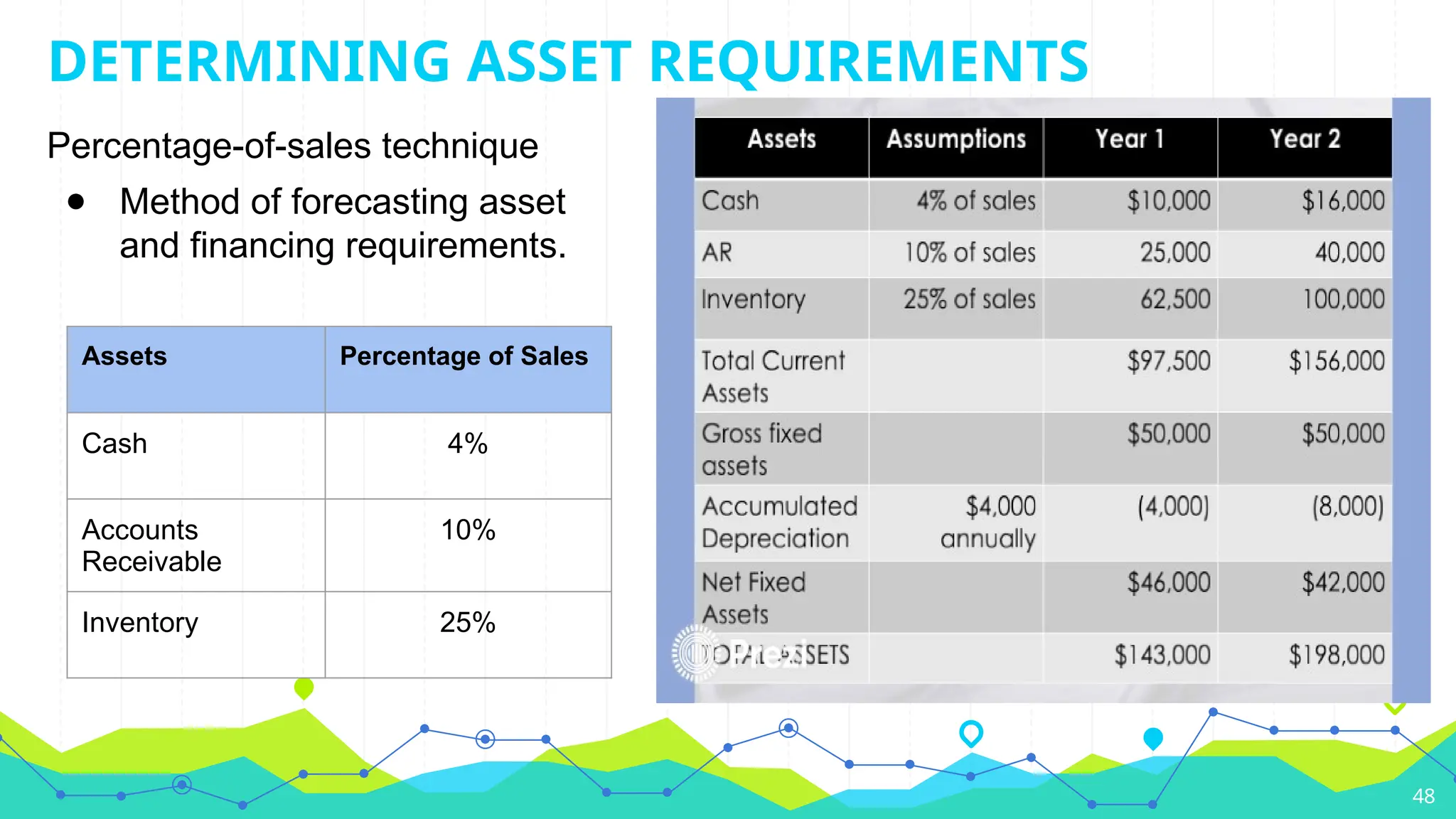
● The moreassets a firm's needs the greater the firms financial
requirements
● A firm should finance its growth in a such a way as to maintain
adequate liquidity.
● The amount of total debt that can be used in financing a
business is limited by the funds provided by the owners
● Some types of short-term debt maintain a relatively constant
relationship with sales
● Equity ownership in a business
DETERMINING FINANCING REQUIREMENTS
50.
● Profits andcash flows are not
the same thing
Can be accomplished in one of 2
ways
1. Information from the pro forma
income statement and balance
sheets to develop a pro forma
cash flows
2. Prepare a cash budget
Pro Forma Statement of Cash
Flows
● Change from working with
historical numbers to
projections of numbers.
50
FORECASTING CASH
FLOWS
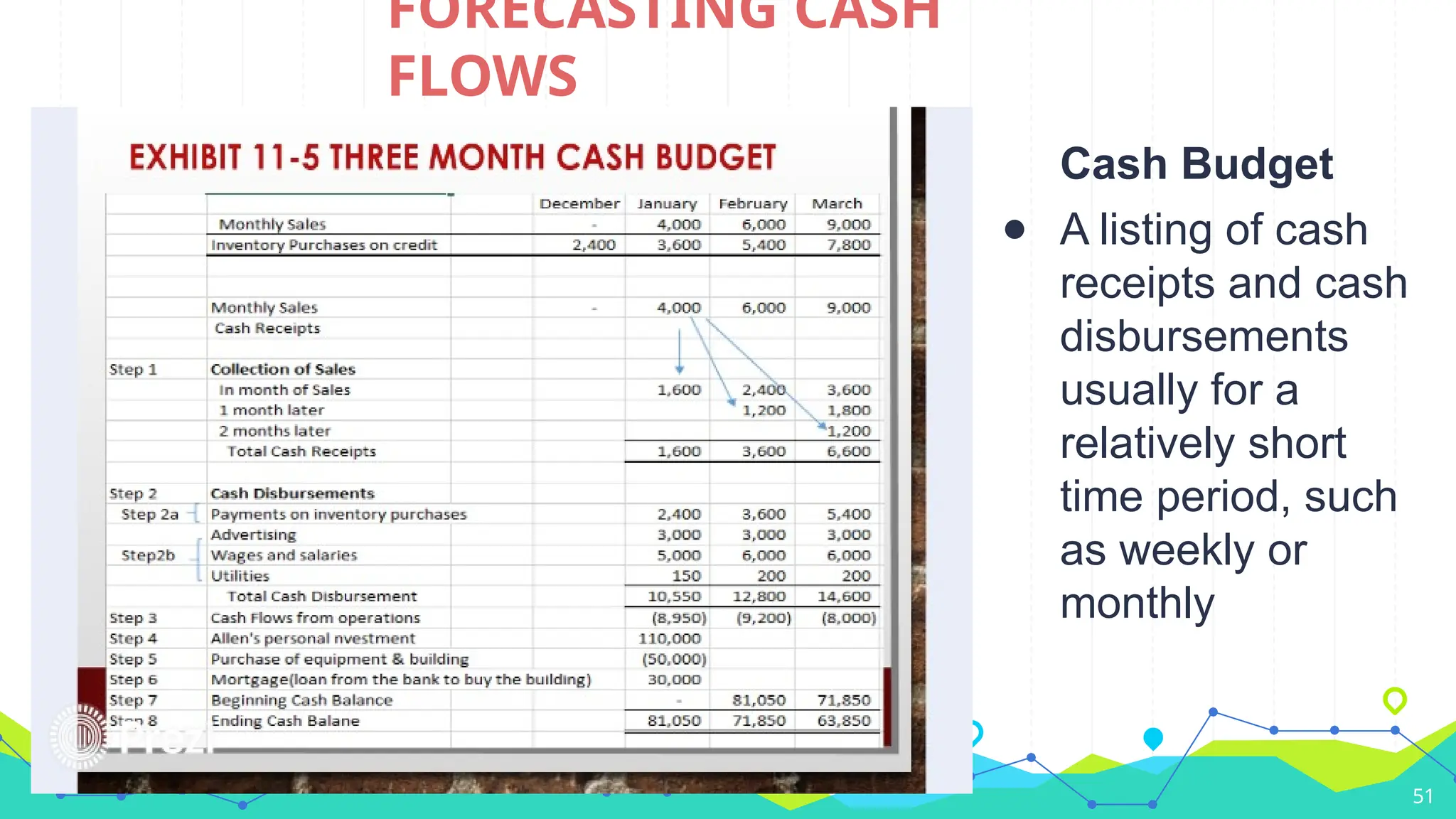
51.
51
Cash Budget
● Alisting of cash
receipts and cash
disbursements
usually for a
relatively short
time period, such
as weekly or
monthly
FORECASTING CASH
FLOWS
52.
Financial Forecast Suggestion
●Develop realistic sales projections
● Build projections from clear assumptions about marketing and pricing
plans
● Do not use unrealistic profit margins
● Don't limit your projections to an income statement
● Provide monthly data for upcoming year and annual data for
succeeding years
● Avoid providing too much financial information
● Be certain that the numbers reconcile and not by simply plugging in a
figure
● Follow the plan
52
USE JUDGEMENT WHEN FORECASTING
- Provide some suggestions for effective financial forecasting
Editor's Notes
#3 It is the process of analyzing what happened in the past, what is happening now, and using that information to determine what is going to happen in the future. Businesses use financial forecasting as a tool for planning and adapting to uncertainty by more effectively predicting risks, opportunities and challenges that the business could encounter.
#4 1. An example of this is having fire insurance for your property. This covers damage and losses caused by fire and lightning to protect you against financial loss from property damages.
2. For example, a company might forecast an increase in demand for its products during the holiday season. As a result, it may decide to increase production before Christmas so that there aren't any shortages.
3. Contingency planning is the preparation to respond effectively to a significant future incident, event or situation. Also known colloquially as “Plan B”, this is a plan devised for dealing with an emergency, or with something that might possibly happen and cause problems in the future.
#6 The level of detail required for the forecast (what product or product group), units of analysis (pieces, boxes) and time horizon (such as monthly, quarterly, etc.)
Identify needed data and if it is available
Cost, ease of use & accuracy
#8 Qualitative methods: Judgmental methods
Forecasts generated subjectively by the forecaster
Educated guesses
Quantitative methods:
- Forecasts generated through mathematical modeling
#9 [READ NOTES ONLY]
To compare the two general categories of forecasting;
For characteristics,
Qualitative is based on human judgement, opinion; subjective and nonmathematical
While Quantitative is based on mathematics.
For their strengths,
Qualitative can incorporate latest changes in the environment and “inside” information
While Quantitative is consistent and objective; and is able to consider much information and data at one time
For weaknesses,
Qualitative can bias the forecast and reduce forecast accuracy
While for Quantitative, Oftentimes, quantifiable data are not available.
#10 [READ NOTES ONLY]
For the Kinds of Forecasting,
For Qualitative Methods, there are 3 kinds:
The jury of executive opinion is a method of forecasting using a composite forecast from the combined opinions of individual experts.
Market research evaluates the success of a company's services or products by introducing them to potential customers and recording details about how they react.
The Delphi method involves questioning a panel of experts individually to collect their opinions. Interviewing or gathering information from the experts one at a time rather than in a group can help to prevent bias and ensure that any consensus about business predictions stems from the expert opinions on their own.
While for Quantitative Methods, there are 2 kinds:
If data uses time, use time series models. Time series analysis assumes that the future will follow the same patterns as in the past, but not in all cases.
If data uses cause-and-effect relationships, use causal models. This uses leading indicators to predict the future.


![MBA_653_PPT [Autosaved].pptx](https://cdn.slidesharecdn.com/ss_thumbnails/mba653pptautosaved-230605133633-db3c46cc-thumbnail.jpg?width=640&height=640&fit=bounds)


