Sam’s Clubs GLOBAL INDUSTRY ANALYSIS - CASE STUDY Wal*Mart Stores, Inc.   a presentation  Anthony, Crystal, Sandy From YZU university
WAL  MART Background Sam Walton  Founder of Wal*Mart Stores, Inc. Performance of Wal*Mart 20-year average return on equity of 33% Compound average sales growth of 35% Market value = $57.5 billion Wal*Mart Industry average Sales per square foot $300 $210
WAL  MART Background Year 1988  CEO: David Glass COO: Don Soderquist How to sustain the company’s  phenomenal performance? 1987  1993 Net sales  15,959 67,345 Net Income 628 2,333 Number Of  Stores Discount Stores 1,114 1,953 Sam’s Wholesale Clubs 84 419 Supercenters N.A. 68
WAL  MART Background Number of Stores (1994)
WAL  MART Discount Retailing Where  Emerged in the U.S. When Mid-1950s Top 10 discounters in 1962  Wal*Mart remained only The industry became more concentrated Discount store companies operated 5 or more stores accounted for 62%
WAL  MART Discount Retailing
WAL  MART Discount Retailing Comparative Pricing Study, 1993
WAL  MART Discount Retailing Overall Performance of Discounters
WAL  MART Wal*Mart’s Discount Stores and  History of Growth Year 1945 Ben Franklin franchise store In 1950s 15 stores Year 1962 Wal*Mart Discount City store Year 1969 18 Wal*Mart stores 15 Ben Franklin franchise stores
WAL  MART Wal*Mart’s Discount Stores and  History of Growth Year 1970 30 discount stores in rural states South and Midwest Cost of good sold Build its own warehouse Buy in volume at attractive prices  Store the merchandise Year 1972 Took the company public Raised $3.3 million
WAL  MART Wal*Mart’s Discount Stores and  History of Growth Year 1993 West coast and northeastern states  Year 1994 Operated in 47 states
 
WAL  MART Wal*Mart’s Discount Stores and  History of Growth Key strategies for growing Locate store in isolated rural areas and small towns (population 5000~25000) Pattern of expansion Always push from inside out Mid-1980s One third were located in areas that were not served by any of its competitors
WAL  MART Wal*Mart’s Discount Stores and  History of Growth Year 1993 Wal*Mart faced 55% (Kmart), 23% (Target) Kmart 82%, Target 85% from Wal*Mart
WAL  MART Wal*Mart’s Discount Stores and  Sam’s Legacy Philosophy Keep prices below everybody else Trip expenses can’t exceed 1% of the purchases Spent lots of time in his own store and observe competitors Culture Do not show off buying luxury goods Success The way it treated its associates
WAL  MART Wal*Mart’s Discount Stores and  Sam’s Legacy Management style Maintain an open-door policy Empowering associates Maintain technology superiority Build loyalty among associates, customers, and suppliers
 
WAL  MART Wal*Mart’s Discount Stores and  Merchandising Tailor to individual market or individual store Information system A process which indexed product movements in the store to over a thousand store and market traits  Using inventory and sales data
 
WAL  MART Wal*Mart’s Discount Stores and  Merchandising Promotional strategy Everyday-low-prices  Few promotions 13 major circulars per year 1993 Satisfaction guaranteed policy
WAL  MART Wal*Mart’s Discount Stores and  Merchandising Marketing slogan Lower price  Store managers set up prices 2-4% pricing differential between Wal*Mart and its best competitors in most markets in early 1990s
Transportation cost  圖
WAL  MART Wal*Mart’s Discount Stores and  Merchandising National brand strategy Private label apparel 25% of apparel sales Other private label 26% price advantage Also sold in Sam’s Clubs and supercenters “ Buy American” program
WAL  MART Wal*Mart’s Discount Stores and  SWOT Analysis Strength Weakness Cost advantage  Low price & customer-oriented Strong supply chain People are key to success Ignore store decoration Since Wal-Mart sell products    across many sectors (such as    clothing, food, or stationary), it    may not have the flexibility of    some of its more focused    competitors.  Opportunity Threat Build its own brand Put efforts on social welfare     better image New locations and store types Overseas markets Other competitors Intense price competition
WAL  MART Wal*Mart’s Discount Stores and  Store Operation
WAL  MART Wal*Mart’s Discount Stores and  Store Operation Electronic scanning of uniform product code  (UPC) at the POS  Ensure accurate pricing Improve efficiency Reduce Shrinkage Improve communications
WAL  MART Wal*Mart’s Discount Stores and  Store Operation Satellite system  Data collected and analyzed Observing Merchandise flow, overstock, discount Video transmissions, credit card authorizations, and inventory control
WAL  MART Wal*Mart’s Discount Stores and  Distribution Phenomenal distribution network  Two step hub-and-spoke
WAL  MART Wal*Mart’s Discount Stores and  Distribution Phenomenal distribution network  Cross-docking technique
WAL  MART Wal*Mart’s Discount Stores and  Distribution Phenomenal distribution network  Distribution center Cost advantage Stable price
WAL  MART Wal*Mart’s Discount Stores and  Distribution Phenomenal distribution network  Computerized pick to light system
WAL  MART Wal*Mart’s Discount Stores and  Distribution
WAL  MART Wal*Mart’s Discount Stores and  Vendor Relationships Backward integration No nonsense negotiator Economies of scale Maintain long term relationship with supplier, as powerful partner (RSP)
WAL  MART Wal*Mart’s Discount Stores and  Vendor Relationships
WAL  MART Wal*Mart’s Discount Stores and  Vendor Relationships Backward integration Electronic data interchange (EDI) CPFR Forecasting Planning Replenishing Shipping applications
The CPFR Process Buyer Seller FRONT END AGREEMENT JOINT BUSINESS PLAN Collaborative Planning CREATE SALES FORECAST IDENTIFY EXCEPTIONS RESOLVE EXCEPTIONS Collaborative Forecasting CREATE ORDER FORECAST IDENTIFY EXCEPTIONS RESOLVE EXCEPTIONS Collaborative Replenishment GENERATE ORDER
WAL  MART Wal*Mart’s Discount Stores and  Vendor Relationships Backward integration Vendor-managed inventory (VMI) system Wrangler GE
WAL  MART Wal*Mart’s Discount Stores and  Vendor Relationships Backward integration From EDI to Retail link
WAL  MART Wal*Mart’s Discount Stores and  Vendor Relationships Whole Supply chain Economies of scale Cost leadership competitive advantage JIT inventor POS and retail link CRS & VMI EDI CPFR
 
WAL  MART Wal*Mart’s Discount Stores and  Human Resource Management Non-unionized Decentralized: full autonomy Profit sharing program Yes we can Sam Store within store Shrink incentive Stock sharing Administrative style Frugality  No hierarchy in organization
WAL  MART Wal*Mart’s Discount Stores and  Value Chain Non-unionized, Full autonomy to associates, Decentralized,   profit sharing program, Job rotation, Stock purchase plan UPC at POS, EDI, Information system, VMI ,Cross ducking , Satellite system, CPFR Maintain long-term relationship, No single supplier accounting for more than 2.4%, Selective suppliers ( P&G & GE), NO nonsense policy Inferior fixtures standardization, Trucks, Average store size 84,000 square feat  Everyday    low price Always low    price,    always Self service Cash and    carry Save money,    live better credit card,  Layaway    plan Outbound Logistics Marketing  & Sales After Sales Service Inbound Logistics Primary Activities Firm Infrastructure Human Resource Management Technology Development Procurement VMI    system Retail link EDI CPFR Six days a    week(9~21)    Monday (12:30~17:30) Two step    hub and    spoke    distributing    system ECR  Satisfaction    guarantee    policy Quick    response    (QR) Operations Margin
WAL  MART Diversification Historical Time Series  Wal*Mart opened the first three Sam’s clubs in 1983 Sam’s sales surpassed Price Club’s, making it the largest wholesale club in 1987 In 1987, Wal*Mart introduced its first supercenter  In 1991, Wal*Mart acquired “The Wholesale Club” with 28 outlets in the Midwest
WAL  MART Diversification In 1993, Sales at Sam’s Club rose 19.5% as the highest in national warehouse club chains, which Sam’s was nearly twice the size of Price Club Sam’s Club acquired 99 of Kmart’s 113 “Pace club” in 1993
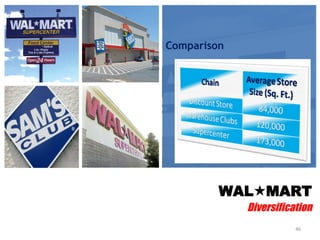
WAL  MART Diversification Comparison
WAL  MART Diversification Backward Integration Acquire “McLane Company” Texas retail grocery supplier To service both Sam’s Clubs and supercenters
WAL  MART Diversification and  Sam’s Clubs Warehouse clubs
Operating philosophy To offer a limited number of SKUs in pallet-size quantities in a no-frills, warehouse-type building Location Often locate next to a Wal*Mart Sam’s chose to cannibalize its own sales rather than give competitors any openings WAL  MART Diversification and  Sam’s Clubs
WAL  MART Diversification and  Sam’s Clubs Payment Discover card Cash- and-carry Membership Free $25 annually Business Hour Seven days a week Supply Direct shipment from supplier - 70% Company’s distribution centers - 30%
WAL  MART Diversification and  Sam’s Clubs Top Warehouse Clubs by 1993
WAL  MART Diversification and  Supercenters Motivation Operating margins within the industry were extremely low- a typical supermarkets was lucky to squeeze out a 2 % profit margin. Industry trend
WAL  MART Diversification and  Supercenters Definition A supercenter is a combination supermarket and discount store averaging 120,000 to 130,000 square feet in size It contains bakeries, delis and convenience shops
WAL  MART Diversification and  Supercenters Familiarity Low-price image Operating Philosophy
WAL  MART Diversification and  Supercenters Layout
WAL  MART Diversification and  Supercenters Staff 450 associates Full-time   - 70%  Part-time  - 30%
WAL  MART Diversification and  Supercenters 24 hours  Seven days a week
WAL  MART Diversification and  Supercenters
1994, March Acquire 122 Woolco stores Woolworth Corp. WAL  MART Diversification and  International Expansion
Year 1992 Joint venture Cifra S.A. (Mexico’s largest retailer)  63 stores (22 Sam’s Clubs, 11 Wal*Mart supercenters) WAL  MART Diversification and  International Expansion
South America Plan to enter in 1995 Brazil & Argentina WAL  MART Diversification and  International Expansion
WAL  MART Diversification and  Five Force Analysis Discount Store Kmart Target Caldor Warehouse Clubs Price Club Costco Pace Supercenter Meijer Fred Meyer Competitors High degree of concentration High industry growth Have excess capacity Cost structure of firms:  sensitive to cost Buyer’s switching cost is low Firm can adjust prices quickly Price elasticity of demand
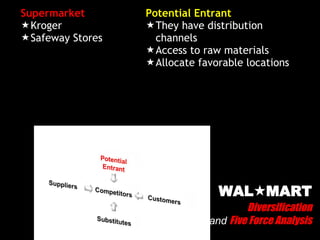
WAL  MART Diversification and  Five Force Analysis Supermarket Kroger Safeway Stores Potential Entrant They have distribution channels Access to raw materials Allocate favorable locations
WAL  MART Diversification and  Five Force Analysis Key players Procter & Gamble  GE Wrangler Suppliers Industry is concentrated Many suppliers No-nonsense
WAL  MART Diversification and  Five Force Analysis Target Market ?????? Customers Low switching cost Transportation cost

wal mart case study

  • 1.
    Sam’s Clubs GLOBALINDUSTRY ANALYSIS - CASE STUDY Wal*Mart Stores, Inc. a presentation Anthony, Crystal, Sandy From YZU university
  • 2.
    WAL  MARTBackground Sam Walton Founder of Wal*Mart Stores, Inc. Performance of Wal*Mart 20-year average return on equity of 33% Compound average sales growth of 35% Market value = $57.5 billion Wal*Mart Industry average Sales per square foot $300 $210
  • 3.
    WAL  MARTBackground Year 1988 CEO: David Glass COO: Don Soderquist How to sustain the company’s phenomenal performance? 1987 1993 Net sales 15,959 67,345 Net Income 628 2,333 Number Of Stores Discount Stores 1,114 1,953 Sam’s Wholesale Clubs 84 419 Supercenters N.A. 68
  • 4.
    WAL  MARTBackground Number of Stores (1994)
  • 5.
    WAL  MARTDiscount Retailing Where Emerged in the U.S. When Mid-1950s Top 10 discounters in 1962 Wal*Mart remained only The industry became more concentrated Discount store companies operated 5 or more stores accounted for 62%
  • 6.
    WAL  MARTDiscount Retailing
  • 7.
    WAL  MARTDiscount Retailing Comparative Pricing Study, 1993
  • 8.
    WAL  MARTDiscount Retailing Overall Performance of Discounters
  • 9.
    WAL  MARTWal*Mart’s Discount Stores and History of Growth Year 1945 Ben Franklin franchise store In 1950s 15 stores Year 1962 Wal*Mart Discount City store Year 1969 18 Wal*Mart stores 15 Ben Franklin franchise stores
  • 10.
    WAL  MARTWal*Mart’s Discount Stores and History of Growth Year 1970 30 discount stores in rural states South and Midwest Cost of good sold Build its own warehouse Buy in volume at attractive prices Store the merchandise Year 1972 Took the company public Raised $3.3 million
  • 11.
    WAL  MARTWal*Mart’s Discount Stores and History of Growth Year 1993 West coast and northeastern states Year 1994 Operated in 47 states
  • 12.
  • 13.
    WAL  MARTWal*Mart’s Discount Stores and History of Growth Key strategies for growing Locate store in isolated rural areas and small towns (population 5000~25000) Pattern of expansion Always push from inside out Mid-1980s One third were located in areas that were not served by any of its competitors
  • 14.
    WAL  MARTWal*Mart’s Discount Stores and History of Growth Year 1993 Wal*Mart faced 55% (Kmart), 23% (Target) Kmart 82%, Target 85% from Wal*Mart
  • 15.
    WAL  MARTWal*Mart’s Discount Stores and Sam’s Legacy Philosophy Keep prices below everybody else Trip expenses can’t exceed 1% of the purchases Spent lots of time in his own store and observe competitors Culture Do not show off buying luxury goods Success The way it treated its associates
  • 16.
    WAL  MARTWal*Mart’s Discount Stores and Sam’s Legacy Management style Maintain an open-door policy Empowering associates Maintain technology superiority Build loyalty among associates, customers, and suppliers
  • 17.
  • 18.
    WAL  MARTWal*Mart’s Discount Stores and Merchandising Tailor to individual market or individual store Information system A process which indexed product movements in the store to over a thousand store and market traits Using inventory and sales data
  • 19.
  • 20.
    WAL  MARTWal*Mart’s Discount Stores and Merchandising Promotional strategy Everyday-low-prices Few promotions 13 major circulars per year 1993 Satisfaction guaranteed policy
  • 21.
    WAL  MARTWal*Mart’s Discount Stores and Merchandising Marketing slogan Lower price Store managers set up prices 2-4% pricing differential between Wal*Mart and its best competitors in most markets in early 1990s
  • 22.
  • 23.
    WAL  MARTWal*Mart’s Discount Stores and Merchandising National brand strategy Private label apparel 25% of apparel sales Other private label 26% price advantage Also sold in Sam’s Clubs and supercenters “ Buy American” program
  • 24.
    WAL  MARTWal*Mart’s Discount Stores and SWOT Analysis Strength Weakness Cost advantage Low price & customer-oriented Strong supply chain People are key to success Ignore store decoration Since Wal-Mart sell products across many sectors (such as clothing, food, or stationary), it may not have the flexibility of some of its more focused competitors. Opportunity Threat Build its own brand Put efforts on social welfare  better image New locations and store types Overseas markets Other competitors Intense price competition
  • 25.
    WAL  MARTWal*Mart’s Discount Stores and Store Operation
  • 26.
    WAL  MARTWal*Mart’s Discount Stores and Store Operation
  • 27.
    WAL  MARTWal*Mart’s Discount Stores and Store Operation Electronic scanning of uniform product code (UPC) at the POS Ensure accurate pricing Improve efficiency Reduce Shrinkage Improve communications
  • 28.
    WAL  MARTWal*Mart’s Discount Stores and Store Operation Satellite system Data collected and analyzed Observing Merchandise flow, overstock, discount Video transmissions, credit card authorizations, and inventory control
  • 29.
    WAL  MARTWal*Mart’s Discount Stores and Distribution Phenomenal distribution network Two step hub-and-spoke
  • 30.
    WAL  MARTWal*Mart’s Discount Stores and Distribution Phenomenal distribution network Cross-docking technique
  • 31.
    WAL  MARTWal*Mart’s Discount Stores and Distribution Phenomenal distribution network Distribution center Cost advantage Stable price
  • 32.
    WAL  MARTWal*Mart’s Discount Stores and Distribution Phenomenal distribution network Computerized pick to light system
  • 33.
    WAL  MARTWal*Mart’s Discount Stores and Distribution
  • 34.
    WAL  MARTWal*Mart’s Discount Stores and Vendor Relationships Backward integration No nonsense negotiator Economies of scale Maintain long term relationship with supplier, as powerful partner (RSP)
  • 35.
    WAL  MARTWal*Mart’s Discount Stores and Vendor Relationships
  • 36.
    WAL  MARTWal*Mart’s Discount Stores and Vendor Relationships Backward integration Electronic data interchange (EDI) CPFR Forecasting Planning Replenishing Shipping applications
  • 37.
    The CPFR ProcessBuyer Seller FRONT END AGREEMENT JOINT BUSINESS PLAN Collaborative Planning CREATE SALES FORECAST IDENTIFY EXCEPTIONS RESOLVE EXCEPTIONS Collaborative Forecasting CREATE ORDER FORECAST IDENTIFY EXCEPTIONS RESOLVE EXCEPTIONS Collaborative Replenishment GENERATE ORDER
  • 38.
    WAL  MARTWal*Mart’s Discount Stores and Vendor Relationships Backward integration Vendor-managed inventory (VMI) system Wrangler GE
  • 39.
    WAL  MARTWal*Mart’s Discount Stores and Vendor Relationships Backward integration From EDI to Retail link
  • 40.
    WAL  MARTWal*Mart’s Discount Stores and Vendor Relationships Whole Supply chain Economies of scale Cost leadership competitive advantage JIT inventor POS and retail link CRS & VMI EDI CPFR
  • 41.
  • 42.
    WAL  MARTWal*Mart’s Discount Stores and Human Resource Management Non-unionized Decentralized: full autonomy Profit sharing program Yes we can Sam Store within store Shrink incentive Stock sharing Administrative style Frugality No hierarchy in organization
  • 43.
    WAL  MARTWal*Mart’s Discount Stores and Value Chain Non-unionized, Full autonomy to associates, Decentralized, profit sharing program, Job rotation, Stock purchase plan UPC at POS, EDI, Information system, VMI ,Cross ducking , Satellite system, CPFR Maintain long-term relationship, No single supplier accounting for more than 2.4%, Selective suppliers ( P&G & GE), NO nonsense policy Inferior fixtures standardization, Trucks, Average store size 84,000 square feat Everyday low price Always low price, always Self service Cash and carry Save money, live better credit card, Layaway plan Outbound Logistics Marketing & Sales After Sales Service Inbound Logistics Primary Activities Firm Infrastructure Human Resource Management Technology Development Procurement VMI system Retail link EDI CPFR Six days a week(9~21) Monday (12:30~17:30) Two step hub and spoke distributing system ECR Satisfaction guarantee policy Quick response (QR) Operations Margin
  • 44.
    WAL  MARTDiversification Historical Time Series Wal*Mart opened the first three Sam’s clubs in 1983 Sam’s sales surpassed Price Club’s, making it the largest wholesale club in 1987 In 1987, Wal*Mart introduced its first supercenter In 1991, Wal*Mart acquired “The Wholesale Club” with 28 outlets in the Midwest
  • 45.
    WAL  MARTDiversification In 1993, Sales at Sam’s Club rose 19.5% as the highest in national warehouse club chains, which Sam’s was nearly twice the size of Price Club Sam’s Club acquired 99 of Kmart’s 113 “Pace club” in 1993
  • 46.
    WAL  MARTDiversification Comparison
  • 47.
    WAL  MARTDiversification Backward Integration Acquire “McLane Company” Texas retail grocery supplier To service both Sam’s Clubs and supercenters
  • 48.
    WAL  MARTDiversification and Sam’s Clubs Warehouse clubs
  • 49.
    Operating philosophy Tooffer a limited number of SKUs in pallet-size quantities in a no-frills, warehouse-type building Location Often locate next to a Wal*Mart Sam’s chose to cannibalize its own sales rather than give competitors any openings WAL  MART Diversification and Sam’s Clubs
  • 50.
    WAL  MARTDiversification and Sam’s Clubs Payment Discover card Cash- and-carry Membership Free $25 annually Business Hour Seven days a week Supply Direct shipment from supplier - 70% Company’s distribution centers - 30%
  • 51.
    WAL  MARTDiversification and Sam’s Clubs Top Warehouse Clubs by 1993
  • 52.
    WAL  MARTDiversification and Supercenters Motivation Operating margins within the industry were extremely low- a typical supermarkets was lucky to squeeze out a 2 % profit margin. Industry trend
  • 53.
    WAL  MARTDiversification and Supercenters Definition A supercenter is a combination supermarket and discount store averaging 120,000 to 130,000 square feet in size It contains bakeries, delis and convenience shops
  • 54.
    WAL  MARTDiversification and Supercenters Familiarity Low-price image Operating Philosophy
  • 55.
    WAL  MARTDiversification and Supercenters Layout
  • 56.
    WAL  MARTDiversification and Supercenters Staff 450 associates Full-time - 70% Part-time - 30%
  • 57.
    WAL  MARTDiversification and Supercenters 24 hours Seven days a week
  • 58.
    WAL  MARTDiversification and Supercenters
  • 59.
    1994, March Acquire122 Woolco stores Woolworth Corp. WAL  MART Diversification and International Expansion
  • 60.
    Year 1992 Jointventure Cifra S.A. (Mexico’s largest retailer) 63 stores (22 Sam’s Clubs, 11 Wal*Mart supercenters) WAL  MART Diversification and International Expansion
  • 61.
    South America Planto enter in 1995 Brazil & Argentina WAL  MART Diversification and International Expansion
  • 62.
    WAL  MARTDiversification and Five Force Analysis Discount Store Kmart Target Caldor Warehouse Clubs Price Club Costco Pace Supercenter Meijer Fred Meyer Competitors High degree of concentration High industry growth Have excess capacity Cost structure of firms: sensitive to cost Buyer’s switching cost is low Firm can adjust prices quickly Price elasticity of demand
  • 63.
    WAL  MARTDiversification and Five Force Analysis Supermarket Kroger Safeway Stores Potential Entrant They have distribution channels Access to raw materials Allocate favorable locations
  • 64.
    WAL  MARTDiversification and Five Force Analysis Key players Procter & Gamble GE Wrangler Suppliers Industry is concentrated Many suppliers No-nonsense
  • 65.
    WAL  MARTDiversification and Five Force Analysis Target Market ?????? Customers Low switching cost Transportation cost