Introduction and Preparation of
Trading Account
Financial Management and Cost
Accounting (DBM-422)
A K JHA
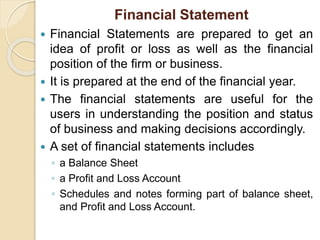
Financial Statement
 Financial Statements are prepared to get an
idea of profit or loss as well as the financial
position of the firm or business.
 It is prepared at the end of the financial year.
 The financial statements are useful for the
users in understanding the position and status
of business and making decisions accordingly.
 A set of financial statements includes
◦ a Balance Sheet
◦ a Profit and Loss Account
◦ Schedules and notes forming part of balance sheet,
and Profit and Loss Account.
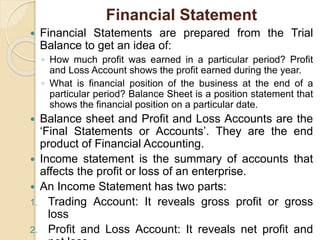
Financial Statement
 Financial Statements are prepared from the Trial
Balance to get an idea of:
◦ How much profit was earned in a particular period? Profit
and Loss Account shows the profit earned during the year.
◦ What is financial position of the business at the end of a
particular period? Balance Sheet is a position statement that
shows the financial position on a particular date.
 Balance sheet and Profit and Loss Accounts are the
‘Final Statements or Accounts’. They are the end
product of Financial Accounting.
 Income statement is the summary of accounts that
affects the profit or loss of an enterprise.
 An Income Statement has two parts:
1. Trading Account: It reveals gross profit or gross
loss
2. Profit and Loss Account: It reveals net profit and
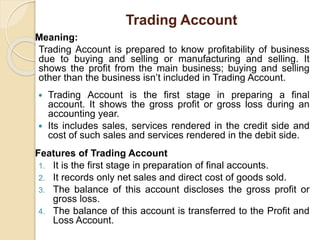
Trading Account
Meaning:
Trading Account is prepared to know profitability of business
due to buying and selling or manufacturing and selling. It
shows the profit from the main business; buying and selling
other than the business isn’t included in Trading Account.
 Trading Account is the first stage in preparing a final
account. It shows the gross profit or gross loss during an
accounting year.
 Its includes sales, services rendered in the credit side and
cost of such sales and services rendered in the debit side.
Features of Trading Account
1. It is the first stage in preparation of final accounts.
2. It records only net sales and direct cost of goods sold.
3. The balance of this account discloses the gross profit or
gross loss.
4. The balance of this account is transferred to the Profit and
Loss Account.
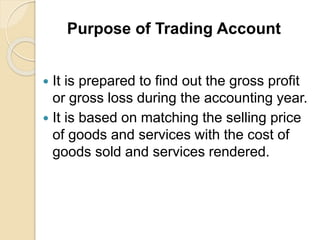
 It is prepared to find out the gross profit
or gross loss during the accounting year.
 It is based on matching the selling price
of goods and services with the cost of
goods sold and services rendered.
Purpose of Trading Account
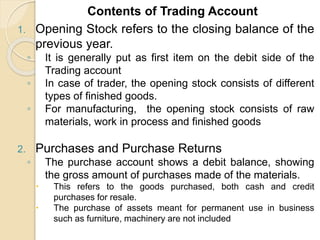
1. Opening Stock refers to the closing balance of the
previous year.
◦ It is generally put as first item on the debit side of the
Trading account
◦ In case of trader, the opening stock consists of different
types of finished goods.
◦ For manufacturing, the opening stock consists of raw
materials, work in process and finished goods
2. Purchases and Purchase Returns
◦ The purchase account shows a debit balance, showing
the gross amount of purchases made of the materials.
 This refers to the goods purchased, both cash and credit
purchases for resale.
 The purchase of assets meant for permanent use in business
such as furniture, machinery are not included
Contents of Trading Account
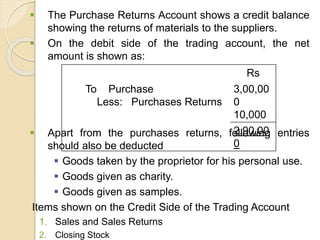
 The Purchase Returns Account shows a credit balance
showing the returns of materials to the suppliers.
 On the debit side of the trading account, the net
amount is shown as:
 Apart from the purchases returns, following entries
should also be deducted
 Goods taken by the proprietor for his personal use.
 Goods given as charity.
 Goods given as samples.
Items shown on the Credit Side of the Trading Account
1. Sales and Sales Returns
2. Closing Stock
Rs
To Purchase
Less: Purchases Returns
3,00,00
0
10,000
2,90,00
0
3. Direct Expenses
◦ those expenses which are incurred on the
goods purchased till they are brought to the
place of business for sale e.g. Freight inward,
insurance, import duty, etc.
◦ In manufacturing business wages, power and
fuel, factory rent, etc. are also direct expenses.
Stores consumed during the last year =
Opening Balance in Stores + Purchase of
Sores during the year – Closing Balance of
Stores
Balancing of Trading Account
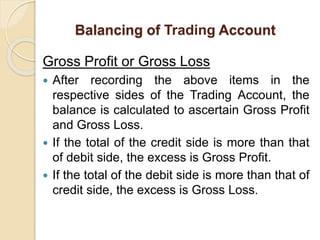
Gross Profit or Gross Loss
 After recording the above items in the
respective sides of the Trading Account, the
balance is calculated to ascertain Gross Profit
and Gross Loss.
 If the total of the credit side is more than that
of debit side, the excess is Gross Profit.
 If the total of the debit side is more than that of
credit side, the excess is Gross Loss.
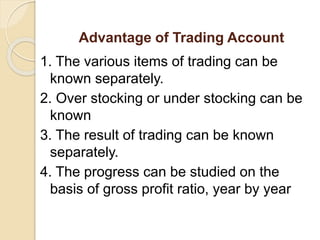
Advantage of Trading Account
1. The various items of trading can be
known separately.
2. Over stocking or under stocking can be
known
3. The result of trading can be known
separately.
4. The progress can be studied on the
basis of gross profit ratio, year by year
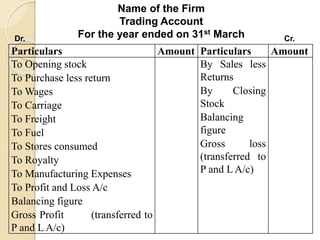
Particulars Amount Particulars Amount
To Opening stock
To Purchase less return
To Wages
To Carriage
To Freight
To Fuel
To Stores consumed
To Royalty
To Manufacturing Expenses
To Profit and Loss A/c
Balancing figure
Gross Profit (transferred to
P and L A/c)
By Sales less
Returns
By Closing
Stock
Balancing
figure
Gross loss
(transferred to
P and L A/c)
Name of the Firm
Trading Account
For the year ended on 31st March
Dr. Cr.
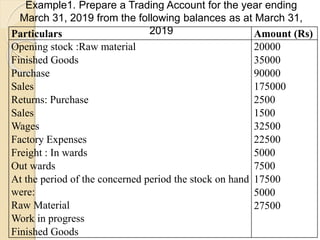
Particulars Amount (Rs)
Opening stock :Raw material
Finished Goods
Purchase
Sales
Returns: Purchase
Sales
Wages
Factory Expenses
Freight : In wards
Out wards
At the period of the concerned period the stock on hand
were:
Raw Material
Work in progress
Finished Goods
20000
35000
90000
175000
2500
1500
32500
22500
5000
7500
17500
5000
27500
Example1. Prepare a Trading Account for the year ending
March 31, 2019 from the following balances as at March 31,
2019
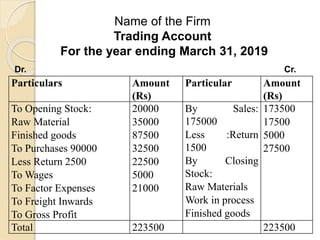
Particulars Amount
(Rs)
Particular Amount
(Rs)
To Opening Stock:
Raw Material
Finished goods
To Purchases 90000
Less Return 2500
To Wages
To Factor Expenses
To Freight Inwards
To Gross Profit
20000
35000
87500
32500
22500
5000
21000
By Sales:
175000
Less :Return
1500
By Closing
Stock:
Raw Materials
Work in process
Finished goods
173500
17500
5000
27500
Total 223500 223500
Name of the Firm
Trading Account
For the year ending March 31, 2019
Dr. Cr.

Introduction-and-Preparation-of-Trading-Account.pptx

  • 1.
    Introduction and Preparationof Trading Account Financial Management and Cost Accounting (DBM-422) A K JHA
  • 2.
    Financial Statement  FinancialStatements are prepared to get an idea of profit or loss as well as the financial position of the firm or business.  It is prepared at the end of the financial year.  The financial statements are useful for the users in understanding the position and status of business and making decisions accordingly.  A set of financial statements includes ◦ a Balance Sheet ◦ a Profit and Loss Account ◦ Schedules and notes forming part of balance sheet, and Profit and Loss Account.
  • 3.
    Financial Statement  FinancialStatements are prepared from the Trial Balance to get an idea of: ◦ How much profit was earned in a particular period? Profit and Loss Account shows the profit earned during the year. ◦ What is financial position of the business at the end of a particular period? Balance Sheet is a position statement that shows the financial position on a particular date.  Balance sheet and Profit and Loss Accounts are the ‘Final Statements or Accounts’. They are the end product of Financial Accounting.  Income statement is the summary of accounts that affects the profit or loss of an enterprise.  An Income Statement has two parts: 1. Trading Account: It reveals gross profit or gross loss 2. Profit and Loss Account: It reveals net profit and
  • 4.
    Trading Account Meaning: Trading Accountis prepared to know profitability of business due to buying and selling or manufacturing and selling. It shows the profit from the main business; buying and selling other than the business isn’t included in Trading Account.  Trading Account is the first stage in preparing a final account. It shows the gross profit or gross loss during an accounting year.  Its includes sales, services rendered in the credit side and cost of such sales and services rendered in the debit side. Features of Trading Account 1. It is the first stage in preparation of final accounts. 2. It records only net sales and direct cost of goods sold. 3. The balance of this account discloses the gross profit or gross loss. 4. The balance of this account is transferred to the Profit and Loss Account.
  • 5.
     It isprepared to find out the gross profit or gross loss during the accounting year.  It is based on matching the selling price of goods and services with the cost of goods sold and services rendered. Purpose of Trading Account
  • 6.
    1. Opening Stockrefers to the closing balance of the previous year. ◦ It is generally put as first item on the debit side of the Trading account ◦ In case of trader, the opening stock consists of different types of finished goods. ◦ For manufacturing, the opening stock consists of raw materials, work in process and finished goods 2. Purchases and Purchase Returns ◦ The purchase account shows a debit balance, showing the gross amount of purchases made of the materials.  This refers to the goods purchased, both cash and credit purchases for resale.  The purchase of assets meant for permanent use in business such as furniture, machinery are not included Contents of Trading Account
  • 7.
     The PurchaseReturns Account shows a credit balance showing the returns of materials to the suppliers.  On the debit side of the trading account, the net amount is shown as:  Apart from the purchases returns, following entries should also be deducted  Goods taken by the proprietor for his personal use.  Goods given as charity.  Goods given as samples. Items shown on the Credit Side of the Trading Account 1. Sales and Sales Returns 2. Closing Stock Rs To Purchase Less: Purchases Returns 3,00,00 0 10,000 2,90,00 0
  • 8.
    3. Direct Expenses ◦those expenses which are incurred on the goods purchased till they are brought to the place of business for sale e.g. Freight inward, insurance, import duty, etc. ◦ In manufacturing business wages, power and fuel, factory rent, etc. are also direct expenses. Stores consumed during the last year = Opening Balance in Stores + Purchase of Sores during the year – Closing Balance of Stores
  • 9.
    Balancing of TradingAccount Gross Profit or Gross Loss  After recording the above items in the respective sides of the Trading Account, the balance is calculated to ascertain Gross Profit and Gross Loss.  If the total of the credit side is more than that of debit side, the excess is Gross Profit.  If the total of the debit side is more than that of credit side, the excess is Gross Loss.
  • 10.
    Advantage of TradingAccount 1. The various items of trading can be known separately. 2. Over stocking or under stocking can be known 3. The result of trading can be known separately. 4. The progress can be studied on the basis of gross profit ratio, year by year
  • 11.
    Particulars Amount ParticularsAmount To Opening stock To Purchase less return To Wages To Carriage To Freight To Fuel To Stores consumed To Royalty To Manufacturing Expenses To Profit and Loss A/c Balancing figure Gross Profit (transferred to P and L A/c) By Sales less Returns By Closing Stock Balancing figure Gross loss (transferred to P and L A/c) Name of the Firm Trading Account For the year ended on 31st March Dr. Cr.
  • 12.
    Particulars Amount (Rs) Openingstock :Raw material Finished Goods Purchase Sales Returns: Purchase Sales Wages Factory Expenses Freight : In wards Out wards At the period of the concerned period the stock on hand were: Raw Material Work in progress Finished Goods 20000 35000 90000 175000 2500 1500 32500 22500 5000 7500 17500 5000 27500 Example1. Prepare a Trading Account for the year ending March 31, 2019 from the following balances as at March 31, 2019
  • 13.
    Particulars Amount (Rs) Particular Amount (Rs) ToOpening Stock: Raw Material Finished goods To Purchases 90000 Less Return 2500 To Wages To Factor Expenses To Freight Inwards To Gross Profit 20000 35000 87500 32500 22500 5000 21000 By Sales: 175000 Less :Return 1500 By Closing Stock: Raw Materials Work in process Finished goods 173500 17500 5000 27500 Total 223500 223500 Name of the Firm Trading Account For the year ending March 31, 2019 Dr. Cr.