Prospect Theory
Presented by
Dinamani Biswal
PhD Scholar, IIT Tirupati
INTRODUCTION
PROSPECT THEORY: AN ANALYSIS OF DECISION UNDER RISK
Prospect Theory Developed over the Expected Utility Theory
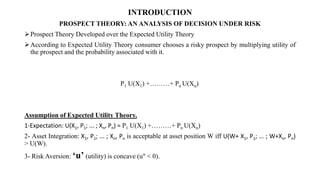
According to Expected Utility Theory consumer chooses a risky prospect by multiplying utility of
the prospect and the probability associated with it.
P1 U(X1) +………+ Pn U(Xn)
Assumption of Expected Utility Theory.
1-Expectation: U(X1, P1; ... ; Xn, Pn) = P1 U(X1) +………+ Pn U(Xn)
2- Asset Integration: X1, P1; ... ; Xn, Pn is acceptable at asset position W iff U(W+ X1, P1; ... ; W+Xn, Pn)
> U(W).
3- Risk Aversion: ‘u’ (utility) is concave (u" < 0).
Violation Of Expected Utility Theory
People overweight outcomes that are considered certain, relative to outcomes which are merely
probable which we label the certainty effect
Certainty Effect
Choose between
• A: 2,500 with probability .33, B: 2,400 with certainty.
• 2,400 with probability .66,
• 0 with probability .01
N=72 [18] [82]*
A: 50% chance to
win 1,000, 50%
chance to win
nothing;
B: 450 for sure.
Choose between
• C: 2,500 with probability .33, D: 2,400 with probability .34,
• 0 with probability .67; 0 with probability .66.
• N =72 [83]* [17]
PROBLEM 1:
• A: (4,000,.80), B: (3,000).
• N = 95 [20] [80]*
PROBLEM 2:
• C: (4,000,.20), D: (3,000,.25).
• N= 95 [65]* [35]
The certainty effect with non-monetary outcomes.
PROBLEM 3:
A: 50% chance to win a three- B: A one-week tour of
week tour of England, France and Italy England, with certainty.
N=72 [22] [78]*
C: 5% chance to win a three- D: 10% chance to win a one week
• tour of England, France, and Italy; tour of England
N=72 [67]* [33]
The Reflection Effect
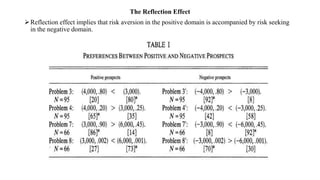
Reflection effect implies that risk aversion in the positive domain is accompanied by risk seeking
in the negative domain.
The Isolation Effect
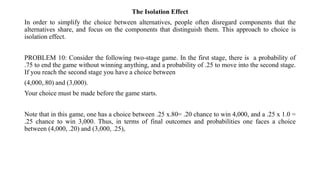
In order to simplify the choice between alternatives, people often disregard components that the
alternatives share, and focus on the components that distinguish them. This approach to choice is
isolation effect.
PROBLEM 10: Consider the following two-stage game. In the first stage, there is a probability of
.75 to end the game without winning anything, and a probability of .25 to move into the second stage.
If you reach the second stage you have a choice between
(4,000,.80) and (3,000).
Your choice must be made before the game starts.
Note that in this game, one has a choice between .25 x.80= .20 chance to win 4,000, and a .25 x 1.0 =
.25 chance to win 3,000. Thus, in terms of final outcomes and probabilities one faces a choice
between (4,000, .20) and (3,000, .25),
Prospect Theory
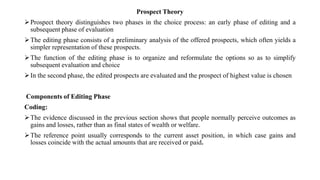
Prospect theory distinguishes two phases in the choice process: an early phase of editing and a
subsequent phase of evaluation
The editing phase consists of a preliminary analysis of the offered prospects, which often yields a
simpler representation of these prospects.
The function of the editing phase is to organize and reformulate the options so as to simplify
subsequent evaluation and choice
In the second phase, the edited prospects are evaluated and the prospect of highest value is chosen
Components of Editing Phase
Coding:
The evidence discussed in the previous section shows that people normally perceive outcomes as
gains and losses, rather than as final states of wealth or welfare.
The reference point usually corresponds to the current asset position, in which case gains and
losses coincide with the actual amounts that are received or paid.
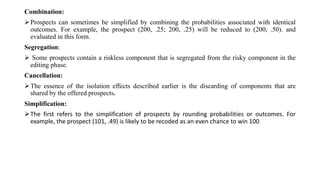
Combination:
Prospects can sometimes be simplified by combining the probabilities associated with identical
outcomes. For example, the prospect (200, .25; 200, .25) will be reduced to (200, .50). and
evaluated in this form.
Segregation:
 Some prospects contain a riskless component that is segregated from the risky component in the
editing phase.
Cancellation:
The essence of the isolation effects described earlier is the discarding of components that are
shared by the offered prospects.
Simplification:
The first refers to the simplification of prospects by rounding probabilities or outcomes. For
example, the prospect (101, .49) is likely to be recoded as an even chance to win 100
Evaluation Phase :
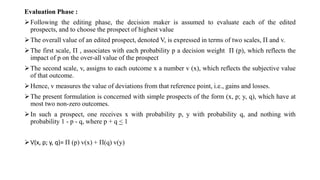
Following the editing phase, the decision maker is assumed to evaluate each of the edited
prospects, and to choose the prospect of highest value
The overall value of an edited prospect, denoted V, is expressed in terms of two scales, Π and v.
The first scale, Π , associates with each probability p a decision weight Π (p), which reflects the
impact of p on the over-all value of the prospect
The second scale, v, assigns to each outcome x a number v (x), which reflects the subjective value
of that outcome.
Hence, v measures the value of deviations from that reference point, i.e., gains and losses.
The present formulation is concerned with simple prospects of the form (x, p; y, q), which have at
most two non-zero outcomes.
In such a prospect, one receives x with probability p, y with probability q, and nothing with
probability 1 - p - q, where p + q < 1
V(x, p; y, q)= Π (p) v(x) + Π(q) v(y)
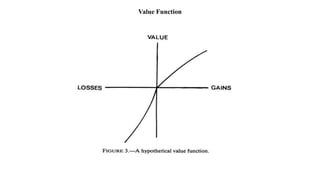
The Value Function
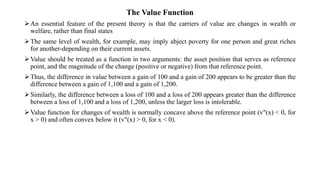
An essential feature of the present theory is that the carriers of value are changes in wealth or
welfare, rather than final states
The same level of wealth, for example, may imply abject poverty for one person and great riches
for another-depending on their current assets.
Value should be treated as a function in two arguments: the asset position that serves as reference
point, and the magnitude of the change (positive or negative) from that reference point.
Thus, the difference in value between a gain of 100 and a gain of 200 appears to be greater than the
difference between a gain of 1,100 and a gain of 1,200.
Similarly, the difference between a loss of 100 and a loss of 200 appears greater than the difference
between a loss of 1,100 and a loss of 1,200, unless the larger loss is intolerable.
Value function for changes of wealth is normally concave above the reference point (v"(x) < 0, for
x > 0) and often convex below it (v"(x) > 0, for x < 0).
Value Function
Value function
 It is defined on deviations from the reference point
 Generally concave for gains and commonly convex for losses
Steeper for losses than for gains.
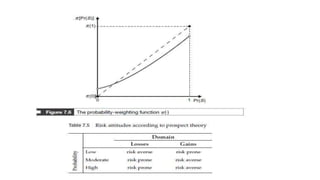
The Weighting Function
In prospect theory, the value of each outcome is multiplied by a decision weight. Decision weights
are inferred from choices between prospects much as subjective probabilities
Decision weights are not probabilities: they do not obey the probability axioms
Consider a gamble in which one can win 1,000 or nothing, depending on the toss of a fair coin. For
any reasonable person, the probability of winning is .50 in this situation.
As will be shown below, however, the decision weight Π(.50) which is derived from choices is
likely to be smaller than .50.
The two scales coincide (i.e., Π(p) = p) if the expectation principle hold
Naturally, Π is an increasing function of p
Thank You
Prospect Theory.pptx

Prospect Theory.pptx

  • 1.
    Prospect Theory Presented by DinamaniBiswal PhD Scholar, IIT Tirupati
  • 2.
    INTRODUCTION PROSPECT THEORY: ANANALYSIS OF DECISION UNDER RISK Prospect Theory Developed over the Expected Utility Theory According to Expected Utility Theory consumer chooses a risky prospect by multiplying utility of the prospect and the probability associated with it. P1 U(X1) +………+ Pn U(Xn) Assumption of Expected Utility Theory. 1-Expectation: U(X1, P1; ... ; Xn, Pn) = P1 U(X1) +………+ Pn U(Xn) 2- Asset Integration: X1, P1; ... ; Xn, Pn is acceptable at asset position W iff U(W+ X1, P1; ... ; W+Xn, Pn) > U(W). 3- Risk Aversion: ‘u’ (utility) is concave (u" < 0).
  • 3.
    Violation Of ExpectedUtility Theory People overweight outcomes that are considered certain, relative to outcomes which are merely probable which we label the certainty effect Certainty Effect Choose between • A: 2,500 with probability .33, B: 2,400 with certainty. • 2,400 with probability .66, • 0 with probability .01 N=72 [18] [82]* A: 50% chance to win 1,000, 50% chance to win nothing; B: 450 for sure.
  • 4.
    Choose between • C:2,500 with probability .33, D: 2,400 with probability .34, • 0 with probability .67; 0 with probability .66. • N =72 [83]* [17] PROBLEM 1: • A: (4,000,.80), B: (3,000). • N = 95 [20] [80]* PROBLEM 2: • C: (4,000,.20), D: (3,000,.25). • N= 95 [65]* [35]
  • 5.
    The certainty effectwith non-monetary outcomes. PROBLEM 3: A: 50% chance to win a three- B: A one-week tour of week tour of England, France and Italy England, with certainty. N=72 [22] [78]* C: 5% chance to win a three- D: 10% chance to win a one week • tour of England, France, and Italy; tour of England N=72 [67]* [33]
  • 6.
    The Reflection Effect Reflectioneffect implies that risk aversion in the positive domain is accompanied by risk seeking in the negative domain.
  • 7.
    The Isolation Effect Inorder to simplify the choice between alternatives, people often disregard components that the alternatives share, and focus on the components that distinguish them. This approach to choice is isolation effect. PROBLEM 10: Consider the following two-stage game. In the first stage, there is a probability of .75 to end the game without winning anything, and a probability of .25 to move into the second stage. If you reach the second stage you have a choice between (4,000,.80) and (3,000). Your choice must be made before the game starts. Note that in this game, one has a choice between .25 x.80= .20 chance to win 4,000, and a .25 x 1.0 = .25 chance to win 3,000. Thus, in terms of final outcomes and probabilities one faces a choice between (4,000, .20) and (3,000, .25),
  • 8.
    Prospect Theory Prospect theorydistinguishes two phases in the choice process: an early phase of editing and a subsequent phase of evaluation The editing phase consists of a preliminary analysis of the offered prospects, which often yields a simpler representation of these prospects. The function of the editing phase is to organize and reformulate the options so as to simplify subsequent evaluation and choice In the second phase, the edited prospects are evaluated and the prospect of highest value is chosen Components of Editing Phase Coding: The evidence discussed in the previous section shows that people normally perceive outcomes as gains and losses, rather than as final states of wealth or welfare. The reference point usually corresponds to the current asset position, in which case gains and losses coincide with the actual amounts that are received or paid.
  • 9.
    Combination: Prospects can sometimesbe simplified by combining the probabilities associated with identical outcomes. For example, the prospect (200, .25; 200, .25) will be reduced to (200, .50). and evaluated in this form. Segregation:  Some prospects contain a riskless component that is segregated from the risky component in the editing phase. Cancellation: The essence of the isolation effects described earlier is the discarding of components that are shared by the offered prospects. Simplification: The first refers to the simplification of prospects by rounding probabilities or outcomes. For example, the prospect (101, .49) is likely to be recoded as an even chance to win 100
  • 10.
    Evaluation Phase : Followingthe editing phase, the decision maker is assumed to evaluate each of the edited prospects, and to choose the prospect of highest value The overall value of an edited prospect, denoted V, is expressed in terms of two scales, Π and v. The first scale, Π , associates with each probability p a decision weight Π (p), which reflects the impact of p on the over-all value of the prospect The second scale, v, assigns to each outcome x a number v (x), which reflects the subjective value of that outcome. Hence, v measures the value of deviations from that reference point, i.e., gains and losses. The present formulation is concerned with simple prospects of the form (x, p; y, q), which have at most two non-zero outcomes. In such a prospect, one receives x with probability p, y with probability q, and nothing with probability 1 - p - q, where p + q < 1 V(x, p; y, q)= Π (p) v(x) + Π(q) v(y)
  • 11.
    The Value Function Anessential feature of the present theory is that the carriers of value are changes in wealth or welfare, rather than final states The same level of wealth, for example, may imply abject poverty for one person and great riches for another-depending on their current assets. Value should be treated as a function in two arguments: the asset position that serves as reference point, and the magnitude of the change (positive or negative) from that reference point. Thus, the difference in value between a gain of 100 and a gain of 200 appears to be greater than the difference between a gain of 1,100 and a gain of 1,200. Similarly, the difference between a loss of 100 and a loss of 200 appears greater than the difference between a loss of 1,100 and a loss of 1,200, unless the larger loss is intolerable. Value function for changes of wealth is normally concave above the reference point (v"(x) < 0, for x > 0) and often convex below it (v"(x) > 0, for x < 0).
  • 12.
  • 13.
    Value function  Itis defined on deviations from the reference point  Generally concave for gains and commonly convex for losses Steeper for losses than for gains. The Weighting Function In prospect theory, the value of each outcome is multiplied by a decision weight. Decision weights are inferred from choices between prospects much as subjective probabilities Decision weights are not probabilities: they do not obey the probability axioms Consider a gamble in which one can win 1,000 or nothing, depending on the toss of a fair coin. For any reasonable person, the probability of winning is .50 in this situation. As will be shown below, however, the decision weight Π(.50) which is derived from choices is likely to be smaller than .50. The two scales coincide (i.e., Π(p) = p) if the expectation principle hold Naturally, Π is an increasing function of p
  • 15.