KENT STATE UNIVERSITY
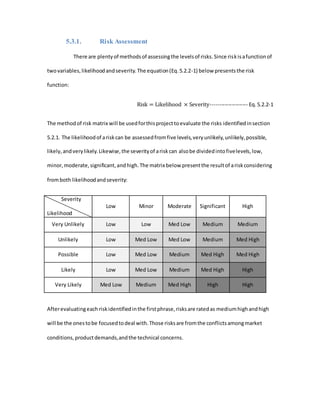
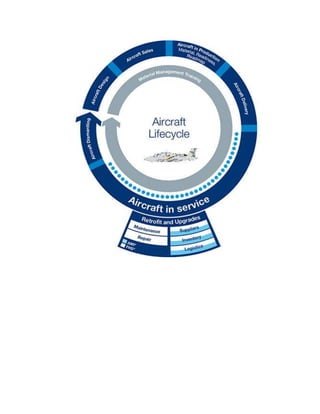
AERN 45700/55700: AIRCRAFT DESIGN
INSTRUCTOR: D. BLAKE STRINGER, PH.D.
Spring 2015
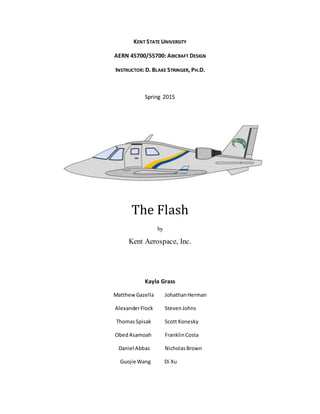
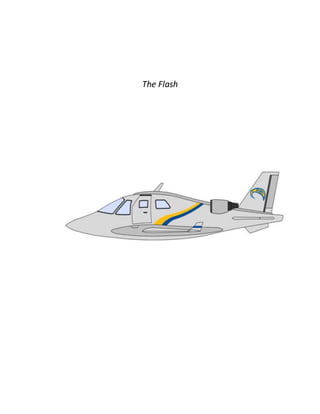
The Flash
by
Kent Aerospace, Inc.
Kayla Grass
Matthew Gazella JohathanHerman
AlexanderFlock StevenJohns
ThomasSpisak Scott Konesky
ObedAsamoah FranklinCosta
Daniel Abbas NicholasBrown
Guojie Wang Di Xu
Table of Contents
1. The Flash
1.1. Description
1.2. Summary of Key Parameters
1.3. ConfigurationLayout
2. RequirementsAnalysis
2.1. RequirementsSummary
2.2. MissionProfile
2.3. Reference DesignConcepts(Baselines)
3. Technical Design
3.1. Reference DesignConcepts(Baselines)
3.2. SizingMethodology
3.2.1. DesignSpace
3.3. Assumptions
3.3.1. AssumptionsUsedfor Lift-to-DragRatio (L/D)
3.3.2. AssumptionsUsedfor Initial Sizing
3.3.3. AssumptionsUsedfor Thrust-to WeightRatio (T/W)
3.3.4. AssumptionsUsedfor WingLoading (W/S)
3.3.5. AssumptionsUsedfor Wing,Tail, and Fuselage Geometry
3.4. Wingand Tail Geometry
3.4.1. Airfoil Selection
3.4.2. WingGeometry
3.4.3. Fuselage Geometry
3.4.4. Tail Geometry
3.5. Thrust-to-WeightRatio
3.6. Introduction to PowerplantData
3.6.1. Introduction to The Flash
3.6.2. Flash Performance
3.6.3. DGEN 380 Specificationsand Performance
3.6.4. Static Takeoff Condition0-15,000 Feet
3.6.5. Static Cruise Condition10,000-23,000 Feet
3.6.6. DGEN 380 Specificationsand Performance
3.6.7. Non-StaticCruise Condition
3.6.8. Non-StaticMax SpeedCondition
3.6.9. WindTunnel Data and L/D Curve
3.7. WingLoading Data
3.7.1. Stall
3.7.2. Takeoff
3.7.3. Cruise
3.7.4. Discussionof the WingLoading
3.8. SizingResultsand DesignSelection
3.8.1. SizingVariabilityand Optimization
3.9. Sizesand Capacities
3.9.1. Fuselage
3.9.2. Wing
3.9.3. Tail
3.9.4. Landing Gear
3.9.5. Fuel
3.9.6. Powerplant
3.10. Weightand Balance
3.11. Performance and Sub-SystemDesigns
3.11.1. FlightControls
3.11.2. Avionics
3.11.3. Electrical System
3.11.4. Landing Gear
3.11.5. PressurizationSystem
3.11.6. Fire Protection System
3.11.7. Fuel System
4. Manufacturing Plan
4.1. Manufacturing ReadinessLevels
4.1.1. DefiningManufacturingReadiness
4.1.2. Manufacturing ReadinessLevels
4.2. Industrial Base
4.2.1. Price Induction
4.2.2. Garmin
4.2.3. Rockwell Collins
4.2.4. Heroux-Devtek
5. Legal and Regulatory/Safety
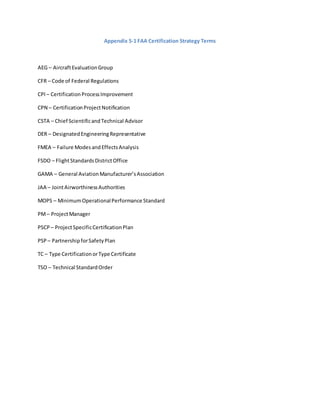
5.1. FAA CertificationStrategy
5.2. Risk MitigationStrategy
5.3. Risk Identification
5.3.1. Risk Assessment
5.3.2. Risk Response Planningand Reevaluation
6. Program Management
6.1. Modificationor NewSystem
6.2. Unique Program Circumstances
6.3. Total PlannedProduction
6.4. Program Schedule
6.4.1. Basis for Deliveryand Performance PeriodRequirements
6.4.2. Program Schedule
6.4.3. ActivitiesPlannedfor SubsequentPhases
6.4.4. Criteriato Move into the NextPhase
6.5. Life Cycle Support
6.6. Program ManagementStaffingand Organization
7. Finance
7.1. Cost Estimate
7.2. Direct and Indirect Cost Estimates
7.3. Fuel Estimates
8. Value Propositionand Marketing Strategy
8.1. CompetitionStrategy
8.2. SustainmentStrategy
8.3. Salesand Distribution
9. Socio-Economic/Ethical Impacts
10. Conclusion
Appendices
References
The Flash
1. The Flash
1.1. Description
The Flashis consideredtobe a new classof aircraft; a lightpersonal jet. The marketfor
thistype of product isexpandingandshouldyieldhighprofitsbeginninginthe thirdyearof
production. The Flashwill be marketedtosmall businesses,flight schoolsandthe government,
to name a few. Its DGEN 380 TurbofanenginesbyPrice Inductionmake thisaircraftunique in
the sense of savingthe consumerinfuel andmaintenance costsaswell asweight. The aircraft
was designedforthe purpose of Price Inductioncreatingamarketforthe sale of theirengines.
The nominal cruisingaltitude is18,000 feetPA and the aircraftis capable of carryingthree
passengersinadditiontothe pilot. Itsstate of the art avionicspackage will attractmany
customersandmake the pilot’sjobmucheasier.
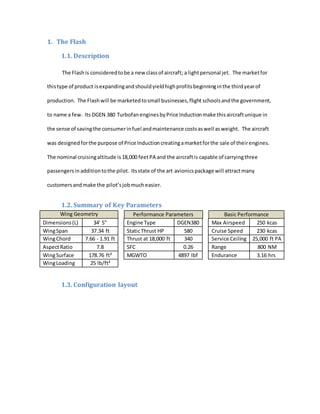
1.2. Summary of Key Parameters
Wing Geometry Performance Parameters Basic Performance
Dimensions(L) 34' 5" Engine Type DGEN380 Max Airspeed 250 kcas
WingSpan 37.34 ft StaticThrust HP 580 Cruise Speed 230 kcas
WingChord 7.66 - 1.91 ft Thrust at 18,000 ft 340 Service Ceiling 25,000 ft PA
AspectRatio 7.8 SFC 0.26 Range 800 NM
WingSurface 178.76 ft² MGWTO 4897 lbf Endurance 3.16 hrs
WingLoading 25 lb/ft²
1.3. Configuration layout
2. REQUIREMENTSANALYSIS
2.1. Requirements Summary
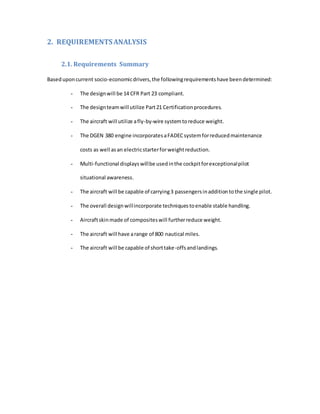
Baseduponcurrent socio-economicdrivers,the followingrequirementshave beendetermined:
- The designwill be 14 CFR Part 23 compliant.
- The designteamwill utilize Part21 Certificationprocedures.
- The aircraft will utilize afly-by-wire systemtoreduce weight.
- The DGEN 380 engine incorporatesaFADECsystemforreducedmaintenance
costs as well asan electricstarterforweightreduction.
- Multi-functional displays willbe usedinthe cockpitforexceptionalpilot
situational awareness.
- The aircraft will be capable of carrying3 passengersinadditiontothe single pilot.
- The overall designwillincorporate techniquestoenable stable handling.
- Aircraftskinmade of compositeswill furtherreduce weight.
- The aircraft will have arange of 800 nautical miles.
- The aircraft will be capable of shorttake-offsandlandings.
2.2. Mission Profile
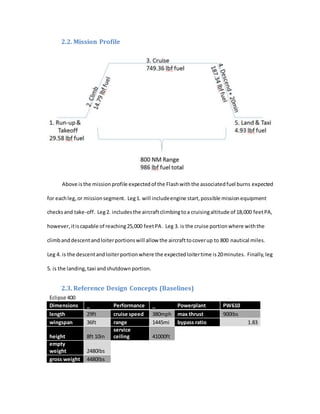
Above isthe missionprofile expectedof the Flashwiththe associatedfuel burns expected
for eachleg,or missionsegment. Leg1. will includeengine start,possible missionequipment
checksand take-off. Leg2. includesthe aircraftclimbingtoa cruisingaltitude of 18,000 feetPA,
however,itiscapable of reaching25,000 feetPA. Leg 3. is the cruise portionwhere withthe
climbanddescentandloiterportionswill allow the aircrafttocoverup to 800 nautical miles.
Leg 4. is the descentandloiterportionwhere the expectedloitertime is20minutes. Finally,leg
5. is the landing,taxi andshutdownportion.
2.3. Reference Design Concepts (Baselines)
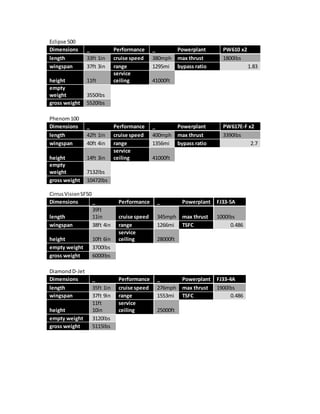
Eclipse 400
Dimensions _ Performance _ Powerplant PW610
length 29ft cruise speed 380mph max thrust 900lbs
wingspan 36ft range 1445mi bypass ratio 1.83
height 8ft 10in
service
ceiling 41000ft
empty
weight 2480lbs
gross weight 4480lbs
Eclipse 500
Dimensions _ Performance _ Powerplant PW610 x2
length 33ft 1in cruise speed 380mph max thrust 1800lbs
wingspan 37ft 3in range 1295mi bypass ratio 1.83
height 11ft
service
ceiling 41000ft
empty
weight 3550lbs
gross weight 5520lbs
Phenom100
Dimensions _ Performance _ Powerplant PW617E-F x2
length 42ft 1in cruise speed 400mph max thrust 3390lbs
wingspan 40ft 4in range 1356mi bypass ratio 2.7
height 14ft 3in
service
ceiling 41000ft
empty
weight 7132lbs
gross weight 10472lbs
CirrusVisionSF50
Dimensions _ Performance _ Powerplant FJ33-5A
length
39ft
11in cruise speed 345mph max thrust 1000lbs
wingspan 38ft 4in range 1266mi TSFC 0.486
height 10ft 6in
service
ceiling 28000ft
empty weight 3700lbs
gross weight 6000lbs
DiamondD-Jet
Dimensions _ Performance _ Powerplant FJ33-4A
length 35ft 1in cruise speed 276mph max thrust 1900lbs
wingspan 37ft 9in range 1553mi TSFC 0.486
height
11ft
10in
service
ceiling 25000ft
empty weight 3120lbs
gross weight 5115lbs
3. TECHNICALDESIGN
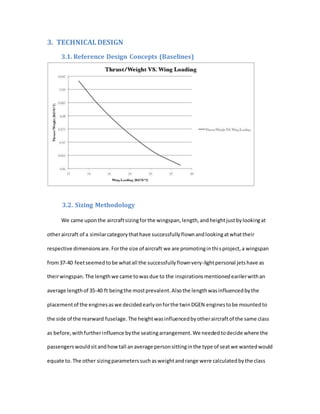
3.1. Reference Design Concepts (Baselines)
3.2. Sizing Methodology
We came uponthe aircraftsizingforthe wingspan,length,andheightjustbylookingat
otheraircraft of a similarcategorythathave successfullyflownandlookingatwhattheir
respective dimensionsare.Forthe size of aircraft we are promotinginthisproject,a wingspan
from37-40 feetseemedtobe whatall the successfullyflownvery-lightpersonal jetshave as
theirwingspan.The lengthwe came towasdue to the inspirationsmentionedearilerwithan
average lengthof 35-40 ft beingthe mostprevalent.Alsothe lengthwasinfluencedbythe
placementof the enginesaswe decidedearlyonforthe twinDGEN enginestobe mountedto
the side of the rearward fuselage.The heightwasinfluencedbyotheraircraftof the same class
as before,withfurtherinfluence bythe seatingarrangement.We neededtodecide where the
passengerswouldsitandhowtall anaverage personsittinginthe type of seatwe wantedwould
equate to.The other sizingparameterssuchasweightandrange were calculatedbythe class
individuallyandthe chosennumberstakenfromthose thatwere deemedmore accurate than
the rest.
3.2.1. Design Space
Since the aircraftwas designedaroundthe engines,we knew fromthe beginningwhatour
altitudesof operationwouldbe. Price Inductionhadalreadydeterminedthe enginestobe
operationallysounduptoan altitude of 25,000 feetPA. Consideringthe powerthe DGEN 380
produces,a lighterjetwasthe onlyviable option.
3.3. Assumptions
Major assumptionsaffectingthe design:
3.3.1. Assumptions Used for Lift-to-Drag Ratio (𝑳 𝑫⁄ )
𝐿
𝐷 𝑚𝑎𝑥
estimationconstant: 𝐾𝐿𝐷 =15.5 for civil Jets
Wettedarearatio: 𝑆 𝑤𝑒𝑡 𝑆 𝑟𝑒𝑓⁄ = 4.1
AspectRatio:AR= 7.8 for General Aviation-twinengine
3.3.2. Assumptions Used for Initial Sizing
Range:R = 800 [𝑚𝑛𝑖]
LoiterTime-Endurance:E= 20 [𝑚𝑖𝑛]
Cruise SpeedatFL180: 𝑀𝑐𝑟𝑢𝑖 𝑠 𝑒 = 𝑉𝑐𝑟𝑢𝑖𝑠𝑒 = 0.35 Mach
Constantinemptyweightfractionequation:A=1.51 for General aviation-twin engine
Constantinemptyweightfractionequation:C= -0.10 forGeneral aviation-twinengine
Variable sweptconstant: 𝐾𝑉𝑆 =1.00 forfixedsweep
3.3.3. Assumptions Used for Thrust-to-Weight Ratio (𝑻 𝑾⁄ )
Maximumspeed: 𝑀 𝑚𝑎𝑥 = 1.2 𝑀𝑐𝑟𝑢𝑖𝑠𝑒
ConstantinT/W statistical estimationequation:a=0.267 forJet Transport
Constantin T/W statistical estimationequation:C=0.363 forJet Transport
3.3.4. Assumptions Used for Wing Loading (𝑾 𝑺⁄ )
Take off distance: 𝑆 𝑡 𝑜⁄ = 2500 [𝑓𝑡]
Take off Parameter: TOP = 120
ApproachSpeed: 𝑉𝐴𝑃𝐻 = 120 [𝑓𝑡]
OswaldEfficiency:e = 0.8
Zero-Left-Dragcoefficient: 𝐶 𝐷0
= 0.015 for Jets
3.3.5. Assumptions Used for Wing, Tail, and Fuselage Geometry
Taper Ratioof wing: 𝜆 𝑤 = 0.25
ConstantinFuselage lengthequation:a= 0.67 for Jettransport
ConstantinFuselage lengthequation:c= 0.43 for Jettransport
Taper Ratioof tails: 𝜆ℎ= 𝜆 𝑣= 𝜆 𝑤 = 0.25
Aspectratioof horizontal tail: 𝐴𝑅ℎ =2 3⁄ 𝐴𝑅
Aspectratioof vertical tail: 𝐴𝑅 𝑣 = 1.5
Horizontal tail volume coefficient: 𝑐 𝐻𝑇 =0.90 fortwinturboprop
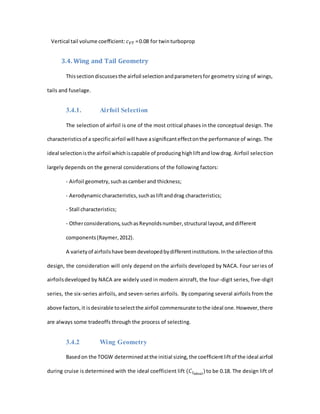
Vertical tail volume coefficient: 𝑐 𝑉𝑇 =0.08 for twinturboprop
3.4. Wing and Tail Geometry
Thissectiondiscussesthe airfoil selectionandparametersfor geometry sizing of wings,
tails and fuselage.
3.4.1. Airfoil Selection
The selection of airfoil is one of the most critical phases in the conceptual design. The
characteristicsof a specificairfoil will have asignificanteffectonthe performance of wings. The
ideal selectionisthe airfoil whichiscapable of producinghighliftandlow drag. Airfoil selection
largely depends on the general considerations of the following factors:
- Airfoil geometry,suchascamberand thickness;
- Aerodynamiccharacteristics,suchasliftanddrag characteristics;
- Stall characteristics;
- Otherconsiderations,suchasReynoldsnumber,structural layout,anddifferent
components(Raymer,2012).
A varietyof airfoilshave beendevelopedbydifferentinstitutions.Inthe selectionof this
design, the consideration will only depend on the airfoils developed by NACA. Four series of
airfoilsdeveloped by NACA are widely used in modern aircraft, the four-digit series, five-digit
series, the six-series airfoils, and seven-series airfoils. By comparing several airfoils from the
above factors,it isdesirable toselectthe airfoil commensurate tothe ideal one.However,there
are always some tradeoffs through the process of selecting.
3.4.2 Wing Geometry
Basedon the TOGW determinedatthe initial sizing,the coefficientliftof the ideal airfoil
during cruise is determined with the ideal coefficient lift (𝐶𝑙 𝑖𝑑𝑒𝑎𝑙
)to be 0.18. The design lift of
coefficientis1.11 whichisthe liftcoefficient( 𝐶𝑙 𝑐𝑟𝑢𝑖𝑠𝑒
) associated to the (𝐿 𝐷) 𝑚𝑎𝑥⁄ . In addition,
other considerations should be included in the selection of tip airfoil. The report Summary of
Airfoil Datapublishedbythe National AdvisoryCommittee forAeronautic (1945) states that it is
desirable for tip selection to have a high maximum lift coefficient ( 𝐶𝑙 𝑚𝑎𝑥
) and a large Critical
angle of attack (∝ 𝑠𝑡𝑎𝑙𝑙) in orderto increase the stall performance (NACA,1945).Asfor thickness,
the thicker the airfoil is, the more lift the airfoil will produce. Consequently, selecting the
thickest airfoil is advantageous.
Takingall above requirementsintoconsideration,the criteriain response to the pivotal
factors for airfoil selections are listed below:
1. Maximumliftcoefficient(𝐶𝑙 𝑚𝑎𝑥
) isthe highest.
2. Critical angle of attack (∝ 𝑠𝑡𝑎𝑙𝑙) isthe highest.
3. Coefficientof pitchingmoment(𝐶 𝑚) isclose to0
4. Maximumlift-to-dragratio(𝐶𝑙 𝐶 𝑑⁄ 𝑚𝑎𝑥) at cruise isclose to (𝐿 𝐷) 𝑚𝑎𝑥⁄
5. Liftcoefficient(𝐶𝑙) of maximumlift-to-dragratio(𝐶𝑙 𝐶 𝑑 𝑚𝑎𝑥⁄ ) atcruise isclose to 𝐶𝑙 𝑖𝑑𝑒𝑎𝑙
6. MinimumDrag coefficient(𝐶 𝑑 𝑚𝑖𝑛
) isthe lowest
7. Liftcoefficient(𝐶𝑙) of minimumdragcoefficient(𝐶 𝑑 𝑚𝑖𝑛
) atcruise isclose to 𝐶𝑙 𝑐𝑟𝑢𝑖𝑠𝑒
8. Thicknessratio(𝑡 𝑐⁄ ) ishighest
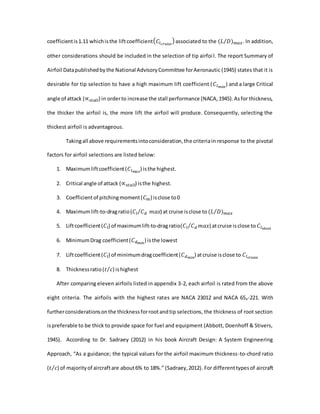
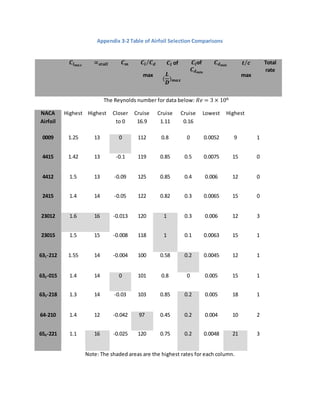
After comparing eleven airfoils listed in appendix 3-2, each airfoil is rated from the above
eight criteria. The airfoils with the highest rates are NACA 23012 and NACA 654-221. With
furtherconsiderationsonthe thicknessforrootandtip selections, the thickness of root section
ispreferable to be thick to provide space for fuel and equipment (Abbott, Doenhoff & Stivers,
1945). According to Dr. Sadraey (2012) in his book Aircraft Design: A System Engineering
Approach, “As a guidance; the typical values for the airfoil maximum thickness-to-chord ratio
(𝑡 𝑐⁄ ) of majorityof aircraftare about6% to 18%.” (Sadraey,2012). For differenttypesof aircraft
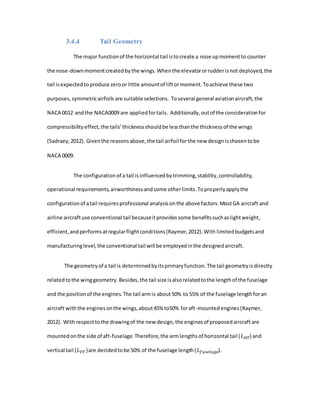
in regard to speed, the maximum 𝑡 𝑐⁄ is between 9% to 12% for a high subsonic passenger
aircraft, and 15% to 18% for a low speed, high lift requiring aircraft (Sadraey, 2012). Therefore,
to optimize the airfoil to promote the performance of the designed aircraft, the airfoil NACA
23012 isselectedforthe tipsof the wings with NACA 23015 for the roots. With the selection of
those two airfoil, the maximum coefficient of lift for wings ( 𝐶 𝐿 𝑚𝑎𝑥
) is determined to be 1.55.
In addition to airfoil selection, there are other key factors regarding the aircraft
wings. Wing location, wing area, wingspan, and sweep angle have major effects on overall
aircraft performance.
For thisaircraft,a lowwinghasbeenselected.Whilebothhigh wing and low wing have
benefits, low wing is usually preferred for training purposes, and is also commonly found on
mostjetaircraft. Lowwingofferseasieraccesstofueling. Low wing also allows easier access to
the enginesformaintenance purposes,andallowsthe student to easier be able to monitor the
engine duringflight.The easieraccessengines also help reduce maintenance costs in the long-
run, withshorterinspectiontimes.Low wingalsooffersbettervisibilityduringturningandother
aerial maneuvers.Stowing landinggearsispossible forbothhighwingandlow wingaircraft, but
is much easier in low wing aircraft, as the structure is much more available to the gear.
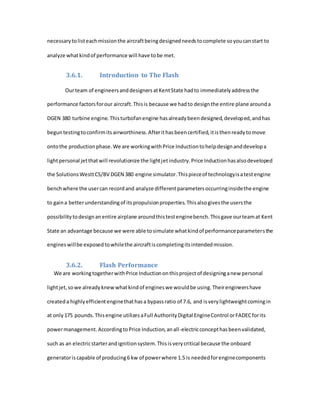
To determine the total wingarearequired,itisnecessarytouse the following equation
(E.q.3.5.2-1). The calculated weight used in the equation is 4,897 pounds. The wing loading
calculation used is 27.3938. The resulting wing planform area comes out to be 178.76 square
feet.
𝑆 = 𝑊 / (𝑊 𝑆)⁄ ------------------------------E.q.3.5.2-1
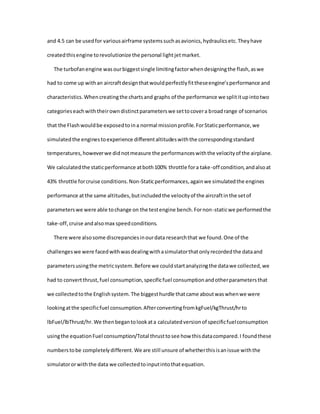
A total wingspan of 37.34 feet has been calculated. In order to calculate wingspan, the
aspectratio isassumedas7.8 for thiscalculation.The formula(E.q.3.5.2-2) explainedisshownas
follows.
𝑏 = √ 𝐴 ∗ 𝑆 --------------------------------------3.5.2-1
Sweep angle is another important parameter regarding wing design. Changing the
sweepangle hasmanyeffects on performance, such as stability due to shifting the MAC of the
wing, or helping to avoid the onset of shock waves. From historical statistics (Raymer, 2012), a
sweep angle of approximately 2.0 degrees would be sufficient for the given aircraft.
3.4.3 Fuselage Geometry
The layoutof a fuselage isgenerallydependentonthe TOGW and the functionof the
aircraft.The primaryfunctionof the designedaircraftistocarry passengers.Giventhe number
of passengersandcrews,the lengthanddiameterof the fuselage will eventuallybe determined.
However,since the proposedaircraftisalsodesignedtoundertake someothertasksmore than
carryingpassengers,otherconsiderationsshouldalsobe takenintoaccount.Fromthe historical
statistics,the followingequation(Eq.3.5.3-1) will be usedtodetermine the lengthof the
fuselage:
𝐿 𝑓𝑢𝑠𝑒𝑙𝑎𝑔𝑒 = 𝑎𝑊0
𝐶
---------------------------------------Eq.3.5.3-1
The TOGW has been determined. Based on the major assumptions made in section 3.4.5,
the length of the fuselage is calculated to be 25.87 [𝑓𝑡]. The maximum fuselage diameter is
determined by the ratio between fuselage length and maximum fuselage diameter, which is
referredasfinenessratio.Tominimize the drag produced by the fuselage, the fineness ratio is
around 3 (Raymer, 2012). As a result, the maximum diameter of the fuselage is set to be 8.62
[𝑓𝑡].
3.4.4 Tail Geometry
The major functionof the horizontal tail istocreate a nose upmomentto counter
the nose-downmomentcreatedbythe wings.Whenthe elevatororrudderisnot deployed,the
tail isexpectedtoproduce zeroor little amountof liftormoment.Toachieve these two
purposes,symmetricairfoils are suitable selections. Toseveral general aviationaircraft,the
NACA 0012 andthe NACA0009 are appliedfortails. Additionally,outof the considerationfor
compressibilityeffect,the tails’thicknessshouldbe lessthanthe thicknessof the wings
(Sadraey,2012). Giventhe reasonsabove,the tail airfoil forthe new designischosentobe
NACA 0009.
The configurationof a tail isinfluencedbytrimming,stability,controllability,
operational requirements,airworthinessandsome otherlimits.Toproperlyapplythe
configurationof atail requiresprofessional analysisonthe above factors.MostGA aircraft and
airline aircraftuse conventional tail becauseitprovidessome benefitssuchaslightweight,
efficient,andperformsatregularflightconditions(Raymer,2012).With limitedbudgetsand
manufacturinglevel,the conventional tail will be employedinthe designedaircraft.
The geometryof a tail is determinedbyitsprimaryfunction.The tail geometryisdirectly
relatedtothe winggeometry. Besides,the tail size isalsorelatedtothe lengthof the fuselage
and the positionof the engines.The tail armis about50% to 55% of the fuselage lengthforan
aircraft withthe enginesonthe wings,about45% to50% foraft-mountedengines(Raymer,
2012). With respecttothe drawingof the new design,the enginesof proposedaircraftare
mountedonthe side of aft-fuselage.Therefore,the armlengthsof horizontal tail (𝐿 𝐻𝑇) and
vertical tail (𝐿 𝑉𝑇)are decidedtobe 50% of the fuselage length(𝐿 𝑓𝑢𝑠𝑒𝑙𝑎𝑔𝑒).
The methodof calculatingthe parametersof tailsispertainingtothe definitionof tail
volume coefficient.The followingtwoequations,Eq.3.5.4-1and Eq. 3.5.4-2 define the horizontal
tail volume coefficientandthe vertical tail volumecoefficientrespectively:
𝑐 𝐻𝑇 =
𝐿 𝐻𝑇 𝑆 𝐻𝑇
𝐶 𝑊 𝑆 𝑊
----------------------------------Eq.3.5.4-1
𝑐 𝑉𝑇 =
𝐿 𝑉𝑇 𝑆 𝑉𝑇
𝑏 𝑊 𝑆 𝑊
-----------------------------------Eq.3.5.4-2
Withthe resultsof winggeometrycalculationsandassumptionsmade insection
3.4.5, the area of the horizontal tail is59.55 [𝑓𝑡2] and the area of the vertical tail is41.30 [𝑓𝑡2].
The methodto calculate the othertail parameters,suchasroot chord, tipchord,span, lengthof
the MAC, and locationof the AC isthe same as the methodusedforwinggeometrycalculation.
Those parameterswill be listedundersection3.11.3.
3.5. Thrust-to-Weight Ratio
The wingswere primarilydesignedtosupportstabile handlingandlongendurance applications.
The thrust to weightratioiscalculatedtobe 25 lb/ft².
3.6. Introduction to Powerplant Data
Performance isone of the mostsoughtafterfactors whendevelopinganew aircraft.It does
not matterwhatkindof aircraft:helicopter,airplane,military,transport,orcargo.You will
alwaysrelyonthe performance of the aircraftto complete the taskat hand.The
mission/objective couldbe takingpassengersfromChicagotoNew York,or a Militaryjointstrike
fighterneedingtotake off froma carrier to dropa payloadovera conflictzone inanother
country.Each missionhasitsown setof establishedperformanceparametersthatthe aircraft
needstomeetinorderto successfullycompletethe objective.Wheninthe designphase,itis
necessarytolisteachmissionthe aircraftbeingdesignedneedstocomplete soyoucanstart to
analyze whatkindof performance will have tobe met.
3.6.1. Introduction to The Flash
Ourteam of engineersanddesignersatKentState hadto immediatelyaddressthe
performance factorsforour aircraft.Thisis because we hadto designthe entire plane arounda
DGEN 380 turbine engine.Thisturbofanengine hasalreadybeendesigned,developed,andhas
beguntestingtoconfirmitsairworthiness.Afterithasbeencertified,itisthenreadytomove
ontothe productionphase.We are workingwithPrice Inductiontohelpdesignanddevelopa
lightpersonal jetthatwill revolutionize the lightjetindustry.Price Inductionhasalsodeveloped
the SolutionsWesttCS/BV DGEN 380 engine simulator.Thispieceof technologyisatestengine
benchwhere the usercan recordand analyze differentparametersoccurringinsidethe engine
to gaina betterunderstandingof itspropulsionproperties.Thisalsogivesthe usersthe
possibilitytodesignanentire airplane aroundthistestenginebench.Thisgave ourteamat Kent
State an advantage because we were able tosimulate whatkindof performanceparametersthe
engineswillbe exposedtowhilethe aircraftiscompletingitsintendedmission.
3.6.2. Flash Performance
We are workingtogetherwithPrice Inductiononthisprojectof designinganew personal
lightjet,sowe alreadyknewwhatkindof engineswe wouldbe using.Theirengineershave
createda highlyefficientenginethathasa bypassratio of 7.6, and isverylightweightcomingin
at only175 pounds.Thisengine utilizesaFull AuthorityDigital EngineControl orFADECforits
powermanagement.AccordingtoPrice Induction,anall-electricconcepthasbeenvalidated,
such as an electricstarterandignitionsystem.Thisisverycritical because the onboard
generatoriscapable of producing6 kw of powerwhere 1.5 is neededforenginecomponents
and 4.5 can be usedfor variousairframe systemssuchasavionics,hydraulicsetc.Theyhave
createdthisengine torevolutionize the personal lightjetmarket.
The turbofanengine wasourbiggestsingle limitingfactorwhendesigningthe flash,aswe
had to come up withan aircraftdesignthatwouldperfectlyfittheseengine’sperformance and
characteristics.Whencreatingthe chartsand graphs of the performance we splititupintotwo
categorieseachwiththeirowndistinctparameterswe settocovera broadrange of scenarios
that the Flashwouldbe exposedtoina normal missionprofile.ForStaticperformance,we
simulatedthe enginestoexperience differentaltitudeswiththe correspondingstandard
temperatures,howeverwe didnotmeasure the performanceswiththe velocityof the airplane.
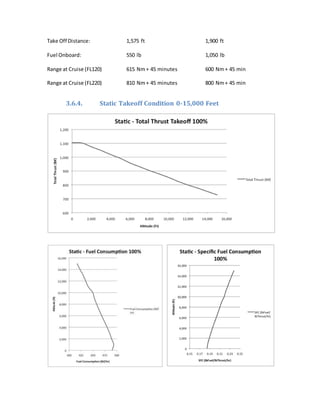
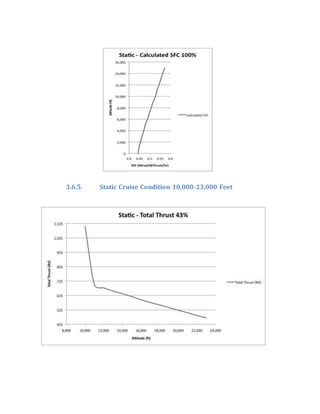
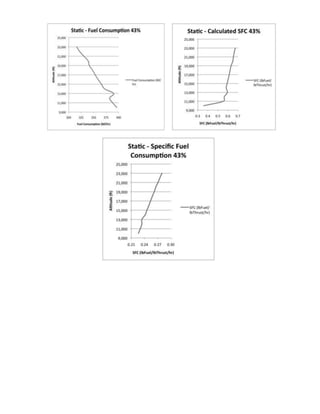
We calculatedthe staticperformance atboth100% throttle fora take-off condition,andalsoat
43% throttle forcruise conditions.Non-Staticperformances,againwe simulatedthe engines
performance atthe same altitudes,butincludedthe velocityof the aircraftinthe setof
parameterswe were able tochange on the testengine bench.Fornon-staticwe performedthe
take-off,cruise andalsomax speedconditions.
There were alsosome discrepanciesinourdata researchthat we found.One of the
challengeswe were facedwithwasdealingwithasimulatorthatonlyrecordedthe dataand
parametersusingthe metricsystem.Before we couldstartanalyzingthe datawe collected,we
had to convertthrust,fuel consumption,specificfuel consumptionandotherparametersthat
we collectedtothe Englishsystem.The biggesthurdle thatcame aboutwaswhenwe were
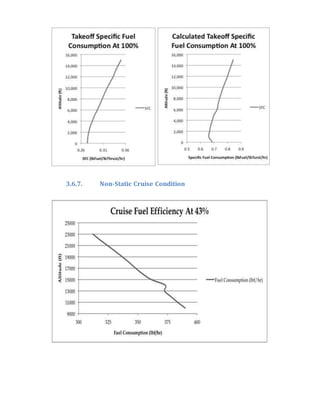
lookingatthe specificfuel consumption.AfterconvertingfromkgFuel/kgThrust/hrto
lbFuel/lbThrust/hr.We thenbegantolookata calculatedversionof specificfuelconsumption
usingthe equationFuel consumption/Total thrusttosee how thisdatacompared.I foundthese
numberstobe completelydifferent.We are still unsure of whetherthisisanissue withthe
simulatororwiththe data we collectedtoinputintothatequation.
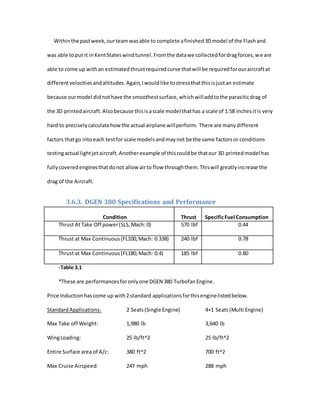
Withinthe pastweek,ourteamwasable to complete afinished3Dmodel of the Flashand
was able toput it inKentStateswindtunnel.Fromthe datawe collectedfordragforces,we are
able to come up withan estimatedthrustrequiredcurve thatwill be requiredforouraircraftat
differentvelocitiesandaltitudes.Again,Iwouldlike tostressthatthisisjustan estimate
because ourmodel didnothave the smoothestsurface,whichwilladdtothe parasiticdrag of
the 3D printedaircraft.Alsobecause thisisascale model thathas a scale of 1:58 inchesitis very
hard to preciselycalculatehowthe actual airplane willperform. There are manydifferent
factors thatgo intoeach testfor scale modelsandmaynot be the same factorsor conditions
testingactual lightjetaircraft.Anotherexample of thiscouldbe thatour 3D printedmodel has
fullycoveredenginesthatdonot allow airto flow throughthem.Thiswill greatlyincrease the
drag of the Aircraft.
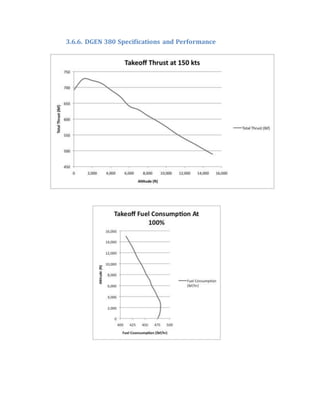
3.6.3. DGEN 380 Specifications and Performance
Condition Thrust SpecificFuel Consumption
Thrust AtTake Off power(SLS,Mach: 0) 570 lbf 0.44
Thrust at Max Continuous(FL100,Mach: 0.338) 240 lbf 0.78
Thrust at Max Continuous(FL180,Mach: 0.4) 185 lbf 0.80
-Table 3.1
*These are performancesforonlyone DGEN 380 TurbofanEngine.
Price Inductionhascome up with2 standard applicationsforthisenginelistedbelow.
StandardApplications: 2 Seats(Single Engine) 4+1 Seats(Multi Engine)
Max Take off Weight: 1,980 lb 3,640 lb
WingLoading: 25 lb/ft^2 25 lb/ft^2
Entire Surface area of A/c: 380 ft^2 700 ft^2
Max Cruise Airspeed: 247 mph 288 mph
Take Off Distance: 1,575 ft 1,900 ft
Fuel Onboard: 550 lb 1,050 lb
Range at Cruise (FL120) 615 Nm+ 45 minutes 600 Nm+ 45 min
Range at Cruise (FL220) 810 Nm+ 45 minutes 800 Nm+ 45 min
3.6.4. Static Takeoff Condition 0-15,000 Feet
3.6.5. Static Cruise Condition 10,000-23,000 Feet
3.6.6. DGEN 380 Specifications and Performance
3.6.7. Non-Static Cruise Condition
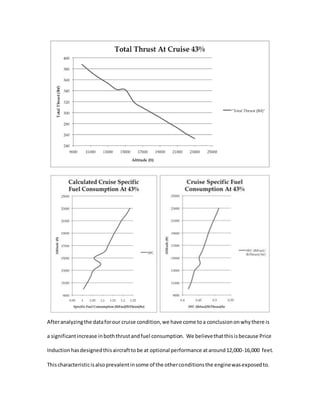
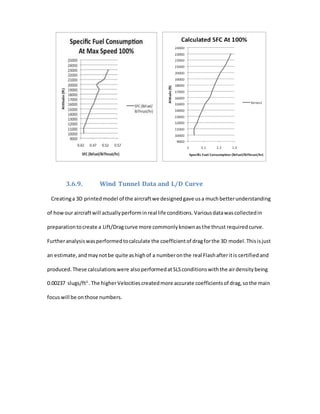
Afteranalyzingthe dataforour cruise condition,we have come toa conclusiononwhythere is
a significantincrease inboththrustandfuel consumption. We believethatthisisbecause Price
Inductionhasdesignedthisaircrafttobe at optional performance ataround12,000-16,000 feet.
Thischaracteristicisalsoprevalentinsome of the otherconditionsthe enginewasexposedto.
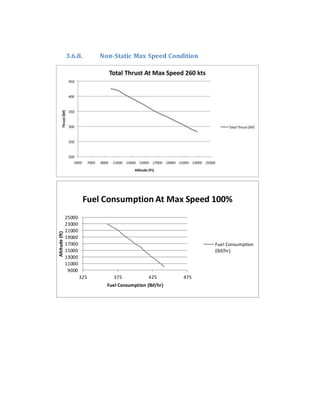
3.6.8. Non-Static Max Speed Condition
9000
11000
13000
15000
17000
19000
21000
23000
25000
325 375 425 475
Altitude(ft)
Fuel Consumption (lbf/hr)
Fuel Consumption At Max Speed 100%
Fuel Consumption
(lbf/hr)
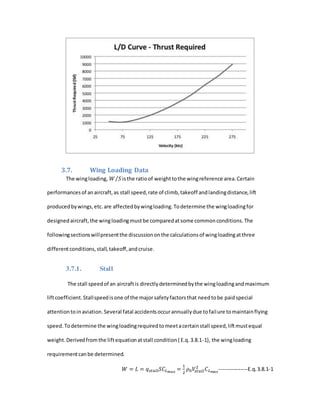
3.6.9. Wind Tunnel Data and L/D Curve
Creatinga 3D printedmodel of the aircraftwe designedgave usa muchbetterunderstanding
of howour aircraftwill actuallyperforminreal life conditions.Variousdatawascollectedin
preparationtocreate a Lift/Dragcurve more commonlyknownasthe thrust requiredcurve.
Furtheranalysiswasperformedtocalculate the coefficientof dragforthe 3D model.Thisisjust
an estimate,andmaynotbe quite ashighof a numberonthe real Flashafteritis certifiedand
produced.These calculationswere alsoperformedatSLSconditionswiththe airdensitybeing
0.00237 slugs/ft3
.The higherVelocitiescreatedmore accurate coefficientsof drag,sothe main
focuswill be onthose numbers.
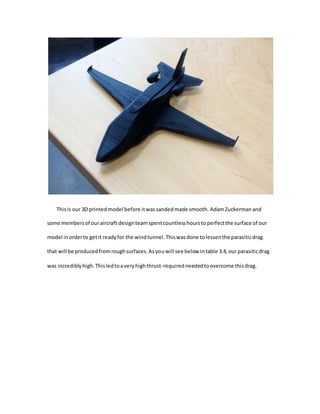
Thisis our 3D printedmodel before itwassandedmade smooth. AdamZuckermanand
some membersof ouraircraft designteamspentcountlesshourstoperfectthe surface of our
model inorderto getit readyfor the windtunnel.Thiswasdone tolessenthe parasiticdrag
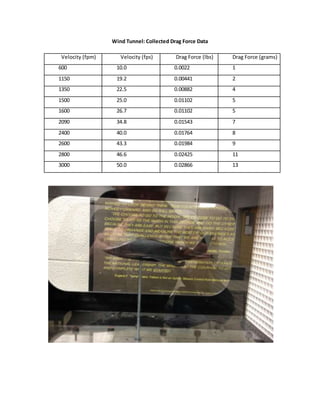
that will be producedfromroughsurfaces.Asyouwill see below intable 3.4,our parasiticdrag
was incrediblyhigh.Thisledtoaveryhighthrust-requiredneededtoovercome thisdrag.
Wind Tunnel: Collected Drag Force Data
Velocity (fpm) Velocity (fps) Drag Force (lbs) Drag Force (grams)
600 10.0 0.0022 1
1150 19.2 0.00441 2
1350 22.5 0.00882 4
1500 25.0 0.01102 5
1600 26.7 0.01102 5
2090 34.8 0.01543 7
2400 40.0 0.01764 8
2600 43.3 0.01984 9
2800 46.6 0.02425 11
3000 50.0 0.02866 13
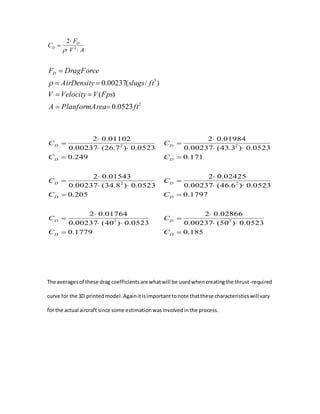

FD  DragForce
  AirDensity  0.00237(slugs/ ft3
)
V  Velocity  V(Fps)
A  PlanformArea 0.0523ft2

CD 
2 0.01102
0.00237 (26.72
) 0.0523
CD  0.249
CD 
2 0.01543
0.00237 (34.82
) 0.0523
CD  0.205
CD 
2 0.01764
0.00237 (402
) 0.0523
CD  0.1779
CD 
2 0.01984
0.00237 (43.32
) 0.0523
CD  0.171
CD 
2 0.02425
0.00237 (46.62
) 0.0523
CD  0.1797
CD 
2 0.02866
0.00237 (502
) 0.0523
CD  0.185
The averagesof these drag coefficientsare whatwill be usedwhencreatingthe thrust-required
curve for the 3D printedmodel.Againitisimportanttonote thatthese characteristicswill vary
for the actual aircraft since some estimationwasinvolvedinthe process.

CD 
2 FD
 V 2
 A

CDA

0.249  0.205  0.1779  0.171  0.1797  0.185
6
CDA
 0.1946
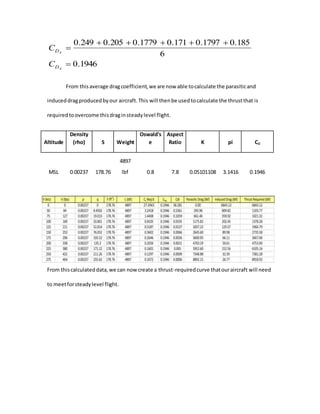
From thisaverage dragcoefficient,we are now able tocalculate the parasiticand
induceddragproducedbyour aircraft.This will thenbe usedtocalculate the thrustthat is
requiredtoovercome thisdraginsteadylevel flight.
Altitude
Density
(rho) S Weight
Oswald's
e
Aspect
Ratio K pi CD
MSL 0.00237 178.76
4897
lbf 0.8 7.8 0.05101108 3.1416 0.1946
From thiscalculateddata,we can now create a thrust-requiredcurve thatouraircraft will need
to meetforsteadylevel flight.
3.7. Wing Loading Data
The wingloading, 𝑊 𝑆⁄ isthe ratioof weighttothe wingreference area.Certain
performancesof anaircraft,as stall speed,rate of climb,takeoff andlandingdistance,lift
producedbywings,etc.are affectedbywingloading.Todetermine the wingloadingfor
designedaircraft,the wingloadingmustbe comparedatsome commonconditions.The
followingsectionswillpresentthe discussiononthe calculationsof wingloadingatthree
differentconditions,stall,takeoff,andcruise.
3.7.1. Stall
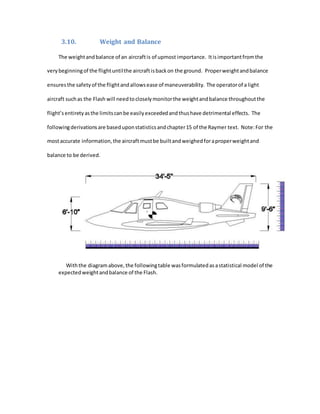
The stall speedof an aircraftis directlydeterminedbythe wingloadingandmaximum
liftcoefficient.Stallspeedisone of the majorsafetyfactorsthat needtobe paidspecial
attentiontoinaviation.Several fatal accidentsoccurannuallydue tofailure tomaintainflying
speed.Todetermine the wingloadingrequiredtomeetacertainstall speed,liftmustequal
weight.Derivedfromthe liftequationatstall condition( E.q.3.8.1-1), the wingloading
requirementcanbe determined.
𝑊 = 𝐿 = 𝑞 𝑠𝑡𝑎𝑙𝑙 𝑆𝐶𝐿 𝑚𝑎𝑥
=
1
2
𝜌0 𝑉𝑠𝑡𝑎𝑙𝑙
2
𝐶 𝐿 𝑚𝑎𝑥
----------------E.q.3.8.1-1
The formulafor wingloadingrequirementforstall givesaresultof 44.79 [𝑙𝑏𝑓 𝑓𝑡2]⁄ . This
calculationisalsodone with 𝐶 𝐿 𝑚𝑎𝑥
of 1.55, a stall velocityof 155.83 fps,and air densityof
0.0024[𝑠𝑙𝑢𝑔 𝑓𝑡3]⁄ at sea level standard(SLS).
3.7.2. Takeoff
To determine the requiredwingloadingtomeetagiventakeoff distance requirement,
the followingexpression(E.q.3.8.2-1) isused.Inthiscalculation,the assumedtakeoff distance is
2,500 feet.The takeoff parameter(TOP) canbe foundfromfig5.4 inthe Raymertext,Aircraft
Design:A Conceptual Approach(Raymer,2012).
𝑊 𝑆⁄ = (𝑇𝑂𝑃)𝜎𝐶 𝐿 𝑇/𝑂
(𝑇 𝑊⁄ ) 𝑇/𝑂 --------------------E.q.3.8.2-1
The wingloadingrequirementfortakeoff comesouttobe 29.96[𝑙𝑏𝑓 𝑓𝑡2]⁄ . The calculated
𝐶 𝐿 𝑇/𝑂
is 1.281. Othervariablesusedinthe equationare the TOPwhichisassumedtobe 120,
densityratioof 1, and (𝑇 𝑊⁄ ) 𝑇/𝑂 of 0.1949.
3.7.3. Cruise
Determiningawingloadingforcruise is utmostimportant.The cruise conditionis
typicallythe mostdesignedaroundfactoronan aircraft. Choosingawingloadingfactorthat
directlysuitsthe cruise conditionforamaximumrange isproblematic.The wingloadingfactor
for a maximumrange ismuchhigherthan the wingloadingfactorrequiredforstall andother
characteristics.Itwouldbe unsafe toflywithsucha small wing,hence where understandingthe
importance of trade-offscomesintoplay.Tocalculate the wingloadingformaximumrange, the
followingequation(E.q.3.8.3-1) istobe used.
𝑊 𝑆⁄ = 𝑞 √ 𝜋𝐴𝑒𝐶 𝐷0
/3---------------------------E.q.3.8.3-1
The dynamicpressat the cruise conditionisdeterminebythe airdensityatcruise
altitude (FLl80) andthe cruise speed.Forjetaircraft, the Oswaldefficiency(e) andthe zero-lift
drag coefficient(𝐶 𝐷0
) are statisticallyassumedtobe 0.8 and 0.015 respectively.Aftertakingall
the variantsintothe above formula,the wingloadingatthe cruise conditioniscalculatedtobe
27.39[𝑙𝑏𝑓 𝑓𝑡2]⁄ .
3.7.4. Discussionof the Wing Loading
To determine the endwingloadingrequirement,all differentflightoperationsmustbe
considered,suchasstall,landing,takeoff,andcruise.Topickthe exactwingloadingthatwill be
usedforthe design process,the lowestcalculatedfromall of the flightconditionsistobe used.
Afterthe comparingthe resultsof the above calculation,the requiredwingloadingis
27.39[𝑙𝑏𝑓 𝑓𝑡2]⁄ . Selectingthe lowestwingloadingimpliesthatthe aircrafthas enoughliftbeing
producedbythe wing,for the givenweight.
3.8. Sizing Results and Design Selection
3.8.1. Sizing Variability and Optimization
Varythe wingloadingbyplus/minus20% andthe aspectratioby plus/minus20% to
determine the optimumcombinationusingthe carpetplotmethodof Chap.19.
3.9. Sizes and Capacities
3.9.1. Fuselage
Fuselage Length:25.86 [𝑓𝑡]
Fuselage maximumdiameter:8.62[𝑓𝑡]
3.9.2. Wing
Wingspan:37.34 [𝑓𝑡] Root chord:7.66 [𝑓𝑡]
Surface area: 178.76 [𝑓𝑡2] Root chordthicknessratio:15%
Wettedarea:732.92 [𝑓𝑡2] Tip chord:1.91 [𝑓𝑡]
Taper ratio:0.25 Tip chordthicknessratio:12%
LE Sweepangle:2[degree] MAC length:5.36 [𝑓𝑡]
Aspectratio:7.8 MAC location:7.47 [𝑓𝑡]
3.9.3. Tail
- Horizontal Tail
Root chord:5.41[𝑓𝑡] Aspectratio:5.2
Tip chord:1.35 [𝑓𝑡] Arm length:12.93 [𝑓𝑡]
Span:17.60 [𝑓𝑡] Taper Ratio:2.5
Area:59.55 [𝑓𝑡2]
- Vertical Tail
Root chord:8.39 [𝑓𝑡] Area:41.29 [𝑓𝑡2]
Tip chord:2.10 [𝑓𝑡] Aspectratio:1.5
Span:7.87 [𝑓𝑡] Arm length:12.93 [𝑓𝑡]
Taper ratio0.25
3.9.4. Landing Gear
The landinggearare designedtohave atotal addedheightof 16 inchesto the aircraft.
Witha tricycle type gearconfiguration,eachstrutwill have asingle Type III(low pressure)
wheel. More detail willbe giveninalaterdiscussion.
3.9.5. Fuel
The fuel systemiscapable of holding986 lbf of Jet-A fuel or147 gallons. More detail will
be givenina laterdiscussion.
3.9.6. Power Plant
The FlashfeaturestwoDGEN 380 enginesmountedaftof the wings. Each engine weighs
175 lbf andis 4 feet,5 inchesinlength. More detail will be giveninalaterdiscussion.
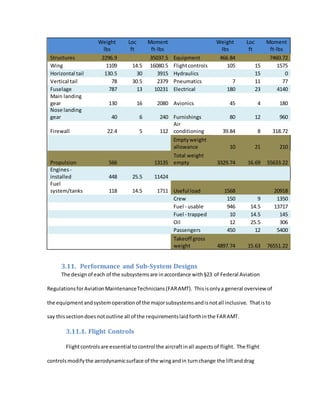
3.10. Weight and Balance
The weightandbalance of an aircraftis of upmost importance. Itisimportantfromthe
verybeginningof the flightuntilthe aircraftisbackon the ground. Properweightandbalance
ensuresthe safetyof the flightandallowsease of maneuverability. The operatorof a light
aircraft suchas the Flash will needtocloselymonitorthe weightandbalance throughoutthe
flight’sentiretyasthe limitscanbe easilyexceededandthushave detrimental effects. The
followingderivationsare baseduponstatisticsandchapter15 of the Raymer text. Note:For the
mostaccurate information,the aircraftmustbe builtandweighedforaproperweightand
balance to be derived.
Withthe diagramabove,the followingtable wasformulatedasastatistical model of the
expectedweightandbalance of the Flash.
Weight
lbs
Loc
ft
Moment
ft-lbs
Weight
lbs
Loc
ft
Moment
ft-lbs
Structures 2296.9 35037.5 Equipment 466.84 7460.72
Wing 1109 14.5 16080.5 Flightcontrols 105 15 1575
Horizontal tail 130.5 30 3915 Hydraulics 15 0
Vertical tail 78 30.5 2379 Pneumatics 7 11 77
Fuselage 787 13 10231 Electrical 180 23 4140
Main landing
gear 130 16 2080 Avionics 45 4 180
Nose landing
gear 40 6 240 Furnishings 80 12 960
Firewall 22.4 5 112
Air
conditioning 39.84 8 318.72
Emptyweight
allowance 10 21 210
Propulsion 566 13135
Total weight
empty 3329.74 16.69 55633.22
Engines -
installed 448 25.5 11424
Fuel
system/tanks 118 14.5 1711 Useful load 1568 20918
Crew 150 9 1350
Fuel - usable 946 14.5 13717
Fuel - trapped 10 14.5 145
Oil 12 25.5 306
Passengers 450 12 5400
Takeoff gross
weight 4897.74 15.63 76551.22
3.11. Performance and Sub-System Designs
The designof each of the subsystemsare inaccordance with§23 of Federal Aviation
RegulationsforAviationMaintenanceTechnicians(FARAMT). Thisisonlya general overviewof
the equipmentandsystemoperationof the majorsubsystemsandisnotall inclusive. Thatisto
say thissectiondoesnotoutline all of the requirementslaidforthinthe FARAMT.
3.11.1. Flight Controls
Flightcontrolsare essential tocontrol the aircraftinall aspectsof flight. The flight
controlsmodifythe aerodynamicsurface of the wingandin turnchange the liftanddrag
producedby the surface it affects. The resultrotatesthe aircraftaround one of three,or a
combinationof the three,axestochange the flightpathof the aircraft. The three axesand the
correspondingflightcontrolsare the lateral axis,longitudinalaxisandvertical axis
correspondingtothe pitch,roll andyaw controlsrespectively. Pitchcontrol utilizesthe
horizontal stabilizer(horizontal tail surface),roll control utilizesthe ailerons(controlsurface
hingedonthe trailingedge of the wings),andyaw control utilizesthe vertical stabilizer(vertical
control surface attachedto the trailingedge of the vertical tail).
The Flashwill feature the mostcurrentandpilotfriendlycontrol surfacesthatwill create
the ease and comfortof flight. The Flash will be usingdifferentialpressureailerons,where one
ailerongoesupthanthe otheraileronwill deflectdown. Thiswillcreate amore significant
change in liftanddrag and a strongerroll overthe longitudinalaxis. The aileronswillalsobe
slotted,inordertoadd additional energytothe boundarylayer. Atthe trailingedge of the
aileronswill be trimtabs,alsocontrolledbythe commandof the pilotinthe cockpit. These are
small movable portionsof the control surface thatalterthe camber of the wingsothat the
change in the deflectionwill holdthe aircraftinanaerodynamicforce. There will be balance
tabs locatedonthe same control surface asthe trimtabs; the ailerons. Thistabaidsin the
movementof thissurface. The flapswill be afowlerflap. The fowlerflapisatype of slotted
flap. Thisflapwill change the camberof the wingandalsoincreasesthe wingareaby slidingthe
flapbackwardson tracks. The Flashwill use afullymovable horizontal stabilizerwithanti-servo
tabs. The anti-servotabisinstalledonthe trailingedgeof the control surface andassistsin
holdingthe control surface initsnew positionratherthanhelpingitmove. Thiswill decrease
the needforadditional actuators. There will be aconventionalhingedrudderlocatedonthe
trailingedge of the vertical stabilizer. These control surfacesare operatedthroughphysical
commandsfromthe cockpitcontrolsmade bythe pilot. These commandsare relayedtothe
flightcontrol surface throughseveral differentpossible meansincludingmechanical,hydraulic
and fly-by-wire.
The Flashwill be usinga fly-by-wire system. Fly-by-wire,intermsof ourapplicationis
an electrical primaryflightcontrol system(EPFCS)whichisdefinedbythe UnitedStatesAir
Force as, “a flightcontrol systemmechanizationwhereinthe pilot’scontrol commandsare
transmittedtothe momentor force produceronlyviaelectrical
wires.” The keyfeaturesthatare associatedwithfly-by-wire systemsare the replacementof
heavyhydraulicsystemswithelectrical wiresandcomputerassistedautostabilizers. The fly-by-
wire systemreducesthe fuel costs,increasepassengercapacity,haslowermaintenance costs,
improvesflightefficiencyandreducesthe fatigue of the pilot. All flightandtrimcontrolsgo
througha transducer,where itwill roll orpitch,andphysical commandsbecome encoded. The
encodedinformation issenttothe control computerwhichdeciphersthe informationandsends
out commandsto the surface actuators. The control computeralsocontainsaircraftmotion
sensors,whichisalsotakenintoaccountand makesadjustmentssothe pilotdoesnothave to
conduct extraworkto fulfillthe flightpathhe wants. The commandoutputfrom the control
computeralso goesthroughservovalvesattachedtothe actuator. The EPFCSfly-by-wire
systemcan containmultiplelayersof redundancytoincrease itsreliability,withoutthe tradeoff
weight,costandmaintenance.
The fly-by-wire systemwill containbuiltintestequipment,whichwillquicklydetectand
isolate failuresinthe system. Thisplacesanaddedlayerof safetyandalsodecreasesthe
amountof maintenance manhoursbydirectingthe mechanictothe source of the failure. North
AmericanRockwell Corporationestimatesthata fly-by-wire systemwilldecreasethe downtime
of an aircraftby at least3% and a reductionincontrol systemandmaintenance manhourscan
be reducedbyas much as 80% or more. With a fly-by-wiresystem,the control computercan
improve aircrafthandlingqualitiesbyadjustingthe stickfeel tothe pilotspreference forall flight
conditions. Thisisdue tothe control andstabilityaugmentation. Control augmentationis
referencedto the removal of the mechanical linkfromthe pilottothe seriesof servosforthe
fly-by-wireoperations. Pilotinputissenttothe commandmodel anddata fromthe aircraft
motionsensorsare thencompiledandsenttothe servoamplifier. The seriesservoreceives
informationfromboththe servoamplifierandthe frictionhysteresisbefore sendingthe
compiledinstructionstothe surface actuator. The stabilityaugmentationisoftenreferredto
the damper. Aircraftmotionsensorssenddatato a servoamplifierwhichisthensenttoa series
servo. The pilotinputissentto the frictionhysteresisandisalsosentto the seriesservobefore
all the informationissenttothe surface actuator. Both formsof augmentationare throughthe
same fly-by-wire system. Inthe fly-by-wiresystem,the seriesservoisprotectedbyavalve from
the aircraft motionsensorsandthe surface actuator isalsoprotectedbya valve so as to not
cause structural damage to the mechanism.
The primaryflightcontrol computeristhe PFCC-4100 fromRockWell Collins,Inc. Itwill
be locatedinthe nose of the aircraft. It offersveryhighintegritycommandoutputstothe
actuationsystem. Itwill have stable augmentationandenvelope protection. Itcoordinates
flightcontrol systemmaintenance toensure the qualityof the flightcontrol system. Thisflight
control computerismulti-channeledtoevaluate manyinputs,whichallowsone computerto
operate manyredundantsystems. Thiswillensure the safetyof the flightcontrol system. The
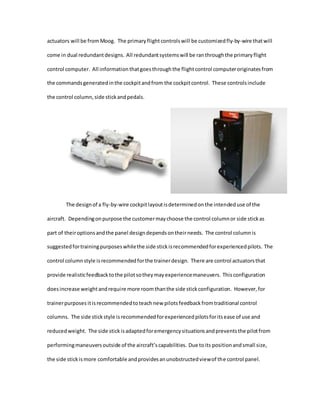
actuators will be fromMoog. The primaryflightcontrolswill be customizedfly-by-wire thatwill
come in dual redundantdesigns. All redundantsystemswill be ranthroughthe primaryflight
control computer. All informationthatgoesthroughthe flightcontrol computeroriginatesfrom
the commandsgeneratedinthe cockpitandfrom the cockpitcontrol. These controlsinclude
the control column,side stickandpedals.
The designof a fly-by-wire cockpitlayoutisdeterminedonthe intendeduse of the
aircraft. Dependingonpurpose the customermaychoose the control columnor side stickas
part of theiroptionsandthe panel designdependsontheirneeds. The control columnis
suggestedfortrainingpurposeswhilethe side stickisrecommendedforexperiencedpilots. The
control columnstyle isrecommendedforthe trainerdesign. There are control actuatorsthat
provide realisticfeedbacktothe pilotsotheymayexperiencemaneuvers. Thisconfiguration
doesincrease weightandrequire more roomthanthe side stickconfiguration. However, for
trainerpurposes itisrecommendedtoteachnew pilotsfeedbackfromtraditional control
columns. The side stickstyle isrecommendedforexperiencedpilotsforitsease of use and
reducedweight. The side stickisadaptedforemergencysituationsandpreventsthe pilotfrom
performingmaneuversoutside of the aircraft’scapabilities. Due toits positionandsmall size,
the side stickismore comfortable andprovidesanunobstructedviewof the control panel.
Cockpitpanelsare arrangeddependingonuse andneedof the pilot. The locationof the
controlstakesintoaccount eachsystems’importance,the frequencyof asystem’soperation,
the ease that the controlscan be reachedand the shape of the control.
3.11.2. Avionics
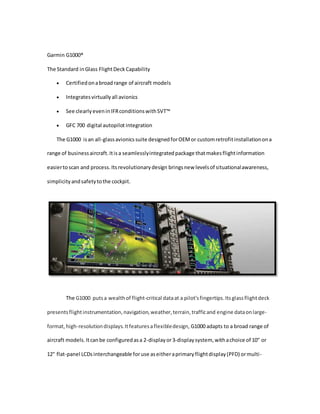
The Avionicspackage inThe Flashisprimarilysuppliedbythe GarminG1000. The G1000 is
the premiere glasscockpitandthe industryleaderincrew resource managementandreliable
operation.Whenselectingthe avionicspackage,Garminpresentsthe mostrobustoutof box
solution,whichincludesbuiltinredundancies,anefficientuserinterface,andthe modular
abilitytoinclude awide varietyof auxiliaryunits,calledLine ReplaceableUnits (LRUs).In
additiontothese builtin redundancies,ouravionicspackage will alsoincludeathirdlayerof
redundancy,ina small trioof traditional mechanical gaugesoperatingona completelyseparate
subsystem.
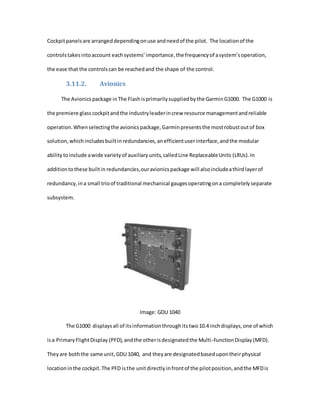
Image: GDU 1040
The G1000 displaysall of itsinformationthroughitstwo10.4 inchdisplays,one of which
isa PrimaryFlightDisplay (PFD),andthe otherisdesignatedthe Multi-FunctionDisplay (MFD).
Theyare boththe same unit,GDU 1040, and theyare designatedbasedupontheirphysical
locationinthe cockpit.The PFD isthe unitdirectly infrontof the pilotposition,andthe MFDis
infront of the copilotposition.Theyare bothfullycustomizableastowhat can be displayedon
eitherscreen,andare redundanttoeach other.Inthe eventof failure all pertinentinformation
be displayedonanysingle screen.Thesedisplayspresentinformationsuchasthe artificial
horizon,heading,VORheading,windspeed,andengine outputs,amongotherinformation.
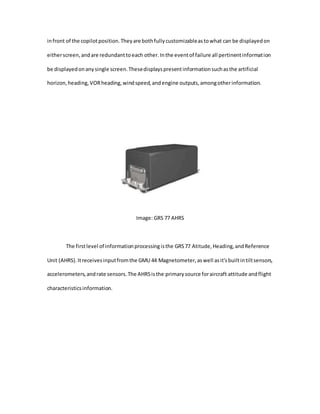
Image: GRS 77 AHRS
The firstlevel of informationprocessingisthe GRS77 Atitude,Heading,andReference
Unit (AHRS).Itreceivesinputfromthe GMU 44 Magnetometer,aswell asit'sbuiltintiltsensors,
accelerometers,andrate sensors.The AHRSisthe primarysource foraircraft attitude andflight
characteristicsinformation.
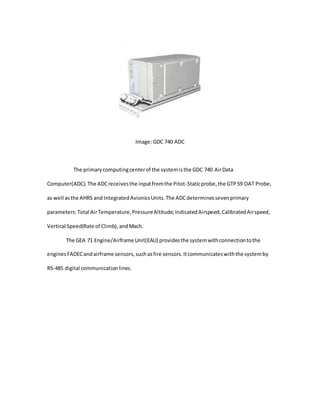
Image: GDC 740 ADC
The primarycomputingcenterof the systemisthe GDC 740 AirData
Computer(ADC).The ADCreceivesthe inputfromthe Pitot-Staticprobe,the GTP59 OAT Probe,
as well asthe AHRS and IntegratedAvionicsUnits.The ADCdeterminessevenprimary
parameters:Total AirTemperature,PressureAltitude,IndicatedAirspeed,CalibratedAirspeed,
Vertical Speed(Rate of Climb),andMach.
The GEA 71 Engine/Airframe Unit(EAU) providesthe systemwithconnectiontothe
enginesFADECandairframe sensors,suchasfire sensors.Itcommunicateswiththe systemby
RS-485 digital communicationlines.
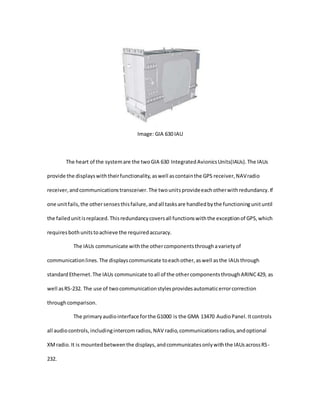
Image: GIA 630 IAU
The heart of the systemare the twoGIA 630 IntegratedAvionicsUnits(IAUs).The IAUs
provide the displayswiththeirfunctionality,aswell ascontainthe GPS receiver,NAVradio
receiver,andcommunicationstransceiver.The twounitsprovideeachotherwithredundancy.If
one unitfails,the othersensesthisfailure,andall tasksare handledbythe functioningunituntil
the failedunitisreplaced.Thisredundancycoversall functionswiththe exceptionof GPS,which
requiresboth unitstoachieve the requiredaccuracy.
The IAUs communicate withthe othercomponentsthroughavarietyof
communicationlines.The displayscommunicate toeachother,aswell asthe IAUsthrough
standardEthernet.The IAUs communicate toall of the othercomponentsthroughARINC429, as
well asRS-232. The use of twocommunicationstylesprovidesautomaticerrorcorrection
throughcomparison.
The primaryaudiointerface forthe G1000 is the GMA 13470 AudioPanel.Itcontrols
all audiocontrols,includingintercomradios,NAV radio,communicationsradios,andoptional
XMradio.It is mountedbetweenthe displays,andcommunicatesonlywiththe IAUsacrossRS-
232.
The GTX 330 Transponderisa Mode-StransponderwhichprovidesmodesA,C,and S
ATC communication.Itiscontrolledbythe IAUsthroughthe display.
There are manyoptional LRUs whichcan be incorporatedintothe G1000, whichcan add
a varietyof featuresandprovide more robustfunctionalitybaseduponthe customer'sneeds.
Additional features includeXMRadio,Weathersystems,andanynumberof differentdisplays.
The basic configurationof the G1000 providesthe necessaryfunctionalitytofullyequipan
aircraft forflight,andrepresentsthe cuttingedge of modernglasscockpit.
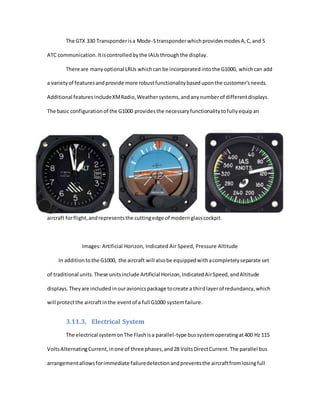
Images: Artificial Horizon, Indicated Air Speed, Pressure Altitude
In additiontothe G1000, the aircraft will alsobe equippedwithacompletelyseparate set
of traditional units.These unitsinclude Artificial Horizon,IndicatedAirSpeed,andAltitude
displays.Theyare includedinouravionicspackage tocreate a thirdlayerof redundancy,which
will protectthe aircraftinthe eventof a full G1000 systemfailure.
3.11.3. Electrical System
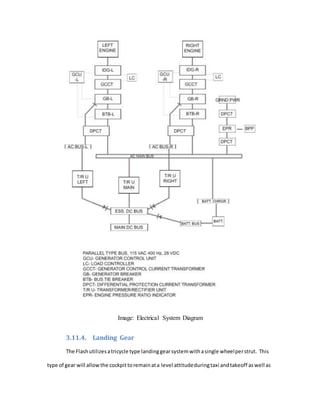
The electrical systemonThe Flashisa parallel-type bussystemoperatingat400 Hz 115
VoltsAlternatingCurrent,inone of three phases,and28 VoltsDirectCurrent.The parallel bus
arrangementallowsforimmediate failuredetectionandpreventsthe aircraftfromlosingfull
powerinthe eventof incidentssuchassingle enginefailure.Itconsistsof twoparallel
subsystems, namedLeftandRight,whichisnamedbaseduponthe enginepoweringthe
subsystem,asviewedfromthe pilot'sperspective.The LeftandRightsystemsare connectedat
twopoints,the firstisthe Main AC Bus,and the secondis the Main DC Bus.The system also
allowsforthe inputof a groundpowercart or truck, whichisa separate ACsubsystem.
In the eventof an engine orcomponentfailureinanyone ACsubsystem, the
functioningsubsystemcanautomaticallyandquicklytransferitspowerintoasecondary
subsystem.The secondarysubsystemscontainmanyof the same componentsasthe main
subsystem,butfeedcompletelyseparate buses.These buses,whileseparate,canpowerall of
the essential componentstothe aircraft.
The engine'sprimaryelectrical outputcontrol isit'sincorporatedFull Authority
Digital Engine Control (FADEC) software.The firstcomponentwhichphysicallybeginsgenerating
electricityisthe IntegratedDriveGenerator (IDG),mountedontothe engine,andcontrolledby
the FADEC. The engine produceselectricitybasedonitscurrentoperatingconditions,andthe
it's the responsibilityof the FADECtocontrol the IDG inorder to preventpotentiallyharmful
situationsfromconcurring.The IDG utilizesthe GeneratorControl CurrentTransformer(GCCT),
communicatingthroughaloadcontroller,toconditionthe ACpowerintothe acceptable range.
The GCCT transformsthe AlternatingCurrent (AC)powerdirectlyfromthe generator
into400 Hz 115 VoltsAC (VAC),andintothe appropriate phase withthe restof the system.The
initial phase isdeterminedbythe firstpowersource operatingduringthatruncycle,andall
otherAC systemsconformtoitfor the durationof the run cycle.
The GeneratorBreaker(GB) isthe firstbreakerinline from the generator.Itsprimary
functionisto preventcommonfailuresfromaffectinganycomponentswhichare still operating.
The GB alsoprovidesthe connectionbetweenthe MainACBus,the IDG, andthe secondaryAC
bus.
The Bus Tie Breaker(BTB) provides the cutoff pointforthe mainACsubsystem, and
closesthe circuitincase of failure.The BTB,GB, andIDG all communicate withthe GCU,which
monitorsthe currentflowinthe subsystemandcan determinefailure.
The DifferentialProtectionCurrentTransformer(DPCT) isacomparative transformer
whichusesthe methodof differentialprotectiontomonitorthe currentflowingthroughboth
the primaryand secondarysubsystems,aswell asthe IDG output.While the GCCTmonitorsthe
systemasa whole,andcommunicateswiththe LoadControllerandGCU, the DPCT monitorsthe
miscellaneousfeederwiresforshortedandopenconditions.The purpose of the DPCTisnot
necessarilytotransformthe engine output,butitregulatesthe componentsdrawingfromthe
system.
Completelyseparate fromeitherof the IDGpoweredlinesisthe GroundPower
subsystem.Thisline allowsforthe use of acart or truck to supplythe aircraftwithpower,when
it isavailable.There are manyadvantagesforutilizingthe groundpoweravailability,primarily
the abilitytostart the aircraft's engineswithoutthe needtodraw energyfromthe battery.The
subsystemcontainstwoDPCTsforline protection,andanEngine Pressure Ratio(EPR) sensor,
whichisprovidedthe currentengine output.ThisEPRsensorclosesthe subsystemwhenthe
engineshave reachedaself-sustainingoperation,whichprotectsthe groundcart fromdamage
due to substantial backloads.
The Direct Current(DC) subsystemisagaindividedintothree furthersubsystems,
baseduponwhere theirpowerisrectifiedfrom.The primaryDCsubsystembeginsatthe
Transformer/RectifierUnit(T/RU) main,whichdrawsdirectlyfromthe MainAC Bus.Similarly,
the T/R U Leftand Rightdraw theirpowerfromthe correspondingACBuses.All power
conditioningforthe DCsubsystemsishandledbythe T/RUs, whichconvertthe ACpowerinto
24 V DC power.
Surge protectioninthe DC subsystemsisprimarilyprovidedbysemiconductor
diodes.These diodespreventDCpowerfromtravelinginareverse pathof the intendedflow,as
well asprotectthe systemfromexcessivevoltages.Fuses
From the T/R U powerisroutedintothe Essential DCBus,whichpowerscomponents
such as the BatteryBus, andthe avionics.It'splacementbefore the MainDCBus createsa
possibilityforprotectionfromfailure whichmayoccur inthe Main DC Bus. Thisarrangementis
an attemptto limitthe effectof,say,lightfailure,fromaffectingflightessential components
such as the avionics.
The Battery Busprovidespowerfromthe batteryintothe Essential DCBuswhen
there isneedforit.The mostcommonneedforbatterypoweriswhenthere isno groundcart in
place for the systembefore andduringenginestart.Batterypowerisalsoa final backupfor
flightinthe eventof dual engine failure,andaccordingto FAA regulationsthe batterymustbe
able to provide powerforthe aircraftfor30 minutes.The aircraftwill containtwo12 V Lithium-
Ionbatteriesconnectedinseriestofulfill thisrequirement.
While Lithium-Ion(Li-Ion)batteriesare still relativelynew inaviation,theiruse has
become more accepted.CompaniessuchasEaglePicherhave fullydevelopedFAA registeredLi-
Ionbatteriesandchargers,whichprovide asubstantial increase overtraditionalLead-Acid
batteriesinthe areasof weight,cycle variability,anddischarge duration.
The batterybus alsohousesthe batterycharger,whichreceives powerfromthe AC
subsystems.While physicallyseparate fromthe DCsubsystem, the batterychargerconverts AC
powerintoDC powerinorder to charge the batteries,whichthenpowersthe DCsystemas
describedinthe conditionsabove.Whilethe batteriesstore 24V of power,the batterycharger
provides28 V of powerto charge the batteries.
Image: Electrical System Diagram
3.11.4. Landing Gear
The Flashutilizesatricycle type landinggearsystemwithasingle wheelperstrut. This
type of gear will allowthe cockpittoremainata level attitudeduringtaxi andtakeoff aswell as
allowthe pilotgoodvisibilityandcontrollability. The landinggeariscapable of withstandingup
to 90% of its max takeoff grossweightinthe eventof anemergencylandingneedingtobe
performedshortlyaftertakeoff.The landinggearwill be retractable toreduce the effectsof
drag and allowasmoother,fasterflight. The landinggearutilizesa12 VDC bi-directional
electro-hydraulicpowerpackandpumpto place the gear intothe desiredposition. The landing
gear will be producedandassembledbyHeroux-DevtekIncorporationandshippedtousfor
final installationontothe aircraft.
The wheel andtire selectionsare basedupontables,chartsandequationslistedin
chapter11 of the Raymertext. The landinggearwill weigh130 lbf.The nose gear will have a7 ̊
forwarddisplacementtocounteract any tendencyforthe gearto retract upona hard landing.
Both the nose andmain landinggearwill utilizethe same size tiresandwheels. The tire will be
type III,lowpressure,andcan supporta maximumspeedif 120 mph,or 104 knots. The tiresare
capable of supporting4400 lbf,90% of the takeoff weight. The areafootprintof the tire is90
in². The tireswill have anoverall diameterof 25.65 inchesand a widthof 8.7 inches. The tires
will be capable of holdinga maximumof 55 psi. During landings,acenteringcamwill ensurethe
nose gearis inthe straightaheadpositionsince itisthe onlygearcapable of swiveling.
Additionally,adrag strut andside brace linkwill be utilizedonthe maingearforsafetyconcerns
inthe eventof a highcrab landing. Air-oleotype shockabsorbersare utilizedoneachstrutand
can be servicedviaanairvalve at the top of each strut. The use of an air-oleoversusaspring-
oleoallowsforconservationof weightwhile still cushioninglandingsandtaxiingoverrough
surfaces.
Whenthe pilotselectsthe landinggeartomove intoeitherthe extendedorposition,an
electricmotorisenergizedandrotatesacam plate that opensthe landinggearstowage doors,
positionsthe gear,andclosesthe doors. Once the gear isin the selectedposition,amicroswitch
breaksthe circuitto the motorand causesthe appropriate gearindicationtobe displayedon
the multi-functionaldisplays. The gearwill retractto stow in a fuselage-poddedconfiguration.
For the purpose of enhancedsafety,alanding-gear-positionindicatorsystemisutilized. Squat
switchesallowthe systemtodeterminewhenthe aircraftisonthe ground,disallowingthe gear
to be retractedaccidently. A warninghornwill soundwhenthe throttle isreducedbelow 100
knotsand the landinggearisnot inthe downposition. Inthe eventof acomplete electrical
failure,abackupCO2 accumulatorwill use itscharge to place the landinggearin the landing
configuration,referredtoasan emergencygearuprelease valve blow downsystem.
The brakesare a single disktype andare operatedviaa brake-by-wire system. When
the pilotpressesthe brakes,anelectrical signalissentfromthe brake pedal transducersandthe
Garmin 1000 systemtoactuate electrical brake actuators. Thissystemutilizesnohydraulic
fluid,allowingforweightconservation. The brake actuatorsprovide brakingpowertoeither
one or all wheels,atthe pilot’sdiscretion,viapressure appliedtothe individual footpedals.
Disksare rigidlyboltedtothe wheel andabrake housingisattached. The pistonsinthe brake
housinghave liningsonthemwhichmustbe replacedwhenwornbelow tolerances,muchlike
the brakesof a car.
3.11.5. Pressurization System
Environmental systemistypicallyincludingairconditioningsystemandpressurization
system.Theyare workingtogethertocreate a comfortable atmosphere forpassengersand
crewsin the cabin.
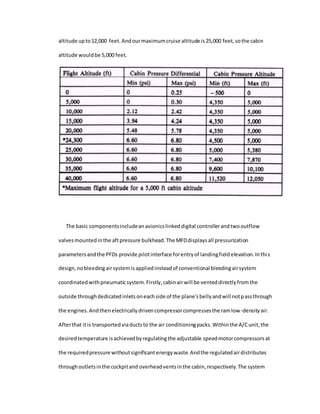
For personal lightjetand/orverylightjet,cabinpressure differential isgenerallyupto
6.7±0.1 psi.The presetpressure differential valueis6.8psi.Thisallowsasealevel cabin
altitude upto12,000 feet.Andourmaximumcruise altitude is25,000 feet,sothe cabin
altitude wouldbe 5,000 feet.
The basic componentsincludeanavionicslinkeddigital controllerandtwooutflow
valvesmountedinthe aftpressure bulkhead.The MFDdisplaysall pressurization
parametersandthe PFDs provide pilotinterface forentryof landingfieldelevation.Inthis
design,nobleedingairsystemisappliedinsteadof conventional bleedingairsystem
coordinatedwithpneumaticsystem.Firstly,cabinairwill be venteddirectlyfromthe
outside throughdedicatedinletsoneachside of the plane'sbellyandwill notpassthrough
the engines.Andthenelectricallydrivencompressorcompressesthe ramlow-densityair.
Afterthat itis transportedviaductsto the air conditioningpacks.Withinthe A/Cunit,the
desiredtemperature isachievedbyregulatingthe adjustable speedmotorcompressorsat
the requiredpressure withoutsignificantenergywaste.Andthe regulatedairdistributes
throughoutletsinthe cockpitand overheadventsinthe cabin,respectively.The system
may be operatedanytime inflight,oronthe ground whengroundpowerisconnectedor
eitherengine isrunning.A freshairventwitha bloweranda checkvalve islocatedbeneath
the nose baggage compartmentto provide outsideairtothe cockpitwheneverthe cabinis
not pressurized.
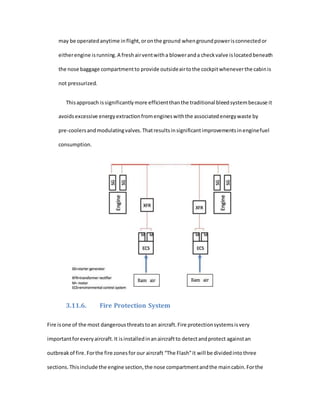
Thisapproach issignificantlymore efficientthanthe traditional bleedsystembecause it
avoidsexcessive energyextractionfromengineswiththe associatedenergywaste by
pre-coolersandmodulatingvalves.Thatresultsinsignificantimprovementsinenginefuel
consumption.
3.11.6. Fire Protection System
Fire isone of the most dangerousthreatstoan aircraft.Fire protectionsystemsisvery
importantforeveryaircraft.It isinstalledinanaircraftto detectandprotect againstan
outbreakof fire.Forthe fire zonesfor our aircraft “The Flash”it will be dividedintothree
sections.Thisinclude the engine section,the nose compartmentandthe maincabin.Forthe
engine section,itwill be dividedintotwozonesnamelyzone A andzone B.Zone A isgoingto
coverthe core sectionof the engine anditis alsogoingto be providedwithfire detectionand
extinguishing.Zone Bwill coverthe exhaustpipeandpylonsection.One extinguisherisgoingto
be paced oneach engine withHalon3301 andone isgoingto be placedinthe cockpit.
For the air cooledradial engines,the powersectionandall portionsof the exhaustsystemmust
be isolatedfromthe engine accessorycompartmentbyadiaphragmthat meetsthe firewall
requirementsof part23.1191. The designof the fire protectionforthisaircraftwill be in
compliance withthe requirementwhichinclude:
(a) Each engine,powerunitsandall othercombustionequipmentwillbe
isolatedfromthe aircraftbyfirewalls.
(b) The firewall willbe constructedsothatno hazardousquantityof liquids,
gas, or flame canpass fromthe compartmentcreatedbythe firewall.
(c) Each openinginthe firewall will be sealedwithclosefitting,fireproof
grommets,bushing,orfirewall fittings.Ourfirewall will be made upof composite
material.The firewall forthisaircraftwill be protectedagainstcorrosionandalsowill
be a fireproof andthisisgoingtoprotectit fromany dangerof fire andas a result,
passengersandcrewdoesn’tgetelectrocutedwhentheyinsideof the cabin.For
example the material thatwillbe usedwhichrequiresfirewall materialsandfittings
mustresistflame penetrationforatleast15 minutes.Forthe designforthisaircraft,
the followingmaterial will be used
1. Stainlesssteel sheet,0.015 inchthick
2. Mildsteel sheet(coatedwithaluminumorotherwise
protectedagainstcorrosion) 0.018 inch thick
3. Monel metal,0.018 inchthick
4. Steel orcooperbase alloyfirewall fittings
5. Titaniumsheet,0.016 inchthick
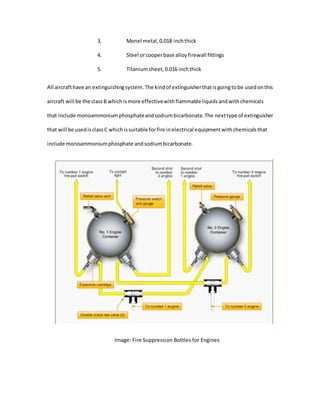
All aircrafthave an extinguishingsystem.The kindof extinguisherthatisgoingtobe usedonthis
aircraft will be the classB whichismore effectivewithflammableliquidsandwithchemicals
that include monoammoniumphosphateandsodiumbicarbonate.The nexttype of extinguisher
that will be usedisclassC whichissuitable forfire inelectrical equipmentwithchemicalsthat
include monoammoniumphosphate andsodiumbicarbonate.
Image: Fire Suppression Bottles for Engines
3.11.7. Fuel System
All powered aircraft require fuel on board to operate the engines throughout the phases of
flight. A fuel system consists of storage tanks, pumps, valves, filters, fuel lines, monitoring
devices, and metering devices. Each system must provide an uninterrupted flow of contaminant
free fuel regardless of the aircraft’s attitude or flight condition. Varying fuel loads and shifts in
weight during maneuvers must not negatively affect control of the aircraft in flight. In general,
fuel systems must be constructed and arranged to ensure fuel flow at a rate and pressure
established for proper engine functioning under each likely operating condition. It also must be
designed and arranged to prevent the ignition of fuel vapor within the system by direct lightning
strikes.
For multiengine aircraft, each fuel system must be arranged so that, in at least one system
configuration, the failure of any one component does not result in the loss of power of more than
one engine. If two fuel tanks interconnected to function as a single fuel tank, there must be
independent tank outlets for each engine, and each incorporating a shut-off valve. The shutoff
valves may serve as firewall shutoff valves. Lines from each tank outlet to each engine must be
completely independent of each other. The fuel tank must have at least two vents arranged to
minimize the probability of both vents becoming obstructed simultaneously. In addition, aircraft
fuel tanks must be designed to retain fuel in the event of a gear-up landing. In case of sever
emergency situations, there must be a means to allow flight crew members to rapidly shut off the
fuel to each engine individually in flight.
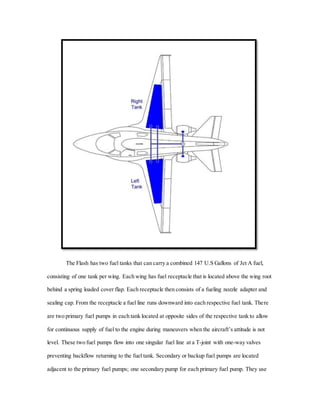
The Flash has two fuel tanks that can carry a combined 147 U.S Gallons of Jet A fuel,
consisting of one tank per wing. Each wing has fuel receptacle that is located above the wing root
behind a spring loaded cover flap. Each receptacle then consists of a fueling nozzle adapter and
sealing cap. From the receptacle a fuel line runs downward into each respective fuel tank. There
are two primary fuel pumps in each tank located at opposite sides of the respective tank to allow
for continuous supply of fuel to the engine during maneuvers when the aircraft’s attitude is not
level. These two fuel pumps flow into one singular fuel line at a T-joint with one-way valves
preventing backflow returning to the fuel tank. Secondary or backup fuel pumps are located
adjacent to the primary fuel pumps; one secondary pump for each primary fuel pump. They use
most of the same fuel lines as their adjacent primary pump. The secondary pumps are on standby
until activated by the pilot, or if fuel pressure drops below a certain amount, they will be
automatically switched on. A collector box in the wing root keeps the electrical pumps inlets
submerged. To prevent pump cavitation, a pump and flaps valves ensure enough fuel in the
collector box at all times.
A single fuel line connects each tank with a crossfeed valve located along the centerline of
the fuselage. An air valve located above the fuel pump allows air to be vented outside for priming
the crossfeed line at engine startup, and allows for air to be pumped into the crossfeed line at
engine shutdown to prevent unwanted expansion of fuel during times of engine inactivity. There
is also a fuel vent system with vent tanks located at the wing tips which prevent damage to the
wings due to excessive buildup of positive or negative pressures inside the fuel tanks and to
provide ram air pressure within the tanks. For fuel indication within the cockpit, four fuel sensors
are installed inside each tank, and are equally spaced across the full length of the tank. measure
fuel levels at each sensor’s location and send the information to a computer that constantly
calculates the overall fuel level of the tank. For manual measurement, there are direct measuring
sticks located on the wings.
4. MANUFACTURINGPLAN
4.1 Manufacturing Readiness Levels
Matters of manufacturingreadinessandproducibilityare asimportanttothe successful
developmentof a systemasthose of readinessandcapabilitiesof the technologiesintendedfor
the system.Theirimportance haslongbeenrecognizedinthe Departmentof Defense(DoD)
acquisition,andare reflectedincurrentDoDacquisitionpolicies.Foranaerospace company,itis
verybeneficial tofollow the DoDstandardsandpractices.
4.1.1 Defining Manufacturing Readiness
Accordingto the DoD, ManufacturingReadinessisthe abilitytoharnessthe
manufacturing,production,qualityassurance,andindustrial functionstoachieve anoperational
capabilitythatsatisfiesmissionneedsinthe quantityandqualityneededbythe aircraftto
performas itis designedtoatthe "bestvalue."Bestvalue referstoincreasedperformanceas
well asreducedcostfor developing,producing,acquiring,andoperatingsystemsthroughout
theirlife cycle. Timelinessalsoisimportant.Ouraircraft,"The Flash"mustmaintaina
technological advantageoverourcompetitor'saircraft.Thisrequiresefficientdevelopmentand
acquisitioncyclesforadvancingtechnologies.
ManufacturingReadinessbeginsbefore,andcontinuesduringthe developmentof an
aircraft's systems,andcontinuesevenafterasystemhasbeeninthe fieldforanumberof years.
The abilitytotransitiontechnologysmoothlyandefficientlyfromdevelopment,production,and
deploymentintothe fieldisacritical enablerforevolutionaryacquisition.
ManufacturingReadinessLevels(MRLs) are designedtobe measuresusedtoassessthe
maturityof a giventechnologyfromamanufacturingprospective.The purpose of MRLsare to
provide decisionmakerswithacommonunderstandingof the relative maturity,andattendant
risksassociatedwithmanufacturingtechnologies,products,andprocessesbeingconsideredto
meetDoD requirements.
4.1.2 Manufacturing Readiness Levels
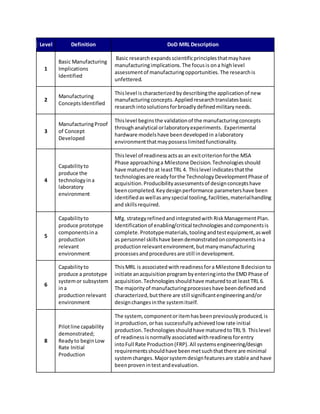
There are tenMRLs that are correlatedtonine TechnologyReadinessLevels(TRLs) inuse.
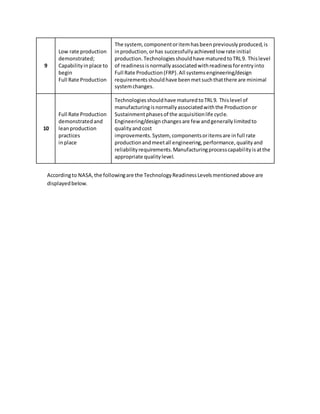
The ten MRLs are describedindetail below.Inregardstoproductionof the aircraft,at MRL 8,
lowrate initial productioncanbegin.AtMRL 9, there isthe capabilitytogo intofull rate
production.ByMRL 10, full rate productionisdemonstratedandleanpracticesforefficient
productionare inplace.
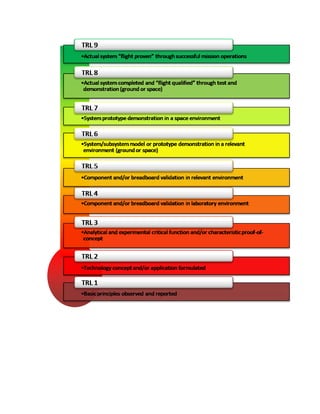
Accordingto the National AeronauticsandSpace Administration(NASA),TRLsare a type
of measurementsystemused toassessthe maturitylevelof aparticulartechnology.Each
technologyprojectisevaluatedagainstthe parametersforeachtechnologylevel andisthen
assignedaTRL ratingbasedon the projectsprogress.There are a total of nine technology
readiness levels.TRL1 is the lowestandTRL 9 isthe highest.
MRL 1: Basic Manufacturing Implications Identified
Thisis the lowestlevel of manufacturingreadiness.The focusistoaddress
manufacturingshortfallsandopportunitiesneededtoachieve programobjectives.Basic
researchbeginsinthe formof studies.
MRL 2: Manufacturing Concepts Identified
Thislevel ischaracterizedbydescribingthe applicationof new manufacturingconcepts.
Appliedresearchtranslatesbasicresearchintosolutionsforbroadly definedneeds.Typicallythis
level of readinessinthe Science andTechnology(S&T) environmentincludesidentification,
paperstudiesandanalysisof material andprocessapproaches.Anunderstandingof
manufacturingfeasibilityandriskisemerging.
MRL 3: Manufacturing Proof of Concept Developed
Thislevel beginsthe validationof the manufacturingconceptsthroughanalytical or
laboratoryexperiments.Thislevel of readinessistypical of technologiesincategoriesof
research,development,andmaterialsprocesseshave beencharacterizedformanufacturability
and availability,butfurtherevaluationanddemonstrationisrequired.Experimental hardware
modelshave beendevelopedinalaboratoryenvironmentthatmaypossesslimited
functionality.
MRL 4: Capability to produce the technology in a laboratory environment
In thislevel,technologiesshouldhave maturedtoatleastTRL 4. Thislevel indicatesthat
the technologiesare readyforthe developmentphase of acquisition.Atthispoint,required
investments,suchasmanufacturingtechnologydevelopment,have beenidentified.Processes
to ensure manufacturability,producibility,andqualityare inplace andare sufficienttoproduce
technologydemonstrators.Manufacturingriskshave beenidentifiedfor buildingprototypesand
mitigationplansare inplace.Targetcost objectiveshave beenestablishedandmanufacturing
cost drivershave beenidentified.Producibilityassessmentsof designconceptshave been
completed.Keydesignperformance parametershave beenidentifiedaswell asanyspecial
tooling,facilities,material handlingandskillsrequired.
MRL 5: Capability to produce prototype components in a production relevant environment
Thislevel of maturityistypical of the mid-pointinthe developmentphase of acquisition.
Technologiesshouldhave maturedtoatleastTRL 5. The industrial base hasbeenassessedto
identifypotential manufacturingsources.A manufacturingstrategyhasbeenrefinedand
integratedwiththe riskmanagementplan.Identificationof enablingcritical technologiesand
componentsiscomplete.Prototypematerials,toolingandtestequipment,aswell aspersonnel
skillshave beendemonstratedoncomponentsinaproductionrelevantenvironment,butmany
manufacturingprocessesandproceduresare still indevelopment.Manufacturingtechnology
developmenteffortshave beeninitiatedorare ongoing.Producibilityassessmentsof key
technologiesandcomponentsare ongoing.A costmodel hasbeenconstructedtoassess
projectedmanufacturingcost.
MRL 6: Capability to produce a prototype system or subsystem in a production relevant
environment
For MRL 6, technologiesshouldhave maturedtoatleastTRL 6. It isnormallyseenasthe
level of manufacturingreadinessthatdenotescompletionof S&Tdevelopmentandacceptance
intoa preliminarysystemdesign.Aninitialmanufacturingapproachhasbeendeveloped.The
majorityof manufacturingprocesseshave beendefinedandcharacterized,butthere are still
significantengineeringand/ordesignchangesinthe systemitself.However,preliminarydesign
of critical componentshasbeencompletedandproducibilityassessmentsof keytechnologies
are complete.Prototype materials,toolingandtestequipment,aswell aspersonnel skillshave
beendemonstratedonsystemsand/orsubsystemsinaproductionrelevantenvironment.A cost
analysishasbeenperformedtoassessprojectedmanufacturingcostversustargetcost
objectivesandthe programhasin place appropriate riskreductiontoachieve costrequirements
or establishanewbaseline.Thisanalysisshouldincludedesigntrades.Producibility
considerationshave shapedsystemdevelopmentplans.Long-leadandkeysupplychain
elementshave beenidentified.
MRL 7: Capability to produce systems, subsystems, or components in a production
representative environment
At thislevel,technologiesshouldbe ona pathto achieve TRL 7. Systemdetaileddesign
activityisunderway.Material specificationshave beenapprovedandmaterialsare available to
meetthe plannedpilotlinebuildschedule.Manufacturingprocessesandprocedureshave been
demonstratedinaproductionrepresentative environment.Detailedproducibilitytrade studies
and riskassessmentsare underway.The costmodel hasbeenupdatedwithdetaileddesigns,
rolledupto systemlevel,andtrackedagainstallocatedtargets.Unitcostreductioneffortshave
beenprioritizedandare underway.The supplychainandsupplierqualityassurancehave been
assessedandlong-leadprocurementplansare in place.Productiontoolingandtestequipment
designanddevelopmenthave beeninitiated.
MRL 8: Pilot line capability demonstrated; Ready to begin Low Rate Initial Production
Thislevel isenteringintoLow Rate Initial Production(LRIP)of the aircraft. Technologies
shouldhave maturedtoat leastTRL 7. Detailedsystemdesignisessentiallycomplete and
sufficientlystable toenterlowrate production.All materialsare availabletomeetthe planned
lowrate productionschedule.Manufacturingandquality processesandprocedureshave been
provenina pilotline environmentandare undercontrol and readyforlow rate production.
Knownproducibilityriskspose nosignificantchallengesforlow rate production.The engineering
cost model isdrivenbydetaileddesignandhasbeenvalidatedwithactual data.
MRL 9: Low rate production demonstrated; Capability in place to begin Full Rate Production
At thislevel,the system,componentoritemhasbeenpreviouslyproduced,isin
production,orhas successfully achievedlow rate initial production.Technologiesshouldhave
maturedto TRL 9. Thislevel of readinessisnormallyassociatedwithreadinessforentryintoFull
Rate Production(FRP).Allsystemsengineeringdesignrequirementsshouldhave beenmetsuch
that there are minimal systemchanges.Majorsystemdesignfeaturesare stable andhave been
provenintestand evaluation.Materialsare availabletomeetplannedrate production
schedules.Manufacturingprocesscapabilityinalow rate productionenvironmentisatan
appropriate qualityleveltomeetdesignkeycharacteristictolerances.Productionrisk
monitoringisongoing.LRIPcosttargetshave beenmet,andlearningcurveshave beenanalyzed
withactual data. The costmodel hasbeendevelopedforFRP environmentandreflectsthe
impactof continuousimprovement.
MRL 10: Full Rate Production demonstrated and lean production practices in place
Thisis the highestlevelof productionreadiness.Technologiesshouldhave maturedto
TRL 9. Engineeringdesignchangesare minimal,andgenerallylimitedtoqualityandcost
improvements.Systems,componentsoritemsare infull rate productionandmeetall
engineering,performance,qualityandreliabilityrequirements.Manufacturingprocess
capabilityisatthe appropriate qualitylevel.Allmaterials,tooling,inspectionandtest
equipment,facilitiesandmanpowerare inplace and have metfull rate production
requirements.Rate productionunitcostsmeetgoals,andfundingissufficientforproductionat
requiredrates.Leanpracticesare well establishedandcontinuousprocessimprovementsare
ongoing.
Althoughthe MRLs are numbered,the numbersthemselvesare unimportant.The
numbersrepresentanon-linearordinalscale thatidentifieswhatmaturityshouldbe asa
functionof where aprogram isin the acquisitionlife cycle.
Level Definition DoD MRL Description
1
Basic Manufacturing
Implications
Identified
Basic researchexpandsscientificprinciplesthatmayhave
manufacturingimplications.The focusis ona highlevel
assessmentof manufacturingopportunities.The researchis
unfettered.
2
Manufacturing
ConceptsIdentified
Thislevel ischaracterizedbydescribingthe applicationof new
manufacturingconcepts.Appliedresearchtranslatesbasic
research intosolutionsforbroadlydefinedmilitaryneeds.
3
ManufacturingProof
of Concept
Developed
Thislevel beginsthe validationof the manufacturingconcepts
throughanalytical orlaboratoryexperiments. Experimental
hardware modelshave beendevelopedin alaboratory
environmentthatmaypossesslimitedfunctionality.
4
Capabilityto
produce the
technologyina
laboratory
environment
Thislevel of readinessactsas an exitcriterionforthe MSA
Phase approachinga Milestone Decision.Technologiesshould
have maturedto at leastTRL 4. Thislevel indicatesthatthe
technologiesare readyforthe TechnologyDevelopmentPhase of
acquisition.Producibilityassessmentsof designconceptshave
beencompleted.Keydesignperformance parametershave been
identifiedaswellasanyspecial tooling,facilities,materialhandling
and skillsrequired.
5
Capabilityto
produce prototype
componentsina
production
relevant
environment
Mfg. strategyrefinedandintegratedwith RiskManagementPlan.
Identificationof enabling/critical technologiesandcomponentsis
complete.Prototypematerials,toolingandtestequipment,aswell
as personnel skillshave beendemonstratedoncomponentsina
productionrelevantenvironment,butmanymanufacturing
processesandproceduresare still indevelopment.
6
Capabilityto
produce a prototype
systemor subsystem
ina
productionrelevant
environment
ThisMRL is associatedwithreadinessfora Milestone Bdecisionto
initiate anacquisitionprogrambyenteringintothe EMD Phase of
acquisition.Technologiesshouldhave maturedtoat leastTRL 6.
The majorityof manufacturingprocesseshave beendefinedand
characterized,butthere are still significantengineeringand/or
designchangesinthe systemitself.
8
Pilotline capability
demonstrated;
Readyto beginLow
Rate Initial
Production
The system, componentoritemhasbeenpreviouslyproduced,is
inproduction,orhas successfullyachievedlow rate initial
production.Technologiesshouldhave maturedtoTRL 9. Thislevel
of readinessisnormallyassociatedwithreadinessforentry
intoFull Rate Production (FRP).All systemsengineering/design
requirementsshouldhave beenmetsuchthatthere are minimal
systemchanges.Majorsystemdesignfeaturesare stable andhave
beenprovenintestandevaluation.
9
Low rate production
demonstrated;
Capabilityinplace to
begin
Full Rate Production
The system, componentoritemhasbeenpreviouslyproduced,is
inproduction,orhas successfullyachievedlow rate initial
production.Technologiesshouldhave maturedtoTRL9. Thislevel
of readinessisnormallyassociatedwithreadinessforentryinto
Full Rate Production(FRP).All systemsengineering/design
requirementsshouldhave beenmetsuchthatthere are minimal
systemchanges.
10
Full Rate Production
demonstratedand
leanproduction
practices
inplace
Technologiesshouldhave maturedtoTRL9. Thislevel of
manufacturingisnormallyassociatedwiththe Productionor
Sustainmentphasesof the acquisitionlife cycle.
Engineering/design changes are few andgenerallylimitedto
qualityandcost
improvements.System, componentsoritemsare infull rate
productionandmeetall engineering,performance,qualityand
reliabilityrequirements.Manufacturingprocesscapabilityisatthe
appropriate qualitylevel.
Accordingto NASA,the followingare the TechnologyReadinessLevelsmentionedabove are
displayedbelow.
4.2 Industrial Base
At thisstage,our ManufacturingReadinessLevel iscurrentlyatLevel 2,and then will be
proceedingintoLevel 3.
2
Manufacturing
ConceptsIdentified
Thislevel ischaracterizedbydescribingthe applicationof new
manufacturingconcepts.Appliedresearchtranslatesbasic
researchintosolutionsforbroadlydefinedmilitaryneeds.
3
ManufacturingProof of
ConceptDeveloped
Thislevel beginsthe validationof the manufacturingconcepts
throughanalytical orlaboratoryexperiments. Experimental
hardware modelshave beendevelopedinalaboratory
environmentthatmaypossesslimitedfunctionality.
Setupwill take approximately12-24 months.
Suppliers:
5 Price Induction(2DGEN 380 engines)
6 Garmin (Avionics)
7 Rockwell (FlightControls)
8 Héroux-Devtek(LandingGear)
4.2.1 Price Induction
Price inductionisone of the few companiestohave developedamodernaeronautical
gas turbine inthe pastdecade.Itsstate-of-the-artproductisthe DGEN 380 engine,the world’s
smallestturbofanintendedfor4-5 seatPersonal LightJets.Thishighbypassratiogeared
turbofanwasdesignedfromablanksheettoallow forthe adventof a new classof aircraftson
the general aviationmarket.Afterfifteenyearsof development,the engine isrecognizedasa
technical successandhas nowto enterthe certificationandindustrializationphase.
Price Induction’sadventure beganin1997, whenBernardEtcheparre,a French
entrepreneur,decidedtolaunchthe DGEN program to contribute tothe innovationinthe
general aviationmarket.Launchedasaventure project,withateamof youngengineers,the
program quicklygainedthe supportof Frenchaerospace laboratories,majorFrench
aeronautical companiesandinstitutional investmentfunds.
On October31st 2006, the firstDGEN 380 engine wassuccessfullyignitedwiththe test
benches.In2011, the DGEN 380 completeditsfirst150-hourendurance blocktest.From2010
onwards,inorderto leverage itsknow-how,the companydiversifieditsactivities:the first
WESTT SOLUTIONStestbenchwasinstalledin2011 andthe firstR&T projectwassignedin
2012. Since then,the DGEN programhas undergone more than2,000 cycles,1,500 hours of
operationsandtwosuccessful 150-hourendurance blocktests.DGEN enginesare regularly
producedforboth the developmentof the programand the WESTT SOLUTIONSproductfamily.
DGEN 380 Engine Cutaway 1
4.2.2. Garmin
Garmin'smission isto be an enduringcompanybycreatingsuperiorproducts for
automotive,aviation,marine,outdoor,andsportsthatare an essential partof our customers’
lives. Garmin'svisionistobe the global leaderineverymarket,andthe productswill be sought
afterfor theircompellingdesign,superiorquality,andbestvalue. The foundationof Garmin's
culture ishonesty,integrity,andrespectforassociates,customers,andbusinesspartners. These
3 words"BuildtoLast" describe the products,company,culture andthe future.Asa leading
worldwide providerof navigation,Garminiscommittedtomakingsuperiorproductsfor
automotive,aviation,marine,outdoorandfitnessmarketsthatare an essential partof our
customers’lives.
Garmin'svertical integrationbusinessmodel keepsall design,manufacturing,marketing
and warehouse processesin-house,givingthemmore control overtimelines,qualityand
service.Theiruser-friendlyproductsare notonlysoughtafterfortheircompellingdesign,
superiorqualityandbestvalue,buttheyalsohave innovativefeaturesthatenhance the livesof
the customers.
DGEN 380 Flow Visualization 1
Garmin G1000®
The Standard inGlass FlightDeckCapability
 Certifiedonabroadrange of aircraft models
 Integratesvirtuallyall avionics
 See clearlyeveninIFRconditionswithSVT™
 GFC 700 digital autopilot integration
The G1000 isan all-glassavionicssuite designedforOEMor customretrofitinstallationona
range of businessaircraft.Itisa seamlesslyintegratedpackage thatmakesflightinformation
easiertoscan and process.Itsrevolutionarydesign bringsnew levelsof situationalawareness,
simplicityandsafetytothe cockpit.
The G1000 putsa wealthof flight-critical dataat a pilot'sfingertips.Itsglassflightdeck
presentsflightinstrumentation,navigation,weather,terrain,trafficand engine dataonlarge-
format,high-resolutiondisplays.Itfeaturesaflexibledesign, G1000 adapts to a broad range of
aircraft models.Itcanbe configuredasa 2-displayor3-displaysystem, withachoice of 10" or
12" flat-panel LCDsinterchangeable foruse aseitheraprimaryflightdisplay(PFD) ormulti-
functiondisplay(MFD).Anoptional 15"screenisalsoavailable forevenlargerformatMFD
configurations.
The G1000 replacestraditionalmechanicalgyroscopicflightinstrumentswithsuper-
reliable GRS77Attitude andHeadingReference System(AHRS).AHRSprovidesaccurate,digital
outputand referencingof youraircraftposition,rate,vectorandaccelerationdata.It’seven
able to restartand properlyreference itself while youraircraftismoving. The G1000 also
includesthe GFC700, the firstentirelynew autopilotdesignedandcertifiedforthe 21st century.
The GFC 700 is capable of usingall data available toG1000 to navigate,includingthe abilityto
maintainairspeedreferencesandoptimize performanceoverthe entire airspeedenvelope.
4.2.3. Rockwell Collins
Rockwell Collinsisapioneerinthe design,productionandsupportof innovative
solutionsfortheircustomersinaerospace anddefense.Rockwell'sexpertiseinflight-deck
avionics,cabinelectronics,missioncommunications,informationmanagementandsimulation
and trainingisstrengthenedbytheirglobal service andsupportnetworkspanning150
countries.Workingtogether,theirglobal teamof nearly20,000 employeessharesavisionto
create the most trustedsource of communicationandaviationelectronicssolutions.
Rockwell'saviationelectronicssystemsandproductsare installedinthe flightdecksof
nearlyeveryairtransportaircraftin the world.Theircommunicationsystemstransmitnearly70
percentof U.S. and alliedmilitaryairbornecommunications.Whetherdevelopingnew
technologytoenable network-centricoperationsforthe military,deliveringintegrated
electronicsolutionsfornewcommercialaircraftorprovidingalevel of service andsupportthat
increasesreliabilityandlowersoperational costsforourcustomersthroughoutthe world,
deliverontheircommitments.
Rockwell Collinsisaleadingproviderof flightcontrol andnavigationsolutionsfor
commercial,militaryandUnmannedAircraftSystems(UAS).Theirflightcontrol systems
expertiseincludesautopilot,actuation,fly-by-wire,pilotcontrols,andenginecontrollers.The
flightcontrol productsexemplifyourcapabilitiesinsystemsengineering,precisionmachining,
fabrication,andassemblyof close-toleranceflightcritical partstomeetdesignandcertification
requirements.Regardlessof asystem’scomplexity,theirflightcontrolsensurethe stabilityand
safetyof flightoperation.
Fly-by-wire systemsreduceweight,improve reliability,andincreaseaircraftfuel
efficiency.Rockwell'sfly-by-wire systemshelpcreate afamiliarenvironmentforpilotsby
combiningcomputersoftware andhardware toemulate the lookandfeelof mechanical pilot
control systems.Movementsof the column,wheel,andpedalsare convertedtoelectronic
signalsandtransmittedelectronicallybywirestothe control surfaces.
4.2.4. Heroux-Devtek
Héroux-DevtekInc.isaCanadiancompany specializinginthe design,development,
manufacture,integration,testingandrepairandoverhaul of landinggearandactuationsystems
and componentsforthe Aerospace market.The Corporationisthe thirdlargestlandinggear
companyworldwide,supplying boththe commercial andmilitarysectorsof the Aerospace
market.The Corporationalsomanufactureshydraulicsystems,fluidfiltrationsystems,electronic
enclosures,heatexchangersandcabinetsforsuppliersof airborne radar,electro-opticsystems
and aircraftcontrols. The Corporation’semphasisonResearch&Development,itssystems
integrationaccomplishments,anditsengineeringprowessare increasinglymakingHéroux-
Devteka preferredpartnerforthe design,qualificationandmanufacture of completelanding
gear systems
5. LEGAL and REGULATORY/ SAFETY
5.1. FAA Certification Strategy
Thissectionwill give averybrief overview of the aircraftandcomponentcertification
process. By no meansisthisto be utilizedasthe sole directionforthe process,butagenerality
for the purpose of understandingthe process.
In general,there are several phasesaccordingtothe FAA forthe entire aircraftapproval
process. The firstphase is todevelopthe conceptual design. The conceptual designwill consist
of the overall generalitiesof the aircraft;nospecifics.
Next,the requirements needtobe identified. The productdefinition,identificationof
associatedrisksanda mutual commitmenttomove forwardwiththose identifiedbyboththe
FAA and the applicantare completedinthisphase. Manymeetingstake place duringthisphase
and a preliminarycertificationboardmeetingisheld. Thisiswhere the proposedschedule for
the entire certificationprocessismade.
Next,the aircraftwill needtobe designedinaccordance withpropercompliances.
Specificprojectplanningisdone and a ProjectSpecificCertificationPlan(PSCP) ismade. Thisis
the FAA’sspecificcompliancesforwhattype of aircraftitis. For our purposes,we designedin
accordance withCFR§23, AirworthinessStandardsforNormal,Utility,AcrobaticandCommuter
CategoryAirplanes. Thissubchapterof the Federal AviationRegulationsforAviation
Maintenance Techniciansdefinesrequirementsof eachsubsystemandwhatkindof testingthey
mustundergo. Otherparts may be specifictolargersubcomponents,however. Anexample
wouldbe §33 talksabout the airworthinessstandardsof aircraftengines.
The implementationprocessiswhere youbegintosee results. The applicantmust
demonstrate theircompliance withthe FARAMTsubsectionsforthe particularsystems,show
compliance andcomformance tothe previouslyidentifiedrequirements,andhave afinal
certificationboardmeeting. Thisiswhenthe aircraftwill be inspectedandsafetyanalysiswill
be performed.
The final phase ispost-certification. Thisphase primarilydealswithprocessestoensure
continuedairworthinessstandardsare met. Thisincludescertificate managementforthe
remainderof the product’slife cycle.
To beginthe process,the applicantwill turninFAA Form8110-12 to the nearest
CertificationOffice,whichislocatedinChicago,IL. Initially,thisformwill be filledout
requestingatype certification.
The followingisageneral outlineof the entire process:
• Within2 weeksafter application:
• Acknowledgementof applicationissued
• FAA CertrificationProjectNotification(CPN) issued
• Within1 month after application:
• Projectteamidentified(FAA andApplicant)
• PreliminaryType CertificationBoardMeeting(PTCBM) scheduled
• Within1-3 months after PTCBM:
• ProposedCertificationBasisG-1issue paperpreparedandprocessingbegins(stage
1)
• PSCPdrafted
• Within4-6 months after PTCBM:
• Final CertificationBasisG-1issue paperclosed
• PSCPagreedandsigned,includingthe mutuallyagreedprojectschedule
• Within6-9 months after PTCBM:
• All issue papersclosed
• One monthprior to scheduledTC/STC/ProductionApproval issuance:
Compliance documentationsubmittalsshouldbe scheduledoverthe course of a
projectto be completedbythispointintime. More than onmonthmay be needed
insome cases,especiallywhensubmittalsare notFAA Designee approvedor
recommendedforapproval
The followingisidentificationof the keyplayersthroughoutthe processandtheirprimaryroles:
 FAA and Applicant’sManagement –Providesacommitmenttothe Partnershipfora
SafetyPlanas well asprovidesleadershipandresources
 FAA and Applicant’sProjectManagers – Jointlyorchestratesthe projectandappliesthe
PartnershipforSafetyPlanagreements
 FAA StandardsStaff ProjectOfficers –Providesatimely,standardizedpolicyand
guidance
 FAA and Applicant’sEngineersandDesignees –Applyregulationsandpolicytofind
compliance includingthe determinationof the adequacyof type designand
substantiationdata
 FAA and Applicant’sInspectorsandDesignees –Determinesconformityand
airworthiness
 FAA and Applicant’sFlightTestPilotsandDesignees –ConductsFAA flighttests
 FAA Chief ScientificandTechnical Advisors(CSTA) –Providesexpertadvice andtechnical
assistance
 FAA AircraftEvaluationGroup – Evaluatesconformance tooperationsandmaintenance
requirements
Belowisan example of the PSCPprocess:
5.2. Risk Mitigation Strategy
Riskisa functionof likelihoodmultipliedbythe severity. Aslongasone of the variables
inthe functionisratedto be high,the projectwill be consideredtobe risky.The risk
managementapproachincludesfourphases,riskidentification,riskassessment,riskresponse
planning,andriskevaluation.
5.3. Risk Identification
In the firststage of riskmanagement,itiscrucial topinpointthe risksandfocuson
the risksthat are highlylikelytocause the projecttofail.Riskscan be foundinternallyand
externally.The internalrisksinclude marketrisk,assumptionrisks,andtechnical risks. The
project,like designinganewaircraftinvolvesaseriesof highrisksinthe marketandtechnical
aspects.
Withthe DGEN 380 engine,the new designisclassifiedasaVLJ or PLJ.The market
for these typesof aircraftisnot completelyexploited.Withthe freshnessof the market,the
definitionof the marketremainsambiguous.Inaddition,whenthe projectisdelegatedbythe
Price Induction,the requirementsfromthe customerneedtobe fullydefinedandincludethe
detailstothe mostextent.Failure todefine the marketorthe customer’srequirementsclearly
couldresultinthe risksof misleadingthe directionof the project.Withthe marketresearch
made by the projectteam,there are three modelscurrentlyonthe marketsold bythree
differentcompanies,butusingthe enginesproducedbythe same companyPratt& Whitney
(Pratt& Whitney,n.d.).However,avarietyof aircraft inthe same class are eitherunderflying
testor in the phrase of undergoingdevelopment.Beingunable tokeeptrackof the newly
introducedproductsandmodifyingthe new designcouldbane the competitivenessof the new
design.
Anothermajorrisksexistinginternallyinthe projectisfromtechnical aspect
includingfouressential features:maturity,complexity,quality,andconcurrencyof the project.
As a newlyformedteamthathasn’tdabbledinthe aircraftdesigningforalongtime,lackof
experience andknowledgecouldleadtothe more time consumingandmore expensive.With
the newlydeveloped engine,the innovationandcreativityinthe projectcanalsoincrease the
risks.Besides,the complexityof aprojectlike aircraftdesigningcanalsoaffectthe likelihood
and severityof the risks.The proceduresinaircraftdesignedare highlyrelated andinvolve
numerousinterrelations.The calculationsandestimationsonthe TOGWdictatesthe
calculationsof the restparametersmostly.The estimationof TOGWcan be influencedby
variousindustrial andeconomicfactorsbesidesthe technical factors,suchasthe customer’s
requirement,budgetof the project,manufacturingprocess,andetc.Like all of the otherdesign
projects,the end-itemof aircraftdesignistoproduce the aircraftdesignedbythe team.Inthe
processof the design,the end-itemcannotbe completelyproducedorfullytested.
Consequently,the extentof testabilityandproducibilityalsohave effectsonthe risksof the
project.Last butnot least,fromthe Gantt chart of the project,due to the time constrainonthe
project,several sequential activitiesoverlapeachotherandmostof the activitiesare dependent
on the otheractivities.
As forexternal risks,the projectislimitedtothe followingfactors:government
regulations,customerneedsandmarketconditions,material orlaborresources,andphysical
environment.Asahighlyregulatedindustry,the projectof designinganew aircrafthas to be
compliedwiththe FAA certificationsandtestingstandards.The amountof demandsandthe
conditionsof the marketforthe newproductcan alsoaffectthe successof the project. Lack of
materials,resources,laborforces,andterraincanalsohave an influence onthe risksof the
project.
5.3.1. Risk Assessment
There are plentyof methodsof assessingthe levelsof risks.Since riskisafunctionof
twovariables,likelihoodandseverity.The equation(Eq.5.2.2-1) below presentsthe risk
function:
Risk = Likelihood × Severity--------------------- Eq.5.2.2-1
The methodof risk matrix will be usedforthisprojecttoevaluate the risks identifiedinsection
5.2.1. The likelihoodof ariskcan be assessedfromfive levels,veryunlikely,unlikely,possible,
likely,andverylikely.Likewise,the severityof ariskcan alsobe dividedintofivelevels,low,
minor,moderate,significant,andhigh.The matrix below presentthe resultof ariskconsidering
fromboth likelihoodandseverity:
Severity
Likelihood
Low Minor Moderate Significant High
Very Unlikely Low Low Med Low Medium Medium
Unlikely Low Med Low Med Low Medium Med High
Possible Low Med Low Medium Med High Med High
Likely Low Med Low Medium Med High High
Very Likely Med Low Medium Med High High High
Afterevaluatingeachriskidentifiedinthe firstphrase,risksare ratedas mediumhighandhigh
will be the onestobe focusedtodeal with.Those risksare fromthe conflictsamongmarket
conditions,productdemands,andthe technical concerns.
5.3.2. Risk Response Planning and Reevaluation
Five thingscanbe arrangedto manage risks,transferring,avoiding,reducing,
acceptingrisks,andcontingencyplanning.Riskscanbe transferredbypurchasinginsurance and
by specifyingthe responsibilitiesandrisksof eachgroup. The groupsinvolvedinhighlyrisky
activitiesshouldbe constantlymonitoredbythe riskmanagementteamorhigherauthority.
The third methodof managingriskisto avoidrisk.However,avoidingrisksinahighlyperplex
projectlike aircraftdesigningcouldpotentiallyincrease the complicityof the project,which
contributestomore risks.Therefore,avoidingthe riskisnotrecommendedforthisproject.
Insteadof avoidingrisks,the riskscanbe reducedor mitigatedbyreducingthe
likelihoodandseverityof technical risks.Beforeputtingthe designintoproduction,modelsand
simulationsshouldbe formedandtestedtoimprove the performance of the design.
Additionally,the projectteamshouldalwaysconductaparallel developmenton the highlyrisky
tasksand assessthe performance of those tasksbefore proceedingtothe nextrelatedactivities.
Afterthe calculationonthe TOGW, the projectteamshouldcarefullyconsideraseriesof
conditionstorefine the sizingresultbefore usingthe resultforfurtherdecisionmade onother
parameters.Tocriticallyevaluate the projectbefore proceedingtothe nextone,the project
teamshouldhire some outside consultantstoassessthe project.Multiple contingencyplans
shouldalsobe proposedbasedonthe scenariosbrainstormedbythe projectteam.Throughout
the whole processof the project,the risksshouldalsobe monitored.Incase of new risksrising
up,the teamshouldinstall the contingencyplanassoonas the earlysymptomsof a risk show
up.Lastly,while estimatingthe budgetof the project,the financial teamshouldreserveapart of
budgetforprojectdelaying,costoverrun,andriskmanagement.
6. PROGRAM MANAGEMENT
Program managementisthe processof managingmultiple related projectsatonce.
Where projectmanagementisoftenusedtodescribe one project,programmanagement
involvesmultiple projectsthatare all relatedandworkingtowardthe same goal or result.For
the KentAerocompany,there are many advantages of usingprogrammanagementtomanage
the separate projects thatgo into completinganentire aircraft,althoughitcanbe challenging
to pull off well.Issueslikegovernance andriskcanbe managedmore successfullyif asingle
teamis coordinatingefforts.
Changescan be managedmuch more effectivelyaswell.Completingall the relatedprojects
withinaprogram while stayingonbudgetandonschedule isfarmore likelywithgoodprogram
managementthanwithoutit. The three factorsthatdrive projectssuchas thisare performance,
schedule,andcost.
6.1. Modification or New System
Currently,there are no active planstomodifythe aircraft, add anynew systems or
components.However,the optionisalwaysopenaswe proceedintothe future. There isa
possible optioninthe future forentities,suchasthe governmenttopurchase thisaircraft,and
have it convertedtosuittheirneeds.Inthiscase,the rearpassengerseatscanbe removed,and
special equipmentcouldbe loadedandinstalledonboard.
6.2. Unique Program Circumstances
The unique circumstance forthisaircraftis the fact that we are buildingandthe designthe
airframe aroundtwoPrice InductionDGEN 380 turbofanengines,whichare veryefficienthigh
bypassturbofanengines,buttheyare still inthe experimental stage,andare notfullycertified
yet.The Flashmust alsogo througha detailedFAA certificationprocess,whichwasdescribedin
the previoussections.
6.3. Total Planned Production
The KentAerocompanyplanson producingan average of 2-3 aircraft permonth,which
wouldtranslate to 24-36 per year.We are aimingto produce around156 aircraft withinthe next
five years.
6.4. Program Schedule
Event/Process Date
Kickoff Meeting (1/16/15)
Requirements Definition (1/19/15 – 2/6/15)
Conceptual Design (1/20/15 - 2/25/15)
Preliminary Design (2/12/15 – 3/6/15)
Preliminary Design Review (3/10/15)
Detail Design (3/12/15 – 4/27/15)
Final Design Review (4/28/15)
Final Report Completion (5/5/15)
6.4.1 Basis for Delivery and Performance Period Requirements
The followingare requirementsforthe supplierdeliveryof productsforthe aircraft,and
the resultingperiodrequirementsandguidelines.Inthiscase,the following agreementpertains
to all suppliersof the KentAeroInc.company.The Buyer(s) andSupplier(s) in scenarioare as
follows:
Buyer(s):
 KentAero.Inc.
Supplier(s):
 Price Induction(2DGEN 380 engines)
 Garmin (Avionics)
 Rockwell (Flight Controls)
 Héroux-Devtek(LandingGear)
Complete Agreement
This Purchase Order, which includes any supplementary sheets, schedules,
exhibits, and attachments annexed hereto by Buyer (Kent Aero Inc. legal entity placing
the Purchase Order), contains the complete and entire agreement between the parties with
respect to the subject matter of this order, when accepted by acknowledgement or
commencement of performance. It supersedes any other communications, representations
or agreements whether verbal or written. The order may be accepted only on all the terms
and conditions herein stated. Additional or different terms proposed by the Supplier shall
not be applicable, unless accepted in writing by an authorized employee of the Buyer and
made a part of this order. No acceptance by Buyer of or payment for goods ordered
hereunder shall be deemed a waiver of the foregoing or an acceptance of any additional
or different terms contained in any acknowledgement, invoice or other form sent or
delivered by Supplier to Buyer. No usage or trade or course of dealing shall serve to alter
or supplement the terms and conditions herein stated.
Changes
The Buyer shall have the right to make, from time to time, changes as to packing,
testing, and destination, specifications, designs, quantity and delivery schedule of goods
covered by this order. Supplier shall promptly notify Buyer when such changes affect
price or other terms and shall request Buyer's written authorization to modify this order
accordingly. Claims for adjustments under this clause must be asserted within thirty (30)
days from the date of receipt of notification of the change(s).
Price
The price of goods covered by this order shall be as set forth on the face hereof
and shall not be subject to increase without Buyer's prior written consent.
Notwithstanding the above, the Supplier agrees that the price of such goods shall not be
less favorable than that extended to any other customer of Supplier for same or like goods
in equal quantities, and that if the price of such same or like goods is reduced prior to the
delivery of goods hereunder, the price hereunder shall be reduced correspondingly.
Unless otherwise set forth on the face hereof, the price of goods covered by this order
shall include all extra charges, including charges for packing, containers, insurance and
transportation. All taxes based upon and measured by the sales, use or manufacture and
imposed on this sale shall be shown separately on Supplier's invoice.
Delivery
Time of delivery as set forth on the face hereof is of the essence. If the Supplier
for any reason does not complete delivery of all goods covered by this order within the
time set forth on the face hereof, Buyer may, at its option, either approve the revised
delivery schedule, reduce the total quantity of goods covered by this order by the amount
of omitted shipments, reduce the price pro rata, or terminate this order by notice to
Supplier as to stated items not yet shipped or services not yet rendered and purchase
substitute items or services elsewhere and charge Supplier with any loss sustained,
without incurring any liability whatsoever for any such revision, reduction or termination.
Deliveries of goods covered by this order in advance of the time set forth on the face
hereof are prohibited without Buyer's prior written consent.
Shipping
Title to and risk of loss on all goods shipped by Supplier to Buyer hereunder shall
pass to the Buyer upon Buyer's inspection and acceptance of such goods at Buyer's plant.
All delivered goods shall be packed and shipped in accordance with instructions or
specifications of this order. In the absence of any such instructions, Supplier shall comply
with best commercial practice to ensure safe arrival at destination at the lowest
transportation cost. If in order to comply with Buyer's required delivery date it becomes
necessary for Supplier to ship by a more expensive method than specified in this order,
Supplier shall pay any increased transportation costs, unless the necessity for such
rerouting or expedited handling is due to the fault of Buyer. Numbered packing slips,
bearing the order number, must be placed in each container. Supplier must list the
packing slip number on its invoice.
Kent Aero. Inc. Requirements for Shipping and Transportation
Supplier agrees to abide by the Buyer's Shipping and Transportation
Requirements. Failure to comply with these Requirements will result in the Supplier
being responsible for the transportation costs for the above order.
Documentation Requirements for Importation
Supplier shall provide all Documentation Requirements for Importation to any
Buyer location, or shipping on our behalf. Supplier shall be responsible for any penalties
assessed by U.S. Customs on the Buyer due to non-compliant documentation.
Warranties
Supplier expressly warrants that all goods or services provided under this order
shall: (i) be wholly new and contain entirely new components and parts; (ii) be
merchantable; (iii) be free from defects in material, workmanship and packaging; (iv) be
fit and sufficient for the purpose for which they are intended; (v) conform to all
applicable specifications and appropriate standards; (vi) be equivalent in materials,
quality, fit finish, workmanship, performance and design to any samples submitted to and
approved by Buyer; and (vii) have been produced in compliance with all applicable
federal, state and local laws, orders, rules and regulations.
Supplier further warrants that it has good warrantable title to the goods, and that it
owns all patents, trademarks, trade names, trade dress, copyrights, trade secrets and other
proprietary rights (other than proprietary rights owned by Buyer) used by Supplier in
connection with the goods and services or has been properly authorized by the owner of
such proprietary rights. Supplier shall indemnify and hold Buyer harmless for all
damages arising out of any breach of these warranties. Supplier shall extend all
warranties it receives from its vendors and suppliers to Buyer, and to Buyer's customers,
and Supplier's warranties herein shall survive the delivery of goods to Buyer and any
resale of goods by Buyer. Breach of these warranties, or any other term of this order,
shall entitle Buyer to all available remedies, including those under applicable law.
Quality
Supplier shall meet all requirements in the Buyer's Supplier Quality Manual in
addition to any quality requirements detailed on the face of this order.
Inspection
All goods covered by this order shall be subject to Buyer's inspection and
acceptance at Buyer's plant or at any other place that Buyer may reasonably designate.
Buyer expressly reserves the right, without any liability hereunder or otherwise, to reject
and refuse acceptance of goods covered by this order that do not conform in all respects
to any instructions of Buyer contained on the face hereof or Buyer's specifications,
drawings, blueprints and data. Neither Buyer's payment of nor its inspection of goods
covered by this order prior to their delivery to Buyer's plant shall in any way waive
Buyer's right to make final inspection and acceptance of such goods at its plant.
Rejection
In case any goods delivered hereunder are defective in material or workmanship
or otherwise not in conformity with the drawings, specifications, samples, and/or other
descriptions or the order, such goods shall be returned to Supplier for credit or refund and
shall not be replaced or repaired by Supplier except upon written instructions from Buyer,
excepting however, those goods which Buyer and Supplier agree in writing shall be
repaired by Buyer at Supplier's expense. Any return goods shall be shipped transportation
collect (declared at full value, unless Supplier advises otherwise), and Supplier shall have
all risk of loss from and after the time of shipment. The inspection rights set forth herein
are in addition to and not in limitation of any other rights and remedies under applicable
law and the failure by Buyer to exercise its right to reject any goods shall not by
implication or otherwise cause a waiver of any such rights or remedies. Any goods
returned to Supplier for credit or refund, not repaired by Supplier, pursuant to written
instructions, shall be destroyed and not resold or disposed of to any other party or parties.
Termination
Buyer may terminate all or any part of this order at any time or times, for
convenience, by written notice to the Supplier. Supplier shall submit its termination claim
to Buyer within thirty (30) days from the effective date of termination. The provisions of
this paragraph shall not limit or affect the right of the Buyer to terminate this order for
default. Buyer shall have the right to terminate this order or any part thereof without
further cost or liability to Buyer in the event of the happening of any of the following:
filing of a voluntary petition in bankruptcy by Supplier; filing of an involuntary petition
to have Supplier declared bankrupt, if such petition is not vacated within thirty (30) days
from the date of filing; the appointment of a receiver or trustee for Supplier, if such
appointment is not vacated within thirty (30) days from the date thereof; the execution by
Supplier of an assignment of the benefit of creditors; Supplier's failure to make or delay
in making deliveries hereunder or any other failure of Supplier to perform in accordance
with this order, without excluding any other remedies available to Buyer.
In the event Buyer terminates this order, in whole or in part as provided in this
paragraph, Buyer may procure, upon such terms and in such manner as Buyer may deem
appropriate, supplies and services similar to those so terminated, and Supplier shall be
liable to Buyer for any excess costs for such similar suppliers and services. Supplier must
furnish Buyer with written notice of any cause of failure which is beyond its control and
without fault or negligence, within five (5) days of the occurrence. Upon any default or
breach of this order by Supplier, Buyer in addition to other remedies, may at its option,
require Supplier to immediately transfer to Buyer all materials, work in process,
completed goods, tooling, plans, and specifications allocable to the canceled portion of
this order.
Payment
Unless otherwise set forth on the face hereof, net invoices relating to goods
purchased hereunder shall be paid within ninety (90) days after the date of invoice or
ninety (90) days after the date of acceptance of such goods, whichever is later. Payment
for goods and/or services covered by this order will be made in the currency set forth on
the face of this order. Upon reasonable notification to Supplier, Buyer may withhold and
deduct from any part of the purchase price due under this order all or any part of the
damages including consequential damages, resulting from any breach of terms and
conditions contained herein, or any other amount which Supplier owes Buyer or any of
Buyer's associated companies.
Discounts
Cash discount period shall be computed either from date of acceptance of goods
purchased hereunder, or date of receipt of correct and proper invoices relating to such
goods, whichever date is later. Buyer shall be deemed to have paid for goods purchased
hereunder on the date on which payment is mailed to Supplier.
Intellectual Property Indemnity
Supplier warrants the goods purchased hereunder and the use of such goods by
Buyer or its customers shall not infringe or misappropriate any intellectual property
rights, including, without limitation, any copyright, trademark, trade secret, patent, or
other intellectual property right. Supplier shall defend, indemnify, and hold Buyer and its
customers harmless from any liability, or claim of liability, for such infringement or
misappropriation, including damages, costs, expense, attorney's fees and lost profits
arising from any claim or suit brought against Buyer or its customer alleging such
infringement or misappropriation, provided, however, that Supplier is notified of such
suit. In the event an injunction shall issue against Buyer in any such suit which prohibits
or limits Buyer's use of goods purchased hereunder, Supplier shall, at no cost to Buyer, at
Buyer's request, furnish Buyer with non-infringing and/or non-misappropriated
replacement goods of a similar kind and quantity or procure for Buyer the right to
continue using the original goods.
Indemnification
Supplier assumes entire responsibility and liability for any breach by Supplier of
its obligations under this Agreement and for all damage and/or injury of any kind or
nature whatsoever, (including death resulting there from) to all persons, and to all
property caused by, resulting from, arising out of or occurring in connection with
Supplier's goods sold hereunder. Except to the extent, if any, expressly prohibited by
statute, should any claims, actions and/or lawsuits for such damage, injury and/or death
be made or asserted, Supplier agrees to defend, indemnify, save and keep harmless
Buyer, its officers, agents, customers, directors, employees and affiliated companies from
and against any and all such claims, actions and/or lawsuits and further from and against
any and all loss, cost, expense, judgment, settlement liability, damage or injury, including
legal fees and disbursements, that Buyer, its officers, agents, customers, directors,
employees and affiliated companies may directly or indirectly sustain, suffer or incur as a
result thereof and the defense of any action at law which may be brought against Buyer,
its officers, agents, customers, directors, employees and affiliated companies upon or by
reason of any such claim, actions, and/or lawsuits and to pay on behalf of Buyer, its
officers, agents, directors, employees and affiliated companies upon demand, the amount
of any judgment and/or settlement that may be entered against Buyer, its officers, agents,
directors, employees and affiliated companies in any such claim, action and/or lawsuit.
Inspection of Records
Supplier agrees that all reasonable records pertaining to this order by Supplier,
shall at all reasonable times be subject to audit and inspection by any authorized
representative of the Buyer. The Supplier agrees to allow the Buyer or his representative
to inspect Supplier's facilities as required to insure order compliance.
Insurance
During the delivery of goods and during the two (2) year period following such
delivery, and during the period of any work to be performed by Supplier on Buyer's
premises, Supplier shall maintain and pay for liability insurance relating to such goods in
amounts no less than the following: (a) with respect to bodily injury liability, One Million
Dollars ($1,000,000) for each occurrence and Five Million Dollars ($5,000,000)
aggregate per policy per year; (b) with respect to property damage liability, One Million
Dollars ($1,000,000) for each occurrence and Five Million Dollars ($5,000,000)
aggregate per policy per year. The insurance shall (a) be extended to include "Vendor's
Coverage", (b) name Buyer as an additional insured and loss payee with respect to such "
Vendor's Coverage"; and (c) be written with insurance companies and contain such
provisions as shall be satisfactory to Buyer. Supplier shall furnish Buyer with certificates
of insurance confirming the existence of such insurance. All such policies shall provide
that the coverage thereunder shall not be terminated without at least thirty (30) days prior
written notice to Buyer.
Buyer's Property and other Special Tooling
Unless otherwise provided in writing or herein agreed, property of every
description, including all tooling, dies, jigs, fixtures, patterns, or other equipment and
materials furnished or made available to Supplier, or prepared by Supplier specifically in
connection with the manufacturing of goods ordered hereby, title to which is with Buyer,
and any replacement thereof, shall be and remain the property of Buyer. Property other
than materials shall not be modified without the written consent of the Buyer. Such
property shall be plainly marked or otherwise adequately identified by Supplier as
property of Buyer (by name) and shall be safely stored separately and apart from
Supplier's property. Supplier shall not use such property except for performance of work
hereunder or as authorized in writing by Buyer. Such property while in Supplier's
possession or control shall be kept in good condition, shall be held at Supplier's risk, and
shall be kept insured by Supplier, at its expense, in an amount equal to the replacement
cost with loss payable to Buyer. To the extent such property is not materially consumed
in the performance of the order, it shall be subject to inspection and removal by Buyer
and Buyer shall have the right of entry for such purposes without any additional liability
whatsoever to Supplier. As and when directed by Buyer, Supplier shall disclose the
location of such property and/or prepare it for shipment and ship freight collect on the
buyer's account.
Unless otherwise herein agreed, special tools, dies, jigs, fixtures, patterns, gauges,
molds and test equipment (hereinafter collectively referred to as "Special Tooling") to be
used in the manufacture of goods ordered hereby, furnished by and at the expense of
Supplier, shall be kept in good condition and, when necessary, shall be replaced by
Supplier, without expense to Buyer. Supplier shall at its own expense maintain such
Special Tooling and special equipment in proper working order and shall be responsible
for all loss thereof or damage thereto while in its possession and shall use the same
facilities, equipment or Special Tooling. Unless specifically provided to the contrary in
this order, Supplier warrants that the price set forth herein does not include any amount
representing rent for the use of Government-owned facilities, equipment or Special
Tooling.
Confidentiality - Information and Materials
All information and materials including, without limitation, drawings, artwork,
data, customers' names, or the like furnished by Buyer in connection with this order, shall
remain property of the Buyer and shall be used by Supplier only for work being done for
Buyer and shall be held in strict confidence by Supplier. Any knowledge or information
which the Supplier shall have disclosed or may hereafter disclose to the Buyer related to
the placing and filing of this order shall not, unless otherwise specifically agreed upon in
writing by the Buyer, be deemed to be confidential or proprietary information, and
accordingly shall be acquired free from any restrictions.
Compliance with Laws, Regulations and Supplier Code of Conduct
Supplier agrees that it will comply with all federal, state and local laws and
regulations applicable to the goods, sale and delivery of the goods or the furnishing of
any labor or services called for by the order and any provisions required thereby to be
included herein shall be deemed to be incorporated herein by reference. In addition,
Supplier agrees that it will comply in all respects of the Kent Aero Inc. Supplier Code of
Conduct. Such Code of Conduct may be amended from time to time and Supplier is
advised to review Buyer's website from time to time when it receives a new purchase
order from Buyer.
Counterfeit Parts
Supplier shall not deliver any Products to Buyer that contains any "Counterfeit
Parts" or "Suspect Parts." Such procedure may be amended from time to time. Supplier
shall indemnify and hold harmless Buyer and its officers, directors and affiliated
companies from any and all losses, damages, claims, costs and expenses for Supplier's
failure to comply with the Kent Aero. Inc. Supplier Counterfeit Material Avoidance
Procedure.
Export Laws
Supplier acknowledges that the goods and any technical data related thereto is or
may be subject to United States (U.S.), European Union (EU), or national export control
laws, regulations or the like, and agrees that it will not transfer, export or re-export the
goods or any technical data, including without limitation any documentation, or
information that incorporates, is derived from or otherwise reveals such, without
complying with all applicable U.S., EU, or national export control laws, regulations and
the like.
Manufacturer's Affidavit and Certificate of Origin
Buyer requires that Supplier complete a Manufacturer's Affidavit and
Certificate of Origin to have on file for Customs compliance matters. The
Manufacturer's Affidavit is to be filled out by Supplier's party knowledgeable of the
manufacturing of the products, or who can access the manufacturing records.
Business Continuity
Supplier acknowledges that single points of failure exist within the supply chain
and agrees to take commercially reasonable efforts to mitigate the risk of business
interruption. Efforts include, but are not limited to, the creation and implementation of a
comprehensive disaster recovery plan, periodic testing to ensure plan remains valid and
executable, and supply chain/supply base analysis and programs to eliminate exposure to
single points of failure including tooling, materials, and any other elements critical to the
manufacturing of products.
Assignment
Supplier shall not assign this order or any contract resulting here from, or any
rights hereunder, without first obtaining the written consent of Buyer. Any such
assignment without the written consent of Buyer shall, at Buyer's option, be void.
Waiver
No course of dealing between Buyer and Supplier or any delay on the part of
Buyer in exercising any rights hereunder or under any contract resulting here from shall
operate as a waiver of any of Buyer's rights, except to the extent expressly waived in
writing by Buyer.
Subcontracting
Supplier shall not subcontract any work or any goods to be supplied under this
order without the prior written approval of Buyer.
Government Subcontract
If a government contract number appears on the face of this order, Supplier agrees
to comply with all terms and conditions of that government contract.
Independent Contractor
Supplier shall perform the work necessary for performance of this contract with
Supplier's employees and agents under the control of Supplier.
Set-Off
Buyer shall be entitled at all times to set-off any amount owing at any time from
Supplier to Buyer.
Use of Buyer's Name
Supplier shall not, without first obtaining prior written consent from Buyer, in any
manner publish the fact that Supplier has furnished or contracted to furnish Buyer the
goods herein mentioned, or use the name of Buyer or any of its customers, in Supplier's
advertising or other publication. If the goods specified in the order are peculiar to Buyer's
design, either as an assembly or component part of an assembly, or if the material bears
Buyer's trademark and/or any other identifying mark, it shall not bear the trademark or
other designation of the maker or Supplier and similar material shall not be sold or
otherwise disposed of to anyone other than Buyer.
Force Majeure
Neither Buyer nor Supplier shall be liable for delay or failure of performance due
to changes in government priorities or control of materials or other necessary compliance
with changes in government regulations, or strikes, fires, accidents, acts of God, or other
causes beyond such party's control and affecting its operations. Notwithstanding the
foregoing, Buyer may terminate all or any portion of this order without liability to
Supplier if such delay or failure to perform by Supplier or on the part of Supplier extends
beyond thirty (30) days after Buyer's requested delivery date. Whenever an actual or
potential labor dispute is delaying or threatens to delay the timely performance of this
order, Supplier shall immediately give notice thereof to Buyer.
Process Control
Supplier shall make no change in material or supply chain used, construction or
fabrication techniques, test methods used without prior written approval of Buyer. Any
such changes desired by the Supplier shall be requested in writing indicating reason for
such change and including effect on cost and performance.
Severability
If any one or more of the conditions of this order shall be invalid, illegal, or
unenforceable in any respect under any applicable law, the validity, legality and
enforceability of the remaining conditions contained herein shall not be affected or
impaired in any way.
Remedies
Nothing is this order shall be claimed or deemed to limit or exclude those
remedies otherwise available to Buyer at law or in equity, and no disclaimers or
modifications or attempted disclaimers or modifications of any express or implied
warranties relating to the goods by Supplier shall be valid or effective.
*The agreement above is based off of the Kollmorgen Supplier Terms & Conditions.
6.4.2 Program Schedule
Schedule Analysisisthe processof evaluatingscheduleresultsandassessingthe
magnitude,impact,andsignificance of actual andforecastvariationstothe baselineand/or
currentoperatingschedules.Todate,everythinghasgone accordingtothe original planned
schedule,andall currentsetdateshave beenachieved.Overall performance hasbeenatahigh
level, andall activitieshave beencompletedinanefficientandtimelymanner.There have been
little tonosetbacksinthe designprocess.The aircraftisinthe laterdesignphase,andwill soon
proceedintothe testingandproductionphase.Duringthisphase,problemsmayarise earlyon,
but we are confidentthatourdesignwill performasdesigned,andthere shouldbe little tono
issuesduringthatstage of testing.
6.4.3. Activities Planned for Subsequent Phases
In additiontothe continueddesign,test,andproductionof the aircraft,otherevents
have to occur coincidently.Contractswiththe supplieshave tobe composedandagreedupon
by bothparties.Major componentsbeinginstalledonthe aircrafthave to be tested,and
validatedeitherpriororuponarrival fromthe supplies.Asmentionedabove,Price Induction
and theirDGEN 380 engineshave toobtainthe propercertification(s)andbe considered
airworthy. §33 & §34 will have to be completedbyPrice Induction.The aircraftitself will have to
go throughthe rigorousFAA certificationprocess.Suchrequirementsare shownbelow.
 FAA CertificationRequirements:
o §21 Certificationprocedures
o §23 Airworthinessstandards:Normal,utility,acrobaticandcommuter category
airplanes
o §33 Airworthinessstandards:Aircraftengines
o §34 Fuel ventingandexhaustemissionrequirementsforturbine engine
poweredairplanes
o §36 Noise standards:Aircrafttype andairworthinesscertification
Shownbelowisthe typical productcertificationprocessnormsthatwill be occurringalongside
the major phasesof aircraftdesign,testingandproduction.The productcertificationprocess
was describedindetailwithinthe Legal &Regulatory/Safetysection.
6.4.4. Criteria to Move into the Next Phase
The Flashis currentlynearthe endof the designphase,andwill be proceedingintotesting,and
the earlystagesof production.Asstatedpreviouslyinthisreport,the aircraftiscurrentlyinMRL
2, and will be proceedingintoMRL3. MRL 2 describesthe applicationof new manufacturing
concepts.Fundamental researchturnsintogeneral solutionsfordefinedrequirements.
Manufacturingproducibilityandoverall riskisemerging.MRL3 consistsof the validationof the
conceptsthroughanalytical andlabresearch. Processesformanufacturabilityhasbeen
characterized,butfurtherevaluationisrequired.Where modelshave beendevelopedfor
research,andcan provide some data.
The nextmajor stage forthisaircraft program isobtainingMRL 4, in whichthe aircraft
mustbe at leastat TRL 4. Requiredinvestments,suchasmanufacturingtechnology
development,have beenidentified.Processestoensure manufacturability,producibility,and
qualityare inplace and are sufficienttoproduce technologydemonstrators.Manufacturingrisks
have beenidentifiedforbuildingprototypesandmitigationplansare inplace.Targetcost
objectiveshave beenestablishedandmanufacturingcostdrivershave beenidentified.
Producibilityassessmentsof design conceptshave beencompleted.Nearthe lastphase of the
program,the aircraftwill be at MRL 9-10, and will be infull production.
6.5. Life Cycle Support
A majorconcern formost aircraftoperatorsishow to maintainoperational capabilities
while atthe same time improvingavailabilityandcost-effectiveness.One wayof addressing
such a challenge istochoose KentAero Inc. as yoursupportsolutionprovidersince the Flashisa
directproductof the KentAeroCompany.
Withour fullyintegratedlife cycle-basedsupportconceptwe canguarantee support
solutionsthatwill increaseaircraftavailability,reduce costs,andhelpyoucounterstronger
competitionandgreaterchallenges.Ourcommitmentislong-termandincludessolutionsforthe
entire supplychain,fromfactorysupportall the wayto the airfield.Withthe purchase of the
Flashcomesa full 2 year or 800 flighthourwarranty.In addition,manycomponentsonthe
aircraft require fairlylow maintenance.The Price InductionDGEN 380 enginesare made of parts
that can be removedpersectionandfairlyeasy,whichcutsmaintenance timeandlaborcosts.
The flightcontrolsconsistof a Rockwell Collinsfly-by-wireelectroniccontrol system, which
requireslessmaintenancethantraditional hydraulicflightcontrol systems.Thisaircraftis
designedtorequire lessmaintenance comparedtosimilaraircraftinitsclass.
6.6. Program Management Staffing and Organization
Position / Area of Concentration Name
Product Lead Kayla
Requirement Analysis Kayla
Technical Design Design Team
Preliminary CAD Drawing Scott
Engine Performance Alex / Matt
Weight Performance Jon
Manufacturing Matt / Frank / Tom
Legal & Regulatory / Safety Kayla / Jasper
Program Management Matt
Finance Steven / Frank
Value Proposition Steven
Sales & Distribution Nick / Dan
Socioeconomic and Ethical Concerns / Impacts Obed / Di
7. FINANCE
7.1. Cost Estimate
The following costs of the Flash’s production are estimates based on a 5 year, 136
aircraft production line
- Engineering Costs: $124 million
-Tooling Costs: $75.5 million
-Manufacturing Costs: $185.85 million
-Quality Control Costs: $27.25 million
-Development Support Costs (Nonrecurring): $36 million
-Flight Test Costs: $11.35 million
-Manufacturing Materials Costs: $62.74 million
-Engines Costs: $108.8 million
-Avionics Costs: $6.8 million
-RDT&E+ Flyaway Total Costs: $638,440,838
7.2. Direct and Indirect Cost Estimates
-Engineering costs include airframe design and analysis, test engineering, configuration
control, and system engineering.
-Tooling costs embrace all of the preparation for production: design and fabrication of
tools and fixtures, preparation of molds and dies, programming for numerically
controlled manufacturing, and development and fabrication of production test
apparatus.
-Manufacturing Costs is the direct labor to fabricate the aircraft, including forming,
machining, fastening, subassembly fabrication, final assembly, routing, and purchased
part instillation.
-Quality control costs includes receiving inspection, production inspection, and final
inspection.
-Development support costs are the nonrecurring costs of manufacturing support
including fabrication of mockups, iron-bird subsystem simulators, structural test articles,
and various other test items used during Research, Development, Test & Evaluation
(RDT&E).
-Flight-test costs include planning, instrumentation, flight operations, data reduction,
and engineering and manufacturing support of flight testing.
-Manufacturing materials is the raw materials and purchased hardware and equipment
from which the aircraft is built.
7.3. Fuel Estimates
The Flash’s fuel consumption averages between 340-380 lbf/hr. The following fuel costs
are estimated at $4.50 per gallon as of 2015.
Fuel Costs:
-Trainer: $648,000/year
-Business Jet: $1,620,000/year
8. VALUE PROPOSITIONand MARKETINGSTRATEGY
8.1. Competition Strategy
Withthe identificationof the competition,we canmore accuratelyidentifyour
weaknesses. We canidentifythe strongestmarketandtargetthem. The competitionwilllikely
change as time progresses,therefore,thiswill be anongoingtaskforthe finance andresearch
departments.
8.2. Sustainment Strategy
Withthe standing-upof the KentAero,Incorporation,the facilitywill be completely
tooledforself-sustainment. Asidefromthe identifiedproductsthatare outsourcedtobe made
and assembledelsewhere,the aircraftwill undergoall assembly,testingandsalesatthe facility.
Withthe ongoingresearchof the competition,ourbudgetwill remainfluid toensure
the companydoesnot fall intoa deficit. Thiswill allow longersustainmentof the company.
Additionally,overtime,total costsare expectedtoreduce asthe marketexpandstodemand
efficiency. Thiswill increase sales,causinganeedforalarger facility.
8.3. Sales and Distribution
The Flashis designedtobe affordabletoa largermarketand has the efficiencytojustify
itscost. Potential buyersincludegovernmentdepartments(includingmilitaryapplication),
universities,flightschools,corporations,andindependentconsumers.All saleswill be directed
througha chief salesconsultant,whose informationwill be locatedonthe corporate website
and formsof advertisingthatwe maypursue.The marketingstrategywill consistof multiple
phasesto insure targetexposure andrapidsalesgrowth.We cannottargetall of our potential
buyersdoto such a wide spreadof potential buyers,therefore we will focusourmarketingon
regionallylocatedcorporations.Inphase one,we will focusourmarketingeffortsatregionally
locatedcorporationsheadquarteredinOhio,whichincludeKroger,Mejier,LimitedBrandsand
Nationwide,ect.Companieslike NationwideandLimitedBrandsare national brands,but
operate inregional markets,thereforebytargetingthemwithinthe NorthEasternRegioncan
leadour aircraftbeingsoldtoone companymultiple timesformultiple regions.Ourstrategyis
to expose ourselvestoourtarget consumer.We will attendthe National BusinessAviation
AssociationExpositionandanyotherbusinessaviationexpositionwhere ourtargetaudience
will be inattendance.We will alsofocusouradvertisinginkeymagazineslike ColumbusCEO,
Chief ExecutiveMagazine,The CEOMagazine,andothers.We intendtouse $500,000 in
advertisingandgeneral marketingthe firstyearof operations.We will alsoutilizeadiscountand
endorsementstrategytobeginthe processof sellingaircraftrapidly.Forthe firstfifteen,
possiblymore,corporationsorchief executive whopurchase ouraircraftwill receive afifteen
percentdiscountif theyposta publicvideoendorsementonall formsof theirsocial mediums.In
phase one we intendonexposingouraircraftandcompanyto the corporate world.
We intendtosell thisaircraftforitscost efficiencyatthe time of purchase and for its
cost efficiencyoveritslifetime.It’salsoenvironmentallyfriendlydue toitslow emissions,
therefore there will be lowimage impactfromconsistentuse of thisaircraft.Corporationswill
be able to sendtheirexecutivestosmallerairportfortravel savingthemtime andmoney.The
executiveswhoneedtoflyoutfora morningmeetingwillbe able todoso withoutanyhassle
that comeswitha largerairport andwill be able toreturnthe same dayfor anothercorporate
meeting.Oursaleswill be primarilyfromcorporationsinitially,butoursalesdepartmentwillbe
opento anyand all sales.We do expectordersfromexecutiveswhohave flowninouraircraft
throughtheircompanyto orderone of our aircraftfor theirownprivate use.All of ouraircraft
will be fittedtoaccompanyapplicationsforscientificequipmentandtransportationoperations,
but itall dependsonwhatconfigurationthatisrequestedattime of purchase.The firstphase of
the marketingstrategywill lastthree tofive years,dependingif we keepmake ourtargetsales
goals.Phase two,will be determinedduringyearthree,butwillmore thanlikelybe targeting
private flightschoolsandall trainingfacilities.
9. SOCIO-ECONOMIC / ETHICALIMPACTS
One of the main cause of environmental impact of aviation is caused by aircraft
engines whichrelease heat, noise and gases in to atmosphere which contribute to climate
change and global dimming. Our aircraft is going to be part of the evolution of newer and
more fuel efficient engine. DGEN380 engine has been developed and improve technology
with a better fuel efficiency andreduced emissions. Low emissions from aircraft engine will
means less pollution into the atmosphere and this is whatthe industry and the environment
need. DGEN380 is a high by-pass ratio designed to power 4 to 5 seat light jets and can
provide up to230 lbs. of thrust.
This engine is constructed in a sense that it use high performance materials which
allows the weight to be optimized from both a structural and a functional point of view.Air
pollution and noise go hand in hand because they both come fromaircraft. Noise is
considered to be the most immediate impact of aircraft. Aircraft noise has always been a
problem forthe people that workaround it or the passengers that travel with it. However,
not only can DGEN380 help reduce pollution, but it can also offerlow noise. The innovation
of the engine with the integration of FADEC around the engine with its high bypass ratio,
can offera low noise and low fuel consumption. With that said, it willend up providing
efficiency foraircraftwith great safety of use and comfort,low maintenance, low pollution
and a reasonable running cost.In addition, it can be used as a training aid and this can help
enhance learning experience.
However,this can be another source of bringing more businesses to the area. If
businesses can be brought from this, then this can be a way of providing more jobs in the
area of Kent, Ohio.
10. CONCLUSION
The Flash, thoughonlya lightpersonal jet,hasmanyqualitiesthatwouldbe attractive to
our identifiedconsumers. The overall processof designinganaircraftfrom the groundup is
demandingandrewarding,both. The Flashhasonlybeendesignedtoareadinesslevel 2,
meaningthere ismuchmore to the processyetto come until the final productiscomplete.
In conclusion,thisoverall experience hasbeenaterrificlearningexperience forthe entire
class. We have learnedthe dynamicsof the collective team effortandthe collaborationthat
goeswith. The Flashis a great conceptmodel of whatthe innovative mindcanaccomplishwith
a bit of direction. The 3-D model allowedustodetermine more accurate performance
measuresandto see first-handhowwell ourdesignworkedout. Greatfuturesare on the
horizonforthisclass.
Appendix 3-1 List of Symbols
AC Aerodynamiccenter
𝐴𝑅ℎ Aspectratioof horizontal tail
𝐴𝑅 𝑣 Aspectratioof vertical tail
𝐴 Aspectratioof wing
∝ Angle of attack
𝑏 𝑤 Wingspan
𝑏 𝐻𝑇 Horizontal tail span
𝑏 𝑉𝑇 Vertical tail span
𝐶 𝐷0
Zero-Left-Dragcoefficient
𝐶 𝐿 Liftcoefficientof wing
𝐶 𝐷 Drag coefficientof wing
𝐶𝑙 Liftcoefficientof airfoil
𝐶 𝑑 Drag coefficientof airfoil
𝐶 𝑚 Momentcoefficientof airfoil
𝑐 𝑤 Wingchord length
𝑐 𝑡 Tip chordlength
𝑐 𝑟 Root chordlength
𝑐 𝐻𝑇 Horizontal tail volume
coefficient
𝑐 𝑉𝑇 Vertical tail volume coefficient
𝐸 Endurance
𝑒 OswaldEfficiency
𝐾𝐿𝐷 Constantin
𝐿
𝐷 𝑚𝑎𝑥
𝐾𝑉𝑆 Variable sweptconstant
𝐿 𝐷⁄ Lift-to-Dragratio
𝐿 𝐻𝑇 Horizontal tail arm
𝐿 𝑉𝑇 Vertical tail arm
𝐿 𝑓𝑢𝑠𝑒𝑙𝑎𝑔𝑒 Fuselage length
MAC Mean aerodynamicchord
𝑀 Mach number
R Range
𝛾̅ Locationof MAC
𝑆 𝑡 𝑜⁄ Take off distance
𝑆 𝑟𝑒𝑓 WingReference area
𝑆 𝑤𝑒𝑡 Wettedarea
𝑇 𝑊⁄ Thrust-to-Weightratio
𝑡 𝑐⁄ Thickness-to-chordratio
𝑡 Airfoil thickness
TOGW Takeoff grossweight
TOP Take off Parameter
𝑉𝐴𝑃𝐻 ApproachSpeed
𝑉𝑐𝑟𝑢𝑖𝑠𝑒 Cruise speed
𝑊 𝑆⁄ Wingloading
𝑊0 Takeoff grossweight
𝜆ℎ Taper Ratioof horizontal tail
𝜆 𝑣 Taper rationof vertical tail
𝜆 𝑤 Taper Ratioof wing
Appendix 3-2 Table of Airfoil Selection Comparisons
The Reynolds number for data below: 𝑅𝑒 = 3 × 10⁶
NACA
Airfoil
Highest Highest Closer
to 0
Cruise
16.9
Cruise
1.11
Cruise
0.16
Lowest Highest
0009 1.25 13 0 112 0.8 0 0.0052 9 1
4415 1.42 13 -0.1 119 0.85 0.5 0.0075 15 0
4412 1.5 13 -0.09 125 0.85 0.4 0.006 12 0
2415 1.4 14 -0.05 122 0.82 0.3 0.0065 15 0
23012 1.6 16 -0.013 120 1 0.3 0.006 12 3
23015 1.5 15 -0.008 118 1 0.1 0.0063 15 1
631-212 1.55 14 -0.004 100 0.58 0.2 0.0045 12 1
632-015 1.4 14 0 101 0.8 0 0.005 15 1
633-218 1.3 14 -0.03 103 0.85 0.2 0.005 18 1
64-210 1.4 12 -0.042 97 0.45 0.2 0.004 10 2
654-221 1.1 16 -0.025 120 0.75 0.2 0.0048 21 3
Note: The shaded areas are the highest rates for each column.
𝑪𝒍 𝒎𝒂𝒙
∝ 𝒔𝒕𝒂𝒍𝒍 𝑪 𝒎 𝑪𝒍 𝑪 𝒅⁄
max
𝑪𝒍 of
(
𝑳
𝑫
) 𝒎𝒂𝒙
𝑪𝒍of
𝑪 𝒅 𝒎𝒊𝒏
𝑪 𝒅 𝒎𝒊𝒏 𝒕 𝒄⁄
max
Total
rate
Appendix 5-1 FAA Certification Strategy Terms
AEG – AircraftEvaluationGroup
CFR – Code of Federal Regulations
CPI– CertificationProcessImprovement
CPN – CertificationProjectNotification
CSTA – Chief ScientificandTechnical Advisor
DER – DesignatedEngineeringRepresentative
FMEA – Failure ModesandEffectsAnalysis
FSDO – FlightStandardsDistrictOffice
GAMA – General AviationManufacturer’sAssociation
JAA – JointAirworthinessAuthorities
MOPS – MinimumOperationalPerformance Standard
PM– ProjectManager
PSCP – ProjectSpecificCertificationPlan
PSP – PartnershipforSafetyPlan
TC – Type CertificationorType Certificate
TSO – Technical StandardOrder
REFERENCES
Abbott, I., Doenhoff, A., & Stivers, L. National Advisory Committee for Aeronautics,
(1945). Summary of airfoil data (Report NO.824)
MOOG, INC. (2013). Flight Control Actuation. 3
Nicholas, J., & Steyn, H. (2012). Project management for engineering, business and
technology (4th ed.). New York, NY: Routledge.
Raymer, D. (2012). Aircraft Design: A Conceptual Approach (5th ed.). Reston, VA: American
Institute of Aeronautics and Astronautics, Inc.
Remer, Dale. D. (1996). Aircraft Systems For Pilots. Englewood, Co: Jeppesen 3
Sanderson Training Products.
Sadraey, M. (2012). Aircraft Design: A Systems Engineering Approach. N.p.: Wiley Publications
Turbofan Engine: PW600. (n.d.). In Pratt & Whitney Canada. Retrieved March 29, 2015, from
http://www.pwc.ca/en/engines/
AcqNotes.(2015).ManufacturingReadinessLevel(MRL) - AcqNotes.Retrievedfrom
http://acqnotes.com/acqnote/careerfields/manufacturing-readiness-levelmanufact
Airbus. [Graph Image]. Retrieved from
http://www.airbus.com/uploads/pics/Material_andLogistics_intro_section__1_.png
Cornell University Law School. (n.d.). 48 CFR 7.105 - Contents of written acquisition plans. |
LII / Legal Information Institute. Retrieved April 14, 2015, from
https://www.law.cornell.edu/cfr/text/48/7.105
DoD ManufacturingReadinessReferencesandLinks.(n.d.).Retrievedfromhttp://www.dodmrl.com/
Garmin.(n.d.).AboutUs| Garmin | UnitedStates.Retrievedfromhttp://www.garmin.com/en-
US/company/about/
Garmin.(n.d.).G1000 | Garmin. Retrievedfromhttps://buy.garmin.com/en-US/US/in-the-air/flight-
decks/g1000-/prod6420.html
Heroux-DevtekInc.(2010).Corporate Profile - Heroux-DevtekDesigner,DeveloperandManufacturerof
Aerospace &Industrial Products.Retrievedfrom
http://www.herouxdevtek.com/company/corporate-profile
Kollmorgen. (n.d.). Supplier Terms & Conditions | Kollmorgen. Retrieved from
http://www.kollmorgen.com/en-us/service-and-support/partners/supplier-terms-
conditions/
Majerowicz, W., & The Boeing Company. (2001, November). Schedule Analysis Techniques
[PDF]. Retrieved from http://www.evmlibrary.org/library/TP-
16%20Schedule%20Analysis%20Techniques,%20Majerowicz.pdf
National AeronauticsandSpace Administration.(2014,February3).TechnologyReadinessLevel|NASA.
Retrievedfromhttps://www.nasa.gov/content/technology-readiness-level/#.VTnRPSFViko
OR-AS. PM Knowledge Center. (n.d.). Schedule Risk Analysis: How to measure your baseline
schedule?s sensitivity? | PM Knowledge Center. Retrieved from
http://www.pmknowledgecenter.com/dynamic_scheduling/risk/schedule-risk-analysis-
how-measure-your-baseline-schedule%E2%80%99s-sensitivity
Pcubed. (2015). Definition: What is Program Management. Retrieved from
http://www.pcubed.com/services/glossary.program
Price Induction.(n.d.).AboutUs| Price Induction.Retrievedfromhttp://www.price-
induction.com/about-us/who-we-are/
Rockwell Collins.(2015).FlightControls.Retrievedfrom
https://www.rockwellcollins.com/Products_and_Systems/Controls.aspx
Rockwell Collins.(2015).Fly-bywire.Retrievedfrom
https://www.rockwellcollins.com/Products_and_Systems/Controls/Fly_by_wire.aspx
Rockwell Collins.(2015).OurCompany.Retrievedfromhttp://rockwellcollins.com/Our_Company.aspx
Saab. (n.d.). Aircraft Support Solutions. Retrieved from http://saab.com/commercial-
aeronautics/aircraft-support-solutions/
The FAA and Industry Guide to Product Certification, Second Edition (2004). AIA, GAMA and
the FAA Aircraft Certification Service. Retrieved from
https://www.faa.gov/aircraft/air_cert/design_approvals/media/CPI_guide_II.pdf.
WebFinance, Inc. (n.d.). What is program management? definition and meaning.
Retrieved April 29, 2015, from http://www.businessdictionary.com/definition/program-
management.html
AircraftPressurizationSystems.(n.d.).RetrievedApril6,2015, from
http://www.tpub.com/ase2/75.htm
http://acqnotes.com/acqnote/careerfields/manufacturing-readiness-levelmanufact
http://aviation-africa.eu/sites/default/files/events/105%20SIASA%20-
%20Introduction%20Fly%20By%20Wire%20Aircraft%20and%20New%20Technology.pdf
http://rockwellcollins.com/Our_Company.aspx
http://saab.com/commercial-aeronautics/aircraft-support-solutions/
http://www.airbus.com/uploads/pics/Material_andLogistics_intro_section__1_.png
http://www.businessdictionary.com/definition/program-management.html
http://www.davi.ws/avionics/TheAvionicsHandbook_Cap_11.pdf
http://www.dodmrl.com/
http://www.evmlibrary.org/library/TP-16%20Schedule%20Analysis%20Techniques,%20Majerowicz.pdf
http://www.garmin.com/en-US/company/about/
http://www.herouxdevtek.com/company/corporate-profile
http://www.kollmorgen.com/en-us/service-and-support/partners/supplier-terms-conditions/
http://www.moog.com/products/actuators-servoactuators/aircraft/flight-control/
http://www.pcubed.com/services/glossary.program
http://www.pmknowledgecenter.com/dynamic_scheduling/risk/schedule-risk-analysis-how-measure-
your-baseline-schedule%E2%80%99s-sensitivity
http://www.price-induction.com/about-us/who-we-are/
https://buy.garmin.com/en-US/US/in-the-air/flight-decks/g1000-/prod6420.html
https://www.law.cornell.edu/cfr/text/48/7.105
https://www.nasa.gov/content/technology-readiness-level/#.VTnRPSFViko
https://www.rockwellcollins.com/Products_and_Systems/Controls.aspx
https://www.rockwellcollins.com/Products_and_Systems/Controls/Fly_by_wire.aspx
https://www.rockwellcollins.com/Products_and_Systems/Controls.aspx
https://www.rockwellcollins.com/Products_and_Systems/Controls/Fly_by_wire.aspx
Rockwell Collins. (2015). PFCC-4100 Primary Flight Control Computers.
http://www.rockwellcollins.com/Data/Products/Controls/Fly-by-
wire/Primary_Flight_Control_Computers.aspx
Final Report -Aircraft Design

Final Report -Aircraft Design

  • 1.
    KENT STATE UNIVERSITY AERN45700/55700: AIRCRAFT DESIGN INSTRUCTOR: D. BLAKE STRINGER, PH.D. Spring 2015 The Flash by Kent Aerospace, Inc. Kayla Grass Matthew Gazella JohathanHerman AlexanderFlock StevenJohns ThomasSpisak Scott Konesky ObedAsamoah FranklinCosta Daniel Abbas NicholasBrown Guojie Wang Di Xu
  • 3.
    Table of Contents 1.The Flash 1.1. Description 1.2. Summary of Key Parameters 1.3. ConfigurationLayout 2. RequirementsAnalysis 2.1. RequirementsSummary 2.2. MissionProfile 2.3. Reference DesignConcepts(Baselines) 3. Technical Design 3.1. Reference DesignConcepts(Baselines) 3.2. SizingMethodology 3.2.1. DesignSpace 3.3. Assumptions 3.3.1. AssumptionsUsedfor Lift-to-DragRatio (L/D) 3.3.2. AssumptionsUsedfor Initial Sizing 3.3.3. AssumptionsUsedfor Thrust-to WeightRatio (T/W) 3.3.4. AssumptionsUsedfor WingLoading (W/S) 3.3.5. AssumptionsUsedfor Wing,Tail, and Fuselage Geometry 3.4. Wingand Tail Geometry 3.4.1. Airfoil Selection 3.4.2. WingGeometry 3.4.3. Fuselage Geometry 3.4.4. Tail Geometry 3.5. Thrust-to-WeightRatio 3.6. Introduction to PowerplantData 3.6.1. Introduction to The Flash 3.6.2. Flash Performance 3.6.3. DGEN 380 Specificationsand Performance 3.6.4. Static Takeoff Condition0-15,000 Feet 3.6.5. Static Cruise Condition10,000-23,000 Feet 3.6.6. DGEN 380 Specificationsand Performance 3.6.7. Non-StaticCruise Condition 3.6.8. Non-StaticMax SpeedCondition 3.6.9. WindTunnel Data and L/D Curve 3.7. WingLoading Data 3.7.1. Stall 3.7.2. Takeoff 3.7.3. Cruise 3.7.4. Discussionof the WingLoading 3.8. SizingResultsand DesignSelection
  • 4.
    3.8.1. SizingVariabilityand Optimization 3.9.Sizesand Capacities 3.9.1. Fuselage 3.9.2. Wing 3.9.3. Tail 3.9.4. Landing Gear 3.9.5. Fuel 3.9.6. Powerplant 3.10. Weightand Balance 3.11. Performance and Sub-SystemDesigns 3.11.1. FlightControls 3.11.2. Avionics 3.11.3. Electrical System 3.11.4. Landing Gear 3.11.5. PressurizationSystem 3.11.6. Fire Protection System 3.11.7. Fuel System 4. Manufacturing Plan 4.1. Manufacturing ReadinessLevels 4.1.1. DefiningManufacturingReadiness 4.1.2. Manufacturing ReadinessLevels 4.2. Industrial Base 4.2.1. Price Induction 4.2.2. Garmin 4.2.3. Rockwell Collins 4.2.4. Heroux-Devtek 5. Legal and Regulatory/Safety 5.1. FAA CertificationStrategy 5.2. Risk MitigationStrategy 5.3. Risk Identification 5.3.1. Risk Assessment 5.3.2. Risk Response Planningand Reevaluation 6. Program Management 6.1. Modificationor NewSystem 6.2. Unique Program Circumstances 6.3. Total PlannedProduction 6.4. Program Schedule 6.4.1. Basis for Deliveryand Performance PeriodRequirements 6.4.2. Program Schedule 6.4.3. ActivitiesPlannedfor SubsequentPhases 6.4.4. Criteriato Move into the NextPhase 6.5. Life Cycle Support
  • 5.
    6.6. Program ManagementStaffingandOrganization 7. Finance 7.1. Cost Estimate 7.2. Direct and Indirect Cost Estimates 7.3. Fuel Estimates 8. Value Propositionand Marketing Strategy 8.1. CompetitionStrategy 8.2. SustainmentStrategy 8.3. Salesand Distribution 9. Socio-Economic/Ethical Impacts 10. Conclusion Appendices References
  • 7.
  • 8.
    1. The Flash 1.1.Description The Flashis consideredtobe a new classof aircraft; a lightpersonal jet. The marketfor thistype of product isexpandingandshouldyieldhighprofitsbeginninginthe thirdyearof production. The Flashwill be marketedtosmall businesses,flight schoolsandthe government, to name a few. Its DGEN 380 TurbofanenginesbyPrice Inductionmake thisaircraftunique in the sense of savingthe consumerinfuel andmaintenance costsaswell asweight. The aircraft was designedforthe purpose of Price Inductioncreatingamarketforthe sale of theirengines. The nominal cruisingaltitude is18,000 feetPA and the aircraftis capable of carryingthree passengersinadditiontothe pilot. Itsstate of the art avionicspackage will attractmany customersandmake the pilot’sjobmucheasier. 1.2. Summary of Key Parameters Wing Geometry Performance Parameters Basic Performance Dimensions(L) 34' 5" Engine Type DGEN380 Max Airspeed 250 kcas WingSpan 37.34 ft StaticThrust HP 580 Cruise Speed 230 kcas WingChord 7.66 - 1.91 ft Thrust at 18,000 ft 340 Service Ceiling 25,000 ft PA AspectRatio 7.8 SFC 0.26 Range 800 NM WingSurface 178.76 ft² MGWTO 4897 lbf Endurance 3.16 hrs WingLoading 25 lb/ft² 1.3. Configuration layout
  • 9.
    2. REQUIREMENTSANALYSIS 2.1. RequirementsSummary Baseduponcurrent socio-economicdrivers,the followingrequirementshave beendetermined: - The designwill be 14 CFR Part 23 compliant. - The designteamwill utilize Part21 Certificationprocedures. - The aircraft will utilize afly-by-wire systemtoreduce weight. - The DGEN 380 engine incorporatesaFADECsystemforreducedmaintenance costs as well asan electricstarterforweightreduction. - Multi-functional displays willbe usedinthe cockpitforexceptionalpilot situational awareness. - The aircraft will be capable of carrying3 passengersinadditiontothe single pilot. - The overall designwillincorporate techniquestoenable stable handling. - Aircraftskinmade of compositeswill furtherreduce weight. - The aircraft will have arange of 800 nautical miles. - The aircraft will be capable of shorttake-offsandlandings.
  • 10.
    2.2. Mission Profile Aboveisthe missionprofile expectedof the Flashwiththe associatedfuel burns expected for eachleg,or missionsegment. Leg1. will includeengine start,possible missionequipment checksand take-off. Leg2. includesthe aircraftclimbingtoa cruisingaltitude of 18,000 feetPA, however,itiscapable of reaching25,000 feetPA. Leg 3. is the cruise portionwhere withthe climbanddescentandloiterportionswill allow the aircrafttocoverup to 800 nautical miles. Leg 4. is the descentandloiterportionwhere the expectedloitertime is20minutes. Finally,leg 5. is the landing,taxi andshutdownportion. 2.3. Reference Design Concepts (Baselines) Eclipse 400 Dimensions _ Performance _ Powerplant PW610 length 29ft cruise speed 380mph max thrust 900lbs wingspan 36ft range 1445mi bypass ratio 1.83 height 8ft 10in service ceiling 41000ft empty weight 2480lbs gross weight 4480lbs
  • 11.
    Eclipse 500 Dimensions _Performance _ Powerplant PW610 x2 length 33ft 1in cruise speed 380mph max thrust 1800lbs wingspan 37ft 3in range 1295mi bypass ratio 1.83 height 11ft service ceiling 41000ft empty weight 3550lbs gross weight 5520lbs Phenom100 Dimensions _ Performance _ Powerplant PW617E-F x2 length 42ft 1in cruise speed 400mph max thrust 3390lbs wingspan 40ft 4in range 1356mi bypass ratio 2.7 height 14ft 3in service ceiling 41000ft empty weight 7132lbs gross weight 10472lbs CirrusVisionSF50 Dimensions _ Performance _ Powerplant FJ33-5A length 39ft 11in cruise speed 345mph max thrust 1000lbs wingspan 38ft 4in range 1266mi TSFC 0.486 height 10ft 6in service ceiling 28000ft empty weight 3700lbs gross weight 6000lbs DiamondD-Jet Dimensions _ Performance _ Powerplant FJ33-4A length 35ft 1in cruise speed 276mph max thrust 1900lbs wingspan 37ft 9in range 1553mi TSFC 0.486 height 11ft 10in service ceiling 25000ft empty weight 3120lbs gross weight 5115lbs
  • 12.
    3. TECHNICALDESIGN 3.1. ReferenceDesign Concepts (Baselines) 3.2. Sizing Methodology We came uponthe aircraftsizingforthe wingspan,length,andheightjustbylookingat otheraircraft of a similarcategorythathave successfullyflownandlookingatwhattheir respective dimensionsare.Forthe size of aircraft we are promotinginthisproject,a wingspan from37-40 feetseemedtobe whatall the successfullyflownvery-lightpersonal jetshave as theirwingspan.The lengthwe came towasdue to the inspirationsmentionedearilerwithan average lengthof 35-40 ft beingthe mostprevalent.Alsothe lengthwasinfluencedbythe placementof the enginesaswe decidedearlyonforthe twinDGEN enginestobe mountedto the side of the rearward fuselage.The heightwasinfluencedbyotheraircraftof the same class as before,withfurtherinfluence bythe seatingarrangement.We neededtodecide where the passengerswouldsitandhowtall anaverage personsittinginthe type of seatwe wantedwould equate to.The other sizingparameterssuchasweightandrange were calculatedbythe class
  • 13.
    individuallyandthe chosennumberstakenfromthose thatweredeemedmore accurate than the rest. 3.2.1. Design Space Since the aircraftwas designedaroundthe engines,we knew fromthe beginningwhatour altitudesof operationwouldbe. Price Inductionhadalreadydeterminedthe enginestobe operationallysounduptoan altitude of 25,000 feetPA. Consideringthe powerthe DGEN 380 produces,a lighterjetwasthe onlyviable option. 3.3. Assumptions Major assumptionsaffectingthe design: 3.3.1. Assumptions Used for Lift-to-Drag Ratio (𝑳 𝑫⁄ ) 𝐿 𝐷 𝑚𝑎𝑥 estimationconstant: 𝐾𝐿𝐷 =15.5 for civil Jets Wettedarearatio: 𝑆 𝑤𝑒𝑡 𝑆 𝑟𝑒𝑓⁄ = 4.1 AspectRatio:AR= 7.8 for General Aviation-twinengine 3.3.2. Assumptions Used for Initial Sizing Range:R = 800 [𝑚𝑛𝑖] LoiterTime-Endurance:E= 20 [𝑚𝑖𝑛] Cruise SpeedatFL180: 𝑀𝑐𝑟𝑢𝑖 𝑠 𝑒 = 𝑉𝑐𝑟𝑢𝑖𝑠𝑒 = 0.35 Mach Constantinemptyweightfractionequation:A=1.51 for General aviation-twin engine Constantinemptyweightfractionequation:C= -0.10 forGeneral aviation-twinengine Variable sweptconstant: 𝐾𝑉𝑆 =1.00 forfixedsweep
  • 14.
    3.3.3. Assumptions Usedfor Thrust-to-Weight Ratio (𝑻 𝑾⁄ ) Maximumspeed: 𝑀 𝑚𝑎𝑥 = 1.2 𝑀𝑐𝑟𝑢𝑖𝑠𝑒 ConstantinT/W statistical estimationequation:a=0.267 forJet Transport Constantin T/W statistical estimationequation:C=0.363 forJet Transport 3.3.4. Assumptions Used for Wing Loading (𝑾 𝑺⁄ ) Take off distance: 𝑆 𝑡 𝑜⁄ = 2500 [𝑓𝑡] Take off Parameter: TOP = 120 ApproachSpeed: 𝑉𝐴𝑃𝐻 = 120 [𝑓𝑡] OswaldEfficiency:e = 0.8 Zero-Left-Dragcoefficient: 𝐶 𝐷0 = 0.015 for Jets 3.3.5. Assumptions Used for Wing, Tail, and Fuselage Geometry Taper Ratioof wing: 𝜆 𝑤 = 0.25 ConstantinFuselage lengthequation:a= 0.67 for Jettransport ConstantinFuselage lengthequation:c= 0.43 for Jettransport Taper Ratioof tails: 𝜆ℎ= 𝜆 𝑣= 𝜆 𝑤 = 0.25 Aspectratioof horizontal tail: 𝐴𝑅ℎ =2 3⁄ 𝐴𝑅 Aspectratioof vertical tail: 𝐴𝑅 𝑣 = 1.5 Horizontal tail volume coefficient: 𝑐 𝐻𝑇 =0.90 fortwinturboprop
  • 15.
    Vertical tail volumecoefficient: 𝑐 𝑉𝑇 =0.08 for twinturboprop 3.4. Wing and Tail Geometry Thissectiondiscussesthe airfoil selectionandparametersfor geometry sizing of wings, tails and fuselage. 3.4.1. Airfoil Selection The selection of airfoil is one of the most critical phases in the conceptual design. The characteristicsof a specificairfoil will have asignificanteffectonthe performance of wings. The ideal selectionisthe airfoil whichiscapable of producinghighliftandlow drag. Airfoil selection largely depends on the general considerations of the following factors: - Airfoil geometry,suchascamberand thickness; - Aerodynamiccharacteristics,suchasliftanddrag characteristics; - Stall characteristics; - Otherconsiderations,suchasReynoldsnumber,structural layout,anddifferent components(Raymer,2012). A varietyof airfoilshave beendevelopedbydifferentinstitutions.Inthe selectionof this design, the consideration will only depend on the airfoils developed by NACA. Four series of airfoilsdeveloped by NACA are widely used in modern aircraft, the four-digit series, five-digit series, the six-series airfoils, and seven-series airfoils. By comparing several airfoils from the above factors,it isdesirable toselectthe airfoil commensurate tothe ideal one.However,there are always some tradeoffs through the process of selecting. 3.4.2 Wing Geometry Basedon the TOGW determinedatthe initial sizing,the coefficientliftof the ideal airfoil during cruise is determined with the ideal coefficient lift (𝐶𝑙 𝑖𝑑𝑒𝑎𝑙 )to be 0.18. The design lift of
  • 16.
    coefficientis1.11 whichisthe liftcoefficient(𝐶𝑙 𝑐𝑟𝑢𝑖𝑠𝑒 ) associated to the (𝐿 𝐷) 𝑚𝑎𝑥⁄ . In addition, other considerations should be included in the selection of tip airfoil. The report Summary of Airfoil Datapublishedbythe National AdvisoryCommittee forAeronautic (1945) states that it is desirable for tip selection to have a high maximum lift coefficient ( 𝐶𝑙 𝑚𝑎𝑥 ) and a large Critical angle of attack (∝ 𝑠𝑡𝑎𝑙𝑙) in orderto increase the stall performance (NACA,1945).Asfor thickness, the thicker the airfoil is, the more lift the airfoil will produce. Consequently, selecting the thickest airfoil is advantageous. Takingall above requirementsintoconsideration,the criteriain response to the pivotal factors for airfoil selections are listed below: 1. Maximumliftcoefficient(𝐶𝑙 𝑚𝑎𝑥 ) isthe highest. 2. Critical angle of attack (∝ 𝑠𝑡𝑎𝑙𝑙) isthe highest. 3. Coefficientof pitchingmoment(𝐶 𝑚) isclose to0 4. Maximumlift-to-dragratio(𝐶𝑙 𝐶 𝑑⁄ 𝑚𝑎𝑥) at cruise isclose to (𝐿 𝐷) 𝑚𝑎𝑥⁄ 5. Liftcoefficient(𝐶𝑙) of maximumlift-to-dragratio(𝐶𝑙 𝐶 𝑑 𝑚𝑎𝑥⁄ ) atcruise isclose to 𝐶𝑙 𝑖𝑑𝑒𝑎𝑙 6. MinimumDrag coefficient(𝐶 𝑑 𝑚𝑖𝑛 ) isthe lowest 7. Liftcoefficient(𝐶𝑙) of minimumdragcoefficient(𝐶 𝑑 𝑚𝑖𝑛 ) atcruise isclose to 𝐶𝑙 𝑐𝑟𝑢𝑖𝑠𝑒 8. Thicknessratio(𝑡 𝑐⁄ ) ishighest After comparing eleven airfoils listed in appendix 3-2, each airfoil is rated from the above eight criteria. The airfoils with the highest rates are NACA 23012 and NACA 654-221. With furtherconsiderationsonthe thicknessforrootandtip selections, the thickness of root section ispreferable to be thick to provide space for fuel and equipment (Abbott, Doenhoff & Stivers, 1945). According to Dr. Sadraey (2012) in his book Aircraft Design: A System Engineering Approach, “As a guidance; the typical values for the airfoil maximum thickness-to-chord ratio (𝑡 𝑐⁄ ) of majorityof aircraftare about6% to 18%.” (Sadraey,2012). For differenttypesof aircraft
  • 17.
    in regard tospeed, the maximum 𝑡 𝑐⁄ is between 9% to 12% for a high subsonic passenger aircraft, and 15% to 18% for a low speed, high lift requiring aircraft (Sadraey, 2012). Therefore, to optimize the airfoil to promote the performance of the designed aircraft, the airfoil NACA 23012 isselectedforthe tipsof the wings with NACA 23015 for the roots. With the selection of those two airfoil, the maximum coefficient of lift for wings ( 𝐶 𝐿 𝑚𝑎𝑥 ) is determined to be 1.55. In addition to airfoil selection, there are other key factors regarding the aircraft wings. Wing location, wing area, wingspan, and sweep angle have major effects on overall aircraft performance. For thisaircraft,a lowwinghasbeenselected.Whilebothhigh wing and low wing have benefits, low wing is usually preferred for training purposes, and is also commonly found on mostjetaircraft. Lowwingofferseasieraccesstofueling. Low wing also allows easier access to the enginesformaintenance purposes,andallowsthe student to easier be able to monitor the engine duringflight.The easieraccessengines also help reduce maintenance costs in the long- run, withshorterinspectiontimes.Low wingalsooffersbettervisibilityduringturningandother aerial maneuvers.Stowing landinggearsispossible forbothhighwingandlow wingaircraft, but is much easier in low wing aircraft, as the structure is much more available to the gear. To determine the total wingarearequired,itisnecessarytouse the following equation (E.q.3.5.2-1). The calculated weight used in the equation is 4,897 pounds. The wing loading calculation used is 27.3938. The resulting wing planform area comes out to be 178.76 square feet. 𝑆 = 𝑊 / (𝑊 𝑆)⁄ ------------------------------E.q.3.5.2-1 A total wingspan of 37.34 feet has been calculated. In order to calculate wingspan, the aspectratio isassumedas7.8 for thiscalculation.The formula(E.q.3.5.2-2) explainedisshownas follows.
  • 18.
    𝑏 = √𝐴 ∗ 𝑆 --------------------------------------3.5.2-1 Sweep angle is another important parameter regarding wing design. Changing the sweepangle hasmanyeffects on performance, such as stability due to shifting the MAC of the wing, or helping to avoid the onset of shock waves. From historical statistics (Raymer, 2012), a sweep angle of approximately 2.0 degrees would be sufficient for the given aircraft. 3.4.3 Fuselage Geometry The layoutof a fuselage isgenerallydependentonthe TOGW and the functionof the aircraft.The primaryfunctionof the designedaircraftistocarry passengers.Giventhe number of passengersandcrews,the lengthanddiameterof the fuselage will eventuallybe determined. However,since the proposedaircraftisalsodesignedtoundertake someothertasksmore than carryingpassengers,otherconsiderationsshouldalsobe takenintoaccount.Fromthe historical statistics,the followingequation(Eq.3.5.3-1) will be usedtodetermine the lengthof the fuselage: 𝐿 𝑓𝑢𝑠𝑒𝑙𝑎𝑔𝑒 = 𝑎𝑊0 𝐶 ---------------------------------------Eq.3.5.3-1 The TOGW has been determined. Based on the major assumptions made in section 3.4.5, the length of the fuselage is calculated to be 25.87 [𝑓𝑡]. The maximum fuselage diameter is determined by the ratio between fuselage length and maximum fuselage diameter, which is referredasfinenessratio.Tominimize the drag produced by the fuselage, the fineness ratio is around 3 (Raymer, 2012). As a result, the maximum diameter of the fuselage is set to be 8.62 [𝑓𝑡].
  • 19.
    3.4.4 Tail Geometry Themajor functionof the horizontal tail istocreate a nose upmomentto counter the nose-downmomentcreatedbythe wings.Whenthe elevatororrudderisnot deployed,the tail isexpectedtoproduce zeroor little amountof liftormoment.Toachieve these two purposes,symmetricairfoils are suitable selections. Toseveral general aviationaircraft,the NACA 0012 andthe NACA0009 are appliedfortails. Additionally,outof the considerationfor compressibilityeffect,the tails’thicknessshouldbe lessthanthe thicknessof the wings (Sadraey,2012). Giventhe reasonsabove,the tail airfoil forthe new designischosentobe NACA 0009. The configurationof a tail isinfluencedbytrimming,stability,controllability, operational requirements,airworthinessandsome otherlimits.Toproperlyapplythe configurationof atail requiresprofessional analysisonthe above factors.MostGA aircraft and airline aircraftuse conventional tail becauseitprovidessome benefitssuchaslightweight, efficient,andperformsatregularflightconditions(Raymer,2012).With limitedbudgetsand manufacturinglevel,the conventional tail will be employedinthe designedaircraft. The geometryof a tail is determinedbyitsprimaryfunction.The tail geometryisdirectly relatedtothe winggeometry. Besides,the tail size isalsorelatedtothe lengthof the fuselage and the positionof the engines.The tail armis about50% to 55% of the fuselage lengthforan aircraft withthe enginesonthe wings,about45% to50% foraft-mountedengines(Raymer, 2012). With respecttothe drawingof the new design,the enginesof proposedaircraftare mountedonthe side of aft-fuselage.Therefore,the armlengthsof horizontal tail (𝐿 𝐻𝑇) and vertical tail (𝐿 𝑉𝑇)are decidedtobe 50% of the fuselage length(𝐿 𝑓𝑢𝑠𝑒𝑙𝑎𝑔𝑒).
  • 20.
    The methodof calculatingtheparametersof tailsispertainingtothe definitionof tail volume coefficient.The followingtwoequations,Eq.3.5.4-1and Eq. 3.5.4-2 define the horizontal tail volume coefficientandthe vertical tail volumecoefficientrespectively: 𝑐 𝐻𝑇 = 𝐿 𝐻𝑇 𝑆 𝐻𝑇 𝐶 𝑊 𝑆 𝑊 ----------------------------------Eq.3.5.4-1 𝑐 𝑉𝑇 = 𝐿 𝑉𝑇 𝑆 𝑉𝑇 𝑏 𝑊 𝑆 𝑊 -----------------------------------Eq.3.5.4-2 Withthe resultsof winggeometrycalculationsandassumptionsmade insection 3.4.5, the area of the horizontal tail is59.55 [𝑓𝑡2] and the area of the vertical tail is41.30 [𝑓𝑡2]. The methodto calculate the othertail parameters,suchasroot chord, tipchord,span, lengthof the MAC, and locationof the AC isthe same as the methodusedforwinggeometrycalculation. Those parameterswill be listedundersection3.11.3. 3.5. Thrust-to-Weight Ratio The wingswere primarilydesignedtosupportstabile handlingandlongendurance applications. The thrust to weightratioiscalculatedtobe 25 lb/ft². 3.6. Introduction to Powerplant Data Performance isone of the mostsoughtafterfactors whendevelopinganew aircraft.It does not matterwhatkindof aircraft:helicopter,airplane,military,transport,orcargo.You will alwaysrelyonthe performance of the aircraftto complete the taskat hand.The mission/objective couldbe takingpassengersfromChicagotoNew York,or a Militaryjointstrike fighterneedingtotake off froma carrier to dropa payloadovera conflictzone inanother country.Each missionhasitsown setof establishedperformanceparametersthatthe aircraft needstomeetinorderto successfullycompletethe objective.Wheninthe designphase,itis
  • 21.
    necessarytolisteachmissionthe aircraftbeingdesignedneedstocomplete soyoucanstartto analyze whatkindof performance will have tobe met. 3.6.1. Introduction to The Flash Ourteam of engineersanddesignersatKentState hadto immediatelyaddressthe performance factorsforour aircraft.Thisis because we hadto designthe entire plane arounda DGEN 380 turbine engine.Thisturbofanengine hasalreadybeendesigned,developed,andhas beguntestingtoconfirmitsairworthiness.Afterithasbeencertified,itisthenreadytomove ontothe productionphase.We are workingwithPrice Inductiontohelpdesignanddevelopa lightpersonal jetthatwill revolutionize the lightjetindustry.Price Inductionhasalsodeveloped the SolutionsWesttCS/BV DGEN 380 engine simulator.Thispieceof technologyisatestengine benchwhere the usercan recordand analyze differentparametersoccurringinsidethe engine to gaina betterunderstandingof itspropulsionproperties.Thisalsogivesthe usersthe possibilitytodesignanentire airplane aroundthistestenginebench.Thisgave ourteamat Kent State an advantage because we were able tosimulate whatkindof performanceparametersthe engineswillbe exposedtowhilethe aircraftiscompletingitsintendedmission. 3.6.2. Flash Performance We are workingtogetherwithPrice Inductiononthisprojectof designinganew personal lightjet,sowe alreadyknewwhatkindof engineswe wouldbe using.Theirengineershave createda highlyefficientenginethathasa bypassratio of 7.6, and isverylightweightcomingin at only175 pounds.Thisengine utilizesaFull AuthorityDigital EngineControl orFADECforits powermanagement.AccordingtoPrice Induction,anall-electricconcepthasbeenvalidated, such as an electricstarterandignitionsystem.Thisisverycritical because the onboard generatoriscapable of producing6 kw of powerwhere 1.5 is neededforenginecomponents
  • 22.
    and 4.5 canbe usedfor variousairframe systemssuchasavionics,hydraulicsetc.Theyhave createdthisengine torevolutionize the personal lightjetmarket. The turbofanengine wasourbiggestsingle limitingfactorwhendesigningthe flash,aswe had to come up withan aircraftdesignthatwouldperfectlyfittheseengine’sperformance and characteristics.Whencreatingthe chartsand graphs of the performance we splititupintotwo categorieseachwiththeirowndistinctparameterswe settocovera broadrange of scenarios that the Flashwouldbe exposedtoina normal missionprofile.ForStaticperformance,we simulatedthe enginestoexperience differentaltitudeswiththe correspondingstandard temperatures,howeverwe didnotmeasure the performanceswiththe velocityof the airplane. We calculatedthe staticperformance atboth100% throttle fora take-off condition,andalsoat 43% throttle forcruise conditions.Non-Staticperformances,againwe simulatedthe engines performance atthe same altitudes,butincludedthe velocityof the aircraftinthe setof parameterswe were able tochange on the testengine bench.Fornon-staticwe performedthe take-off,cruise andalsomax speedconditions. There were alsosome discrepanciesinourdata researchthat we found.One of the challengeswe were facedwithwasdealingwithasimulatorthatonlyrecordedthe dataand parametersusingthe metricsystem.Before we couldstartanalyzingthe datawe collected,we had to convertthrust,fuel consumption,specificfuel consumptionandotherparametersthat we collectedtothe Englishsystem.The biggesthurdle thatcame aboutwaswhenwe were lookingatthe specificfuel consumption.AfterconvertingfromkgFuel/kgThrust/hrto lbFuel/lbThrust/hr.We thenbegantolookata calculatedversionof specificfuelconsumption usingthe equationFuel consumption/Total thrusttosee how thisdatacompared.I foundthese numberstobe completelydifferent.We are still unsure of whetherthisisanissue withthe simulatororwiththe data we collectedtoinputintothatequation.
  • 23.
    Withinthe pastweek,ourteamwasable tocomplete afinished3Dmodel of the Flashand was able toput it inKentStateswindtunnel.Fromthe datawe collectedfordragforces,we are able to come up withan estimatedthrustrequiredcurve thatwill be requiredforouraircraftat differentvelocitiesandaltitudes.Again,Iwouldlike tostressthatthisisjustan estimate because ourmodel didnothave the smoothestsurface,whichwilladdtothe parasiticdrag of the 3D printedaircraft.Alsobecause thisisascale model thathas a scale of 1:58 inchesitis very hard to preciselycalculatehowthe actual airplane willperform. There are manydifferent factors thatgo intoeach testfor scale modelsandmaynot be the same factorsor conditions testingactual lightjetaircraft.Anotherexample of thiscouldbe thatour 3D printedmodel has fullycoveredenginesthatdonot allow airto flow throughthem.Thiswill greatlyincrease the drag of the Aircraft. 3.6.3. DGEN 380 Specifications and Performance Condition Thrust SpecificFuel Consumption Thrust AtTake Off power(SLS,Mach: 0) 570 lbf 0.44 Thrust at Max Continuous(FL100,Mach: 0.338) 240 lbf 0.78 Thrust at Max Continuous(FL180,Mach: 0.4) 185 lbf 0.80 -Table 3.1 *These are performancesforonlyone DGEN 380 TurbofanEngine. Price Inductionhascome up with2 standard applicationsforthisenginelistedbelow. StandardApplications: 2 Seats(Single Engine) 4+1 Seats(Multi Engine) Max Take off Weight: 1,980 lb 3,640 lb WingLoading: 25 lb/ft^2 25 lb/ft^2 Entire Surface area of A/c: 380 ft^2 700 ft^2 Max Cruise Airspeed: 247 mph 288 mph
  • 24.
    Take Off Distance:1,575 ft 1,900 ft Fuel Onboard: 550 lb 1,050 lb Range at Cruise (FL120) 615 Nm+ 45 minutes 600 Nm+ 45 min Range at Cruise (FL220) 810 Nm+ 45 minutes 800 Nm+ 45 min 3.6.4. Static Takeoff Condition 0-15,000 Feet
  • 25.
    3.6.5. Static CruiseCondition 10,000-23,000 Feet
  • 27.
    3.6.6. DGEN 380Specifications and Performance
  • 28.
  • 29.
    Afteranalyzingthe dataforour cruisecondition,we have come toa conclusiononwhythere is a significantincrease inboththrustandfuel consumption. We believethatthisisbecause Price Inductionhasdesignedthisaircrafttobe at optional performance ataround12,000-16,000 feet. Thischaracteristicisalsoprevalentinsome of the otherconditionsthe enginewasexposedto.
  • 30.
    3.6.8. Non-Static MaxSpeed Condition 9000 11000 13000 15000 17000 19000 21000 23000 25000 325 375 425 475 Altitude(ft) Fuel Consumption (lbf/hr) Fuel Consumption At Max Speed 100% Fuel Consumption (lbf/hr)
  • 31.
    3.6.9. Wind TunnelData and L/D Curve Creatinga 3D printedmodel of the aircraftwe designedgave usa muchbetterunderstanding of howour aircraftwill actuallyperforminreal life conditions.Variousdatawascollectedin preparationtocreate a Lift/Dragcurve more commonlyknownasthe thrust requiredcurve. Furtheranalysiswasperformedtocalculate the coefficientof dragforthe 3D model.Thisisjust an estimate,andmaynotbe quite ashighof a numberonthe real Flashafteritis certifiedand produced.These calculationswere alsoperformedatSLSconditionswiththe airdensitybeing 0.00237 slugs/ft3 .The higherVelocitiescreatedmore accurate coefficientsof drag,sothe main focuswill be onthose numbers.
  • 32.
    Thisis our 3Dprintedmodel before itwassandedmade smooth. AdamZuckermanand some membersof ouraircraft designteamspentcountlesshourstoperfectthe surface of our model inorderto getit readyfor the windtunnel.Thiswasdone tolessenthe parasiticdrag that will be producedfromroughsurfaces.Asyouwill see below intable 3.4,our parasiticdrag was incrediblyhigh.Thisledtoaveryhighthrust-requiredneededtoovercome thisdrag.
  • 33.
    Wind Tunnel: CollectedDrag Force Data Velocity (fpm) Velocity (fps) Drag Force (lbs) Drag Force (grams) 600 10.0 0.0022 1 1150 19.2 0.00441 2 1350 22.5 0.00882 4 1500 25.0 0.01102 5 1600 26.7 0.01102 5 2090 34.8 0.01543 7 2400 40.0 0.01764 8 2600 43.3 0.01984 9 2800 46.6 0.02425 11 3000 50.0 0.02866 13
  • 34.
     FD  DragForce  AirDensity  0.00237(slugs/ ft3 ) V  Velocity  V(Fps) A  PlanformArea 0.0523ft2  CD  2 0.01102 0.00237 (26.72 ) 0.0523 CD  0.249 CD  2 0.01543 0.00237 (34.82 ) 0.0523 CD  0.205 CD  2 0.01764 0.00237 (402 ) 0.0523 CD  0.1779 CD  2 0.01984 0.00237 (43.32 ) 0.0523 CD  0.171 CD  2 0.02425 0.00237 (46.62 ) 0.0523 CD  0.1797 CD  2 0.02866 0.00237 (502 ) 0.0523 CD  0.185 The averagesof these drag coefficientsare whatwill be usedwhencreatingthe thrust-required curve for the 3D printedmodel.Againitisimportanttonote thatthese characteristicswill vary for the actual aircraft since some estimationwasinvolvedinthe process.  CD  2 FD  V 2  A
  • 35.
     CDA  0.249  0.205 0.1779  0.171  0.1797  0.185 6 CDA  0.1946 From thisaverage dragcoefficient,we are now able tocalculate the parasiticand induceddragproducedbyour aircraft.This will thenbe usedtocalculate the thrustthat is requiredtoovercome thisdraginsteadylevel flight. Altitude Density (rho) S Weight Oswald's e Aspect Ratio K pi CD MSL 0.00237 178.76 4897 lbf 0.8 7.8 0.05101108 3.1416 0.1946 From thiscalculateddata,we can now create a thrust-requiredcurve thatouraircraft will need to meetforsteadylevel flight.
  • 36.
    3.7. Wing LoadingData The wingloading, 𝑊 𝑆⁄ isthe ratioof weighttothe wingreference area.Certain performancesof anaircraft,as stall speed,rate of climb,takeoff andlandingdistance,lift producedbywings,etc.are affectedbywingloading.Todetermine the wingloadingfor designedaircraft,the wingloadingmustbe comparedatsome commonconditions.The followingsectionswillpresentthe discussiononthe calculationsof wingloadingatthree differentconditions,stall,takeoff,andcruise. 3.7.1. Stall The stall speedof an aircraftis directlydeterminedbythe wingloadingandmaximum liftcoefficient.Stallspeedisone of the majorsafetyfactorsthat needtobe paidspecial attentiontoinaviation.Several fatal accidentsoccurannuallydue tofailure tomaintainflying speed.Todetermine the wingloadingrequiredtomeetacertainstall speed,liftmustequal weight.Derivedfromthe liftequationatstall condition( E.q.3.8.1-1), the wingloading requirementcanbe determined. 𝑊 = 𝐿 = 𝑞 𝑠𝑡𝑎𝑙𝑙 𝑆𝐶𝐿 𝑚𝑎𝑥 = 1 2 𝜌0 𝑉𝑠𝑡𝑎𝑙𝑙 2 𝐶 𝐿 𝑚𝑎𝑥 ----------------E.q.3.8.1-1
  • 37.
    The formulafor wingloadingrequirementforstallgivesaresultof 44.79 [𝑙𝑏𝑓 𝑓𝑡2]⁄ . This calculationisalsodone with 𝐶 𝐿 𝑚𝑎𝑥 of 1.55, a stall velocityof 155.83 fps,and air densityof 0.0024[𝑠𝑙𝑢𝑔 𝑓𝑡3]⁄ at sea level standard(SLS). 3.7.2. Takeoff To determine the requiredwingloadingtomeetagiventakeoff distance requirement, the followingexpression(E.q.3.8.2-1) isused.Inthiscalculation,the assumedtakeoff distance is 2,500 feet.The takeoff parameter(TOP) canbe foundfromfig5.4 inthe Raymertext,Aircraft Design:A Conceptual Approach(Raymer,2012). 𝑊 𝑆⁄ = (𝑇𝑂𝑃)𝜎𝐶 𝐿 𝑇/𝑂 (𝑇 𝑊⁄ ) 𝑇/𝑂 --------------------E.q.3.8.2-1 The wingloadingrequirementfortakeoff comesouttobe 29.96[𝑙𝑏𝑓 𝑓𝑡2]⁄ . The calculated 𝐶 𝐿 𝑇/𝑂 is 1.281. Othervariablesusedinthe equationare the TOPwhichisassumedtobe 120, densityratioof 1, and (𝑇 𝑊⁄ ) 𝑇/𝑂 of 0.1949. 3.7.3. Cruise Determiningawingloadingforcruise is utmostimportant.The cruise conditionis typicallythe mostdesignedaroundfactoronan aircraft. Choosingawingloadingfactorthat directlysuitsthe cruise conditionforamaximumrange isproblematic.The wingloadingfactor for a maximumrange ismuchhigherthan the wingloadingfactorrequiredforstall andother characteristics.Itwouldbe unsafe toflywithsucha small wing,hence where understandingthe importance of trade-offscomesintoplay.Tocalculate the wingloadingformaximumrange, the followingequation(E.q.3.8.3-1) istobe used. 𝑊 𝑆⁄ = 𝑞 √ 𝜋𝐴𝑒𝐶 𝐷0 /3---------------------------E.q.3.8.3-1 The dynamicpressat the cruise conditionisdeterminebythe airdensityatcruise altitude (FLl80) andthe cruise speed.Forjetaircraft, the Oswaldefficiency(e) andthe zero-lift
  • 38.
    drag coefficient(𝐶 𝐷0 )are statisticallyassumedtobe 0.8 and 0.015 respectively.Aftertakingall the variantsintothe above formula,the wingloadingatthe cruise conditioniscalculatedtobe 27.39[𝑙𝑏𝑓 𝑓𝑡2]⁄ . 3.7.4. Discussionof the Wing Loading To determine the endwingloadingrequirement,all differentflightoperationsmustbe considered,suchasstall,landing,takeoff,andcruise.Topickthe exactwingloadingthatwill be usedforthe design process,the lowestcalculatedfromall of the flightconditionsistobe used. Afterthe comparingthe resultsof the above calculation,the requiredwingloadingis 27.39[𝑙𝑏𝑓 𝑓𝑡2]⁄ . Selectingthe lowestwingloadingimpliesthatthe aircrafthas enoughliftbeing producedbythe wing,for the givenweight. 3.8. Sizing Results and Design Selection 3.8.1. Sizing Variability and Optimization Varythe wingloadingbyplus/minus20% andthe aspectratioby plus/minus20% to determine the optimumcombinationusingthe carpetplotmethodof Chap.19. 3.9. Sizes and Capacities 3.9.1. Fuselage Fuselage Length:25.86 [𝑓𝑡] Fuselage maximumdiameter:8.62[𝑓𝑡] 3.9.2. Wing Wingspan:37.34 [𝑓𝑡] Root chord:7.66 [𝑓𝑡] Surface area: 178.76 [𝑓𝑡2] Root chordthicknessratio:15% Wettedarea:732.92 [𝑓𝑡2] Tip chord:1.91 [𝑓𝑡] Taper ratio:0.25 Tip chordthicknessratio:12%
  • 39.
    LE Sweepangle:2[degree] MAClength:5.36 [𝑓𝑡] Aspectratio:7.8 MAC location:7.47 [𝑓𝑡] 3.9.3. Tail - Horizontal Tail Root chord:5.41[𝑓𝑡] Aspectratio:5.2 Tip chord:1.35 [𝑓𝑡] Arm length:12.93 [𝑓𝑡] Span:17.60 [𝑓𝑡] Taper Ratio:2.5 Area:59.55 [𝑓𝑡2] - Vertical Tail Root chord:8.39 [𝑓𝑡] Area:41.29 [𝑓𝑡2] Tip chord:2.10 [𝑓𝑡] Aspectratio:1.5 Span:7.87 [𝑓𝑡] Arm length:12.93 [𝑓𝑡] Taper ratio0.25 3.9.4. Landing Gear The landinggearare designedtohave atotal addedheightof 16 inchesto the aircraft. Witha tricycle type gearconfiguration,eachstrutwill have asingle Type III(low pressure) wheel. More detail willbe giveninalaterdiscussion. 3.9.5. Fuel The fuel systemiscapable of holding986 lbf of Jet-A fuel or147 gallons. More detail will be givenina laterdiscussion. 3.9.6. Power Plant The FlashfeaturestwoDGEN 380 enginesmountedaftof the wings. Each engine weighs 175 lbf andis 4 feet,5 inchesinlength. More detail will be giveninalaterdiscussion.
  • 40.
    3.10. Weight andBalance The weightandbalance of an aircraftis of upmost importance. Itisimportantfromthe verybeginningof the flightuntilthe aircraftisbackon the ground. Properweightandbalance ensuresthe safetyof the flightandallowsease of maneuverability. The operatorof a light aircraft suchas the Flash will needtocloselymonitorthe weightandbalance throughoutthe flight’sentiretyasthe limitscanbe easilyexceededandthushave detrimental effects. The followingderivationsare baseduponstatisticsandchapter15 of the Raymer text. Note:For the mostaccurate information,the aircraftmustbe builtandweighedforaproperweightand balance to be derived. Withthe diagramabove,the followingtable wasformulatedasastatistical model of the expectedweightandbalance of the Flash.
  • 41.
    Weight lbs Loc ft Moment ft-lbs Weight lbs Loc ft Moment ft-lbs Structures 2296.9 35037.5Equipment 466.84 7460.72 Wing 1109 14.5 16080.5 Flightcontrols 105 15 1575 Horizontal tail 130.5 30 3915 Hydraulics 15 0 Vertical tail 78 30.5 2379 Pneumatics 7 11 77 Fuselage 787 13 10231 Electrical 180 23 4140 Main landing gear 130 16 2080 Avionics 45 4 180 Nose landing gear 40 6 240 Furnishings 80 12 960 Firewall 22.4 5 112 Air conditioning 39.84 8 318.72 Emptyweight allowance 10 21 210 Propulsion 566 13135 Total weight empty 3329.74 16.69 55633.22 Engines - installed 448 25.5 11424 Fuel system/tanks 118 14.5 1711 Useful load 1568 20918 Crew 150 9 1350 Fuel - usable 946 14.5 13717 Fuel - trapped 10 14.5 145 Oil 12 25.5 306 Passengers 450 12 5400 Takeoff gross weight 4897.74 15.63 76551.22 3.11. Performance and Sub-System Designs The designof each of the subsystemsare inaccordance with§23 of Federal Aviation RegulationsforAviationMaintenanceTechnicians(FARAMT). Thisisonlya general overviewof the equipmentandsystemoperationof the majorsubsystemsandisnotall inclusive. Thatisto say thissectiondoesnotoutline all of the requirementslaidforthinthe FARAMT. 3.11.1. Flight Controls Flightcontrolsare essential tocontrol the aircraftinall aspectsof flight. The flight controlsmodifythe aerodynamicsurface of the wingandin turnchange the liftanddrag
  • 42.
    producedby the surfaceit affects. The resultrotatesthe aircraftaround one of three,or a combinationof the three,axestochange the flightpathof the aircraft. The three axesand the correspondingflightcontrolsare the lateral axis,longitudinalaxisandvertical axis correspondingtothe pitch,roll andyaw controlsrespectively. Pitchcontrol utilizesthe horizontal stabilizer(horizontal tail surface),roll control utilizesthe ailerons(controlsurface hingedonthe trailingedge of the wings),andyaw control utilizesthe vertical stabilizer(vertical control surface attachedto the trailingedge of the vertical tail). The Flashwill feature the mostcurrentandpilotfriendlycontrol surfacesthatwill create the ease and comfortof flight. The Flash will be usingdifferentialpressureailerons,where one ailerongoesupthanthe otheraileronwill deflectdown. Thiswillcreate amore significant change in liftanddrag and a strongerroll overthe longitudinalaxis. The aileronswillalsobe slotted,inordertoadd additional energytothe boundarylayer. Atthe trailingedge of the aileronswill be trimtabs,alsocontrolledbythe commandof the pilotinthe cockpit. These are small movable portionsof the control surface thatalterthe camber of the wingsothat the change in the deflectionwill holdthe aircraftinanaerodynamicforce. There will be balance tabs locatedonthe same control surface asthe trimtabs; the ailerons. Thistabaidsin the movementof thissurface. The flapswill be afowlerflap. The fowlerflapisatype of slotted flap. Thisflapwill change the camberof the wingandalsoincreasesthe wingareaby slidingthe flapbackwardson tracks. The Flashwill use afullymovable horizontal stabilizerwithanti-servo tabs. The anti-servotabisinstalledonthe trailingedgeof the control surface andassistsin holdingthe control surface initsnew positionratherthanhelpingitmove. Thiswill decrease the needforadditional actuators. There will be aconventionalhingedrudderlocatedonthe trailingedge of the vertical stabilizer. These control surfacesare operatedthroughphysical commandsfromthe cockpitcontrolsmade bythe pilot. These commandsare relayedtothe
  • 43.
    flightcontrol surface throughseveraldifferentpossible meansincludingmechanical,hydraulic and fly-by-wire. The Flashwill be usinga fly-by-wire system. Fly-by-wire,intermsof ourapplicationis an electrical primaryflightcontrol system(EPFCS)whichisdefinedbythe UnitedStatesAir Force as, “a flightcontrol systemmechanizationwhereinthe pilot’scontrol commandsare transmittedtothe momentor force produceronlyviaelectrical wires.” The keyfeaturesthatare associatedwithfly-by-wire systemsare the replacementof heavyhydraulicsystemswithelectrical wiresandcomputerassistedautostabilizers. The fly-by- wire systemreducesthe fuel costs,increasepassengercapacity,haslowermaintenance costs,
  • 44.
    improvesflightefficiencyandreducesthe fatigue ofthe pilot. All flightandtrimcontrolsgo througha transducer,where itwill roll orpitch,andphysical commandsbecome encoded. The encodedinformation issenttothe control computerwhichdeciphersthe informationandsends out commandsto the surface actuators. The control computeralsocontainsaircraftmotion sensors,whichisalsotakenintoaccountand makesadjustmentssothe pilotdoesnothave to conduct extraworkto fulfillthe flightpathhe wants. The commandoutputfrom the control computeralso goesthroughservovalvesattachedtothe actuator. The EPFCSfly-by-wire systemcan containmultiplelayersof redundancytoincrease itsreliability,withoutthe tradeoff weight,costandmaintenance. The fly-by-wire systemwill containbuiltintestequipment,whichwillquicklydetectand
  • 45.
    isolate failuresinthe system.Thisplacesanaddedlayerof safetyandalsodecreasesthe amountof maintenance manhoursbydirectingthe mechanictothe source of the failure. North AmericanRockwell Corporationestimatesthata fly-by-wire systemwilldecreasethe downtime of an aircraftby at least3% and a reductionincontrol systemandmaintenance manhourscan be reducedbyas much as 80% or more. With a fly-by-wiresystem,the control computercan improve aircrafthandlingqualitiesbyadjustingthe stickfeel tothe pilotspreference forall flight conditions. Thisisdue tothe control andstabilityaugmentation. Control augmentationis referencedto the removal of the mechanical linkfromthe pilottothe seriesof servosforthe fly-by-wireoperations. Pilotinputissenttothe commandmodel anddata fromthe aircraft motionsensorsare thencompiledandsenttothe servoamplifier. The seriesservoreceives informationfromboththe servoamplifierandthe frictionhysteresisbefore sendingthe compiledinstructionstothe surface actuator. The stabilityaugmentationisoftenreferredto the damper. Aircraftmotionsensorssenddatato a servoamplifierwhichisthensenttoa series servo. The pilotinputissentto the frictionhysteresisandisalsosentto the seriesservobefore all the informationissenttothe surface actuator. Both formsof augmentationare throughthe same fly-by-wire system. Inthe fly-by-wiresystem,the seriesservoisprotectedbyavalve from the aircraft motionsensorsandthe surface actuator isalsoprotectedbya valve so as to not cause structural damage to the mechanism. The primaryflightcontrol computeristhe PFCC-4100 fromRockWell Collins,Inc. Itwill be locatedinthe nose of the aircraft. It offersveryhighintegritycommandoutputstothe actuationsystem. Itwill have stable augmentationandenvelope protection. Itcoordinates flightcontrol systemmaintenance toensure the qualityof the flightcontrol system. Thisflight control computerismulti-channeledtoevaluate manyinputs,whichallowsone computerto operate manyredundantsystems. Thiswillensure the safetyof the flightcontrol system. The
  • 46.
    actuators will befromMoog. The primaryflightcontrolswill be customizedfly-by-wire thatwill come in dual redundantdesigns. All redundantsystemswill be ranthroughthe primaryflight control computer. All informationthatgoesthroughthe flightcontrol computeroriginatesfrom the commandsgeneratedinthe cockpitandfrom the cockpitcontrol. These controlsinclude the control column,side stickandpedals. The designof a fly-by-wire cockpitlayoutisdeterminedonthe intendeduse of the aircraft. Dependingonpurpose the customermaychoose the control columnor side stickas part of theiroptionsandthe panel designdependsontheirneeds. The control columnis suggestedfortrainingpurposeswhilethe side stickisrecommendedforexperiencedpilots. The control columnstyle isrecommendedforthe trainerdesign. There are control actuatorsthat provide realisticfeedbacktothe pilotsotheymayexperiencemaneuvers. Thisconfiguration doesincrease weightandrequire more roomthanthe side stickconfiguration. However, for trainerpurposes itisrecommendedtoteachnew pilotsfeedbackfromtraditional control columns. The side stickstyle isrecommendedforexperiencedpilotsforitsease of use and reducedweight. The side stickisadaptedforemergencysituationsandpreventsthe pilotfrom performingmaneuversoutside of the aircraft’scapabilities. Due toits positionandsmall size, the side stickismore comfortable andprovidesanunobstructedviewof the control panel.
  • 47.
    Cockpitpanelsare arrangeddependingonuse andneedofthe pilot. The locationof the controlstakesintoaccount eachsystems’importance,the frequencyof asystem’soperation, the ease that the controlscan be reachedand the shape of the control. 3.11.2. Avionics The Avionicspackage inThe Flashisprimarilysuppliedbythe GarminG1000. The G1000 is the premiere glasscockpitandthe industryleaderincrew resource managementandreliable operation.Whenselectingthe avionicspackage,Garminpresentsthe mostrobustoutof box solution,whichincludesbuiltinredundancies,anefficientuserinterface,andthe modular abilitytoinclude awide varietyof auxiliaryunits,calledLine ReplaceableUnits (LRUs).In additiontothese builtin redundancies,ouravionicspackage will alsoincludeathirdlayerof redundancy,ina small trioof traditional mechanical gaugesoperatingona completelyseparate subsystem. Image: GDU 1040 The G1000 displaysall of itsinformationthroughitstwo10.4 inchdisplays,one of which isa PrimaryFlightDisplay (PFD),andthe otherisdesignatedthe Multi-FunctionDisplay (MFD). Theyare boththe same unit,GDU 1040, and theyare designatedbasedupontheirphysical locationinthe cockpit.The PFD isthe unitdirectly infrontof the pilotposition,andthe MFDis
  • 48.
    infront of thecopilotposition.Theyare bothfullycustomizableastowhat can be displayedon eitherscreen,andare redundanttoeach other.Inthe eventof failure all pertinentinformation be displayedonanysingle screen.Thesedisplayspresentinformationsuchasthe artificial horizon,heading,VORheading,windspeed,andengine outputs,amongotherinformation. Image: GRS 77 AHRS The firstlevel of informationprocessingisthe GRS77 Atitude,Heading,andReference Unit (AHRS).Itreceivesinputfromthe GMU 44 Magnetometer,aswell asit'sbuiltintiltsensors, accelerometers,andrate sensors.The AHRSisthe primarysource foraircraft attitude andflight characteristicsinformation.
  • 49.
    Image: GDC 740ADC The primarycomputingcenterof the systemisthe GDC 740 AirData Computer(ADC).The ADCreceivesthe inputfromthe Pitot-Staticprobe,the GTP59 OAT Probe, as well asthe AHRS and IntegratedAvionicsUnits.The ADCdeterminessevenprimary parameters:Total AirTemperature,PressureAltitude,IndicatedAirspeed,CalibratedAirspeed, Vertical Speed(Rate of Climb),andMach. The GEA 71 Engine/Airframe Unit(EAU) providesthe systemwithconnectiontothe enginesFADECandairframe sensors,suchasfire sensors.Itcommunicateswiththe systemby RS-485 digital communicationlines.
  • 50.
    Image: GIA 630IAU The heart of the systemare the twoGIA 630 IntegratedAvionicsUnits(IAUs).The IAUs provide the displayswiththeirfunctionality,aswell ascontainthe GPS receiver,NAVradio receiver,andcommunicationstransceiver.The twounitsprovideeachotherwithredundancy.If one unitfails,the othersensesthisfailure,andall tasksare handledbythe functioningunituntil the failedunitisreplaced.Thisredundancycoversall functionswiththe exceptionof GPS,which requiresboth unitstoachieve the requiredaccuracy. The IAUs communicate withthe othercomponentsthroughavarietyof communicationlines.The displayscommunicate toeachother,aswell asthe IAUsthrough standardEthernet.The IAUs communicate toall of the othercomponentsthroughARINC429, as well asRS-232. The use of twocommunicationstylesprovidesautomaticerrorcorrection throughcomparison. The primaryaudiointerface forthe G1000 is the GMA 13470 AudioPanel.Itcontrols all audiocontrols,includingintercomradios,NAV radio,communicationsradios,andoptional XMradio.It is mountedbetweenthe displays,andcommunicatesonlywiththe IAUsacrossRS- 232.
  • 51.
    The GTX 330Transponderisa Mode-StransponderwhichprovidesmodesA,C,and S ATC communication.Itiscontrolledbythe IAUsthroughthe display. There are manyoptional LRUs whichcan be incorporatedintothe G1000, whichcan add a varietyof featuresandprovide more robustfunctionalitybaseduponthe customer'sneeds. Additional features includeXMRadio,Weathersystems,andanynumberof differentdisplays. The basic configurationof the G1000 providesthe necessaryfunctionalitytofullyequipan aircraft forflight,andrepresentsthe cuttingedge of modernglasscockpit. Images: Artificial Horizon, Indicated Air Speed, Pressure Altitude In additiontothe G1000, the aircraft will alsobe equippedwithacompletelyseparate set of traditional units.These unitsinclude Artificial Horizon,IndicatedAirSpeed,andAltitude displays.Theyare includedinouravionicspackage tocreate a thirdlayerof redundancy,which will protectthe aircraftinthe eventof a full G1000 systemfailure. 3.11.3. Electrical System The electrical systemonThe Flashisa parallel-type bussystemoperatingat400 Hz 115 VoltsAlternatingCurrent,inone of three phases,and28 VoltsDirectCurrent.The parallel bus arrangementallowsforimmediate failuredetectionandpreventsthe aircraftfromlosingfull
  • 52.
    powerinthe eventof incidentssuchassingleenginefailure.Itconsistsof twoparallel subsystems, namedLeftandRight,whichisnamedbaseduponthe enginepoweringthe subsystem,asviewedfromthe pilot'sperspective.The LeftandRightsystemsare connectedat twopoints,the firstisthe Main AC Bus,and the secondis the Main DC Bus.The system also allowsforthe inputof a groundpowercart or truck, whichisa separate ACsubsystem. In the eventof an engine orcomponentfailureinanyone ACsubsystem, the functioningsubsystemcanautomaticallyandquicklytransferitspowerintoasecondary subsystem.The secondarysubsystemscontainmanyof the same componentsasthe main subsystem,butfeedcompletelyseparate buses.These buses,whileseparate,canpowerall of the essential componentstothe aircraft. The engine'sprimaryelectrical outputcontrol isit'sincorporatedFull Authority Digital Engine Control (FADEC) software.The firstcomponentwhichphysicallybeginsgenerating electricityisthe IntegratedDriveGenerator (IDG),mountedontothe engine,andcontrolledby the FADEC. The engine produceselectricitybasedonitscurrentoperatingconditions,andthe it's the responsibilityof the FADECtocontrol the IDG inorder to preventpotentiallyharmful situationsfromconcurring.The IDG utilizesthe GeneratorControl CurrentTransformer(GCCT), communicatingthroughaloadcontroller,toconditionthe ACpowerintothe acceptable range. The GCCT transformsthe AlternatingCurrent (AC)powerdirectlyfromthe generator into400 Hz 115 VoltsAC (VAC),andintothe appropriate phase withthe restof the system.The initial phase isdeterminedbythe firstpowersource operatingduringthatruncycle,andall otherAC systemsconformtoitfor the durationof the run cycle. The GeneratorBreaker(GB) isthe firstbreakerinline from the generator.Itsprimary functionisto preventcommonfailuresfromaffectinganycomponentswhichare still operating.
  • 53.
    The GB alsoprovidestheconnectionbetweenthe MainACBus,the IDG, andthe secondaryAC bus. The Bus Tie Breaker(BTB) provides the cutoff pointforthe mainACsubsystem, and closesthe circuitincase of failure.The BTB,GB, andIDG all communicate withthe GCU,which monitorsthe currentflowinthe subsystemandcan determinefailure. The DifferentialProtectionCurrentTransformer(DPCT) isacomparative transformer whichusesthe methodof differentialprotectiontomonitorthe currentflowingthroughboth the primaryand secondarysubsystems,aswell asthe IDG output.While the GCCTmonitorsthe systemasa whole,andcommunicateswiththe LoadControllerandGCU, the DPCT monitorsthe miscellaneousfeederwiresforshortedandopenconditions.The purpose of the DPCTisnot necessarilytotransformthe engine output,butitregulatesthe componentsdrawingfromthe system. Completelyseparate fromeitherof the IDGpoweredlinesisthe GroundPower subsystem.Thisline allowsforthe use of acart or truck to supplythe aircraftwithpower,when it isavailable.There are manyadvantagesforutilizingthe groundpoweravailability,primarily the abilitytostart the aircraft's engineswithoutthe needtodraw energyfromthe battery.The subsystemcontainstwoDPCTsforline protection,andanEngine Pressure Ratio(EPR) sensor, whichisprovidedthe currentengine output.ThisEPRsensorclosesthe subsystemwhenthe engineshave reachedaself-sustainingoperation,whichprotectsthe groundcart fromdamage due to substantial backloads. The Direct Current(DC) subsystemisagaindividedintothree furthersubsystems, baseduponwhere theirpowerisrectifiedfrom.The primaryDCsubsystembeginsatthe Transformer/RectifierUnit(T/RU) main,whichdrawsdirectlyfromthe MainAC Bus.Similarly,
  • 54.
    the T/R ULeftand Rightdraw theirpowerfromthe correspondingACBuses.All power conditioningforthe DCsubsystemsishandledbythe T/RUs, whichconvertthe ACpowerinto 24 V DC power. Surge protectioninthe DC subsystemsisprimarilyprovidedbysemiconductor diodes.These diodespreventDCpowerfromtravelinginareverse pathof the intendedflow,as well asprotectthe systemfromexcessivevoltages.Fuses From the T/R U powerisroutedintothe Essential DCBus,whichpowerscomponents such as the BatteryBus, andthe avionics.It'splacementbefore the MainDCBus createsa possibilityforprotectionfromfailure whichmayoccur inthe Main DC Bus. Thisarrangementis an attemptto limitthe effectof,say,lightfailure,fromaffectingflightessential components such as the avionics. The Battery Busprovidespowerfromthe batteryintothe Essential DCBuswhen there isneedforit.The mostcommonneedforbatterypoweriswhenthere isno groundcart in place for the systembefore andduringenginestart.Batterypowerisalsoa final backupfor flightinthe eventof dual engine failure,andaccordingto FAA regulationsthe batterymustbe able to provide powerforthe aircraftfor30 minutes.The aircraftwill containtwo12 V Lithium- Ionbatteriesconnectedinseriestofulfill thisrequirement. While Lithium-Ion(Li-Ion)batteriesare still relativelynew inaviation,theiruse has become more accepted.CompaniessuchasEaglePicherhave fullydevelopedFAA registeredLi- Ionbatteriesandchargers,whichprovide asubstantial increase overtraditionalLead-Acid batteriesinthe areasof weight,cycle variability,anddischarge duration.
  • 55.
    The batterybus alsohousesthebatterycharger,whichreceives powerfromthe AC subsystems.While physicallyseparate fromthe DCsubsystem, the batterychargerconverts AC powerintoDC powerinorder to charge the batteries,whichthenpowersthe DCsystemas describedinthe conditionsabove.Whilethe batteriesstore 24V of power,the batterycharger provides28 V of powerto charge the batteries.
  • 56.
    Image: Electrical SystemDiagram 3.11.4. Landing Gear The Flashutilizesatricycle type landinggearsystemwithasingle wheelperstrut. This type of gear will allowthe cockpittoremainata level attitudeduringtaxi andtakeoff aswell as
  • 57.
    allowthe pilotgoodvisibilityandcontrollability. Thelandinggeariscapable of withstandingup to 90% of its max takeoff grossweightinthe eventof anemergencylandingneedingtobe performedshortlyaftertakeoff.The landinggearwill be retractable toreduce the effectsof drag and allowasmoother,fasterflight. The landinggearutilizesa12 VDC bi-directional electro-hydraulicpowerpackandpumpto place the gear intothe desiredposition. The landing gear will be producedandassembledbyHeroux-DevtekIncorporationandshippedtousfor final installationontothe aircraft. The wheel andtire selectionsare basedupontables,chartsandequationslistedin chapter11 of the Raymertext. The landinggearwill weigh130 lbf.The nose gear will have a7 ̊ forwarddisplacementtocounteract any tendencyforthe gearto retract upona hard landing. Both the nose andmain landinggearwill utilizethe same size tiresandwheels. The tire will be type III,lowpressure,andcan supporta maximumspeedif 120 mph,or 104 knots. The tiresare capable of supporting4400 lbf,90% of the takeoff weight. The areafootprintof the tire is90 in². The tireswill have anoverall diameterof 25.65 inchesand a widthof 8.7 inches. The tires will be capable of holdinga maximumof 55 psi. During landings,acenteringcamwill ensurethe nose gearis inthe straightaheadpositionsince itisthe onlygearcapable of swiveling. Additionally,adrag strut andside brace linkwill be utilizedonthe maingearforsafetyconcerns inthe eventof a highcrab landing. Air-oleotype shockabsorbersare utilizedoneachstrutand can be servicedviaanairvalve at the top of each strut. The use of an air-oleoversusaspring- oleoallowsforconservationof weightwhile still cushioninglandingsandtaxiingoverrough surfaces. Whenthe pilotselectsthe landinggeartomove intoeitherthe extendedorposition,an electricmotorisenergizedandrotatesacam plate that opensthe landinggearstowage doors,
  • 58.
    positionsthe gear,andclosesthe doors.Once the gear isin the selectedposition,amicroswitch breaksthe circuitto the motorand causesthe appropriate gearindicationtobe displayedon the multi-functionaldisplays. The gearwill retractto stow in a fuselage-poddedconfiguration. For the purpose of enhancedsafety,alanding-gear-positionindicatorsystemisutilized. Squat switchesallowthe systemtodeterminewhenthe aircraftisonthe ground,disallowingthe gear to be retractedaccidently. A warninghornwill soundwhenthe throttle isreducedbelow 100 knotsand the landinggearisnot inthe downposition. Inthe eventof acomplete electrical failure,abackupCO2 accumulatorwill use itscharge to place the landinggearin the landing configuration,referredtoasan emergencygearuprelease valve blow downsystem. The brakesare a single disktype andare operatedviaa brake-by-wire system. When the pilotpressesthe brakes,anelectrical signalissentfromthe brake pedal transducersandthe Garmin 1000 systemtoactuate electrical brake actuators. Thissystemutilizesnohydraulic fluid,allowingforweightconservation. The brake actuatorsprovide brakingpowertoeither one or all wheels,atthe pilot’sdiscretion,viapressure appliedtothe individual footpedals. Disksare rigidlyboltedtothe wheel andabrake housingisattached. The pistonsinthe brake housinghave liningsonthemwhichmustbe replacedwhenwornbelow tolerances,muchlike the brakesof a car. 3.11.5. Pressurization System Environmental systemistypicallyincludingairconditioningsystemandpressurization system.Theyare workingtogethertocreate a comfortable atmosphere forpassengersand crewsin the cabin. For personal lightjetand/orverylightjet,cabinpressure differential isgenerallyupto 6.7±0.1 psi.The presetpressure differential valueis6.8psi.Thisallowsasealevel cabin
  • 59.
    altitude upto12,000 feet.Andourmaximumcruisealtitude is25,000 feet,sothe cabin altitude wouldbe 5,000 feet. The basic componentsincludeanavionicslinkeddigital controllerandtwooutflow valvesmountedinthe aftpressure bulkhead.The MFDdisplaysall pressurization parametersandthe PFDs provide pilotinterface forentryof landingfieldelevation.Inthis design,nobleedingairsystemisappliedinsteadof conventional bleedingairsystem coordinatedwithpneumaticsystem.Firstly,cabinairwill be venteddirectlyfromthe outside throughdedicatedinletsoneachside of the plane'sbellyandwill notpassthrough the engines.Andthenelectricallydrivencompressorcompressesthe ramlow-densityair. Afterthat itis transportedviaductsto the air conditioningpacks.Withinthe A/Cunit,the desiredtemperature isachievedbyregulatingthe adjustable speedmotorcompressorsat the requiredpressure withoutsignificantenergywaste.Andthe regulatedairdistributes throughoutletsinthe cockpitand overheadventsinthe cabin,respectively.The system
  • 60.
    may be operatedanytimeinflight,oronthe ground whengroundpowerisconnectedor eitherengine isrunning.A freshairventwitha bloweranda checkvalve islocatedbeneath the nose baggage compartmentto provide outsideairtothe cockpitwheneverthe cabinis not pressurized. Thisapproach issignificantlymore efficientthanthe traditional bleedsystembecause it avoidsexcessive energyextractionfromengineswiththe associatedenergywaste by pre-coolersandmodulatingvalves.Thatresultsinsignificantimprovementsinenginefuel consumption. 3.11.6. Fire Protection System Fire isone of the most dangerousthreatstoan aircraft.Fire protectionsystemsisvery importantforeveryaircraft.It isinstalledinanaircraftto detectandprotect againstan outbreakof fire.Forthe fire zonesfor our aircraft “The Flash”it will be dividedintothree sections.Thisinclude the engine section,the nose compartmentandthe maincabin.Forthe
  • 61.
    engine section,itwill bedividedintotwozonesnamelyzone A andzone B.Zone A isgoingto coverthe core sectionof the engine anditis alsogoingto be providedwithfire detectionand extinguishing.Zone Bwill coverthe exhaustpipeandpylonsection.One extinguisherisgoingto be paced oneach engine withHalon3301 andone isgoingto be placedinthe cockpit. For the air cooledradial engines,the powersectionandall portionsof the exhaustsystemmust be isolatedfromthe engine accessorycompartmentbyadiaphragmthat meetsthe firewall requirementsof part23.1191. The designof the fire protectionforthisaircraftwill be in compliance withthe requirementwhichinclude: (a) Each engine,powerunitsandall othercombustionequipmentwillbe isolatedfromthe aircraftbyfirewalls. (b) The firewall willbe constructedsothatno hazardousquantityof liquids, gas, or flame canpass fromthe compartmentcreatedbythe firewall. (c) Each openinginthe firewall will be sealedwithclosefitting,fireproof grommets,bushing,orfirewall fittings.Ourfirewall will be made upof composite material.The firewall forthisaircraftwill be protectedagainstcorrosionandalsowill be a fireproof andthisisgoingtoprotectit fromany dangerof fire andas a result, passengersandcrewdoesn’tgetelectrocutedwhentheyinsideof the cabin.For example the material thatwillbe usedwhichrequiresfirewall materialsandfittings mustresistflame penetrationforatleast15 minutes.Forthe designforthisaircraft, the followingmaterial will be used 1. Stainlesssteel sheet,0.015 inchthick 2. Mildsteel sheet(coatedwithaluminumorotherwise protectedagainstcorrosion) 0.018 inch thick
  • 62.
    3. Monel metal,0.018inchthick 4. Steel orcooperbase alloyfirewall fittings 5. Titaniumsheet,0.016 inchthick All aircrafthave an extinguishingsystem.The kindof extinguisherthatisgoingtobe usedonthis aircraft will be the classB whichismore effectivewithflammableliquidsandwithchemicals that include monoammoniumphosphateandsodiumbicarbonate.The nexttype of extinguisher that will be usedisclassC whichissuitable forfire inelectrical equipmentwithchemicalsthat include monoammoniumphosphate andsodiumbicarbonate. Image: Fire Suppression Bottles for Engines
  • 63.
    3.11.7. Fuel System Allpowered aircraft require fuel on board to operate the engines throughout the phases of flight. A fuel system consists of storage tanks, pumps, valves, filters, fuel lines, monitoring devices, and metering devices. Each system must provide an uninterrupted flow of contaminant free fuel regardless of the aircraft’s attitude or flight condition. Varying fuel loads and shifts in weight during maneuvers must not negatively affect control of the aircraft in flight. In general, fuel systems must be constructed and arranged to ensure fuel flow at a rate and pressure established for proper engine functioning under each likely operating condition. It also must be designed and arranged to prevent the ignition of fuel vapor within the system by direct lightning strikes. For multiengine aircraft, each fuel system must be arranged so that, in at least one system configuration, the failure of any one component does not result in the loss of power of more than one engine. If two fuel tanks interconnected to function as a single fuel tank, there must be independent tank outlets for each engine, and each incorporating a shut-off valve. The shutoff valves may serve as firewall shutoff valves. Lines from each tank outlet to each engine must be completely independent of each other. The fuel tank must have at least two vents arranged to minimize the probability of both vents becoming obstructed simultaneously. In addition, aircraft fuel tanks must be designed to retain fuel in the event of a gear-up landing. In case of sever emergency situations, there must be a means to allow flight crew members to rapidly shut off the fuel to each engine individually in flight.
  • 64.
    The Flash hastwo fuel tanks that can carry a combined 147 U.S Gallons of Jet A fuel, consisting of one tank per wing. Each wing has fuel receptacle that is located above the wing root behind a spring loaded cover flap. Each receptacle then consists of a fueling nozzle adapter and sealing cap. From the receptacle a fuel line runs downward into each respective fuel tank. There are two primary fuel pumps in each tank located at opposite sides of the respective tank to allow for continuous supply of fuel to the engine during maneuvers when the aircraft’s attitude is not level. These two fuel pumps flow into one singular fuel line at a T-joint with one-way valves preventing backflow returning to the fuel tank. Secondary or backup fuel pumps are located adjacent to the primary fuel pumps; one secondary pump for each primary fuel pump. They use
  • 65.
    most of thesame fuel lines as their adjacent primary pump. The secondary pumps are on standby until activated by the pilot, or if fuel pressure drops below a certain amount, they will be automatically switched on. A collector box in the wing root keeps the electrical pumps inlets submerged. To prevent pump cavitation, a pump and flaps valves ensure enough fuel in the collector box at all times. A single fuel line connects each tank with a crossfeed valve located along the centerline of the fuselage. An air valve located above the fuel pump allows air to be vented outside for priming the crossfeed line at engine startup, and allows for air to be pumped into the crossfeed line at engine shutdown to prevent unwanted expansion of fuel during times of engine inactivity. There is also a fuel vent system with vent tanks located at the wing tips which prevent damage to the wings due to excessive buildup of positive or negative pressures inside the fuel tanks and to
  • 66.
    provide ram airpressure within the tanks. For fuel indication within the cockpit, four fuel sensors are installed inside each tank, and are equally spaced across the full length of the tank. measure fuel levels at each sensor’s location and send the information to a computer that constantly calculates the overall fuel level of the tank. For manual measurement, there are direct measuring sticks located on the wings. 4. MANUFACTURINGPLAN 4.1 Manufacturing Readiness Levels Matters of manufacturingreadinessandproducibilityare asimportanttothe successful developmentof a systemasthose of readinessandcapabilitiesof the technologiesintendedfor the system.Theirimportance haslongbeenrecognizedinthe Departmentof Defense(DoD) acquisition,andare reflectedincurrentDoDacquisitionpolicies.Foranaerospace company,itis verybeneficial tofollow the DoDstandardsandpractices. 4.1.1 Defining Manufacturing Readiness Accordingto the DoD, ManufacturingReadinessisthe abilitytoharnessthe manufacturing,production,qualityassurance,andindustrial functionstoachieve anoperational capabilitythatsatisfiesmissionneedsinthe quantityandqualityneededbythe aircraftto performas itis designedtoatthe "bestvalue."Bestvalue referstoincreasedperformanceas well asreducedcostfor developing,producing,acquiring,andoperatingsystemsthroughout theirlife cycle. Timelinessalsoisimportant.Ouraircraft,"The Flash"mustmaintaina technological advantageoverourcompetitor'saircraft.Thisrequiresefficientdevelopmentand acquisitioncyclesforadvancingtechnologies. ManufacturingReadinessbeginsbefore,andcontinuesduringthe developmentof an aircraft's systems,andcontinuesevenafterasystemhasbeeninthe fieldforanumberof years.
  • 67.
    The abilitytotransitiontechnologysmoothlyandefficientlyfromdevelopment,production,and deploymentintothe fieldisacriticalenablerforevolutionaryacquisition. ManufacturingReadinessLevels(MRLs) are designedtobe measuresusedtoassessthe maturityof a giventechnologyfromamanufacturingprospective.The purpose of MRLsare to provide decisionmakerswithacommonunderstandingof the relative maturity,andattendant risksassociatedwithmanufacturingtechnologies,products,andprocessesbeingconsideredto meetDoD requirements. 4.1.2 Manufacturing Readiness Levels There are tenMRLs that are correlatedtonine TechnologyReadinessLevels(TRLs) inuse. The ten MRLs are describedindetail below.Inregardstoproductionof the aircraft,at MRL 8, lowrate initial productioncanbegin.AtMRL 9, there isthe capabilitytogo intofull rate production.ByMRL 10, full rate productionisdemonstratedandleanpracticesforefficient productionare inplace. Accordingto the National AeronauticsandSpace Administration(NASA),TRLsare a type of measurementsystemused toassessthe maturitylevelof aparticulartechnology.Each technologyprojectisevaluatedagainstthe parametersforeachtechnologylevel andisthen assignedaTRL ratingbasedon the projectsprogress.There are a total of nine technology readiness levels.TRL1 is the lowestandTRL 9 isthe highest. MRL 1: Basic Manufacturing Implications Identified Thisis the lowestlevel of manufacturingreadiness.The focusistoaddress manufacturingshortfallsandopportunitiesneededtoachieve programobjectives.Basic researchbeginsinthe formof studies. MRL 2: Manufacturing Concepts Identified
  • 68.
    Thislevel ischaracterizedbydescribingthe applicationofnew manufacturingconcepts. Appliedresearchtranslatesbasicresearchintosolutionsforbroadly definedneeds.Typicallythis level of readinessinthe Science andTechnology(S&T) environmentincludesidentification, paperstudiesandanalysisof material andprocessapproaches.Anunderstandingof manufacturingfeasibilityandriskisemerging. MRL 3: Manufacturing Proof of Concept Developed Thislevel beginsthe validationof the manufacturingconceptsthroughanalytical or laboratoryexperiments.Thislevel of readinessistypical of technologiesincategoriesof research,development,andmaterialsprocesseshave beencharacterizedformanufacturability and availability,butfurtherevaluationanddemonstrationisrequired.Experimental hardware modelshave beendevelopedinalaboratoryenvironmentthatmaypossesslimited functionality. MRL 4: Capability to produce the technology in a laboratory environment In thislevel,technologiesshouldhave maturedtoatleastTRL 4. Thislevel indicatesthat the technologiesare readyforthe developmentphase of acquisition.Atthispoint,required investments,suchasmanufacturingtechnologydevelopment,have beenidentified.Processes to ensure manufacturability,producibility,andqualityare inplace andare sufficienttoproduce technologydemonstrators.Manufacturingriskshave beenidentifiedfor buildingprototypesand mitigationplansare inplace.Targetcost objectiveshave beenestablishedandmanufacturing cost drivershave beenidentified.Producibilityassessmentsof designconceptshave been completed.Keydesignperformance parametershave beenidentifiedaswell asanyspecial tooling,facilities,material handlingandskillsrequired. MRL 5: Capability to produce prototype components in a production relevant environment
  • 69.
    Thislevel of maturityistypicalof the mid-pointinthe developmentphase of acquisition. Technologiesshouldhave maturedtoatleastTRL 5. The industrial base hasbeenassessedto identifypotential manufacturingsources.A manufacturingstrategyhasbeenrefinedand integratedwiththe riskmanagementplan.Identificationof enablingcritical technologiesand componentsiscomplete.Prototypematerials,toolingandtestequipment,aswell aspersonnel skillshave beendemonstratedoncomponentsinaproductionrelevantenvironment,butmany manufacturingprocessesandproceduresare still indevelopment.Manufacturingtechnology developmenteffortshave beeninitiatedorare ongoing.Producibilityassessmentsof key technologiesandcomponentsare ongoing.A costmodel hasbeenconstructedtoassess projectedmanufacturingcost. MRL 6: Capability to produce a prototype system or subsystem in a production relevant environment For MRL 6, technologiesshouldhave maturedtoatleastTRL 6. It isnormallyseenasthe level of manufacturingreadinessthatdenotescompletionof S&Tdevelopmentandacceptance intoa preliminarysystemdesign.Aninitialmanufacturingapproachhasbeendeveloped.The majorityof manufacturingprocesseshave beendefinedandcharacterized,butthere are still significantengineeringand/ordesignchangesinthe systemitself.However,preliminarydesign of critical componentshasbeencompletedandproducibilityassessmentsof keytechnologies are complete.Prototype materials,toolingandtestequipment,aswell aspersonnel skillshave beendemonstratedonsystemsand/orsubsystemsinaproductionrelevantenvironment.A cost analysishasbeenperformedtoassessprojectedmanufacturingcostversustargetcost objectivesandthe programhasin place appropriate riskreductiontoachieve costrequirements or establishanewbaseline.Thisanalysisshouldincludedesigntrades.Producibility
  • 70.
    considerationshave shapedsystemdevelopmentplans.Long-leadandkeysupplychain elementshave beenidentified. MRL7: Capability to produce systems, subsystems, or components in a production representative environment At thislevel,technologiesshouldbe ona pathto achieve TRL 7. Systemdetaileddesign activityisunderway.Material specificationshave beenapprovedandmaterialsare available to meetthe plannedpilotlinebuildschedule.Manufacturingprocessesandprocedureshave been demonstratedinaproductionrepresentative environment.Detailedproducibilitytrade studies and riskassessmentsare underway.The costmodel hasbeenupdatedwithdetaileddesigns, rolledupto systemlevel,andtrackedagainstallocatedtargets.Unitcostreductioneffortshave beenprioritizedandare underway.The supplychainandsupplierqualityassurancehave been assessedandlong-leadprocurementplansare in place.Productiontoolingandtestequipment designanddevelopmenthave beeninitiated. MRL 8: Pilot line capability demonstrated; Ready to begin Low Rate Initial Production Thislevel isenteringintoLow Rate Initial Production(LRIP)of the aircraft. Technologies shouldhave maturedtoat leastTRL 7. Detailedsystemdesignisessentiallycomplete and sufficientlystable toenterlowrate production.All materialsare availabletomeetthe planned lowrate productionschedule.Manufacturingandquality processesandprocedureshave been provenina pilotline environmentandare undercontrol and readyforlow rate production. Knownproducibilityriskspose nosignificantchallengesforlow rate production.The engineering cost model isdrivenbydetaileddesignandhasbeenvalidatedwithactual data. MRL 9: Low rate production demonstrated; Capability in place to begin Full Rate Production At thislevel,the system,componentoritemhasbeenpreviouslyproduced,isin production,orhas successfully achievedlow rate initial production.Technologiesshouldhave
  • 71.
    maturedto TRL 9.Thislevel of readinessisnormallyassociatedwithreadinessforentryintoFull Rate Production(FRP).Allsystemsengineeringdesignrequirementsshouldhave beenmetsuch that there are minimal systemchanges.Majorsystemdesignfeaturesare stable andhave been provenintestand evaluation.Materialsare availabletomeetplannedrate production schedules.Manufacturingprocesscapabilityinalow rate productionenvironmentisatan appropriate qualityleveltomeetdesignkeycharacteristictolerances.Productionrisk monitoringisongoing.LRIPcosttargetshave beenmet,andlearningcurveshave beenanalyzed withactual data. The costmodel hasbeendevelopedforFRP environmentandreflectsthe impactof continuousimprovement. MRL 10: Full Rate Production demonstrated and lean production practices in place Thisis the highestlevelof productionreadiness.Technologiesshouldhave maturedto TRL 9. Engineeringdesignchangesare minimal,andgenerallylimitedtoqualityandcost improvements.Systems,componentsoritemsare infull rate productionandmeetall engineering,performance,qualityandreliabilityrequirements.Manufacturingprocess capabilityisatthe appropriate qualitylevel.Allmaterials,tooling,inspectionandtest equipment,facilitiesandmanpowerare inplace and have metfull rate production requirements.Rate productionunitcostsmeetgoals,andfundingissufficientforproductionat requiredrates.Leanpracticesare well establishedandcontinuousprocessimprovementsare ongoing. Althoughthe MRLs are numbered,the numbersthemselvesare unimportant.The numbersrepresentanon-linearordinalscale thatidentifieswhatmaturityshouldbe asa functionof where aprogram isin the acquisitionlife cycle.
  • 72.
    Level Definition DoDMRL Description 1 Basic Manufacturing Implications Identified Basic researchexpandsscientificprinciplesthatmayhave manufacturingimplications.The focusis ona highlevel assessmentof manufacturingopportunities.The researchis unfettered. 2 Manufacturing ConceptsIdentified Thislevel ischaracterizedbydescribingthe applicationof new manufacturingconcepts.Appliedresearchtranslatesbasic research intosolutionsforbroadlydefinedmilitaryneeds. 3 ManufacturingProof of Concept Developed Thislevel beginsthe validationof the manufacturingconcepts throughanalytical orlaboratoryexperiments. Experimental hardware modelshave beendevelopedin alaboratory environmentthatmaypossesslimitedfunctionality. 4 Capabilityto produce the technologyina laboratory environment Thislevel of readinessactsas an exitcriterionforthe MSA Phase approachinga Milestone Decision.Technologiesshould have maturedto at leastTRL 4. Thislevel indicatesthatthe technologiesare readyforthe TechnologyDevelopmentPhase of acquisition.Producibilityassessmentsof designconceptshave beencompleted.Keydesignperformance parametershave been identifiedaswellasanyspecial tooling,facilities,materialhandling and skillsrequired. 5 Capabilityto produce prototype componentsina production relevant environment Mfg. strategyrefinedandintegratedwith RiskManagementPlan. Identificationof enabling/critical technologiesandcomponentsis complete.Prototypematerials,toolingandtestequipment,aswell as personnel skillshave beendemonstratedoncomponentsina productionrelevantenvironment,butmanymanufacturing processesandproceduresare still indevelopment. 6 Capabilityto produce a prototype systemor subsystem ina productionrelevant environment ThisMRL is associatedwithreadinessfora Milestone Bdecisionto initiate anacquisitionprogrambyenteringintothe EMD Phase of acquisition.Technologiesshouldhave maturedtoat leastTRL 6. The majorityof manufacturingprocesseshave beendefinedand characterized,butthere are still significantengineeringand/or designchangesinthe systemitself. 8 Pilotline capability demonstrated; Readyto beginLow Rate Initial Production The system, componentoritemhasbeenpreviouslyproduced,is inproduction,orhas successfullyachievedlow rate initial production.Technologiesshouldhave maturedtoTRL 9. Thislevel of readinessisnormallyassociatedwithreadinessforentry intoFull Rate Production (FRP).All systemsengineering/design requirementsshouldhave beenmetsuchthatthere are minimal systemchanges.Majorsystemdesignfeaturesare stable andhave beenprovenintestandevaluation.
  • 73.
    9 Low rate production demonstrated; Capabilityinplaceto begin Full Rate Production The system, componentoritemhasbeenpreviouslyproduced,is inproduction,orhas successfullyachievedlow rate initial production.Technologiesshouldhave maturedtoTRL9. Thislevel of readinessisnormallyassociatedwithreadinessforentryinto Full Rate Production(FRP).All systemsengineering/design requirementsshouldhave beenmetsuchthatthere are minimal systemchanges. 10 Full Rate Production demonstratedand leanproduction practices inplace Technologiesshouldhave maturedtoTRL9. Thislevel of manufacturingisnormallyassociatedwiththe Productionor Sustainmentphasesof the acquisitionlife cycle. Engineering/design changes are few andgenerallylimitedto qualityandcost improvements.System, componentsoritemsare infull rate productionandmeetall engineering,performance,qualityand reliabilityrequirements.Manufacturingprocesscapabilityisatthe appropriate qualitylevel. Accordingto NASA,the followingare the TechnologyReadinessLevelsmentionedabove are displayedbelow.
  • 75.
    4.2 Industrial Base Atthisstage,our ManufacturingReadinessLevel iscurrentlyatLevel 2,and then will be proceedingintoLevel 3. 2 Manufacturing ConceptsIdentified Thislevel ischaracterizedbydescribingthe applicationof new manufacturingconcepts.Appliedresearchtranslatesbasic researchintosolutionsforbroadlydefinedmilitaryneeds. 3 ManufacturingProof of ConceptDeveloped Thislevel beginsthe validationof the manufacturingconcepts throughanalytical orlaboratoryexperiments. Experimental hardware modelshave beendevelopedinalaboratory environmentthatmaypossesslimitedfunctionality. Setupwill take approximately12-24 months. Suppliers: 5 Price Induction(2DGEN 380 engines) 6 Garmin (Avionics) 7 Rockwell (FlightControls) 8 Héroux-Devtek(LandingGear) 4.2.1 Price Induction Price inductionisone of the few companiestohave developedamodernaeronautical gas turbine inthe pastdecade.Itsstate-of-the-artproductisthe DGEN 380 engine,the world’s smallestturbofanintendedfor4-5 seatPersonal LightJets.Thishighbypassratiogeared turbofanwasdesignedfromablanksheettoallow forthe adventof a new classof aircraftson the general aviationmarket.Afterfifteenyearsof development,the engine isrecognizedasa technical successandhas nowto enterthe certificationandindustrializationphase.
  • 76.
    Price Induction’sadventure beganin1997,whenBernardEtcheparre,a French entrepreneur,decidedtolaunchthe DGEN program to contribute tothe innovationinthe general aviationmarket.Launchedasaventure project,withateamof youngengineers,the program quicklygainedthe supportof Frenchaerospace laboratories,majorFrench aeronautical companiesandinstitutional investmentfunds. On October31st 2006, the firstDGEN 380 engine wassuccessfullyignitedwiththe test benches.In2011, the DGEN 380 completeditsfirst150-hourendurance blocktest.From2010 onwards,inorderto leverage itsknow-how,the companydiversifieditsactivities:the first WESTT SOLUTIONStestbenchwasinstalledin2011 andthe firstR&T projectwassignedin 2012. Since then,the DGEN programhas undergone more than2,000 cycles,1,500 hours of operationsandtwosuccessful 150-hourendurance blocktests.DGEN enginesare regularly producedforboth the developmentof the programand the WESTT SOLUTIONSproductfamily. DGEN 380 Engine Cutaway 1
  • 77.
    4.2.2. Garmin Garmin'smission istobe an enduringcompanybycreatingsuperiorproducts for automotive,aviation,marine,outdoor,andsportsthatare an essential partof our customers’ lives. Garmin'svisionistobe the global leaderineverymarket,andthe productswill be sought afterfor theircompellingdesign,superiorquality,andbestvalue. The foundationof Garmin's culture ishonesty,integrity,andrespectforassociates,customers,andbusinesspartners. These 3 words"BuildtoLast" describe the products,company,culture andthe future.Asa leading worldwide providerof navigation,Garminiscommittedtomakingsuperiorproductsfor automotive,aviation,marine,outdoorandfitnessmarketsthatare an essential partof our customers’lives. Garmin'svertical integrationbusinessmodel keepsall design,manufacturing,marketing and warehouse processesin-house,givingthemmore control overtimelines,qualityand service.Theiruser-friendlyproductsare notonlysoughtafterfortheircompellingdesign, superiorqualityandbestvalue,buttheyalsohave innovativefeaturesthatenhance the livesof the customers. DGEN 380 Flow Visualization 1
  • 78.
    Garmin G1000® The StandardinGlass FlightDeckCapability  Certifiedonabroadrange of aircraft models  Integratesvirtuallyall avionics  See clearlyeveninIFRconditionswithSVT™  GFC 700 digital autopilot integration The G1000 isan all-glassavionicssuite designedforOEMor customretrofitinstallationona range of businessaircraft.Itisa seamlesslyintegratedpackage thatmakesflightinformation easiertoscan and process.Itsrevolutionarydesign bringsnew levelsof situationalawareness, simplicityandsafetytothe cockpit. The G1000 putsa wealthof flight-critical dataat a pilot'sfingertips.Itsglassflightdeck presentsflightinstrumentation,navigation,weather,terrain,trafficand engine dataonlarge- format,high-resolutiondisplays.Itfeaturesaflexibledesign, G1000 adapts to a broad range of aircraft models.Itcanbe configuredasa 2-displayor3-displaysystem, withachoice of 10" or 12" flat-panel LCDsinterchangeable foruse aseitheraprimaryflightdisplay(PFD) ormulti-
  • 79.
    functiondisplay(MFD).Anoptional 15"screenisalsoavailable forevenlargerformatMFD configurations. TheG1000 replacestraditionalmechanicalgyroscopicflightinstrumentswithsuper- reliable GRS77Attitude andHeadingReference System(AHRS).AHRSprovidesaccurate,digital outputand referencingof youraircraftposition,rate,vectorandaccelerationdata.It’seven able to restartand properlyreference itself while youraircraftismoving. The G1000 also includesthe GFC700, the firstentirelynew autopilotdesignedandcertifiedforthe 21st century. The GFC 700 is capable of usingall data available toG1000 to navigate,includingthe abilityto maintainairspeedreferencesandoptimize performanceoverthe entire airspeedenvelope. 4.2.3. Rockwell Collins Rockwell Collinsisapioneerinthe design,productionandsupportof innovative solutionsfortheircustomersinaerospace anddefense.Rockwell'sexpertiseinflight-deck avionics,cabinelectronics,missioncommunications,informationmanagementandsimulation and trainingisstrengthenedbytheirglobal service andsupportnetworkspanning150 countries.Workingtogether,theirglobal teamof nearly20,000 employeessharesavisionto create the most trustedsource of communicationandaviationelectronicssolutions. Rockwell'saviationelectronicssystemsandproductsare installedinthe flightdecksof nearlyeveryairtransportaircraftin the world.Theircommunicationsystemstransmitnearly70 percentof U.S. and alliedmilitaryairbornecommunications.Whetherdevelopingnew technologytoenable network-centricoperationsforthe military,deliveringintegrated electronicsolutionsfornewcommercialaircraftorprovidingalevel of service andsupportthat increasesreliabilityandlowersoperational costsforourcustomersthroughoutthe world, deliverontheircommitments.
  • 80.
    Rockwell Collinsisaleadingproviderof flightcontrolandnavigationsolutionsfor commercial,militaryandUnmannedAircraftSystems(UAS).Theirflightcontrol systems expertiseincludesautopilot,actuation,fly-by-wire,pilotcontrols,andenginecontrollers.The flightcontrol productsexemplifyourcapabilitiesinsystemsengineering,precisionmachining, fabrication,andassemblyof close-toleranceflightcritical partstomeetdesignandcertification requirements.Regardlessof asystem’scomplexity,theirflightcontrolsensurethe stabilityand safetyof flightoperation. Fly-by-wire systemsreduceweight,improve reliability,andincreaseaircraftfuel efficiency.Rockwell'sfly-by-wire systemshelpcreate afamiliarenvironmentforpilotsby combiningcomputersoftware andhardware toemulate the lookandfeelof mechanical pilot control systems.Movementsof the column,wheel,andpedalsare convertedtoelectronic signalsandtransmittedelectronicallybywirestothe control surfaces. 4.2.4. Heroux-Devtek Héroux-DevtekInc.isaCanadiancompany specializinginthe design,development, manufacture,integration,testingandrepairandoverhaul of landinggearandactuationsystems and componentsforthe Aerospace market.The Corporationisthe thirdlargestlandinggear companyworldwide,supplying boththe commercial andmilitarysectorsof the Aerospace market.The Corporationalsomanufactureshydraulicsystems,fluidfiltrationsystems,electronic enclosures,heatexchangersandcabinetsforsuppliersof airborne radar,electro-opticsystems and aircraftcontrols. The Corporation’semphasisonResearch&Development,itssystems integrationaccomplishments,anditsengineeringprowessare increasinglymakingHéroux- Devteka preferredpartnerforthe design,qualificationandmanufacture of completelanding gear systems
  • 81.
    5. LEGAL andREGULATORY/ SAFETY 5.1. FAA Certification Strategy Thissectionwill give averybrief overview of the aircraftandcomponentcertification process. By no meansisthisto be utilizedasthe sole directionforthe process,butagenerality for the purpose of understandingthe process. In general,there are several phasesaccordingtothe FAA forthe entire aircraftapproval process. The firstphase is todevelopthe conceptual design. The conceptual designwill consist of the overall generalitiesof the aircraft;nospecifics. Next,the requirements needtobe identified. The productdefinition,identificationof associatedrisksanda mutual commitmenttomove forwardwiththose identifiedbyboththe FAA and the applicantare completedinthisphase. Manymeetingstake place duringthisphase and a preliminarycertificationboardmeetingisheld. Thisiswhere the proposedschedule for the entire certificationprocessismade. Next,the aircraftwill needtobe designedinaccordance withpropercompliances. Specificprojectplanningisdone and a ProjectSpecificCertificationPlan(PSCP) ismade. Thisis the FAA’sspecificcompliancesforwhattype of aircraftitis. For our purposes,we designedin accordance withCFR§23, AirworthinessStandardsforNormal,Utility,AcrobaticandCommuter CategoryAirplanes. Thissubchapterof the Federal AviationRegulationsforAviation Maintenance Techniciansdefinesrequirementsof eachsubsystemandwhatkindof testingthey mustundergo. Otherparts may be specifictolargersubcomponents,however. Anexample wouldbe §33 talksabout the airworthinessstandardsof aircraftengines.
  • 82.
    The implementationprocessiswhere youbegintoseeresults. The applicantmust demonstrate theircompliance withthe FARAMTsubsectionsforthe particularsystems,show compliance andcomformance tothe previouslyidentifiedrequirements,andhave afinal certificationboardmeeting. Thisiswhenthe aircraftwill be inspectedandsafetyanalysiswill be performed. The final phase ispost-certification. Thisphase primarilydealswithprocessestoensure continuedairworthinessstandardsare met. Thisincludescertificate managementforthe remainderof the product’slife cycle. To beginthe process,the applicantwill turninFAA Form8110-12 to the nearest CertificationOffice,whichislocatedinChicago,IL. Initially,thisformwill be filledout requestingatype certification. The followingisageneral outlineof the entire process: • Within2 weeksafter application: • Acknowledgementof applicationissued • FAA CertrificationProjectNotification(CPN) issued • Within1 month after application: • Projectteamidentified(FAA andApplicant) • PreliminaryType CertificationBoardMeeting(PTCBM) scheduled • Within1-3 months after PTCBM: • ProposedCertificationBasisG-1issue paperpreparedandprocessingbegins(stage 1) • PSCPdrafted
  • 83.
    • Within4-6 monthsafter PTCBM: • Final CertificationBasisG-1issue paperclosed • PSCPagreedandsigned,includingthe mutuallyagreedprojectschedule • Within6-9 months after PTCBM: • All issue papersclosed • One monthprior to scheduledTC/STC/ProductionApproval issuance: Compliance documentationsubmittalsshouldbe scheduledoverthe course of a projectto be completedbythispointintime. More than onmonthmay be needed insome cases,especiallywhensubmittalsare notFAA Designee approvedor recommendedforapproval The followingisidentificationof the keyplayersthroughoutthe processandtheirprimaryroles:  FAA and Applicant’sManagement –Providesacommitmenttothe Partnershipfora SafetyPlanas well asprovidesleadershipandresources  FAA and Applicant’sProjectManagers – Jointlyorchestratesthe projectandappliesthe PartnershipforSafetyPlanagreements  FAA StandardsStaff ProjectOfficers –Providesatimely,standardizedpolicyand guidance  FAA and Applicant’sEngineersandDesignees –Applyregulationsandpolicytofind compliance includingthe determinationof the adequacyof type designand substantiationdata  FAA and Applicant’sInspectorsandDesignees –Determinesconformityand airworthiness  FAA and Applicant’sFlightTestPilotsandDesignees –ConductsFAA flighttests
  • 84.
     FAA ChiefScientificandTechnical Advisors(CSTA) –Providesexpertadvice andtechnical assistance  FAA AircraftEvaluationGroup – Evaluatesconformance tooperationsandmaintenance requirements Belowisan example of the PSCPprocess:
  • 85.
    5.2. Risk MitigationStrategy Riskisa functionof likelihoodmultipliedbythe severity. Aslongasone of the variables inthe functionisratedto be high,the projectwill be consideredtobe risky.The risk managementapproachincludesfourphases,riskidentification,riskassessment,riskresponse planning,andriskevaluation. 5.3. Risk Identification In the firststage of riskmanagement,itiscrucial topinpointthe risksandfocuson the risksthat are highlylikelytocause the projecttofail.Riskscan be foundinternallyand externally.The internalrisksinclude marketrisk,assumptionrisks,andtechnical risks. The project,like designinganewaircraftinvolvesaseriesof highrisksinthe marketandtechnical aspects. Withthe DGEN 380 engine,the new designisclassifiedasaVLJ or PLJ.The market for these typesof aircraftisnot completelyexploited.Withthe freshnessof the market,the definitionof the marketremainsambiguous.Inaddition,whenthe projectisdelegatedbythe Price Induction,the requirementsfromthe customerneedtobe fullydefinedandincludethe detailstothe mostextent.Failure todefine the marketorthe customer’srequirementsclearly couldresultinthe risksof misleadingthe directionof the project.Withthe marketresearch made by the projectteam,there are three modelscurrentlyonthe marketsold bythree differentcompanies,butusingthe enginesproducedbythe same companyPratt& Whitney (Pratt& Whitney,n.d.).However,avarietyof aircraft inthe same class are eitherunderflying testor in the phrase of undergoingdevelopment.Beingunable tokeeptrackof the newly introducedproductsandmodifyingthe new designcouldbane the competitivenessof the new design.
  • 86.
    Anothermajorrisksexistinginternallyinthe projectisfromtechnical aspect includingfouressentialfeatures:maturity,complexity,quality,andconcurrencyof the project. As a newlyformedteamthathasn’tdabbledinthe aircraftdesigningforalongtime,lackof experience andknowledgecouldleadtothe more time consumingandmore expensive.With the newlydeveloped engine,the innovationandcreativityinthe projectcanalsoincrease the risks.Besides,the complexityof aprojectlike aircraftdesigningcanalsoaffectthe likelihood and severityof the risks.The proceduresinaircraftdesignedare highlyrelated andinvolve numerousinterrelations.The calculationsandestimationsonthe TOGWdictatesthe calculationsof the restparametersmostly.The estimationof TOGWcan be influencedby variousindustrial andeconomicfactorsbesidesthe technical factors,suchasthe customer’s requirement,budgetof the project,manufacturingprocess,andetc.Like all of the otherdesign projects,the end-itemof aircraftdesignistoproduce the aircraftdesignedbythe team.Inthe processof the design,the end-itemcannotbe completelyproducedorfullytested. Consequently,the extentof testabilityandproducibilityalsohave effectsonthe risksof the project.Last butnot least,fromthe Gantt chart of the project,due to the time constrainonthe project,several sequential activitiesoverlapeachotherandmostof the activitiesare dependent on the otheractivities. As forexternal risks,the projectislimitedtothe followingfactors:government regulations,customerneedsandmarketconditions,material orlaborresources,andphysical environment.Asahighlyregulatedindustry,the projectof designinganew aircrafthas to be compliedwiththe FAA certificationsandtestingstandards.The amountof demandsandthe conditionsof the marketforthe newproductcan alsoaffectthe successof the project. Lack of materials,resources,laborforces,andterraincanalsohave an influence onthe risksof the project.
  • 87.
    5.3.1. Risk Assessment Thereare plentyof methodsof assessingthe levelsof risks.Since riskisafunctionof twovariables,likelihoodandseverity.The equation(Eq.5.2.2-1) below presentsthe risk function: Risk = Likelihood × Severity--------------------- Eq.5.2.2-1 The methodof risk matrix will be usedforthisprojecttoevaluate the risks identifiedinsection 5.2.1. The likelihoodof ariskcan be assessedfromfive levels,veryunlikely,unlikely,possible, likely,andverylikely.Likewise,the severityof ariskcan alsobe dividedintofivelevels,low, minor,moderate,significant,andhigh.The matrix below presentthe resultof ariskconsidering fromboth likelihoodandseverity: Severity Likelihood Low Minor Moderate Significant High Very Unlikely Low Low Med Low Medium Medium Unlikely Low Med Low Med Low Medium Med High Possible Low Med Low Medium Med High Med High Likely Low Med Low Medium Med High High Very Likely Med Low Medium Med High High High Afterevaluatingeachriskidentifiedinthe firstphrase,risksare ratedas mediumhighandhigh will be the onestobe focusedtodeal with.Those risksare fromthe conflictsamongmarket conditions,productdemands,andthe technical concerns.
  • 88.
    5.3.2. Risk ResponsePlanning and Reevaluation Five thingscanbe arrangedto manage risks,transferring,avoiding,reducing, acceptingrisks,andcontingencyplanning.Riskscanbe transferredbypurchasinginsurance and by specifyingthe responsibilitiesandrisksof eachgroup. The groupsinvolvedinhighlyrisky activitiesshouldbe constantlymonitoredbythe riskmanagementteamorhigherauthority. The third methodof managingriskisto avoidrisk.However,avoidingrisksinahighlyperplex projectlike aircraftdesigningcouldpotentiallyincrease the complicityof the project,which contributestomore risks.Therefore,avoidingthe riskisnotrecommendedforthisproject. Insteadof avoidingrisks,the riskscanbe reducedor mitigatedbyreducingthe likelihoodandseverityof technical risks.Beforeputtingthe designintoproduction,modelsand simulationsshouldbe formedandtestedtoimprove the performance of the design. Additionally,the projectteamshouldalwaysconductaparallel developmenton the highlyrisky tasksand assessthe performance of those tasksbefore proceedingtothe nextrelatedactivities. Afterthe calculationonthe TOGW, the projectteamshouldcarefullyconsideraseriesof conditionstorefine the sizingresultbefore usingthe resultforfurtherdecisionmade onother parameters.Tocriticallyevaluate the projectbefore proceedingtothe nextone,the project teamshouldhire some outside consultantstoassessthe project.Multiple contingencyplans shouldalsobe proposedbasedonthe scenariosbrainstormedbythe projectteam.Throughout the whole processof the project,the risksshouldalsobe monitored.Incase of new risksrising up,the teamshouldinstall the contingencyplanassoonas the earlysymptomsof a risk show up.Lastly,while estimatingthe budgetof the project,the financial teamshouldreserveapart of budgetforprojectdelaying,costoverrun,andriskmanagement.
  • 89.
    6. PROGRAM MANAGEMENT Programmanagementisthe processof managingmultiple related projectsatonce. Where projectmanagementisoftenusedtodescribe one project,programmanagement involvesmultiple projectsthatare all relatedandworkingtowardthe same goal or result.For the KentAerocompany,there are many advantages of usingprogrammanagementtomanage the separate projects thatgo into completinganentire aircraft,althoughitcanbe challenging to pull off well.Issueslikegovernance andriskcanbe managedmore successfullyif asingle teamis coordinatingefforts. Changescan be managedmuch more effectivelyaswell.Completingall the relatedprojects withinaprogram while stayingonbudgetandonschedule isfarmore likelywithgoodprogram managementthanwithoutit. The three factorsthatdrive projectssuchas thisare performance, schedule,andcost. 6.1. Modification or New System Currently,there are no active planstomodifythe aircraft, add anynew systems or components.However,the optionisalwaysopenaswe proceedintothe future. There isa possible optioninthe future forentities,suchasthe governmenttopurchase thisaircraft,and have it convertedtosuittheirneeds.Inthiscase,the rearpassengerseatscanbe removed,and special equipmentcouldbe loadedandinstalledonboard. 6.2. Unique Program Circumstances The unique circumstance forthisaircraftis the fact that we are buildingandthe designthe airframe aroundtwoPrice InductionDGEN 380 turbofanengines,whichare veryefficienthigh bypassturbofanengines,buttheyare still inthe experimental stage,andare notfullycertified yet.The Flashmust alsogo througha detailedFAA certificationprocess,whichwasdescribedin the previoussections.
  • 90.
    6.3. Total PlannedProduction The KentAerocompanyplanson producingan average of 2-3 aircraft permonth,which wouldtranslate to 24-36 per year.We are aimingto produce around156 aircraft withinthe next five years. 6.4. Program Schedule Event/Process Date Kickoff Meeting (1/16/15) Requirements Definition (1/19/15 – 2/6/15) Conceptual Design (1/20/15 - 2/25/15) Preliminary Design (2/12/15 – 3/6/15) Preliminary Design Review (3/10/15) Detail Design (3/12/15 – 4/27/15) Final Design Review (4/28/15) Final Report Completion (5/5/15) 6.4.1 Basis for Delivery and Performance Period Requirements The followingare requirementsforthe supplierdeliveryof productsforthe aircraft,and the resultingperiodrequirementsandguidelines.Inthiscase,the following agreementpertains to all suppliersof the KentAeroInc.company.The Buyer(s) andSupplier(s) in scenarioare as follows: Buyer(s):  KentAero.Inc.
  • 91.
    Supplier(s):  Price Induction(2DGEN380 engines)  Garmin (Avionics)  Rockwell (Flight Controls)  Héroux-Devtek(LandingGear) Complete Agreement This Purchase Order, which includes any supplementary sheets, schedules, exhibits, and attachments annexed hereto by Buyer (Kent Aero Inc. legal entity placing the Purchase Order), contains the complete and entire agreement between the parties with respect to the subject matter of this order, when accepted by acknowledgement or commencement of performance. It supersedes any other communications, representations or agreements whether verbal or written. The order may be accepted only on all the terms and conditions herein stated. Additional or different terms proposed by the Supplier shall not be applicable, unless accepted in writing by an authorized employee of the Buyer and made a part of this order. No acceptance by Buyer of or payment for goods ordered hereunder shall be deemed a waiver of the foregoing or an acceptance of any additional or different terms contained in any acknowledgement, invoice or other form sent or delivered by Supplier to Buyer. No usage or trade or course of dealing shall serve to alter or supplement the terms and conditions herein stated.
  • 92.
    Changes The Buyer shallhave the right to make, from time to time, changes as to packing, testing, and destination, specifications, designs, quantity and delivery schedule of goods covered by this order. Supplier shall promptly notify Buyer when such changes affect price or other terms and shall request Buyer's written authorization to modify this order accordingly. Claims for adjustments under this clause must be asserted within thirty (30) days from the date of receipt of notification of the change(s). Price The price of goods covered by this order shall be as set forth on the face hereof and shall not be subject to increase without Buyer's prior written consent. Notwithstanding the above, the Supplier agrees that the price of such goods shall not be less favorable than that extended to any other customer of Supplier for same or like goods in equal quantities, and that if the price of such same or like goods is reduced prior to the delivery of goods hereunder, the price hereunder shall be reduced correspondingly. Unless otherwise set forth on the face hereof, the price of goods covered by this order shall include all extra charges, including charges for packing, containers, insurance and transportation. All taxes based upon and measured by the sales, use or manufacture and imposed on this sale shall be shown separately on Supplier's invoice. Delivery Time of delivery as set forth on the face hereof is of the essence. If the Supplier for any reason does not complete delivery of all goods covered by this order within the time set forth on the face hereof, Buyer may, at its option, either approve the revised
  • 93.
    delivery schedule, reducethe total quantity of goods covered by this order by the amount of omitted shipments, reduce the price pro rata, or terminate this order by notice to Supplier as to stated items not yet shipped or services not yet rendered and purchase substitute items or services elsewhere and charge Supplier with any loss sustained, without incurring any liability whatsoever for any such revision, reduction or termination. Deliveries of goods covered by this order in advance of the time set forth on the face hereof are prohibited without Buyer's prior written consent. Shipping Title to and risk of loss on all goods shipped by Supplier to Buyer hereunder shall pass to the Buyer upon Buyer's inspection and acceptance of such goods at Buyer's plant. All delivered goods shall be packed and shipped in accordance with instructions or specifications of this order. In the absence of any such instructions, Supplier shall comply with best commercial practice to ensure safe arrival at destination at the lowest transportation cost. If in order to comply with Buyer's required delivery date it becomes necessary for Supplier to ship by a more expensive method than specified in this order, Supplier shall pay any increased transportation costs, unless the necessity for such rerouting or expedited handling is due to the fault of Buyer. Numbered packing slips, bearing the order number, must be placed in each container. Supplier must list the packing slip number on its invoice. Kent Aero. Inc. Requirements for Shipping and Transportation Supplier agrees to abide by the Buyer's Shipping and Transportation Requirements. Failure to comply with these Requirements will result in the Supplier being responsible for the transportation costs for the above order.
  • 94.
    Documentation Requirements forImportation Supplier shall provide all Documentation Requirements for Importation to any Buyer location, or shipping on our behalf. Supplier shall be responsible for any penalties assessed by U.S. Customs on the Buyer due to non-compliant documentation. Warranties Supplier expressly warrants that all goods or services provided under this order shall: (i) be wholly new and contain entirely new components and parts; (ii) be merchantable; (iii) be free from defects in material, workmanship and packaging; (iv) be fit and sufficient for the purpose for which they are intended; (v) conform to all applicable specifications and appropriate standards; (vi) be equivalent in materials, quality, fit finish, workmanship, performance and design to any samples submitted to and approved by Buyer; and (vii) have been produced in compliance with all applicable federal, state and local laws, orders, rules and regulations. Supplier further warrants that it has good warrantable title to the goods, and that it owns all patents, trademarks, trade names, trade dress, copyrights, trade secrets and other proprietary rights (other than proprietary rights owned by Buyer) used by Supplier in connection with the goods and services or has been properly authorized by the owner of such proprietary rights. Supplier shall indemnify and hold Buyer harmless for all damages arising out of any breach of these warranties. Supplier shall extend all warranties it receives from its vendors and suppliers to Buyer, and to Buyer's customers, and Supplier's warranties herein shall survive the delivery of goods to Buyer and any resale of goods by Buyer. Breach of these warranties, or any other term of this order, shall entitle Buyer to all available remedies, including those under applicable law.
  • 95.
    Quality Supplier shall meetall requirements in the Buyer's Supplier Quality Manual in addition to any quality requirements detailed on the face of this order. Inspection All goods covered by this order shall be subject to Buyer's inspection and acceptance at Buyer's plant or at any other place that Buyer may reasonably designate. Buyer expressly reserves the right, without any liability hereunder or otherwise, to reject and refuse acceptance of goods covered by this order that do not conform in all respects to any instructions of Buyer contained on the face hereof or Buyer's specifications, drawings, blueprints and data. Neither Buyer's payment of nor its inspection of goods covered by this order prior to their delivery to Buyer's plant shall in any way waive Buyer's right to make final inspection and acceptance of such goods at its plant. Rejection In case any goods delivered hereunder are defective in material or workmanship or otherwise not in conformity with the drawings, specifications, samples, and/or other descriptions or the order, such goods shall be returned to Supplier for credit or refund and shall not be replaced or repaired by Supplier except upon written instructions from Buyer, excepting however, those goods which Buyer and Supplier agree in writing shall be repaired by Buyer at Supplier's expense. Any return goods shall be shipped transportation collect (declared at full value, unless Supplier advises otherwise), and Supplier shall have all risk of loss from and after the time of shipment. The inspection rights set forth herein are in addition to and not in limitation of any other rights and remedies under applicable law and the failure by Buyer to exercise its right to reject any goods shall not by
  • 96.
    implication or otherwisecause a waiver of any such rights or remedies. Any goods returned to Supplier for credit or refund, not repaired by Supplier, pursuant to written instructions, shall be destroyed and not resold or disposed of to any other party or parties. Termination Buyer may terminate all or any part of this order at any time or times, for convenience, by written notice to the Supplier. Supplier shall submit its termination claim to Buyer within thirty (30) days from the effective date of termination. The provisions of this paragraph shall not limit or affect the right of the Buyer to terminate this order for default. Buyer shall have the right to terminate this order or any part thereof without further cost or liability to Buyer in the event of the happening of any of the following: filing of a voluntary petition in bankruptcy by Supplier; filing of an involuntary petition to have Supplier declared bankrupt, if such petition is not vacated within thirty (30) days from the date of filing; the appointment of a receiver or trustee for Supplier, if such appointment is not vacated within thirty (30) days from the date thereof; the execution by Supplier of an assignment of the benefit of creditors; Supplier's failure to make or delay in making deliveries hereunder or any other failure of Supplier to perform in accordance with this order, without excluding any other remedies available to Buyer. In the event Buyer terminates this order, in whole or in part as provided in this paragraph, Buyer may procure, upon such terms and in such manner as Buyer may deem appropriate, supplies and services similar to those so terminated, and Supplier shall be liable to Buyer for any excess costs for such similar suppliers and services. Supplier must furnish Buyer with written notice of any cause of failure which is beyond its control and without fault or negligence, within five (5) days of the occurrence. Upon any default or
  • 97.
    breach of thisorder by Supplier, Buyer in addition to other remedies, may at its option, require Supplier to immediately transfer to Buyer all materials, work in process, completed goods, tooling, plans, and specifications allocable to the canceled portion of this order. Payment Unless otherwise set forth on the face hereof, net invoices relating to goods purchased hereunder shall be paid within ninety (90) days after the date of invoice or ninety (90) days after the date of acceptance of such goods, whichever is later. Payment for goods and/or services covered by this order will be made in the currency set forth on the face of this order. Upon reasonable notification to Supplier, Buyer may withhold and deduct from any part of the purchase price due under this order all or any part of the damages including consequential damages, resulting from any breach of terms and conditions contained herein, or any other amount which Supplier owes Buyer or any of Buyer's associated companies. Discounts Cash discount period shall be computed either from date of acceptance of goods purchased hereunder, or date of receipt of correct and proper invoices relating to such goods, whichever date is later. Buyer shall be deemed to have paid for goods purchased hereunder on the date on which payment is mailed to Supplier. Intellectual Property Indemnity Supplier warrants the goods purchased hereunder and the use of such goods by Buyer or its customers shall not infringe or misappropriate any intellectual property rights, including, without limitation, any copyright, trademark, trade secret, patent, or
  • 98.
    other intellectual propertyright. Supplier shall defend, indemnify, and hold Buyer and its customers harmless from any liability, or claim of liability, for such infringement or misappropriation, including damages, costs, expense, attorney's fees and lost profits arising from any claim or suit brought against Buyer or its customer alleging such infringement or misappropriation, provided, however, that Supplier is notified of such suit. In the event an injunction shall issue against Buyer in any such suit which prohibits or limits Buyer's use of goods purchased hereunder, Supplier shall, at no cost to Buyer, at Buyer's request, furnish Buyer with non-infringing and/or non-misappropriated replacement goods of a similar kind and quantity or procure for Buyer the right to continue using the original goods. Indemnification Supplier assumes entire responsibility and liability for any breach by Supplier of its obligations under this Agreement and for all damage and/or injury of any kind or nature whatsoever, (including death resulting there from) to all persons, and to all property caused by, resulting from, arising out of or occurring in connection with Supplier's goods sold hereunder. Except to the extent, if any, expressly prohibited by statute, should any claims, actions and/or lawsuits for such damage, injury and/or death be made or asserted, Supplier agrees to defend, indemnify, save and keep harmless Buyer, its officers, agents, customers, directors, employees and affiliated companies from and against any and all such claims, actions and/or lawsuits and further from and against any and all loss, cost, expense, judgment, settlement liability, damage or injury, including legal fees and disbursements, that Buyer, its officers, agents, customers, directors, employees and affiliated companies may directly or indirectly sustain, suffer or incur as a
  • 99.
    result thereof andthe defense of any action at law which may be brought against Buyer, its officers, agents, customers, directors, employees and affiliated companies upon or by reason of any such claim, actions, and/or lawsuits and to pay on behalf of Buyer, its officers, agents, directors, employees and affiliated companies upon demand, the amount of any judgment and/or settlement that may be entered against Buyer, its officers, agents, directors, employees and affiliated companies in any such claim, action and/or lawsuit. Inspection of Records Supplier agrees that all reasonable records pertaining to this order by Supplier, shall at all reasonable times be subject to audit and inspection by any authorized representative of the Buyer. The Supplier agrees to allow the Buyer or his representative to inspect Supplier's facilities as required to insure order compliance. Insurance During the delivery of goods and during the two (2) year period following such delivery, and during the period of any work to be performed by Supplier on Buyer's premises, Supplier shall maintain and pay for liability insurance relating to such goods in amounts no less than the following: (a) with respect to bodily injury liability, One Million Dollars ($1,000,000) for each occurrence and Five Million Dollars ($5,000,000) aggregate per policy per year; (b) with respect to property damage liability, One Million Dollars ($1,000,000) for each occurrence and Five Million Dollars ($5,000,000) aggregate per policy per year. The insurance shall (a) be extended to include "Vendor's Coverage", (b) name Buyer as an additional insured and loss payee with respect to such " Vendor's Coverage"; and (c) be written with insurance companies and contain such provisions as shall be satisfactory to Buyer. Supplier shall furnish Buyer with certificates
  • 100.
    of insurance confirmingthe existence of such insurance. All such policies shall provide that the coverage thereunder shall not be terminated without at least thirty (30) days prior written notice to Buyer. Buyer's Property and other Special Tooling Unless otherwise provided in writing or herein agreed, property of every description, including all tooling, dies, jigs, fixtures, patterns, or other equipment and materials furnished or made available to Supplier, or prepared by Supplier specifically in connection with the manufacturing of goods ordered hereby, title to which is with Buyer, and any replacement thereof, shall be and remain the property of Buyer. Property other than materials shall not be modified without the written consent of the Buyer. Such property shall be plainly marked or otherwise adequately identified by Supplier as property of Buyer (by name) and shall be safely stored separately and apart from Supplier's property. Supplier shall not use such property except for performance of work hereunder or as authorized in writing by Buyer. Such property while in Supplier's possession or control shall be kept in good condition, shall be held at Supplier's risk, and shall be kept insured by Supplier, at its expense, in an amount equal to the replacement cost with loss payable to Buyer. To the extent such property is not materially consumed in the performance of the order, it shall be subject to inspection and removal by Buyer and Buyer shall have the right of entry for such purposes without any additional liability whatsoever to Supplier. As and when directed by Buyer, Supplier shall disclose the location of such property and/or prepare it for shipment and ship freight collect on the buyer's account.
  • 101.
    Unless otherwise hereinagreed, special tools, dies, jigs, fixtures, patterns, gauges, molds and test equipment (hereinafter collectively referred to as "Special Tooling") to be used in the manufacture of goods ordered hereby, furnished by and at the expense of Supplier, shall be kept in good condition and, when necessary, shall be replaced by Supplier, without expense to Buyer. Supplier shall at its own expense maintain such Special Tooling and special equipment in proper working order and shall be responsible for all loss thereof or damage thereto while in its possession and shall use the same facilities, equipment or Special Tooling. Unless specifically provided to the contrary in this order, Supplier warrants that the price set forth herein does not include any amount representing rent for the use of Government-owned facilities, equipment or Special Tooling. Confidentiality - Information and Materials All information and materials including, without limitation, drawings, artwork, data, customers' names, or the like furnished by Buyer in connection with this order, shall remain property of the Buyer and shall be used by Supplier only for work being done for Buyer and shall be held in strict confidence by Supplier. Any knowledge or information which the Supplier shall have disclosed or may hereafter disclose to the Buyer related to the placing and filing of this order shall not, unless otherwise specifically agreed upon in writing by the Buyer, be deemed to be confidential or proprietary information, and accordingly shall be acquired free from any restrictions. Compliance with Laws, Regulations and Supplier Code of Conduct Supplier agrees that it will comply with all federal, state and local laws and regulations applicable to the goods, sale and delivery of the goods or the furnishing of
  • 102.
    any labor orservices called for by the order and any provisions required thereby to be included herein shall be deemed to be incorporated herein by reference. In addition, Supplier agrees that it will comply in all respects of the Kent Aero Inc. Supplier Code of Conduct. Such Code of Conduct may be amended from time to time and Supplier is advised to review Buyer's website from time to time when it receives a new purchase order from Buyer. Counterfeit Parts Supplier shall not deliver any Products to Buyer that contains any "Counterfeit Parts" or "Suspect Parts." Such procedure may be amended from time to time. Supplier shall indemnify and hold harmless Buyer and its officers, directors and affiliated companies from any and all losses, damages, claims, costs and expenses for Supplier's failure to comply with the Kent Aero. Inc. Supplier Counterfeit Material Avoidance Procedure. Export Laws Supplier acknowledges that the goods and any technical data related thereto is or may be subject to United States (U.S.), European Union (EU), or national export control laws, regulations or the like, and agrees that it will not transfer, export or re-export the goods or any technical data, including without limitation any documentation, or information that incorporates, is derived from or otherwise reveals such, without complying with all applicable U.S., EU, or national export control laws, regulations and the like.
  • 103.
    Manufacturer's Affidavit andCertificate of Origin Buyer requires that Supplier complete a Manufacturer's Affidavit and Certificate of Origin to have on file for Customs compliance matters. The Manufacturer's Affidavit is to be filled out by Supplier's party knowledgeable of the manufacturing of the products, or who can access the manufacturing records. Business Continuity Supplier acknowledges that single points of failure exist within the supply chain and agrees to take commercially reasonable efforts to mitigate the risk of business interruption. Efforts include, but are not limited to, the creation and implementation of a comprehensive disaster recovery plan, periodic testing to ensure plan remains valid and executable, and supply chain/supply base analysis and programs to eliminate exposure to single points of failure including tooling, materials, and any other elements critical to the manufacturing of products. Assignment Supplier shall not assign this order or any contract resulting here from, or any rights hereunder, without first obtaining the written consent of Buyer. Any such assignment without the written consent of Buyer shall, at Buyer's option, be void. Waiver No course of dealing between Buyer and Supplier or any delay on the part of Buyer in exercising any rights hereunder or under any contract resulting here from shall operate as a waiver of any of Buyer's rights, except to the extent expressly waived in writing by Buyer.
  • 104.
    Subcontracting Supplier shall notsubcontract any work or any goods to be supplied under this order without the prior written approval of Buyer. Government Subcontract If a government contract number appears on the face of this order, Supplier agrees to comply with all terms and conditions of that government contract. Independent Contractor Supplier shall perform the work necessary for performance of this contract with Supplier's employees and agents under the control of Supplier. Set-Off Buyer shall be entitled at all times to set-off any amount owing at any time from Supplier to Buyer. Use of Buyer's Name Supplier shall not, without first obtaining prior written consent from Buyer, in any manner publish the fact that Supplier has furnished or contracted to furnish Buyer the goods herein mentioned, or use the name of Buyer or any of its customers, in Supplier's advertising or other publication. If the goods specified in the order are peculiar to Buyer's design, either as an assembly or component part of an assembly, or if the material bears Buyer's trademark and/or any other identifying mark, it shall not bear the trademark or other designation of the maker or Supplier and similar material shall not be sold or otherwise disposed of to anyone other than Buyer.
  • 105.
    Force Majeure Neither Buyernor Supplier shall be liable for delay or failure of performance due to changes in government priorities or control of materials or other necessary compliance with changes in government regulations, or strikes, fires, accidents, acts of God, or other causes beyond such party's control and affecting its operations. Notwithstanding the foregoing, Buyer may terminate all or any portion of this order without liability to Supplier if such delay or failure to perform by Supplier or on the part of Supplier extends beyond thirty (30) days after Buyer's requested delivery date. Whenever an actual or potential labor dispute is delaying or threatens to delay the timely performance of this order, Supplier shall immediately give notice thereof to Buyer. Process Control Supplier shall make no change in material or supply chain used, construction or fabrication techniques, test methods used without prior written approval of Buyer. Any such changes desired by the Supplier shall be requested in writing indicating reason for such change and including effect on cost and performance. Severability If any one or more of the conditions of this order shall be invalid, illegal, or unenforceable in any respect under any applicable law, the validity, legality and enforceability of the remaining conditions contained herein shall not be affected or impaired in any way. Remedies Nothing is this order shall be claimed or deemed to limit or exclude those remedies otherwise available to Buyer at law or in equity, and no disclaimers or
  • 106.
    modifications or attempteddisclaimers or modifications of any express or implied warranties relating to the goods by Supplier shall be valid or effective. *The agreement above is based off of the Kollmorgen Supplier Terms & Conditions. 6.4.2 Program Schedule Schedule Analysisisthe processof evaluatingscheduleresultsandassessingthe magnitude,impact,andsignificance of actual andforecastvariationstothe baselineand/or currentoperatingschedules.Todate,everythinghasgone accordingtothe original planned schedule,andall currentsetdateshave beenachieved.Overall performance hasbeenatahigh level, andall activitieshave beencompletedinanefficientandtimelymanner.There have been little tonosetbacksinthe designprocess.The aircraftisinthe laterdesignphase,andwill soon proceedintothe testingandproductionphase.Duringthisphase,problemsmayarise earlyon, but we are confidentthatourdesignwill performasdesigned,andthere shouldbe little tono issuesduringthatstage of testing. 6.4.3. Activities Planned for Subsequent Phases In additiontothe continueddesign,test,andproductionof the aircraft,otherevents have to occur coincidently.Contractswiththe supplieshave tobe composedandagreedupon by bothparties.Major componentsbeinginstalledonthe aircrafthave to be tested,and validatedeitherpriororuponarrival fromthe supplies.Asmentionedabove,Price Induction and theirDGEN 380 engineshave toobtainthe propercertification(s)andbe considered airworthy. §33 & §34 will have to be completedbyPrice Induction.The aircraftitself will have to go throughthe rigorousFAA certificationprocess.Suchrequirementsare shownbelow.  FAA CertificationRequirements: o §21 Certificationprocedures
  • 107.
    o §23 Airworthinessstandards:Normal,utility,acrobaticandcommutercategory airplanes o §33 Airworthinessstandards:Aircraftengines o §34 Fuel ventingandexhaustemissionrequirementsforturbine engine poweredairplanes o §36 Noise standards:Aircrafttype andairworthinesscertification Shownbelowisthe typical productcertificationprocessnormsthatwill be occurringalongside the major phasesof aircraftdesign,testingandproduction.The productcertificationprocess was describedindetailwithinthe Legal &Regulatory/Safetysection. 6.4.4. Criteria to Move into the Next Phase The Flashis currentlynearthe endof the designphase,andwill be proceedingintotesting,and the earlystagesof production.Asstatedpreviouslyinthisreport,the aircraftiscurrentlyinMRL 2, and will be proceedingintoMRL3. MRL 2 describesthe applicationof new manufacturing concepts.Fundamental researchturnsintogeneral solutionsfordefinedrequirements. Manufacturingproducibilityandoverall riskisemerging.MRL3 consistsof the validationof the conceptsthroughanalytical andlabresearch. Processesformanufacturabilityhasbeen characterized,butfurtherevaluationisrequired.Where modelshave beendevelopedfor research,andcan provide some data. The nextmajor stage forthisaircraft program isobtainingMRL 4, in whichthe aircraft mustbe at leastat TRL 4. Requiredinvestments,suchasmanufacturingtechnology development,have beenidentified.Processestoensure manufacturability,producibility,and qualityare inplace and are sufficienttoproduce technologydemonstrators.Manufacturingrisks have beenidentifiedforbuildingprototypesandmitigationplansare inplace.Targetcost objectiveshave beenestablishedandmanufacturingcostdrivershave beenidentified.
  • 108.
    Producibilityassessmentsof design conceptshavebeencompleted.Nearthe lastphase of the program,the aircraftwill be at MRL 9-10, and will be infull production. 6.5. Life Cycle Support A majorconcern formost aircraftoperatorsishow to maintainoperational capabilities while atthe same time improvingavailabilityandcost-effectiveness.One wayof addressing such a challenge istochoose KentAero Inc. as yoursupportsolutionprovidersince the Flashisa directproductof the KentAeroCompany. Withour fullyintegratedlife cycle-basedsupportconceptwe canguarantee support solutionsthatwill increaseaircraftavailability,reduce costs,andhelpyoucounterstronger competitionandgreaterchallenges.Ourcommitmentislong-termandincludessolutionsforthe entire supplychain,fromfactorysupportall the wayto the airfield.Withthe purchase of the Flashcomesa full 2 year or 800 flighthourwarranty.In addition,manycomponentsonthe aircraft require fairlylow maintenance.The Price InductionDGEN 380 enginesare made of parts that can be removedpersectionandfairlyeasy,whichcutsmaintenance timeandlaborcosts. The flightcontrolsconsistof a Rockwell Collinsfly-by-wireelectroniccontrol system, which requireslessmaintenancethantraditional hydraulicflightcontrol systems.Thisaircraftis designedtorequire lessmaintenance comparedtosimilaraircraftinitsclass.
  • 110.
    6.6. Program ManagementStaffing and Organization Position / Area of Concentration Name Product Lead Kayla Requirement Analysis Kayla Technical Design Design Team Preliminary CAD Drawing Scott Engine Performance Alex / Matt Weight Performance Jon Manufacturing Matt / Frank / Tom Legal & Regulatory / Safety Kayla / Jasper Program Management Matt Finance Steven / Frank Value Proposition Steven Sales & Distribution Nick / Dan Socioeconomic and Ethical Concerns / Impacts Obed / Di 7. FINANCE 7.1. Cost Estimate The following costs of the Flash’s production are estimates based on a 5 year, 136 aircraft production line - Engineering Costs: $124 million -Tooling Costs: $75.5 million -Manufacturing Costs: $185.85 million
  • 111.
    -Quality Control Costs:$27.25 million -Development Support Costs (Nonrecurring): $36 million -Flight Test Costs: $11.35 million -Manufacturing Materials Costs: $62.74 million -Engines Costs: $108.8 million -Avionics Costs: $6.8 million -RDT&E+ Flyaway Total Costs: $638,440,838 7.2. Direct and Indirect Cost Estimates -Engineering costs include airframe design and analysis, test engineering, configuration control, and system engineering. -Tooling costs embrace all of the preparation for production: design and fabrication of tools and fixtures, preparation of molds and dies, programming for numerically controlled manufacturing, and development and fabrication of production test apparatus. -Manufacturing Costs is the direct labor to fabricate the aircraft, including forming, machining, fastening, subassembly fabrication, final assembly, routing, and purchased part instillation. -Quality control costs includes receiving inspection, production inspection, and final inspection. -Development support costs are the nonrecurring costs of manufacturing support including fabrication of mockups, iron-bird subsystem simulators, structural test articles,
  • 112.
    and various othertest items used during Research, Development, Test & Evaluation (RDT&E). -Flight-test costs include planning, instrumentation, flight operations, data reduction, and engineering and manufacturing support of flight testing. -Manufacturing materials is the raw materials and purchased hardware and equipment from which the aircraft is built. 7.3. Fuel Estimates The Flash’s fuel consumption averages between 340-380 lbf/hr. The following fuel costs are estimated at $4.50 per gallon as of 2015. Fuel Costs: -Trainer: $648,000/year -Business Jet: $1,620,000/year 8. VALUE PROPOSITIONand MARKETINGSTRATEGY 8.1. Competition Strategy Withthe identificationof the competition,we canmore accuratelyidentifyour weaknesses. We canidentifythe strongestmarketandtargetthem. The competitionwilllikely change as time progresses,therefore,thiswill be anongoingtaskforthe finance andresearch departments.
  • 113.
    8.2. Sustainment Strategy Withthestanding-upof the KentAero,Incorporation,the facilitywill be completely tooledforself-sustainment. Asidefromthe identifiedproductsthatare outsourcedtobe made and assembledelsewhere,the aircraftwill undergoall assembly,testingandsalesatthe facility. Withthe ongoingresearchof the competition,ourbudgetwill remainfluid toensure the companydoesnot fall intoa deficit. Thiswill allow longersustainmentof the company. Additionally,overtime,total costsare expectedtoreduce asthe marketexpandstodemand efficiency. Thiswill increase sales,causinganeedforalarger facility. 8.3. Sales and Distribution The Flashis designedtobe affordabletoa largermarketand has the efficiencytojustify itscost. Potential buyersincludegovernmentdepartments(includingmilitaryapplication), universities,flightschools,corporations,andindependentconsumers.All saleswill be directed througha chief salesconsultant,whose informationwill be locatedonthe corporate website and formsof advertisingthatwe maypursue.The marketingstrategywill consistof multiple phasesto insure targetexposure andrapidsalesgrowth.We cannottargetall of our potential buyersdoto such a wide spreadof potential buyers,therefore we will focusourmarketingon regionallylocatedcorporations.Inphase one,we will focusourmarketingeffortsatregionally locatedcorporationsheadquarteredinOhio,whichincludeKroger,Mejier,LimitedBrandsand Nationwide,ect.Companieslike NationwideandLimitedBrandsare national brands,but operate inregional markets,thereforebytargetingthemwithinthe NorthEasternRegioncan leadour aircraftbeingsoldtoone companymultiple timesformultiple regions.Ourstrategyis to expose ourselvestoourtarget consumer.We will attendthe National BusinessAviation AssociationExpositionandanyotherbusinessaviationexpositionwhere ourtargetaudience
  • 114.
    will be inattendance.Wewill alsofocusouradvertisinginkeymagazineslike ColumbusCEO, Chief ExecutiveMagazine,The CEOMagazine,andothers.We intendtouse $500,000 in advertisingandgeneral marketingthe firstyearof operations.We will alsoutilizeadiscountand endorsementstrategytobeginthe processof sellingaircraftrapidly.Forthe firstfifteen, possiblymore,corporationsorchief executive whopurchase ouraircraftwill receive afifteen percentdiscountif theyposta publicvideoendorsementonall formsof theirsocial mediums.In phase one we intendonexposingouraircraftandcompanyto the corporate world. We intendtosell thisaircraftforitscost efficiencyatthe time of purchase and for its cost efficiencyoveritslifetime.It’salsoenvironmentallyfriendlydue toitslow emissions, therefore there will be lowimage impactfromconsistentuse of thisaircraft.Corporationswill be able to sendtheirexecutivestosmallerairportfortravel savingthemtime andmoney.The executiveswhoneedtoflyoutfora morningmeetingwillbe able todoso withoutanyhassle that comeswitha largerairport andwill be able toreturnthe same dayfor anothercorporate meeting.Oursaleswill be primarilyfromcorporationsinitially,butoursalesdepartmentwillbe opento anyand all sales.We do expectordersfromexecutiveswhohave flowninouraircraft throughtheircompanyto orderone of our aircraftfor theirownprivate use.All of ouraircraft will be fittedtoaccompanyapplicationsforscientificequipmentandtransportationoperations, but itall dependsonwhatconfigurationthatisrequestedattime of purchase.The firstphase of the marketingstrategywill lastthree tofive years,dependingif we keepmake ourtargetsales goals.Phase two,will be determinedduringyearthree,butwillmore thanlikelybe targeting private flightschoolsandall trainingfacilities.
  • 115.
    9. SOCIO-ECONOMIC /ETHICALIMPACTS One of the main cause of environmental impact of aviation is caused by aircraft engines whichrelease heat, noise and gases in to atmosphere which contribute to climate change and global dimming. Our aircraft is going to be part of the evolution of newer and more fuel efficient engine. DGEN380 engine has been developed and improve technology with a better fuel efficiency andreduced emissions. Low emissions from aircraft engine will means less pollution into the atmosphere and this is whatthe industry and the environment need. DGEN380 is a high by-pass ratio designed to power 4 to 5 seat light jets and can provide up to230 lbs. of thrust. This engine is constructed in a sense that it use high performance materials which allows the weight to be optimized from both a structural and a functional point of view.Air pollution and noise go hand in hand because they both come fromaircraft. Noise is considered to be the most immediate impact of aircraft. Aircraft noise has always been a problem forthe people that workaround it or the passengers that travel with it. However, not only can DGEN380 help reduce pollution, but it can also offerlow noise. The innovation of the engine with the integration of FADEC around the engine with its high bypass ratio, can offera low noise and low fuel consumption. With that said, it willend up providing efficiency foraircraftwith great safety of use and comfort,low maintenance, low pollution and a reasonable running cost.In addition, it can be used as a training aid and this can help enhance learning experience. However,this can be another source of bringing more businesses to the area. If businesses can be brought from this, then this can be a way of providing more jobs in the area of Kent, Ohio.
  • 116.
    10. CONCLUSION The Flash,thoughonlya lightpersonal jet,hasmanyqualitiesthatwouldbe attractive to our identifiedconsumers. The overall processof designinganaircraftfrom the groundup is demandingandrewarding,both. The Flashhasonlybeendesignedtoareadinesslevel 2, meaningthere ismuchmore to the processyetto come until the final productiscomplete. In conclusion,thisoverall experience hasbeenaterrificlearningexperience forthe entire class. We have learnedthe dynamicsof the collective team effortandthe collaborationthat goeswith. The Flashis a great conceptmodel of whatthe innovative mindcanaccomplishwith a bit of direction. The 3-D model allowedustodetermine more accurate performance measuresandto see first-handhowwell ourdesignworkedout. Greatfuturesare on the horizonforthisclass.
  • 117.
    Appendix 3-1 Listof Symbols AC Aerodynamiccenter 𝐴𝑅ℎ Aspectratioof horizontal tail 𝐴𝑅 𝑣 Aspectratioof vertical tail 𝐴 Aspectratioof wing ∝ Angle of attack 𝑏 𝑤 Wingspan 𝑏 𝐻𝑇 Horizontal tail span 𝑏 𝑉𝑇 Vertical tail span 𝐶 𝐷0 Zero-Left-Dragcoefficient 𝐶 𝐿 Liftcoefficientof wing 𝐶 𝐷 Drag coefficientof wing 𝐶𝑙 Liftcoefficientof airfoil 𝐶 𝑑 Drag coefficientof airfoil 𝐶 𝑚 Momentcoefficientof airfoil 𝑐 𝑤 Wingchord length 𝑐 𝑡 Tip chordlength 𝑐 𝑟 Root chordlength 𝑐 𝐻𝑇 Horizontal tail volume coefficient 𝑐 𝑉𝑇 Vertical tail volume coefficient 𝐸 Endurance 𝑒 OswaldEfficiency 𝐾𝐿𝐷 Constantin 𝐿 𝐷 𝑚𝑎𝑥 𝐾𝑉𝑆 Variable sweptconstant 𝐿 𝐷⁄ Lift-to-Dragratio 𝐿 𝐻𝑇 Horizontal tail arm 𝐿 𝑉𝑇 Vertical tail arm 𝐿 𝑓𝑢𝑠𝑒𝑙𝑎𝑔𝑒 Fuselage length MAC Mean aerodynamicchord 𝑀 Mach number R Range 𝛾̅ Locationof MAC 𝑆 𝑡 𝑜⁄ Take off distance 𝑆 𝑟𝑒𝑓 WingReference area 𝑆 𝑤𝑒𝑡 Wettedarea 𝑇 𝑊⁄ Thrust-to-Weightratio 𝑡 𝑐⁄ Thickness-to-chordratio 𝑡 Airfoil thickness TOGW Takeoff grossweight TOP Take off Parameter 𝑉𝐴𝑃𝐻 ApproachSpeed 𝑉𝑐𝑟𝑢𝑖𝑠𝑒 Cruise speed 𝑊 𝑆⁄ Wingloading 𝑊0 Takeoff grossweight 𝜆ℎ Taper Ratioof horizontal tail 𝜆 𝑣 Taper rationof vertical tail 𝜆 𝑤 Taper Ratioof wing
  • 118.
    Appendix 3-2 Tableof Airfoil Selection Comparisons The Reynolds number for data below: 𝑅𝑒 = 3 × 10⁶ NACA Airfoil Highest Highest Closer to 0 Cruise 16.9 Cruise 1.11 Cruise 0.16 Lowest Highest 0009 1.25 13 0 112 0.8 0 0.0052 9 1 4415 1.42 13 -0.1 119 0.85 0.5 0.0075 15 0 4412 1.5 13 -0.09 125 0.85 0.4 0.006 12 0 2415 1.4 14 -0.05 122 0.82 0.3 0.0065 15 0 23012 1.6 16 -0.013 120 1 0.3 0.006 12 3 23015 1.5 15 -0.008 118 1 0.1 0.0063 15 1 631-212 1.55 14 -0.004 100 0.58 0.2 0.0045 12 1 632-015 1.4 14 0 101 0.8 0 0.005 15 1 633-218 1.3 14 -0.03 103 0.85 0.2 0.005 18 1 64-210 1.4 12 -0.042 97 0.45 0.2 0.004 10 2 654-221 1.1 16 -0.025 120 0.75 0.2 0.0048 21 3 Note: The shaded areas are the highest rates for each column. 𝑪𝒍 𝒎𝒂𝒙 ∝ 𝒔𝒕𝒂𝒍𝒍 𝑪 𝒎 𝑪𝒍 𝑪 𝒅⁄ max 𝑪𝒍 of ( 𝑳 𝑫 ) 𝒎𝒂𝒙 𝑪𝒍of 𝑪 𝒅 𝒎𝒊𝒏 𝑪 𝒅 𝒎𝒊𝒏 𝒕 𝒄⁄ max Total rate
  • 119.
    Appendix 5-1 FAACertification Strategy Terms AEG – AircraftEvaluationGroup CFR – Code of Federal Regulations CPI– CertificationProcessImprovement CPN – CertificationProjectNotification CSTA – Chief ScientificandTechnical Advisor DER – DesignatedEngineeringRepresentative FMEA – Failure ModesandEffectsAnalysis FSDO – FlightStandardsDistrictOffice GAMA – General AviationManufacturer’sAssociation JAA – JointAirworthinessAuthorities MOPS – MinimumOperationalPerformance Standard PM– ProjectManager PSCP – ProjectSpecificCertificationPlan PSP – PartnershipforSafetyPlan TC – Type CertificationorType Certificate TSO – Technical StandardOrder
  • 121.
    REFERENCES Abbott, I., Doenhoff,A., & Stivers, L. National Advisory Committee for Aeronautics, (1945). Summary of airfoil data (Report NO.824) MOOG, INC. (2013). Flight Control Actuation. 3 Nicholas, J., & Steyn, H. (2012). Project management for engineering, business and technology (4th ed.). New York, NY: Routledge. Raymer, D. (2012). Aircraft Design: A Conceptual Approach (5th ed.). Reston, VA: American Institute of Aeronautics and Astronautics, Inc. Remer, Dale. D. (1996). Aircraft Systems For Pilots. Englewood, Co: Jeppesen 3 Sanderson Training Products. Sadraey, M. (2012). Aircraft Design: A Systems Engineering Approach. N.p.: Wiley Publications Turbofan Engine: PW600. (n.d.). In Pratt & Whitney Canada. Retrieved March 29, 2015, from http://www.pwc.ca/en/engines/ AcqNotes.(2015).ManufacturingReadinessLevel(MRL) - AcqNotes.Retrievedfrom http://acqnotes.com/acqnote/careerfields/manufacturing-readiness-levelmanufact Airbus. [Graph Image]. Retrieved from http://www.airbus.com/uploads/pics/Material_andLogistics_intro_section__1_.png Cornell University Law School. (n.d.). 48 CFR 7.105 - Contents of written acquisition plans. | LII / Legal Information Institute. Retrieved April 14, 2015, from https://www.law.cornell.edu/cfr/text/48/7.105 DoD ManufacturingReadinessReferencesandLinks.(n.d.).Retrievedfromhttp://www.dodmrl.com/ Garmin.(n.d.).AboutUs| Garmin | UnitedStates.Retrievedfromhttp://www.garmin.com/en- US/company/about/
  • 122.
    Garmin.(n.d.).G1000 | Garmin.Retrievedfromhttps://buy.garmin.com/en-US/US/in-the-air/flight- decks/g1000-/prod6420.html Heroux-DevtekInc.(2010).Corporate Profile - Heroux-DevtekDesigner,DeveloperandManufacturerof Aerospace &Industrial Products.Retrievedfrom http://www.herouxdevtek.com/company/corporate-profile Kollmorgen. (n.d.). Supplier Terms & Conditions | Kollmorgen. Retrieved from http://www.kollmorgen.com/en-us/service-and-support/partners/supplier-terms- conditions/ Majerowicz, W., & The Boeing Company. (2001, November). Schedule Analysis Techniques [PDF]. Retrieved from http://www.evmlibrary.org/library/TP- 16%20Schedule%20Analysis%20Techniques,%20Majerowicz.pdf National AeronauticsandSpace Administration.(2014,February3).TechnologyReadinessLevel|NASA. Retrievedfromhttps://www.nasa.gov/content/technology-readiness-level/#.VTnRPSFViko OR-AS. PM Knowledge Center. (n.d.). Schedule Risk Analysis: How to measure your baseline schedule?s sensitivity? | PM Knowledge Center. Retrieved from http://www.pmknowledgecenter.com/dynamic_scheduling/risk/schedule-risk-analysis- how-measure-your-baseline-schedule%E2%80%99s-sensitivity Pcubed. (2015). Definition: What is Program Management. Retrieved from http://www.pcubed.com/services/glossary.program Price Induction.(n.d.).AboutUs| Price Induction.Retrievedfromhttp://www.price- induction.com/about-us/who-we-are/ Rockwell Collins.(2015).FlightControls.Retrievedfrom https://www.rockwellcollins.com/Products_and_Systems/Controls.aspx
  • 123.
    Rockwell Collins.(2015).Fly-bywire.Retrievedfrom https://www.rockwellcollins.com/Products_and_Systems/Controls/Fly_by_wire.aspx Rockwell Collins.(2015).OurCompany.Retrievedfromhttp://rockwellcollins.com/Our_Company.aspx Saab.(n.d.). Aircraft Support Solutions. Retrieved from http://saab.com/commercial- aeronautics/aircraft-support-solutions/ The FAA and Industry Guide to Product Certification, Second Edition (2004). AIA, GAMA and the FAA Aircraft Certification Service. Retrieved from https://www.faa.gov/aircraft/air_cert/design_approvals/media/CPI_guide_II.pdf. WebFinance, Inc. (n.d.). What is program management? definition and meaning. Retrieved April 29, 2015, from http://www.businessdictionary.com/definition/program- management.html AircraftPressurizationSystems.(n.d.).RetrievedApril6,2015, from http://www.tpub.com/ase2/75.htm http://acqnotes.com/acqnote/careerfields/manufacturing-readiness-levelmanufact http://aviation-africa.eu/sites/default/files/events/105%20SIASA%20- %20Introduction%20Fly%20By%20Wire%20Aircraft%20and%20New%20Technology.pdf http://rockwellcollins.com/Our_Company.aspx http://rockwellcollins.com/Our_Company.aspx http://saab.com/commercial-aeronautics/aircraft-support-solutions/ http://www.airbus.com/uploads/pics/Material_andLogistics_intro_section__1_.png http://www.businessdictionary.com/definition/program-management.html http://www.davi.ws/avionics/TheAvionicsHandbook_Cap_11.pdf http://www.dodmrl.com/
  • 124.
    http://www.evmlibrary.org/library/TP-16%20Schedule%20Analysis%20Techniques,%20Majerowicz.pdf http://www.garmin.com/en-US/company/about/ http://www.garmin.com/en-US/company/about/ http://www.herouxdevtek.com/company/corporate-profile http://www.herouxdevtek.com/company/corporate-profile http://www.kollmorgen.com/en-us/service-and-support/partners/supplier-terms-conditions/ http://www.moog.com/products/actuators-servoactuators/aircraft/flight-control/ http://www.pcubed.com/services/glossary.program http://www.pmknowledgecenter.com/dynamic_scheduling/risk/schedule-risk-analysis-how-measure- your-baseline-schedule%E2%80%99s-sensitivity http://www.price-induction.com/about-us/who-we-are/ http://www.price-induction.com/about-us/who-we-are/ https://buy.garmin.com/en-US/US/in-the-air/flight-decks/g1000-/prod6420.html https://buy.garmin.com/en-US/US/in-the-air/flight-decks/g1000-/prod6420.html https://www.law.cornell.edu/cfr/text/48/7.105 https://www.nasa.gov/content/technology-readiness-level/#.VTnRPSFViko https://www.rockwellcollins.com/Products_and_Systems/Controls.aspx https://www.rockwellcollins.com/Products_and_Systems/Controls/Fly_by_wire.aspx https://www.rockwellcollins.com/Products_and_Systems/Controls.aspx https://www.rockwellcollins.com/Products_and_Systems/Controls/Fly_by_wire.aspx Rockwell Collins. (2015).PFCC-4100 Primary Flight Control Computers. http://www.rockwellcollins.com/Data/Products/Controls/Fly-by- wire/Primary_Flight_Control_Computers.aspx